
Art movements: Surrealism, Pop Art and contemporary art
Lerne es beim Spielen
Beantworte diese Fragen für Energie, dann angle und erkunde. Kein Konto nötig.
Für Lehrkräfte: sofort einsetzbare Lektionsfolien, Lernnotizen für Art movements: Surrealism, Pop Art and contemporary art (Art and Design, Critical and Contextual Study) — nutze sie in deiner Lektion oder starte das Thema als interaktive Klassenaktivität, die deine Lernenden als Live-Spiel spielen.
Lektionsnotizen
Dada and Surrealist strategies
- Dada challenged established conventions through varied methods, including readymades, chance and absurdity. Fountain was submitted in 1917 and is associated with Duchamp; the original was lost, so distinguish later replicas and photographs when researching it.
- Surrealism explored unconscious association through dreams, automatism and other experiments. Dalí’s The Persistence of Memory (1931) and Magritte’s The Treachery of Images (1929) are selected references alongside varied work by Miró and Ernst. It is not a single realistic dream-painting formula.
Different challenges to convention
Abstract Expressionism and mark-making
- Pollock’s poured/dripped marks and Rothko’s soft-edged colour fields offer different approaches within Abstract Expressionism. Willem de Kooning provides another reference rather than evidence that everyone used one technique.
- Action painting foregrounds gesture and making; it can involve control, planning and revision as well as spontaneity. A reproduction or energetic-looking mark alone cannot establish the whole process or a maker’s private emotion.
Pop imagery and making process
- Pop Art engages popular culture and mass media, with varied attitudes toward products, celebrities and circulation. Warhol, Lichtenstein, Hamilton, Blake and Hockney supply different historical references rather than one career-long label for every work.
- Warhol’s 1962 Campbell’s Soup Cans was hand-painted despite its manufactured appearance; he also made screenprinted work. Lichtenstein’s Whaam! (1963) enlarges comic-derived visual conventions. Repetition and Ben-Day-like dots do not prove the finished object was made by a commercial print process.
Separate appearance from process
Contemporary forms and themes
- Contemporary art is a broad category, encompassing painting and drawing as well as installation, performance, video and digital work. Some work explores identity, politics or environment, but there is no single compulsory theme or material.
- Emin’s My Bed (1998), Kusama’s mirrored environments, Banksy’s stencil imagery and Ai Weiwei’s socially engaged practice offer distinct references. Installation need not always be site-specific, and performance can use other performers or recorded actions rather than only the artist’s body.
Experience form in context
Original juxtaposition and repetition studies
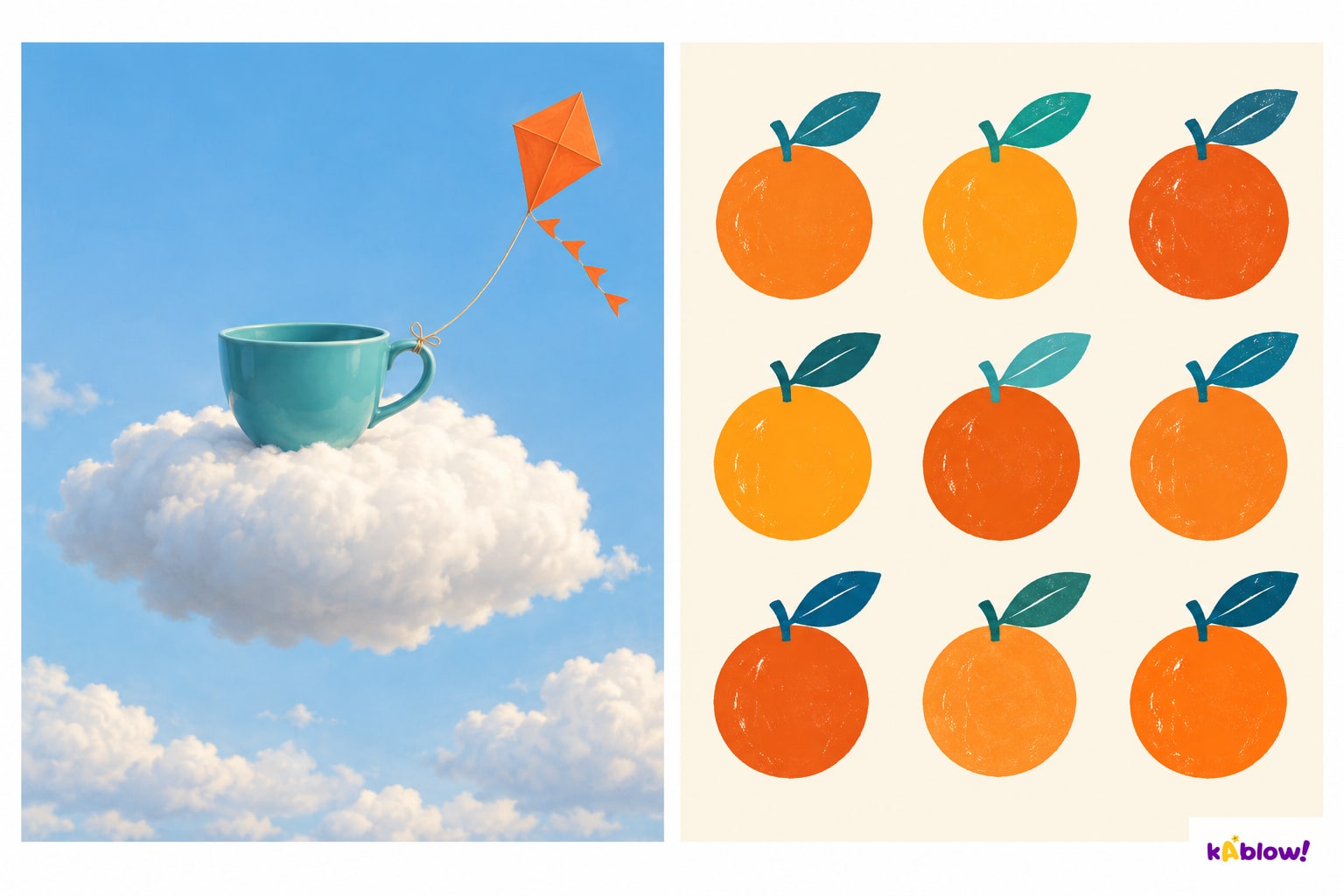
- The illustration pairs an invented cup resting on a cloud with a kite, and a repeated invented fruit motif. The first creates an impossible relationship; the second makes a serial arrangement with colour variation.
- These are new teaching images, not reproductions or authentic historical works. The repeated motif does not claim a physical printing process, and neither image alone establishes a movement label or an artist’s intention.
Juxtaposition and serial imagery
Distinguish Op from Pop
- Op Art investigates visual perception and optical effects, with Bridget Riley an important reference. Pop Art engages popular imagery and media circulation. Similar-sounding names do not make them the same movement.
- Both can involve repetition, but compare the particular relationship and purpose rather than identify a whole movement by one shape or colour. Artist statements, catalogue records and close looking can strengthen the enquiry.
Keep related terms distinct
Source-led personal development
- Start with an enquiry and select a material or format for a reason. Test an original motif, association, spatial arrangement or planned action, using the taught process and accurately crediting any source.
- Explain what the trial reveals and what remains uncertain. A new material, public setting, visual resemblance or famous source is not by itself evidence of effectiveness, authorship or social commentary.
Make a source-led personal test
Folien
Sign up free to view the lesson slides
Step through every slide for this topic — plus flashcards and revision notes — with a free account.
Übungsfragen
Gratis-Vorschau — 8 von 33 Fragen. Registriere dich, um alle zu sehen.
1.What is Surrealism?
Easy- Aa movement exploring unconscious association through varied artistic strategies
- Ba requirement to paint only outdoor light
- Ca rule that all art must be geometric diagrams
- Da photographic format defined only by print size
2.What is Pop Art?
Easy- Aevery religious image in every period
- Ball landscapes regardless of their context
- Call portraits regardless of their sources
- Dart engaging with popular imagery, consumer culture and mass media
3.Who painted The Treachery of Images?
Easy- AWarhol
- BHockney
- CRené Magritte
- DDalí
4.Who is famous for drip painting?
Easy- AAndy Warhol
- BJackson Pollock
- CMark Rothko
- DRoy Lichtenstein
5.Which artist is especially associated with colour-field paintings of soft-edged rectangular areas?
Easy- AMark Rothko
- BPollock
- CWarhol
- DDalí
6.What is Dada?
Easy- Aa landscape movement
- Ba religious movement
- Ca portrait style
- Da varied movement challenging established art conventions, including through absurdity and chance
7.What kind of object was submitted as Fountain in 1917, associated with Duchamp?
Easy- Aa sculpture of water
- Ba photograph
- Ca manufactured urinal selected and presented as a readymade
- Da painting
8.What is Whaam! by Lichtenstein?
Easy- Aa still life
- Ba comic-book style painting of an aeroplane explosion
- Ca portrait
- Da landscape
Unlock all 33 questions & more
Erstelle ein Gratis-Konto, um alle Fragen, Folien, Karteikarten und Lernnotizen zu diesem Thema zu sehen.
Altklausuren
Altklausuren-Übungen für dieses Thema kommen bald.
Bald verfügbar