
Evaluating and annotating your own work
Lerne es beim Spielen
Beantworte diese Fragen für Energie, dann angle und erkunde. Kein Konto nötig.
Für Lehrkräfte: sofort einsetzbare Lektionsfolien, Lernnotizen für Evaluating and annotating your own work (Art and Design, Exam Skills) — nutze sie in deiner Lektion oder starte das Thema als interaktive Klassenaktivität, die deine Lernenden als Live-Spiel spielen.
Lektionsnotizen
Annotation and evaluation do different jobs
- Annotations can record observations, processes, reasons or decisions. An evaluation makes a reasoned judgement against an intention or explicit relevant criterion; description supplies evidence but does not alone justify the judgement.
- What, how and why are helpful prompts rather than a fixed formula. Use enough detail to make the relationship clear, without inventing a process or claiming a guaranteed grade from a sentence type.
Separate the parts of a useful comment
Observe a feature and connect it to the aim
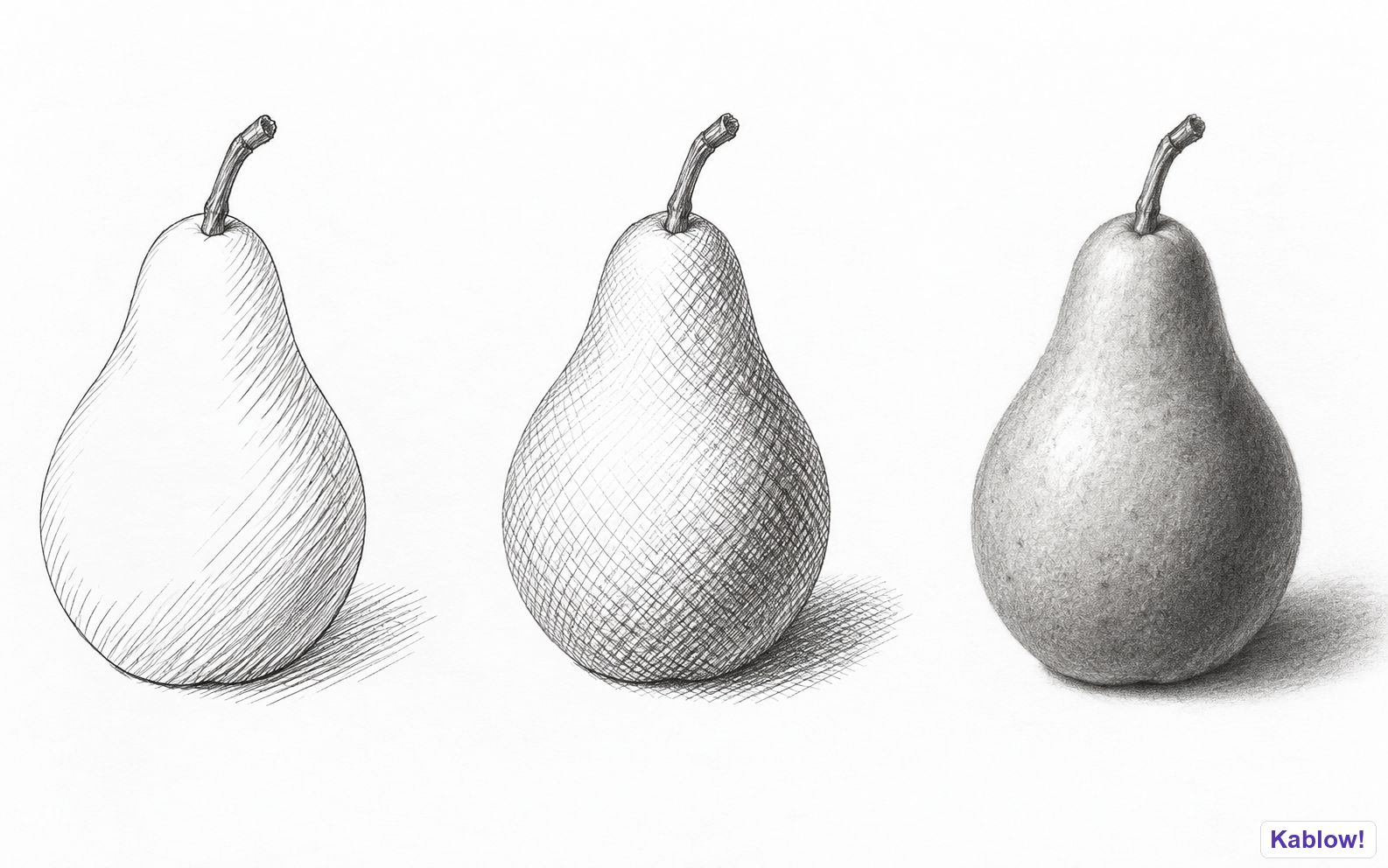
- The original pear studies compare visible hatching, intersecting hatching and smoother tone. A preference becomes useful when supported by a specific feature and an intention, such as emphasising line direction or continuous tonal transition.
- These are teaching illustrations, not real student submissions or a named historical artist’s work. No technique is universally strongest, and the image alone does not reveal a maker’s private intention or physical method in every detail.
Evaluate marks against an intention
Intention, effect and judgement
- An intention is what you aim to explore or communicate; an observed feature is evidence of what is actually present. A proposed effect or reading should be tied to that evidence and may differ between viewers.
- Evaluate how the relationship serves the intention, including trade-offs. More detail, stronger contrast, thick paint or neat edges are not automatic improvements independent of the enquiry.
Language that supports reasoning
- Use accurate terms such as tone, texture and composition to identify a particular feature. Verbs and connectives can make the relationship clear, but a technical word or because alone does not prove the claim.
- Qualify interpretations where needed: a colour may suggest an atmosphere in this setting without having one universal meaning. Personal preference can begin reflection, followed by a reason that the work supports.
Language needs evidence
Source connections and truthful attribution
- Identify the named work and selected feature that informed an actual trial. Explain what you retained, changed or rejected and why it matters to your own intention.
- Do not invent an artist influence or present copied work as wholly self-created. A source may provide a useful comparison after a trial, but label that relationship accurately instead of rewriting the history of making.
Name the actual source relationship
Plan a useful next test
- In the supplied invented shell scenario, denser cross-hatching on shadowed curves and lighter paper can support a reading of rounded form. Additional mid-tone marks are one possible test of the transition, not a guaranteed improvement.
- A next action can repeat, simplify, retain, compare or return to an earlier option. Explain what the test would reveal and how the criterion would guide the decision; do not claim observations from a trial not performed.
A next test has an open result
Constructive honesty
- Identify strengths and limitations with evidence against the intention. An unresolved result can reveal a useful question, while deliberate roughness or empty space may already serve the aim.
- Avoid harsh unsupported self-judgement and a manufactured story of automatic improvement. A clear record can acknowledge changed aims, uncertainty and alternatives without promising marks.
Concise review and next decision
- A useful review connects an intention, a relevant observation, a reasoned judgement and a next question. Include comparisons or source links when they inform the actual decision.
- Keep descriptions specific enough to support the judgement. Longer text, biographies and vocabulary lists do not substitute for evidence, a criterion and a realistic consequence.
A concise review follows evidence
Folien
Sign up free to view the lesson slides
Step through every slide for this topic — plus flashcards and revision notes — with a free account.
Übungsfragen
Gratis-Vorschau — 8 von 32 Fragen. Registriere dich, um alle zu sehen.
1.What is an annotation?
Easy- Aa short note explaining your work
- Ba drawing
- Ca paint
- Da frame
2.What is an evaluation?
Easy- Aa copy
- Ba drawing
- Ca frame
- Da reasoned judgement against intentions or relevant criteria
3.What does 'intention' mean?
Easy- Athe price
- Bthe frame
- Cwhat you aim to achieve
- Dthe colour
4.What does 'strength' mean?
Easy- Aa cost
- Ba feature that serves a stated intention or criterion
- Ca flaw
- Da tool
5.What does 'next step' mean?
Easy- Aa proposed action informed by a result or question
- Bthe end
- Ca frame
- Da signature
6.Which comment gives the least specific evidence for its judgement?
Easy- AThe contrast between the red shape and blue field draws my attention.
- BI used scumbling to create texture.
- CThe repeated diagonals direct my eye toward the corner.
- DIt looks nice.
7.Which is specific?
Easy- AI like it.
- BIt is nice.
- CThe raised paint ridges make the surface physically textured.
- DIt is good.
8.Which word is a connective?
Easy- Acanvas
- Bbecause
- Cpaint
- Dbrush
Unlock all 32 questions & more
Erstelle ein Gratis-Konto, um alle Fragen, Folien, Karteikarten und Lernnotizen zu diesem Thema zu sehen.
Altklausuren
Altklausuren-Übungen für dieses Thema kommen bald.
Bald verfügbar