
Sculpture and 3D work
Lerne es beim Spielen
Beantworte diese Fragen für Energie, dann angle und erkunde. Kein Konto nötig.
Für Lehrkräfte: sofort einsetzbare Lektionsfolien, Lernnotizen für Sculpture and 3D work (Art and Design, Materials and Processes) — nutze sie in deiner Lektion oder starte das Thema als interaktive Klassenaktivität, die deine Lernenden als Live-Spiel spielen.
Lektionsnotizen
Form, space and different viewing conditions
- Sculpture explores three-dimensional form and space, including relief, freestanding, installed and kinetic approaches. Relief has a supporting background and need not be viewed from every side.
- Kinetic work incorporates actual movement. Site-specific work relates to its location; installation can combine sculpture with other media. Consider the intended viewing conditions instead of treating every work as a statue on a plinth.
Methods and material compatibility
- Modelling shapes workable material, carving removes material, constructing assembles parts and casting forms material in a mould as it sets or solidifies. A work can combine these approaches.
- Armatures can support compatible modelling/construction systems. A temporary clay model, paper form and kiln-fired ceramic work need different support plans; do not assume ordinary internal wire or mixed materials can remain through firing.
Ways to make form
Clay handbuilding and material stages
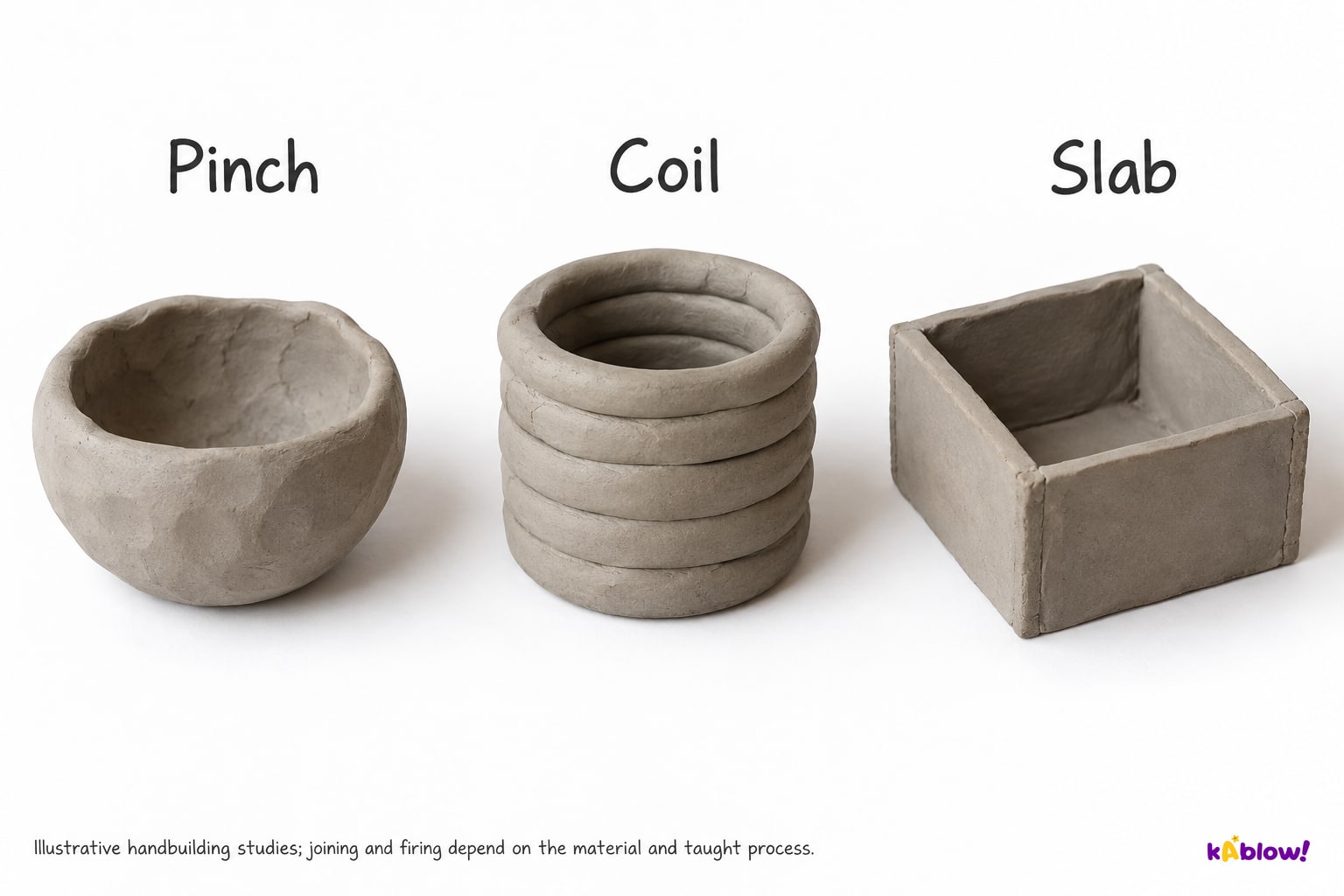
- Pinching forms a bowl from a clay mass; coils build a wall from joined rolls; slabs use sheets. Sound joins and compatible moisture matter, with scoring and suitable slip used where the taught process requires them.
- Slip is clay in water and can also serve decoration. A common ceramic route includes drying, an initial bisque firing and a later glaze stage, but systems vary. Air-dry materials and other clay-like compounds must follow their own instructions, not a ceramic kiln sequence.
Pinch, coil and slab studies
Scale, stability and display
- Scale compares the work with viewers or a setting. Negative spaces within or between forms, surface texture and the route around the work affect its experience.
- Visual balance is not physical stability. Plan bases, joins and supports using the approved method; a small maquette cannot establish all full-size structural demands. Movement or suspension still needs a controlled support system.
Plan spatial and practical relationships
Named practitioner references
- Henry Moore’s Reclining Figure: Holes and Barbara Hepworth’s pierced forms offer examples for investigating mass and openings. Alberto Giacometti’s Man Walking II (1960) uses an elongated human figure.
- Antony Gormley’s Angel of the North (1998) gives a named example for scale and site. These are selected references rather than complete career definitions. The handbuilding illustration is original teaching artwork, not a reproduction of these sculptures.
Study a named reference
Approved studio methods
- Control dust exposure through a suitable taught method, cleanup and any required equipment or protection. Do not assume a generic mask alone makes dry sanding appropriate. Use the actual material instructions and classroom supervision.
- Kilns, casting and chemical finishes need approved facilities and guidance. This lesson teaches distinctions, not an independent molten-metal, plaster-body-casting or kiln-operation procedure.
Use the approved studio system
Other materials and finishes
- Papier-mâché uses paper strips or pulp with a suitable binder. Mould materials and casts must be compatible; some moulds are temporary and others reusable.
- Paint, glaze, polish or patina can change a surface where appropriate. Patina often concerns metal appearance altered by age, reaction or an applied treatment; a finish should serve the intention and material rather than follow a universal recipe.
Match the material process
Folien
Sign up free to view the lesson slides
Step through every slide for this topic — plus flashcards and revision notes — with a free account.
Übungsfragen
Gratis-Vorschau — 8 von 33 Fragen. Registriere dich, um alle zu sehen.
1.What is sculpture?
Easy- Aart concerned with three-dimensional form and space
- Bflat art
- Ca painting
- Da print
2.What is relief sculpture?
Easy- Aa freestanding statue
- Ba drawing
- Ca print
- Dforms projecting from or worked into a supporting background
3.What is modelling?
Easy- Apouring liquid
- Bprinting
- Cshaping and building with a workable material
- Dcutting away
4.What is carving?
Easy- Asewing
- Bcutting away material
- Cadding material
- Dpouring
5.What is casting?
Easy- Aforming a material in a mould and allowing it to set or solidify
- Bcarving
- Cdrawing
- Dprinting
6.What is a coil pot?
Easy- Aa pinched pot
- Ba slab pot
- Ca cast pot
- Da pot built from rolled coils of clay
7.What is a slab method?
Easy- Apinching
- Bcasting
- Cbuilding with flat sheets of clay
- Dcoils
8.What is slip?
Easy- Aa kiln
- Bclay suspended in water, used for suitable joining or decoration
- Ca type of glaze
- Da tool
Unlock all 33 questions & more
Erstelle ein Gratis-Konto, um alle Fragen, Folien, Karteikarten und Lernnotizen zu diesem Thema zu sehen.
Altklausuren
Altklausuren-Übungen für dieses Thema kommen bald.
Bald verfügbar