
Texture, pattern and shape
Lerne es beim Spielen
Beantworte diese Fragen für Energie, dann angle und erkunde. Kein Konto nötig.
Für Lehrkräfte: sofort einsetzbare Lektionsfolien, Lernnotizen für Texture, pattern and shape (Art and Design, Visual Elements) — nutze sie in deiner Lektion oder starte das Thema als interaktive Klassenaktivität, die deine Lernenden als Live-Spiel spielen.
Lektionsnotizen
Actual and visual texture
- Texture describes surface quality, including smoothness as well as roughness. Physical relief is actual texture; depicted marks can suggest visual texture without reproducing the material’s feel. Both can coexist.
- The original sampler contrasts pictured raised paint with drawn bark on flat paper. As screen images, neither panel lets you verify tactile properties by touch; the terms describe the represented materials.
Surface and repeated motif comparisons
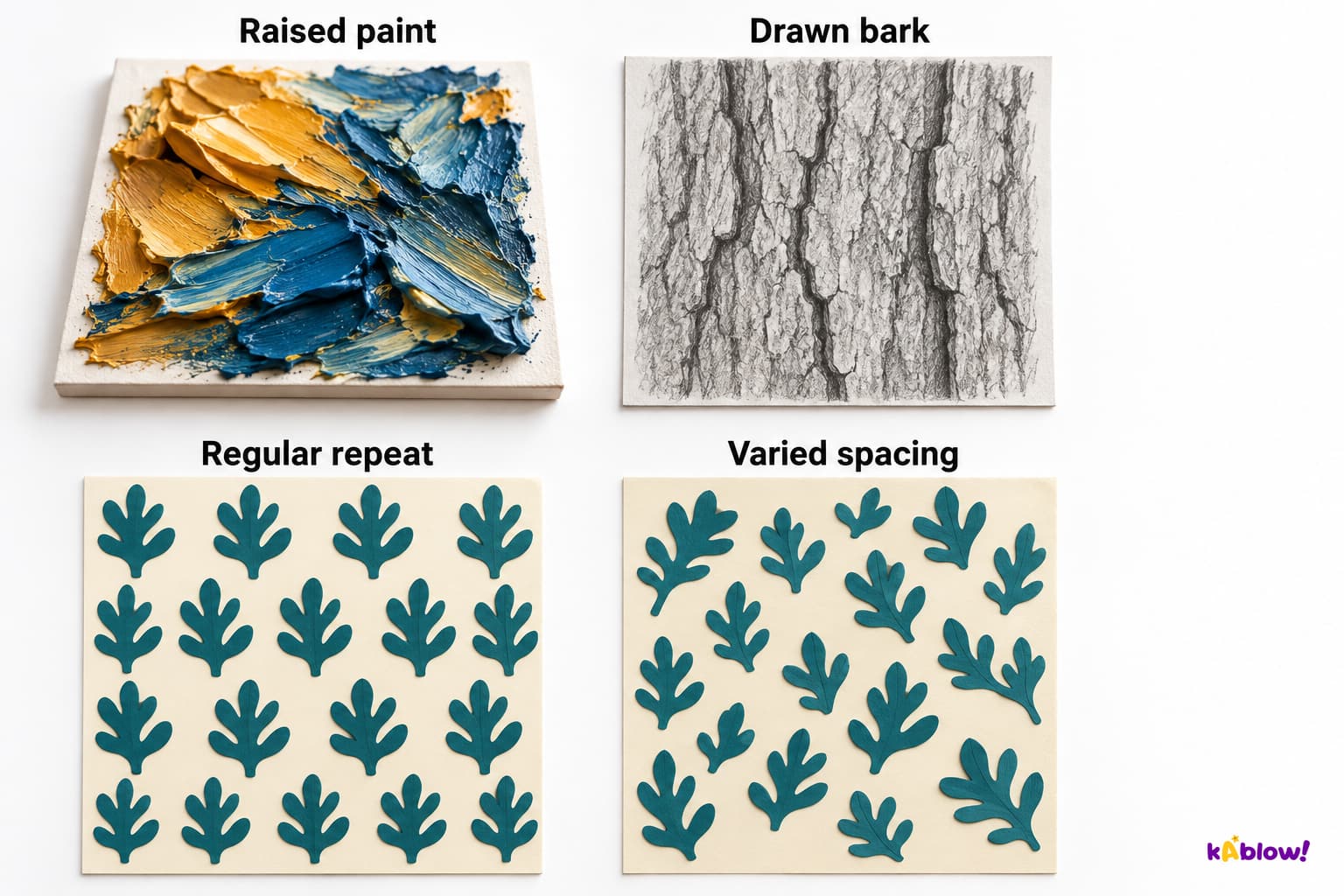
Motif and distribution
- A motif is a design unit in the repeated arrangements taught here. Regular spacing and varied or apparently random placement describe how units are distributed. Geometric and organic describe the character of those units.
- The categories overlap: organic shapes can repeat evenly. Tessellation means covering a surface without gaps or overlaps; periodic repetition is common in examples but is not required by every tiling.
Separate motif from distribution
Shape, abstraction and negative space
- Geometric shapes have describable structures such as circles or polygons; geometric does not mean only regular polygons. Organic shapes are free-flowing or irregular and may be invented; natural forms can also show geometric structure.
- Silhouettes emphasise filled profiles and can use colours other than black. Abstraction can simplify or alter a recognisable source rather than remove every reference. Negative shapes occur around, between and within positive forms.
Describe the shape accurately
Practitioners and cultural context
- Matisse’s cut-outs use gouache-painted paper forms arranged into compositions. Klimt’s The Kiss is a named example of patterned garments and metallic materials including gold leaf. Avoid turning one example into a universal description of either artist.
- Study specific works, makers, communities and contexts when researching a pattern. Identify sources and distinguish an original response from a reproduction or claim of cultural authenticity.
Use a specific practitioner example
Recording a suitable surface
- Use a sketch or photograph, or a rubbing where the surface is suitable and permission is given. Avoid damage to fragile, protected or living surfaces; non-contact recording can answer the same project question.
- Label source and method, then compare selected features using your own marks. Paper, pressure and tool affect a rubbing, so it records an interpretation rather than every feature exactly.
Record responsibly
Processes and surface effects
- Impasto is thickly applied paint with raised brush or knife marks. Sgraffito scratches through an upper layer to reveal a contrasting layer below. Collage and stitching can add physical relief and visual pattern.
- Frottage records a suitable surface through a rubbing. Drawn marks, lifting and erasing can suggest visual texture; a plain painted area still has material texture. Choose processes for purpose rather than treating a medium as incapable of texture.
Process and surface
Develop a personal pattern
- Start from an observed or invented motif and test spacing, scale and rotation. Compare the positive units with the negative shapes between them.
- Explain how regular intervals or varied distribution affect the intended rhythm or emphasis. Use acknowledged influences without presenting an invented design as a genuine historical or cultural artefact.
Folien
Sign up free to view the lesson slides
Step through every slide for this topic — plus flashcards and revision notes — with a free account.
Übungsfragen
Gratis-Vorschau — 8 von 33 Fragen. Registriere dich, um alle zu sehen.
1.What is texture?
Easy- Athe surface quality of something
- Bits colour
- Cits size
- Dits shape
2.What is pattern?
Easy- Aa single shape
- Bone colour
- Cno design
- Drepeated elements
3.What is a geometric shape?
Easy- Aevery shape that resembles a leaf
- Bonly a shape made without measuring
- Ca shape described through geometric structure, such as a circle or triangle
- Donly a mathematically regular polygon
4.What is an organic shape?
Easy- Aa triangle
- Ba free-flowing or irregular shape associated with living or natural forms
- Ca regular shape
- Da square
5.What is a silhouette?
Easy- Aa filled shape emphasising the outer profile rather than internal detail
- Ba detailed drawing
- Ca texture
- Da colour
6.What is impasto?
Easy- Aa thin wash
- Ba drawing medium
- Ca print
- Dthickly applied paint with visible raised marks or ridges
7.What is sgraffito?
Easy- Aprinting
- Bmodelling
- Cscratching through an upper layer to expose a contrasting layer below
- Dthick painting
8.What is frottage?
Easy- Acollage
- Bmaking a rubbing from a surface
- Cpainting
- Dcasting
Unlock all 33 questions & more
Erstelle ein Gratis-Konto, um alle Fragen, Folien, Karteikarten und Lernnotizen zu diesem Thema zu sehen.
Altklausuren
Altklausuren-Übungen für dieses Thema kommen bald.
Bald verfügbar