
Text, images and sound
Lerne es beim Spielen
Beantworte diese Fragen für Energie, dann angle und erkunde. Kein Konto nötig.
Für Lehrkräfte: sofort einsetzbare Lektionsfolien, Lernnotizen für Text, images and sound (Computer Science, Data Representation) — nutze sie in deiner Lektion oder starte das Thema als interaktive Klassenaktivität, die deine Lernenden als Live-Spiel spielen.
Lektionsnotizen
Text
- Character sets map characters to codes. Original ASCII defines 128 codes using seven bits; text files often store each ASCII character in a full byte. A = 65, a = 97 and 0 = 48.
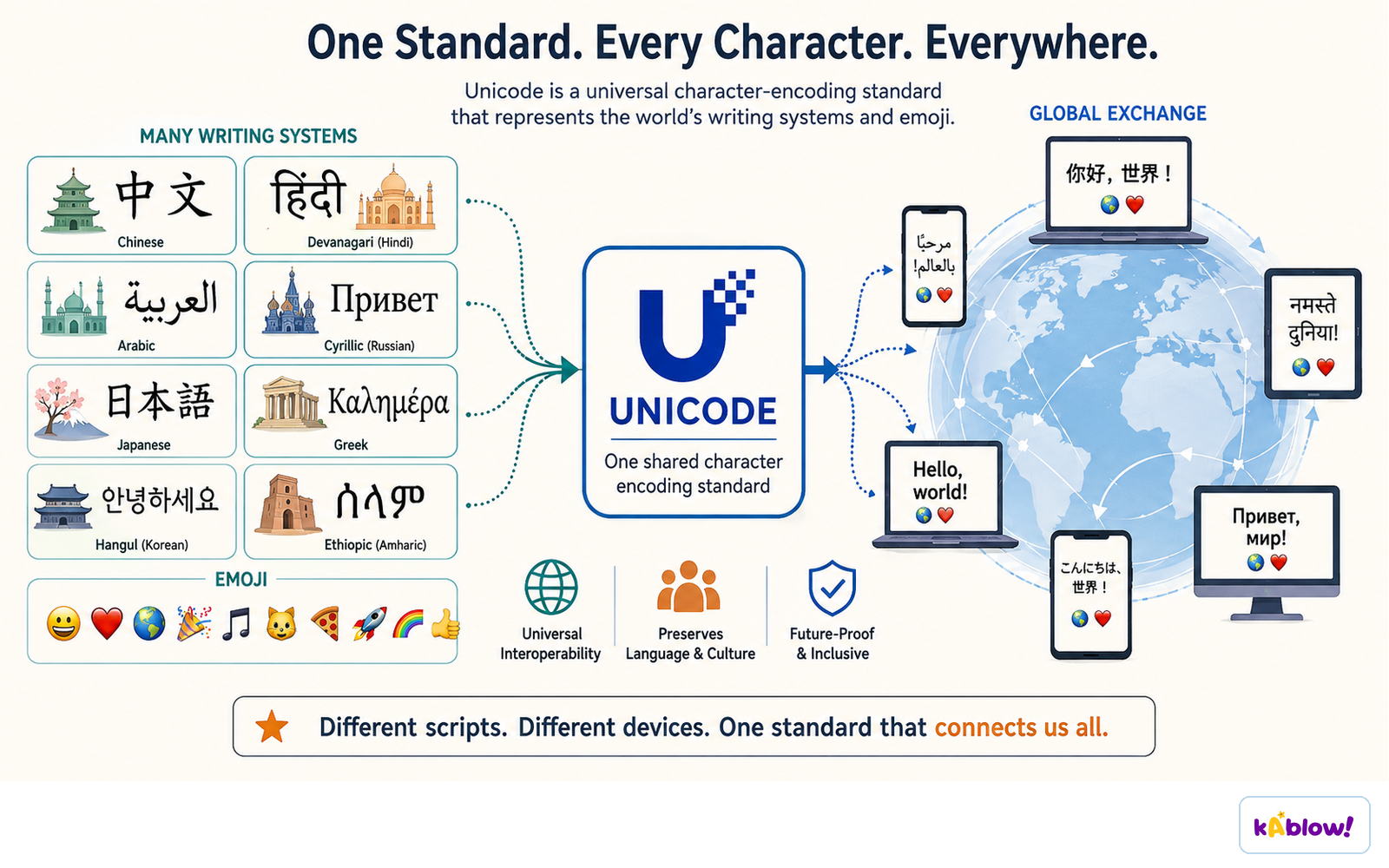
- Unicode covers many writing systems and emoji. Its encodings differ: UTF-8 uses one to four bytes per code point and preserves ASCII-range byte values; UTF-16 uses one or two 16-bit code units.
- Text size depends on the encoding and actual characters. A fixed characters × bits-per-character calculation needs an explicit fixed-width assumption and excludes headers or compression.
Unicode character representation
Images
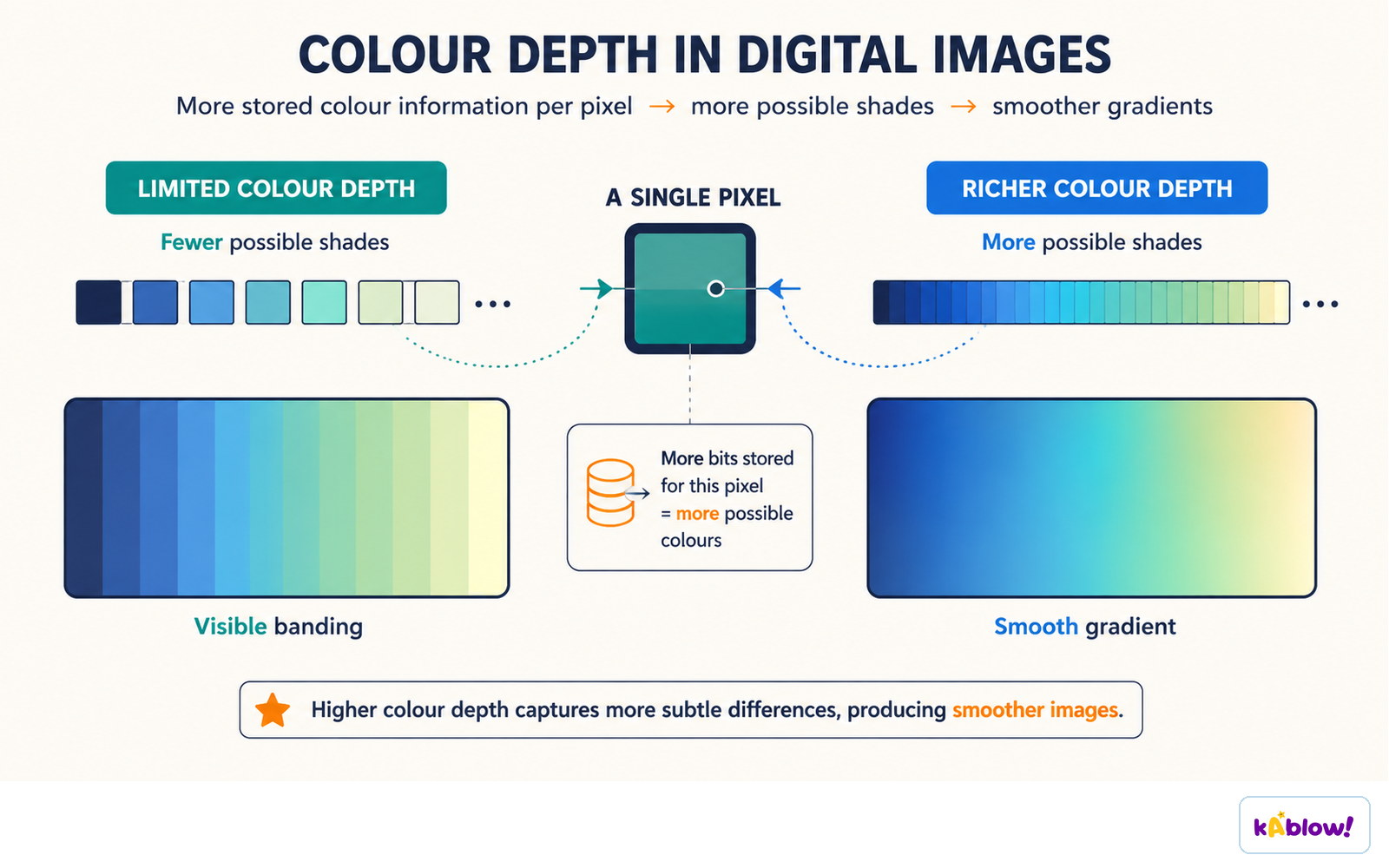
- A bitmap is a grid of pixels. Pixel dimensions are width × height; colour depth is bits per pixel, allowing up to 2depth possible pixel values.
- Raw pixel-data size = width × height × colour depth. At 100 × 100 and eight bits per pixel, this is 80,000 bits = 10,000 bytes.
- Headers, metadata, padding and compression can change the stored file size. More bits allow more possible colours but cannot recreate absent source detail.
Colour depth and available shades
Sound
- Sampling measures an analogue signal at regular intervals; quantisation represents each measured amplitude using an available discrete level. Sample rate is samples per second, and bit depth is bits per sample.
- Raw PCM size in bits = sample rate × bit depth × duration × channels, excluding headers and compression. Mono audio at 44,100 Hz, 16 bits and ten seconds needs 7,056,000 bits = 882,000 bytes.
- Higher sample rate can capture higher-frequency detail, and greater bit depth permits finer amplitude precision. Neither guarantees audible improvement for every source.
Illustrative 2-bit samples
Trade-offs
- Quality versus file size, storage and transmission.
Folien
Sign up free to view the lesson slides
Step through every slide for this topic — plus flashcards and revision notes — with a free account.
Übungsfragen
Gratis-Vorschau — 8 von 33 Fragen. Registriere dich, um alle zu sehen.
1.What is a pixel in a bitmap image?
Easy- Athe smallest element of an image
- Ba sound sample
- Ca character
- Da byte
2.What is ASCII?
Easy- Aa character set using 7 bits
- Ban image format
- Ca sound format
- Da compression type
3.What do bitmap pixel dimensions specify?
Easy- Athe number of pixels in width by height
- Bthe bits per pixel
- Cthe number of colours
- Dthe sample rate
4.What is colour depth?
Easy- Anumber of bits used per pixel
- Bthe width
- Cthe file size
- Dthe sample rate
5.What is sample rate?
Easy- Athe number of samples per second
- Bbits per sample
- Cnumber of channels
- Dlength
6.What is the maximum number of distinct pixel values at eight bits per pixel?
Easy- A256
- B8
- C128
- D65,536
7.Ignoring compression and headers, how many bytes of pixel data are in a 100 × 100 bitmap at eight bits per pixel?
Easy- A10,000
- B80,000
- C1,000
- D100
8.What is the ASCII code for A?
Easy- A65
- B97
- C1
- D48
Unlock all 33 questions & more
Erstelle ein Gratis-Konto, um alle Fragen, Folien, Karteikarten und Lernnotizen zu diesem Thema zu sehen.
Altklausuren
Altklausuren-Übungen für dieses Thema kommen bald.
Bald verfügbar