
Tools, equipment and processes
Lerne es beim Spielen
Beantworte diese Fragen für Energie, dann angle und erkunde. Kein Konto nötig.
Für Lehrkräfte: sofort einsetzbare Lektionsfolien, Lernnotizen für Tools, equipment and processes (Design and Technology, Making) — nutze sie in deiner Lektion oder starte das Thema als interaktive Klassenaktivität, die deine Lernenden als Live-Spiel spielen.
Lektionsnotizen
Measuring and marking out
- Measuring and marking tools include a suitable rule, try square, marking gauge, scriber and dividers. Choose the tool for the material and task, use a sound reference or datum, and check its condition. A template transfers a pattern and must be aligned and verified.
- Tolerance is permitted variation, while instrument resolution concerns the smallest indicated increment and accuracy concerns closeness to a reference. A fine display alone does not guarantee accurate measurement. Choose an inspection method suitable for the allowed limits.
Measure from a sound reference
Cutting and shaping
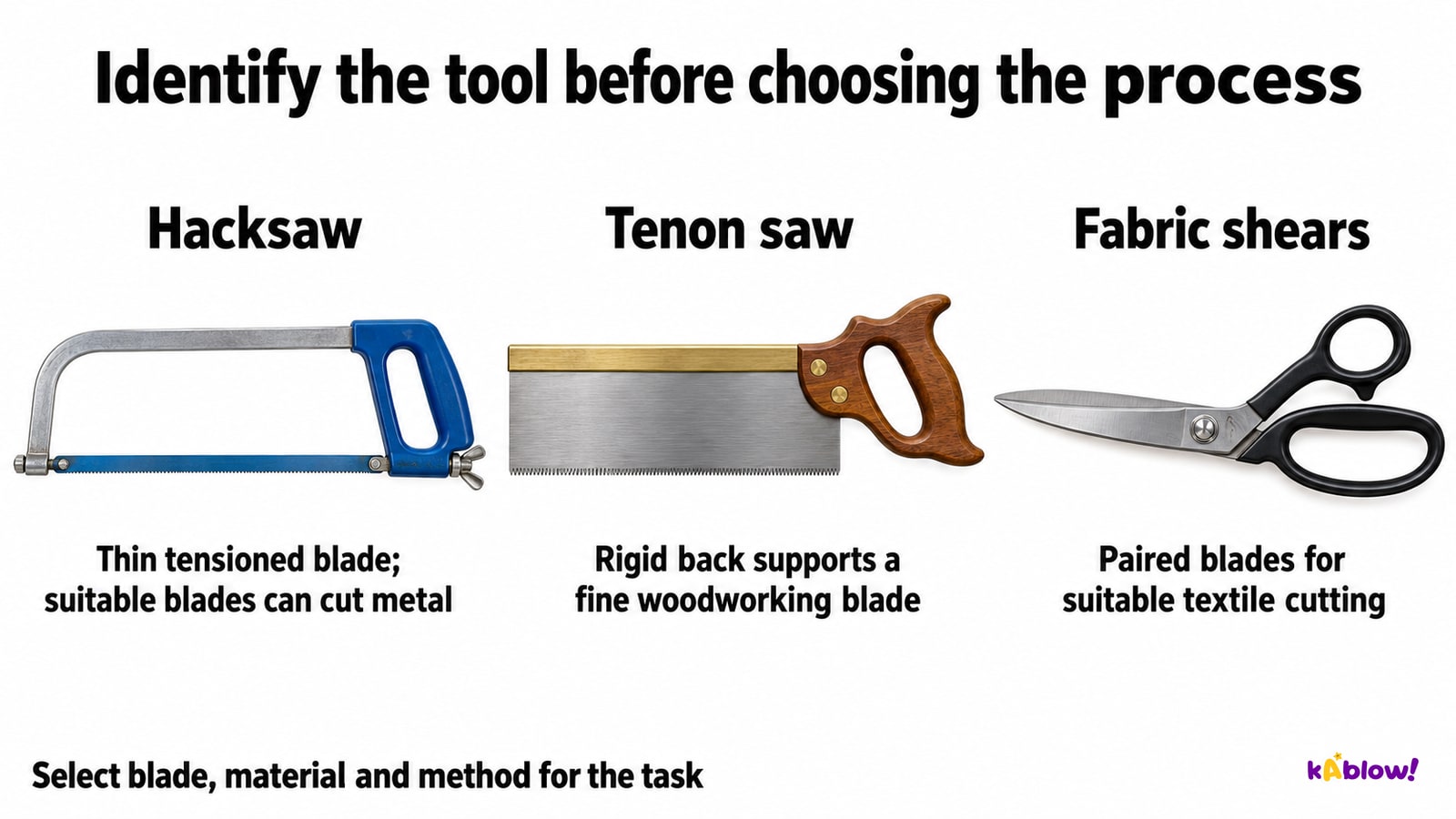
- Tool selection depends on material, section, shape, quality and workholding. A tenon saw supports selected timber-joint cuts; a coping saw can follow suitable curves; a chisel or plane removes material differently. A hacksaw with an appropriate blade can cut metal bar, while snips or metal shears suit some sheet.
- Fabric shears and rotary textile cutters suit different textile tasks. Paper or board may use an appropriate knife or guillotine under the authorised procedure. The original tools-at-rest illustration teaches recognition, not an operating sequence.
Recognise common hand tools
Forming and joining
- Forming changes shape, such as bending suitable metal sheet, line bending a suitable thermoplastic or vacuum forming an appropriate heated sheet. Joining instead connects parts through a suitable mechanical fastener, adhesive, seam or metallurgical process.
- Soldering and brazing melt a compatible filler without melting the parent metals as the joining mechanism. The conventional distinction uses about 450°C: solder filler below it, braze filler above it and below the parents. Many welding processes melt parent material; solid-state welding also exists. Joint performance depends on design, materials and process quality.
Joining route: what creates the joint?
Machining and CNC
- A conventional lathe rotates the workpiece; a mill uses a rotating cutter; a pillar drill controls drill alignment and feed. These definitions do not replace training, guarding or the machine-specific procedure. Routers and milling machines can exist in manual or CNC forms.
- CNC means computer numerical control. CAM helps prepare and control manufacture. Suitable digital control can improve repeatability and make complex paths practical, but programming, setup, maintenance, tooling and inspection remain necessary. Include setup and production volume before claiming savings.
Quality control
- A fixture locates and holds work; a jig also guides the tool. A template provides a repeated pattern. The distinction matters when explaining how the device helps a specific operation rather than calling every clamp a jig.
- Repeatability concerns consistent outcomes under repeated conditions; accuracy concerns closeness to the required reference. A jig or CNC program can consistently produce a wrong location. Check the first suitable part and relevant later samples or features against requirements before errors propagate.
Three different production aids
Safety
- Identify hazards, assess who could be harmed, implement suitable controls and review them. Trained supervision, guards, secure workholding, suitable extraction and the machine-specific procedure are central. Appropriate PPE complements these controls rather than replacing them.
- Wood dust, including dust from machining or sanding MDF, requires suitable control at source. Additional respiratory protection may be needed for the assessed task. Hair, loose clothing and jewellery can entangle; gloves can also be caught near exposed rotating drill or machine parts, so a generic wear-gloves instruction is unsafe.
- The lesson teaches reasons behind workshop controls, not authorisation to operate equipment. Use only approved materials and procedures for cutting, heating, soldering and laser work; machine capability and material identity affect suitability.
Control the hazard before work
Folien
Sign up free to view the lesson slides
Step through every slide for this topic — plus flashcards and revision notes — with a free account.
Übungsfragen
Gratis-Vorschau — 8 von 33 Fragen. Registriere dich, um alle zu sehen.
1.What is a tolerance?
Easy- Athe allowed variation in size
- Ba tool
- Ca joint
- Da finish
2.What does PPE stand for?
Easy- Apower plant engineering
- Bplastic processing equipment
- Cprecise production energy
- Dpersonal protective equipment
3.Which listed hand tool is normally suitable for cutting a small solid metal bar with the correct blade?
Easy- Afabric-only shears
- Bscalpel
- Chacksaw
- Dtenon saw
4.Which tool cuts timber joints?
Easy- Asnips
- Btenon saw
- Cshears
- Dguillotine
5.Which tool is used to cut fabric?
Easy- Ashears
- Bhacksaw
- Cchisel
- Dplane
6.What is a centre punch used for?
Easy- Acutting
- Bjoining
- Cpainting
- Dmarking a drilling point on metal
7.What is a try square used for?
Easy- Adrilling
- Bpolishing
- Cchecking and marking right angles
- Dcutting
8.What is a jig?
Easy- Aa brief
- Ba device locating work and guiding the tool for a repeated operation
- Ca drawing
- Da finish
Unlock all 33 questions & more
Erstelle ein Gratis-Konto, um alle Fragen, Folien, Karteikarten und Lernnotizen zu diesem Thema zu sehen.
Altklausuren
Altklausuren-Übungen für dieses Thema kommen bald.
Bald verfügbar