
Descriptive writing
Lerne es beim Spielen
Beantworte diese Fragen für Energie, dann angle und erkunde. Kein Konto nötig.
Für Lehrkräfte: sofort einsetzbare Lektionsfolien, Lernnotizen für Descriptive writing (English Language, Writing) — nutze sie in deiner Lektion oder starte das Thema als interaktive Klassenaktivität, die deine Lernenden als Live-Spiel spielen.
Lektionsnotizen
What descriptive writing does
- Descriptive writing paints a picture in words, bringing a person, place or moment alive for the reader. It is often set by a prompt: an image, a title, or an opening such as "Describe a deserted street at night."
- It is less about plot and more about atmosphere and detail.
Techniques
- Use sensory language: sight, sound, smell, touch, taste. "The air smelt of damp earth and woodsmoke."
- Use figurative language: similes, metaphors and personification. "The moon hung like a coin."
- Choose precise vocabulary: verbs and adjectives that suggest more than basic words ("trudged", "glimmering").
- Vary sentence patterns and lengths purposefully. A minor sentence may isolate a detail or create a pause; the effect depends on the surrounding writing.
- Use concrete actions and sensory details to suggest feelings where useful. Direct statements and summary can also be effective; “show, don’t tell” is a technique, not an absolute rule.
An imagined bakery

Structure
- Move through the scene in a clear order: zoom in from the wider view to details, or follow a journey through a place; shift the focus to sustain interest.
- Keep viewpoint and time relationships clear. Deliberate shifts can work when signalled. Choose an opening and ending that suit the intended impression rather than following a fixed formula.
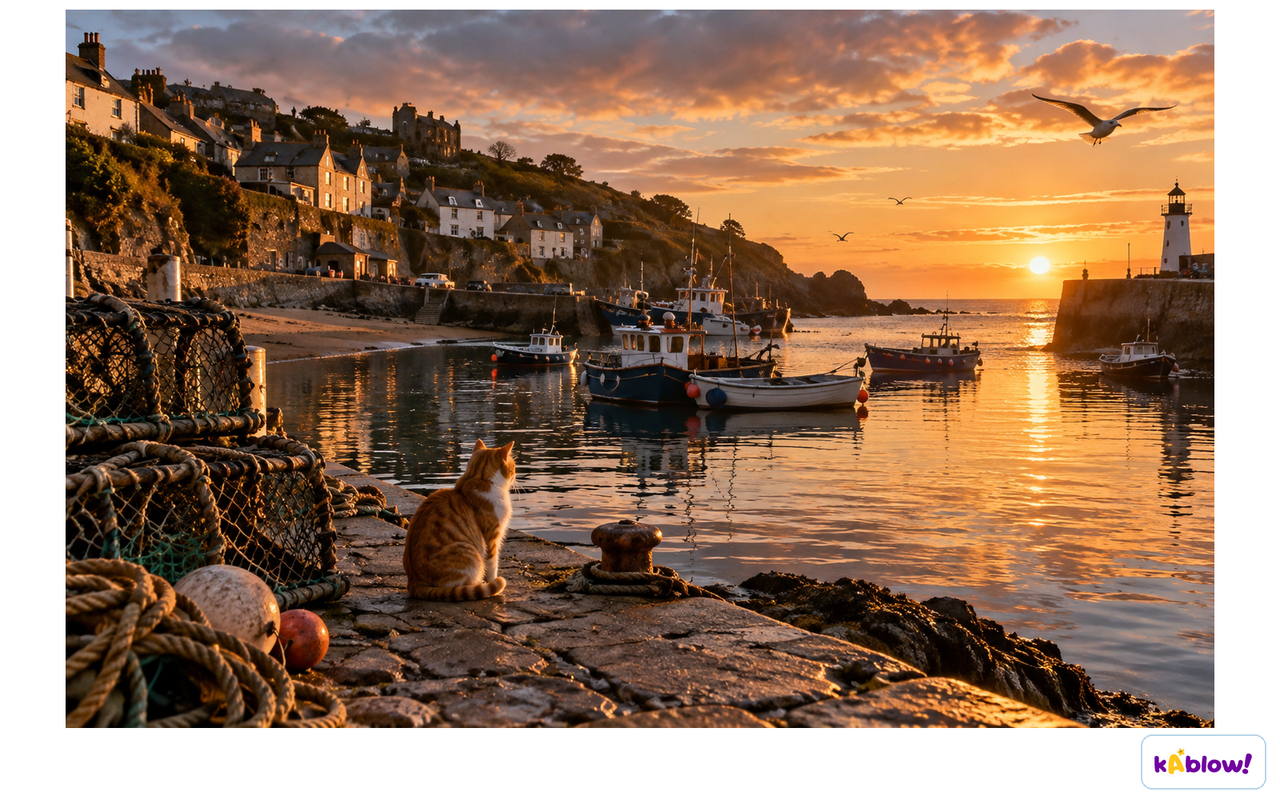
From a harbour view to a small detail
Avoid
- Avoid vague, unselected adjective piles and accidental shifts of tense or viewpoint. Choose details for a purpose; an original use of a familiar phrase or a small action can still contribute to description.
Choose details for an impression
Folien
Sign up free to view the lesson slides
Step through every slide for this topic — plus flashcards and revision notes — with a free account.
Übungsfragen
Gratis-Vorschau — 8 von 32 Fragen. Registriere dich, um alle zu sehen.
1.What is descriptive writing mostly about?
Easy- Aatmosphere and detail
- Bplot twists
- Carguments
- Dinstructions
2.Which sense is used in 'The air smelt of rain'?
Easy- Asight
- Btouch
- Ctaste
- Dsmell
3.What is a simile?
Easy- Aa sound word
- Ba fact
- Ca comparison using 'like' or 'as'
- Dan exaggeration
4.Which comparison is the clearest example of a familiar stock phrase?
Easy- Athe street breathed
- Bwhite as snow
- Cthe moon hung like a cracked coin
- Dfrost gripped the window
5.What does 'zoom in' mean in description?
Easy- Amove from a wide view to details
- Bshorten the piece
- Cadd a title
- Duse only adjectives
6.Which verb is more precise than 'walked'?
Easy- Awent
- Bdid
- Cmoved
- Dtrudged
7.Which is the best description of a quiet street?
Easy- AQuiet street.
- BIt was quiet and nice.
- CA single cat slid between parked cars; somewhere a tap dripped.
- DThe street was quiet.
8.What can the minor sentence “Silence.” do after a paragraph of noisy action?
Easy- Amake the passage grammatically unacceptable
- Bisolate and emphasise the change to quiet
- Cautomatically introduce a list
- Dalways make every passage faster
Unlock all 32 questions & more
Erstelle ein Gratis-Konto, um alle Fragen, Folien, Karteikarten und Lernnotizen zu diesem Thema zu sehen.
Altklausuren
Altklausuren-Übungen für dieses Thema kommen bald.
Bald verfügbar