
Anglo-Saxon and Norman England: establishing Norman rule
Lerne es beim Spielen
Beantworte diese Fragen für Energie, dann angle und erkunde. Kein Konto nötig.
Für Lehrkräfte: sofort einsetzbare Lektionsfolien, Lernnotizen für Anglo-Saxon and Norman England: establishing Norman rule (History, British Depth Study) — nutze sie in deiner Lektion oder starte das Thema als interaktive Klassenaktivität, die deine Lernenden als Live-Spiel spielen.
Lektionsnotizen
Controlling England
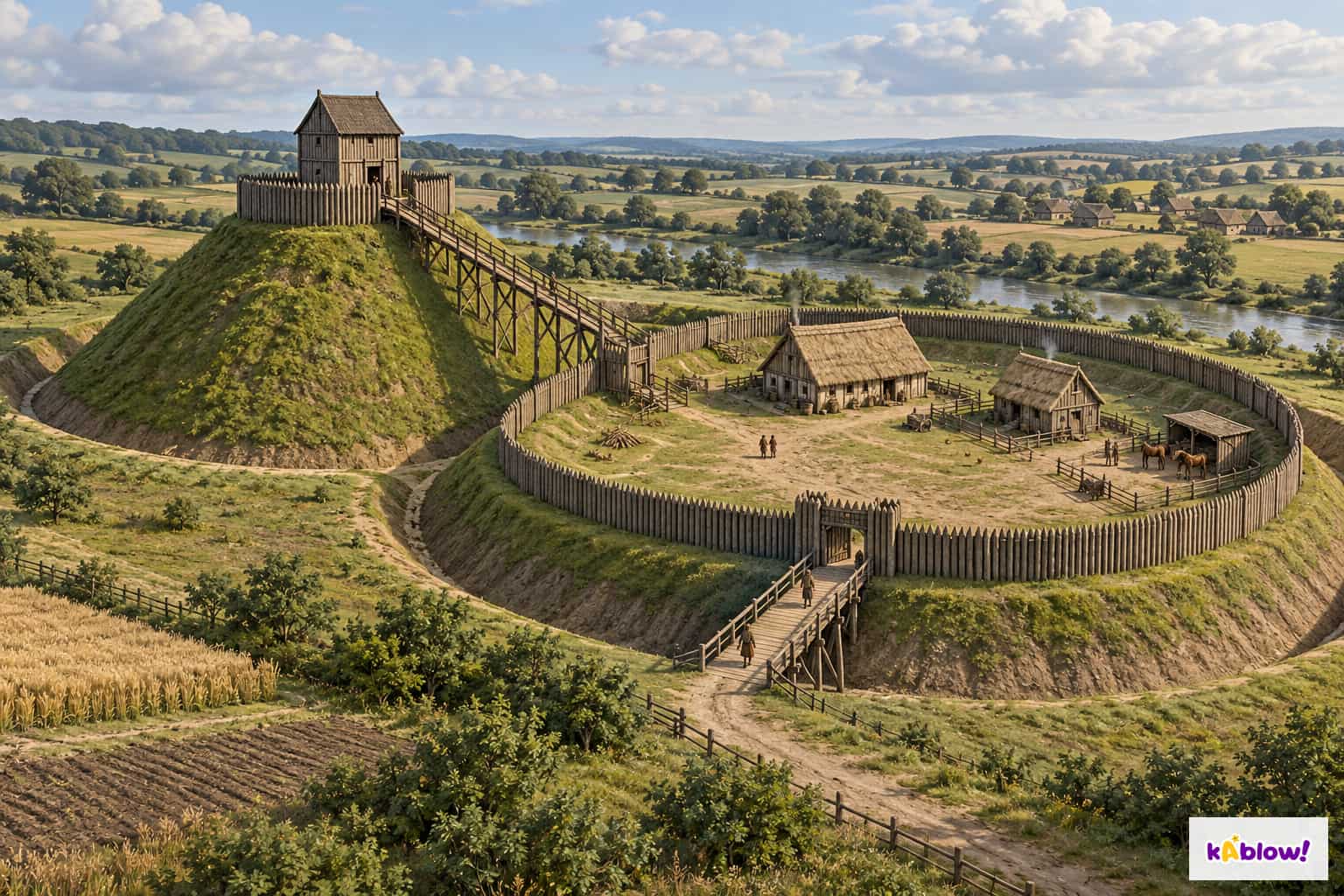
- Castles supported garrisons, administration and visible domination. A motte-and-bailey joined a mound strongpoint to a defended enclosure, often using timber and earth. Ringworks and early stone structures also existed; later rebuilding varied by site. Construction could displace households and demand labour.
- William rewarded supporters through confiscation and land grants tied to loyalty and obligations. Tenants-in-chief could be secular lords or church institutions; subtenancies and local customs varied. The feudal pyramid is a teaching simplification, not a complete description of all social relationships or proof that every institution began in 1066.
- Important landholders assembled at Old Sarum in August 1086 and swore direct loyalty to William, including some who held from other lords. This did not mean every peasant attended. Existing shires, sheriffs and taxation provided continuity alongside changes in the elite.
Mound and enclosure served different functions
Resistance
- Rebellions included Exeter in 1068, northern resistance with Danish involvement in 1069, and the Ely resistance associated with Hereward in 1070–71. Alliances and aims varied; some later stories about Hereward are embellished. Military action, diplomacy, divided support and lack of coordination contributed differently to defeat.
- The Harrying of 1069–70 destroyed food, livestock and settlements and caused severe suffering and famine. Later chroniclers’ descriptions and numbers require critical comparison. The scale, geographical reach and exact death toll are debated; a precise modern total cannot be assumed.
- The Revolt of the Earls in 1075 involved powerful continental as well as English figures. Loyal officials acted while William was in Normandy, using forces that included English people. Norman rulers and English subjects did not divide into two entirely uniform opposing camps.
Resistance and suppression varied over time
The Domesday Book (1085-86)
- William commissioned a major survey at Christmas 1085; inquests in 1086 compared holdings, resources and values under Edward, when granted to new holders, and at the time of enquiry. It aided taxation, defence and landholding claims. The surviving volumes were copied and compiled over a longer period.
- Domesday is not a census of every individual. It omits London, Winchester, Durham, Northumberland and much of the north-west, although some border areas of Wales appear. Its Latin categories describe different free and unfree statuses rather than one undifferentiated peasantry.
- A chronicler’s sweeping praise of completeness should not be read as proof that every animal and person was recorded. Northern waste entries are important evidence, but their meaning and relation to the Harrying are debated. Compare values, classifications, chronology and other sources instead of calculating a death toll from one word.
Use Domesday within its limits
The Church
- Lanfranc replaced Stigand as Archbishop of Canterbury in 1070. Extensive continental appointments altered senior leadership, but Wulfstan remained at Worcester until 1095. Not every new bishop was Norman-born or every English bishop immediately dismissed.
- Reforms addressed administration, discipline and ecclesiastical jurisdiction. Separate Church courts did not make the Church wholly independent of the king or abolish secular courts. Bishops and abbots also held land and could support royal government.
- Rebuilding expressed wealth, faith and authority. Lanfranc rebuilt Canterbury, while Durham’s present cathedral began in 1093, after William I’s death. St Paul’s also had a Norman rebuilding from 1087. Distinguish buildings, dates and successive phases rather than attributing every surviving structure to the Conqueror himself.
Church change had exceptions and later phases
Impact
- Elite landholding changed extensively, with supporters from several continental regions gaining estates. Some English institutions and individuals continued. Peasant rents, labour and customary dues differed by status and locality; not every peasant was a villein or owed identical service.
- French influenced elite culture and later English vocabulary, while Latin remained important in written administration and the Church. English continued to be spoken. Cultural and linguistic change unfolded over time, rather than one language instantly replacing another everywhere.
- Royal forest was a legal hunting jurisdiction, not simply woodland. Forest restrictions protected royal interests while affecting other land users. To judge William’s effectiveness, state criteria and weigh control, resistance, continuity and human costs; political success does not itself justify violence.
Land and obligations were not one uniform pyramid
Folien
Sign up free to view the lesson slides
Step through every slide for this topic — plus flashcards and revision notes — with a free account.
Übungsfragen
Gratis-Vorschau — 8 von 33 Fragen. Registriere dich, um alle zu sehen.
1.What was the Domesday Book?
Easy- Aa survey of land and wealth
- Ba law code
- Ca prayer book
- Da battle plan
2.Which Archbishop replaced Stigand?
Easy- ABecket
- BAnselm
- CCranmer
- DLanfranc
3.What was a baron?
Easy- Aa slave
- Ba priest
- Ca powerful noble who held land from the king
- Da peasant
4.What was a villein?
Easy- Aa monk
- Ba peasant bound to a lord
- Ca knight
- Da baron
5.What was the Salisbury Oath?
Easy- Aimportant landholders assembled to swear direct loyalty to William
- Ba peace treaty
- Ca church vow
- Da law
6.What was the Harrying of the North?
Easy- Aa Viking invasion
- Ba church reform
- Ca trade fair
- Da destructive campaign in northern England during 1069–70
7.Why did William carry out the Harrying of the North?
Easy- Ato end the feudal system
- Bto build castles
- Cto crush rebellion and warn others
- Dto help farmers
8.Why was the Domesday Book compiled?
Easy- Ato record battles
- Bto investigate landholding, resources and values for royal government
- Cto list kings
- Dto praise William
Unlock all 33 questions & more
Erstelle ein Gratis-Konto, um alle Fragen, Folien, Karteikarten und Lernnotizen zu diesem Thema zu sehen.
Altklausuren
Altklausuren-Übungen für dieses Thema kommen bald.
Bald verfügbar