
Chemical Equilibria, Le Chatelier’S Principle & Kc
Apréndelo jugando
Responde estas preguntas para ganar energía, luego pesca y explora. Sin cuenta.
Apuntes de la lección
Explain dynamic equilibrium in a closed system
- A reversible reaction can proceed in both directions. At dynamic equilibrium the forward and reverse reactions continue at equal rates, so there is no net composition change under fixed conditions.
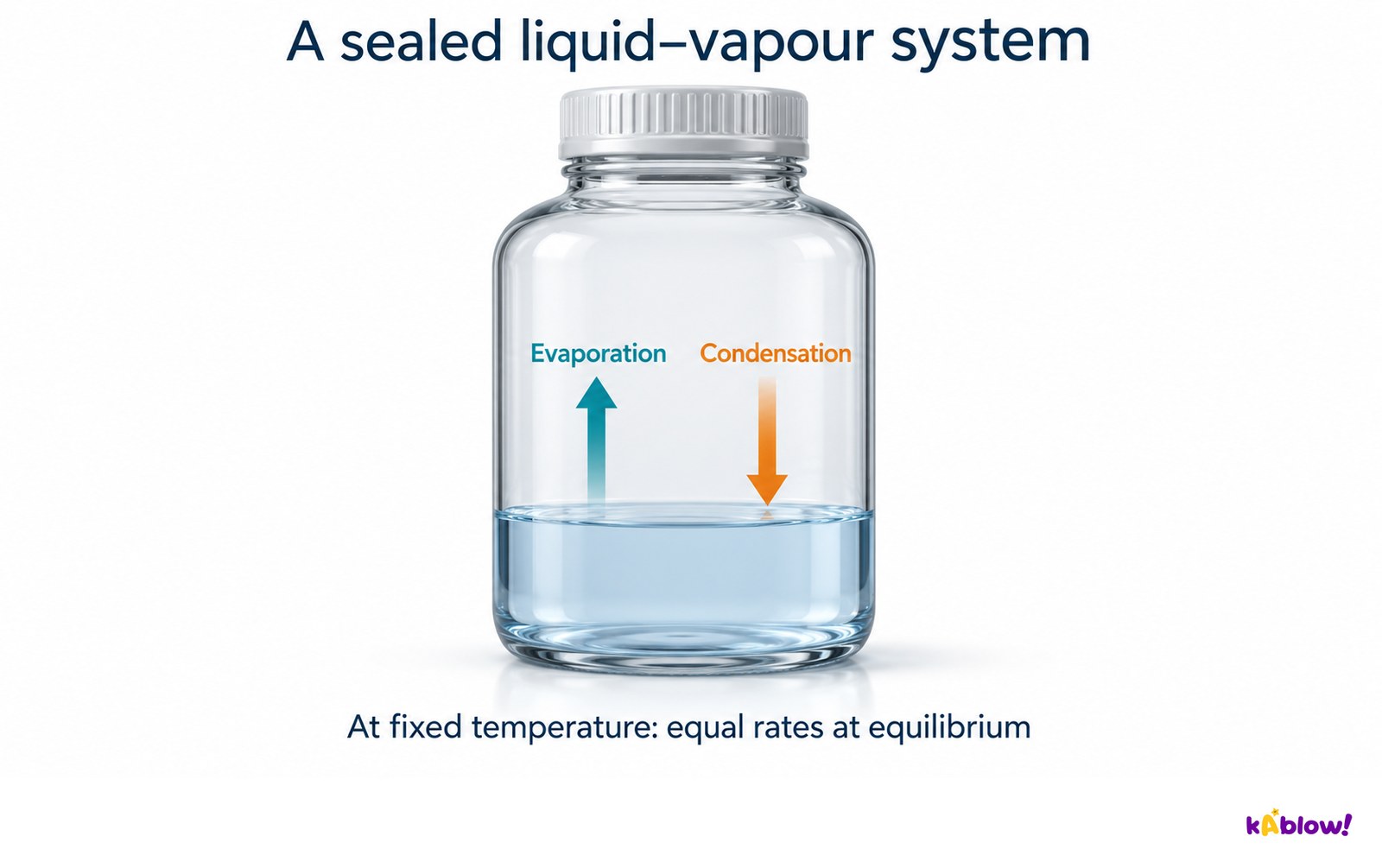
- A closed system exchanges no matter with its surroundings, although heat can pass through its boundary. A sealed liquid–vapour system provides a physical analogy: evaporation and condensation continue.
- Constant amounts alone do not prove equilibrium; a reaction might be stopped or an open flow might maintain a steady state. Use evidence for ongoing opposite processes and fixed conditions.
A sealed liquid–vapour system
Interpret forward and reverse rate curves
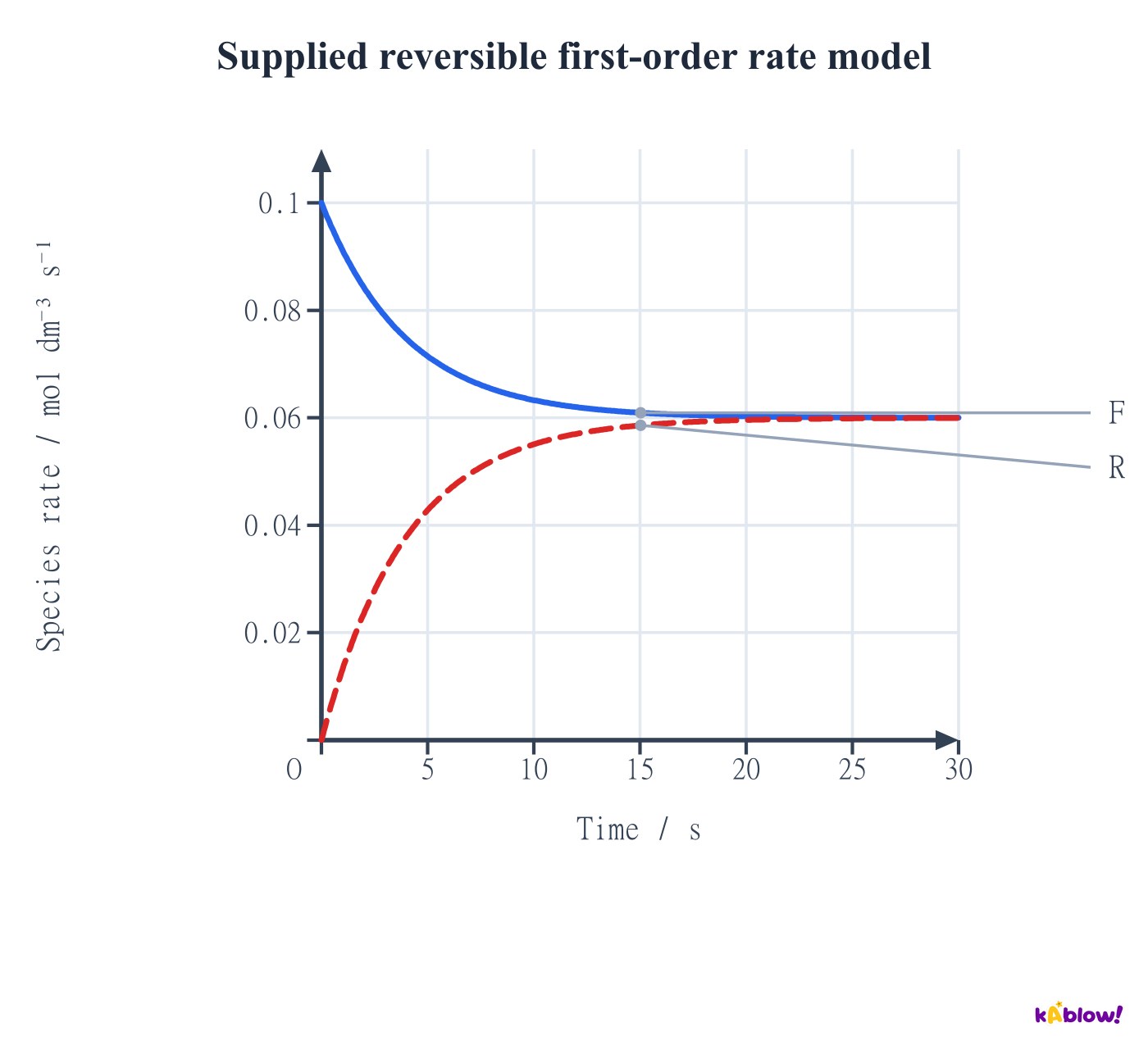
- For the supplied A ⇌ B model, F is the forward species rate and R the reverse species rate. Starting with A only gives a nonzero forward rate and initially zero reverse rate.
- As B forms, the reverse rate rises and the forward rate falls towards their common nonzero limiting value. Equilibrium involves continued turnover, not two zero rates.
- The exact exponential curves belong to this first-order model. Their asymptotic approach does not imply that every real reaction follows the same time course or reaches an exact plateau at a finite plotted time.
Supplied reversible first-order rate model
Distinguish constant concentrations from equal concentrations
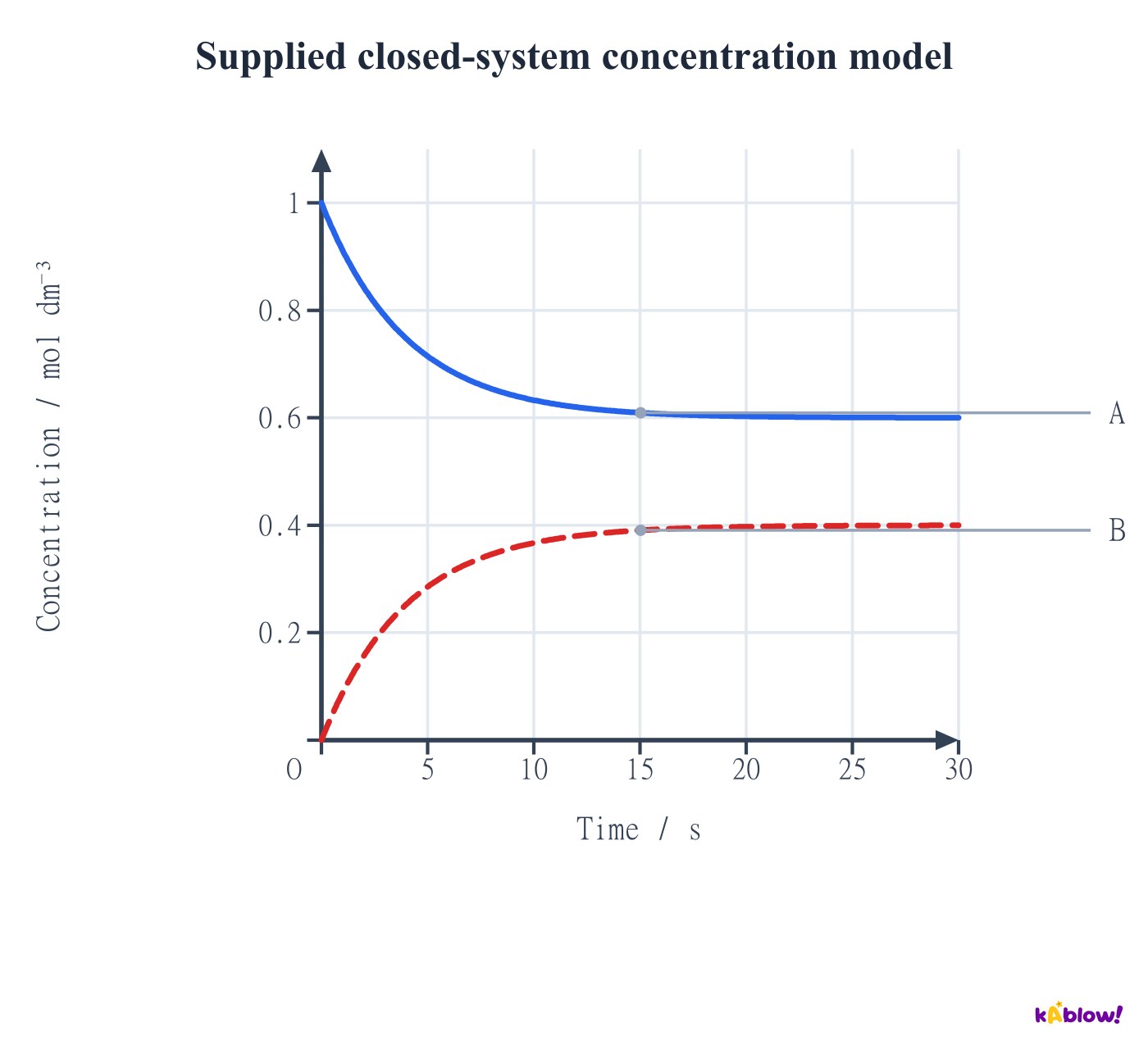
- The supplied concentration model describes A ⇌ B in a fixed volume, with A initially 1.00 mol dm⁻³ and B initially zero.
- The long-time values are [A] = 0.600 and [B] = 0.400 mol dm⁻³. Both become approximately constant on the plotted scale while remaining unequal.
- For this one-to-one model [A] + [B] remains 1.00 mol dm⁻³. A different balanced equation or changing volume would require the appropriate material balance.
Supplied closed-system concentration model
Separate an imposed addition from the later response
- Le Chatelier’s principle predicts that a disturbed equilibrium tends to respond in a direction that partially opposes the disturbance, subject to the specified constraints.
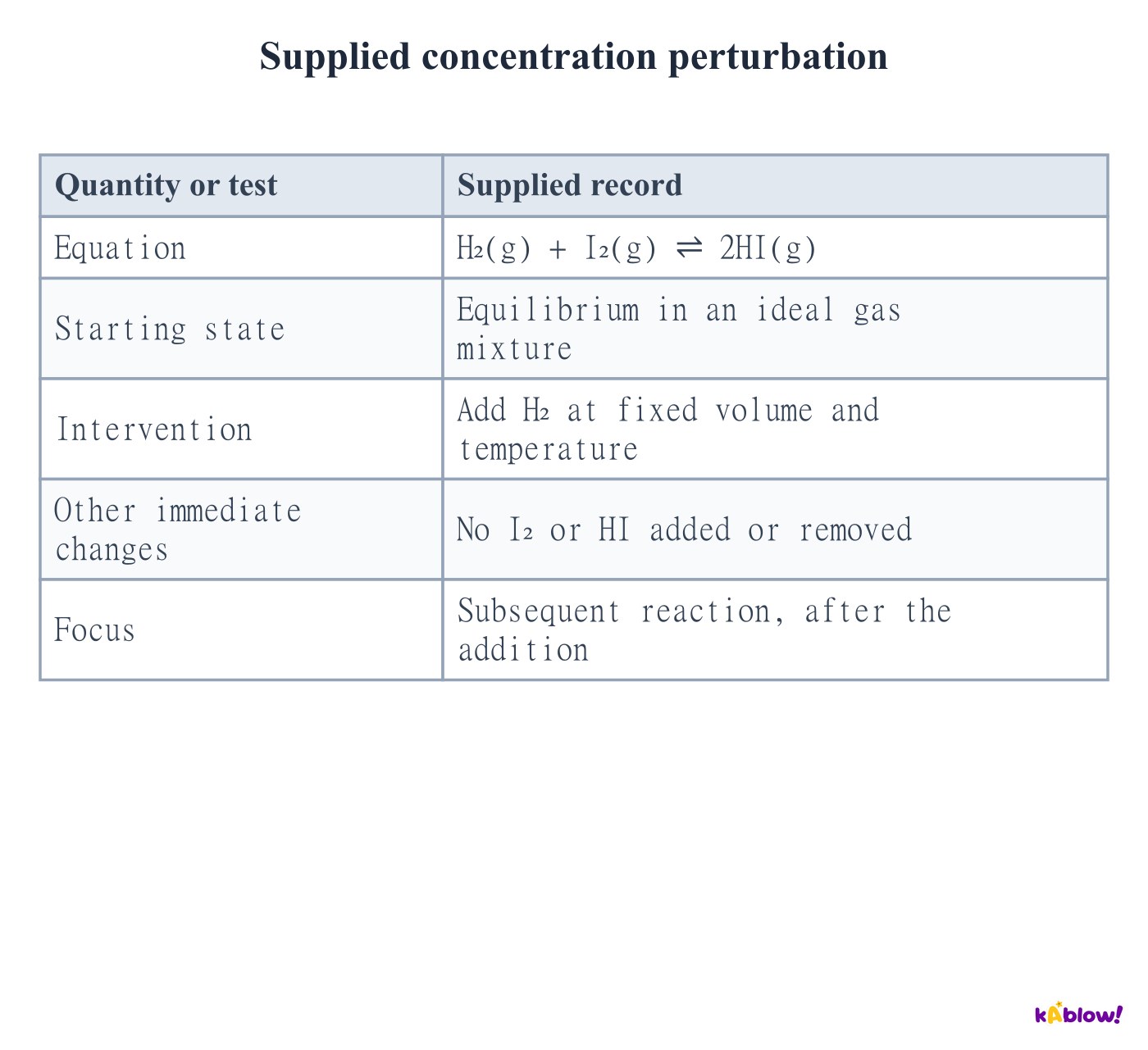
- Adding one reactant at fixed volume immediately raises that reactant concentration. Subsequent forward reaction can consume some of the added reactant and form more products.
- The response does not generally restore every original concentration. State the initial intervention and the subsequent chemical change separately.
Supplied concentration perturbation
Predict a response to removing product
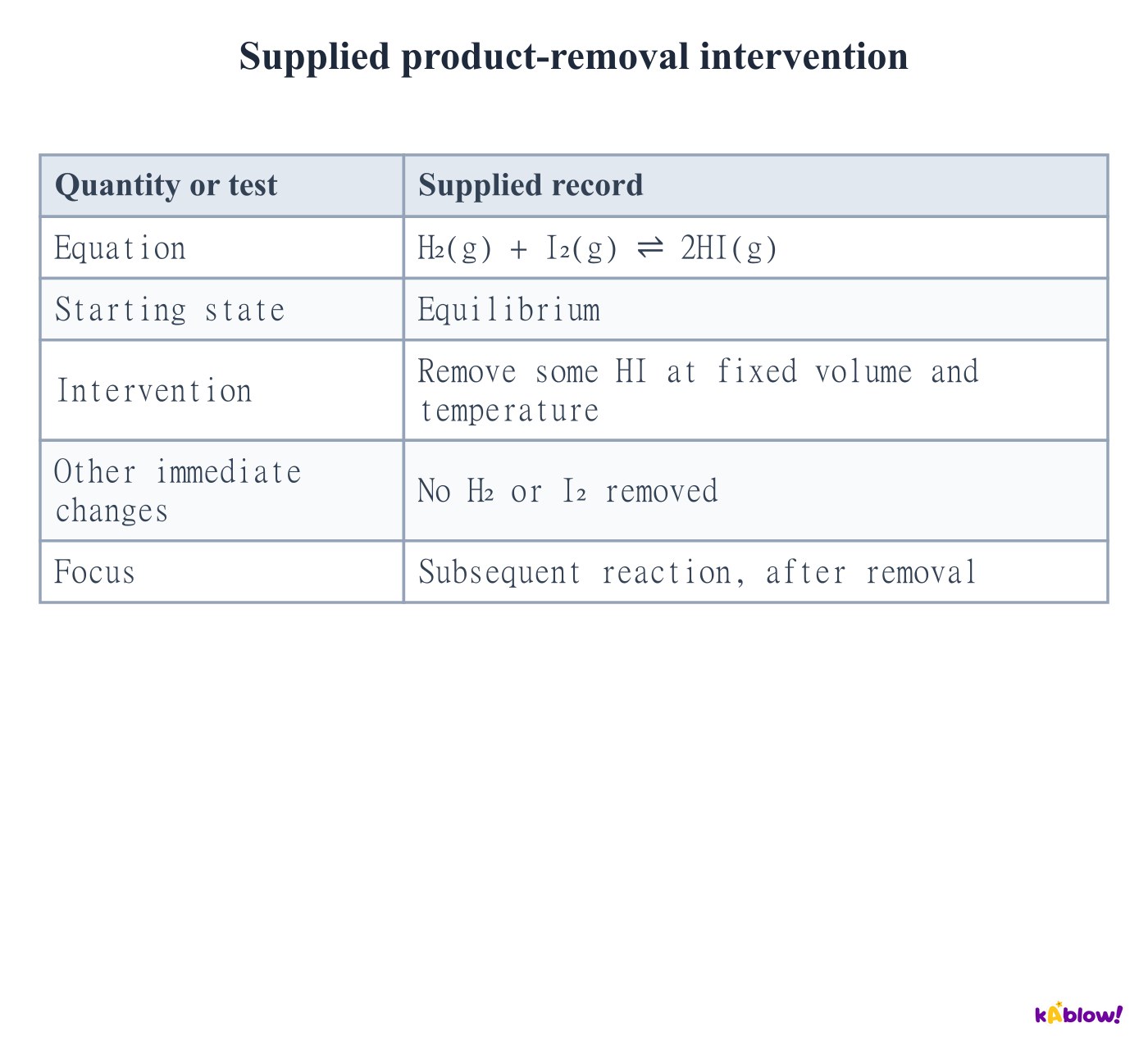
- Removing some product from an equilibrium mixture changes its composition immediately. At fixed temperature, the equilibrium constant for the same equation remains unchanged.
- The subsequent net reaction can form more product, opposing some of the removal. This is a change in equilibrium composition, not a new value of the constant.
- Industrial product separation and recycle apply this idea across an open process. They are not the same as retaining all matter in one sealed vessel.
Supplied product-removal intervention
Predict the effect of isothermal gas compression
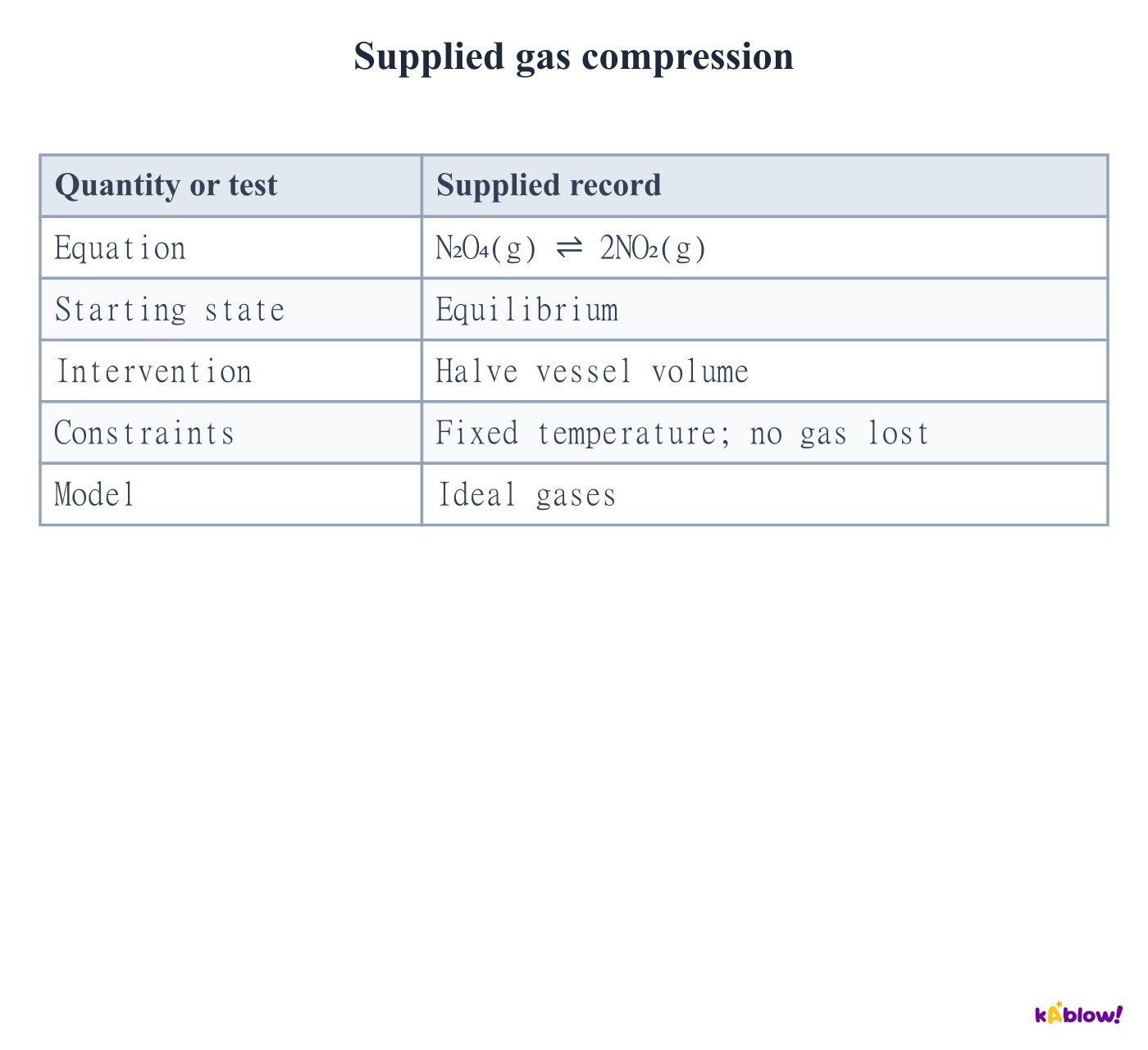
- Compression at fixed temperature raises reacting-gas concentrations and partial pressures immediately. Compare the total gaseous stoichiometric coefficients on the two sides.
- For N₂O₄(g) ⇌ 2NO₂(g), compression favours net formation of N₂O₄, the side with fewer gaseous molecules. The reaction response partially opposes the pressure increase.
- This ideal-gas prediction refers to changing volume. It is not a universal rule that any increase in total pressure has the same effect.
Supplied gas compression
Recognise equal gaseous stoichiometric totals
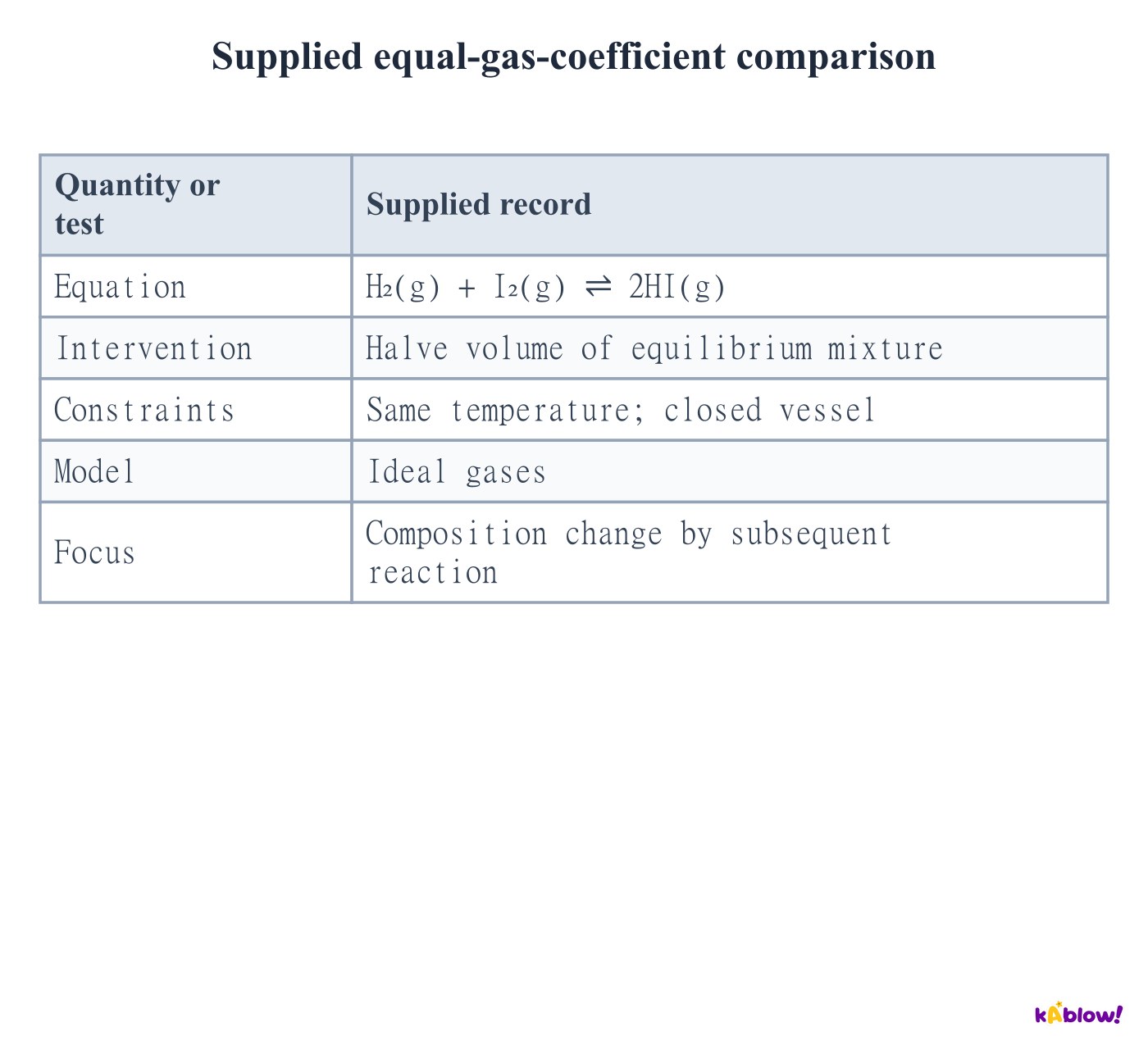
- For H₂(g) + I₂(g) ⇌ 2HI(g), each side has two gaseous stoichiometric units.
- At fixed temperature, changing the ideal-gas volume scales all concentrations together. The squared concentration factor in the numerator cancels the two factors in the denominator.
- There is therefore no shift in composition by subsequent reaction in this model, although the immediate concentrations and total pressure change.
Supplied equal-gas-coefficient comparison
Distinguish an inert-gas pressure increase
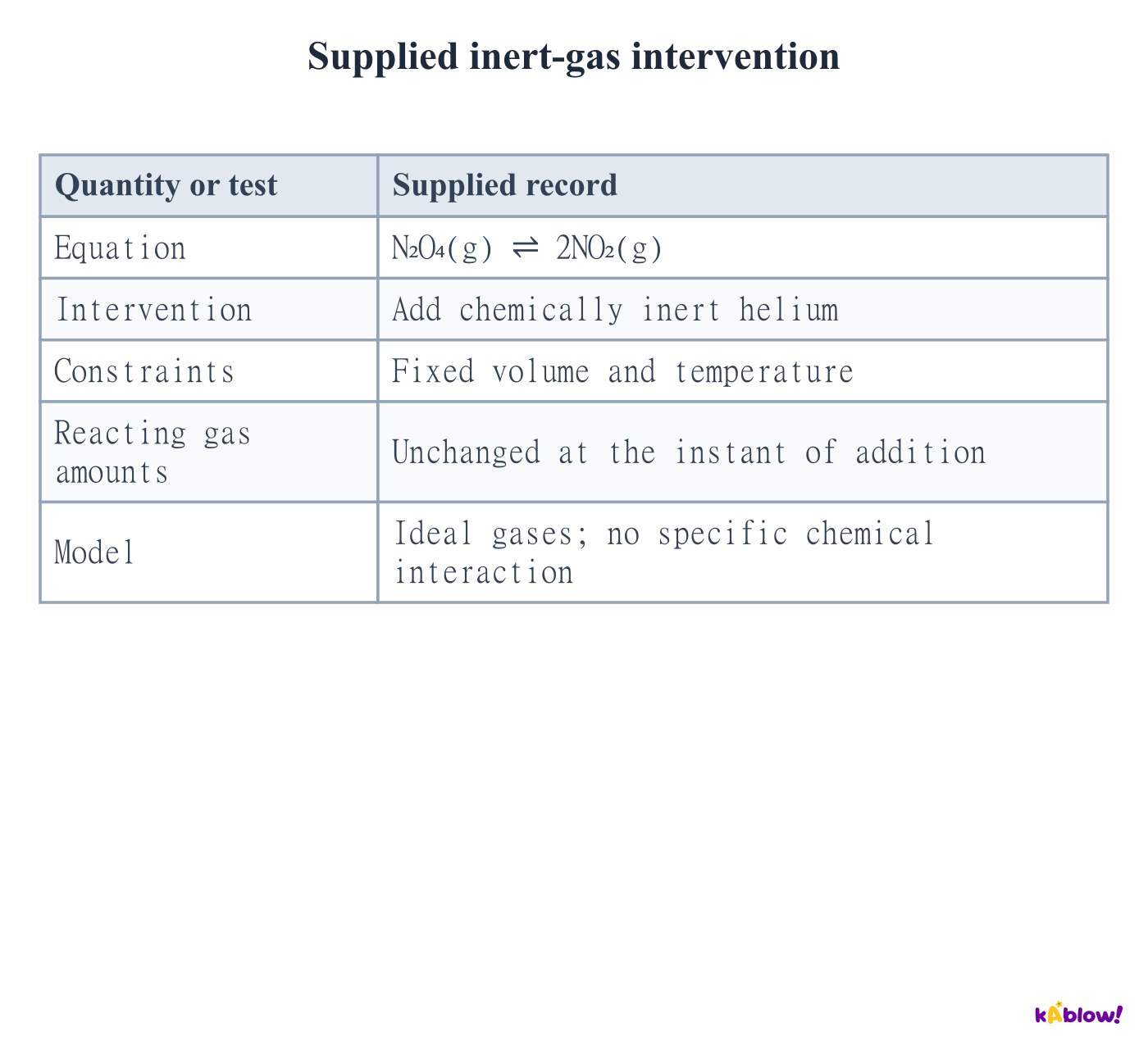
- Adding a chemically inert ideal gas at fixed volume and temperature raises total pressure but leaves reacting-gas concentrations and partial pressures unchanged.
- The reacting mixture’s concentration quotient is unchanged, so an initially equilibrated ideal mixture has no composition shift from this intervention alone.
- At fixed total pressure, inert-gas addition can expand the volume instead. Always specify the constraint before making a pressure prediction.
Supplied inert-gas intervention
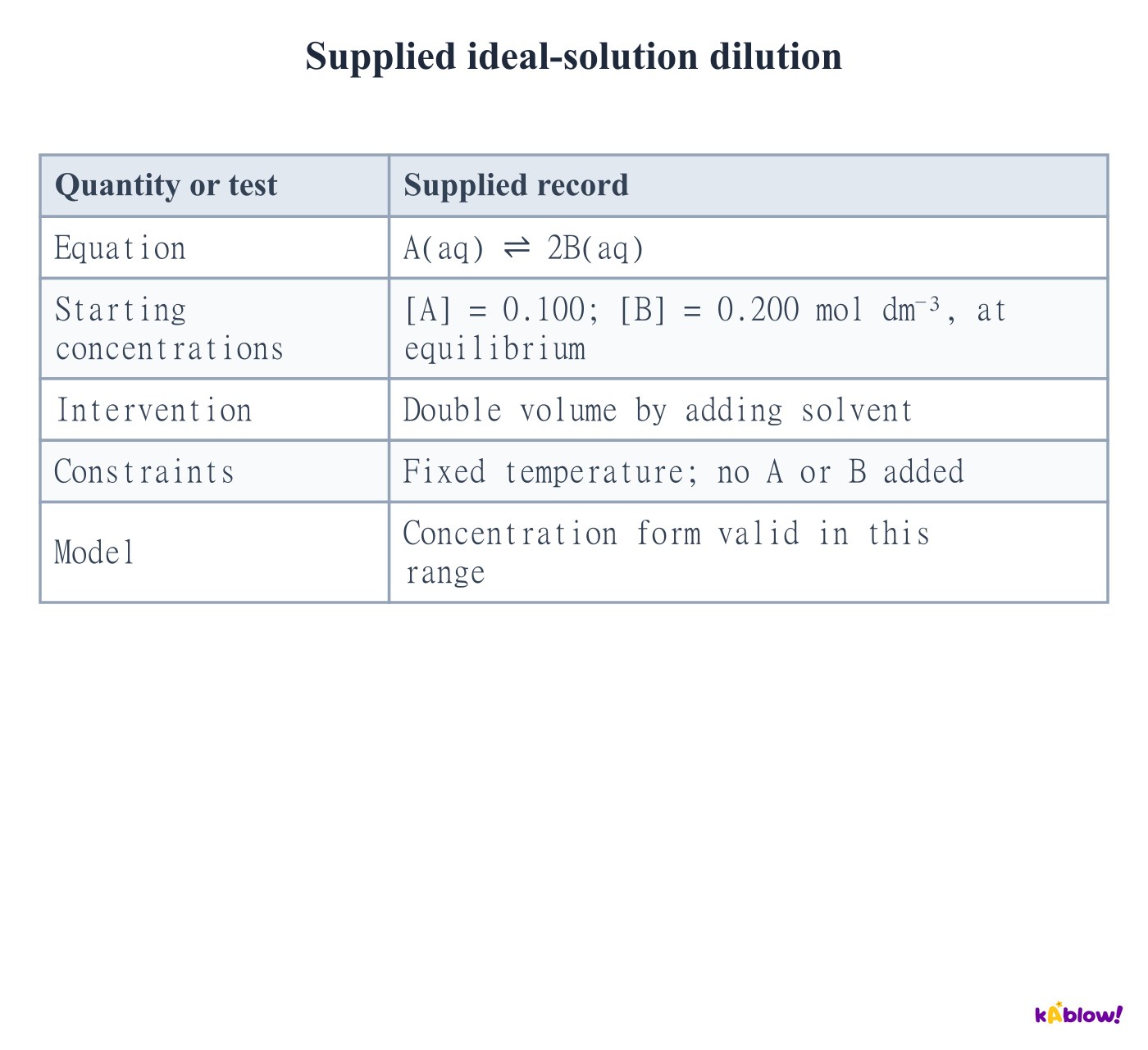
Analyse dilution using the balanced equation
- Dilution lowers solution concentrations, but whether an equilibrium shifts depends on how those concentrations enter its expression.
- For A(aq) ⇌ 2B(aq), the quotient [B]²/[A] falls when all concentrations are halved. Subsequent forward reaction raises it back towards the same Kc.
- Equal overall powers on each side would instead cancel the common dilution factor in the ideal concentration model. Do not infer no shift merely because every species was diluted equally.
Supplied ideal-solution dilution
Predict temperature effects from reaction enthalpy
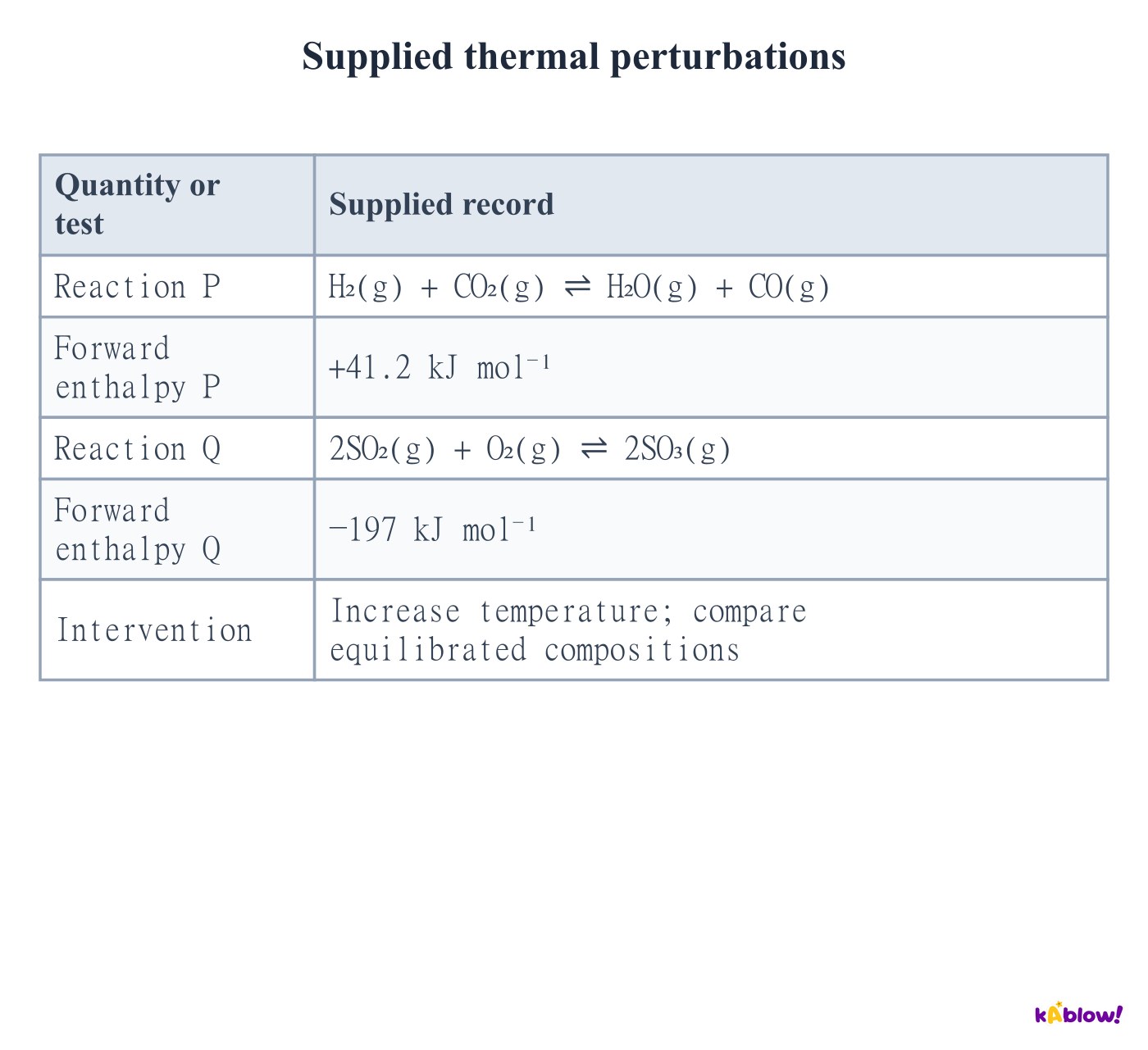
- Increasing temperature favours the endothermic direction; decreasing temperature favours the exothermic direction, within the stated equilibrium model.
- The supplied P forward reaction is endothermic, so heating favours its products. The supplied Q forward reaction is exothermic, so heating favours its reactants.
- Temperature affects both rate and equilibrium composition. A faster approach does not by itself establish a greater final product yield.
Supplied thermal perturbations
Explain catalysis without changing equilibrium yield
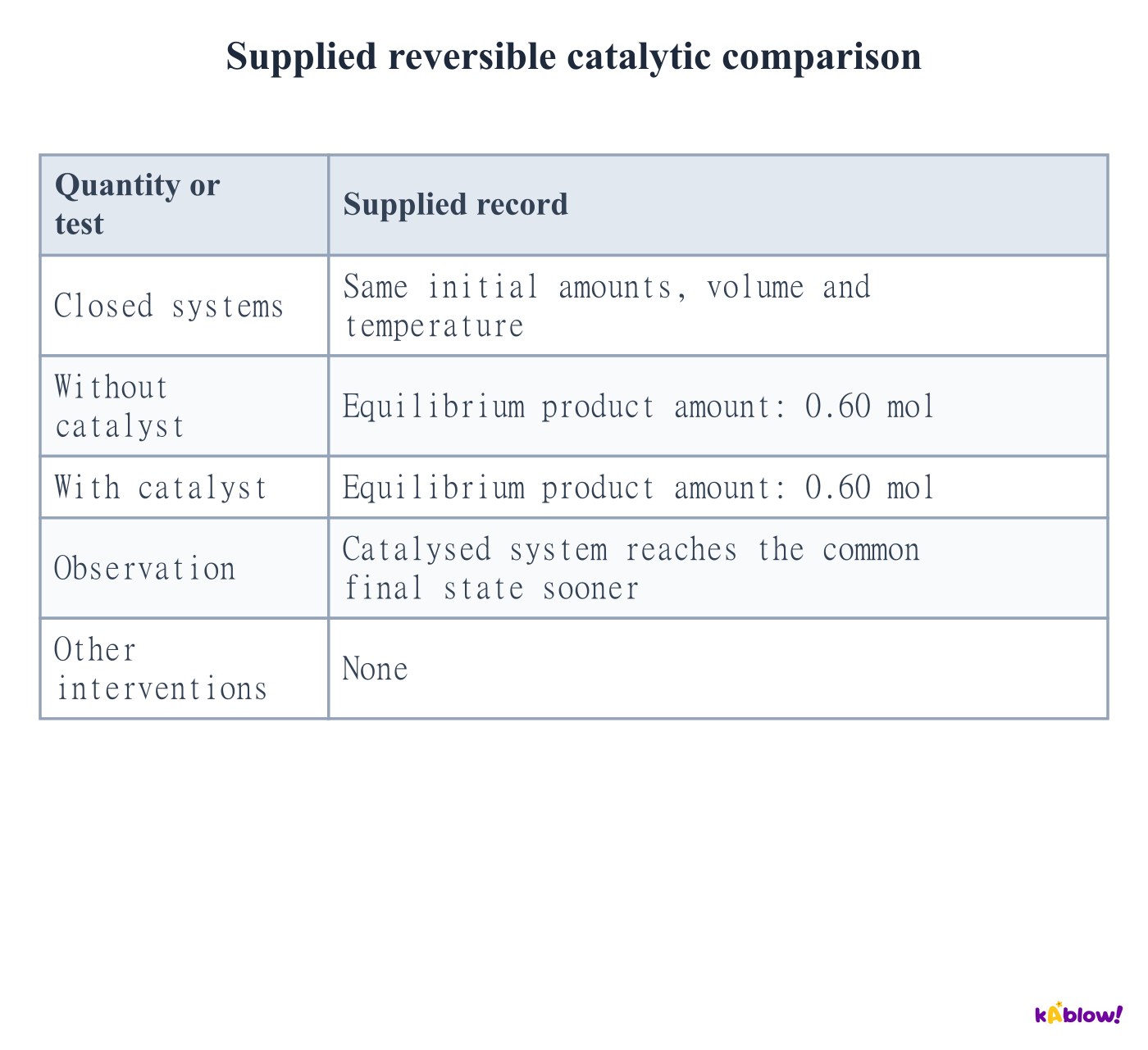
- A catalyst provides an alternative pathway and facilitates approach to equilibrium in both directions. It does not change the equilibrium constant at fixed temperature.
- The matched closed systems therefore reach the same final composition, though the catalysed one reaches it sooner.
- Do not claim that forward and reverse rates must be equal at every stage after adding a catalyst. Their equality characterises equilibrium, not every earlier mixture.
Supplied reversible catalytic comparison
Evaluate an ammonia-synthesis compromise
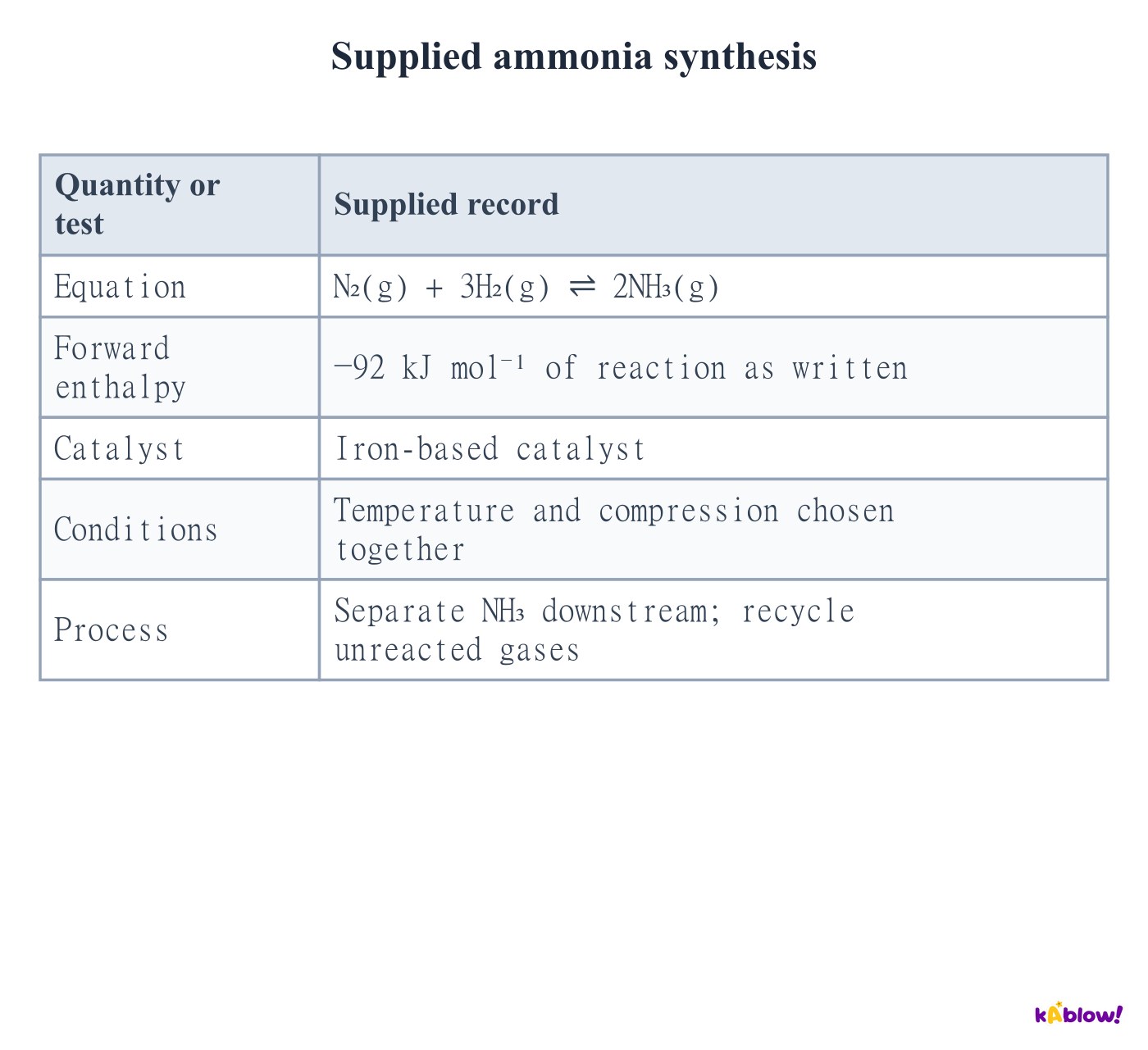
- The Haber reaction is exothermic and reduces the gaseous stoichiometric total from four to two. Lower temperature and higher pressure favour ammonia at equilibrium in the usual model.
- A lower temperature also slows reaction. High compression requires energy and strong equipment, so operating choices balance rate, conversion, cost and safety rather than maximising one variable alone.
- Iron-based catalysis supports a useful rate. Downstream ammonia separation and recycle improve overall utilisation; representative textbook temperatures and pressures are not universal plant settings.
Supplied ammonia synthesis
Evaluate sulfur-trioxide production and separation
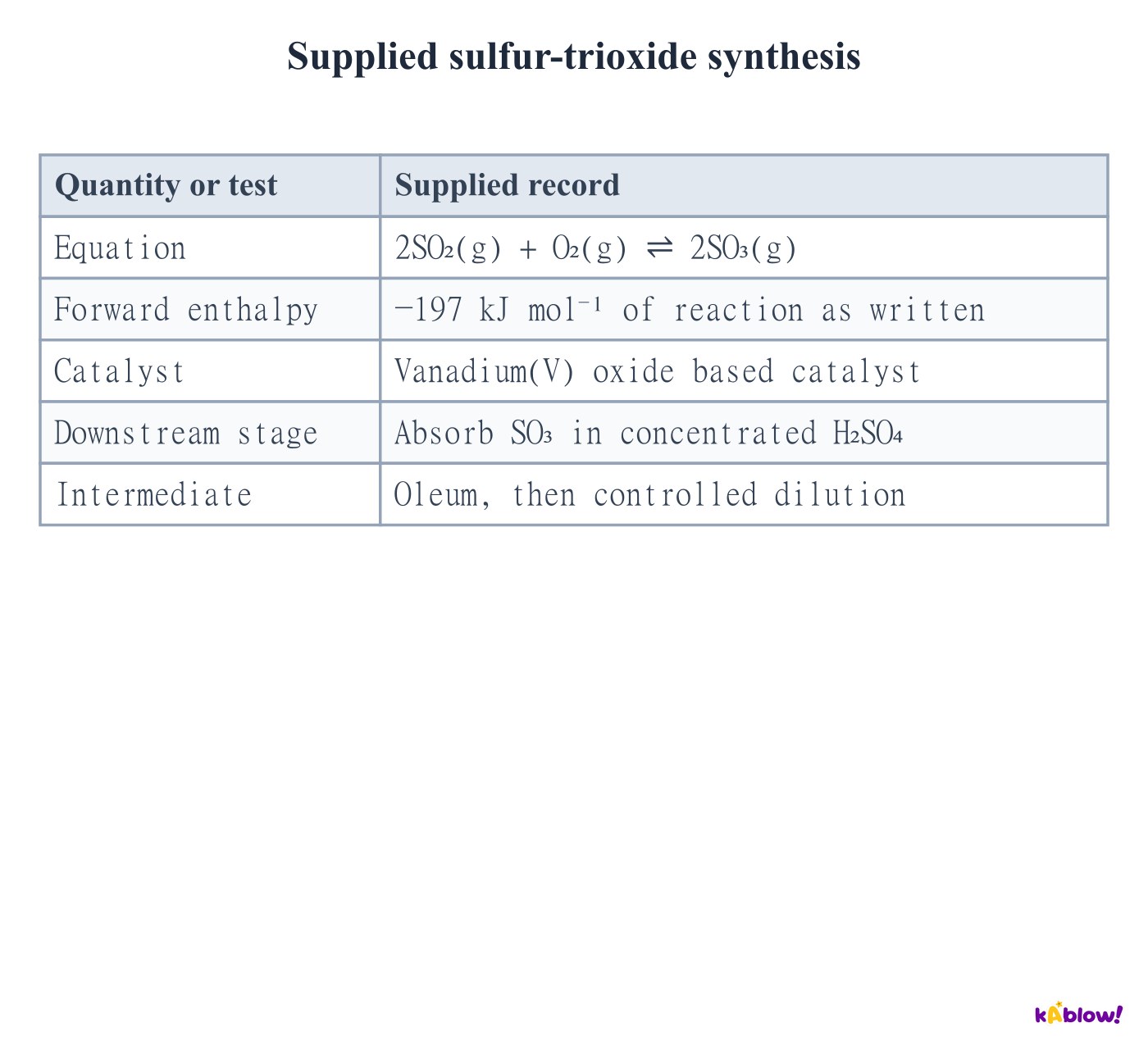
- The Contact-process equilibrium stage converts sulfur dioxide and oxygen to sulfur trioxide. The forward step is exothermic and reduces the gaseous stoichiometric total.
- A suitable catalyst and a compromise temperature support useful production. Compression can favour SO₃, but the benefit must justify its equipment and energy costs.
- Downstream SO₃ is absorbed into concentrated sulfuric acid to make oleum, followed by controlled dilution. Directly mixing SO₃ with water is difficult to control and produces acid mist; this is an industrial description, not a practical instruction.
Supplied sulfur-trioxide synthesis
Construct a homogeneous equilibrium expression
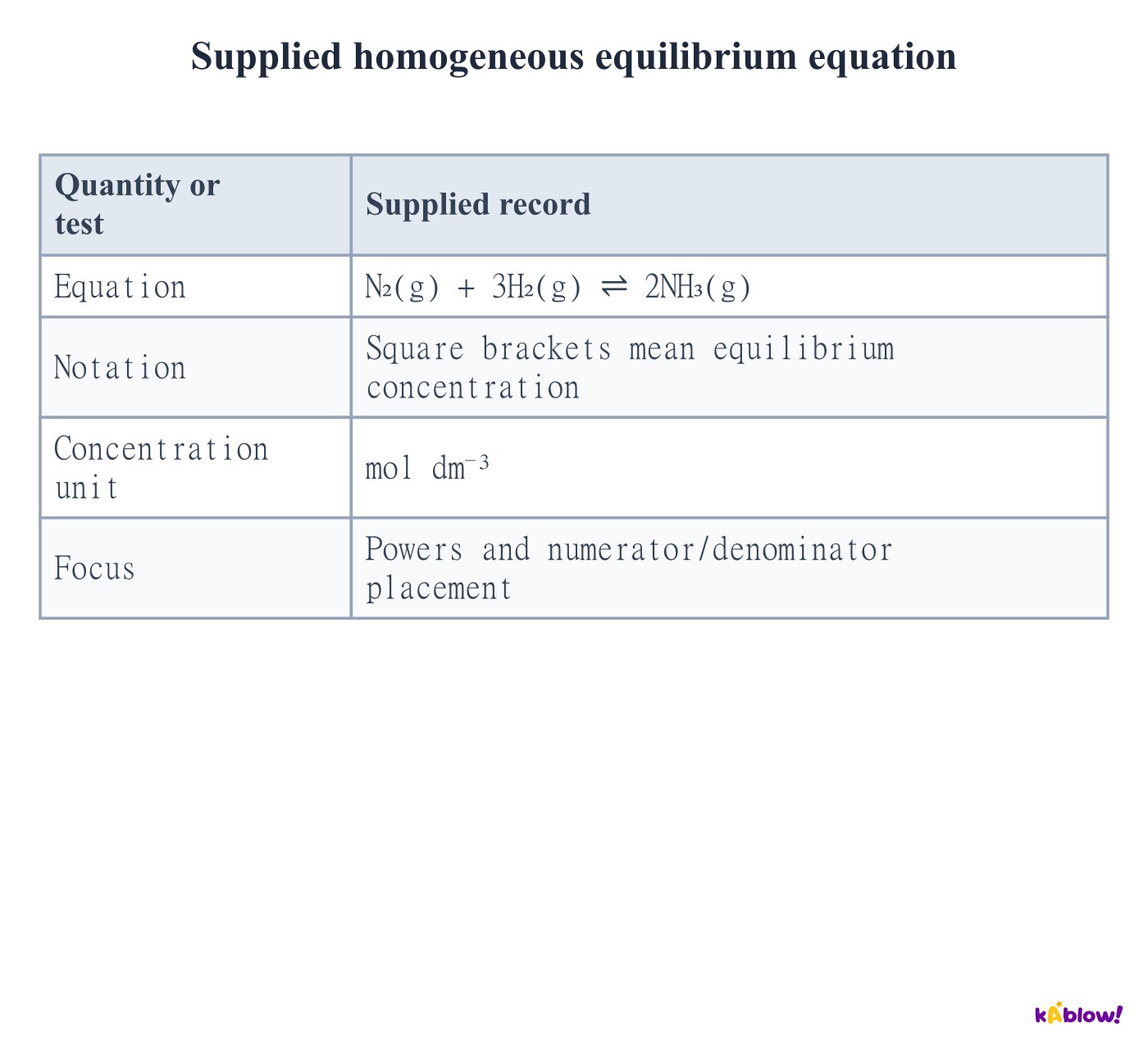
- Write product equilibrium concentrations in the numerator and reactant equilibrium concentrations in the denominator. Raise each concentration to its balanced-equation coefficient.
- For N₂(g) + 3H₂(g) ⇌ 2NH₃(g), Kc = [NH₃]²/([N₂][H₂]³). Brackets refer to equilibrium concentrations, not initial amounts.
- The expression belongs to the particular equation and direction. It cannot be transferred unchanged to a reversed or rescaled equation.
Supplied homogeneous equilibrium equation
Apply phase conventions carefully
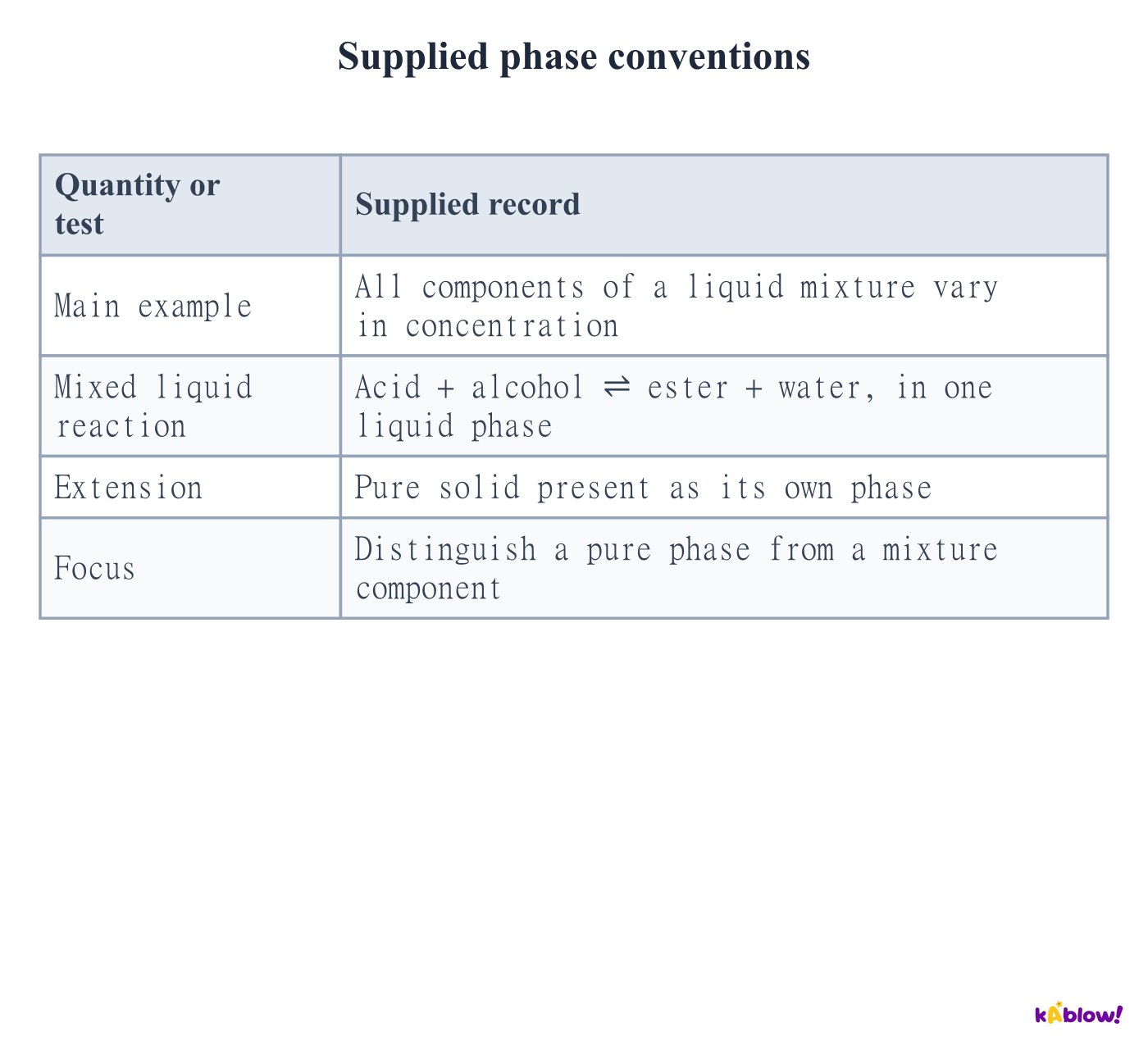
- The main AQA Kc treatment here is for homogeneous systems. In a single liquid mixture, varying component concentrations can belong in the expression, including water when treated as a mixture component.
- As an extension, the activity of a pure solid or pure liquid phase is conventionally one and is omitted from an activity expression while that phase remains present.
- Do not remove every species marked (l), or treat adding more pure solid as changing its activity. A mixed-liquid component is different from a separate pure phase.
Supplied phase conventions
Deduce the units of concentration-form Kc
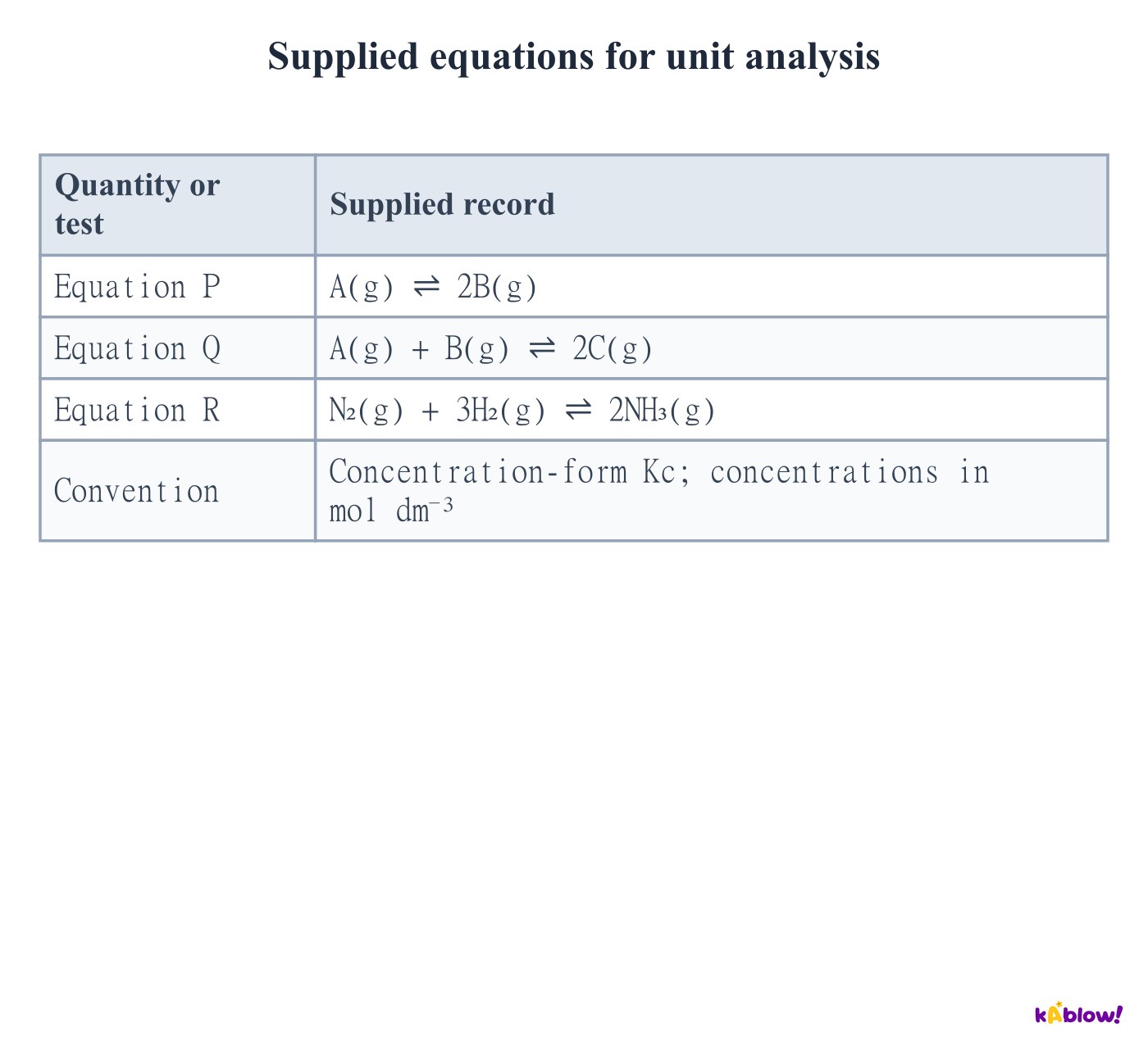
- Substitute mol dm⁻³ for each included concentration and combine the powers algebraically. The net product exponent minus reactant exponent determines the remaining unit power.
- For A ⇌ 2B, concentration-form Kc has units mol dm⁻³. For A + B ⇌ 2C the units cancel; for ammonia synthesis they are mol⁻² dm⁶.
- This A-level concentration-form convention differs from a dimensionless thermodynamic constant written with standard-state activities. Keep the convention and equation explicit.
Supplied equations for unit analysis
Convert equilibrium amounts to concentrations
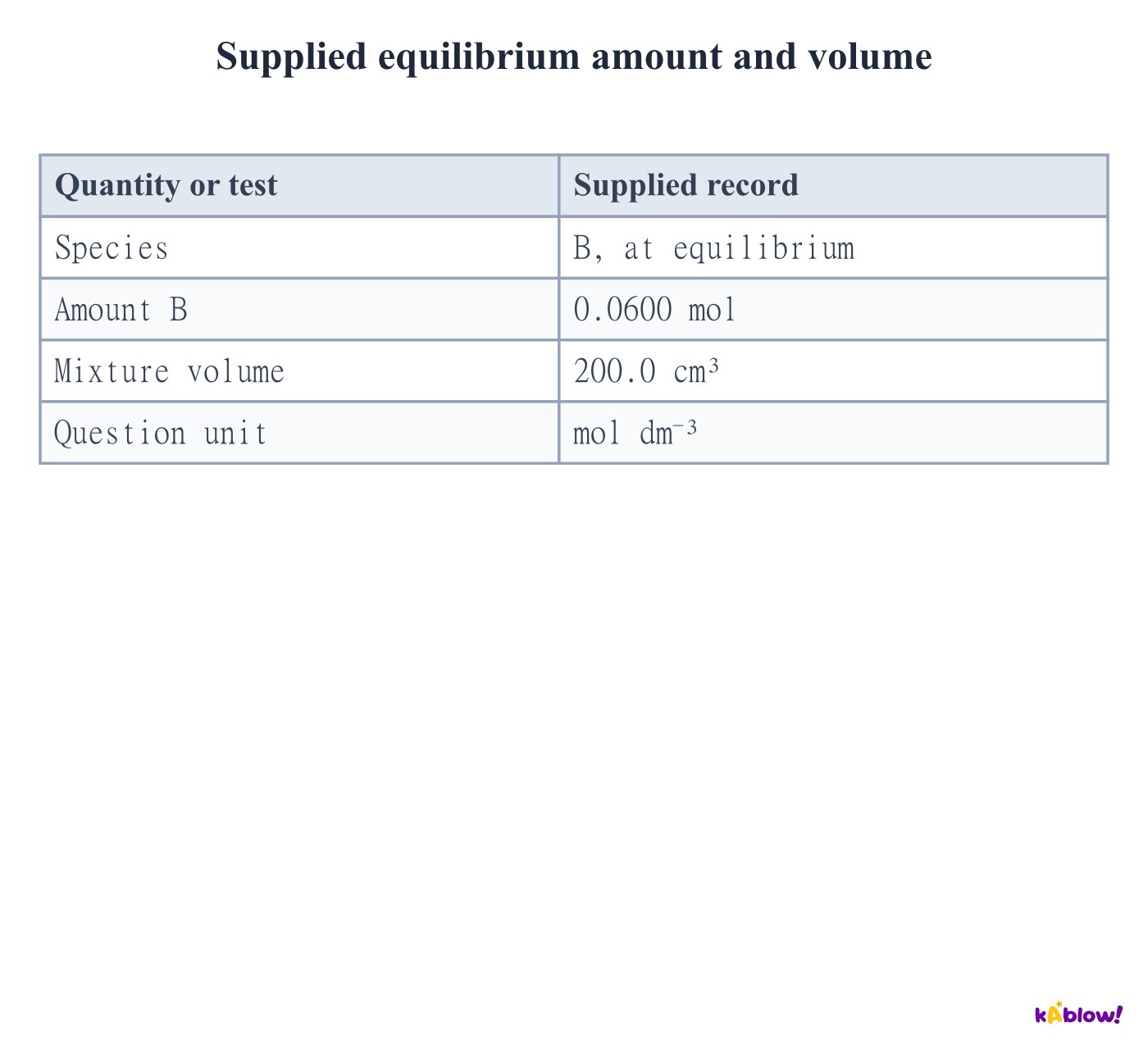
- Concentration equals amount divided by mixture volume in the required unit. Convert cm³ to dm³ by dividing by 1000.
- The supplied 0.0600 mol in 200.0 cm³ occupies 0.2000 dm³, giving 0.300 mol dm⁻³.
- Use equilibrium amounts for a direct Kc substitution. Initial quantities require a material-balance calculation before they become equilibrium concentrations.
Supplied equilibrium amount and volume
Calculate Kc from equilibrium concentrations
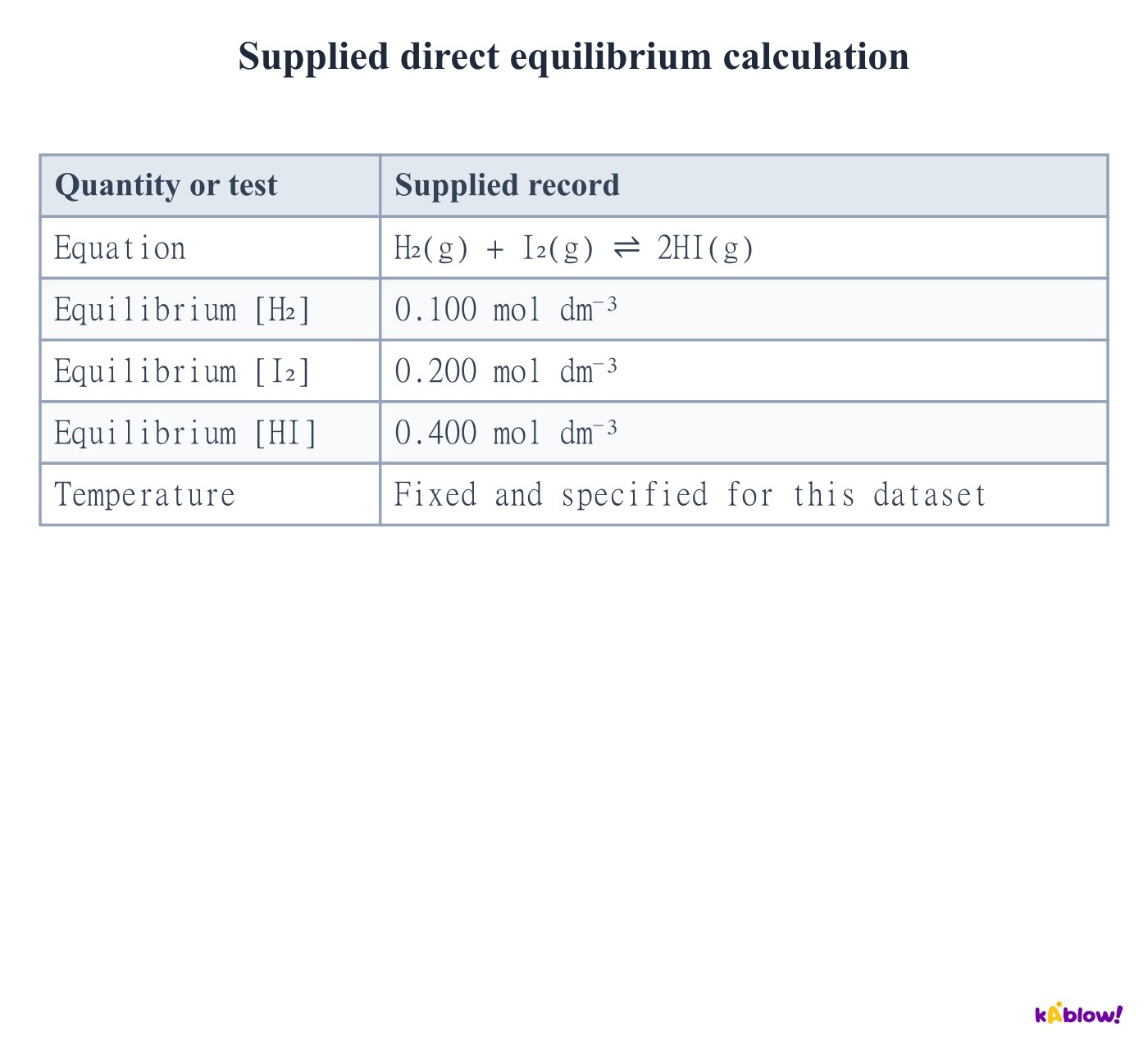
- For the supplied H₂ + I₂ ⇌ 2HI dataset, write Kc = [HI]²/([H₂][I₂]) before substituting.
- The numerator is 0.400² and the denominator is 0.100×0.200, giving Kc = 8.00 with no remaining concentration units.
- Keep intermediate precision and report to the stated data precision. The number does not tell you how quickly equilibrium was reached.
Supplied direct equilibrium calculation
Build an initial–change–equilibrium balance
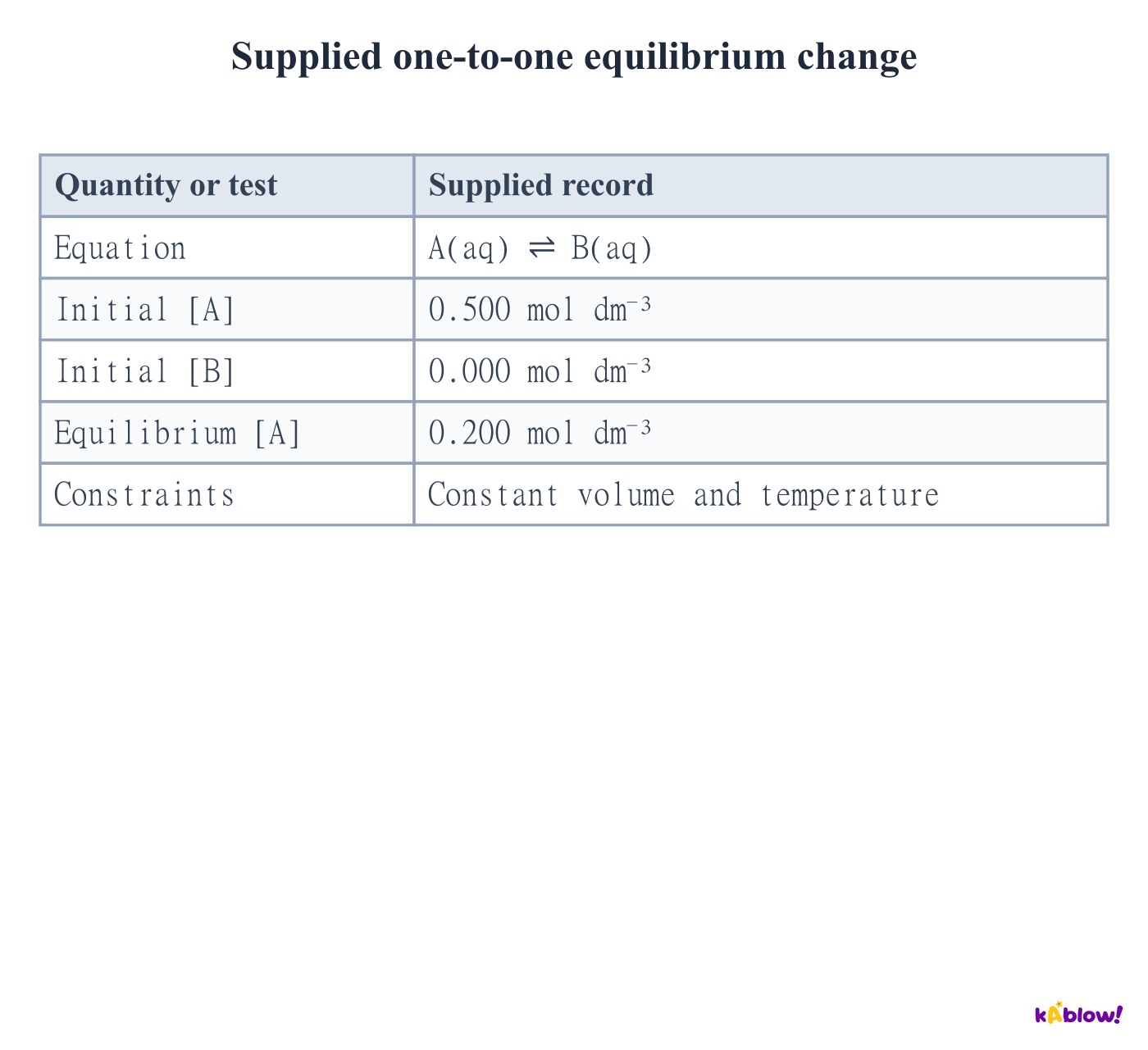
- An ICE table separates initial concentration, stoichiometric change and equilibrium concentration. Define a change variable with a clear basis.
- For the supplied A ⇌ B example, A falls by 0.300 mol dm⁻³. The one-to-one equation therefore forms the same concentration of B at constant volume.
- At equilibrium [A] = 0.200 and [B] = 0.300, so Kc = 1.50. Verify nonnegative values and the conserved total rather than guessing the product concentration.
Supplied one-to-one equilibrium change
Apply stoichiometric coefficients in an ICE calculation
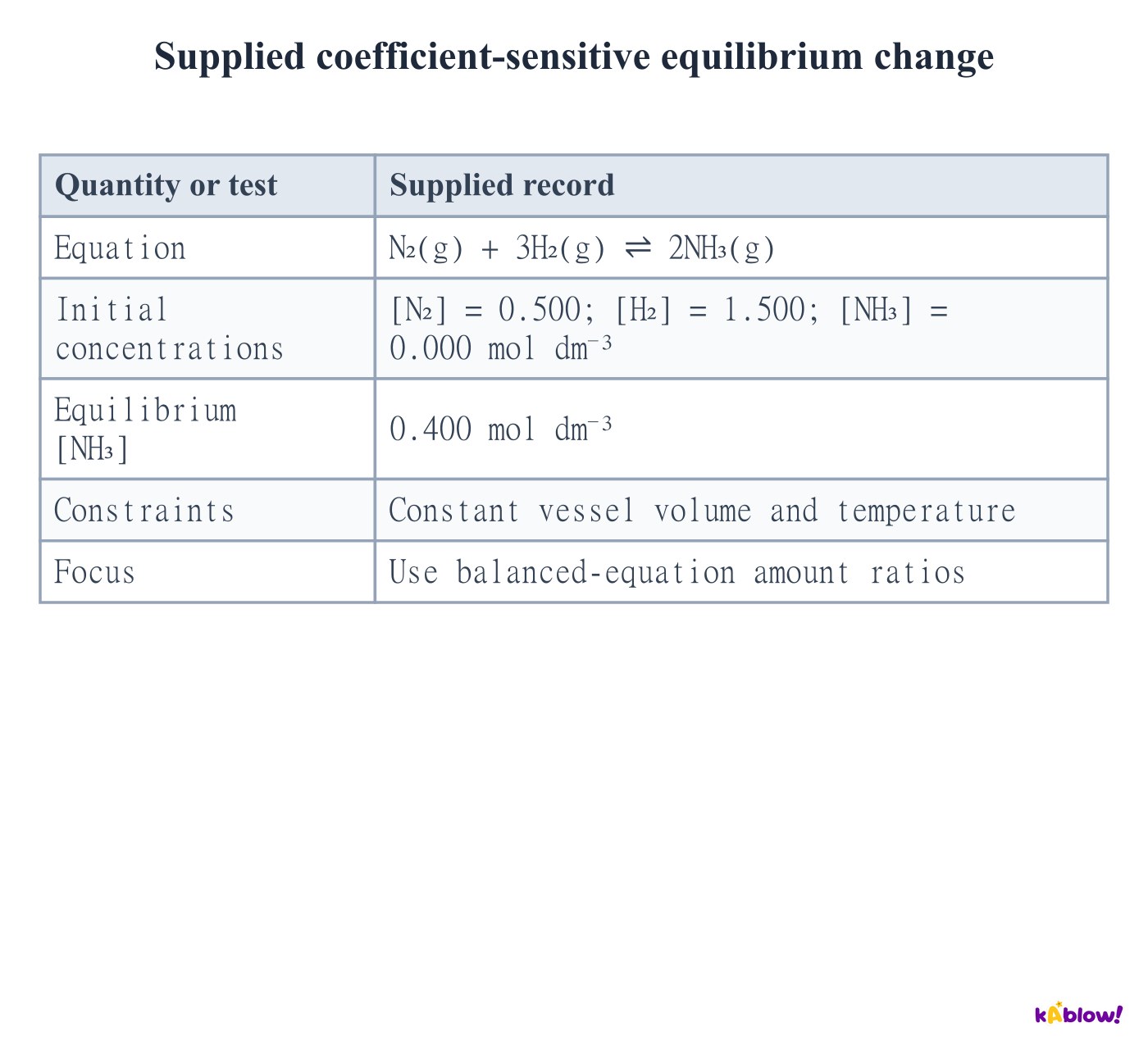
- For N₂ + 3H₂ ⇌ 2NH₃, forming two concentration units of ammonia consumes one of nitrogen and three of hydrogen in a fixed volume.
- The supplied 0.400 mol dm⁻³ ammonia corresponds to a change basis of 0.200. Equilibrium nitrogen is 0.300 and hydrogen is 0.900 mol dm⁻³.
- Substitute those equilibrium concentrations into the coefficient-powered expression. Equal numerical concentration changes would violate the balanced equation.
Supplied coefficient-sensitive equilibrium change
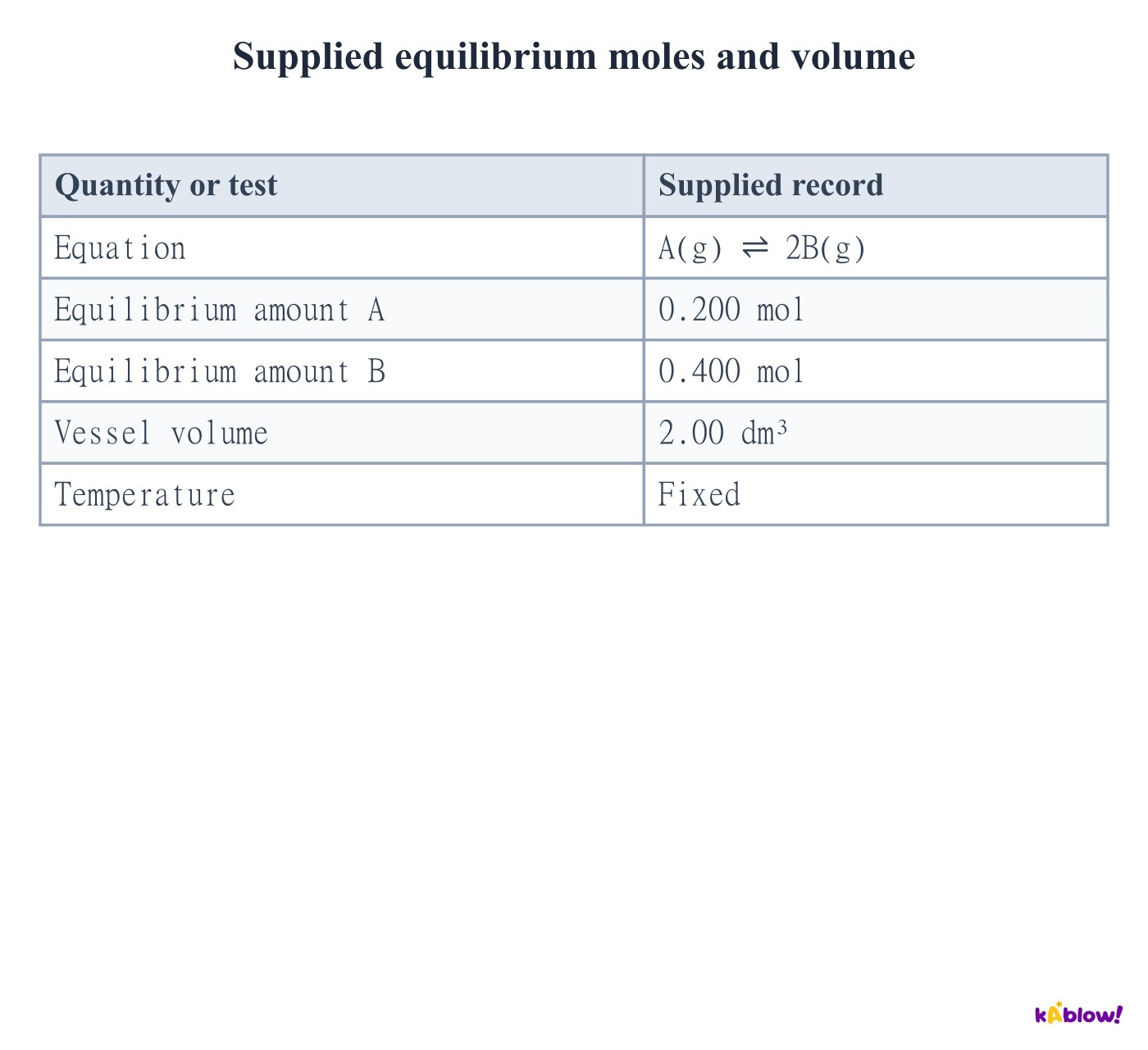
Identify when volume factors do not cancel
- For A ⇌ 2B, replacing each concentration by n/V gives Kc = nB2/(nA V). One inverse volume remains because the net concentration exponent is one.
- The supplied equilibrium amounts in 2.00 dm³ give [A] = 0.100 and [B] = 0.200 mol dm⁻³, hence Kc = 0.400 mol dm⁻³.
- For equations with zero net exponent, common volume factors cancel. Do not extend that simplification to every equation merely because all species share the same vessel.
Supplied equilibrium moles and volume
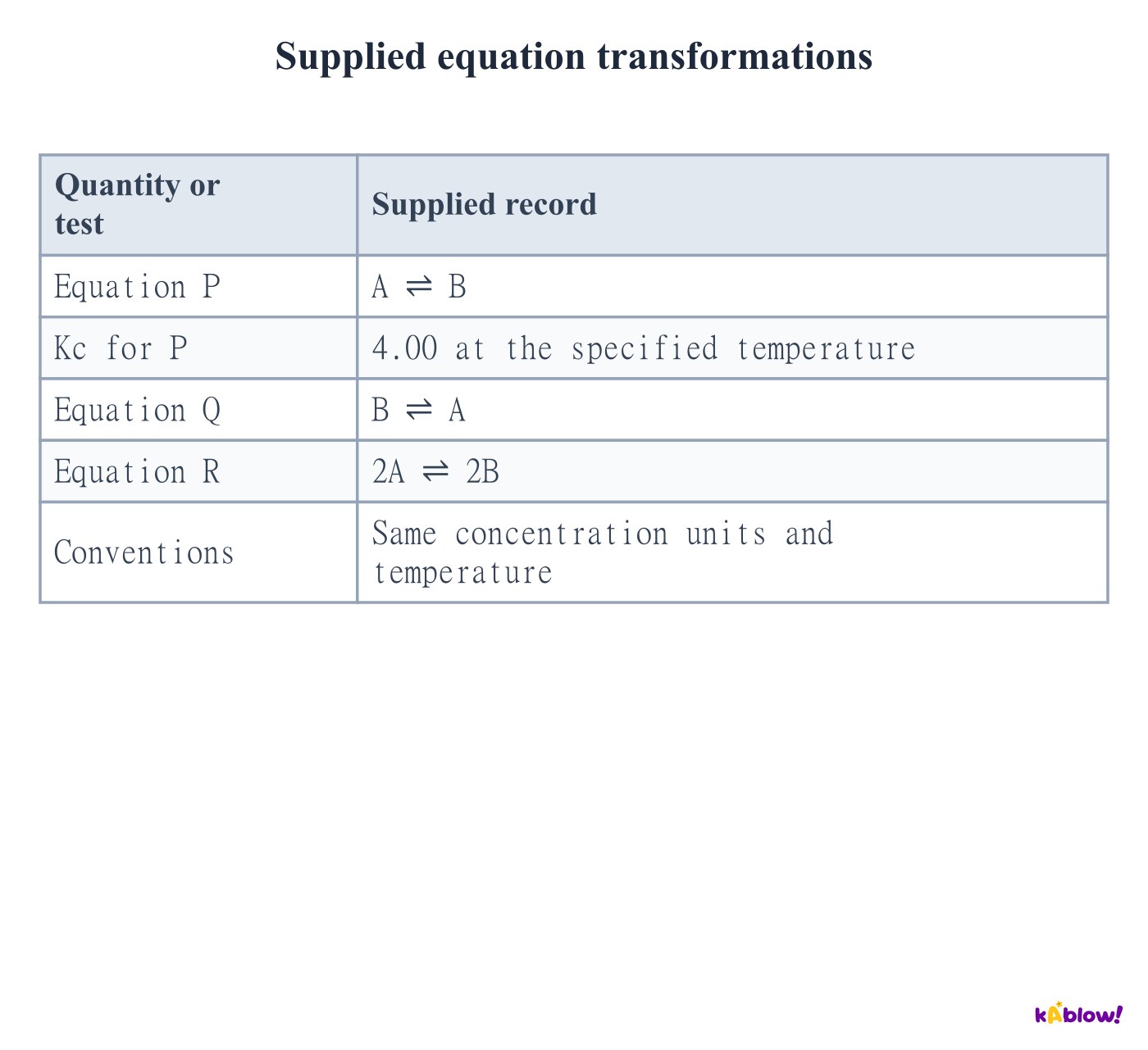
Transform Kc when the equation changes
- Reversing an equation replaces its equilibrium expression by the reciprocal, so the new constant is 1/Kc at the same temperature.
- Multiplying every coefficient by a factor raises the original constant to that factor. Doubling all coefficients squares Kc.
- Numerical constant magnitudes therefore depend on how the equation and units are written. Compare like expressions rather than using one universal large-number yield rule.
Supplied equation transformations
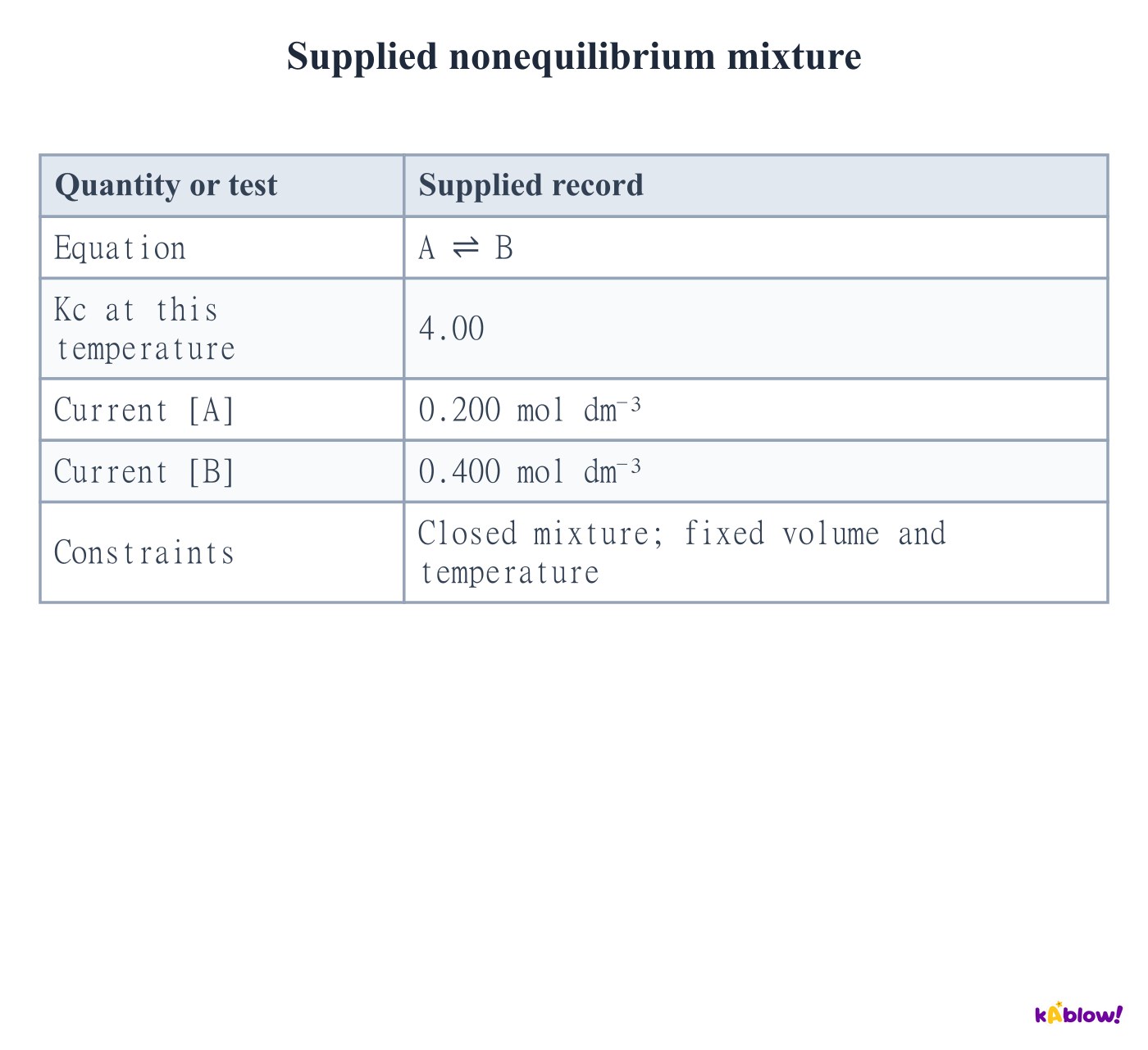
Distinguish a current quotient from equilibrium Kc
- The reaction quotient Qc uses the same concentration expression as Kc but can be calculated for a mixture that is not at equilibrium.
- For the supplied A ⇌ B mixture, Qc = 0.400/0.200 = 2.00, below Kc = 4.00. Net forward reaction increases the quotient towards its equilibrium value.
- This quotient method makes the direction test explicit. Kc is unchanged by the composition adjustment at fixed temperature; Qc changes as the reaction proceeds.
Supplied nonequilibrium mixture
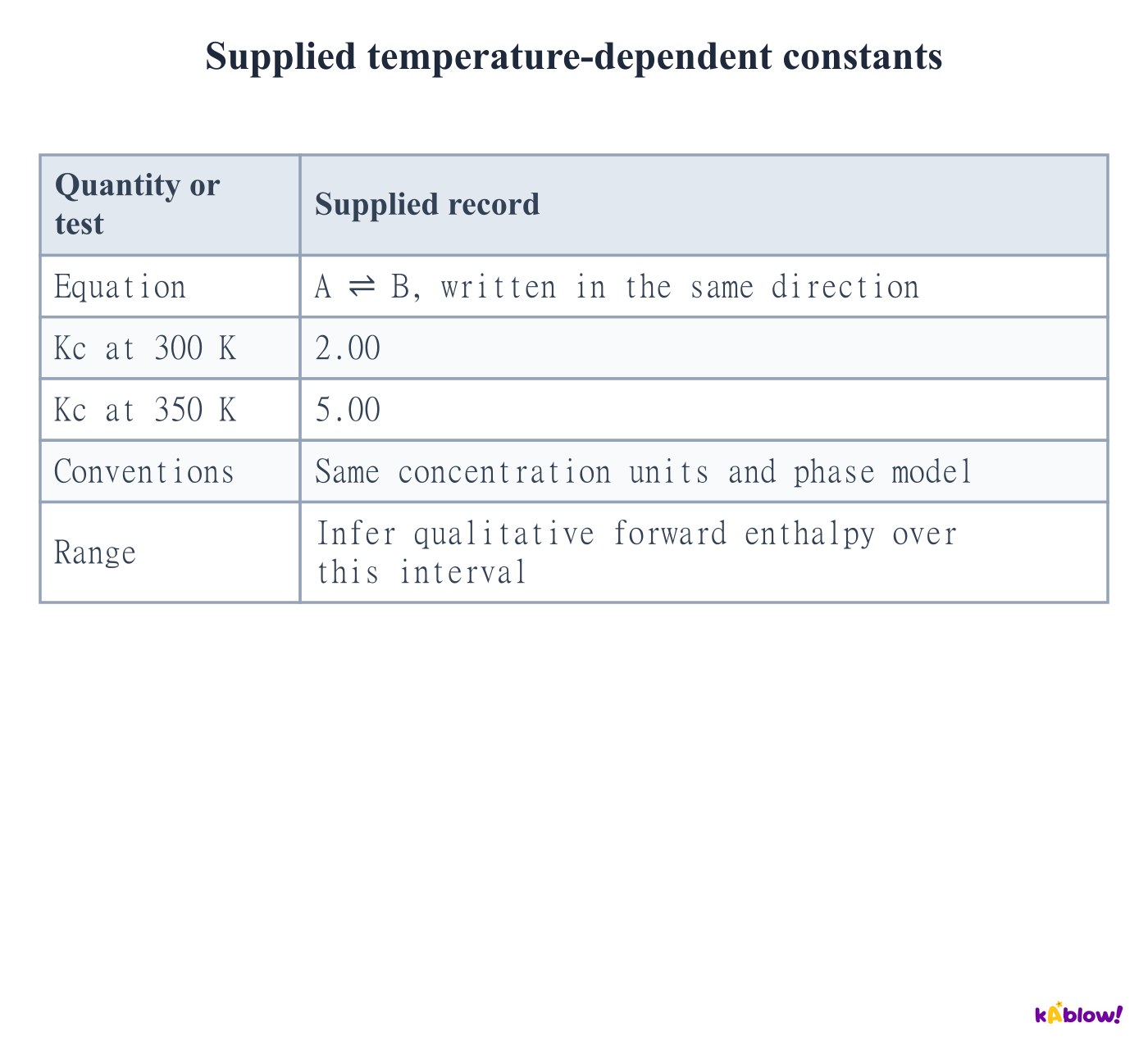
Infer temperature effects on Kc
- At fixed equation and phase model, temperature changes Kc. For an endothermic forward reaction, heating increases Kc; for an exothermic forward reaction, heating decreases it.
- The supplied constant increases from 2.00 at 300 K to 5.00 at 350 K. That qualitative pattern supports an endothermic forward reaction over the stated interval.
- Concentration changes, ideal-gas compression and catalysts do not change Kc at fixed temperature in this treatment. They can affect composition, reaction rate or approach time in different ways.
Supplied temperature-dependent constants
Diapositivas
Sign up free to view the lesson slides
Step through every slide for this topic — plus flashcards and revision notes — with a free account.
Preguntas de práctica
Vista previa gratis — 8 de 60 preguntas. Regístrate para verlas todas.
1.What does the supplied conversion record establish about A and B?
Medium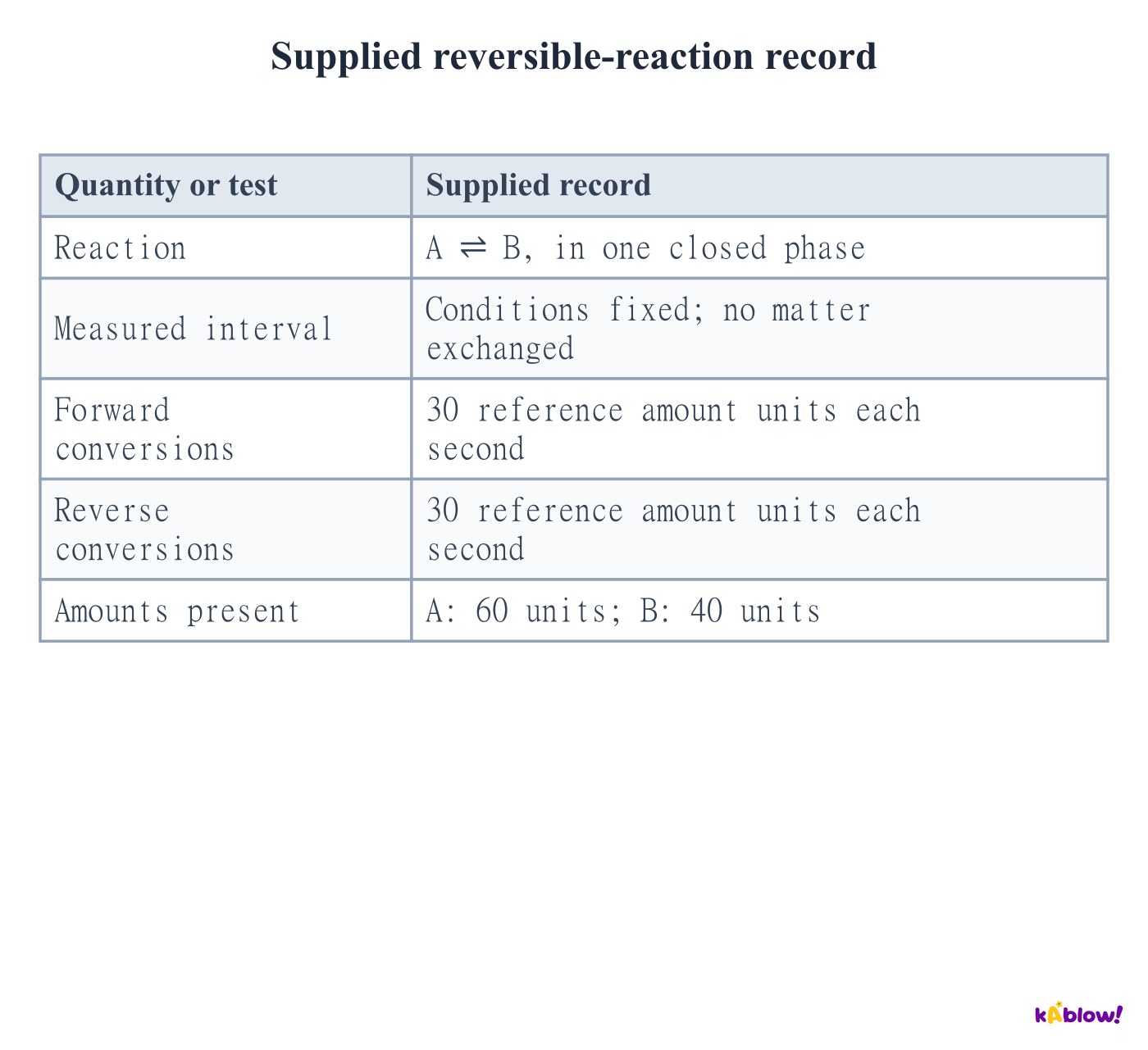
- AThey are at dynamic equilibrium under the stated conditions
- BBoth reactions have stopped
- CA and B must be present in equal amounts
- DOnly A is changing into B
2.What common long-time species rate do F and R approach in the supplied model?
Medium- A0
- B0.040 mol dm⁻³ s⁻¹
- C0.060 mol dm⁻³ s⁻¹
- D0.100 mol dm⁻³ s⁻¹
3.Which limiting concentration comparison follows from the supplied model?
Medium- A[A] = [B] = 0.500
- B[A] > [B], with both approaching constant values
- C[A] becomes zero
- D[B] increases without bound
4.After the supplied H₂ addition, which subsequent net reaction is favoured?
Medium- AForward, forming more HI
- BReverse, forming more I₂
- CNeither, because temperature is fixed
- DAll HI immediately disappears
5.After the supplied HI removal, which subsequent change is predicted?
Medium- AMore HI forms by net forward reaction
- BAll remaining HI decomposes
- CThe equilibrium constant must increase
- DNo reverse process can ever occur again
6.Which net reaction follows the supplied isothermal compression?
Medium- ATowards NO₂
- BTowards N₂O₄
- CNo change because gas coefficients are equal
- DBoth species disappear
7.What happens to composition by subsequent reaction after the supplied compression?
Medium- AMore HI must form
- BMore H₂ and I₂ must form
- CNo composition shift is predicted in the ideal model
- DThe equilibrium constant doubles
8.What composition response follows the supplied fixed-volume helium addition?
Medium- AA shift towards NO₂ is compulsory
- BA shift towards N₂O₄ is compulsory
- CNo shift is predicted in the stated ideal model
- DAll reacting partial pressures double
Unlock all 60 questions, flashcards & more
Crea una cuenta gratis para ver todas las preguntas, las diapositivas, las tarjetas y los apuntes de repaso de este tema.