
Further Acids & Bases Calculations
Apréndelo jugando
Responde estas preguntas para ganar energía, luego pesca y explora. Sin cuenta.
Apuntes de la lección
Define the acid dissociation constant
- For HA ⇌ H⁺ + A⁻, Ka=[H⁺][A⁻]/[HA] in the dilute concentration convention. All concentrations are equilibrium values.
- Water is the solvent; its approximately constant activity is absorbed into this convention. Neglecting water-derived H⁺ is a separate calculation assumption.
- For a polyprotic acid, write one Ka for each proton-loss step. H₂CO₃ first gives HCO₃⁻, not CO₃²⁻ and two protons at once.
A single ionisation step
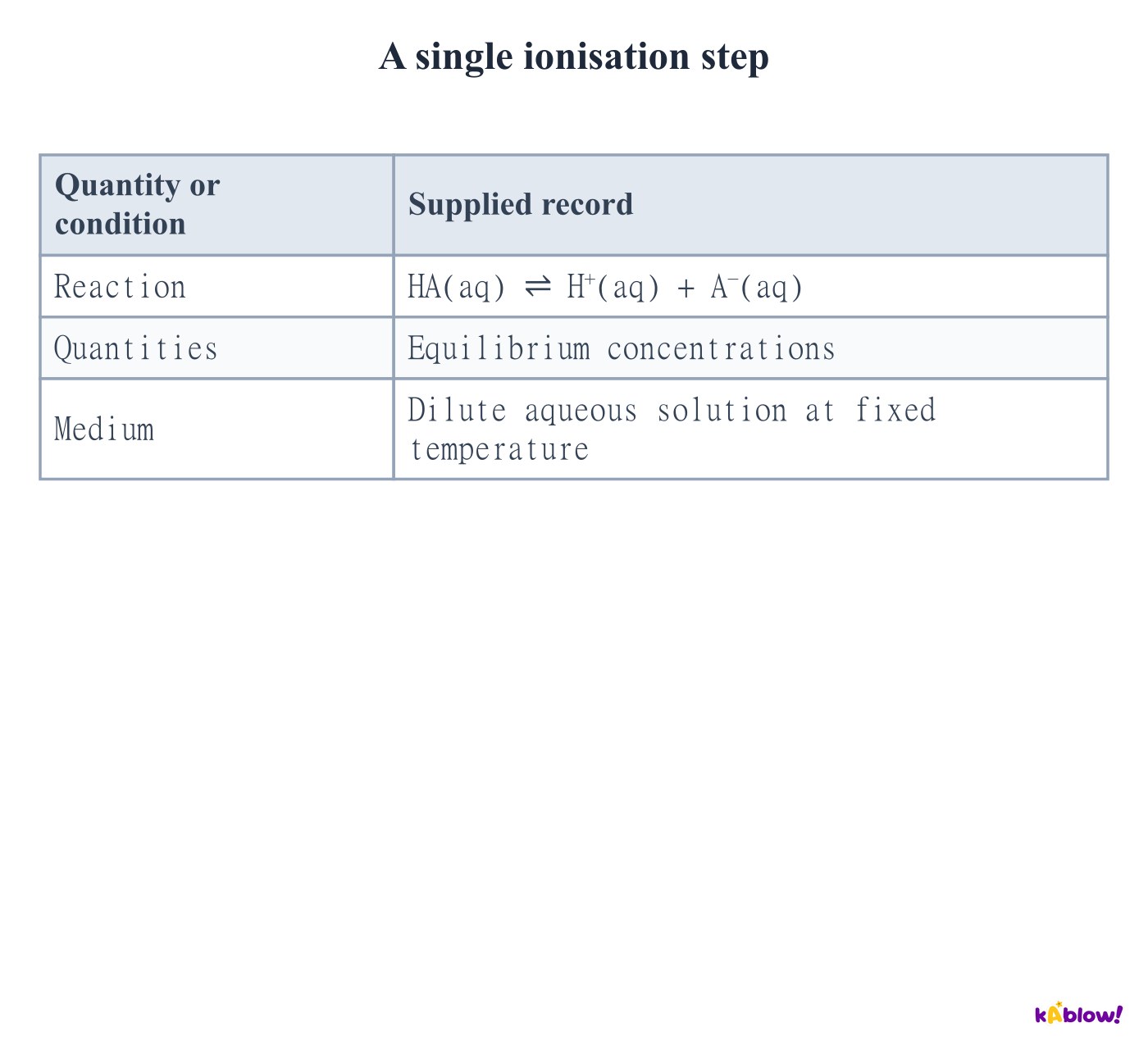
Calculate weak-acid pH with stated assumptions
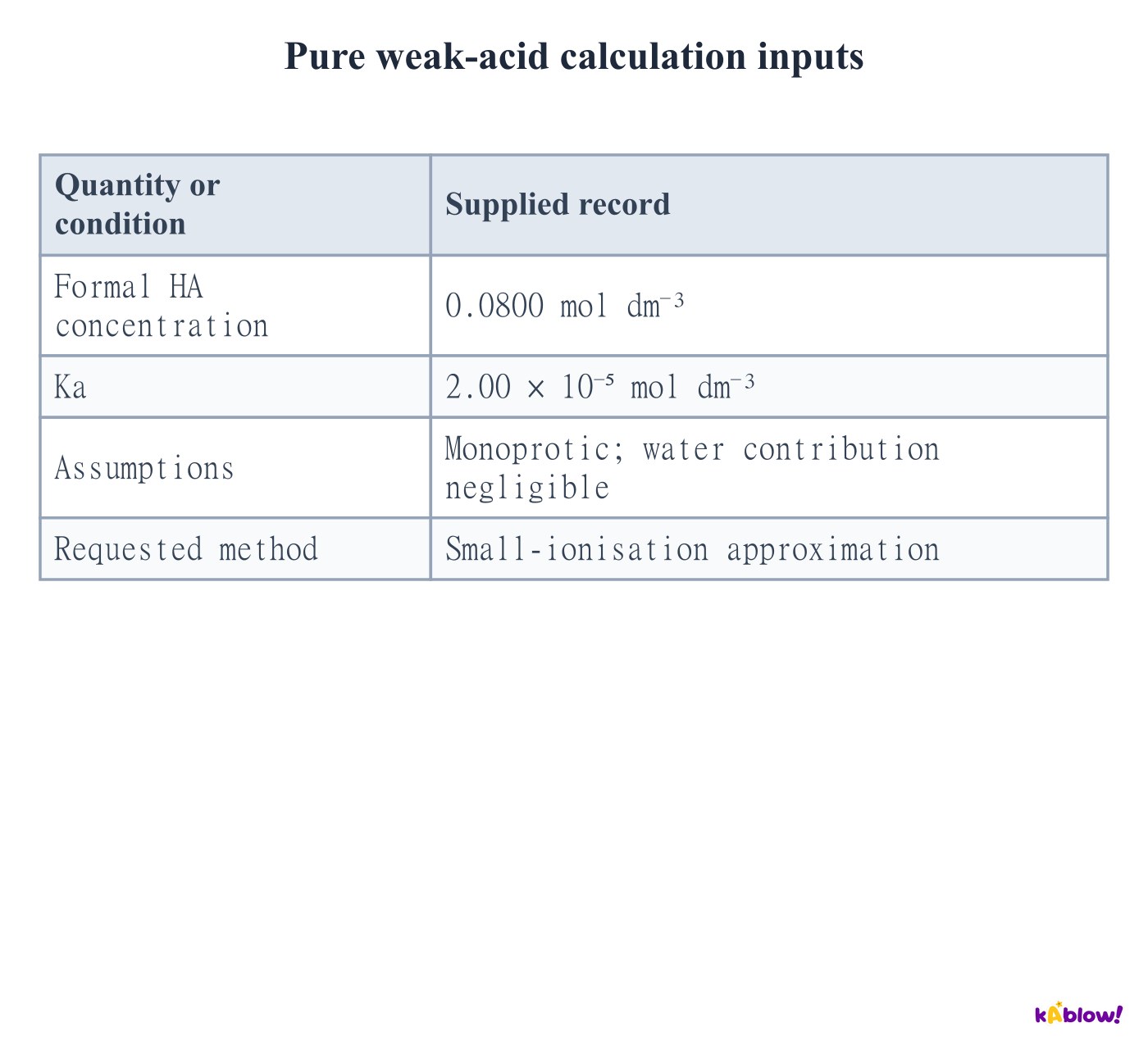
- For a pure monoprotic acid with negligible water ionisation, [H⁺]≈[A⁻]=x and [HA]=C−x. Thus Ka=x²/(C−x).
- If x is much smaller than C, use x≈√(KaC). For C=0.0800 and Ka=2.00×10⁻⁵, x≈1.265×10⁻³ mol dm⁻³.
- Then pH≈2.90 to two decimal places. Retain guard digits and check that ionisation is small before accepting the approximation.
Pure weak-acid calculation inputs
Test the small-ionisation shortcut
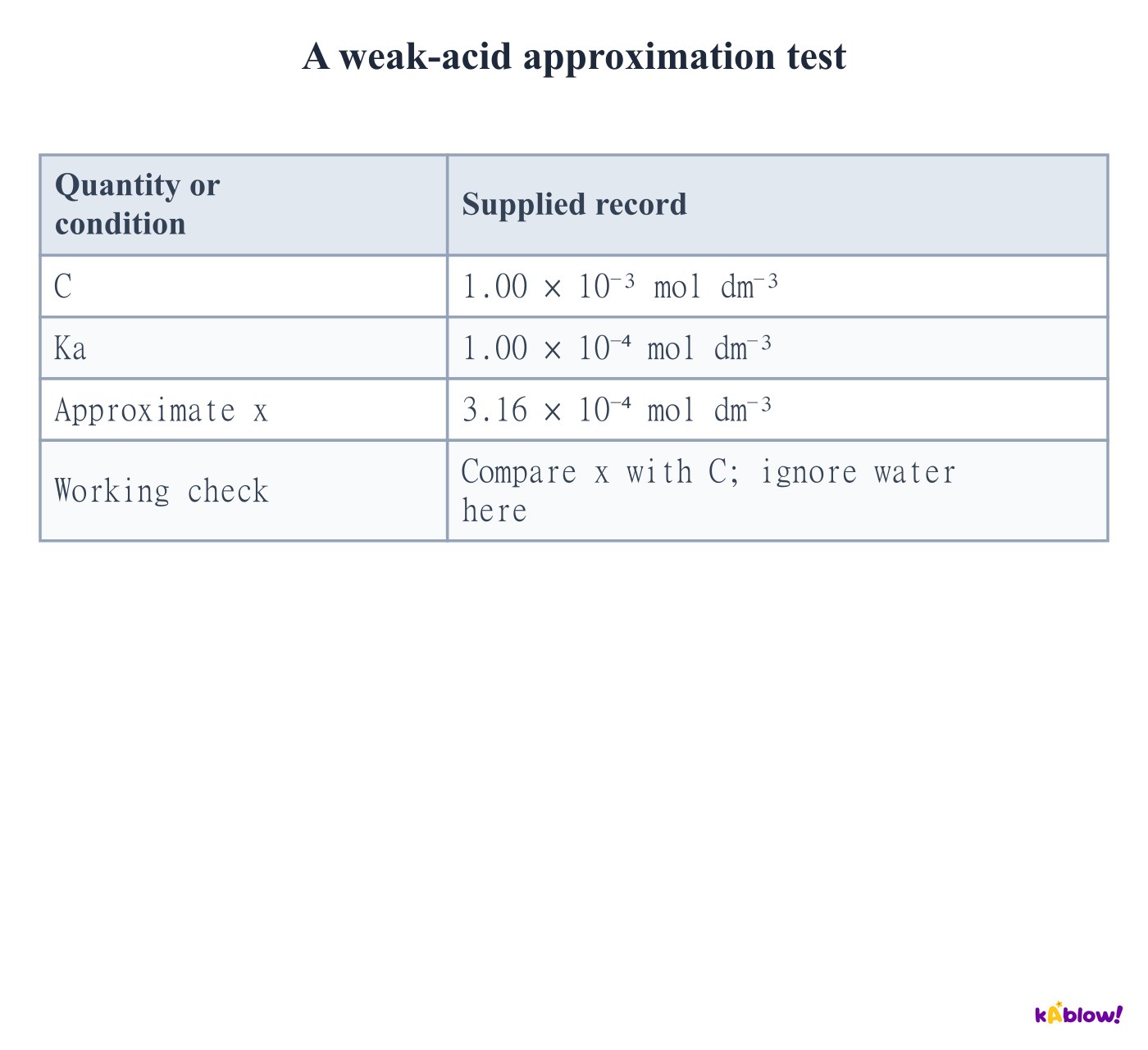
- The square-root estimate must be checked against the original acid concentration. A five-percent check is a useful stated classroom criterion, not a law of equilibrium.
- Here x/C≈0.316, or 31.6%, so replacing C−x by C is poor. Solve x²+Kax−KaC=0 instead.
- The positive root is 2.70×10⁻⁴ mol dm⁻³ and pH≈3.57. If water ionisation is also important, a fuller charge-balance treatment is needed.
A weak-acid approximation test
Find Ka from a measured pH
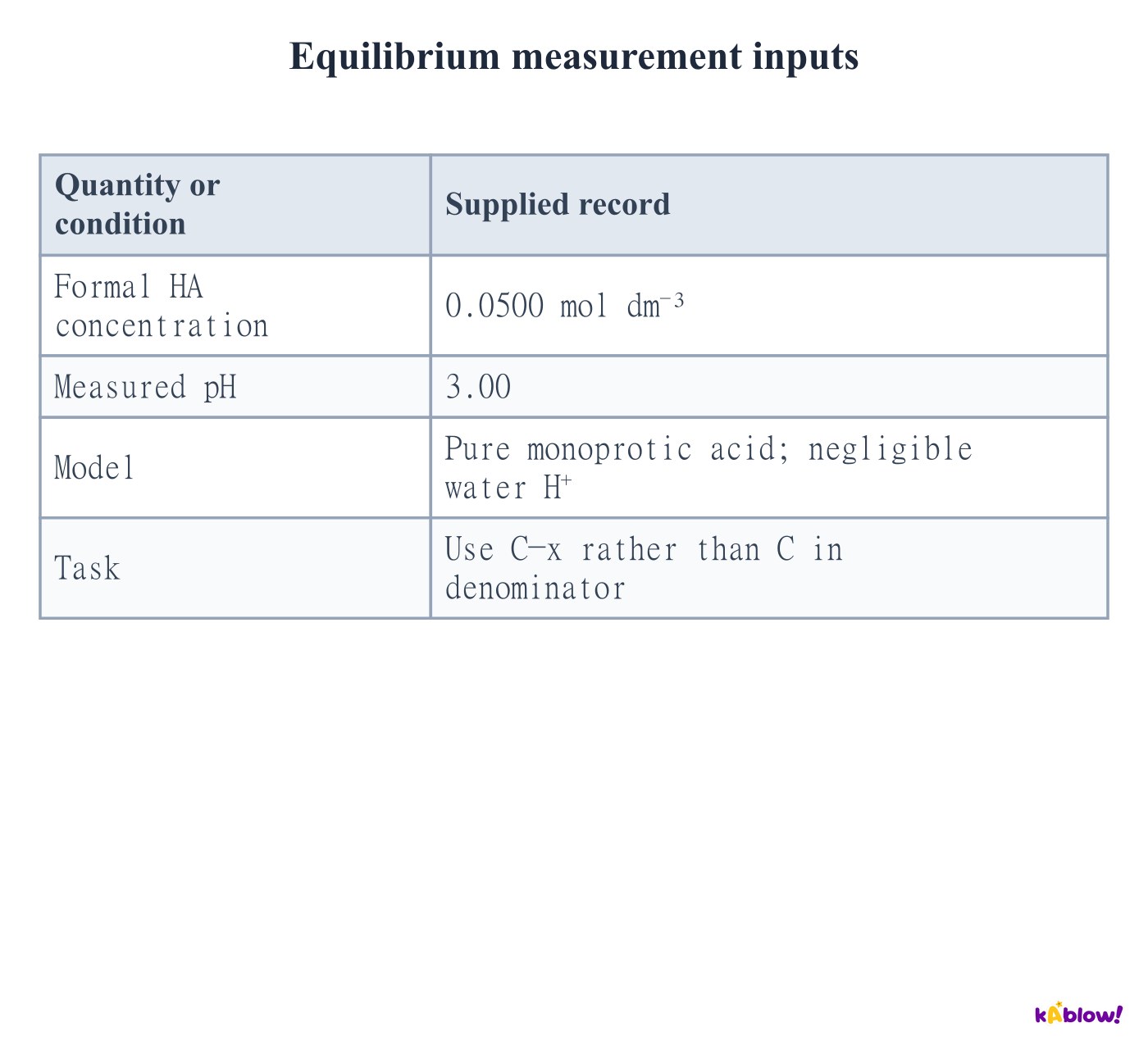
- Convert pH to [H⁺] first: pH 3.00 gives x=1.00×10⁻³ mol dm⁻³. For the specified pure-acid model, [A⁻]≈x.
- The remaining acid is 0.0500−0.00100=0.0490 mol dm⁻³. Thus Ka=x²/(C−x)=2.04×10⁻⁵ mol dm⁻³.
- Using the initial concentration in the denominator would be an approximation. Do not present an approximate denominator as the exact equilibrium concentration.
Equilibrium measurement inputs
Use pKa to compare acids
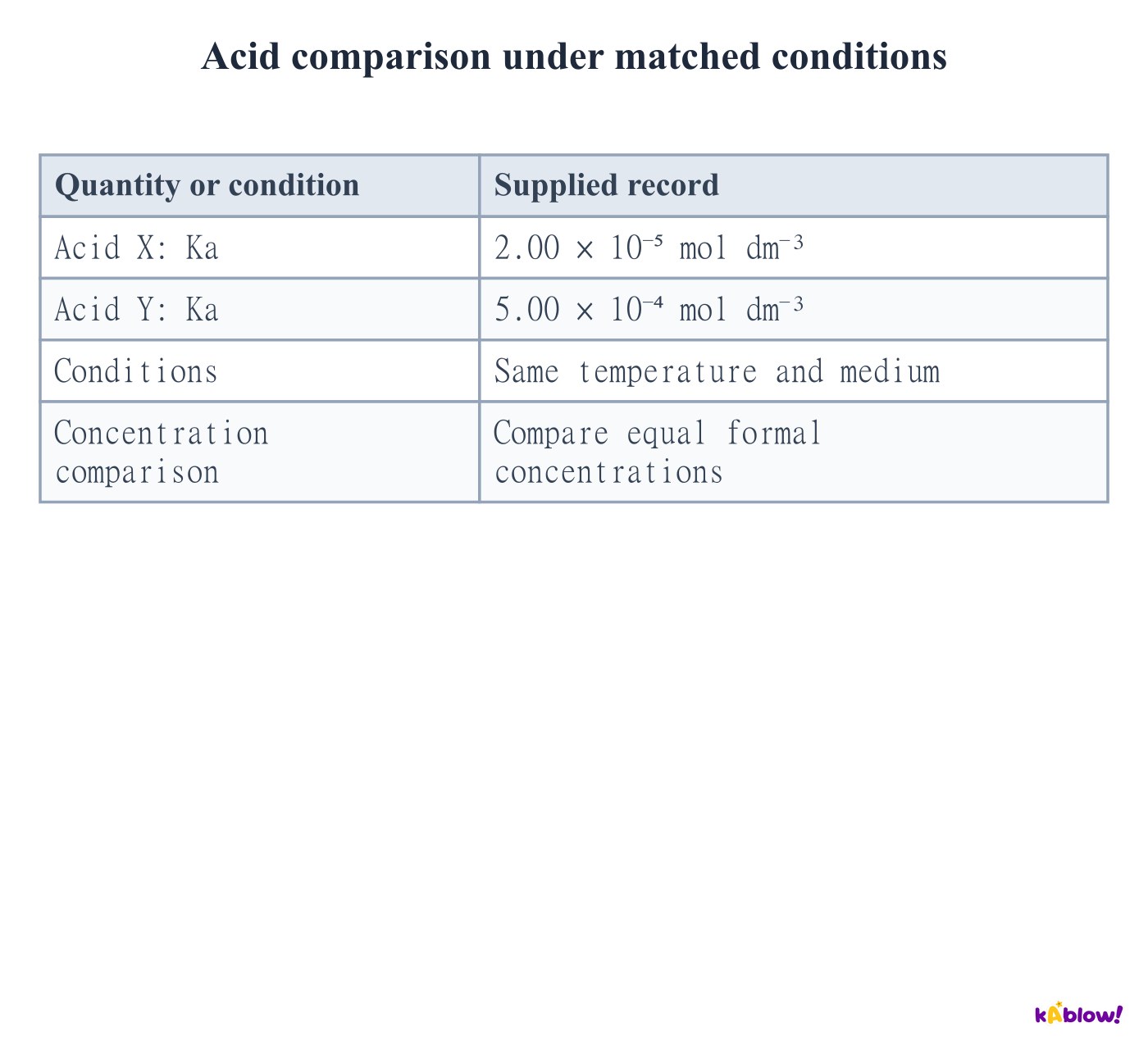
- pKa=−log₁₀Ka using the specified concentration reference convention. Ka=2.00×10⁻⁵ gives pKa=4.70 to two decimal places.
- A larger Ka corresponds to a smaller pKa and greater ionisation at matched concentration and conditions. Acid Y is stronger than acid X in this comparison.
- Dilution can increase the fraction ionised without changing Ka at fixed temperature. Weak-acid pKa values do not all lie between 3 and 7.
Acid comparison under matched conditions
Use half-neutralisation to estimate pKa
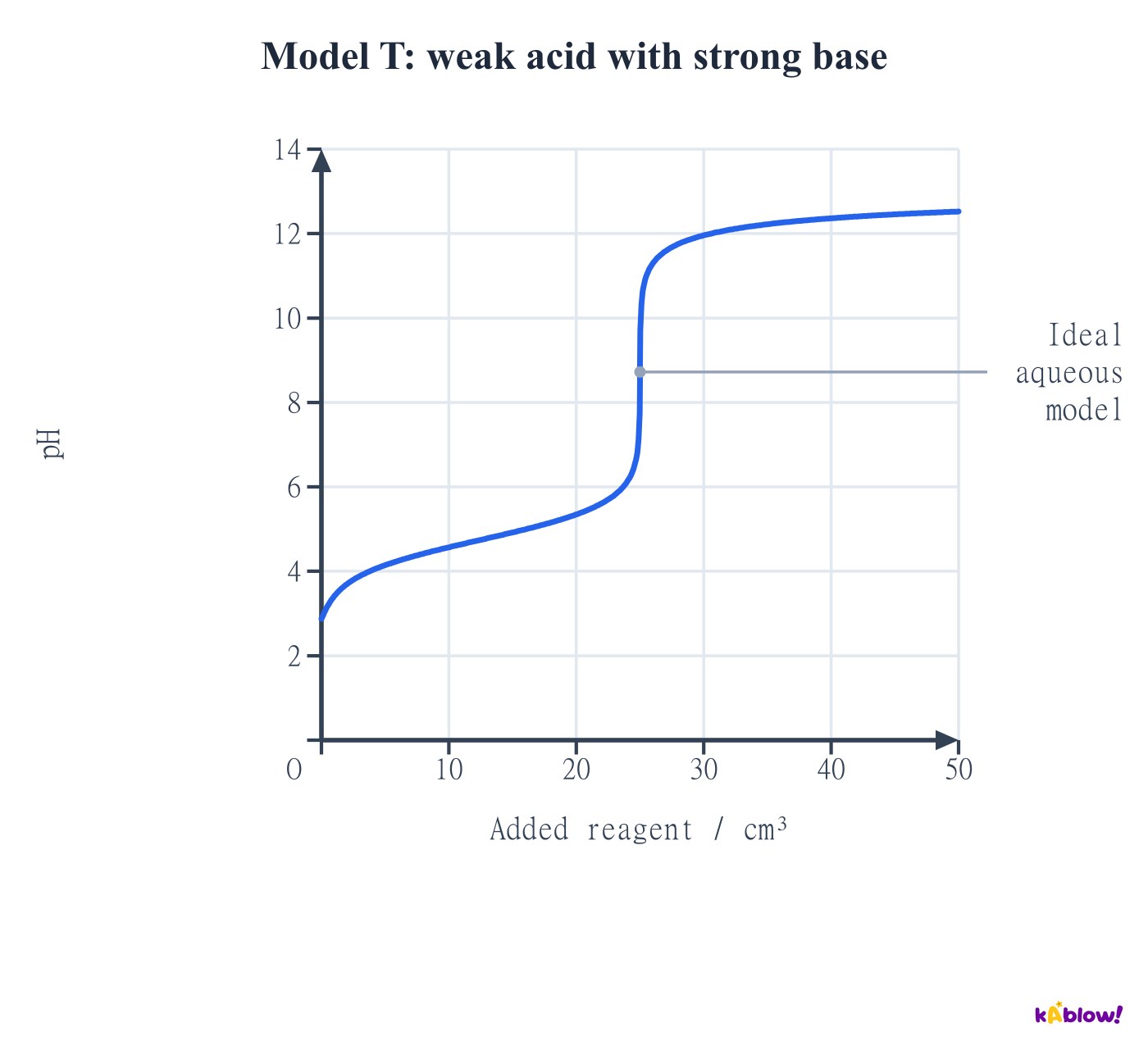
- The plotted model starts with 25.0 cm³ of 0.100 mol dm⁻³ HA and adds 0.100 mol dm⁻³ strong base; Ka=1.80×10⁻⁵ and Kw=1.00×10⁻¹⁴ at 298 K using the rounded Kw.
- Equivalence is 25.0 cm³, so half-neutralisation is 12.5 cm³. With appreciable HA and A⁻ and small equilibrium corrections, their concentrations are approximately equal and pH≈pKa≈4.74.
- Read pH at half the equivalence volume, then calculate Ka≈10^(−pH). The graph includes water and equilibrium shifts, so formal half-neutralisation does not assert exact equality of all equilibrium species.
Model T: weak acid with strong base
Calculate concentration from a titre
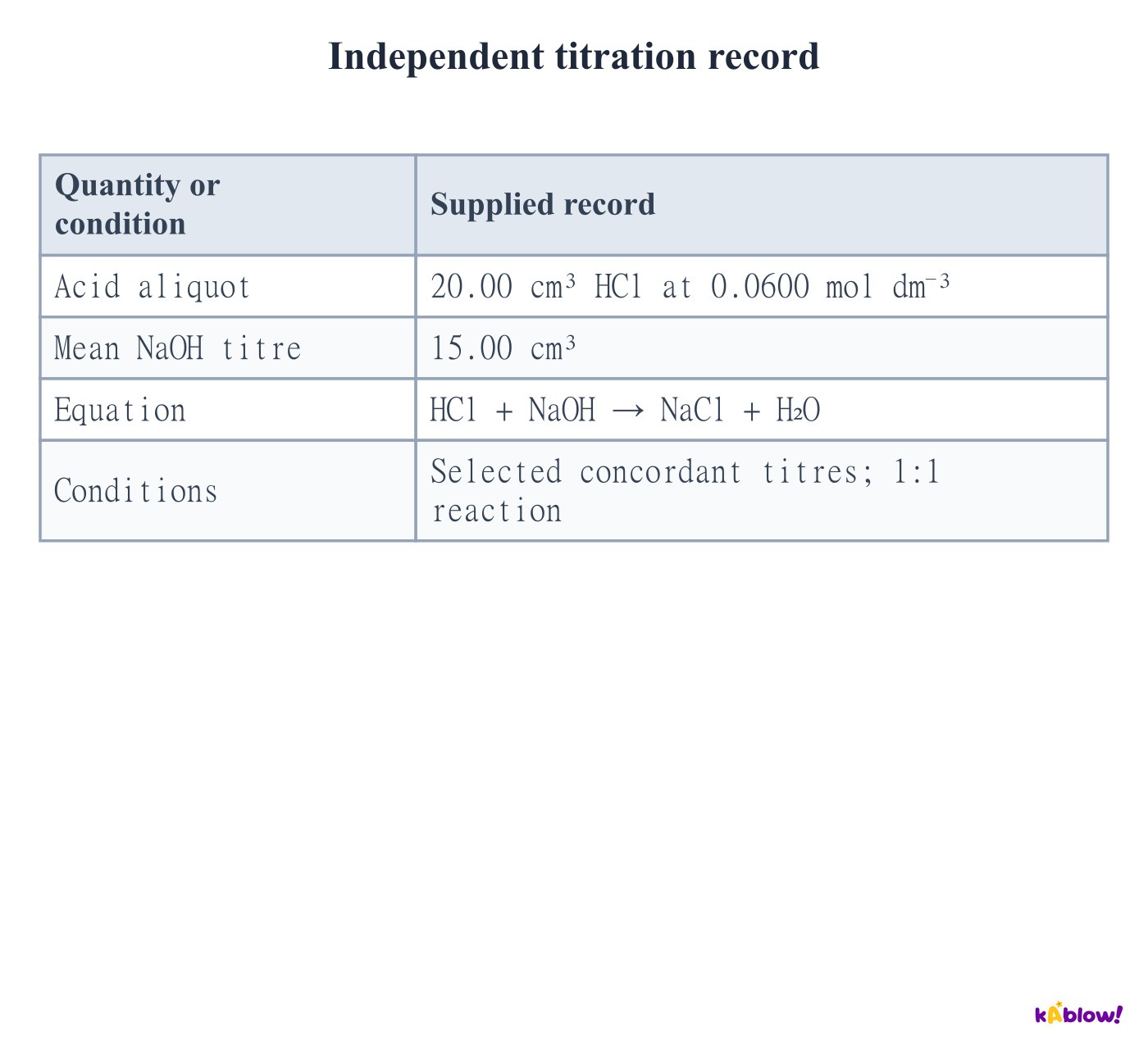
- Convert the acid volume to dm³: n(HCl)=0.0600×0.02000=1.20×10⁻³ mol. The equation gives the same amount of NaOH.
- Divide by the delivered base volume in dm³: C(NaOH)=0.00120/0.01500=0.0800 mol dm⁻³.
- Use the balanced equation rather than assuming every titration is 1:1. Diprotic neutralisation can require two moles of OH⁻ per mole of acid.
Independent titration record
Find pH after a strong reagent is in excess
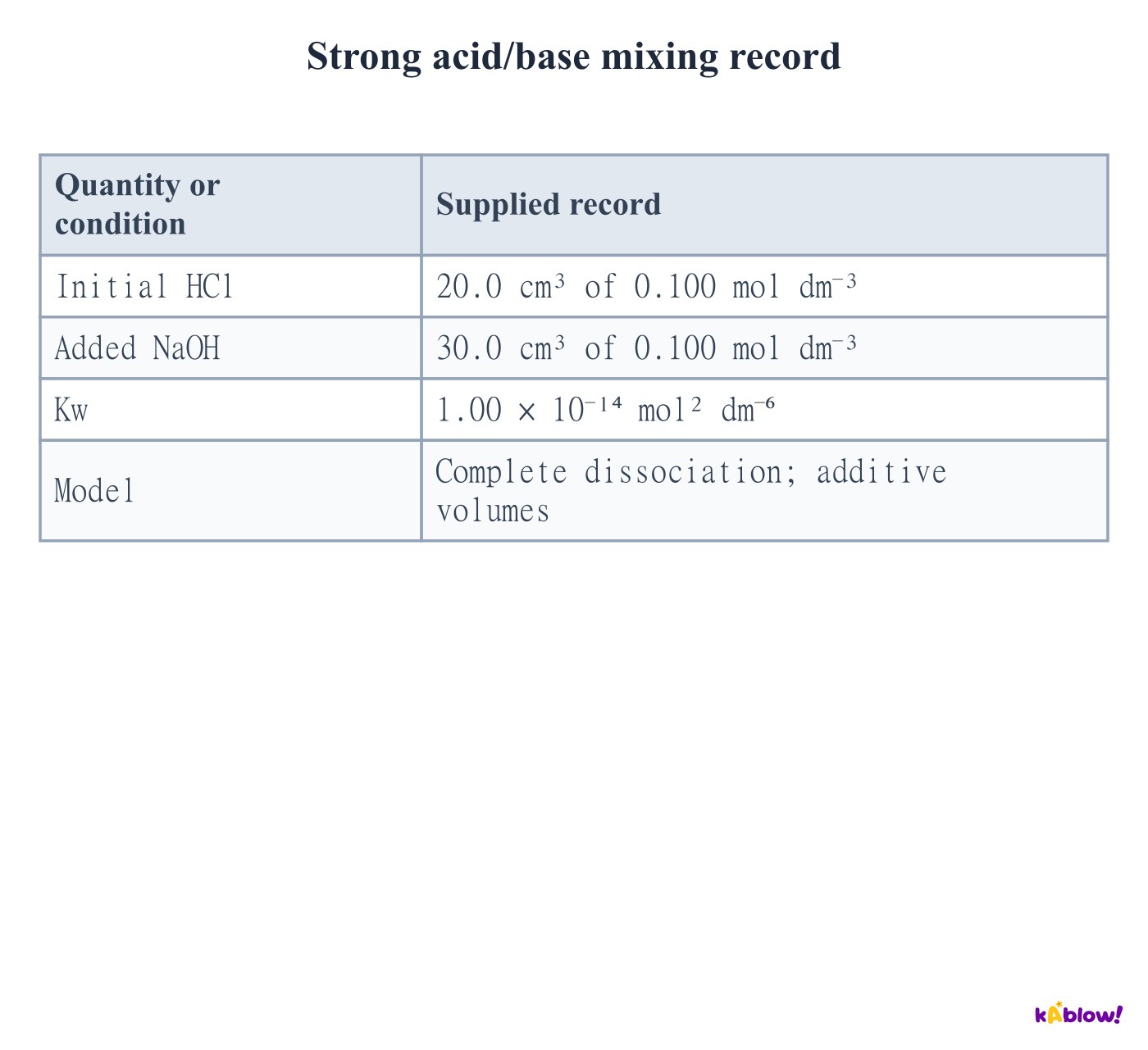
- Neutralise amounts first: acid supplies 2.00 mmol and base supplies 3.00 mmol. There is 1.00 mmol of excess hydroxide.
- Use the total 50.0 cm³ volume, giving [OH⁻]≈0.0200 mol dm⁻³. Then pH=pKw+log₁₀[OH⁻]=12.30.
- Before equivalence, excess strong acid controls pH; after equivalence, excess strong base controls it. At equivalence use the appropriate water or salt equilibrium.
Strong acid/base mixing record
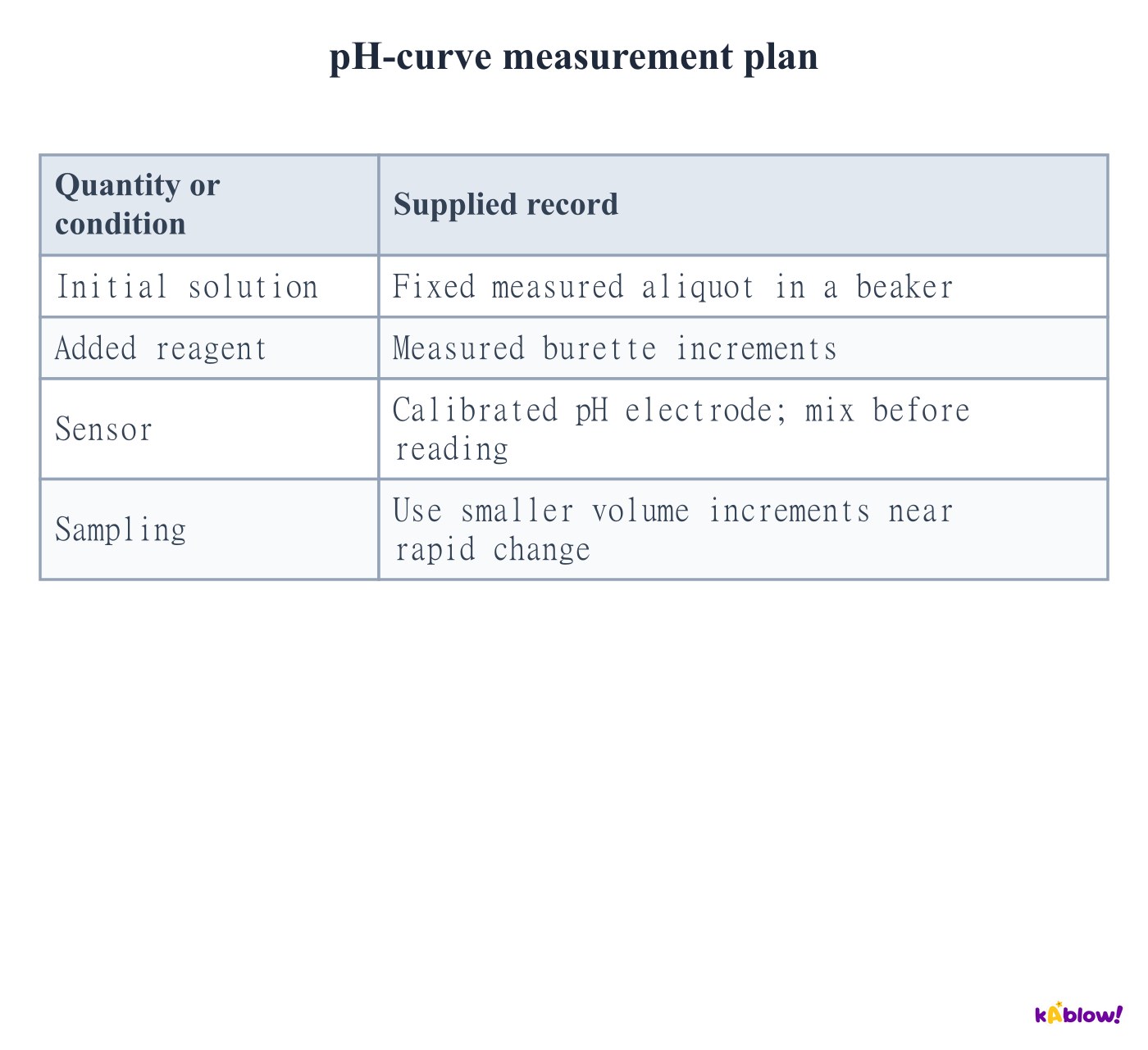
Measure a pH curve in required practical 9
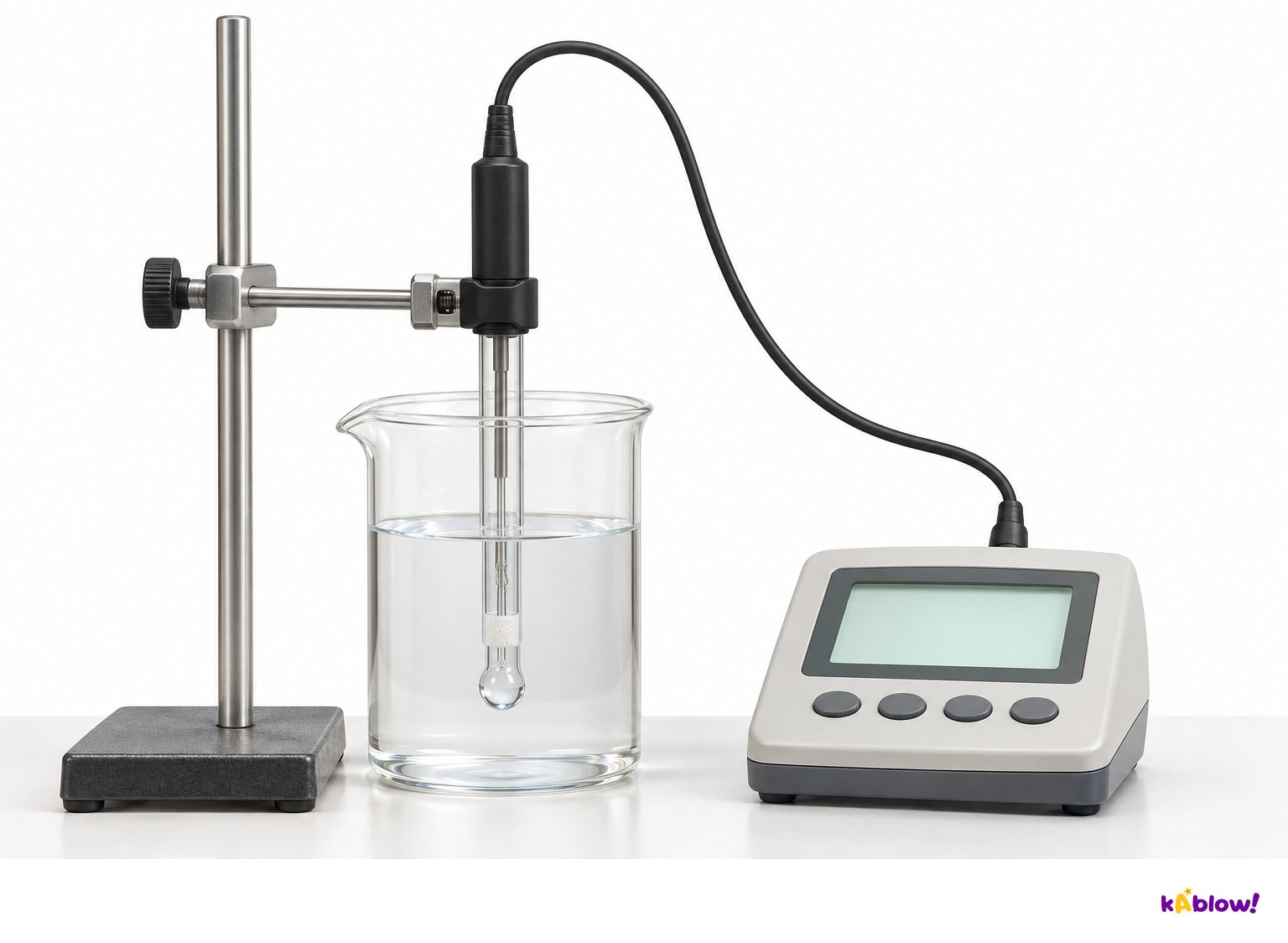
- Transfer a fixed aliquot using suitable volumetric apparatus and record the initial pH with a calibrated probe. Keep the sensing region immersed without striking the glass base.
- Add measured reagent increments from a rinsed burette, mix and wait for stable readings. Use smaller increments around the rapid pH change.
- Plot pH against cumulative added volume. Remove the filling funnel before readings, avoid a jet air bubble, read the meniscus at eye level and follow the specified eye-protection and handling procedure.
pH-curve measurement plan
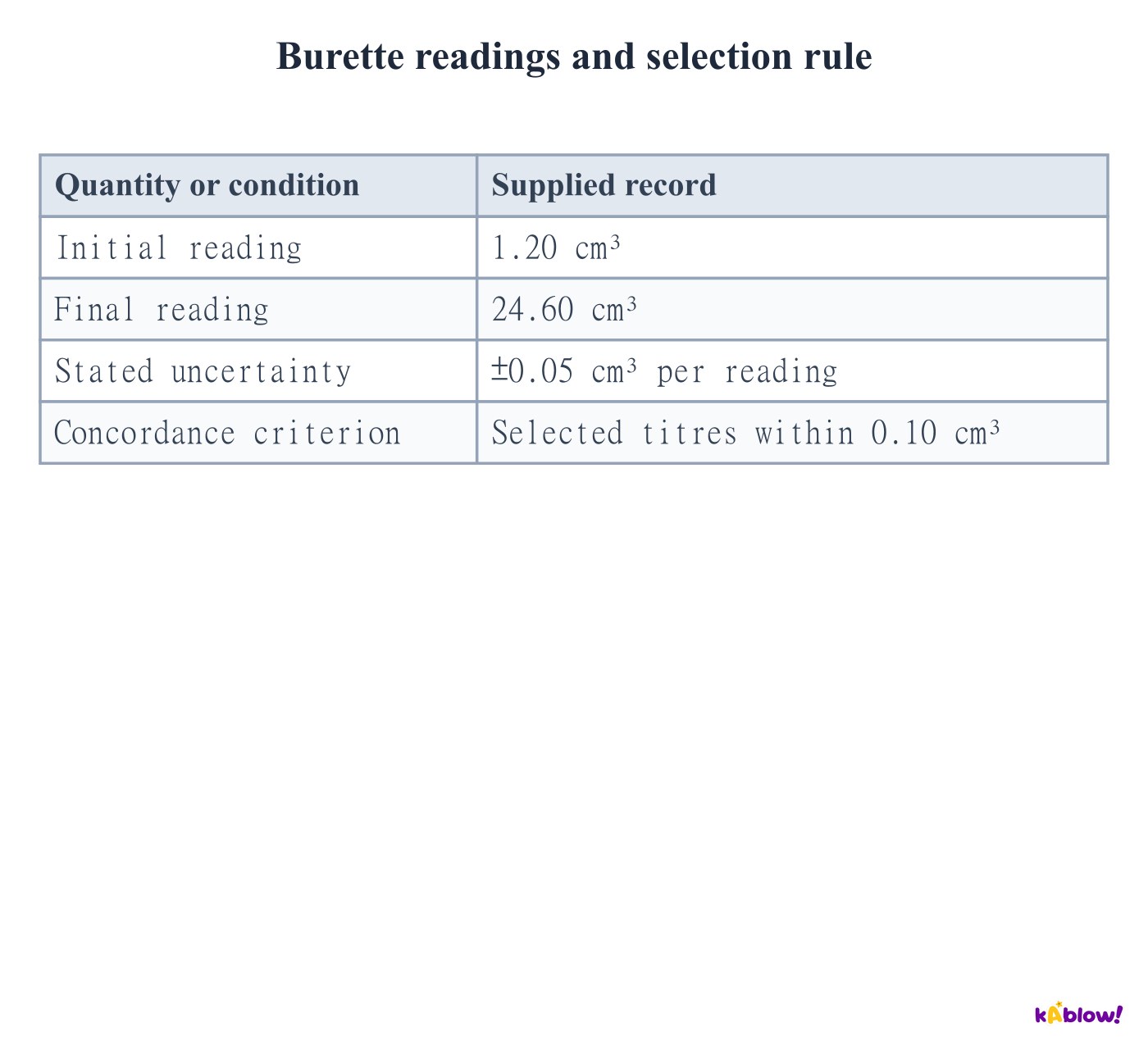
Treat titres and uncertainty consistently
- The titre is final minus initial reading: 24.60−1.20=23.40 cm³. It is a delivered volume, not the final burette reading alone.
- With ±0.05 cm³ per reading, the worst-case absolute titre uncertainty is ±0.10 cm³. The corresponding percentage is about 0.43%.
- Use the stated concordance rule to select repeat results before averaging; exclude the rough trial. Instrument uncertainty and the permitted spread between repeats are different quantities.
Burette readings and selection rule
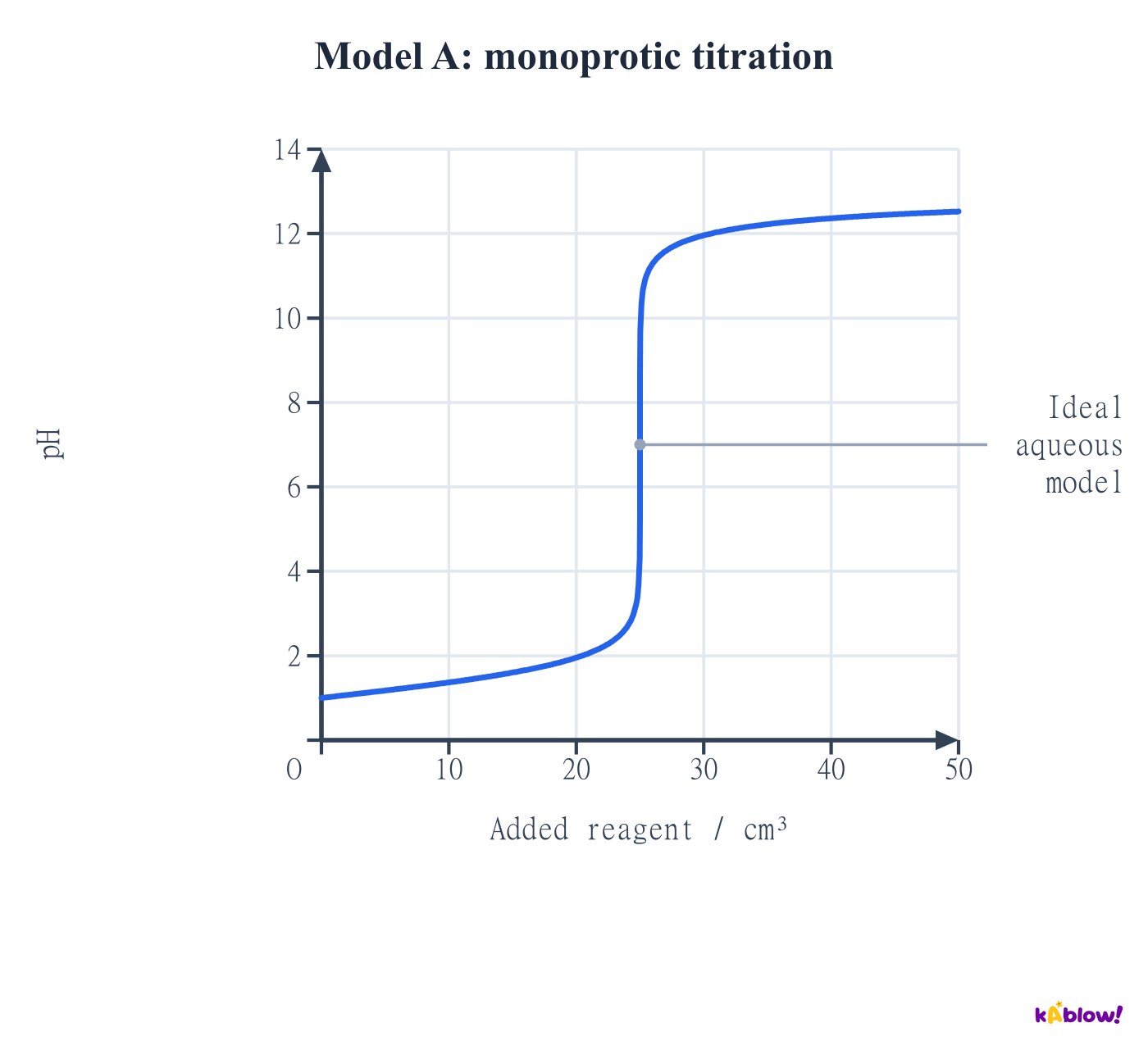
Interpret a strong-acid/strong-base curve
- Model A starts with 25.0 cm³ of 0.100 mol dm⁻³ strong monoprotic acid and adds 0.100 mol dm⁻³ strong base; Kw=1.00×10⁻¹⁴ at 298 K.
- The equivalence volume is 25.0 cm³. With inert salt ions, [H⁺]=[OH⁻] there and the specified neutral pH is 7.00.
- The model solves water ionisation continuously through equivalence. Neutrality is not universally pH 7 at other temperatures, and the vertical region depends on concentration.
Model A: monoprotic titration
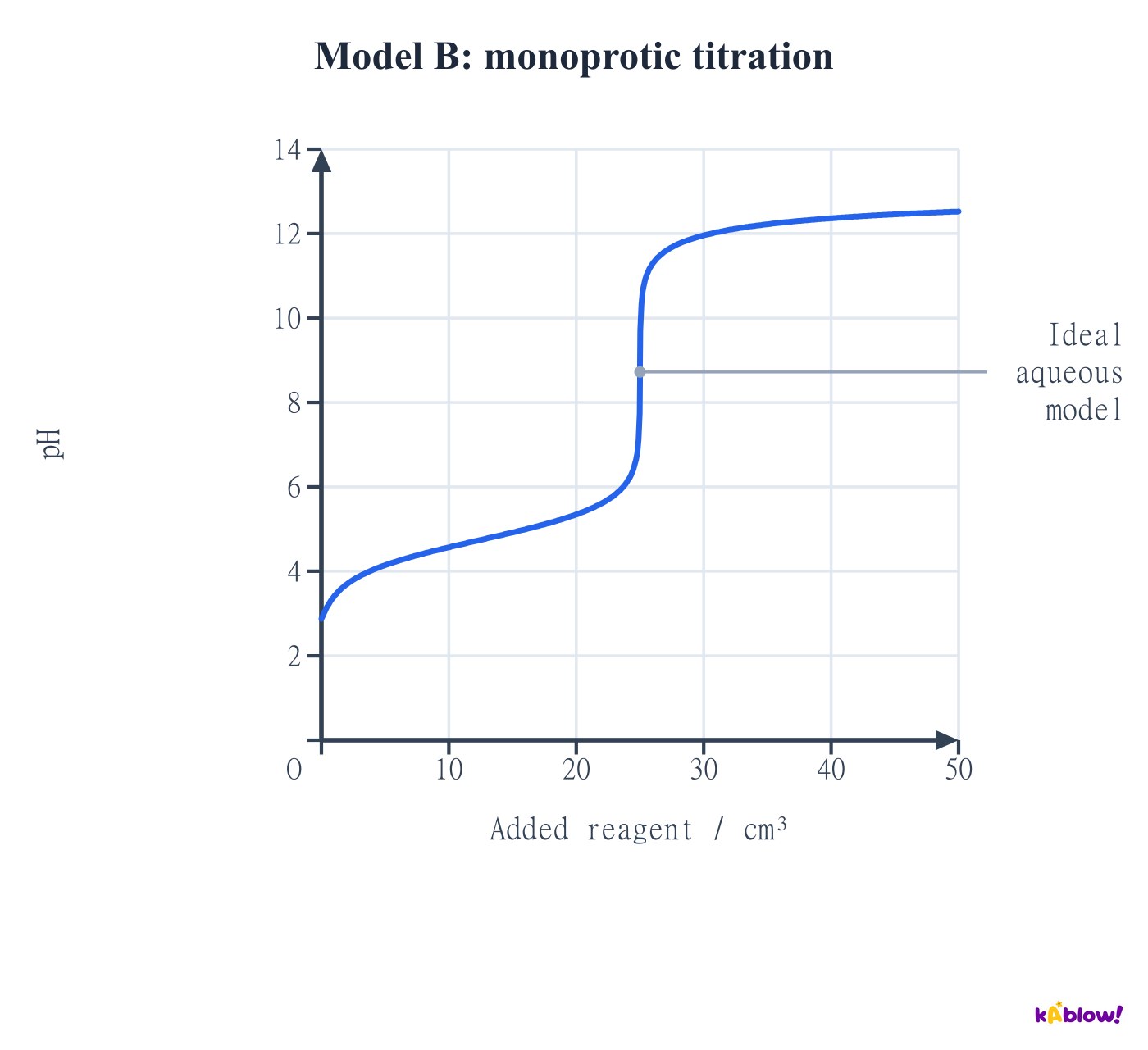
Explain weak-acid/strong-base equivalence
- Model B uses the same 25.0 cm³ and 0.100 mol dm⁻³ reagents, with HA Ka=1.80×10⁻⁵, a strong base and Kw=1.00×10⁻¹⁴.
- Before equivalence, HA and A⁻ form a buffer region. At equivalence the conjugate base hydrolyses: A⁻+H₂O⇌HA+OH⁻.
- The equivalence solution is alkaline, about pH 8.72 in this model. Stoichiometric equivalence does not mean every equilibrium molecule of HA has disappeared.
Model B: monoprotic titration
Explain strong-acid/weak-base equivalence
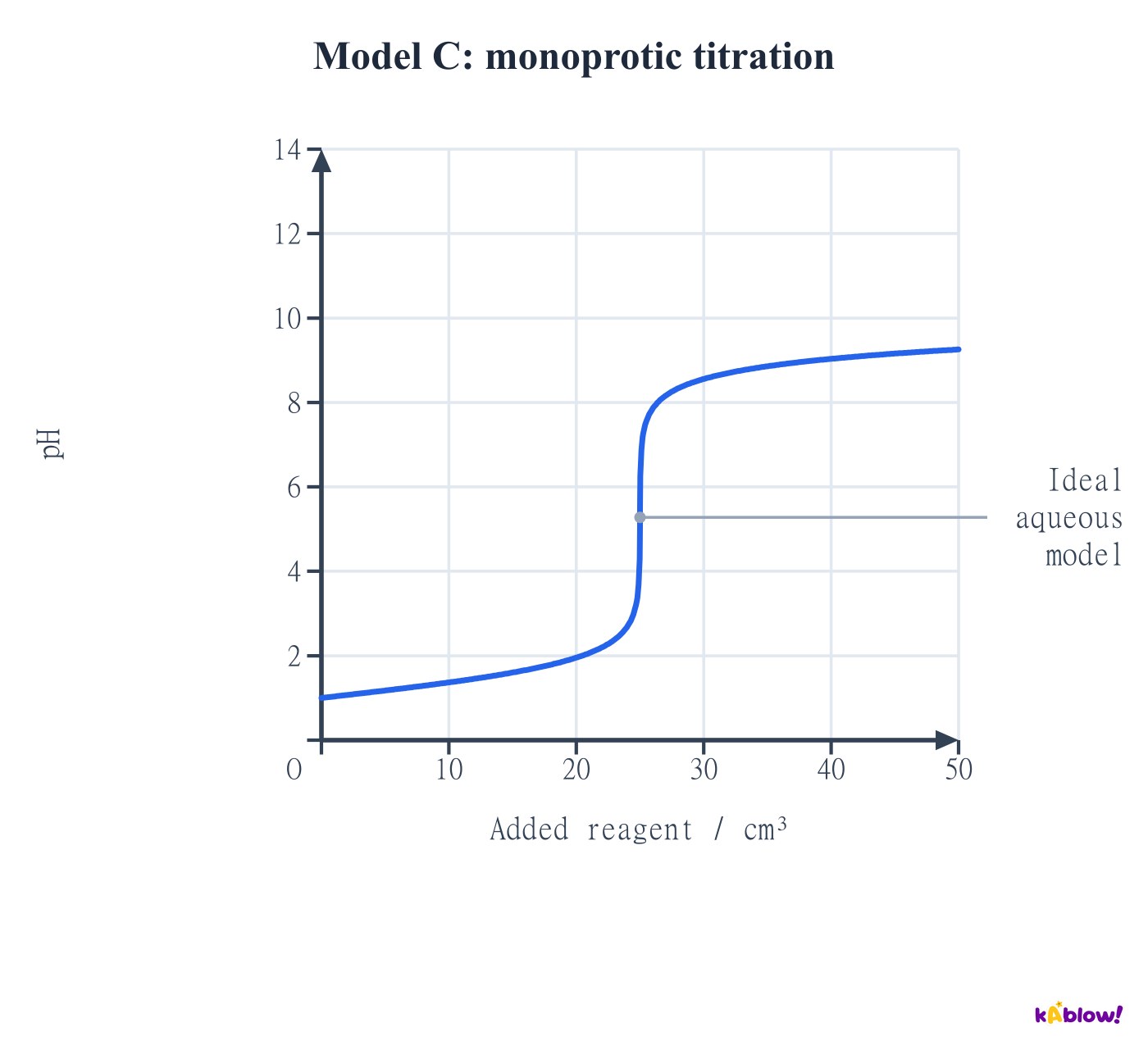
- Model C uses a strong monoprotic acid and a weak base with Kb=1.80×10⁻⁵; initial and added reagent concentrations are 0.100 mol dm⁻³, with 25.0 cm³ initially and Kw=1.00×10⁻¹⁴.
- At equivalence the weak base’s conjugate acid reacts with water: BH⁺+H₂O⇌B+H₃O⁺. The equivalence pH is about 5.28 in this model.
- Beyond equivalence the excess weak base does not follow [OH⁻]=its formal concentration. Its ionisation equilibrium must still be considered.
Model C: monoprotic titration
Evaluate a weak-acid/weak-base curve
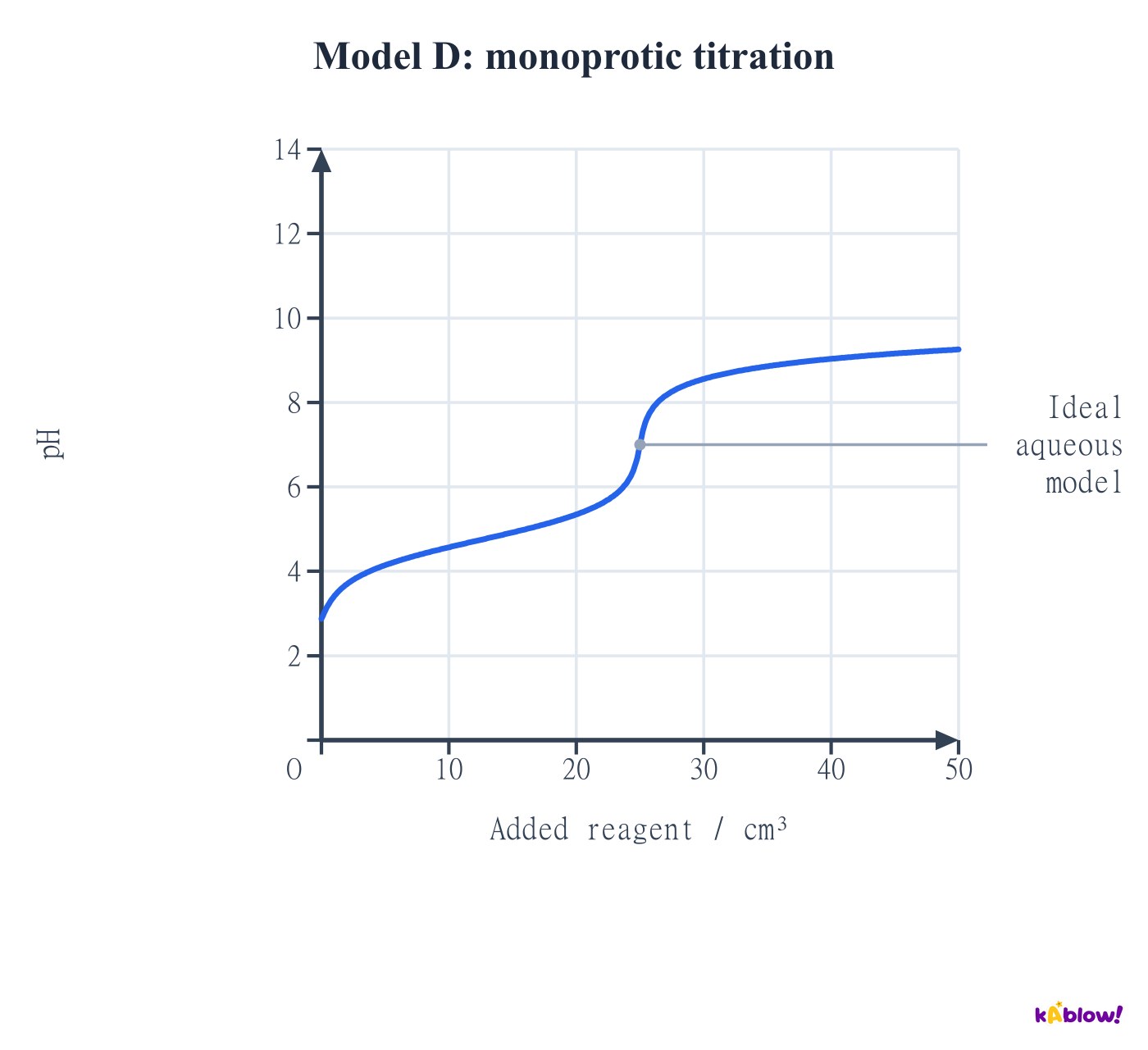
- Model D has 25.0 cm³ of 0.100 mol dm⁻³ weak acid and adds 0.100 mol dm⁻³ weak base, with Ka=Kb=1.80×10⁻⁵ and Kw=1.00×10⁻¹⁴.
- Both conjugate partners participate in equilibrium. Matching Ka and Kb gives neutral equivalence here; unequal constants can give acidic or alkaline equivalence.
- This curve has a gradual transition, so a simple colour indicator gives a poorly defined endpoint for this example. A weak/weak titration does not universally have a sharp vertical step.
Model D: monoprotic titration
Read the addition direction before interpreting a curve
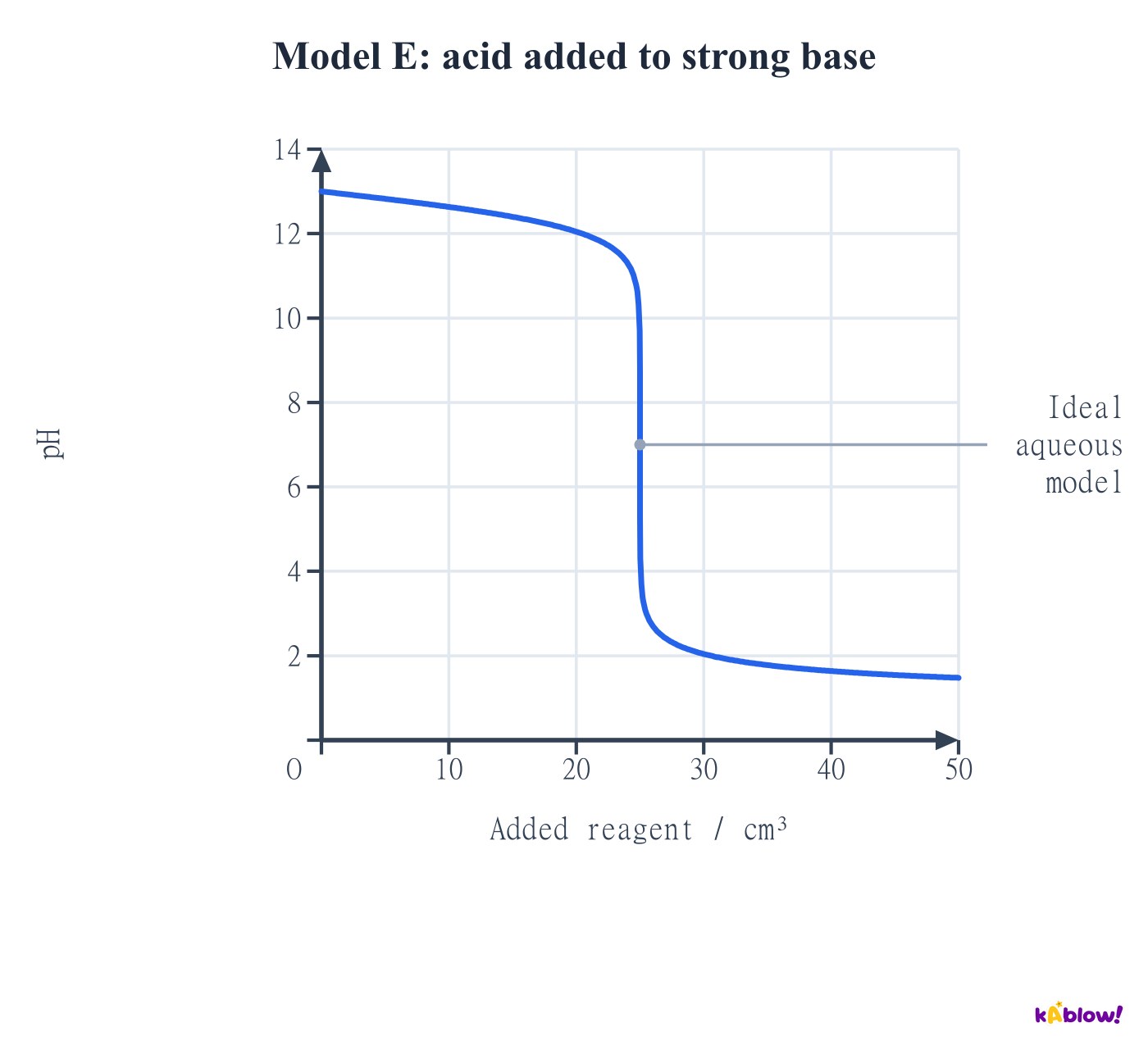
- Model E starts with 25.0 cm³ of 0.100 mol dm⁻³ strong base and adds 0.100 mol dm⁻³ strong acid; Kw=1.00×10⁻¹⁴.
- The x axis still records added volume, but the pH falls as acid is added. The initial reagent and addition direction determine which excess species is present.
- Do not mechanically reflect arbitrary weak/strong curves. Recalculate diluted totals and equilibrium for the stated reagents and concentrations.
Model E: acid added to strong base
Explain an indicator colour transition
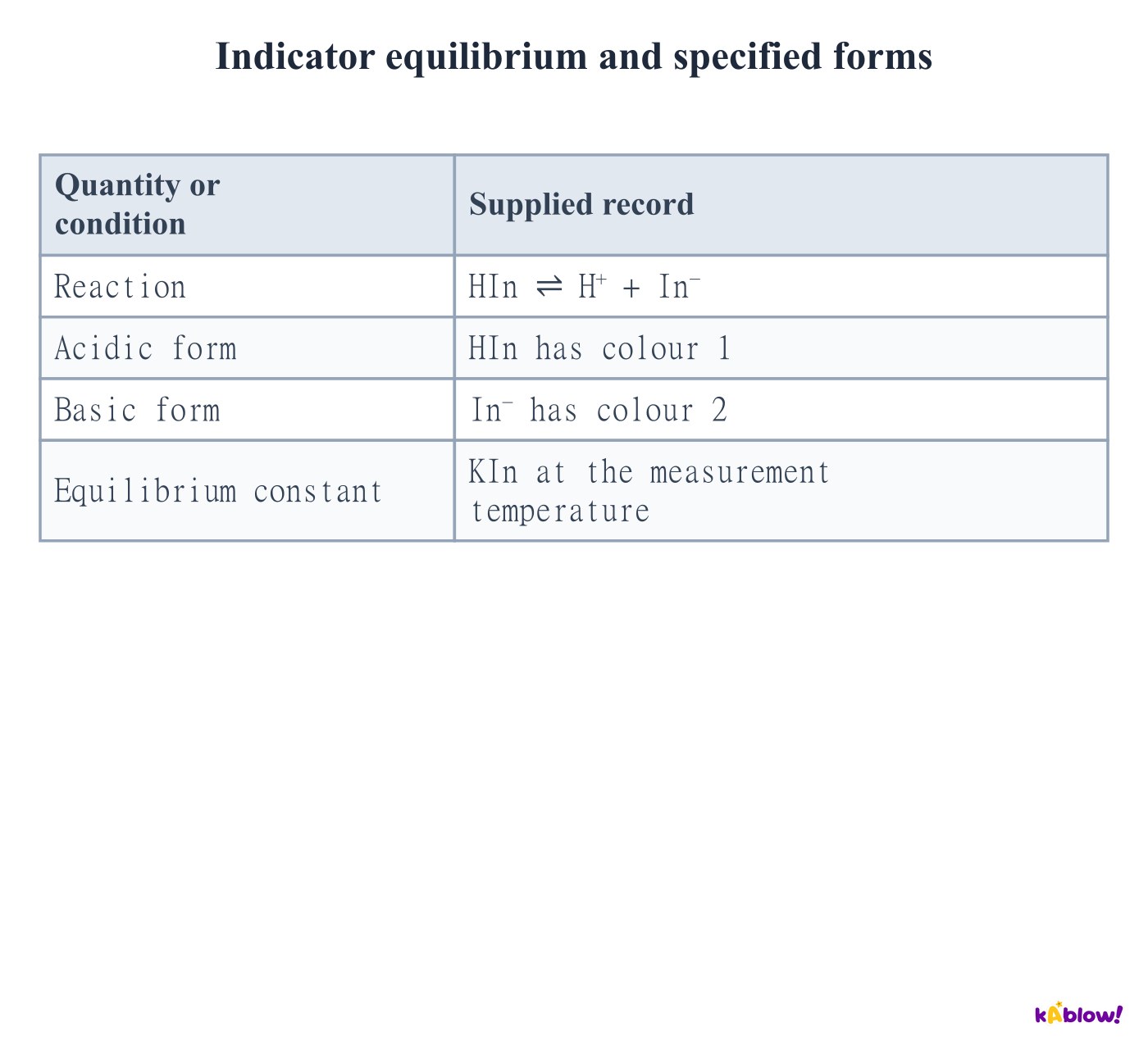
- An acid–base indicator has differently coloured conjugate forms. In the stated model HIn⇌H⁺+In⁻, increasing acidity favours HIn.
- At equal equilibrium concentrations of the two forms, pH=pKIn in the dilute model. A visible endpoint need not occur at exactly equal form concentrations.
- The observed colour changes over a range because the form ratio changes continuously. The endpoint is the chosen experimental colour change; equivalence is the stoichiometric point.
Indicator equilibrium and specified forms
Choose an indicator from the actual curve
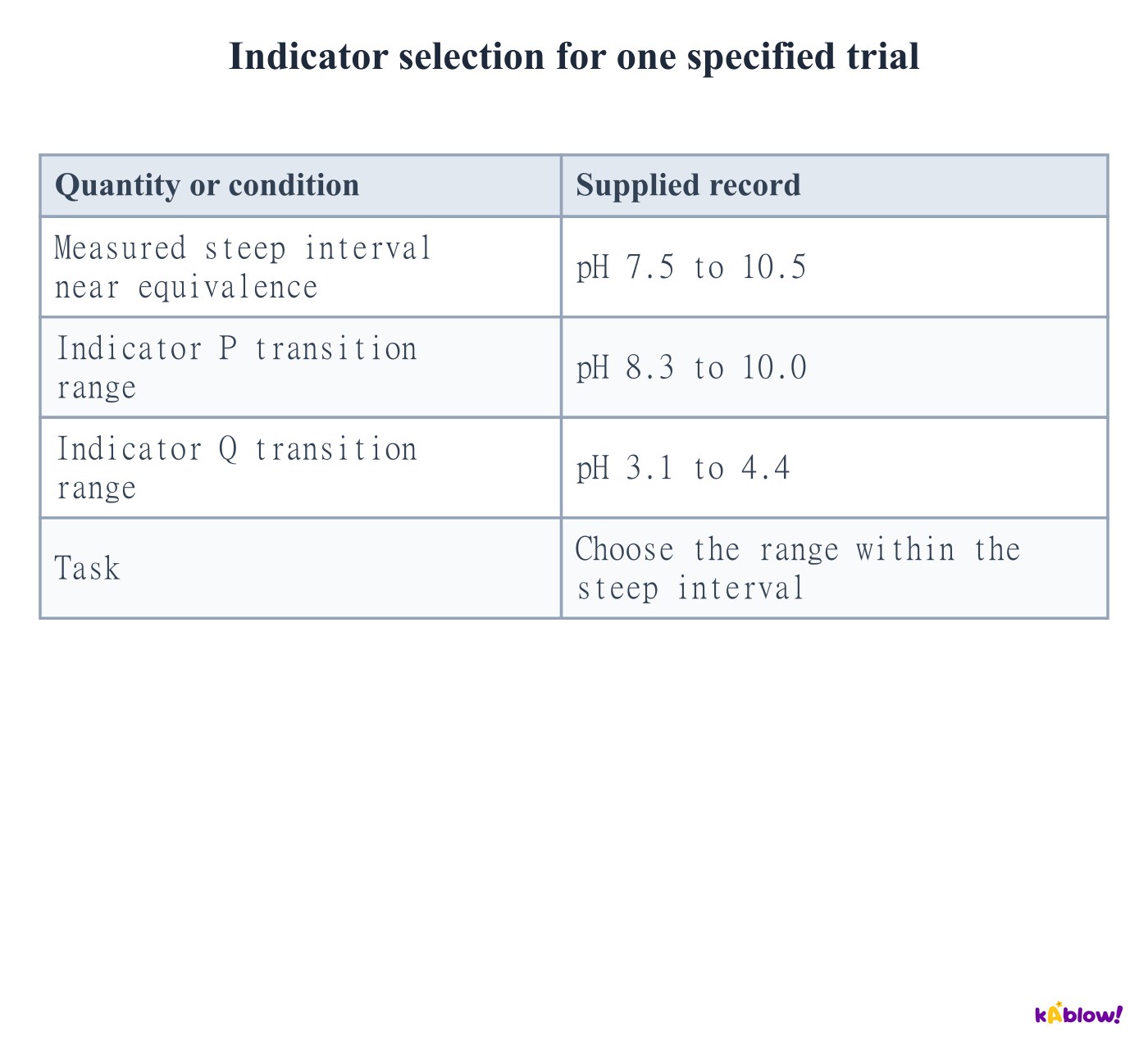
- Compare the indicator’s transition range with the steep pH region around equivalence for the actual titration. The supplied example supports indicator P.
- A transition inside this region changes colour over a small delivered volume, reducing endpoint error. Universal rules such as every steep region being pH 4–10 are unreliable.
- Phenolphthalein often suits a weak-acid/strong-base titration at suitable concentrations. Acidic-range indicators can suit a strong-acid/weak-base example; use the supplied curve and range.
Indicator selection for one specified trial
Recognise the components of a buffer
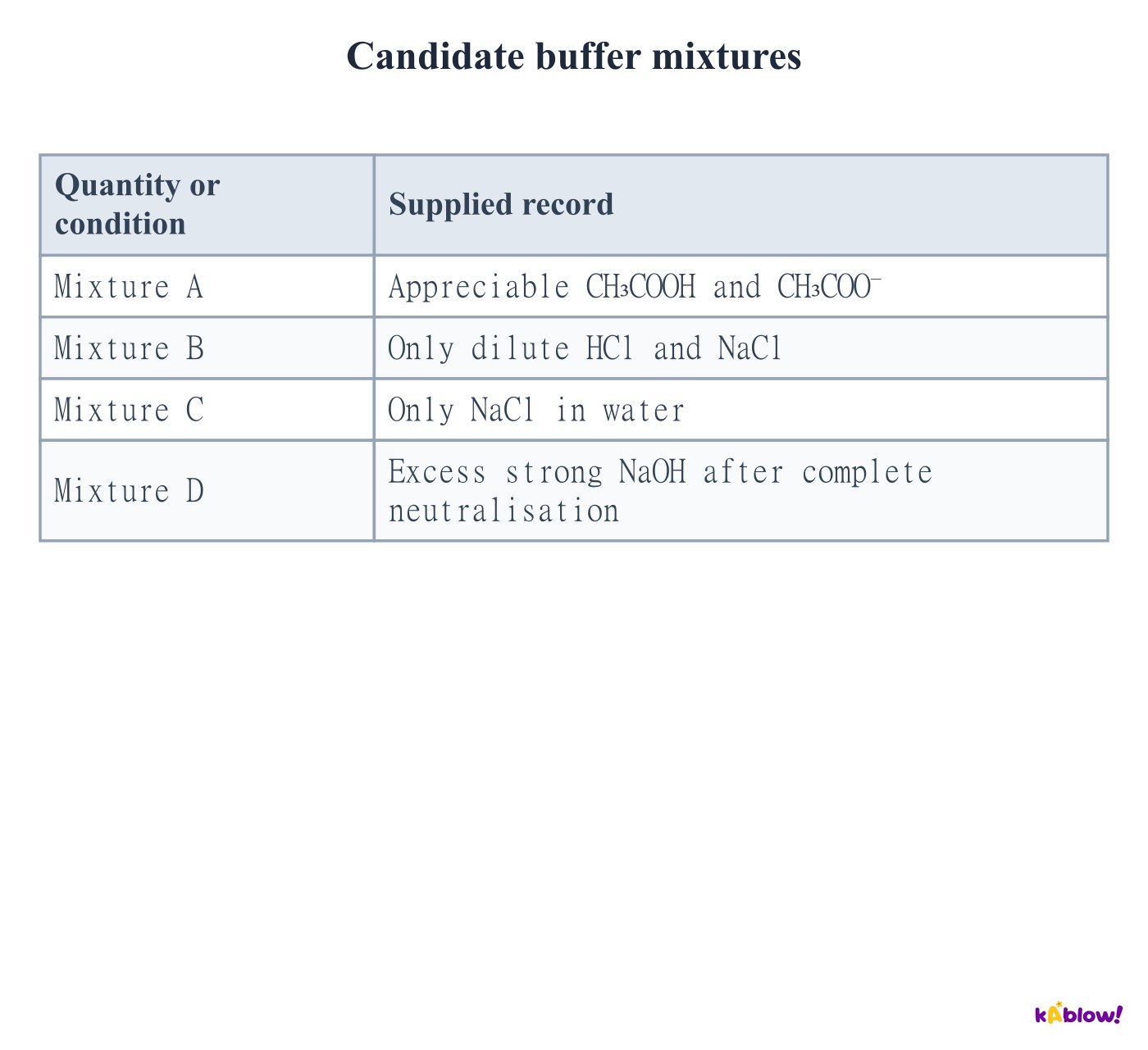
- A buffer resists large pH changes when small quantities of acid or alkali are added. An acidic buffer contains appreciable weak acid and its conjugate base.
- Ethanoic acid and soluble ethanoate supply CH₃COOH/CH₃COO⁻. A strong acid plus its inert salt is not the same kind of buffer.
- There must be enough of each component to consume the intended addition. The statement pH remains exactly constant overclaims what a buffer can do.
Candidate buffer mixtures
Write both acidic-buffer reactions
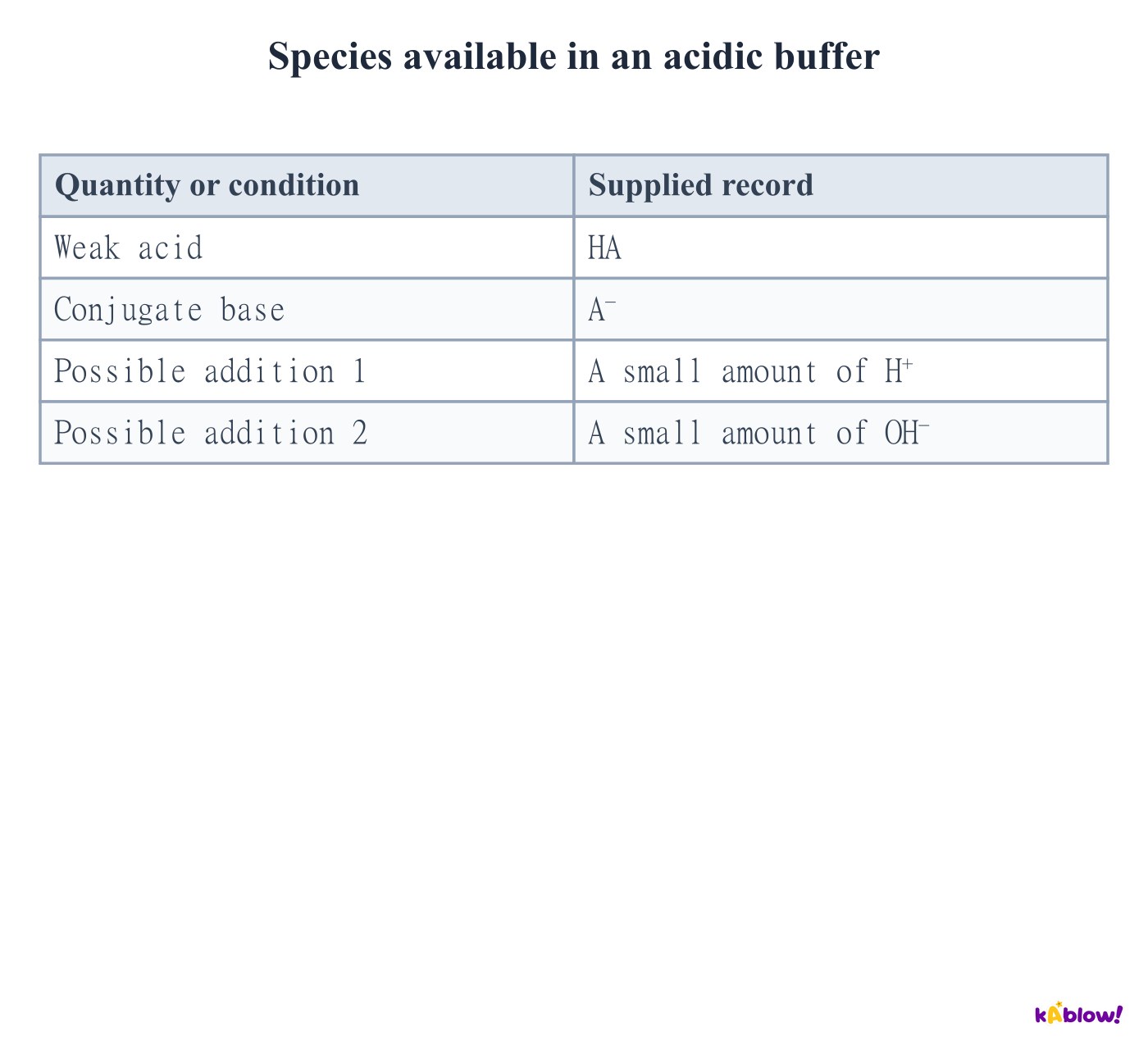
- Added acid is consumed mainly by the conjugate base: A⁻+H⁺→HA. Added alkali is consumed by the weak acid: HA+OH⁻→A⁻+H₂O.
- Both net equations conserve atoms and charge. Do not add an extra H⁺ to the products of the hydroxide reaction.
- The component ratio changes slightly, so the pH changes slightly. Appreciable reserves of both partners explain the limited response.
Species available in an acidic buffer
Explain a basic buffer without inventing hydroxide in the salt
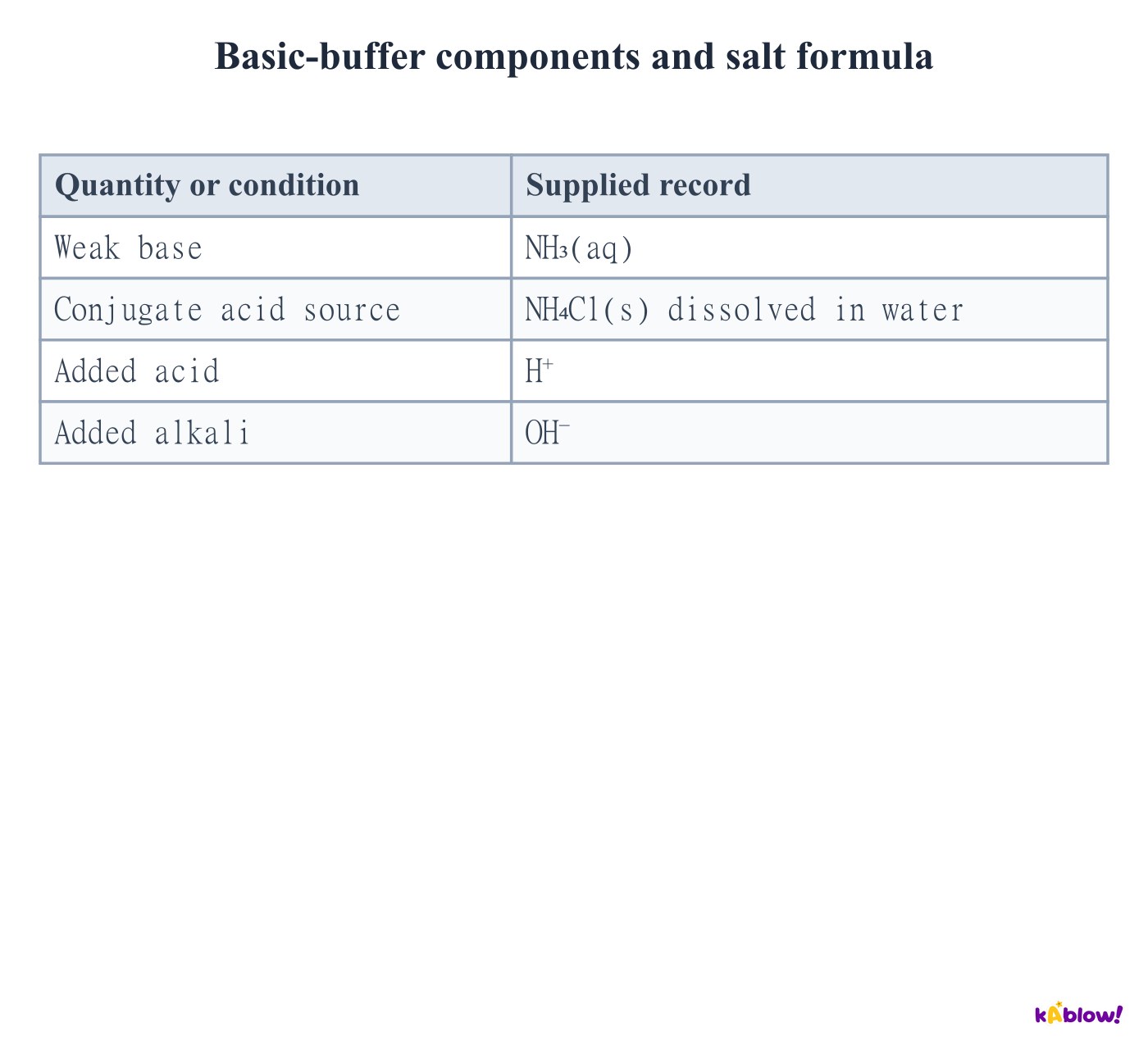
- An NH₃/NH₄⁺ mixture is a basic buffer under appropriate conditions. NH₄Cl dissolves into NH₄⁺ and Cl⁻; it does not dissociate into NH₄⁺ and OH⁻.
- Added acid reacts with ammonia: NH₃+H⁺→NH₄⁺. Added hydroxide reacts with ammonium: NH₄⁺+OH⁻→NH₃+H₂O.
- The chloride is a spectator in these net proton-transfer reactions. Distinguish salt dissolution from weak-base equilibrium with water.
Basic-buffer components and salt formula
Calculate buffer pH with the correct ratio
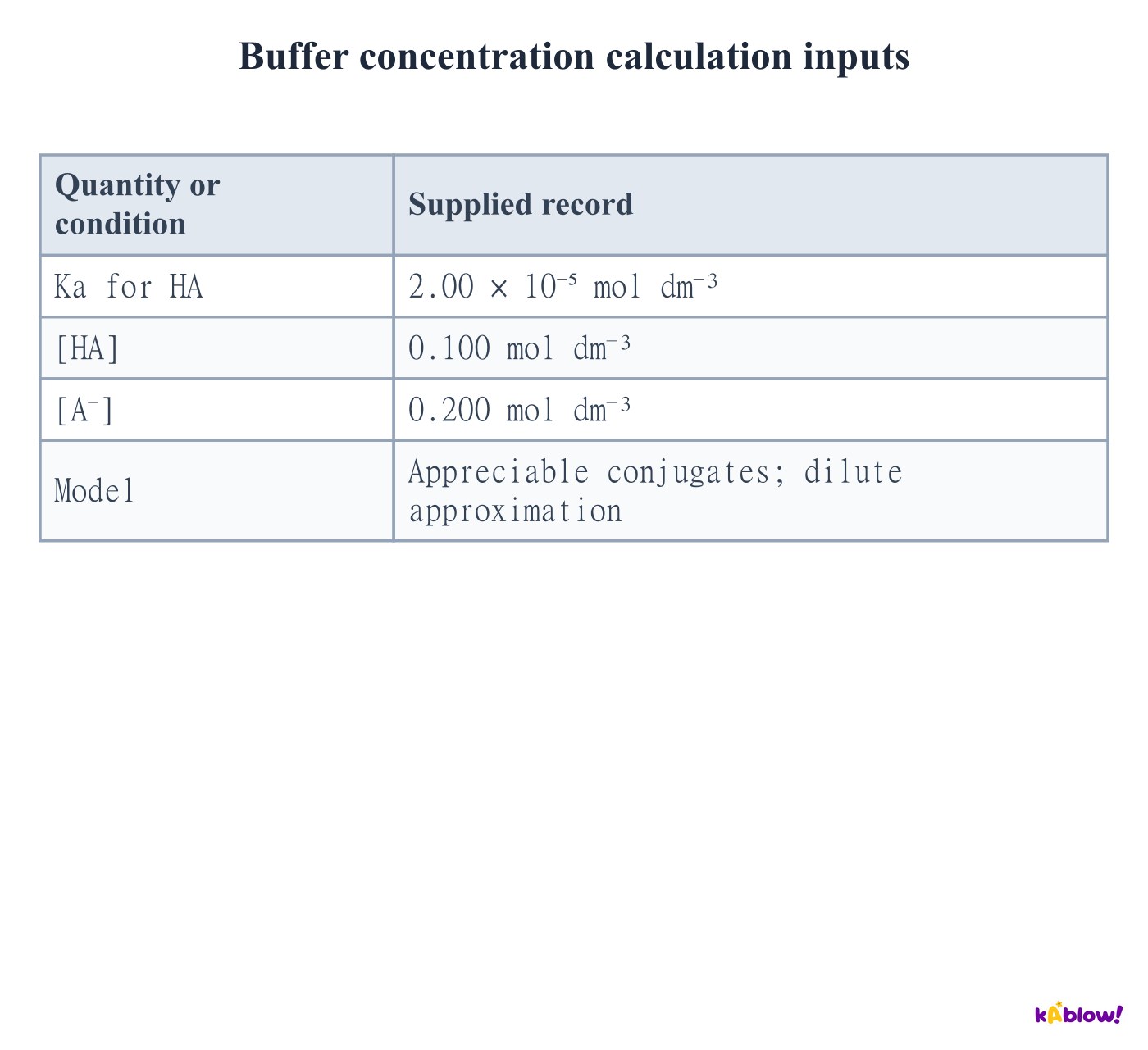
- Rearrange Ka=[H⁺][A⁻]/[HA] to [H⁺]=Ka[HA]/[A⁻]. Taking negative base-10 logarithms gives pH=pKa+log₁₀([A⁻]/[HA]).
- For the supplied concentrations, [H⁺]≈1.00×10⁻⁵ mol dm⁻³ and pH≈5.00. More conjugate base than acid makes pH greater than pKa.
- Use equilibrium concentrations, or analytical amounts when equilibrium corrections are negligible. Amount ratios replace concentration ratios only when both components share the same final volume.
Buffer concentration calculation inputs
Neutralise first when preparing a buffer
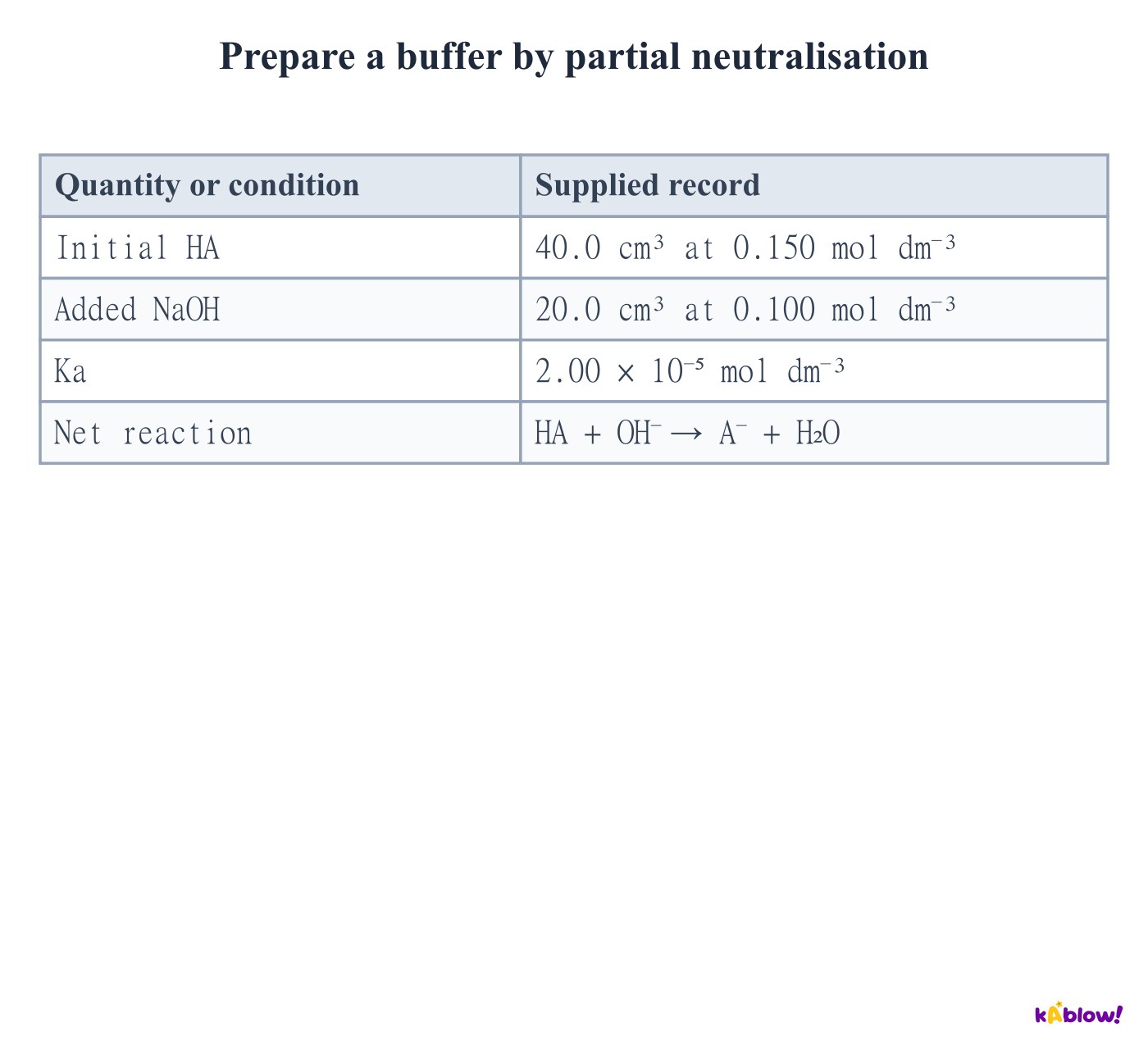
- The acid initially supplies 6.00 mmol and hydroxide supplies 2.00 mmol. After the stoichiometric reaction, approximately 4.00 mmol HA and 2.00 mmol A⁻ remain.
- Both components occupy the same 60.0 cm³ final volume, so their ratio is 2.00/4.00. Then pH≈4.69897+log₁₀(0.5)=4.40.
- Do not put the original acid and hydroxide amounts directly into the buffer ratio. The hydroxide has reacted and the weak-acid amount has changed.
Prepare a buffer by partial neutralisation
Update both amounts after adding acid
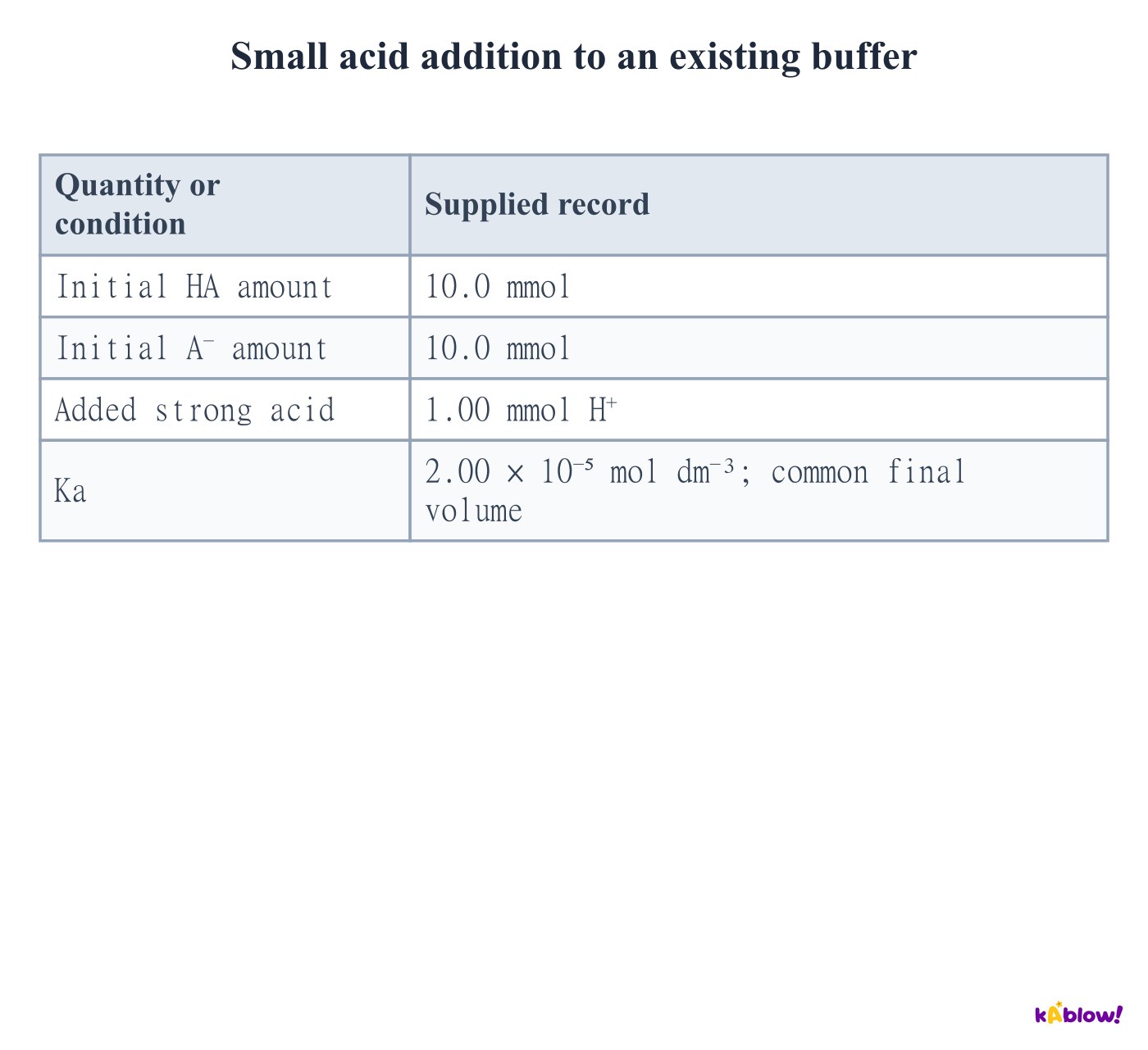
- Added H⁺ converts A⁻ into HA. The supplied addition changes the approximate amounts to 9.00 mmol A⁻ and 11.0 mmol HA.
- Then pH≈pKa+log₁₀(9/11)=4.61. The pH falls slightly because the conjugate-base/acid ratio decreases.
- Account for final volume if concentrations are needed. It cancels in this ratio because both remaining components share that volume.
Small acid addition to an existing buffer
Update both amounts after adding alkali
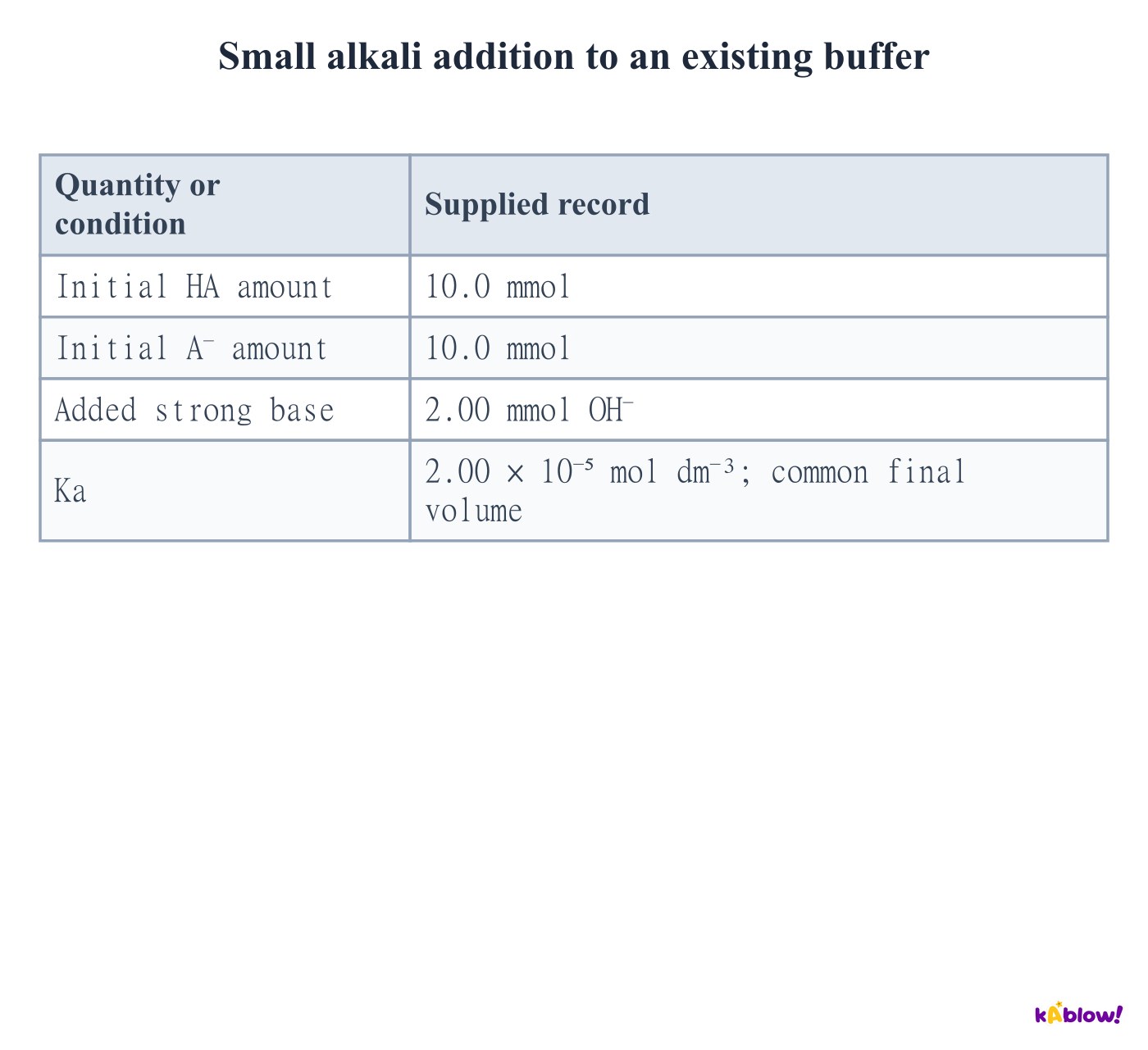
- Hydroxide consumes HA and forms A⁻. The approximate component amounts become 8.00 mmol HA and 12.0 mmol A⁻.
- The buffer calculation gives pH≈pKa+log₁₀(12/8)=4.88. The pH rises because the conjugate-base/acid ratio increases.
- A small pH change is compatible with buffering. The same absolute addition has a larger effect when the original component amounts are smaller.
Small alkali addition to an existing buffer
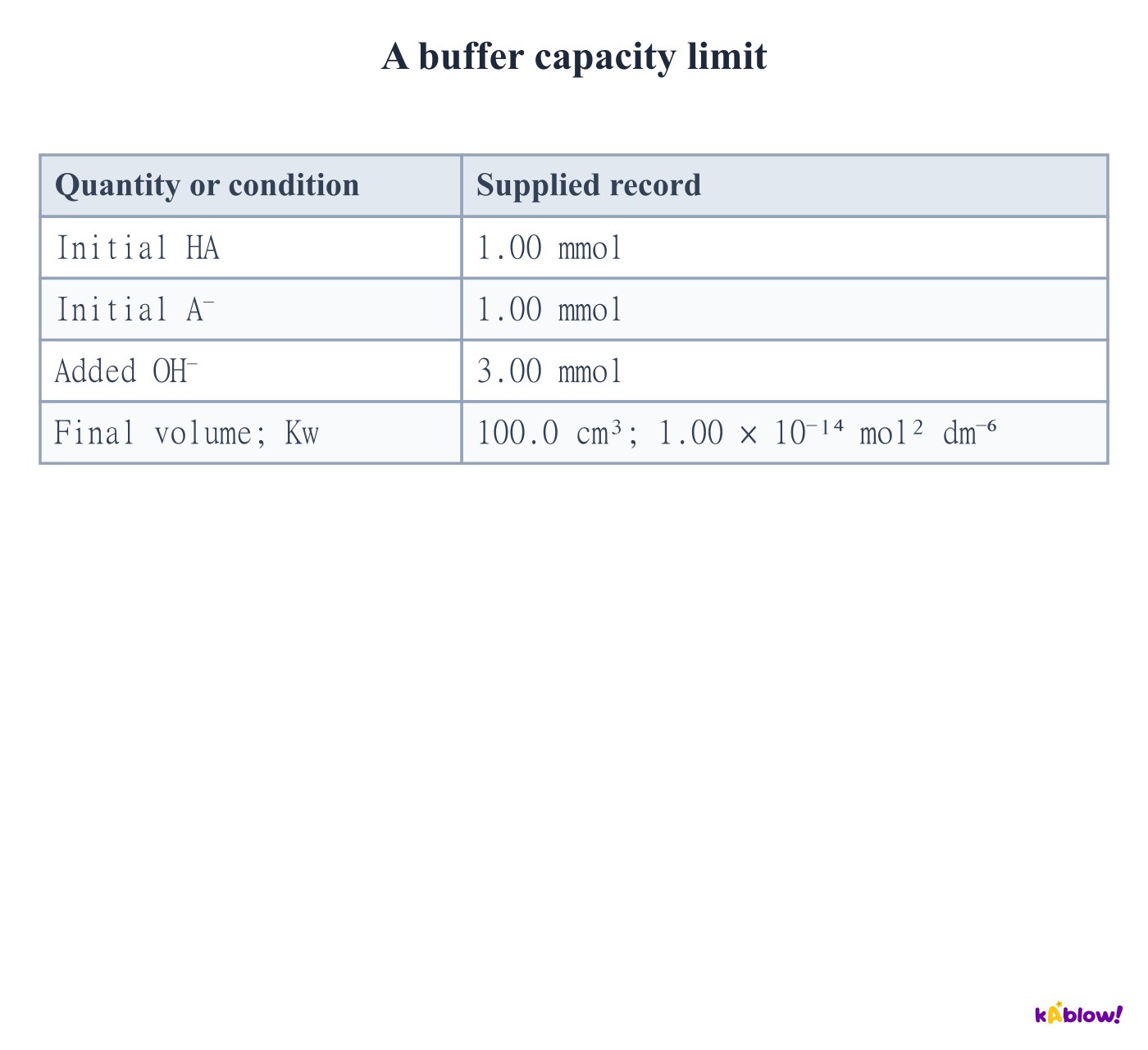
Stop using the buffer equation after a component is depleted
- The first 1.00 mmol OH⁻ consumes the available HA. Another 2.00 mmol OH⁻ remains in excess, so the buffer approximation no longer applies.
- In the stated strong-excess approximation, [OH⁻]≈0.00200/0.1000=0.0200 mol dm⁻³, giving pH≈12.30.
- Do not take the logarithm of a negative or zero remaining analytical acid amount. At a weak-acid titration’s exact equivalence, consider conjugate-base hydrolysis instead.
A buffer capacity limit
Separate buffer pH, capacity and application
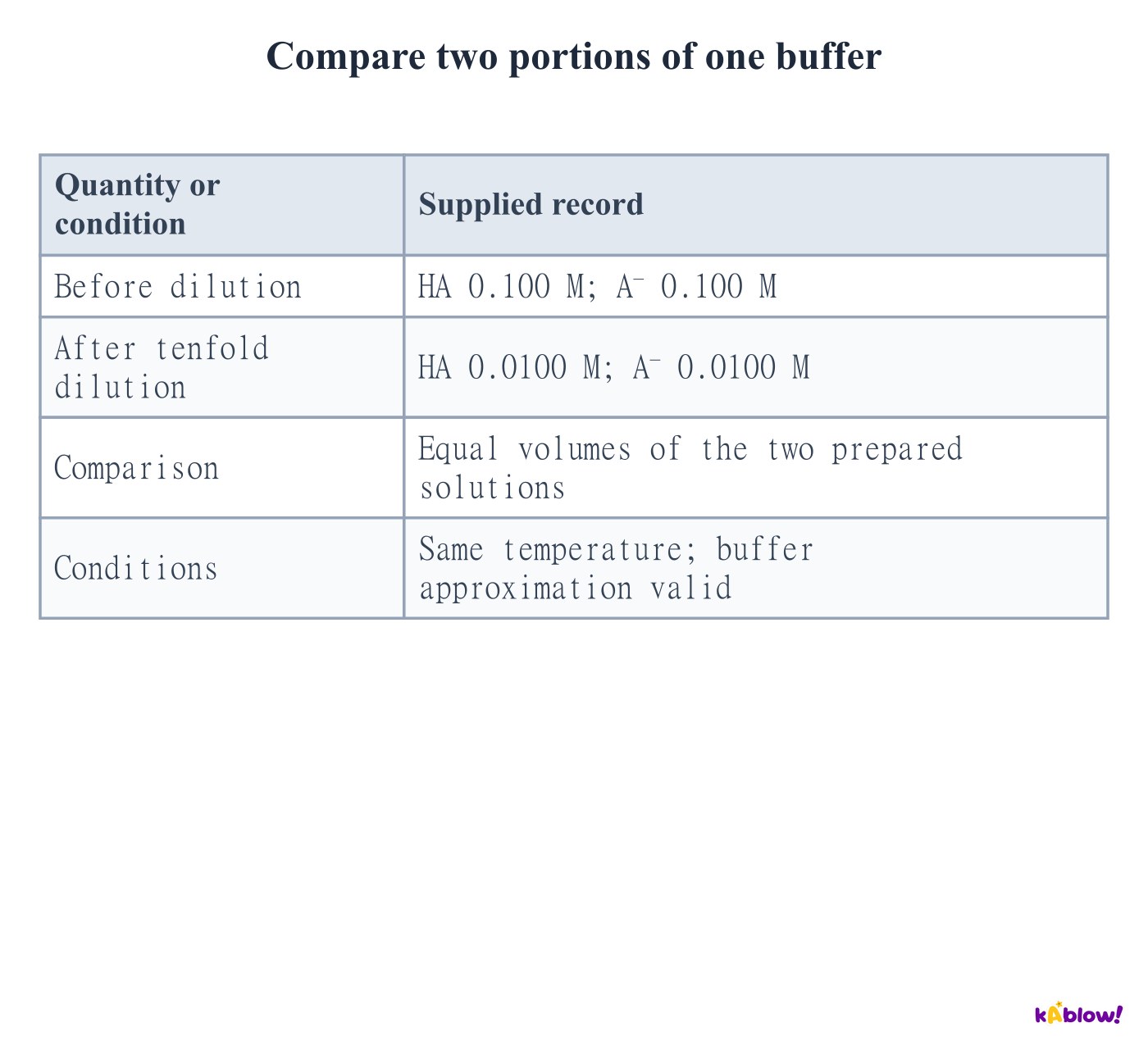
- Diluting both components by the same factor preserves their ratio and approximately preserves pH while the buffer approximation remains valid.
- Equal volumes of the diluted solution contain fewer moles of each component, so they resist a smaller acid or alkali addition. Extreme dilution can invalidate the simple ratio treatment.
- Buffers help maintain suitable pH in food processing and enzyme assays. Biological bicarbonate buffering belongs to an open system regulated by gas exchange and ion handling; a buffer alone does not hold physiological pH fixed.
Compare two portions of one buffer
Diapositivas
Sign up free to view the lesson slides
Step through every slide for this topic — plus flashcards and revision notes — with a free account.
Preguntas de práctica
Vista previa gratis — 8 de 60 preguntas. Regístrate para verlas todas.
1.Which expression matches the single ionisation shown?
Medium- A[H⁺][A⁻]/[HA]
- B[HA]/[H⁺][A⁻]
- C[H⁺]²[HA]
- D[A⁻]/[H⁺]
2.Using the requested approximation, what is the pH to two decimal places?
Medium- A1.60
- B2.90
- C4.70
- D11.10
3.Why is the supplied square-root estimate unreliable?
Medium- AWater is always the only source of H⁺
- BKa changes because C is small
- CThe estimated ionisation is a large fraction of C
- DA weak acid cannot have this concentration
4.What equilibrium [HA] belongs in the denominator?
Medium- A0.0500 mol dm⁻³
- B0.0510 mol dm⁻³
- C0.00100 mol dm⁻³
- D0.0490 mol dm⁻³
5.Which statement follows from the supplied comparison?
Medium- AY has the smaller pKa
- BX has the smaller pKa
- CBoth pKa values are identical
- DDilution must change each Ka
6.For the specified model, at what added volume should pH be used to estimate pKa?
Medium- A25.0 cm³
- B12.5 cm³
- C50.0 cm³
- D0.0 cm³
7.What is the NaOH concentration in the supplied record?
Medium- A0.0450 mol dm⁻³
- B0.800 mol dm⁻³
- C0.0800 mol dm⁻³
- D0.00300 mol dm⁻³
8.Which volume belongs in the final excess-ion concentration calculation?
Medium- A20.0 cm³
- B30.0 cm³
- C10.0 cm³
- D50.0 cm³
Unlock all 60 questions, flashcards & more
Crea una cuenta gratis para ver todas las preguntas, las diapositivas, las tarjetas y los apuntes de repaso de este tema.