
Modern and smart materials
Apréndelo jugando
Responde estas preguntas para ganar energía, luego pesca y explora. Sin cuenta.
Para educadores: diapositivas de la lección, apuntes de repaso listos para usar sobre Modern and smart materials (Design and Technology, Core Technical Principles) — úsalos en tu lección, o presenta el tema como una actividad interactiva de clase que tus aprendices juegan como un juego en vivo.
Apuntes de la lección
Smart materials
- A smart material is selected for a controlled useful response to a stimulus. Examples include temperature-related colour change, light-related optical change, mechanical-to-electrical response or shape recovery. Many responses are reversible within limits, but reset, hysteresis, ageing and operating range matter.
- Thermochromic pigments can provide visual temperature cues; they do not automatically measure an exact safe temperature. Photochromic products respond to relevant light wavelengths, with temperature and time also influencing behaviour. Identify the actual material system rather than treating every coating or lens as identical.
- Piezoelectric materials generate charge under suitable mechanical stress and can also deform under electrical excitation. Suitable QTC sensors show force- or pressure-dependent resistance, often decreasing as load rises within their specified range. Electroluminescent systems emit light under electrical excitation rather than requiring a temperature change.
Match stimulus to response
Modern materials
- Modern is a curriculum grouping rather than a claim that every example was invented recently. Graphene is a single carbon-atom layer in a honeycomb arrangement, with useful intrinsic conductivity and mechanical properties. Practical films and devices depend on quality, processing and integration; a material headline is not evidence that every application is ready or superior.
- Kevlar is a para-aramid fibre used in selected strong reinforcements or protective systems; Nomex is a meta-aramid associated with heat and flame resistance. Protective performance belongs to the assessed full product and conditions, not a promise of bulletproof or fireproof material in any construction.
- Suitable waterproof breathable garment systems permit water-vapour transfer while resisting liquid water under specified conditions. Breathability is not simply unlimited air passage. Membrane, textile layers, seams, other components, care and wear affect a finished product.
- PLA is commonly bio-based but is not automatically home-compostable, harmless as litter or lower impact than every alternative. Product-specific testing, treatment conditions and collection routes determine end-of-life suitability.
Material properties need a product context
Composites and technical textiles
- A composite combines distinct constituents with complementary roles, often reinforcement and matrix. Glass-reinforced polymer and carbon-fibre reinforced polymer combine fibres with a polymer matrix. Fibre direction, amount, interfaces, lay-up, joints and manufacturing quality affect properties and damage behaviour.
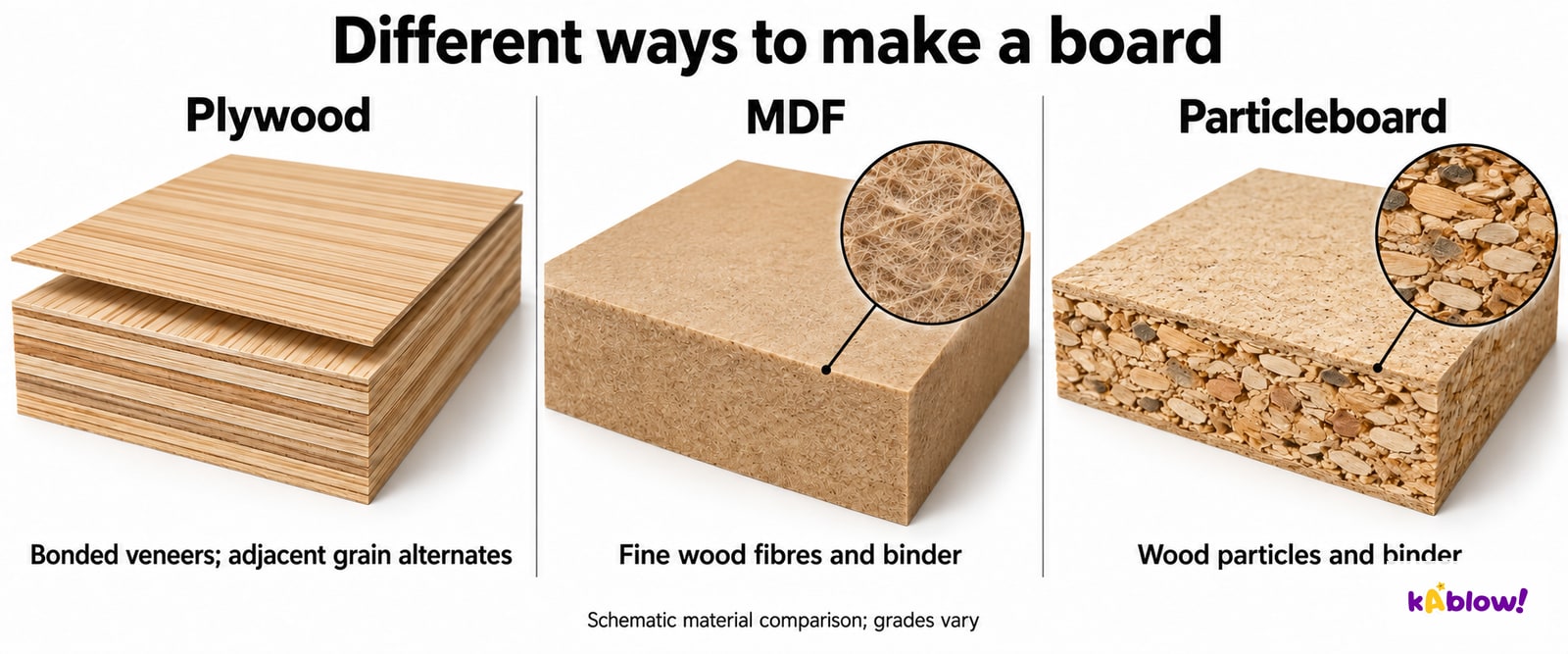
- Plywood, MDF and particleboard use different engineered wood structures shown in the original reused illustration. Natural solid wood is also a composite, with cellulose-rich reinforcing structures and a surrounding matrix; natural does not mean not composite. Pure copper provides a clearer non-composite contrast for this lesson.
- Technical textiles are designed primarily for functional performance such as filtration, sensing, reinforcement or specified protection. They can still have appearance requirements. A composite or textile can improve selected properties while creating cost, repair, separation or directionality trade-offs.
Engineered wood composite examples
Heat-triggered shape memory
- Selected alloys such as Nitinol can recover a trained shape through a temperature-driven phase change after suitable deformation. Composition, processing and the operating range determine the response; it is not simply melting or ordinary elastic springback.
- Cooling after recovery does not necessarily bend the component back to the previous deformed shape. Reset arrangements and cycle limits matter. The flow diagram explains a conceptual response and does not specify heat treatment, temperatures or fabrication.
Heat-triggered shape-memory route
Superelasticity is a different trigger
- Selected Nitinol can deform through stress-induced transformation and recover substantially when unloaded within an appropriate temperature and strain range. This superelastic effect can support resilient spectacle-frame components.
- Heat-triggered shape memory and superelastic unloading are related material behaviours but are not interchangeable mechanisms. A practical component still has deformation, fatigue, joining and temperature limits; returning after one bend does not prove unlimited durability.
Superelastic route: recover on unloading
Select the finished material system
- Define the function and service conditions, then connect a relevant property to the design requirement. For a lightweight frame, investigate a complete suitable CFRP structure; for a weather garment, investigate a suitable layered textile system; for a cue, define what the stimulus response must communicate.
- Use relevant evidence for the finished construction and care conditions, including limitations and trade-offs. A brand, fibre name, composite label or intrinsic laboratory property alone does not establish that a product meets all its requirements.
A technical textile is a complete choice
Diapositivas
Sign up free to view the lesson slides
Step through every slide for this topic — plus flashcards and revision notes — with a free account.
Preguntas de práctica
Vista previa gratis — 8 de 33 preguntas. Regístrate para verlas todas.
1.What is a smart material?
Easy- Aone selected for a useful controlled response to a stimulus, often reversible within limits
- Ba hard material
- Ca cheap material
- Da recycled material
2.What is a composite?
Easy- Aa metal
- Ba polymer
- Ca timber
- Da material combining distinct constituents with different roles
3.What does thermochromic mean?
Easy- Aconducts electricity
- Bstores heat
- Cchanges colour with temperature
- Dchanges colour with light
4.What does photochromic mean?
Easy- Aflexes
- Bchanges colour with light
- Cchanges with heat
- Dconducts
5.What is graphene?
Easy- Aa one-atom-thick layer of carbon
- Ba type of plastic
- Ca timber
- Da fabric
6.What is Kevlar used for?
Easy- Awaterproof coats
- Bfire gloves
- Cmugs
- Dsuitable ballistic- or cut-resistant systems and other engineered applications
7.What is Gore-Tex used for?
Easy- Abridges
- Bbottles
- Cwaterproof, breathable clothing
- Delectronics
8.What is Nomex used for?
Easy- Alenses
- Bfire-resistant clothing
- Cbulletproof vests
- Dmugs
Unlock all 33 questions & more
Crea una cuenta gratis para ver todas las preguntas, las diapositivas, las tarjetas y los apuntes de repaso de este tema.
Exámenes anteriores
La práctica con exámenes anteriores de este tema llegará pronto.
Próximamente