
Home, town and region
Apréndelo jugando
Responde estas preguntas para ganar energía, luego pesca y explora. Sin cuenta.
Para educadores: diapositivas de la lección, apuntes de repaso listos para usar sobre Home, town and region (French, Local Area, Holidays and Travel) — úsalos en tu lección, o presenta el tema como una actividad interactiva de clase que tus aprendices juegan como un juego en vivo.
Apuntes de la lección
Home
- J’habite dans une maison/dans un appartement describes a house or flat. Un salon, une cuisine, une chambre, une salle à manger and une salle de bains name rooms; jardin and garage name other home spaces. Chambre is bedroom in this context, while πèce is the general room word. Learn nouns with their articles.
- Match descriptions to the noun: ma chambre est petite and mon appartement est petit. A real or imagined home is acceptable; do not provide an address or private household information. Il y a introduces both singular and plural presence: il y a un lit, il y a des chaises.
Home words in context
Prepositions
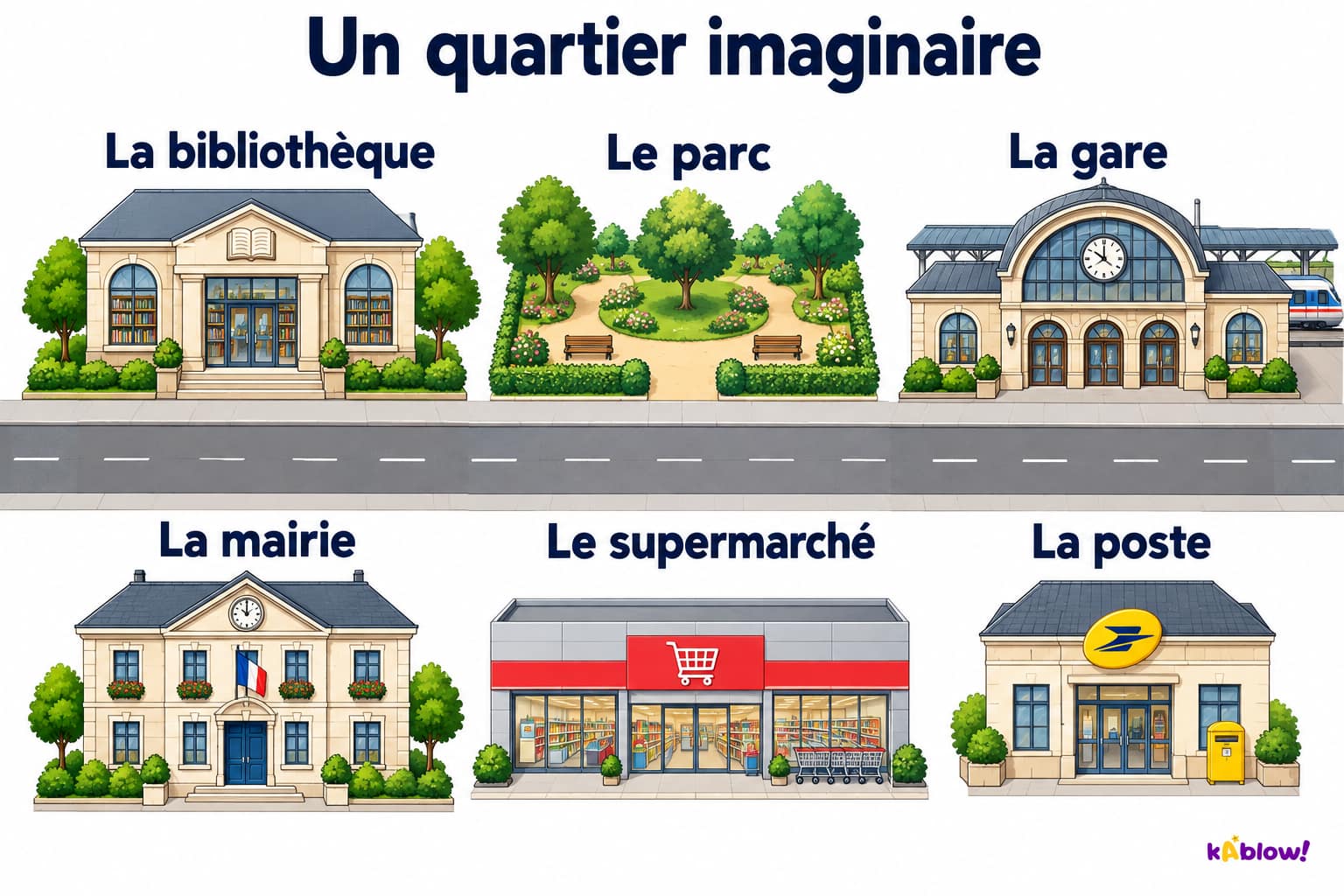
- Use the imaginary layout: le parc est entre la bibliothèque et la gare; la mairie est en face de la bibliothèque across the street. Entre identifies the two surrounding referents and en face de describes opposite/facing. The drawing is a schematic arrangement, not a scaled map, route or literal architectural plan.
- Other phrases include dans, sur, sous, devant, derrière, à côté de, près de and loin de. Keep articles: à côté de la poste, près du parc, en face des magasins and près de l’hôtel. De plus le becomes du, de plus les becomes des; devant la gare and derrière la mairie do not automatically add de.
Un quartier imaginaire
Town
- La mairie is town hall, la poste post office, la gare railway station, la boulangerie bakery, la pharmacie pharmacy, le parc park and la piscine swimming pool. La bibliothèque means library, while la librairie is a bookshop. Similar-looking English words are not enough to identify meaning.
- Read the full phrase: la gare routière is a bus/coach station, le centre commercial a shopping centre and le centre-ville the town/city centre. Facilities vary by place; vocabulary examples do not establish that a real town has all of them. The picture provides only the six sites explicitly shown.
Read the whole place name
Directions
- Formal singular or plural vous directions include allez tout droit, tournez à gauche/à droite, prenez la première rue à gauche and traversez le pont. Imperatives here omit the subject pronoun; a familiar singular uses va, tourne, prends and traverse. Use a consistent form appropriate to the listener.
- Tout droit is straight ahead and à droite is right. Traversez le pont means cross the bridge, not go past it. A language example does not establish a real safe route or road distance; follow the given text and do not invent a junction or landmark.
Direction forms and precise meaning
Where you live
- Describe the setting with la ville, le village, la campagne, la banlieue, la côte or à la montagne. In the ordinary presence pattern, il y a un cinéma becomes il n’y a pas de cinéma; before a vowel sound use d’, as in il n’y a pas d’hôtel. The phrase il y a itself does not change for a plural noun.
- The article-change rule is specific to ordinary negative-presence examples here, not every article after any negative. Definite articles, contrast and other constructions can behave differently. Read the actual statement and avoid turning absence of one facility into a claim that there is nothing to do.
State presence and absence
Advantages and disadvantages
- Use an opinion with a suitable reason: j’aime cette ville parce qu’elle est calme or je préfère ce quartier parce qu’il y a plus de choses à faire. A person’s reason is not proof that every city or countryside area has the same qualities; understand the given speaker rather than guessing from a stereotype.
- Adjectives agree with the noun: un quartier bruyant/animé/pollué and une ville bruyante/animée/polluée. Calme and propre keep the same written singular gender form. Ennuyeux changes to ennuyeuse; choose agreement and degree words such as assez or un peu to express the intended view.
Opinion and adjective agreement
Weather
- Weather chunks include il fait beau/chaud/froid/mauvais, il pleut, il neige, il y a du vent and il y a du soleil. Impersonal il does not refer to a male person, and French does not always translate English is as a separate word in these expressions.
- Weather describes the stated conditions; climate refers to longer-term patterns. Do not infer a permanent climate from one sentence such as il pleut aujourd’hui. A local-area description can combine place and weather with a time marker without making a universal regional claim.
Weather expressions
Saying where a place is
- Ma ville est située dans le nord de la France locates the town within northern France. Située agrees with feminine ville; un village est situé uses masculine. Dans le sud/l’est/l’ouest changes the region while retaining the meaning of being within that part of a larger area.
- Au nord de Paris means north of Paris, using Paris as a reference point. Près de la côte means near the coast and loin du centre means far from the centre. These broad descriptions practise language and do not require a private address or an exact distance.
Use a reference for location
Original fictional reading and writing model
- Dans mon quartier, il y a une bibliothèque près du parc, mais il n’y a pas de piscine. C’est assez calme et j’aime y habiter. This original fictional text states a library near a park, no swimming pool and enjoyment of living there. It does not mention a station or a precise distance.
- For your own real or imagined description, include named facilities, an ordinary negative-presence phrase and a connected opinion with a reason. Keep articles and adjective agreement accurate, and do not invent details when answering comprehension. No personal address, home image or private household information is needed.
Read only the fictional details given
Diapositivas
Sign up free to view the lesson slides
Step through every slide for this topic — plus flashcards and revision notes — with a free account.
Preguntas de práctica
Vista previa gratis — 8 de 39 preguntas. Regístrate para verlas todas.
1.What does "une maison" mean?
Easy- Aa house
- Ban apartment
- Ca garden
- Da kitchen
2.What does "un appartement" mean?
Easy- Aa house
- Ba garden
- Ca room
- Da flat or apartment
3.In a description of rooms at home, what does la cuisine mean?
Easy- Athe bathroom
- Bthe lounge
- Cthe kitchen
- Dthe bedroom
4.What does "la salle de bains" mean?
Easy- Athe garage
- Bthe bathroom
- Cthe dining room
- Dthe garden
5.What does "le jardin" mean?
Easy- Athe garden
- Bthe garage
- Cthe bedroom
- Dthe kitchen
6.What does "la chambre" mean?
Easy- Athe kitchen
- Bthe lounge
- Cthe garden
- Dthe bedroom
7.What does "sous" mean?
Easy- Abehind
- Bin front of
- Cunder
- Don
8.What does "devant" mean?
Easy- Aunder
- Bin front of
- Cbehind
- Dbetween
Unlock all 39 questions & more
Crea una cuenta gratis para ver todas las preguntas, las diapositivas, las tarjetas y los apuntes de repaso de este tema.
Exámenes anteriores
La práctica con exámenes anteriores de este tema llegará pronto.
Próximamente