
Reading and writing notation
Apréndelo jugando
Responde estas preguntas para ganar energía, luego pesca y explora. Sin cuenta.
Apuntes de la lección
The stave and clefs
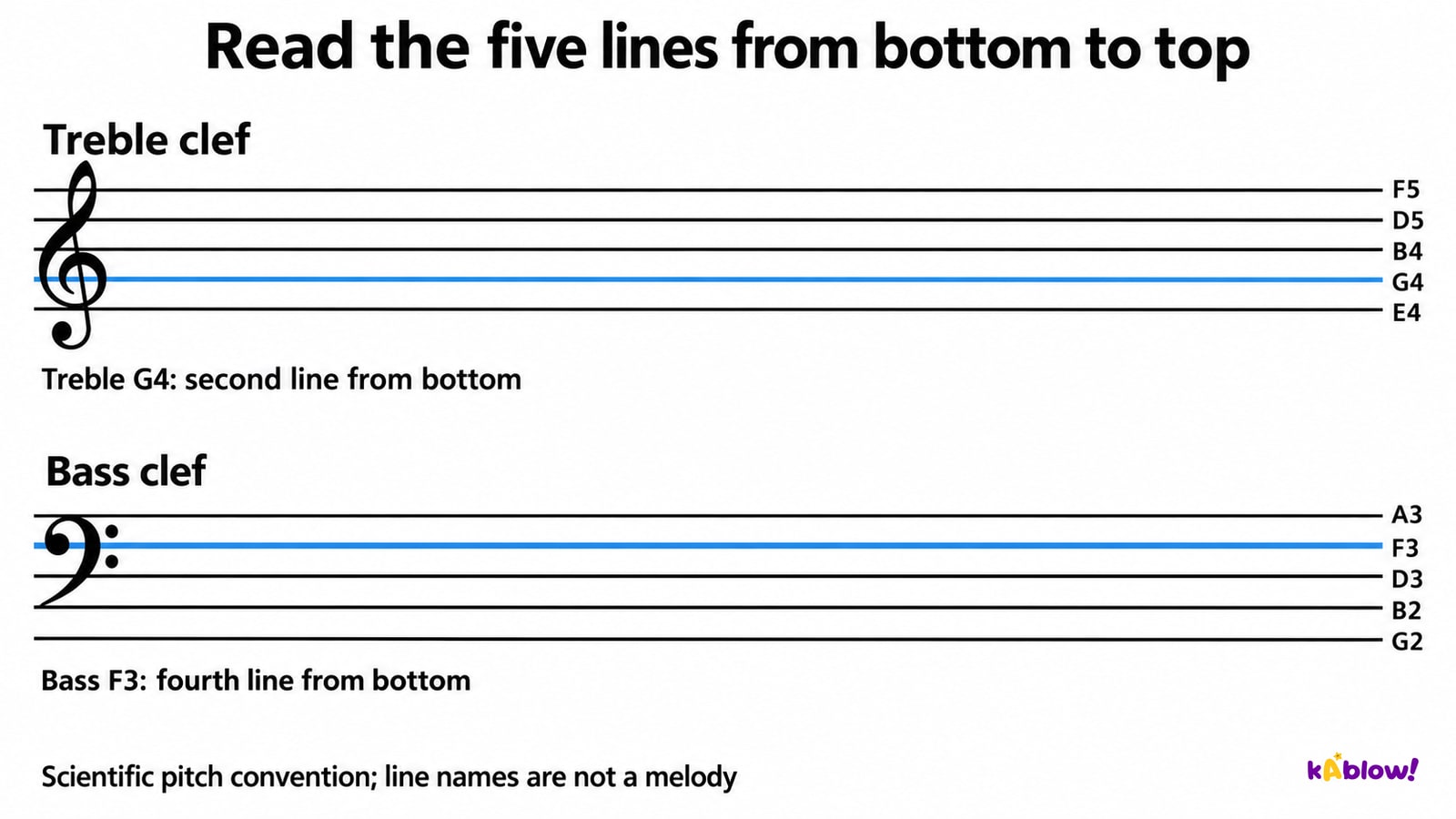
- A standard pitched stave has five lines and four internal spaces; read each list from bottom to top. Treble lines are E4 G4 B4 D5 F5, spaces F4 A4 C5 E5. Bass lines are G2 B2 D3 F3 A3, spaces A2 C3 E3 G3. Scientific pitch notation names middle C as C4 here.
- Treble is a G clef locating G4 on its second line from the bottom. Bass is an F clef with its dots surrounding F3 on the fourth line from the bottom. These reference positions determine the other line and space pitches; the clef is not an absolute limit on a performer’s register.
Clefs establish pitch references
Ledger lines
- Ledger lines are short additional stave lines above or below the five main lines, with spaces continuing between them. In ordinary treble clef C4 is on the first ledger line below; in bass clef it is on the first ledger line above.
- Middle C is one pitch with different written positions under different clefs. A grand staff can place its two possible representations between the staves, but it is not necessary to have two staves to write it. The ledger-position table compares the two clef conventions without pretending to be a drawn note example.
Middle C uses a clef-dependent written position
Accidentals
- Sharp specifies one semitone above the natural letter pitch; flat one below; natural restores the natural form. A sign replaces the applicable pitch state rather than adding an extra change to the last sign. Natural can therefore raise a flattened pitch or lower a sharpened one.
- In conventional modern staff notation, a local accidental normally affects the same written pitch and octave through the bar, unless replaced. It does not automatically affect another octave. A tied altered note keeps its sounding pitch across a barline; later new attacks follow their bar’s signature and accidental context.
Read local accidentals with their scope
Key signatures
- A signature provides default altered letters across octaves: G major/E minor use F sharp, F major/D minor use B flat, D major/B minor use F sharp and C sharp. B-flat major/G minor share B flat and E flat. Local accidentals can override these defaults in their scope.
- Signature content alone does not prove a tonic or forbid chromatic notes. Read the actual pitch context and any signature change. A performer needs both the signature and local signs rather than a rule that every written occurrence stays altered throughout the entire work.
A signature can belong to relative keys
Other symbols
- A tie joins consecutive same-pitch values into one duration without a new attack; it may cross a barline. A slur guides connected articulation or phrasing and does not add durations into one held note. Check the actual notation and instrumental convention rather than deciding solely from a same/different-pitch slogan.
- D.C. returns to the beginning; D.S. returns to the segno. Al Fine and al Coda qualify the route and stopping point. A fermata extends or suspends a marked note, rest or pause in context, rather than universally doubling a note’s duration.
Duration and articulation are different roles
Italian terms
- Dolce means sweetly, cantabile in a singing style, maestoso majestically, con brio with spirit and grave slow/solemn. Character and tempo language must be interpreted with the musical context, not as rigid universal metronome values.
- These directions can apply to voices or instruments. Combine them with the written dynamics, phrasing and performance practice rather than assuming one word establishes every expressive detail.
Transposition basics
- Transposition moves musical material by a specified interval while preserving relevant relationships. In the twelve-tone equal-tempered model a tone equals two semitones; C4 D4 E4 moved up a tone becomes D4 E4 F#4. Correct notation preserves interval spelling as well as sounding distance.
- A semitone is the adjacent chromatic step in this model, not the smallest possible interval in all Western or world music: microtonal practices use smaller steps. This introductory reference is not a complete notation or transposing-instrument syllabus.
Transpose an original written pitch pattern
Diapositivas
Sign up free to view the lesson slides
Step through every slide for this topic — plus flashcards and revision notes — with a free account.
Preguntas de práctica
Vista previa gratis — 8 de 37 preguntas. Regístrate para verlas todas.
1.How many lines does a standard pitched-music stave have?
Easy- Afive
- Bfour
- Csix
- Dthree
2.Relative to a letter’s natural pitch, what does a sharp specify?
Easy- Alowers by a semitone
- Bmakes a note longer
- Ccancels the key
- Draises a note by a semitone
3.Relative to a letter’s natural pitch, what does a flat specify?
Easy- Amakes a note longer
- Badds a beat
- Clowers a note by a semitone
- Draises by a semitone
4.What does a natural do?
Easy- Adoubles the note
- Brestores the natural pitch of the named letter
- Cadds a sharp
- Dadds a flat
5.From bottom to top, which letters name the treble-clef lines?
Easy- AEGBDF
- BFACE
- CGBDFA
- DACEG
6.From bottom to top, which letters name the bass-clef lines?
Easy- AEGBDF
- BFACE
- CACEG
- DGBDFA
7.What are ledger lines?
Easy- Arests
- Bslurs
- Cextra lines above or below the stave
- Dbar lines
8.In ordinary treble and bass clefs, how can middle C (C4) be written?
Easy- Aon the middle line of the treble clef
- Bon the first ledger line below treble or above bass
- Con the top line
- Dat the end of the stave
Unlock all 37 questions & more
Crea una cuenta gratis para ver todas las preguntas, las diapositivas, las tarjetas y los apuntes de repaso de este tema.