
Alkanes
Belajar sambil bermain
Jawab soal-soal ini untuk dapat energi, lalu memancing dan menjelajah. Tanpa akun.
Catatan pelajaran
Identify an alkane from bonding and composition
- Alkanes are saturated hydrocarbons with only carbon–carbon single bonds. The usual acyclic series has general formula CₙH₂ₙ₊₂.
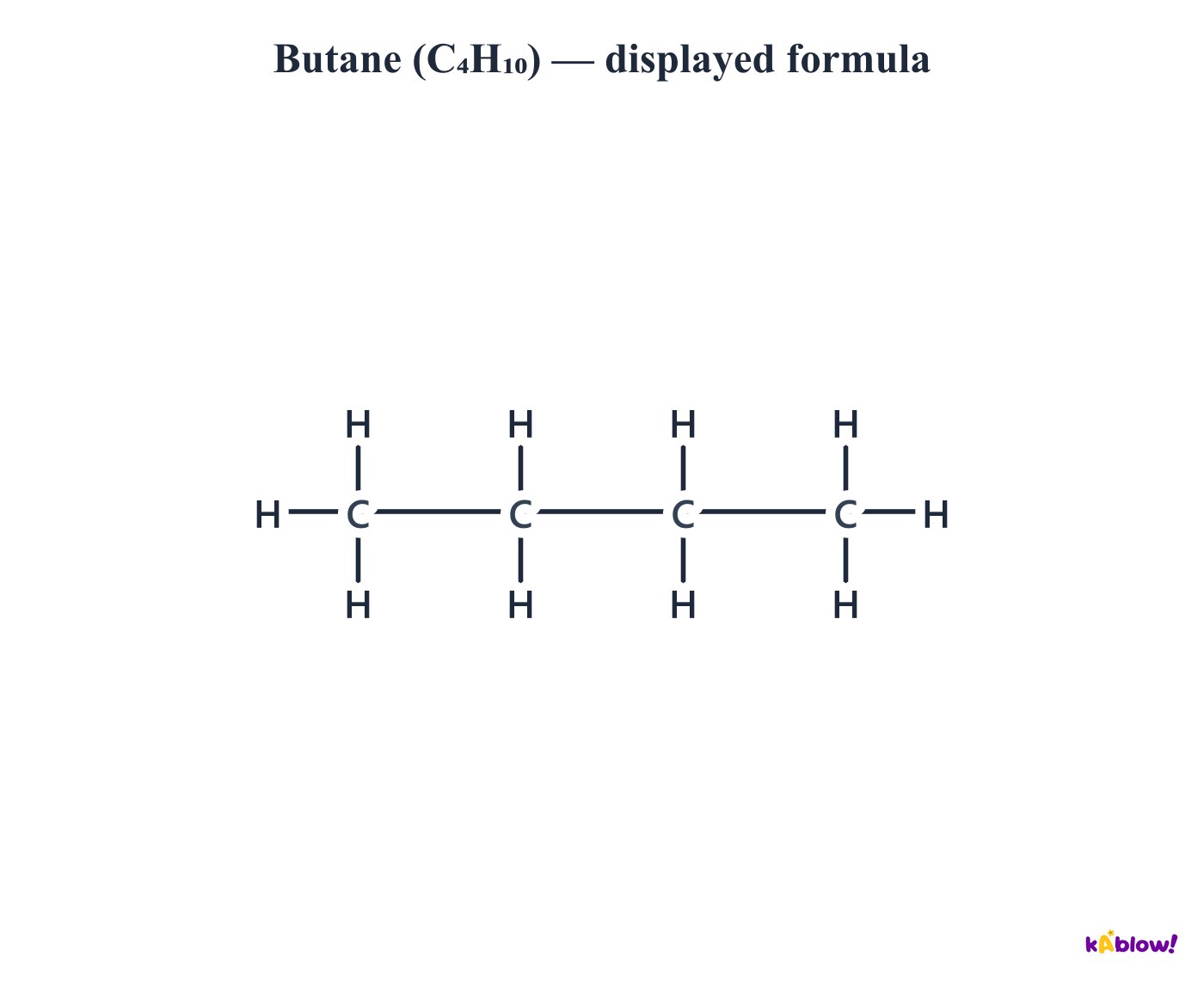
- The displayed butane model has four carbons and ten hydrogens. A branched acyclic alkane follows the same formula pattern; branching changes connectivity rather than saturation.
- The formula constraint matters:a saturated monocyclic hydrocarbon has CₙH₂ₙ, so not every saturated hydrocarbon belongs to the acyclic alkane series.
Displayed butane connectivity
Treat crude oil and its fractions as mixtures
- Crude oil contains many hydrocarbons, mainly alkanes in the course description, with other hydrocarbon families and sulfur-containing compounds also present.
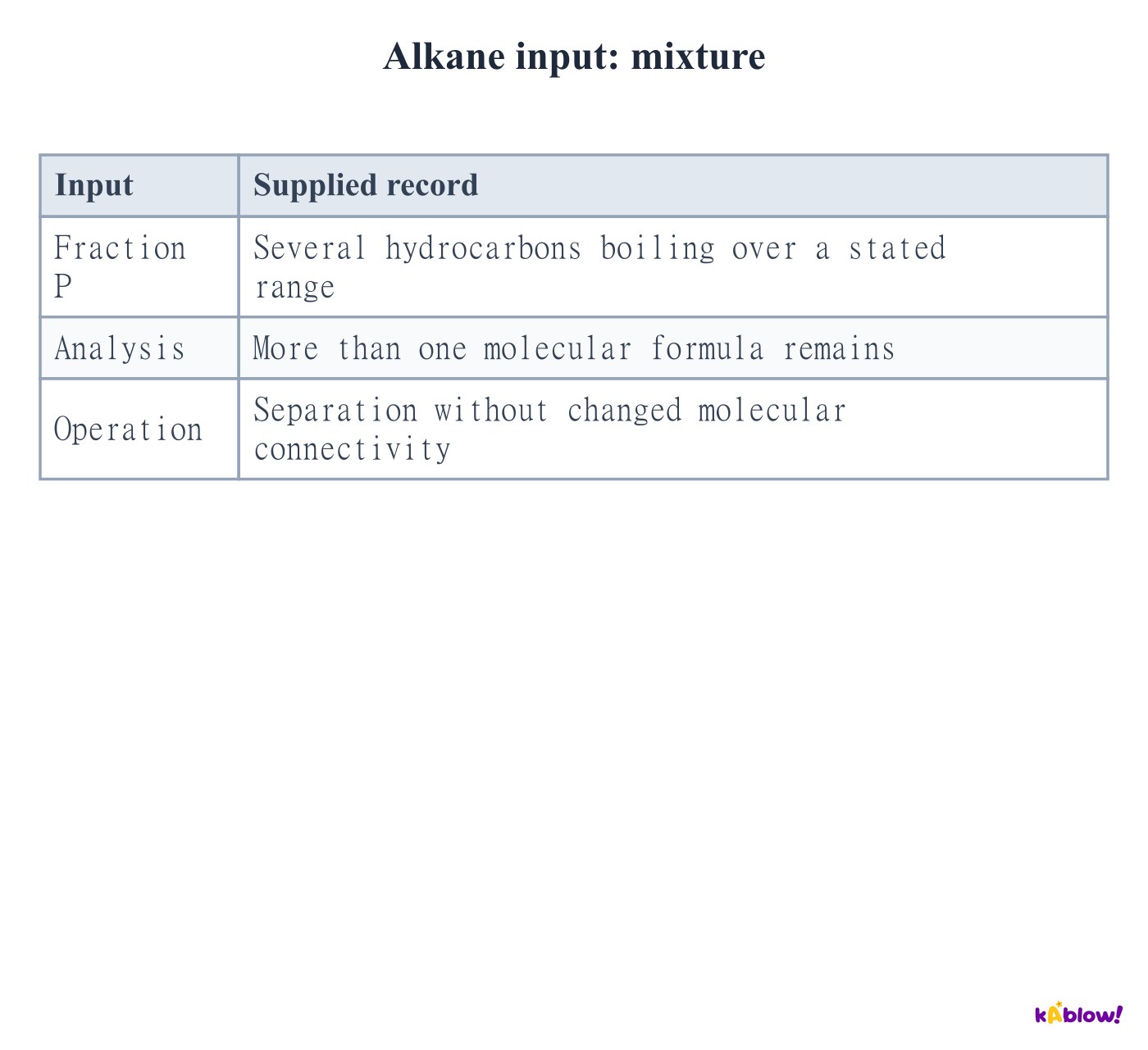
- A fraction groups substances with a useful boiling range. It is usually still a mixture rather than one pure molecular compound.
- Fractional distillation changes which molecules are collected together. It does not convert every original molecule into one new fuel molecule.
Alkane input: mixture
Explain the hot-to-cool fractionating column
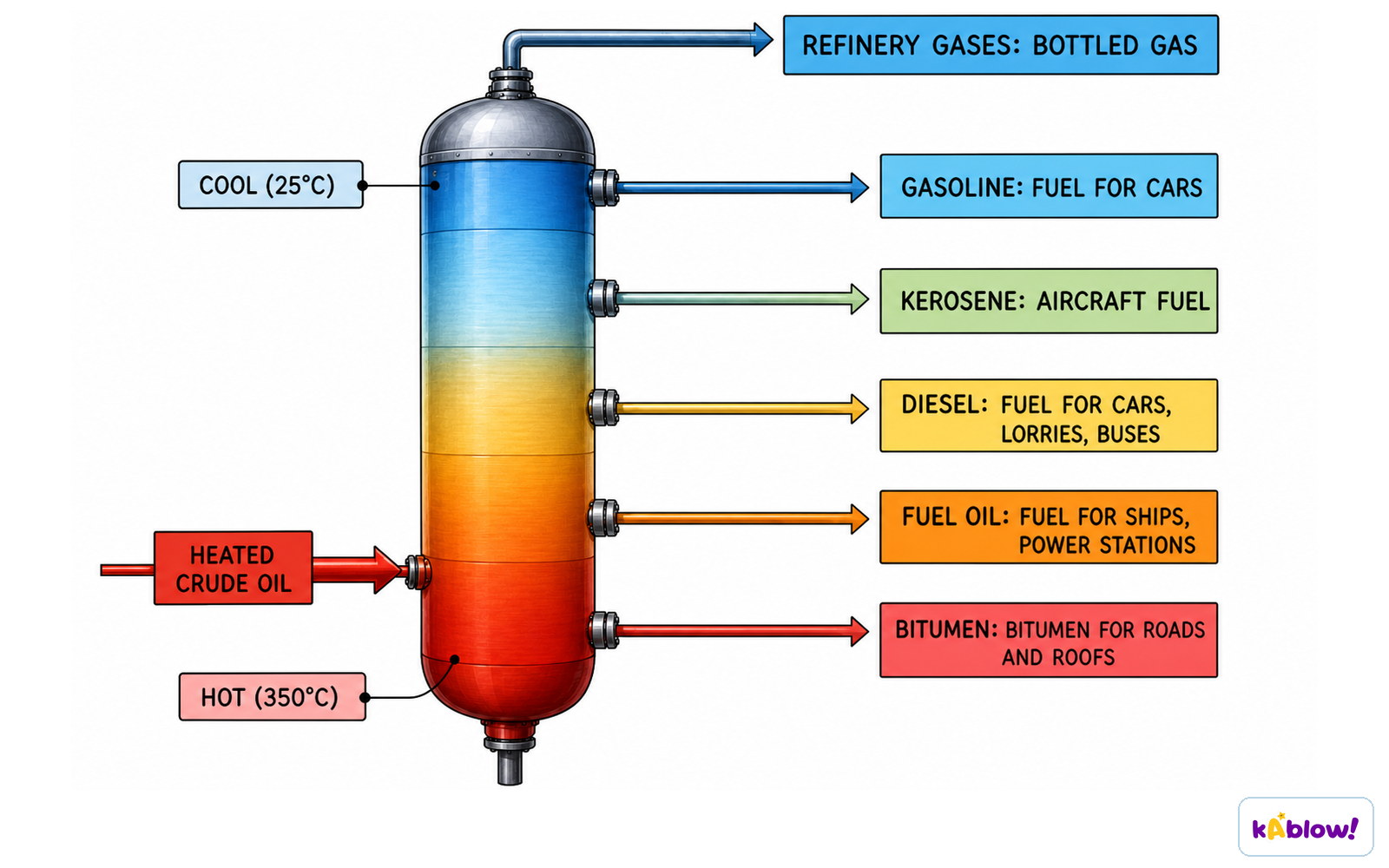
- Heated crude enters the lower region of a fractionating column. Vapours move into progressively cooler regions as they rise.
- Higher-boiling components condense lower down; more volatile components travel farther before condensing, and some gases leave at the top. Heavy residue remains low in the system.
- The refinery illustration gives a schematic order of cuts. Its printed temperatures are illustrative conditions, not universal boundaries or exact boiling points for every fraction.
Refinery fractionating column
Separate intermolecular attraction from covalent bonding
- In a comparable unbranched alkane series, larger molecules generally have more electrons and stronger London attractions. More energy is needed to separate molecules during boiling.
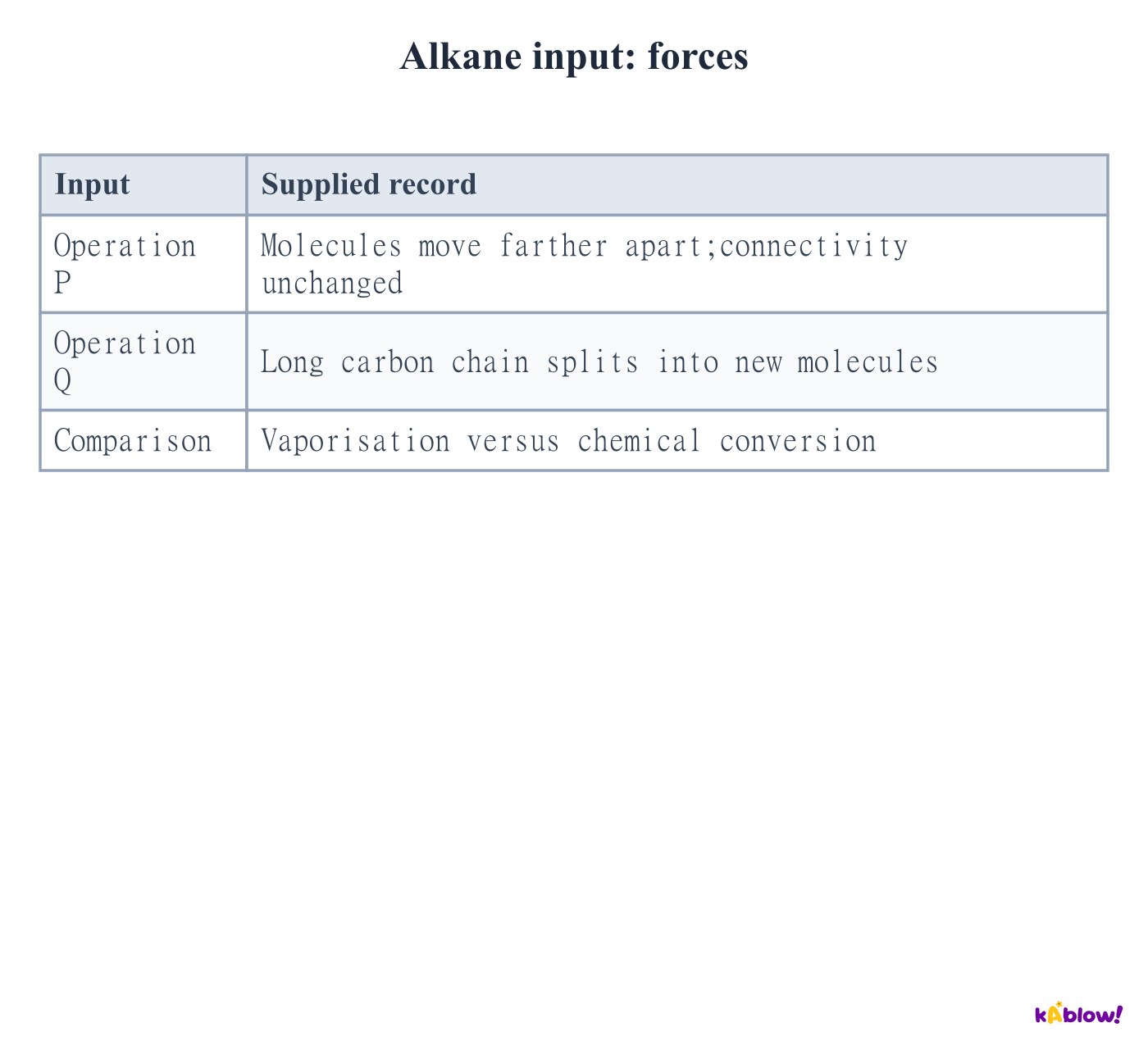
- The carbon skeleton remains intact in ordinary vaporisation. Breaking C–C covalent bonds belongs to chemical conversion such as cracking.
- Compare like structures:branching and shape affect contact between molecules. Carbon count alone is not a universal predictor across all hydrocarbon structures.
Alkane input: forces
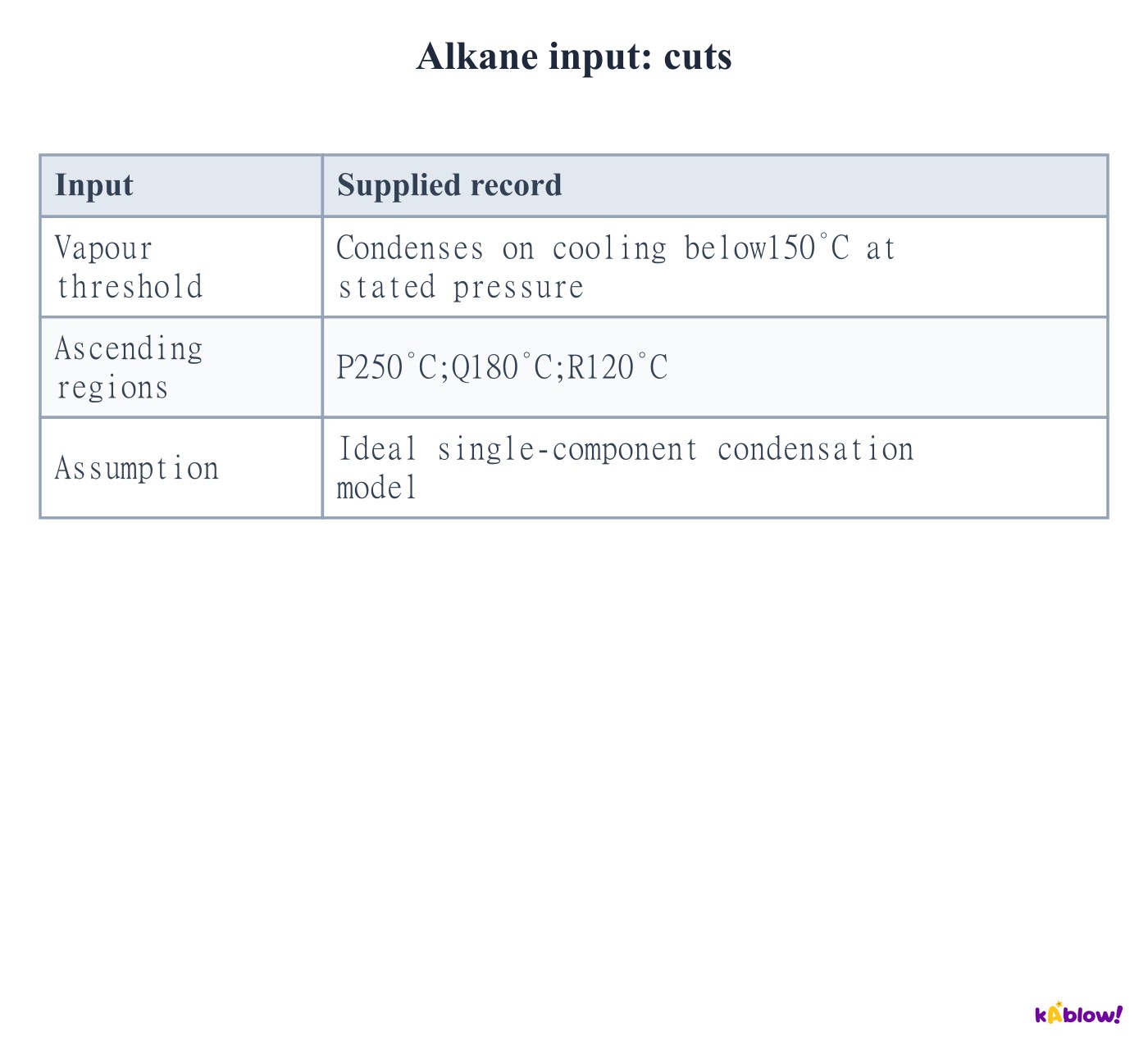
Use a specified condensation model
- A simplified question may assign condensation ranges or collection bands. Use those stated inputs rather than memorising a rigid universal fraction list.
- The supplied single-component model cools a vapour through three regions. Its stated boiling threshold determines where the first liquid appears.
- Real columns involve mixtures, pressure and repeated vapour–liquid contact. This model isolates the temperature comparison rather than predicting every real tray composition.
Alkane input: cuts
Relate cracking to a stated supply-and-demand pattern
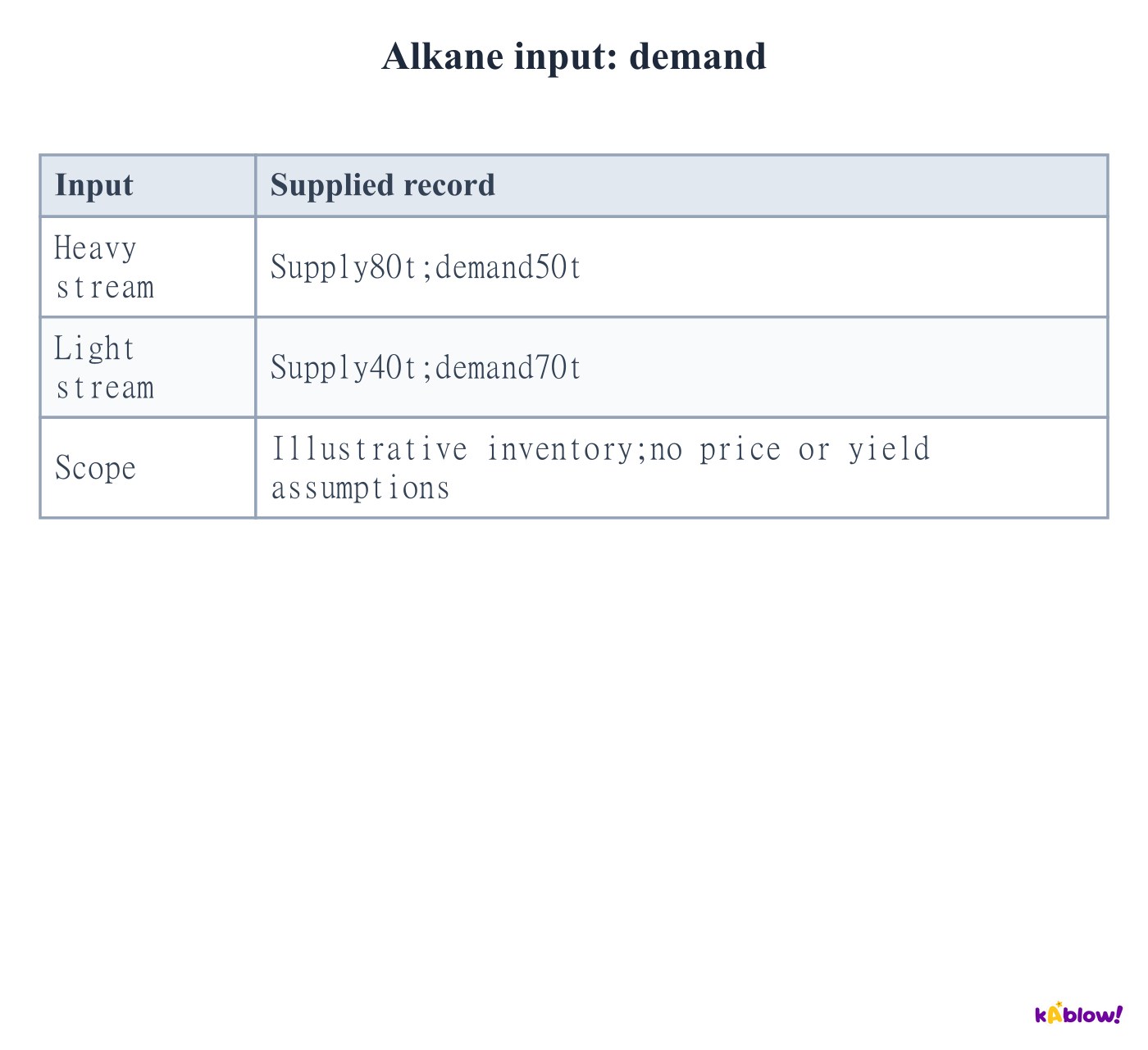
- A refinery can use conversion processes to turn less-demanded heavy material into more useful lighter fuel and chemical feedstock streams.
- The supplied fictional inventory has a surplus heavy fraction and a shortfall lighter fraction. It illustrates the economic reason to consider cracking, not a current market forecast.
- Conversion has energy, catalyst and equipment costs. A product being useful does not prove every operating choice is economically or environmentally preferable.
Alkane input: demand
Conserve atoms when cracking a molecule
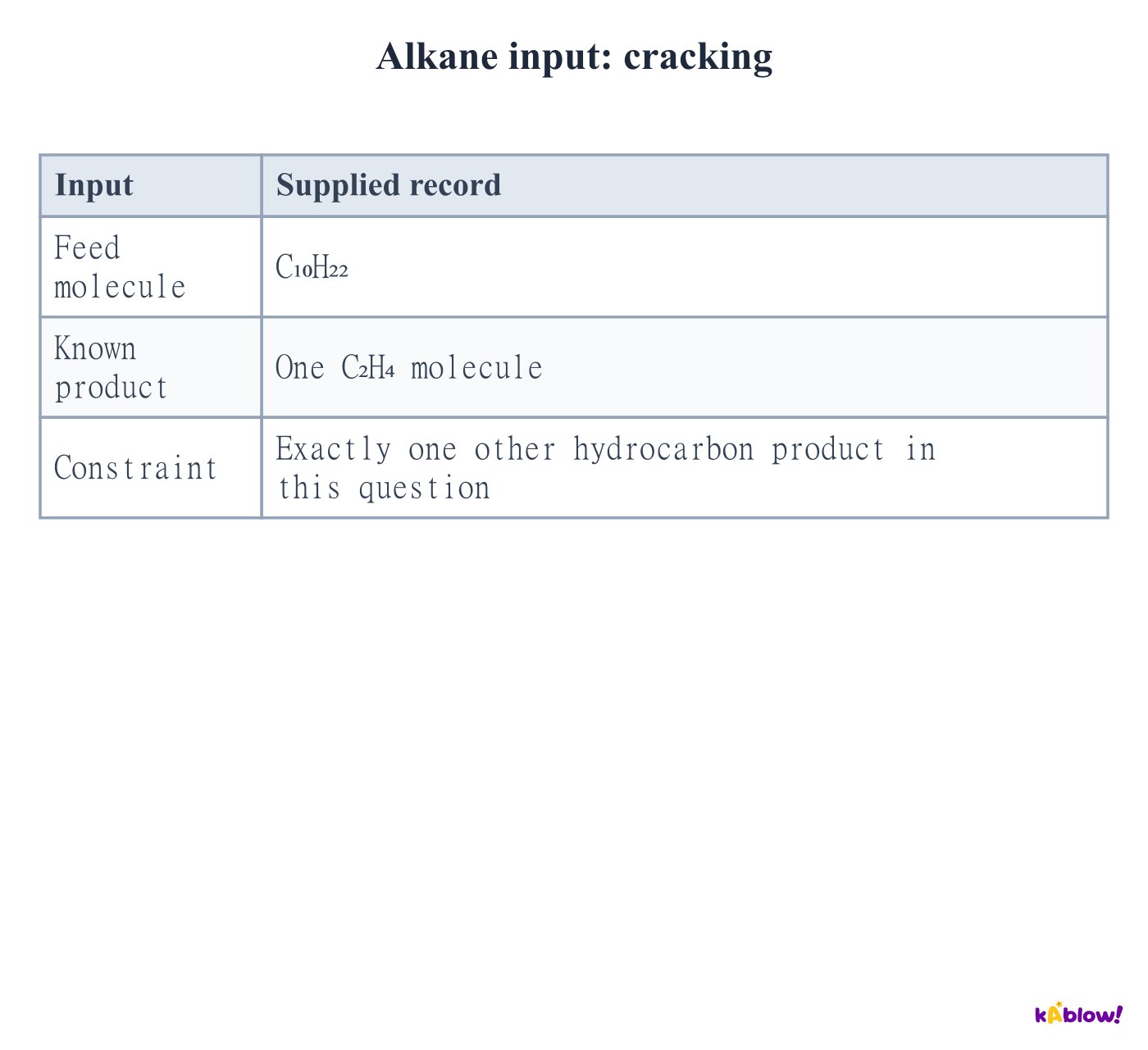
- Cracking changes covalent connectivity by breaking larger hydrocarbon molecules into smaller products. The course contrasts this chemical process with distillation.
- One balanced simplified route is C₁₀H₂₂→C₈H₁₈+C₂H₄. Its atom balance does not imply these are the only possible real products or a 100% selective yield.
- The reaction system receives heat, and the cracking feed is kept from simply burning with oxygen. Industrial product distributions depend on conditions and catalyst.
Alkane input: cracking
Compare thermal and catalytic cracking
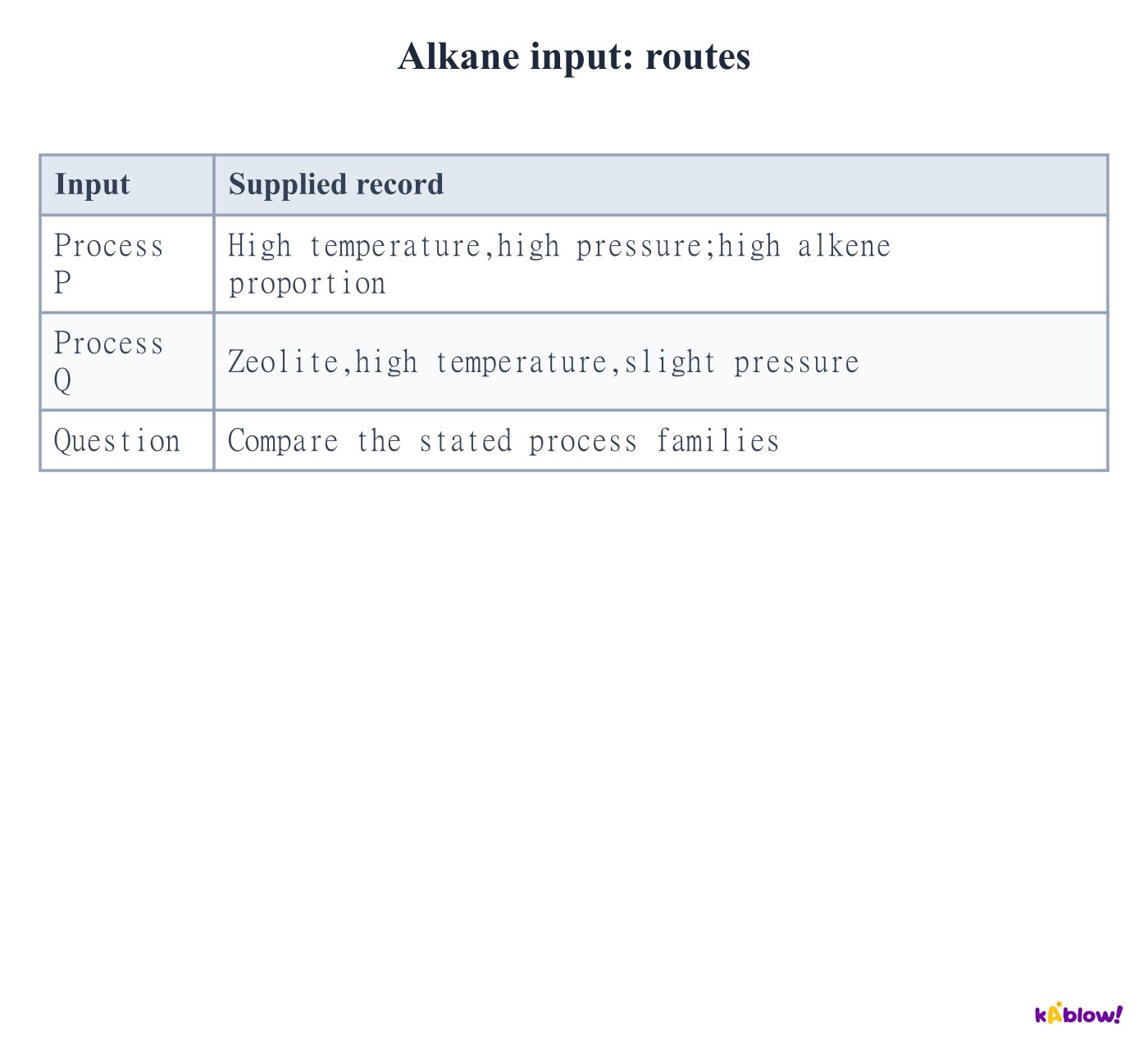
- Thermal cracking uses high temperature and high pressure and gives a high proportion of alkenes in the AQA comparison.
- Catalytic cracking uses a zeolite catalyst, high temperature and slight pressure. Its useful products include motor-fuel components and aromatic hydrocarbons.
- These are process families rather than one compulsory temperature for every unit. Do not claim catalytic cracking always gives exactly one smaller alkane and one alkene.
Alkane input: routes
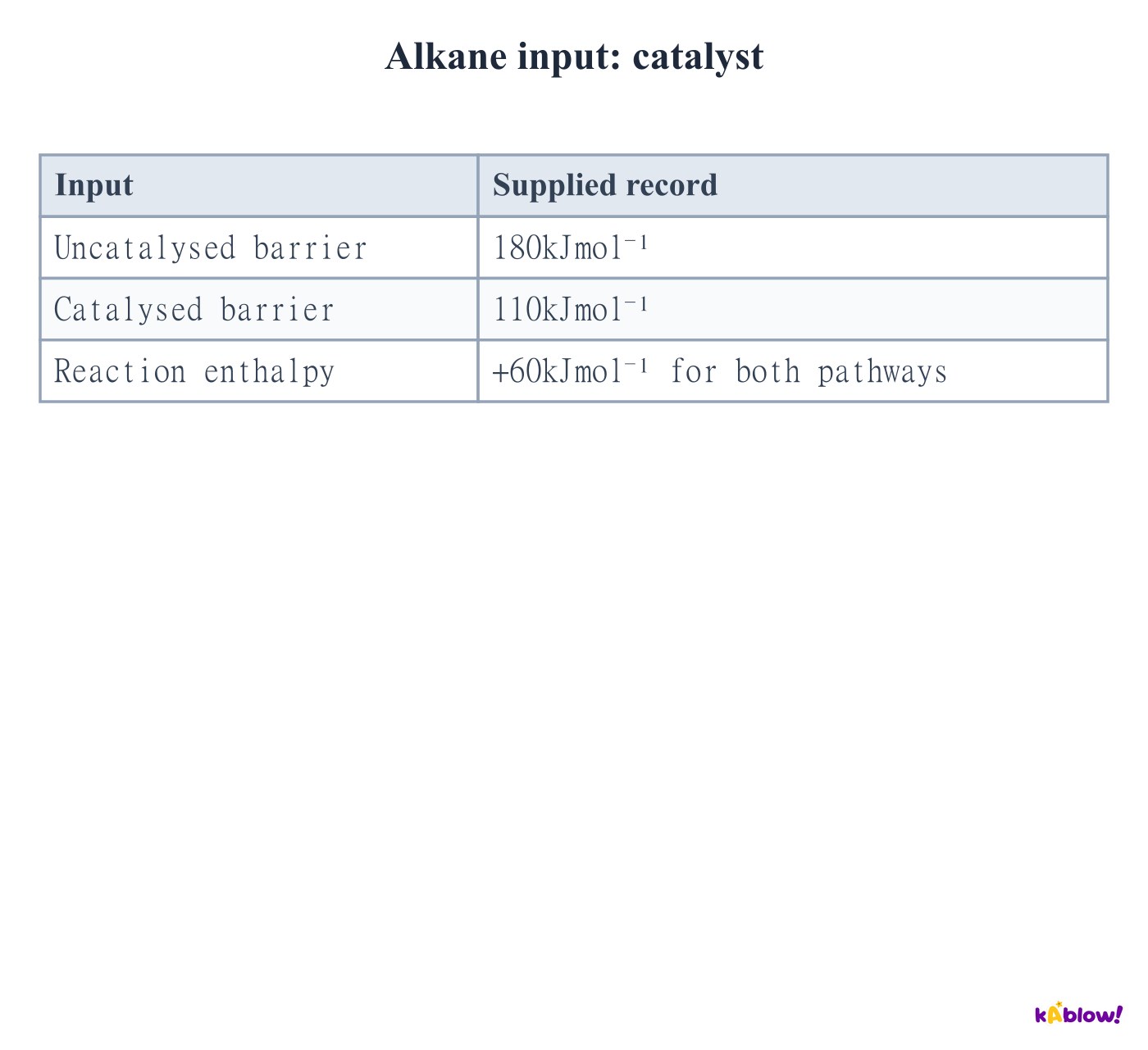
Keep catalyst action distinct from heat supply
- A catalyst provides an alternative pathway with lower activation energy. It can increase the reaction rate at suitable conditions without being consumed overall.
- Lower activation energy does not mean the reaction enthalpy changes or the equilibrium constant is automatically increased. Heat supply and catalyst action answer different questions.
- The illustrative energy figures are model inputs. They describe a barrier comparison rather than a measured commercial cracking unit.
Alkane input: catalyst
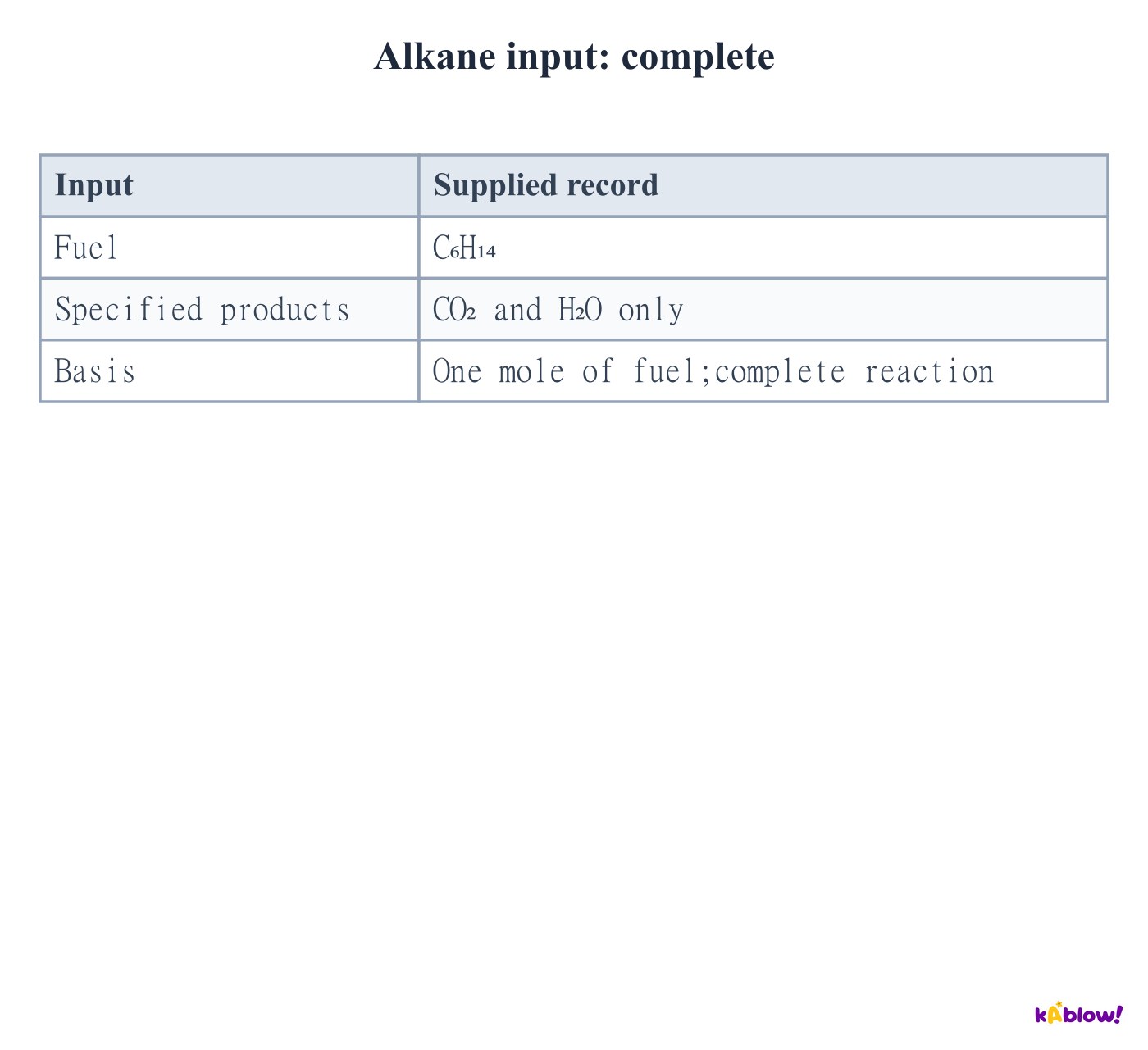
Write complete combustion from atom conservation
- Complete combustion of an acyclic alkane forms carbon dioxide and water under suitable oxygen supply and reaction conditions.
- For CₙH₂ₙ₊₂, the balanced amount ratio is one alkane to(3n+1)/2 oxygen, n carbon dioxide and(n+1) water.
- This is an ideal complete-combustion model. Real flames and engines can have mixing or kinetic limitations even when an overall oxygen supply is large.
Alkane input: complete
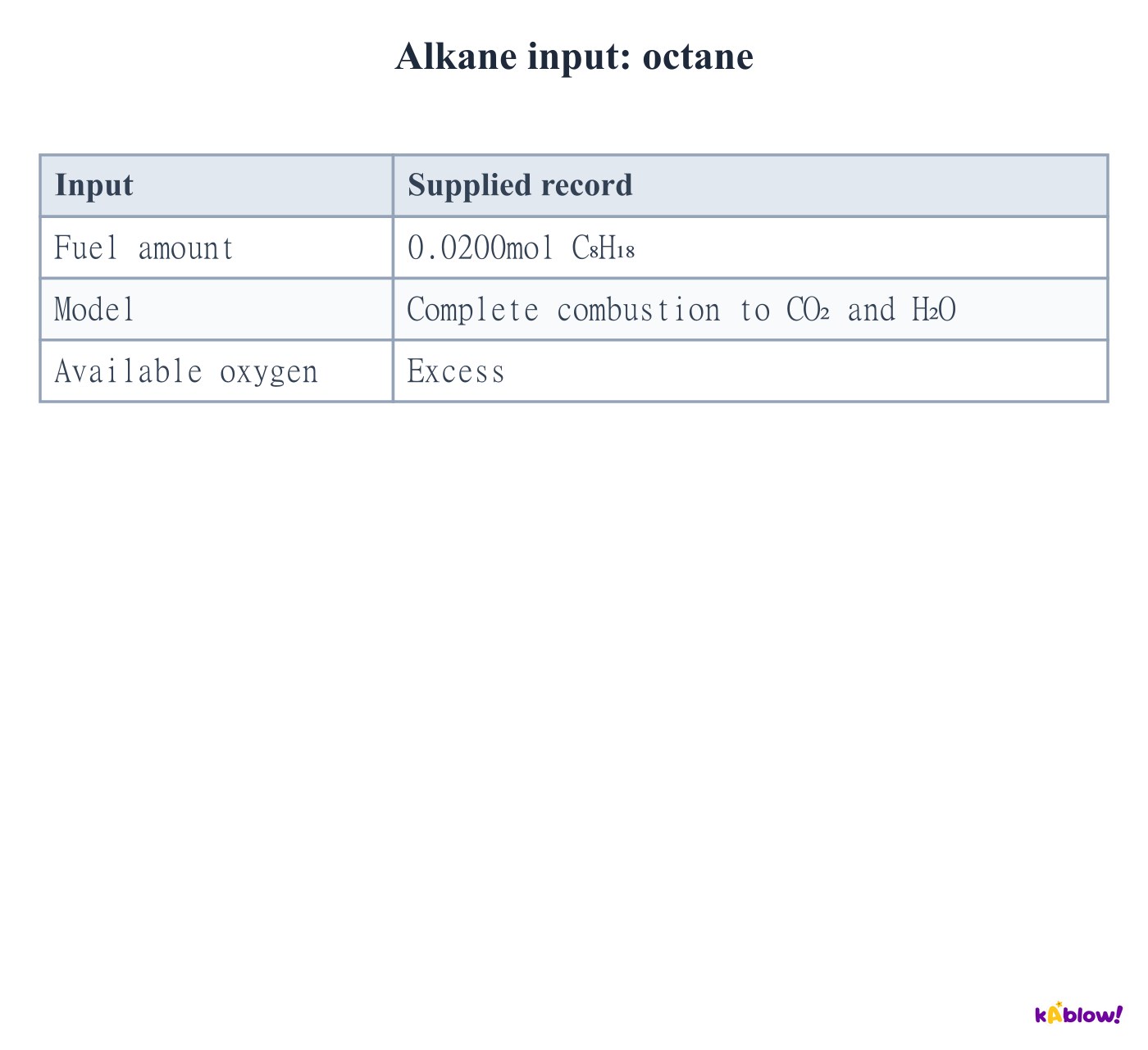
Use a balanced octane equation quantitatively
- The balanced integer equation is 2C₈H₁₈+25O₂→16CO₂+18H₂O. Coefficients give mole ratios as well as molecular counts.
- One mole of octane therefore uses 12.5 mol O₂ and produces 8 mol CO₂ and 9 mol H₂O in this model.
- A combustion equation must conserve oxygen atoms as well as carbon and hydrogen. An oxygen coefficient cannot be chosen solely from the carbon dioxide term.
Alkane input: octane
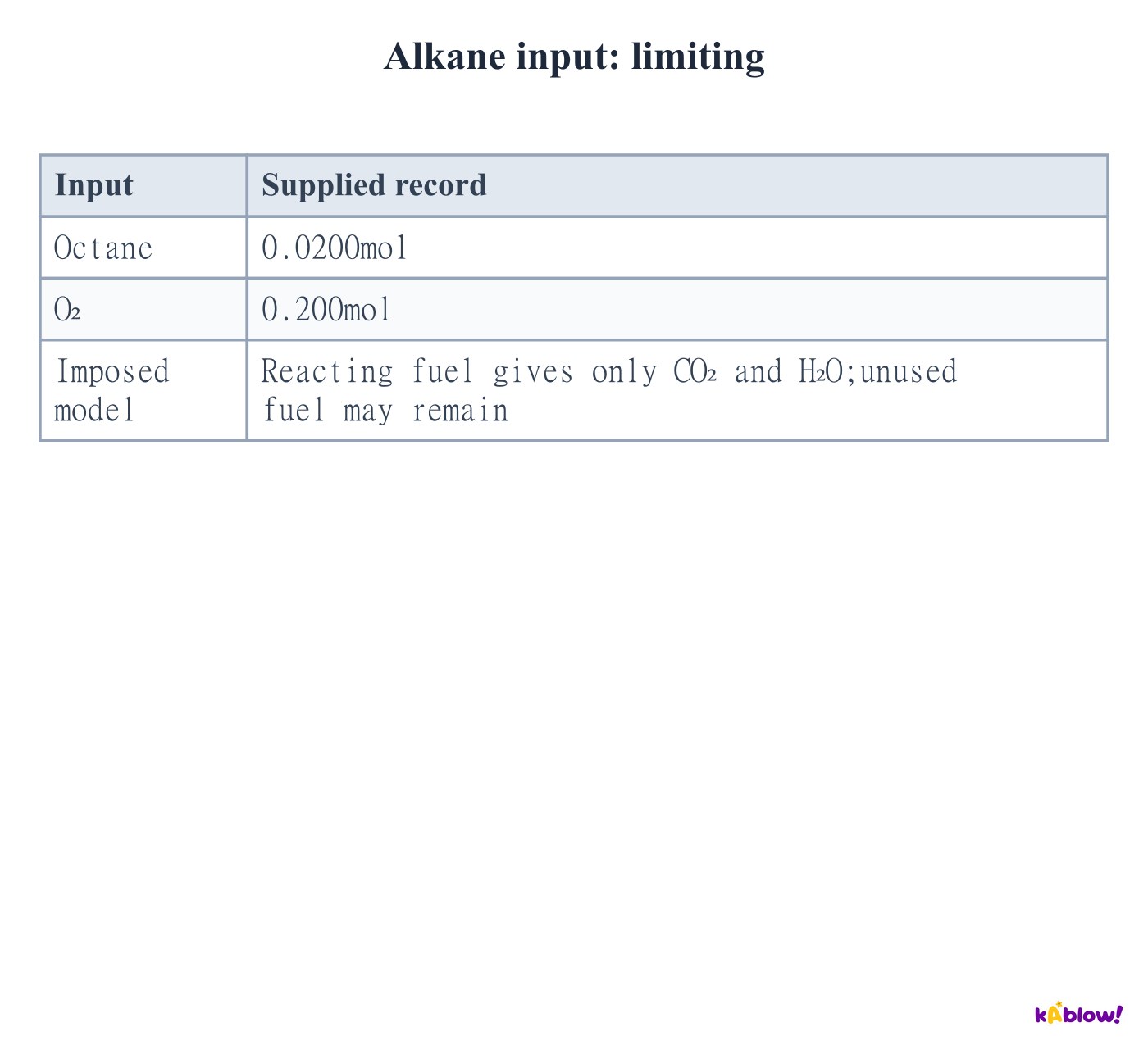
Identify the limiting reactant in an ideal combustion model
- The supplied octane amount would need 0.250 mol O₂ for full consumption, but only 0.200 mol is available. Oxygen limits the extent of the specified model.
- If the problem explicitly allows only the complete-combustion route for the reacting fraction,0.0160 mol octane reacts and 0.00400 mol remains.
- This calculation is not a prediction that an oxygen-starved real flame produces only CO₂. Incomplete products may form unless the ideal product model is imposed.
Alkane input: limiting
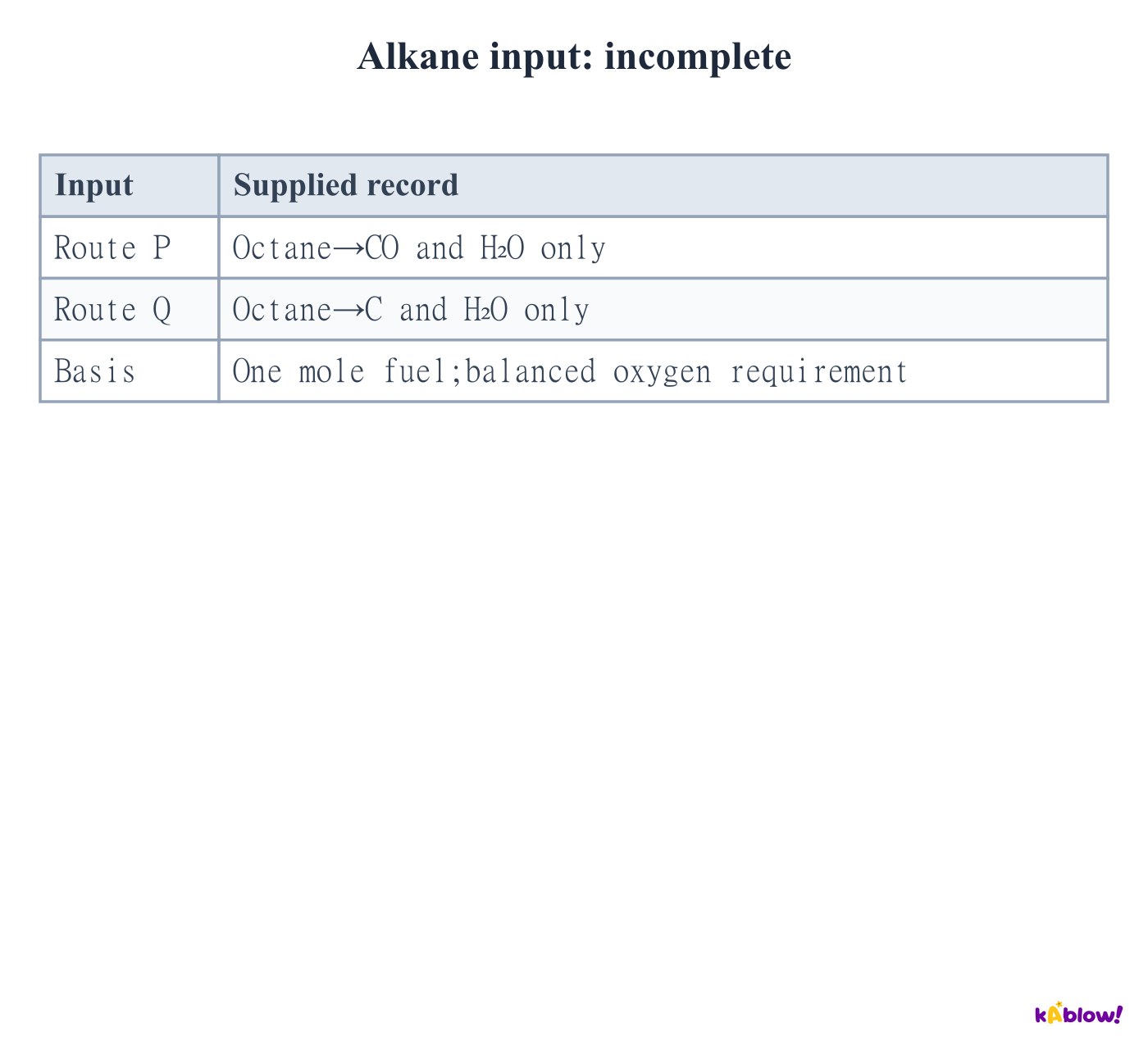
Allow more than one incomplete-combustion product
- With limited or poorly mixed oxygen, carbon monoxide and/or carbon soot may form alongside water and some carbon dioxide. There is no single compulsory incomplete-product ratio.
- Two ideal limiting equations for octane are 2C₈H₁₈+17O₂→16CO+18H₂O and 2C₈H₁₈+9O₂→16C+18H₂O.
- These equations isolate different carbon-containing products. Real exhaust can contain mixtures and unburned fuel, so a product analysis is needed for exact emissions.
Alkane input: incomplete
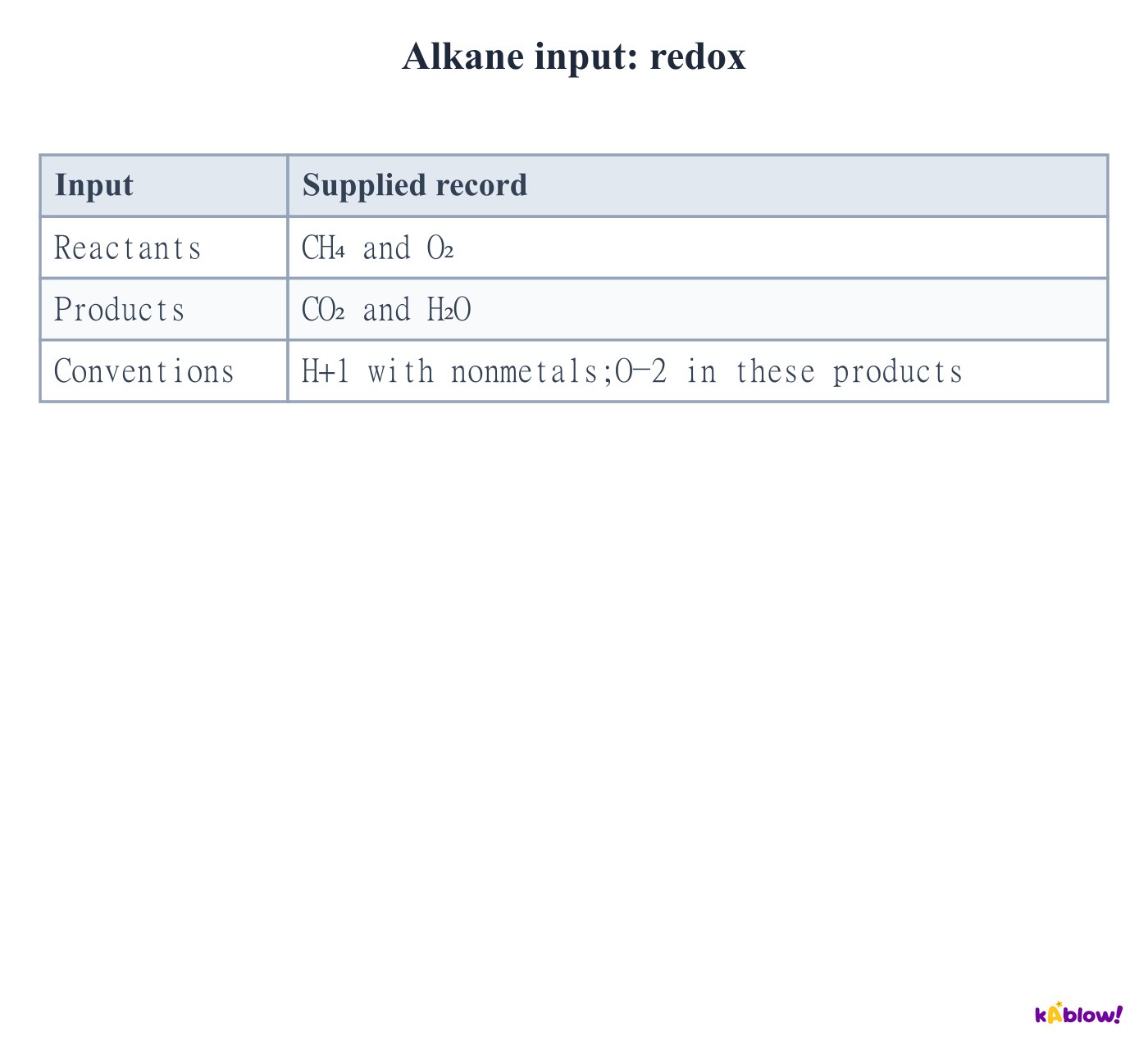
Check oxidation states rather than saying every atom is oxidised
- In these hydrocarbon combustion models, hydrogen is normally+1 in the fuel and remains +1 in water. Formation of water does not mean hydrogen must have increased its oxidation state.
- Carbon undergoes net oxidation to+4 in CO₂ or to+2 in CO. Oxygen changes from 0 in O₂ to−2 in these products.
- Bond breaking requires energy; energy released on forming product bonds can exceed that input. An exothermic overall reaction is not evidence that breaking any bond releases energy.
Alkane input: redox
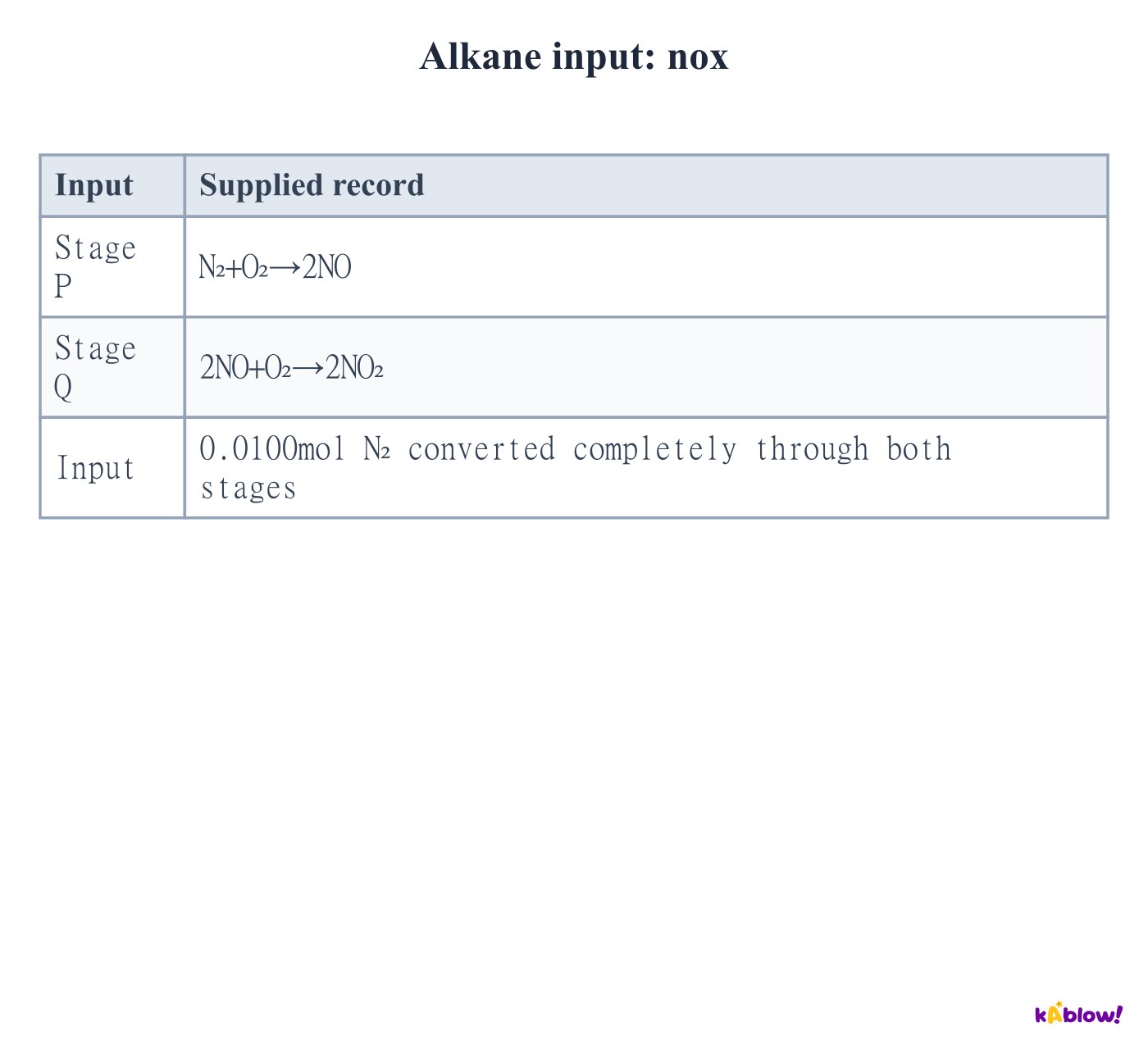
Trace nitrogen oxides to hot air reactions
- At high engine temperatures, nitrogen and oxygen from air can form NO. Nitrogen monoxide can then oxidise further to NO₂ in air.
- Use N₂+O₂→2NO and 2NO+O₂→2NO₂ as balanced course equations. Fuel does not need to contain nitrogen for this thermal-NO route.
- NOx contributes to atmospheric chemistry including acid formation and photochemical pollution. Avoid claiming that every pollutant has one identical environmental effect.
Alkane input: nox
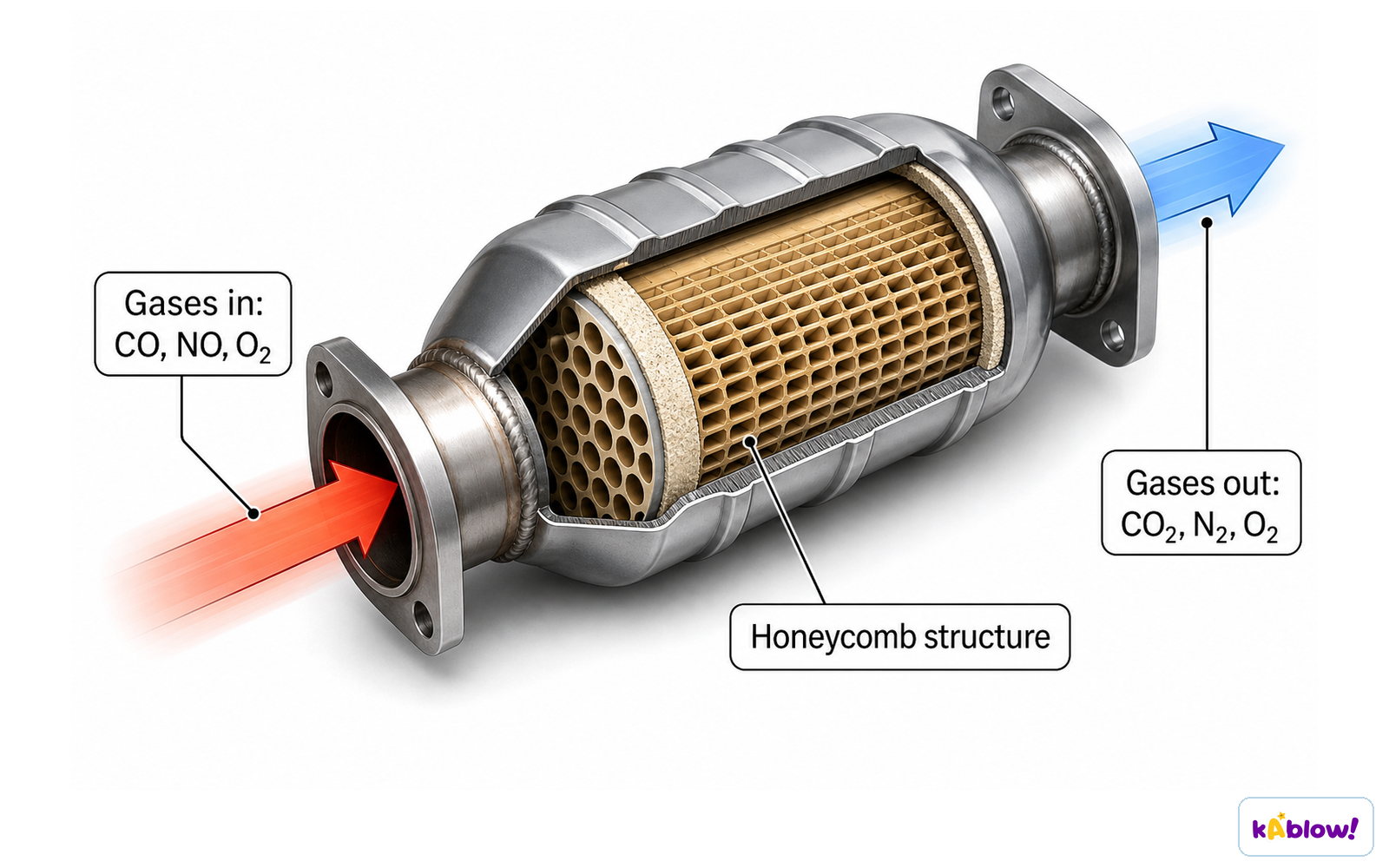
Explain the catalytic converter’s reacting surface
- The cutaway shows gas flow through many catalyst-coated channels. A large accessible surface allows gases to contact the catalytic material.
- The course examples oxidise CO to CO₂ and use CO to reduce NO to N₂. Oxidation of unburned hydrocarbons can also produce CO₂ and water.
- The illustration selects a few gas species and includes possible unused O₂; it is not the full composition of an exhaust stream or proof of 100% removal. The catalyst needs suitable operating conditions.
Catalyst-coated gas-flow channels
Connect sulfur impurities with sulfur dioxide
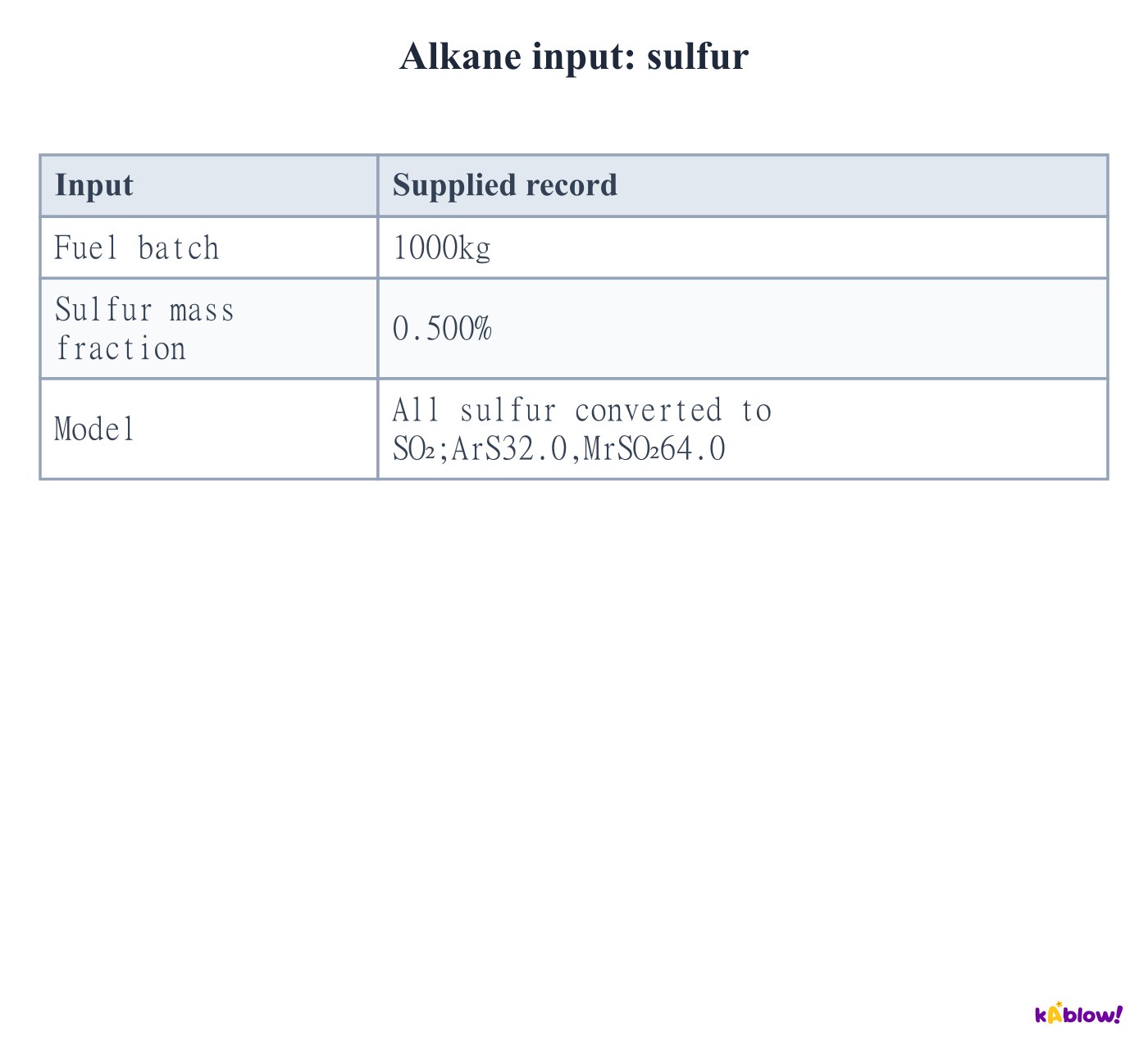
- Sulfur-containing material in a fuel can form SO₂ during combustion. A basic oxide or carbonate can be used to remove this acidic gas from flue gas.
- The simplified sulfur balance S+O₂→SO₂ gives one mole of SO₂ per mole of sulfur oxidised by that route.
- Removing SO₂ reduces one acidifying emission. It does not automatically remove the CO₂ generated by the fuel or all other exhaust components.
Alkane input: sulfur
Use countercurrent contact and forced oxidation
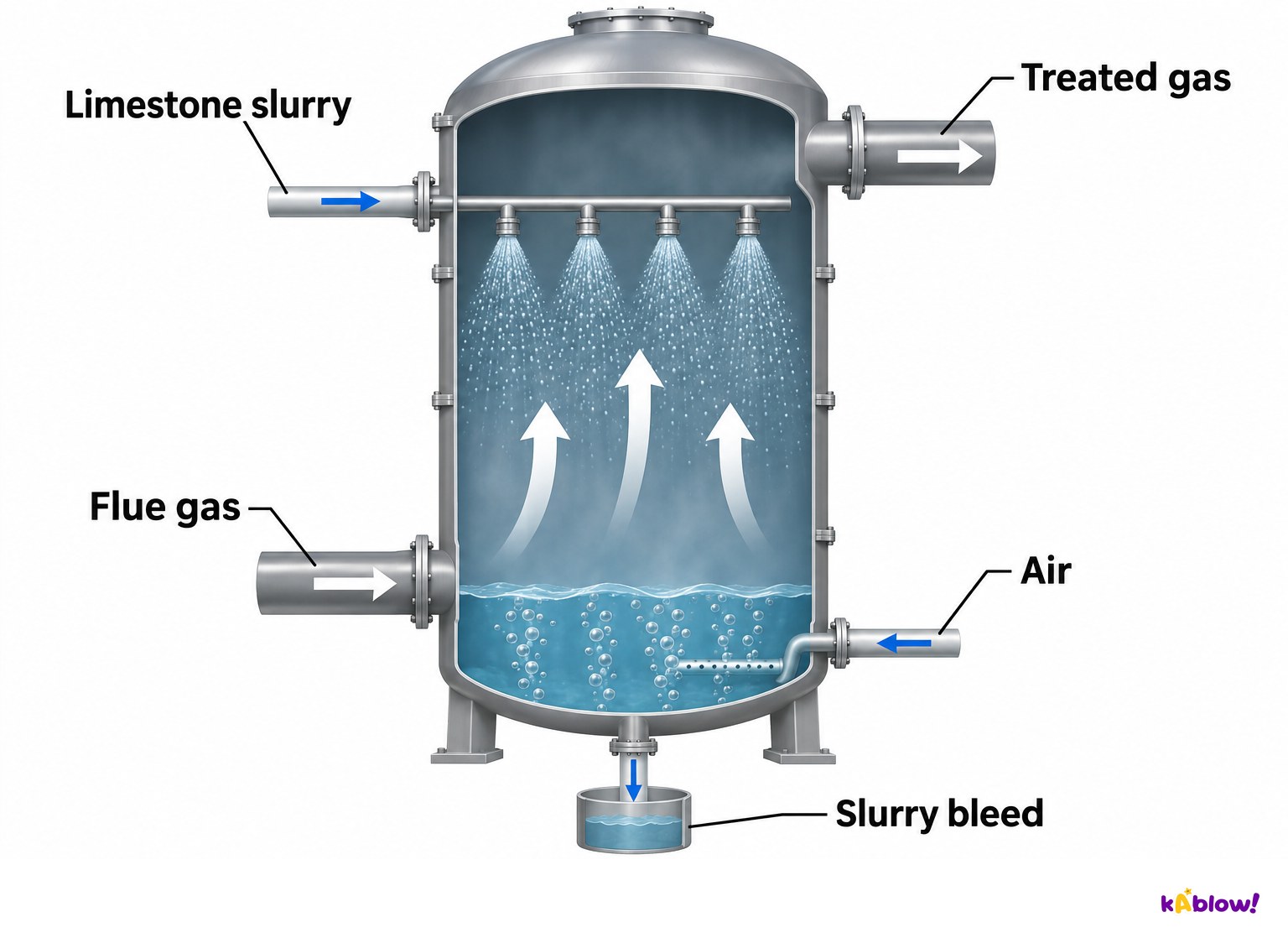
- The scrubber cutaway shows rising flue gas meeting descending limestone slurry. Distributed spray creates contact between gas and liquid.
- Air enters the sump in this forced-oxidation model, allowing absorbed sulfur(IV) products to be oxidised toward sulfate. The bleed removes slurry for further processing.
- Treated gas is not necessarily pollutant-free. The drawing gives no fixed removal percentage and does not imply that collected solids are automatically pure gypsum.
Countercurrent wet scrubber with sump aeration
Distinguish sulfite capture from sulfate formation
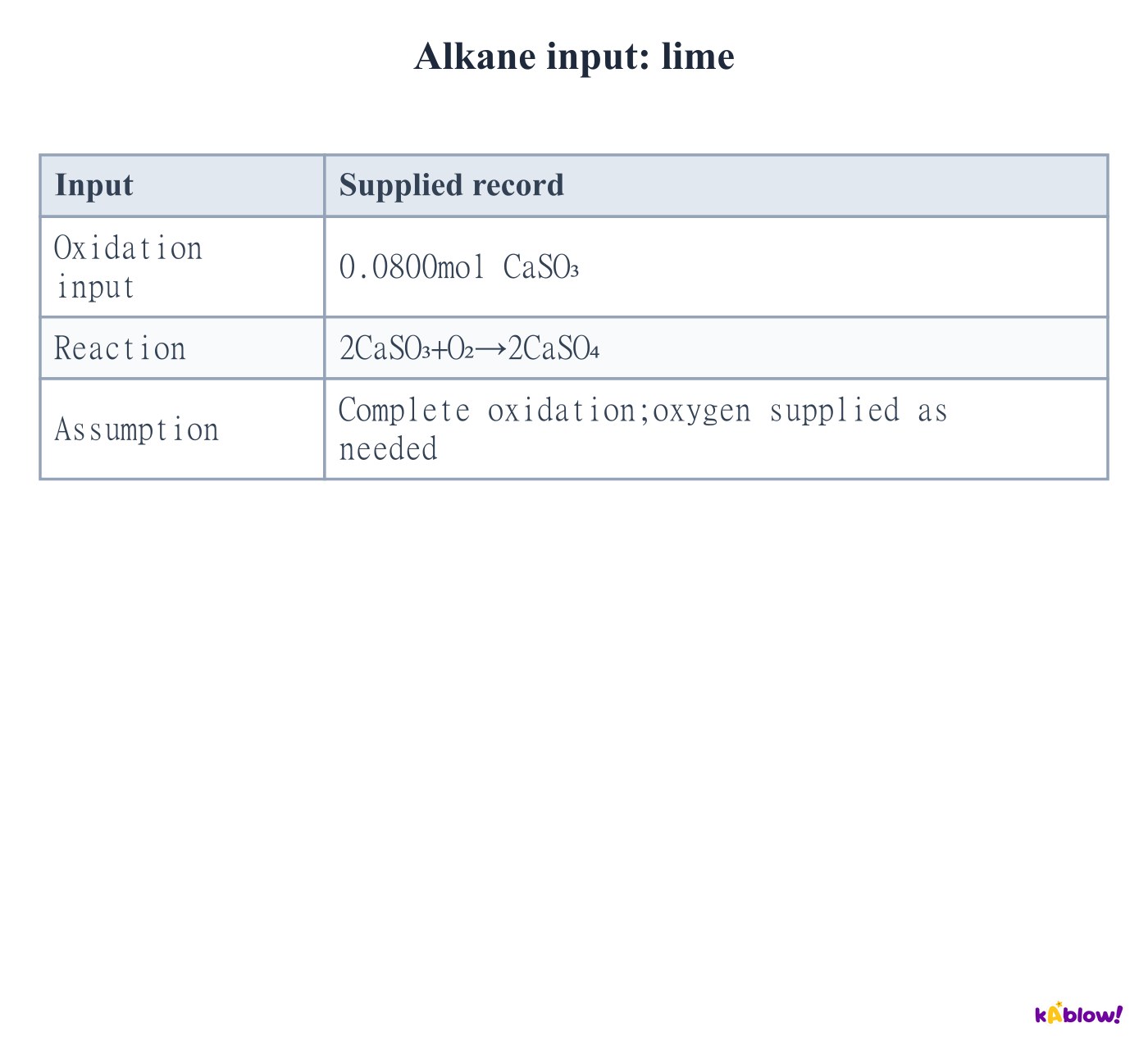
- A simplified capture equation is CaO+SO₂→CaSO₃. Calcium sulfite can then be oxidised:2CaSO₃+O₂→2CaSO₄.
- In aqueous operation, hydration and dissolved species add detail. The net dry-form overall equation is CaO+SO₂+½O₂→CaSO₄.
- Gypsum is CaSO₄·2H₂O rather than anhydrous CaSO₄. Include two waters per formula unit if the requested product is the dihydrate.
Alkane input: lime
Balance removal benefits against reagent and carbon costs
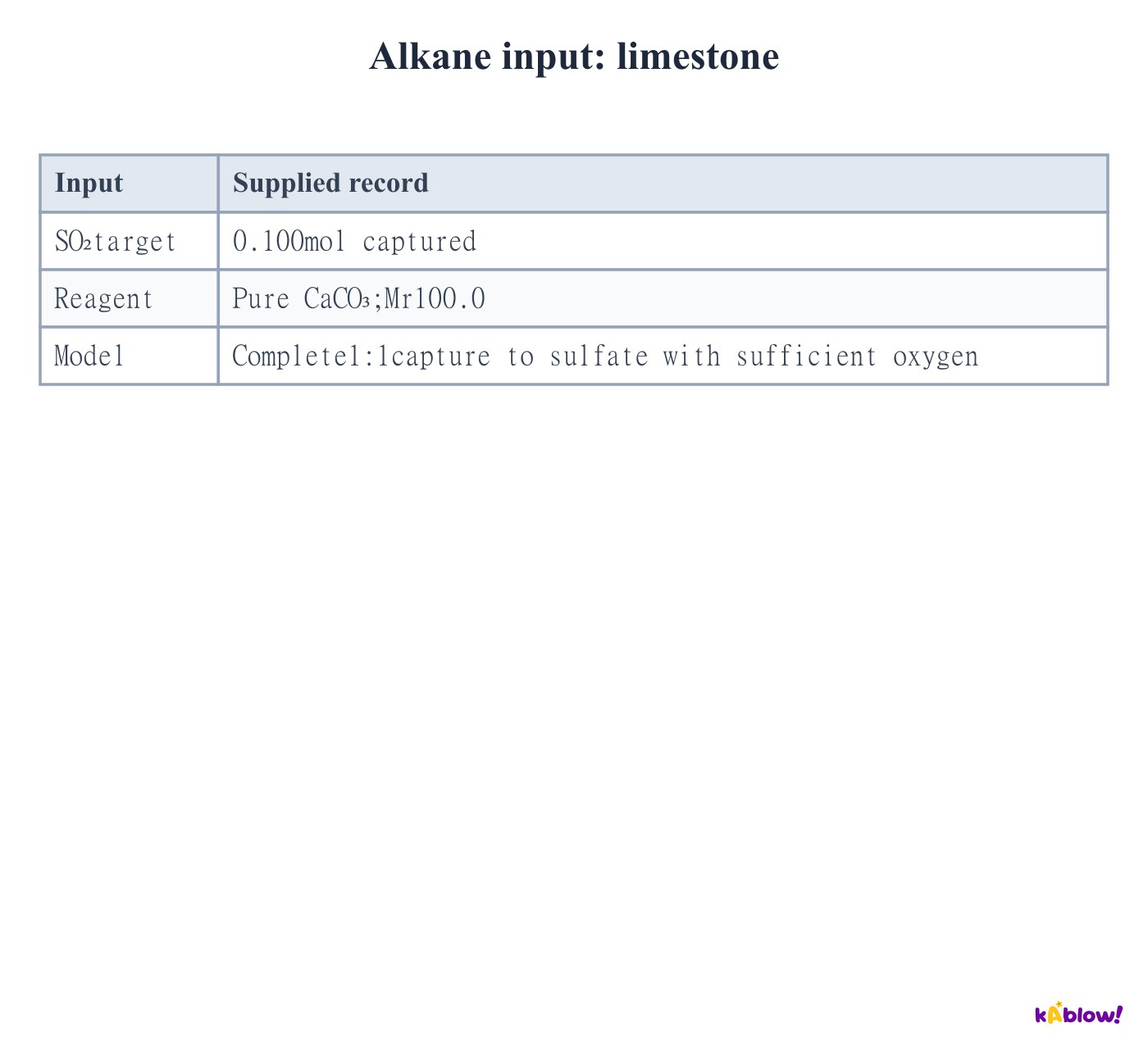
- For the stated sulfate model, CaCO₃+SO₂+½O₂→CaSO₄+CO₂. Carbonate consumption and captured SO₂ have a 1:1mole ratio.
- Calcium carbonate also releases CO₂ in this reaction. An SO₂control process is not automatically a carbon-capture process.
- For gypsum output, include two waters in the overall balance. Actual reagent demand can exceed stoichiometry when purity and conversion are below 100%.
Alkane input: limestone
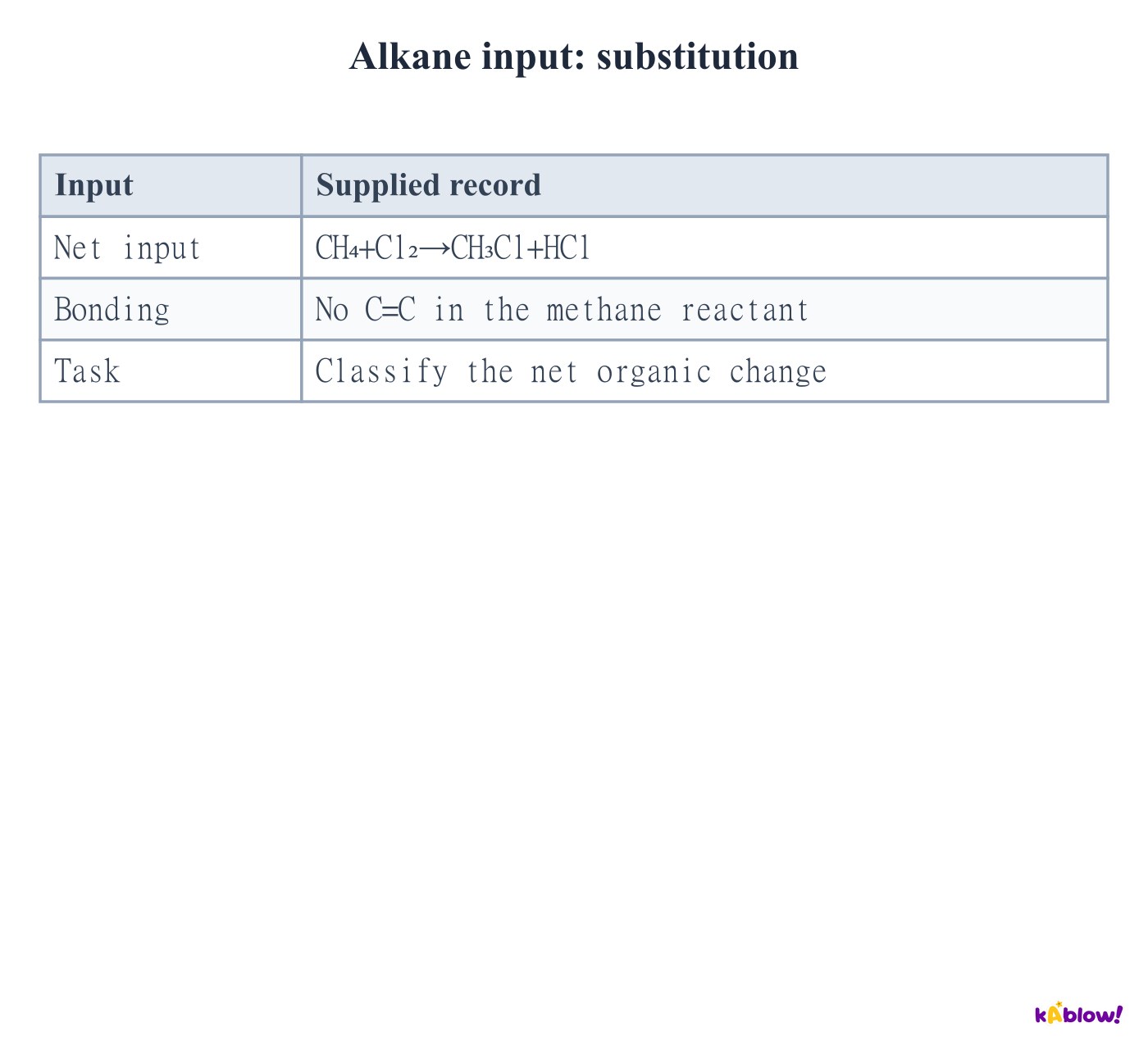
Describe methane chlorination as substitution
- The overall single-substitution equation is CH₄+Cl₂→CH₃Cl+HCl. A hydrogen atom is replaced by chlorine rather than a double bond being opened.
- The course initiates the chain by UV light causing Cl–Cl homolysis. Artificial UV can supply this input; sunlight is not the only possible light source.
- Keep an overall equation separate from the mechanism. It gives net atom balance without showing the radical intermediates.
Alkane input: substitution
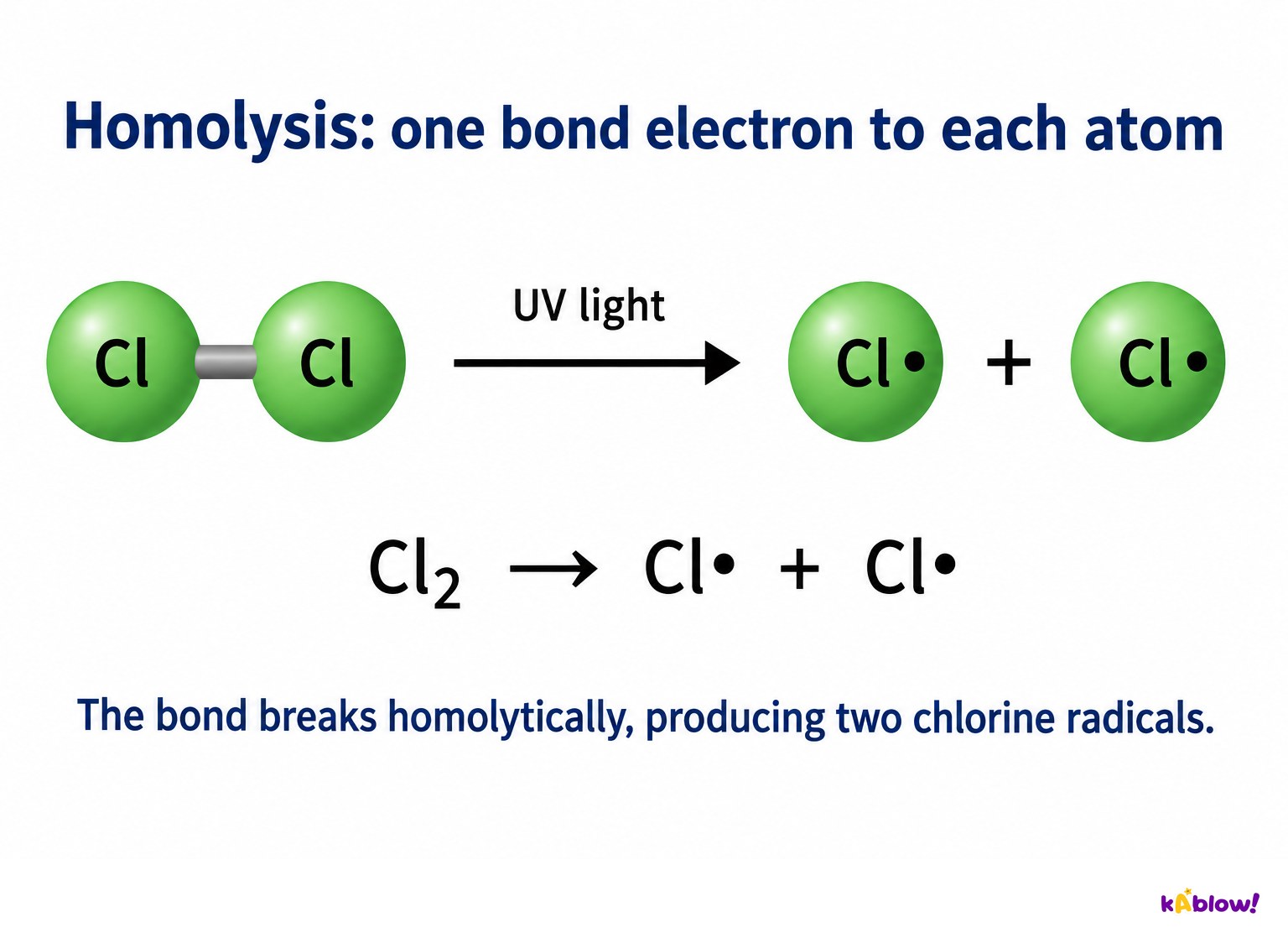
Mark the unpaired electron in initiation
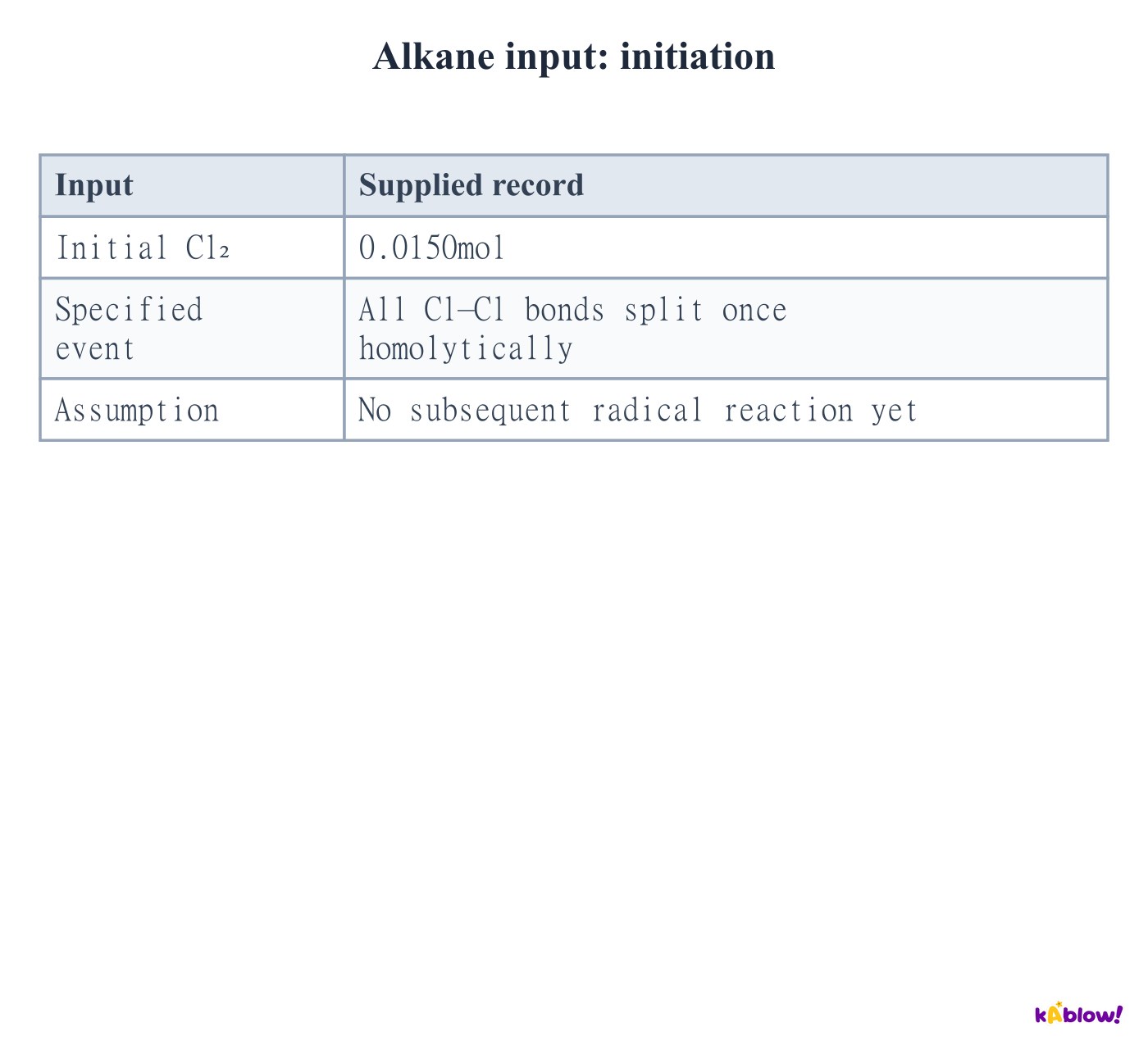
- UV light can split Cl₂ homolytically to give 2Cl•. Each radical receives one electron from the original shared pair.
- The dot records an unpaired electron rather than an ionic charge. This is different from assigning both bond electrons to one atom.
- The illustration shows the initiation event. A radical chain can subsequently undergo many propagation cycles before termination; UV does not have to supply a new photon for every individual propagation step.
Chlorine homolysis and radical notation
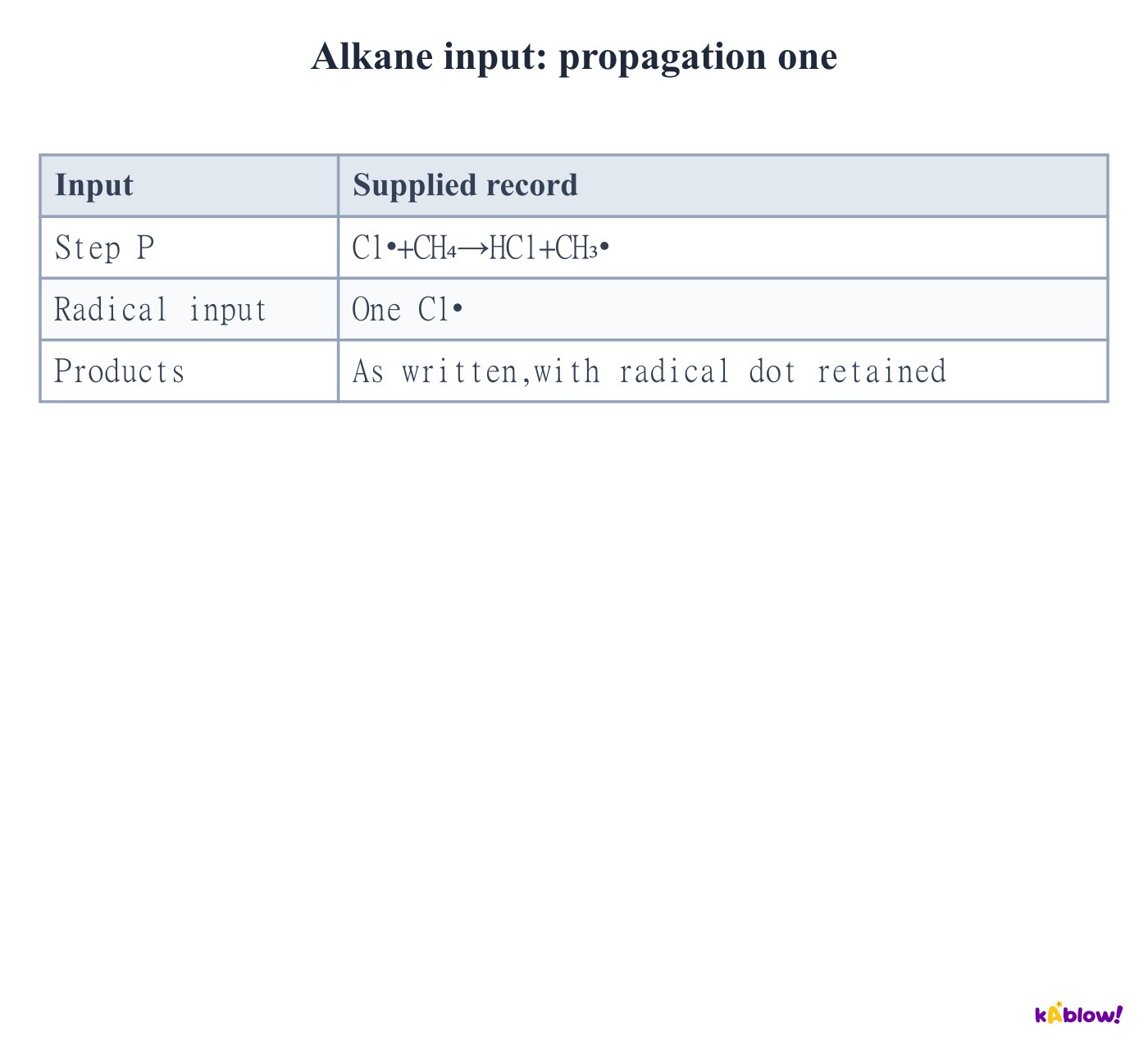
Form the carbon radical in the first propagation step
- The first methane step is Cl•+CH₄→HCl+CH₃•. It transfers the radical character from chlorine to the methyl species while conserving atoms.
- One radical appears on each side. The dot must remain onCH₃• in the product:writing ordinary CH₃ without explaining its radical state loses important electron bookkeeping.
- The step is not the final net reaction. The methyl radical still needs a subsequent reaction to form chloromethane and regenerate chlorine radical.
Alkane input: propagation one
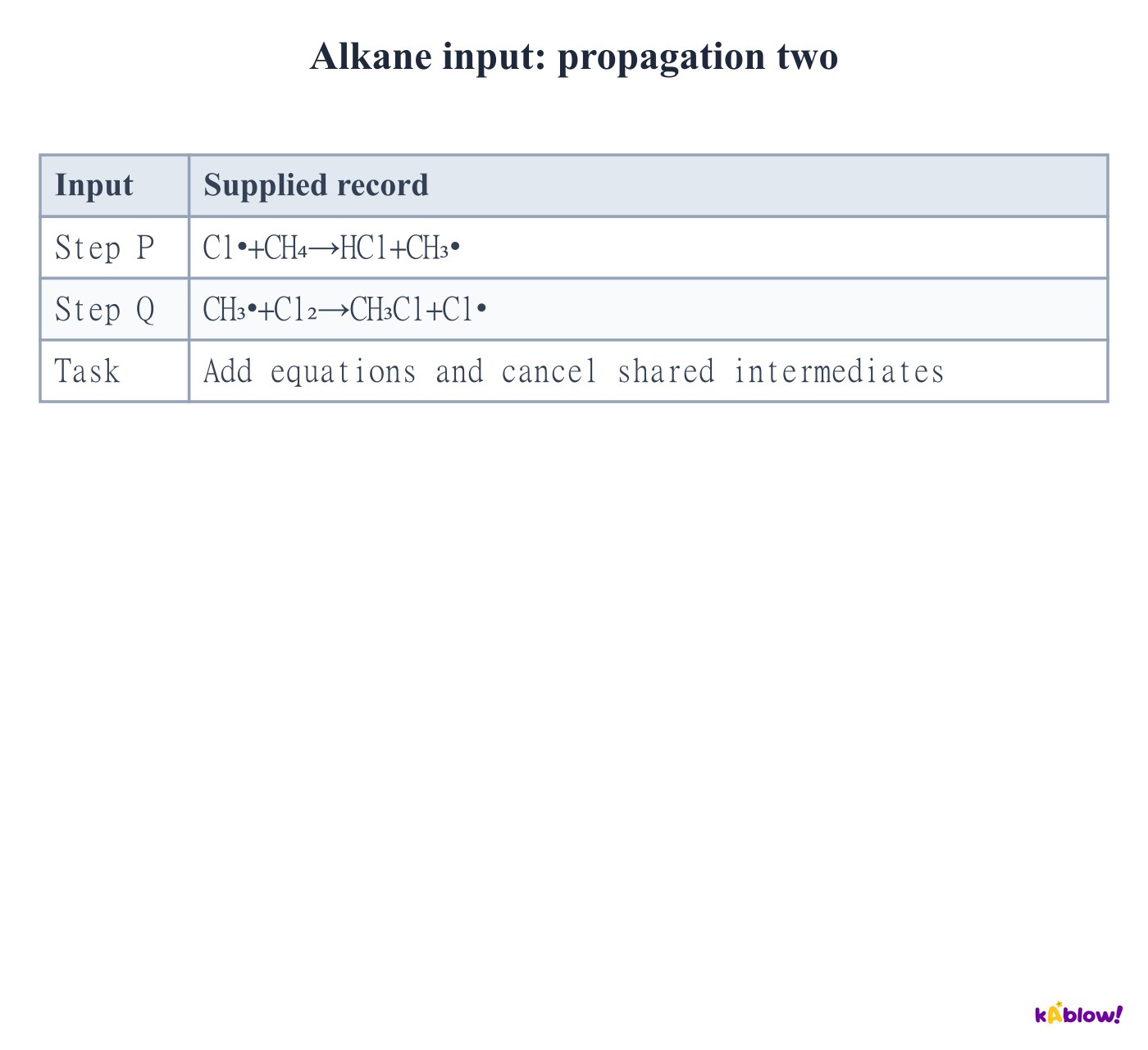
Regenerate the chlorine radical
- The second step is CH₃•+Cl₂→CH₃Cl+Cl•. It forms chloromethane and regenerates the chlorine radical.
- Adding the two propagation equations cancelsCH₃• and Cl• to giveCH₄+Cl₂→CH₃Cl+HCl. A radical can carry the chain without appearing in the net equation.
- Cancellation does not mean intermediates were never formed. It means the two listed steps consume and regenerate them in matching amounts.
Alkane input: propagation two
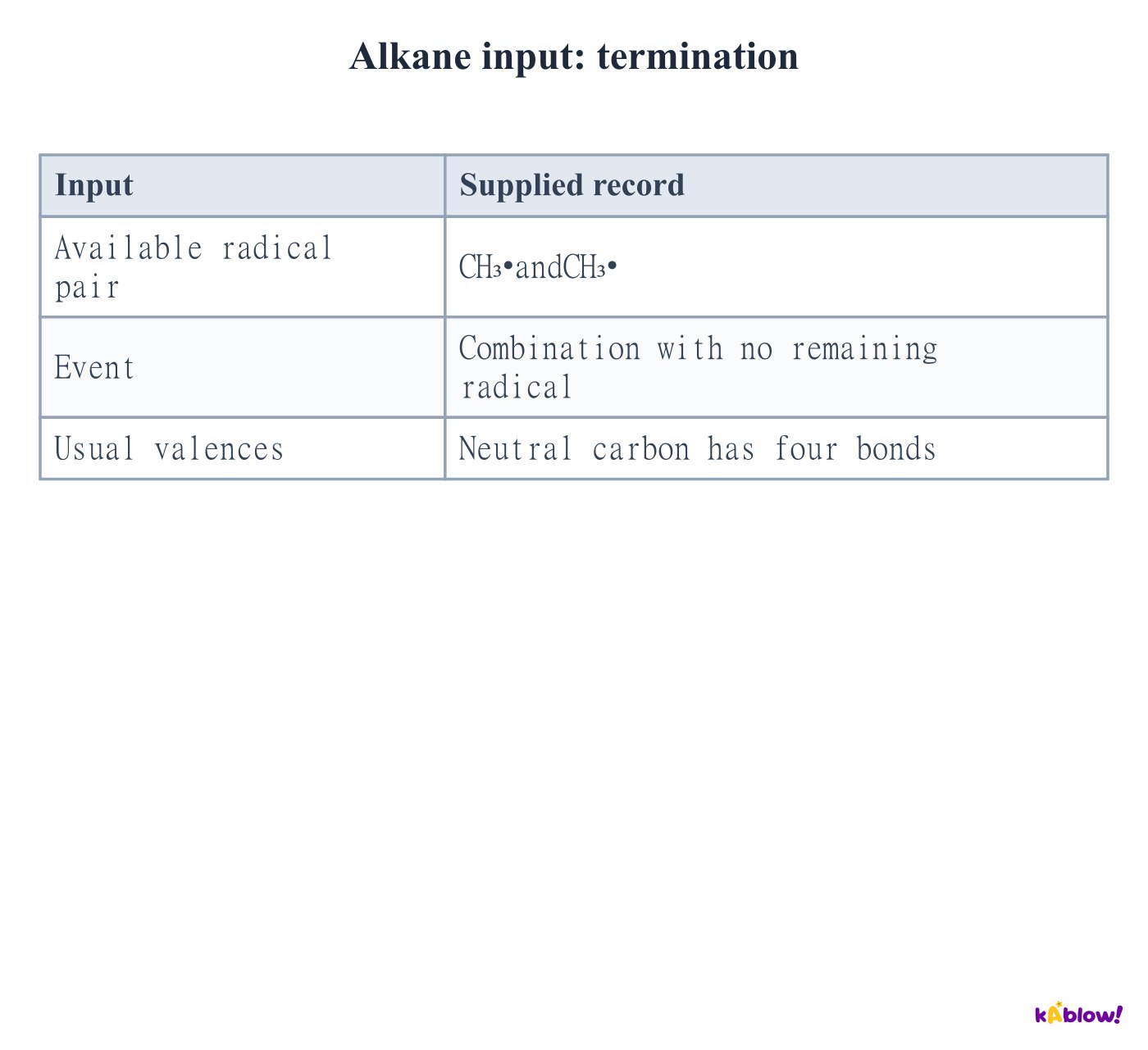
Remove radicals by combination
- Possible methane-system termination equations includeCl•+Cl•→Cl₂, CH₃•+Cl•→CH₃Cl and CH₃•+CH₃•→C₂H₆.
- Two radicals combine without a radical product in these models. Forming ethane is a possible side-product pathway, not the intended single-substitution net equation.
- Answer the requested radical combination. Chlorine recombination is chemically a termination event, but it does not answer a question asking specifically for an organic termination product.
Alkane input: termination
Explain why radical substitution gives mixtures
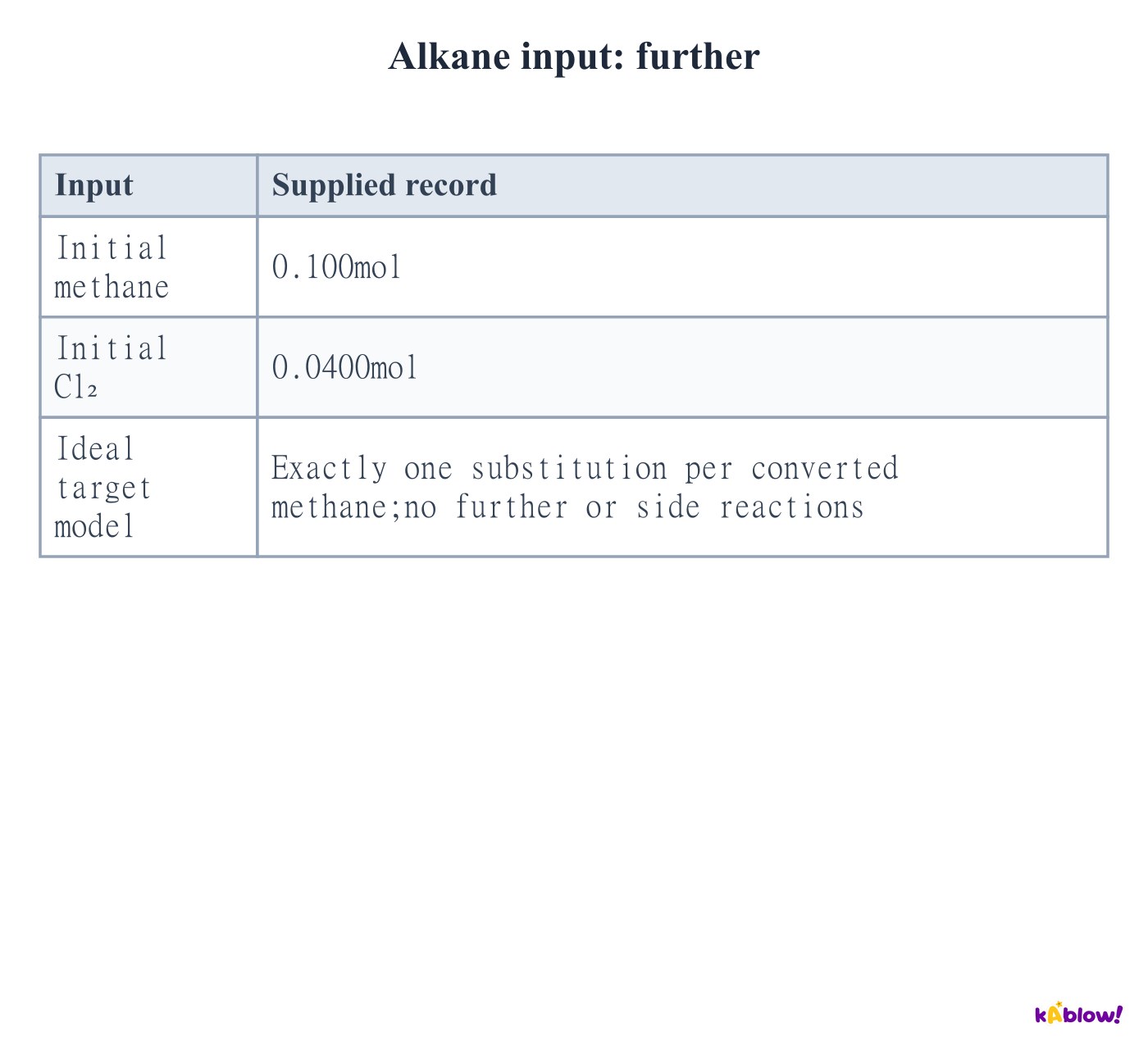
- Chloromethane can undergo further substitution to CH₂Cl₂, CHCl₃ and CCl₄ under suitable conditions. One reaction mixture need not stop cleanly at the first substitution.
- Using a large excess of methane relative to chlorine can favour fewer multiple substitutions, but it does not prove a pure isolated product or eliminate termination pathways.
- Product yield must use the specified target and limiting reagent. A fully substituted formula is a possible endpoint model, not a guarantee that every molecule reaches it.
Alkane input: further
Use symmetry when counting monochloro products
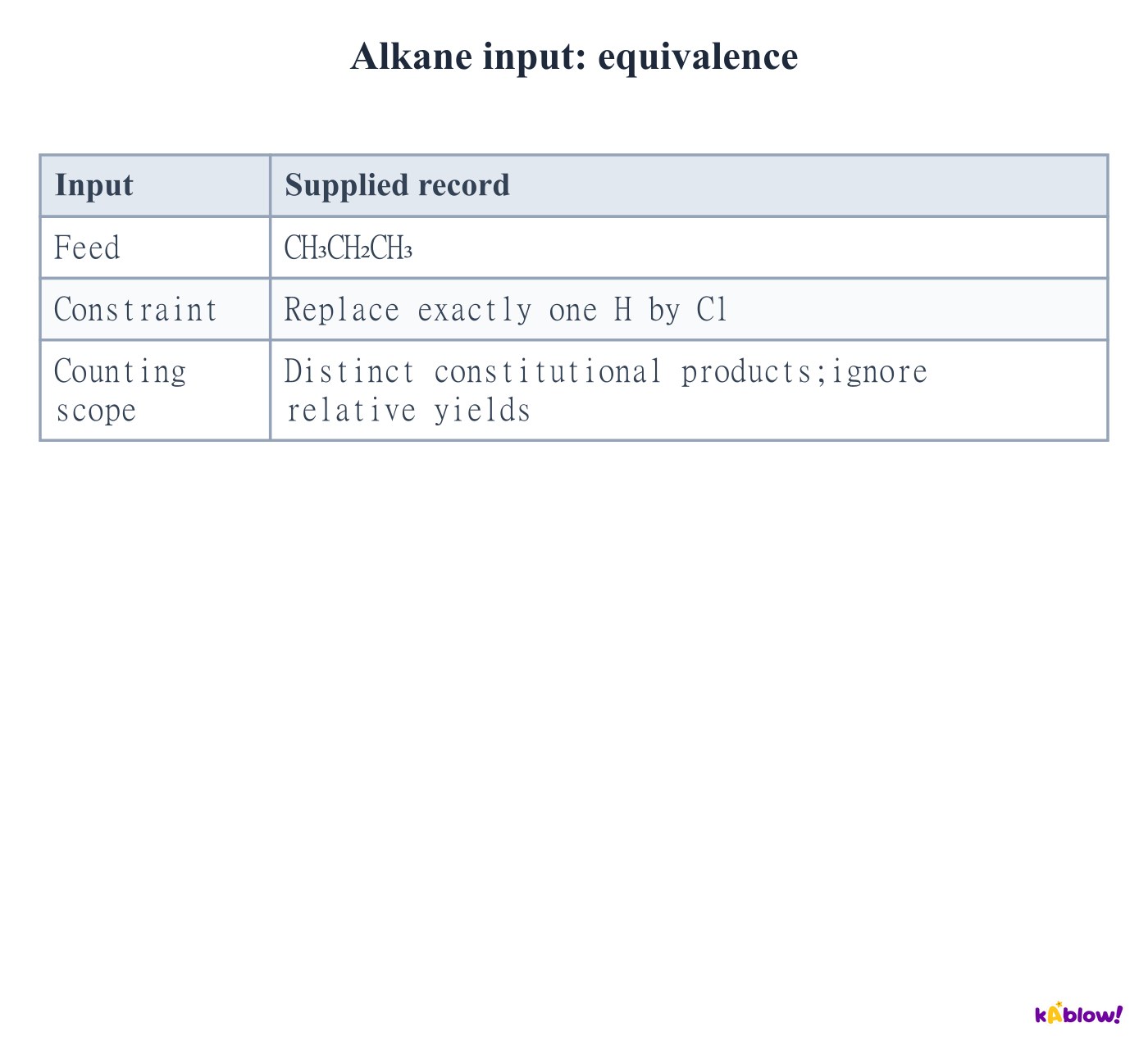
- All hydrogen positions in ethane are equivalent for constitutional monochlorination, so only one chloroethane connectivity results.
- Propane has equivalent terminal positions and a different middle position. Its distinct constitutional monochloro products are 1-chloropropane and 2-chloropropane.
- This is a connectivity count, not a prediction of equal product amounts. Equivalent drawings and repeated hydrogens do not each become new structural isomers.
Alkane input: equivalence
Evaluate a stated emissions reduction
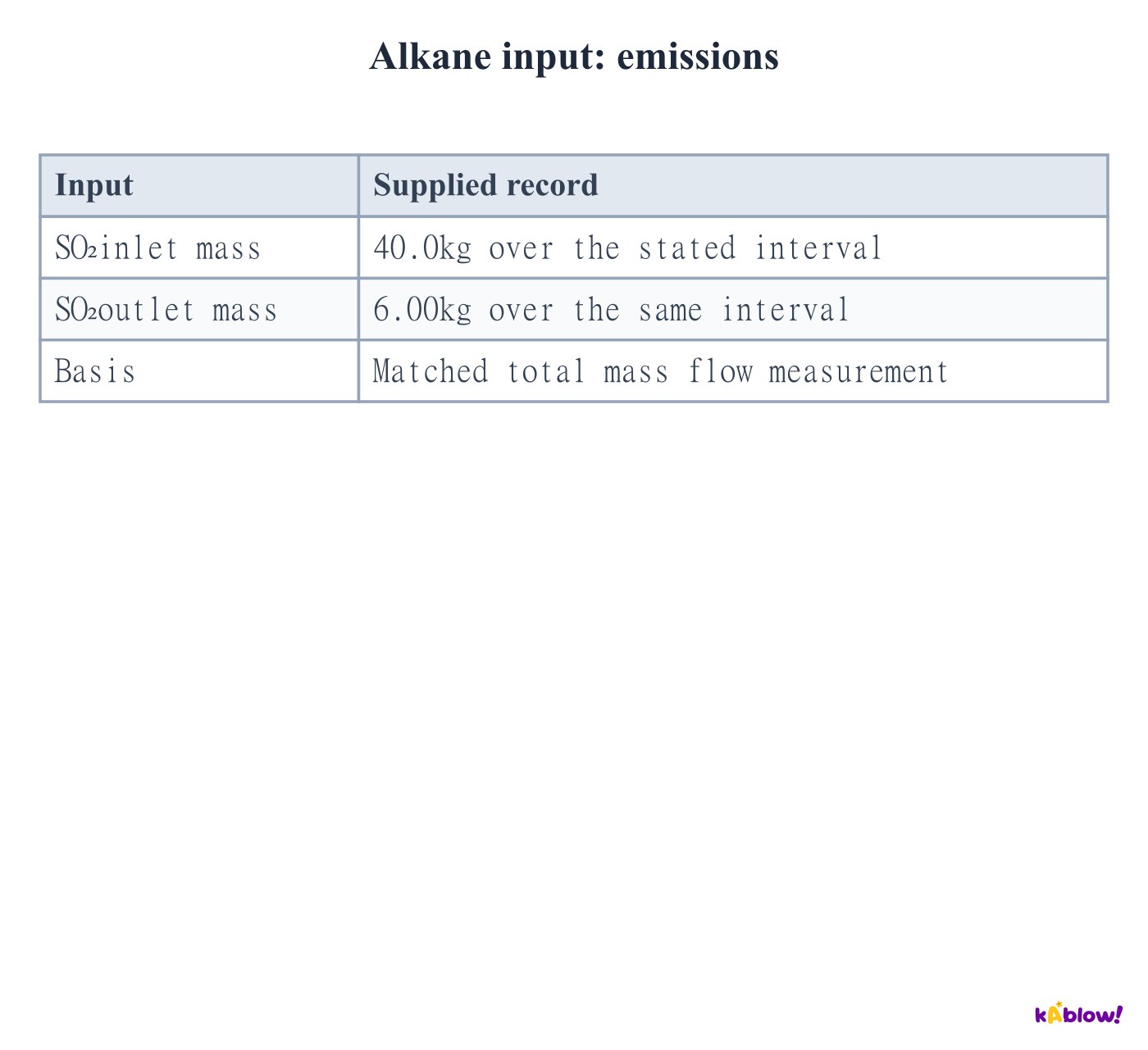
- The supplied before-and-after masses quantify removal of one pollutant. Calculate the percentage using the original inlet mass as the denominator.
- An 85% reduction leaves 15% of that pollutant in this data model. It is not proof that all exhaust species are removed or that treatment creates no other emissions.
- Compare flow, measurement basis and conditions before combining concentration records. A lower concentration alone may reflect dilution rather than a lower emitted mass.
Alkane input: emissions
Slide
Sign up free to view the lesson slides
Step through every slide for this topic — plus flashcards and revision notes — with a free account.
Soal latihan
Pratinjau gratis — 8 dari 60 soal. Daftar untuk melihat semuanya.
1.Which supplied species is an acyclic saturated hydrocarbon?
Medium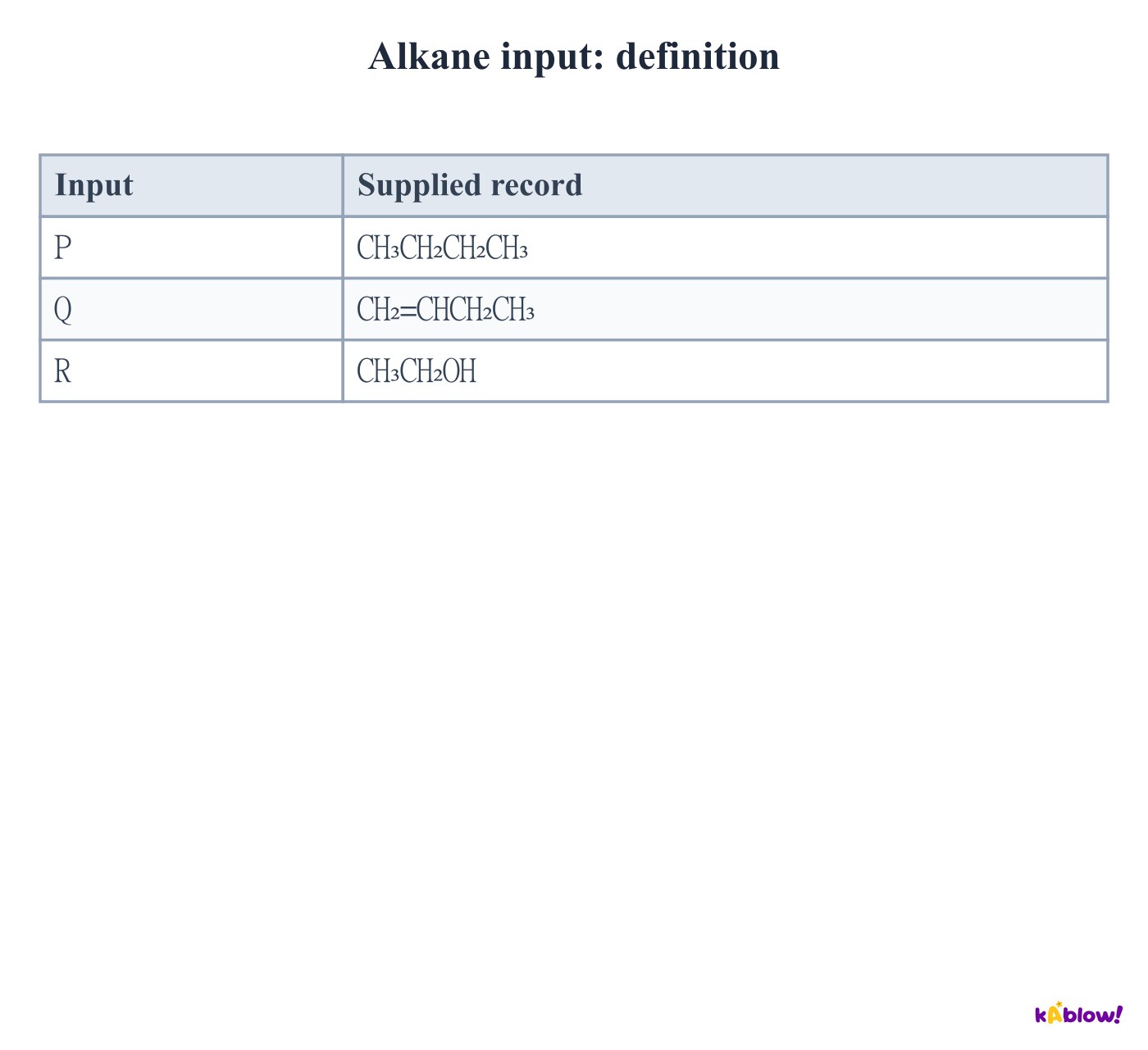
- AP
- BQ
- CR
- DAll three
2.Which conclusion follows for P?
Medium- AA single pure substance
- BA mixture separated by physical properties
- COne giant molecule
- DA product requiring C–C cleavage
3.Where would X generally condense relative to Y in this model?
Medium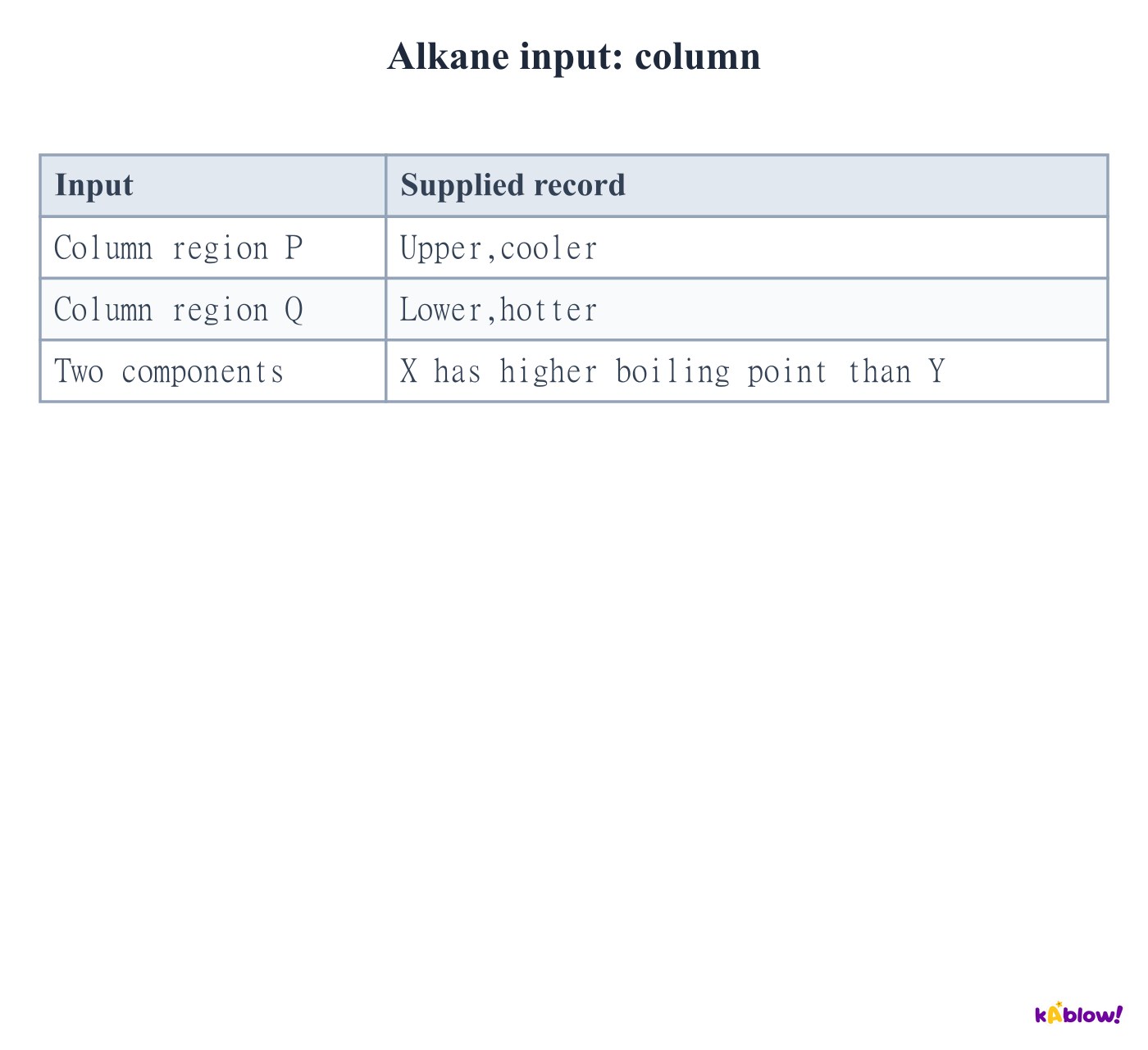
- AHigher because it is heavier
- BAt the identical level necessarily
- CLower, where the temperature is higher
- DOnly outside the column
4.Which statement correctly distinguishes P and Q?
Medium- ABoth must break every C–H bond
- BP must create a new element
- CQ is only condensation
- DP overcomes attractions; Q changes covalent connectivity
5.In which first listed region does condensation occur as the vapour rises?
Medium- AR
- BQ
- CP
- DNone because the molecule is organic
6.What equal-sized surplus and deficit are shown?
Medium- A20t heavy surplus and 40t light deficit
- B30t heavy surplus and 30t light deficit
- C50t surplus in both
- DNo imbalance
7.Which formula completes the supplied atom balance?
Medium- AC₈H₁₆
- BC₁₂H₂₆
- CC₈H₁₈
- DC₈H₂₂
8.Which assignment matches P and Q?
Medium- ABoth physical distillation
- BP catalytic; Q thermal
- CBoth complete combustion
- DP thermal; Q catalytic
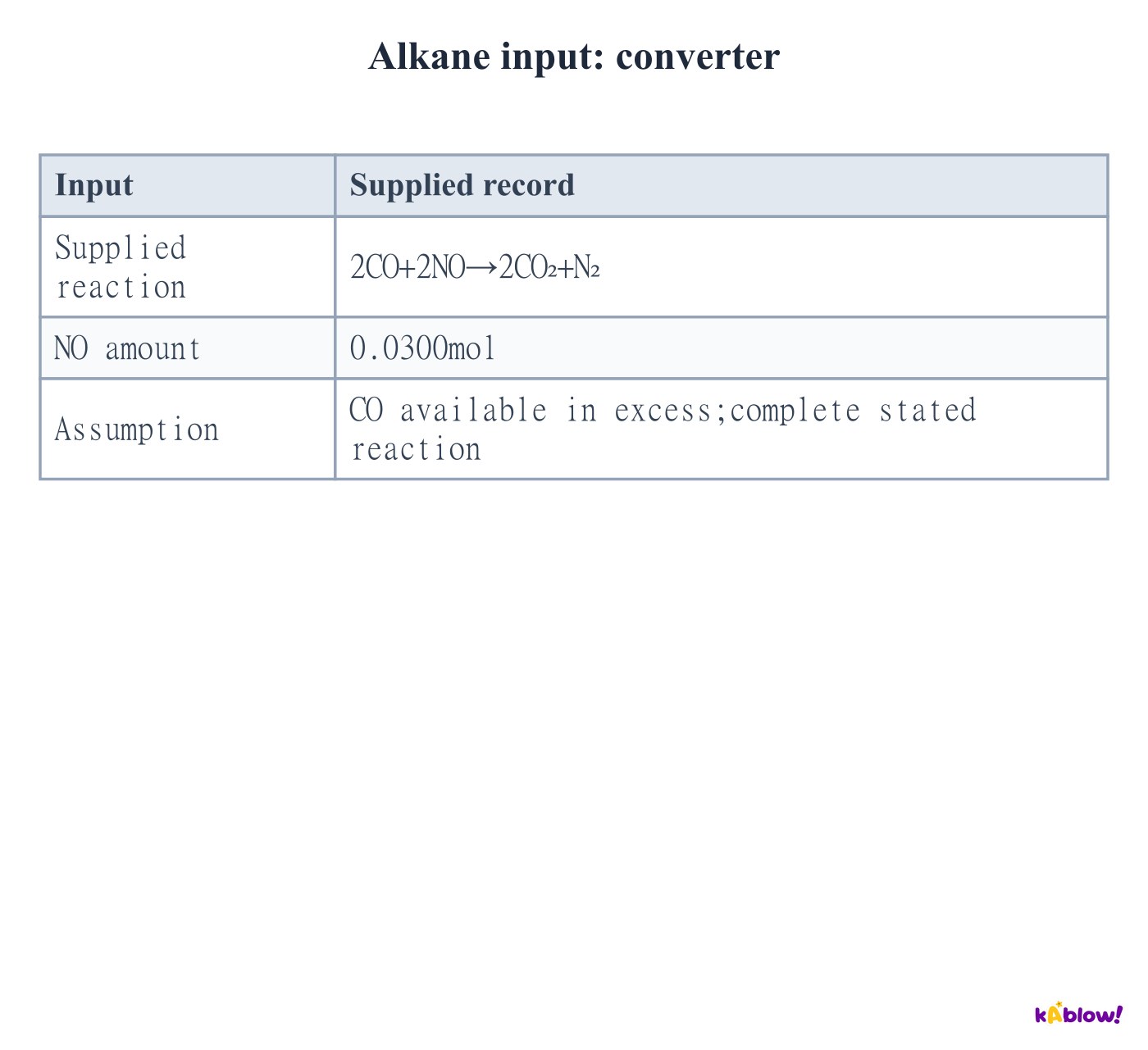
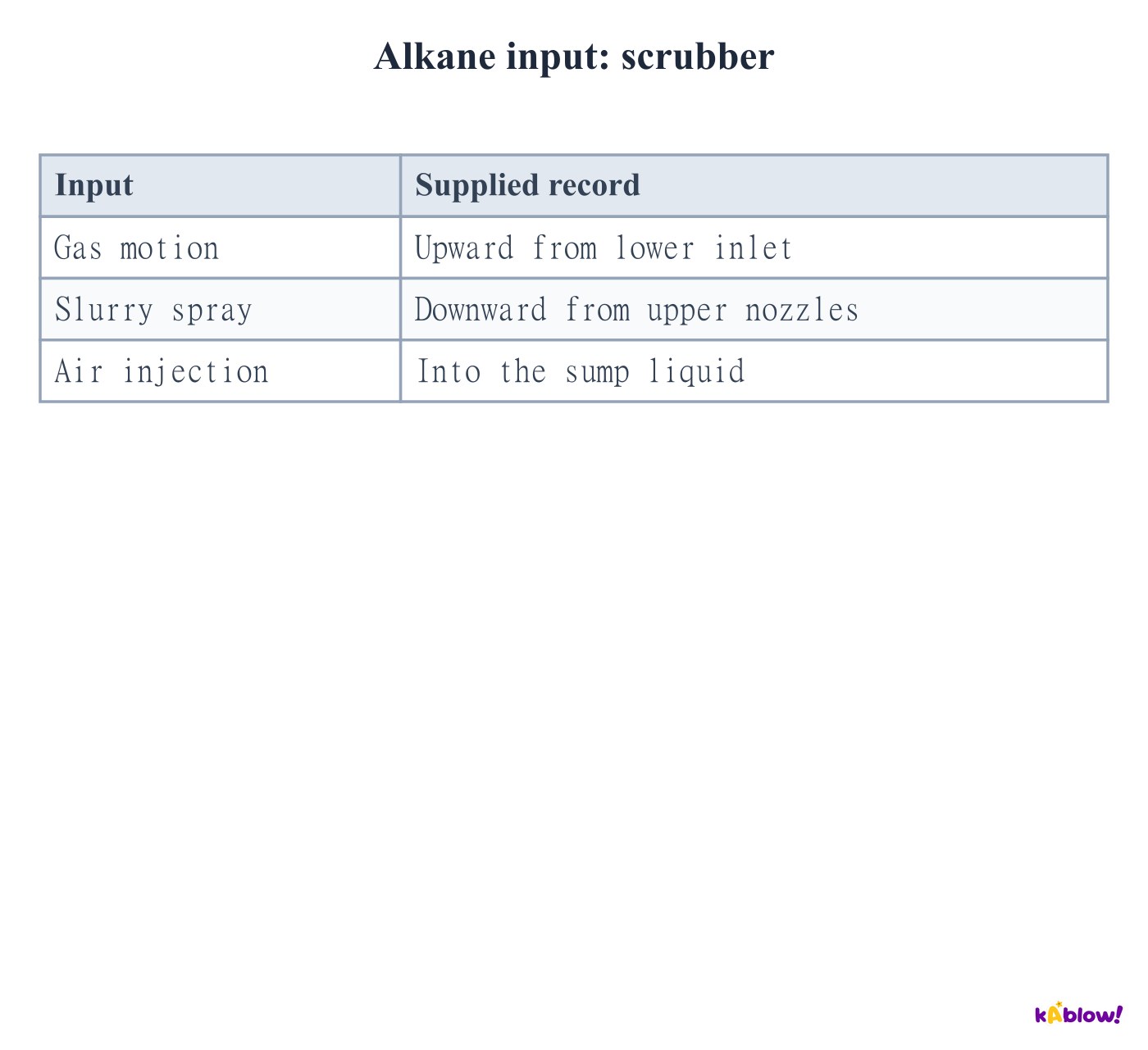
Unlock all 60 questions, flashcards & more
Buat akun gratis untuk melihat setiap soal, slide, kartu flash, dan catatan ulasan topik ini.