
Developing ideas from sources
Belajar sambil bermain
Jawab soal-soal ini untuk dapat energi, lalu memancing dan menjelajah. Tanpa akun.
Untuk pendidik: slide pelajaran, catatan ulasan siap pakai untuk Developing ideas from sources (Art and Design, Developing Ideas) — gunakan dalam pelajaranmu, atau jalankan topik sebagai aktivitas kelas interaktif yang dimainkan pembelajar sebagai permainan langsung.
Catatan pelajaran
Sources and first-hand enquiry
- A theme, object, visit, artwork, concept or chance mark can start an enquiry. Its usefulness depends on how it informs observation, making and decisions rather than whether the starting page looks polished.
- Primary or secondary status depends on the research question. Direct observation can be first-hand evidence for a subject; books and websites can hold primary records, reproductions or secondary interpretation. Record authorship and the actual source role.
Ask what a source supplies
Compare a purposeful variation
- A crop can change emphasis between an object’s context, identity and detail; scale, material, colour and arrangement can raise other questions. Select changes relevant to an intention and compare the results.
- The original key studies show a broad view, close worn detail and intermediate view. They are teaching illustrations, not a student’s first-hand recording. No image is universally strongest and a crop cannot recover an unseen side of the object.
Compare emphasis in three key studies
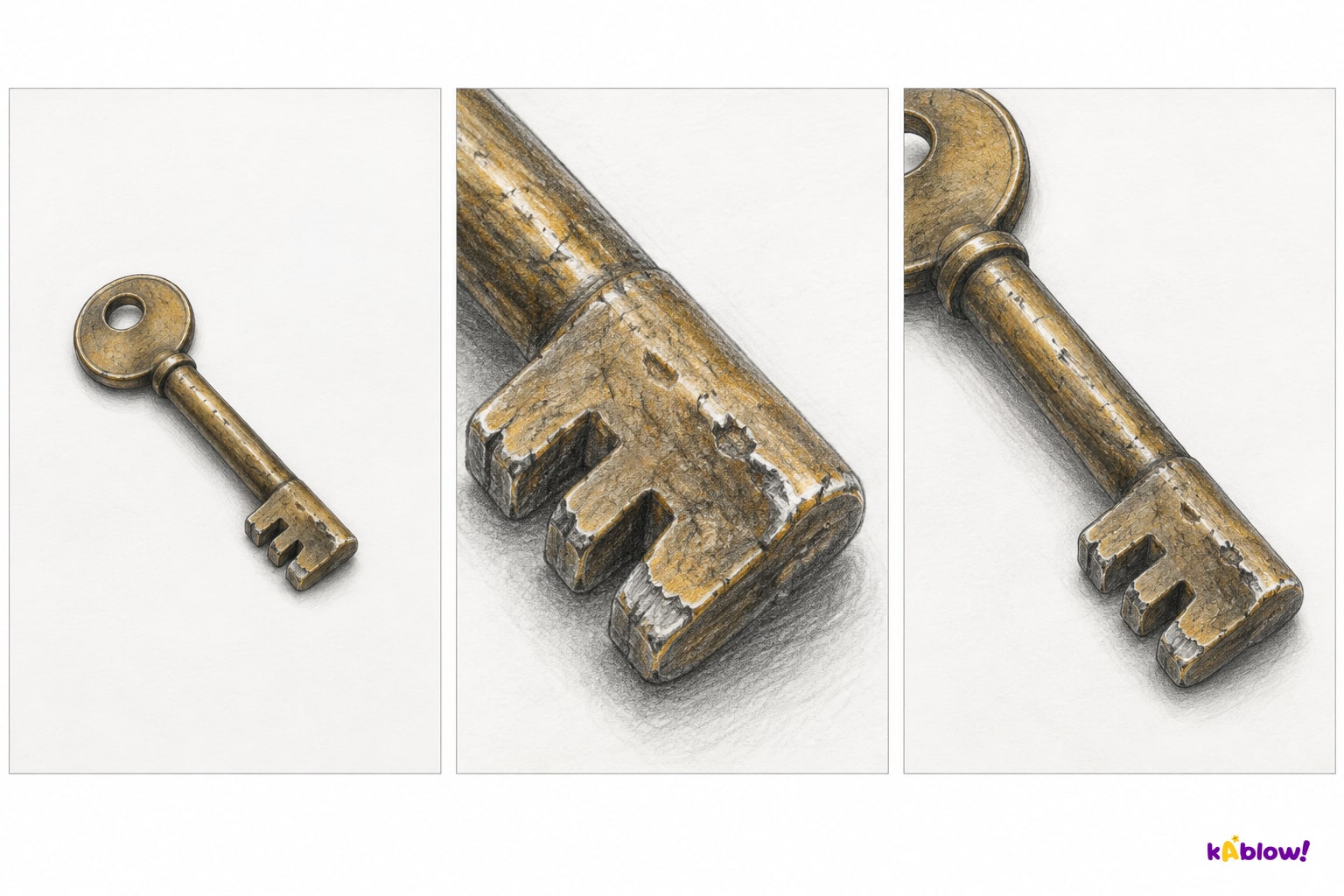
Plan with a testable question
- Thumbnails, samples, mock-ups and maquettes offer different forms of testing. State the feature being tested and what the result can or cannot reveal about the full-size outcome.
- For an enquiry into surface wear, a close detail might be useful; an enquiry into access may need the whole key. This is an invented comparison of intentions, not a compulsory answer or evidence of a real student’s decision.
Choose a test for a question
Connect a source with personal development
- Choose a feature in a named work and explain its relevance. A credited copy or partial study can investigate a process; a further trial develops it through your own subject, intention or decisions.
- Changing colour or medium alone does not make borrowed imagery wholly original. Show the influence accurately, check appropriate use and explain what you learnt, retained or changed.
Develop a selected source feature
Originality and a flexible process
- Originality involves independent, purposeful decisions rather than a demand to invent an unprecedented technique. A personal response need not disclose private identity or avoid every shared visual convention.
- Research, experimentation, selection and reflection can inform each other throughout. Chance marks and earlier options can become useful; more techniques do not automatically make the enquiry stronger.
Explain a decision and a limitation
- Record the tested option, observed result and reason for the next choice. In the invented key example, retaining the whole form serves one intention while a detail crop serves another.
- A trial may answer a local question while leaving scale, material durability or display unresolved. Identify a useful next test rather than label an option best without a criterion.
Make the decision explicit
Achievable sources and next steps
- Choose a subject you can observe appropriately and use the taught material process. Ordinary objects and familiar settings can support meaningful work; a special journey or personal disclosure is not required.
- An outcome can be a drawing or another appropriate form. Select a next action from the evidence and intention, whether a new observation, material comparison, composition change or display test.
Select an achievable next action
Slide
Sign up free to view the lesson slides
Step through every slide for this topic — plus flashcards and revision notes — with a free account.
Soal latihan
Pratinjau gratis — 8 dari 33 soal. Daftar untuk melihat semuanya.
1.What is a theme?
Easy- Aa central subject or enquiry that can guide a project
- Ba type of paint
- Ca tool
- Da frame
2.What is a source?
Easy- Aonly a physical tool regardless of its use
- Bonly a particular paint brand
- Conly the external frame of a picture
- Dsomething used to inform or stimulate an enquiry
3.What is brainstorming?
Easy- Aframing
- Bprinting
- Cgenerating many ideas quickly
- Dtesting a final piece
4.What is a mind map?
Easy- Aan unrelated collage with no links or organising enquiry
- Ba visual arrangement connecting ideas around an enquiry
- Ca map of a town
- Da painting
5.What is a mock-up?
Easy- Aa trial model or layout used to test a proposal
- Ba final work
- Ca print
- Da frame
6.What does 'select' mean in developing ideas?
Easy- Akeep all ideas
- Bignore ideas
- Ccopy
- Dchoose ideas for stated intentions and practical requirements
7.What does 'adapt' mean?
Easy- Adestroy
- Bhide
- Cchange something to suit your idea
- Dcopy exactly
8.What is originality?
Easy- Aa tool
- Bindependent, purposeful decisions that develop a personal response
- Ca copy
- Dan old idea
Unlock all 33 questions & more
Buat akun gratis untuk melihat setiap soal, slide, kartu flash, dan catatan ulasan topik ini.
Soal ujian lampau
Latihan soal ujian lampau untuk topik ini segera hadir.
Segera hadir