
Networks, topologies and protocols
Belajar sambil bermain
Jawab soal-soal ini untuk dapat energi, lalu memancing dan menjelajah. Tanpa akun.
Untuk pendidik: slide pelajaran, catatan ulasan siap pakai untuk Networks, topologies and protocols (Computer Science, Networks and Security) — gunakan dalam pelajaranmu, atau jalankan topik sebagai aktivitas kelas interaktif yang dimainkan pembelajar sebagai permainan langsung.
Catatan pelajaran
Types of network
- LAN (local area network): covers a small area (building); owned by the organisation. WAN (wide area network): covers a large area (the Internet is the largest WAN); uses third-party links.
- Client-server: a central server provides services (files, web, email) to clients; easier to manage and secure. Peer-to-peer: each computer shares resources equally; cheap, but harder to manage and less secure.
A home local-area network
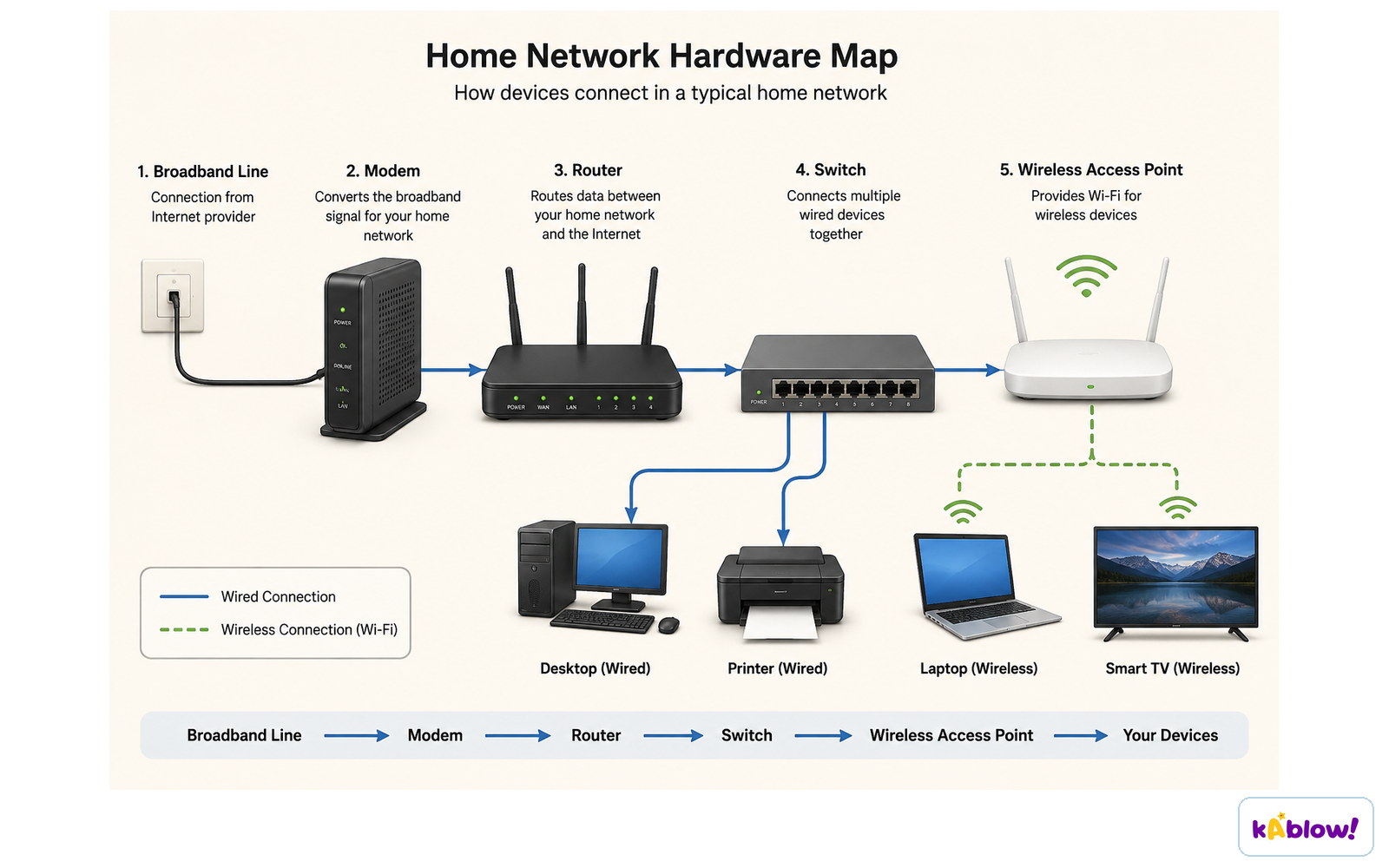
Hardware
- NIC (network interface card), router (connects networks and directs data), switch (connects devices in a LAN), wireless access point (WAP), modem, cables (copper, fibre optic) or wireless.
A central switch in a star LAN
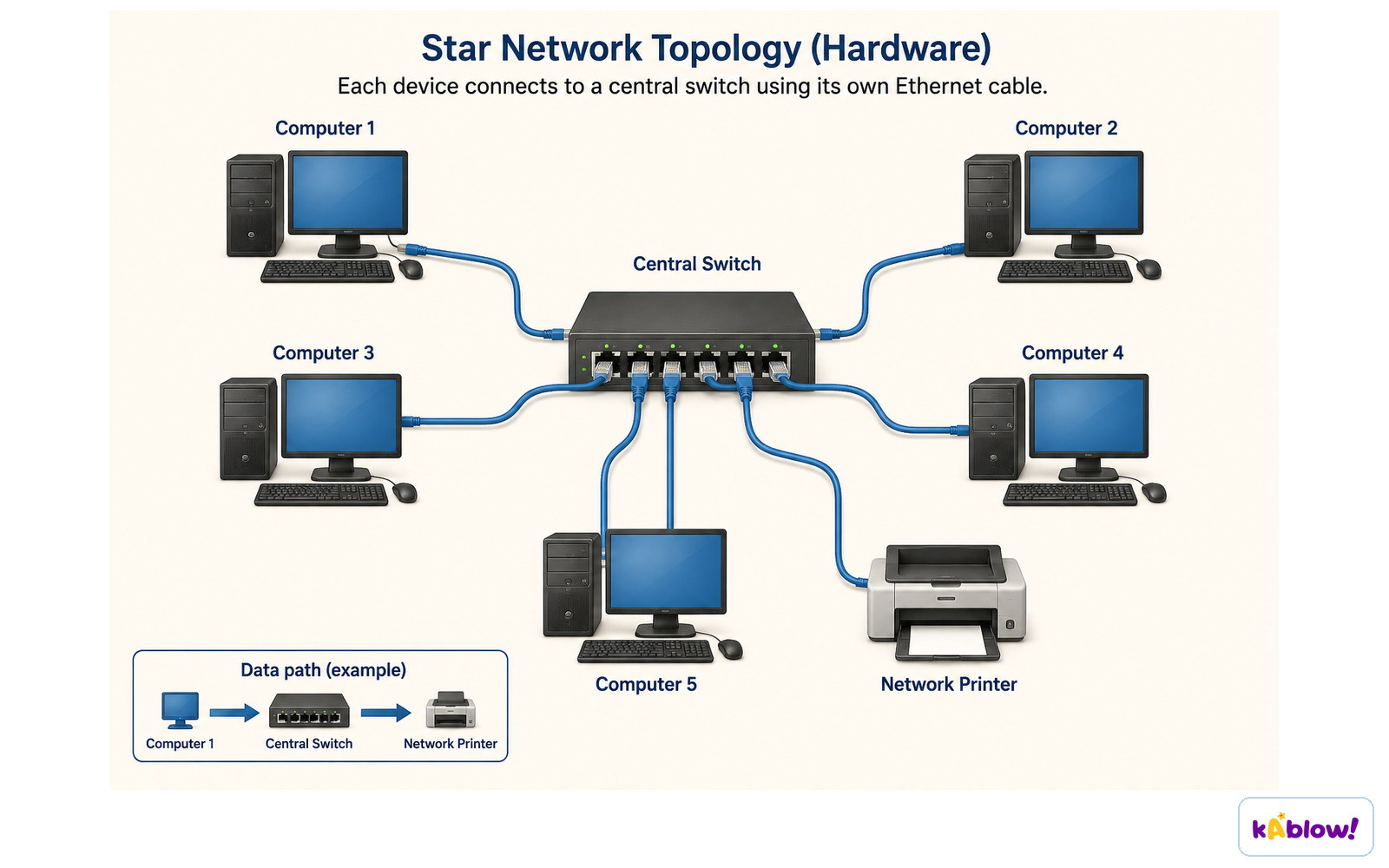
Topologies
- Star: all devices connect to a central switch; if one cable fails, others work; the switch is a single point of failure; popular.
- Mesh: devices connect to many others; very reliable but costly.
Addresses
- An IP address identifies a network interface for routing and communication; IPv6 offers a much larger address space than IPv4.
- A MAC address identifies an interface on a local link. It may be manufacturer-assigned or locally assigned/randomised; it is not an infallible permanent identity.
- DNS resolves domain names to associated records, including IP addresses.
Protocols and layers
- A protocol defines communication rules. HTTP/HTTPS serve the Web, SMTP sends email, IMAP/POP access mail, and FTP is specifically named for file transfer. HTTP can transfer files too.
- HTTPS uses TLS to protect HTTP traffic in transit and authenticate the server; it does not guarantee that a site’s contents are trustworthy.
- IP forwards packets between networks. TCP can provide ordered reliable delivery, including recovery of missing data; not every protocol retransmits packets.
Client requests and server responses
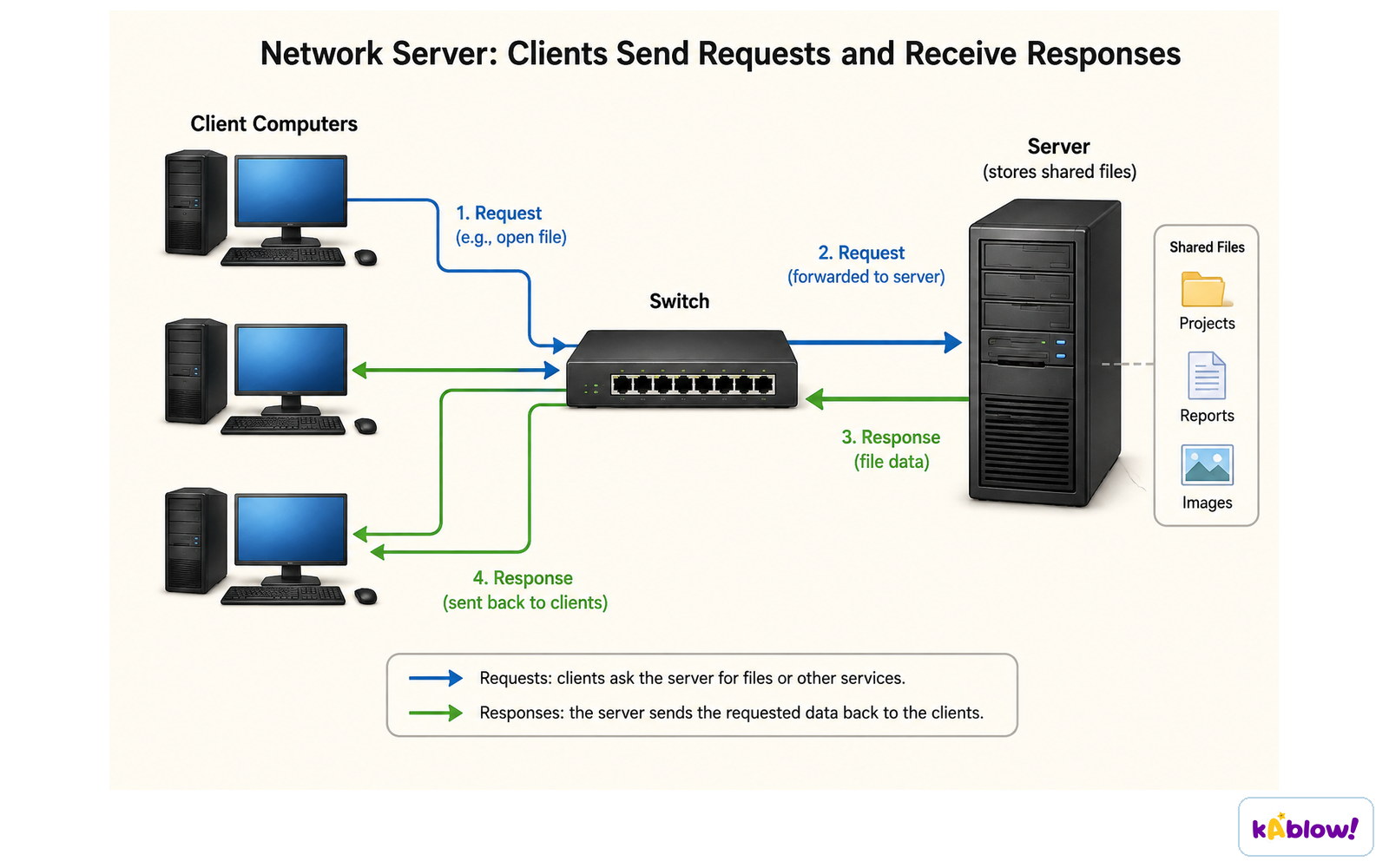
Slide
Sign up free to view the lesson slides
Step through every slide for this topic — plus flashcards and revision notes — with a free account.
Soal latihan
Pratinjau gratis — 8 dari 34 soal. Daftar untuk melihat semuanya.
1.What does LAN stand for?
Easy- Alocal area network
- Blarge area network
- Clong access network
- Dlinked area node
2.What does WAN stand for?
Easy- Awide area network
- Bweb area network
- Cwired area network
- Dwireless area node
3.What is a router?
Easy- Aa device that connects networks and directs data
- Ba storage device
- Ca printer
- Da monitor
4.What is a switch?
Easy- Aconnects devices in a LAN
- Bconnects networks
- Cstores data
- Dencrypts data
5.What is an IP address?
Easy- Aidentifies a device on a network
- Ba hardware ID
- Ca website name
- Da password
6.What is a MAC address?
Easy- Aan address identifying a network interface on a local link
- Ba website domain name
- Can email message
- Da password
7.What is a protocol?
Easy- Aa set of rules for communication
- Ba type of cable
- Ca device
- Da program
8.Which protocol is used to send email?
Easy- ASMTP
- BHTTP
- CFTP
- DIMAP
Unlock all 34 questions & more
Buat akun gratis untuk melihat setiap soal, slide, kartu flash, dan catatan ulasan topik ini.
Soal ujian lampau
Latihan soal ujian lampau untuk topik ini segera hadir.
Segera hadir