
Festivals, customs and traditions
Belajar sambil bermain
Jawab soal-soal ini untuk dapat energi, lalu memancing dan menjelajah. Tanpa akun.
Untuk pendidik: slide pelajaran, catatan ulasan siap pakai untuk Festivals, customs and traditions (French, Identity and Culture) — gunakan dalam pelajaranmu, atau jalankan topik sebagai aktivitas kelas interaktif yang dimainkan pembelajar sebagai permainan langsung.
Catatan pelajaran
Festivals in France
- Named associations include Noël with gifts or a decorated sapin in some households, Pâques with Easter traditions, le 14 juillet with France’s national day, and la Chandeleur on 2 February with crêpes. These describe cultural examples rather than every person’s beliefs or habits.
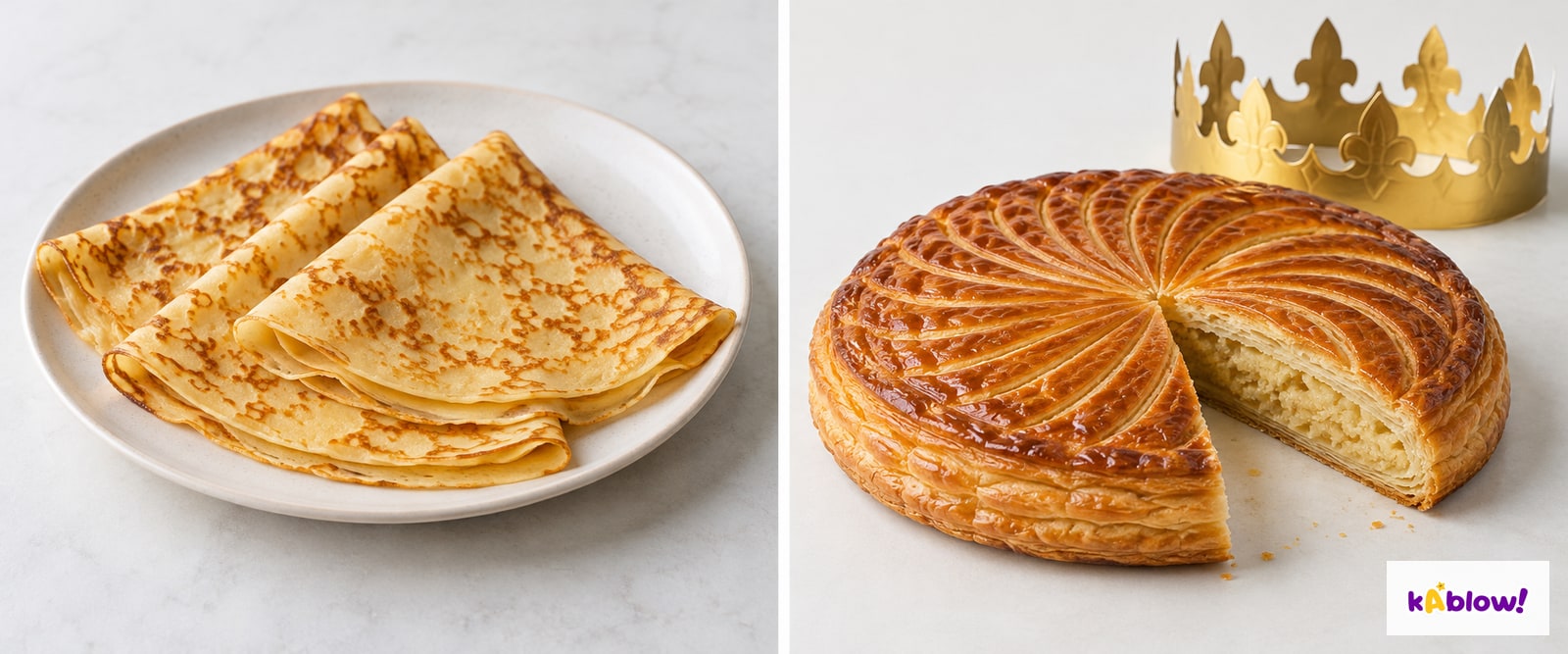
- La galette des rois is associated with Epiphany and commonly shared during January; recipes and regional forms differ. The original generated food reference shows thin crêpes on the left and one puff-pastry galette with a separate paper crown on the right. La Fête de la musique takes place on 21 June.
Crêpes and a galette des rois
Other celebrations
- Un anniversaire can be a birthday or an anniversary of another event. Un mariage can refer to a wedding celebration or to marriage. La naissance is birth; une fête can refer to a celebration or party in context.
- People may celebrate religious, cultural, family or school events, or choose not to participate. Practice may use an invented school concert or other event. Do not assume a learner celebrates Noël, receives gifts or shares a household tradition.
Read celebration vocabulary in context
Describing events in the past
- The perfect can present completed actions: j’ai mangé, nous avons regardé. Aller takes être, giving je suis allé/allée according to the intended speaker. Other movement verbs such as marcher and voyager use avoir, so movement alone is not an auxiliary rule.
- The imperfect can supply background or description: il faisait beau, c’était agréable. The perfect il a fait beau is also valid for a completed period, so a question requesting a particular form must specify it. Choose tense for the narrative meaning rather than the topic alone.
Connect actions and background
Customs
- La galette des rois is associated with Epiphany and wider January sharing. Le poisson d’avril names an April Fool’s prank in the 1 April context, and giving du muguet is a recognised 1 May custom in France. Not every household participates.
- La Chandeleur and la Fête de la musique have annual associations with 2 February and 21 June. A national or traditional date does not establish the actual venue, price or timetable of a local event. Read the named programme for those details.
Named date associations
Francophone world
- Le Carnaval de Québec is a named winter event in Québec City, with outdoor winter activities. Québec City is a specific place; this example is not a description of every resident, every part of the province or every French-speaking community.
- Original fictional contrast: Au carnaval imaginaire de notre école, nous avons fabriqué des décorations. Keep an invented practice event separate from statements about a real festival. Other places should be linked to named evidence rather than presented as a list of unsupported customs.
Keep the example’s scope clear
Comparing traditions
- Original household examples: Chez moi, nous avons fait des crêpes. Chez Léo, ils ont préparé un gâteau. Both prepared food, but the specific dishes differ. This compares the named groups, not all residents of a country.
- En France… mais en Angleterre…, c’est similaire/différent and plus…que can frame a comparison. Supply the actual stated evidence and avoid turning one person’s experience into a national stereotype.
Compare original household accounts
Opinions
- Ma fête préférée est… agrees with feminine fête. J’adore cette fête parce que… introduces a preference and a reason; a speaker can also express a qualified or negative view.
- Original model: Notre collège a organisé un concert. Nous avons écouté de la musique. C’était agréable parce que les chansons étaient variées. This fictional event uses a completed action and past evaluation without assuming a religious celebration or a particular family experience.
Support the opinion
Original fictional music notice
- Le 21 juin, concert à 18 h dans la cour du collège. Entrée gratuite. En cas de pluie, le concert aura lieu dans le gymnase. These are original invented reading details, not a real public programme.
- The stated start is 18 h and admission free. Rain changes the venue from courtyard to sports hall; it does not imply cancellation or a different date. Distinguish the annual festival date from the particular fictional timetable.
Original fictional music notice
Past time expressions
- Hier means yesterday, l’année dernière last year, le week-end dernier last weekend and il y a deux jours two days ago. Demain refers forward to tomorrow.
- Original model: Hier, nous avons préparé la salle. Il faisait froid, mais le concert était agréable. Keep each time phrase with the correct event and use the verb construction to identify its precise tense and role.
Identify the time reference
Slide
Sign up free to view the lesson slides
Step through every slide for this topic — plus flashcards and revision notes — with a free account.
Soal latihan
Pratinjau gratis — 8 dari 37 soal. Daftar untuk melihat semuanya.
1.What does "Noël" mean?
Easy- AChristmas
- BEaster
- CNew Year
- Dbirthday
2.In « Pour mon anniversaire, je fête mes seize ans », what does « anniversaire » mean?
Easy- Awedding
- Bholiday
- Cparty hat
- Dbirthday
3.What does "les cadeaux" mean?
Easy- Acakes
- Bcandles
- Cpresents
- Dcards
4.What does "le sapin" mean?
Easy- Athe card
- Bthe fir tree
- Cthe star
- Dthe candle
5.What does "le feu d'artifice" mean?
Easy- Afireworks
- Ba bonfire
- Ca parade
- Da dance
6.In a description of a wedding ceremony and reception, what does « le mariage » mean?
Easy- Amarriage law
- Bbirthday
- Cbaptism
- Dwedding
7.What does "Pâques" mean?
Easy- ANew Year
- BWhitsun
- CEaster
- DChristmas
8.What does "le réveillon" mean?
Easy- Aa parade
- Bthe festive evening meal
- Cthe alarm clock
- Dthe morning meal
Unlock all 37 questions & more
Buat akun gratis untuk melihat setiap soal, slide, kartu flash, dan catatan ulasan topik ini.
Soal ujian lampau
Latihan soal ujian lampau untuk topik ini segera hadir.
Segera hadir