
Fundamentals Of Acids & Bases
遊んで学ぼう
問題に答えてエネルギーを集めたら、釣りや探検を楽しもう。アカウント不要。
教育者の方へ: Fundamentals Of Acids & Bases(Chemistry、AQA)向けのすぐ使えるレッスンスライド, 復習ノート, 図解 — レッスンで使うか、学習者がライブゲームとして遊ぶインタラクティブなクラス活動としてトピックを実施できます。
レッスンノート
Identify proton donation and acceptance
- A Brønsted–Lowry acid donates a proton and a Brønsted–Lowry base accepts one in the reaction being considered.
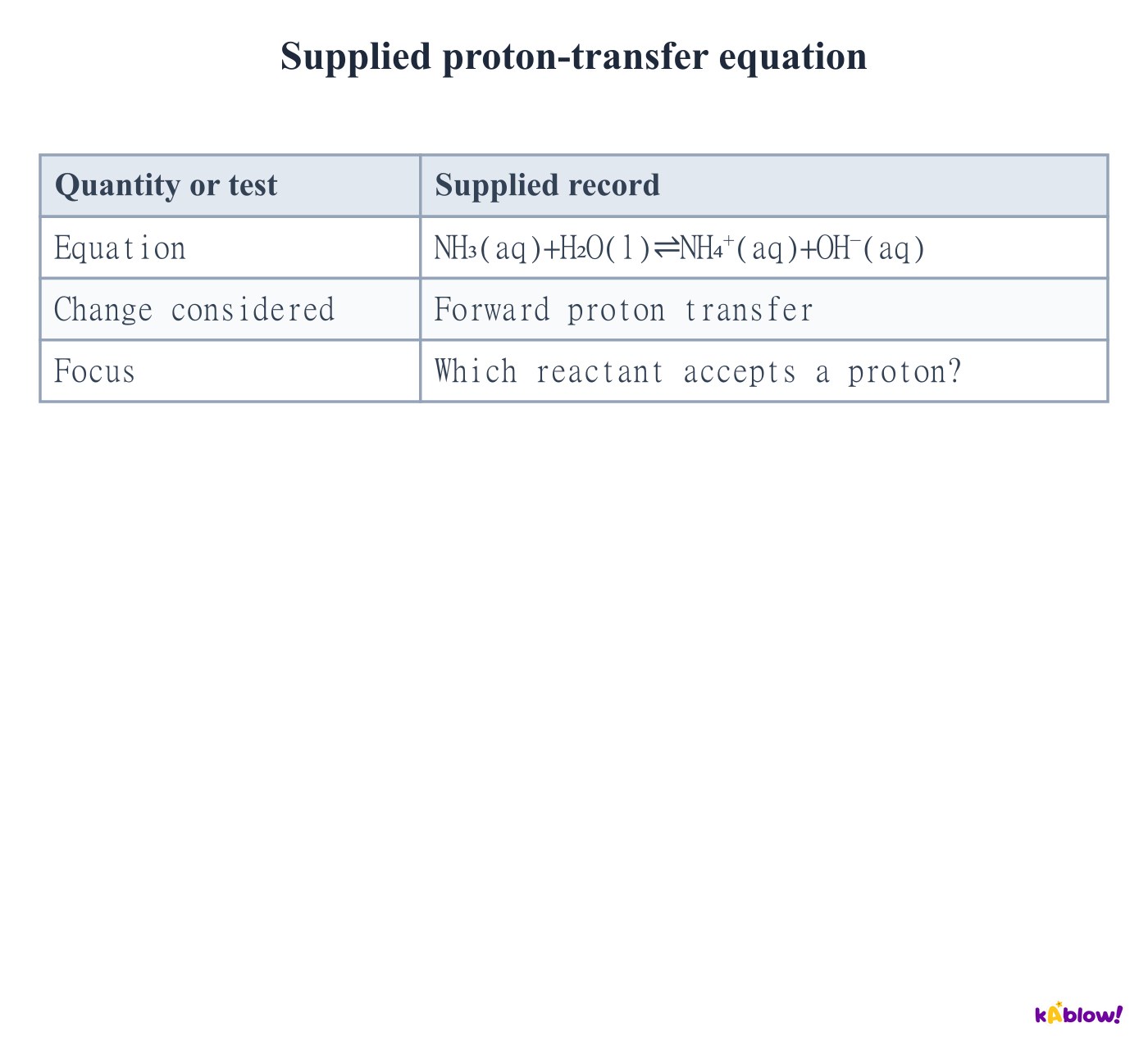
- In NH₃+H₂O⇌NH₄⁺+OH⁻, ammonia accepts H⁺ and water donates it. The proton transfer changes each partner’s hydrogen count and charge.
- Aqueous H⁺ is shorthand for a hydrated proton; H₃O⁺ makes water’s role explicit. Acid–base proton transfer does not by itself require a change in oxidation states.
Supplied proton-transfer equation
Recognise genuine conjugate acid–base pairs
- A conjugate acid and base differ by exactly one H⁺. Removing H⁺ lowers the species charge by one unit.
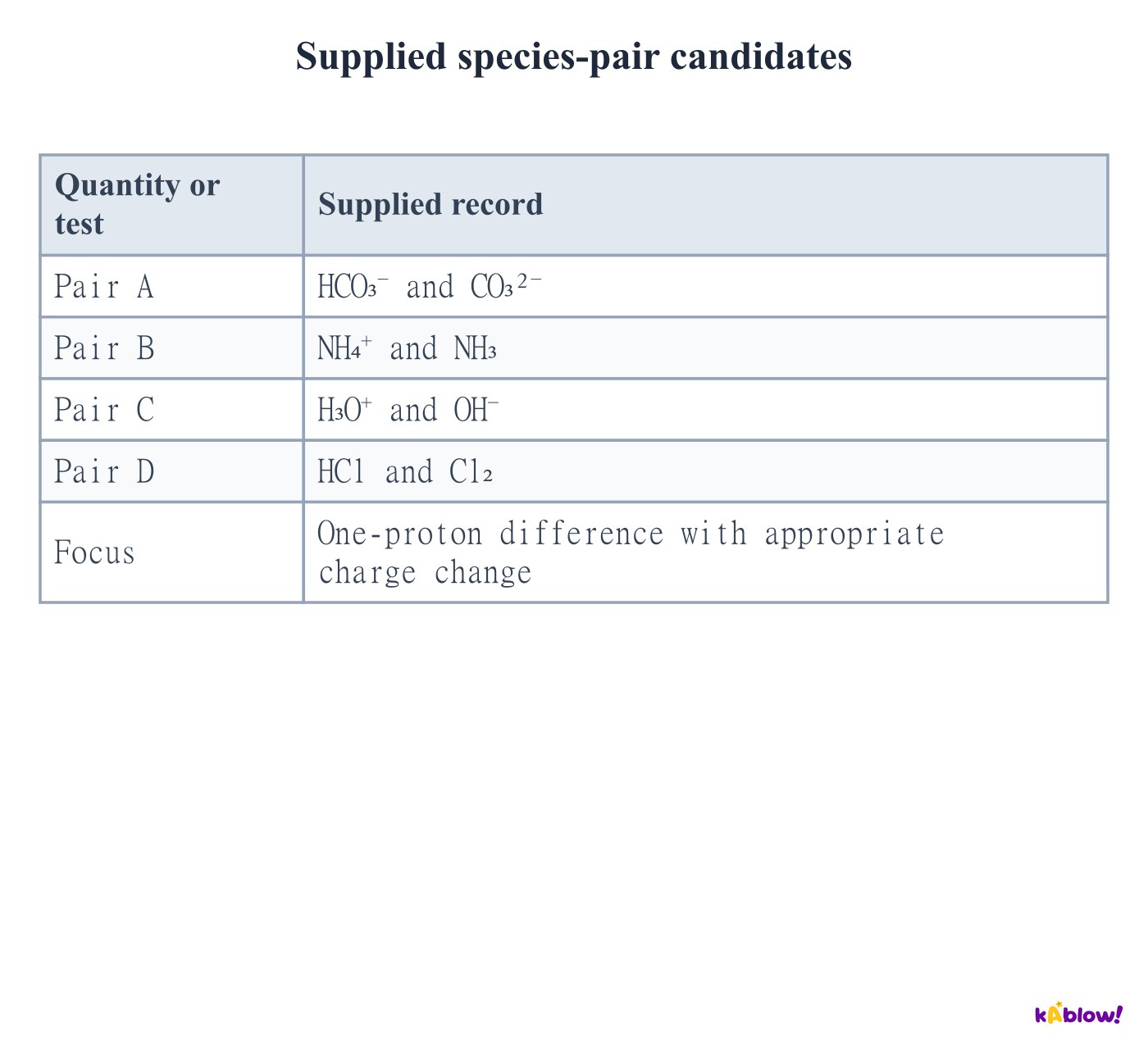
- HCO₃⁻/CO₃²⁻ and NH₄⁺/NH₃ are conjugate pairs. H₃O⁺/OH⁻ differ by two hydrogens and are not one conjugate pair.
- A pair can contain molecules or ions. Use atom and charge bookkeeping rather than choosing species only because both occur in an acid–base equation.
Supplied species-pair candidates
Explain water’s amphiprotic behaviour
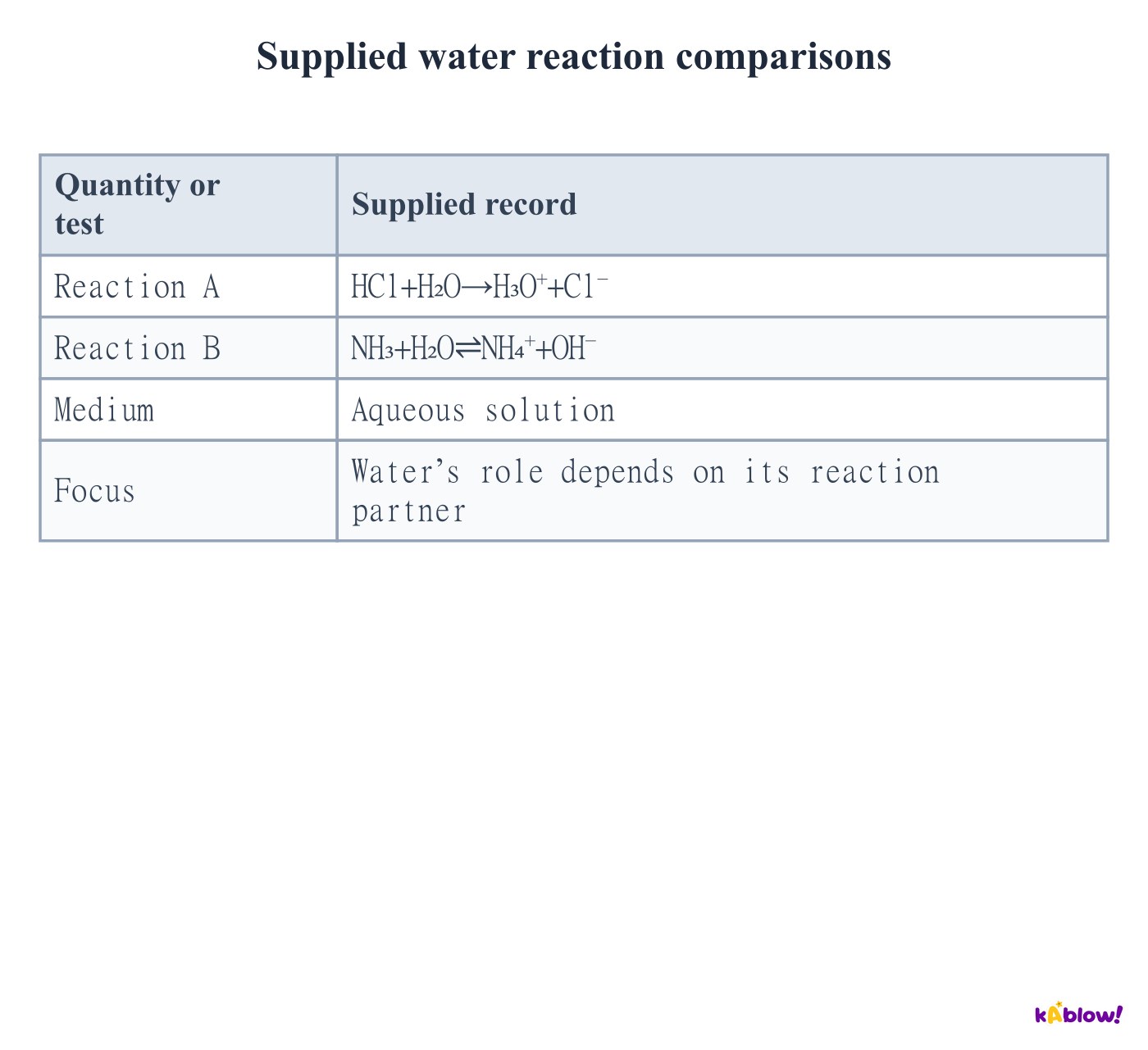
- Water can accept a proton from HCl to form H₃O⁺. In that reaction water acts as a Brønsted base.
- Water can donate a proton to ammonia to form OH⁻. In that reaction water acts as a Brønsted acid.
- Amphiprotic means able to act as a proton donor or acceptor. The role depends on the reaction partner, not on water having one permanent acid/base label.
Supplied water reaction comparisons
Separate proton transfer from a later chemical change
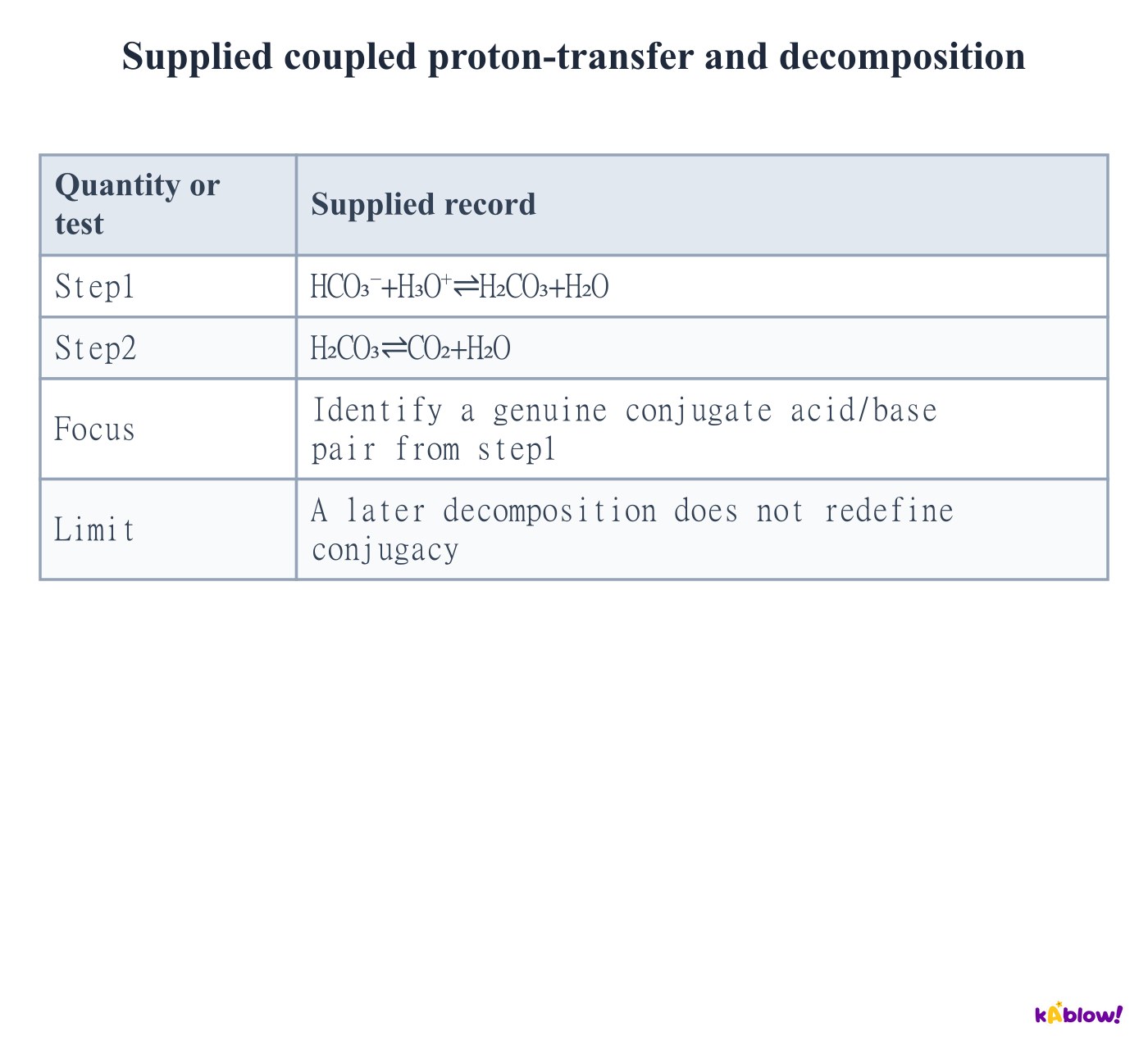
- In the supplied first step, bicarbonate accepts H⁺ to form H₂CO₃. The conjugate pair is H₂CO₃/HCO₃⁻.
- The subsequent conversion H₂CO₃⇌CO₂+H₂O is a separate chemical process. It does not turn the two-product collection CO₂+H₂O into one conjugate species.
- Apply the same care when a protonated species later loses water: identify the immediate one-proton partner before interpreting the overall multi-step equation.
Supplied coupled proton-transfer and decomposition
Distinguish acid strength from concentration
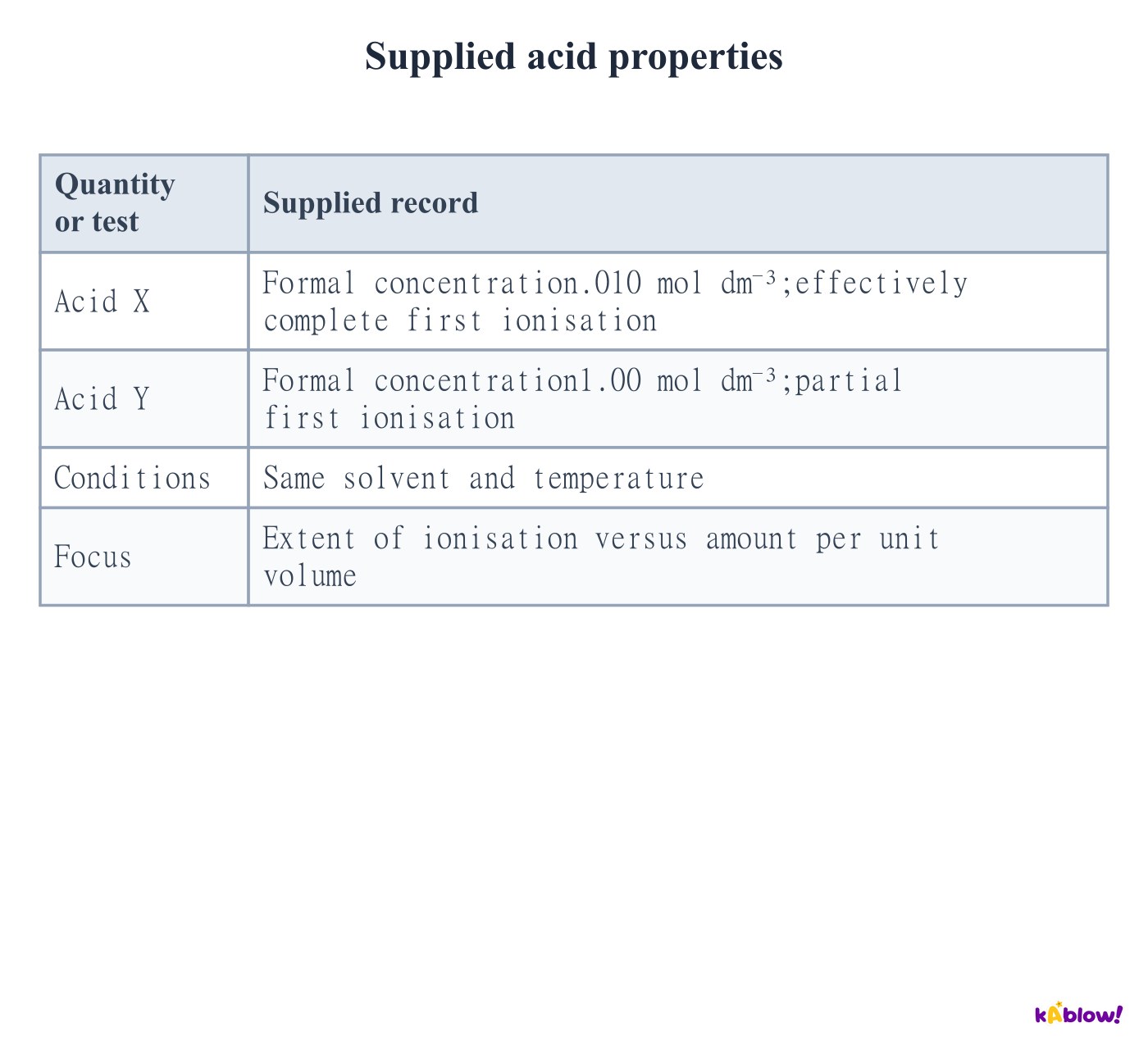
- Strength describes the extent of ionisation under the stated conditions. Concentration describes how much solute is present per unit volume.
- The supplied X is strong and relatively dilute, while Y is weak and more concentrated. A concentrated weak acid is not automatically a strong acid.
- pH depends on the resulting hydrogen-ion activity or its dilute concentration approximation. It is not determined by the word strong alone, and it is not total neutralisation capacity.
Supplied acid properties
Calculate pH using a base10 logarithm
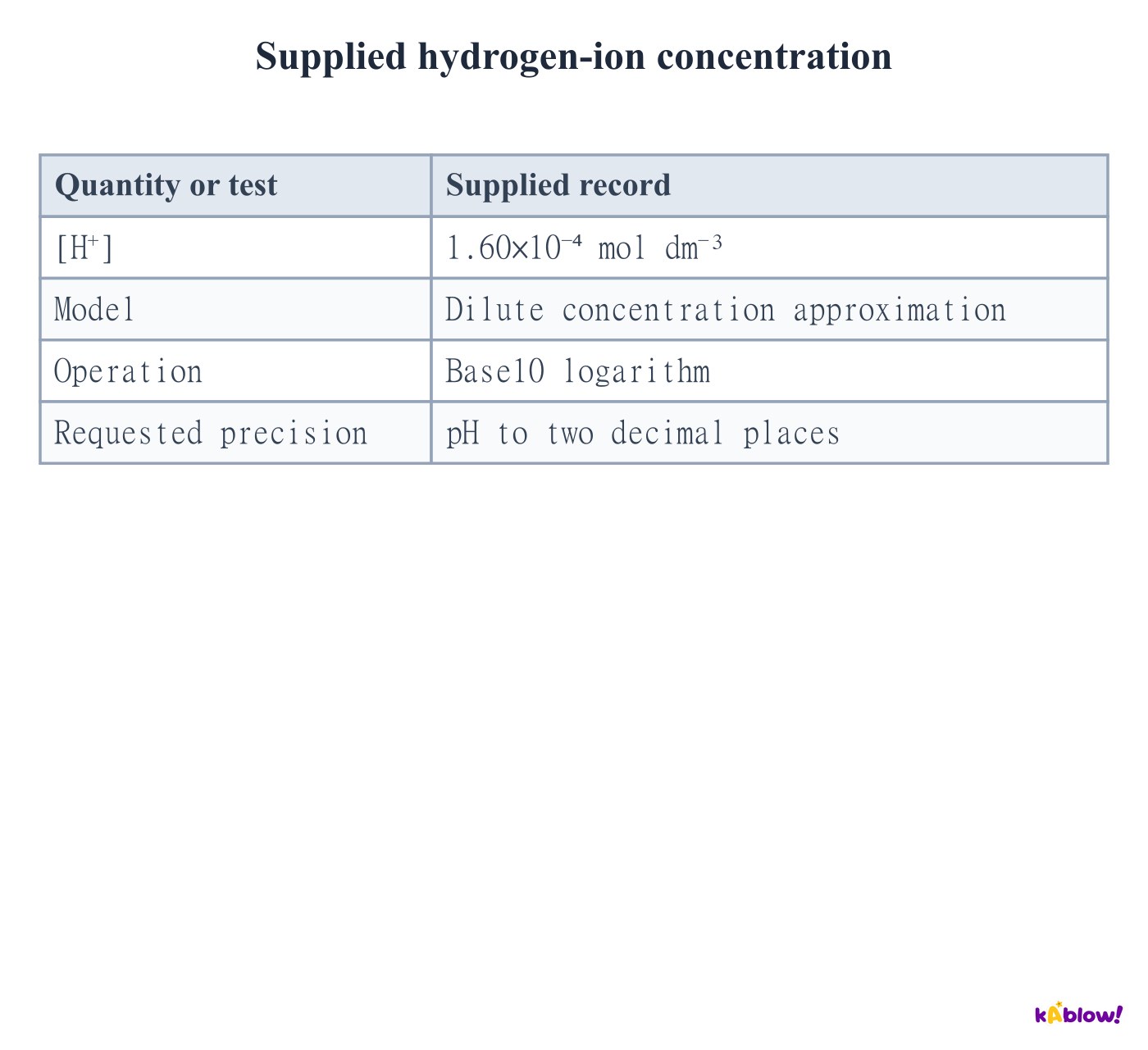
- In the dilute AQA concentration approximation, pH=−log₁₀([H⁺]/(1 mol dm⁻³)). Use the numerical concentration in mol dm⁻³.
- The supplied concentration1.60×10⁻⁴ gives pH3.795880..., which rounds to 3.80 to two decimal places.
- pH has no unit. The more precise thermodynamic definition uses dimensionless hydrogen-ion activity; the concentration approximation has limits outside its applicable range.
Supplied hydrogen-ion concentration
Recover hydrogen-ion concentration from pH
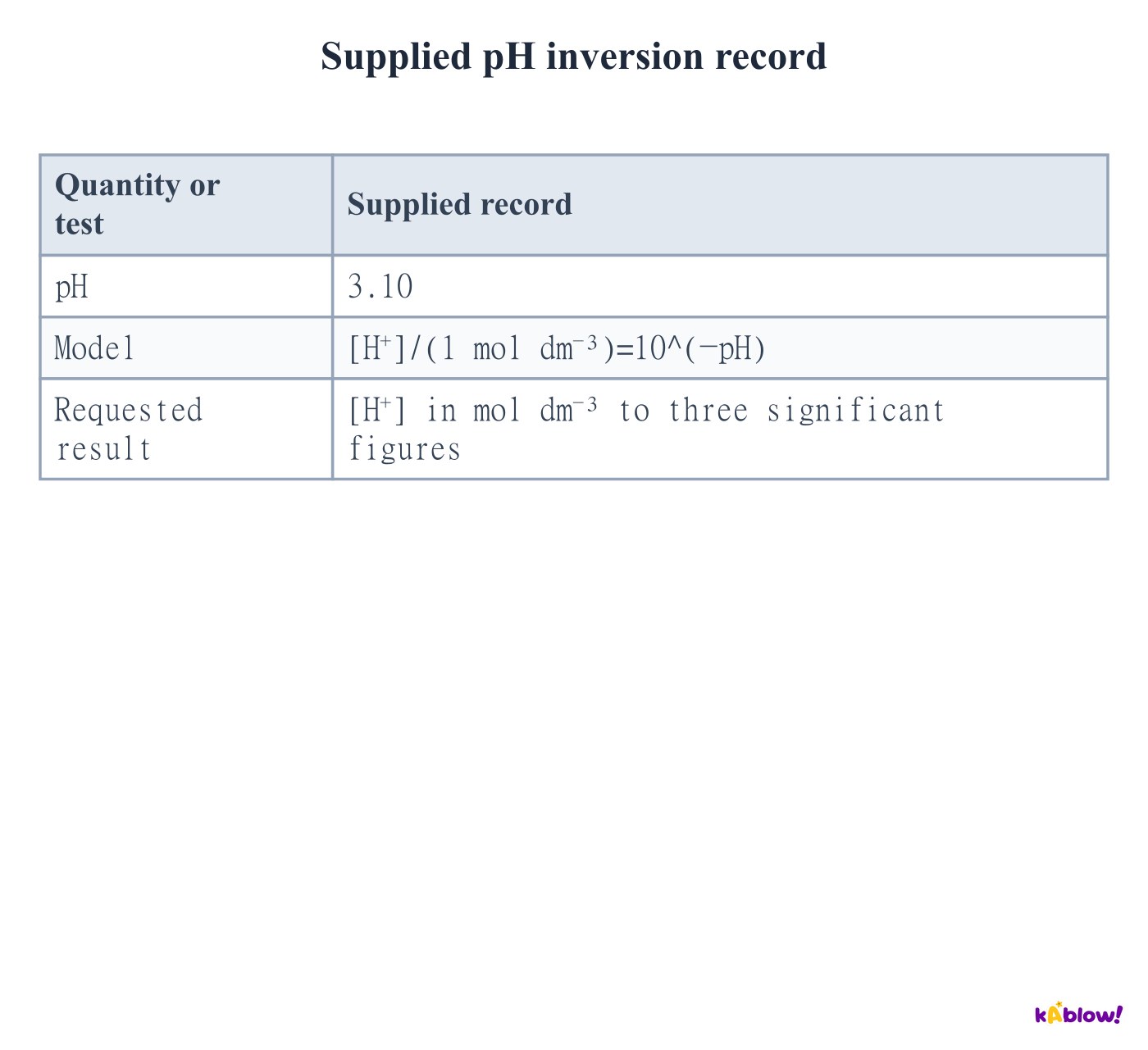
- Rearrange the logarithmic relation to[H⁺]/(1 mol dm⁻³)=10^(−pH). The exponent is negative.
- For pH3.10, the concentration is 7.943282...×10⁻⁴ mol dm⁻³, or7.94×10⁻⁴ to three significant figures.
- Check direction: a lower pH corresponds to a higher hydrogen-ion concentration under the same approximation. Do not use a natural exponential instead of a base10 antilogarithm.
Supplied pH inversion record
Translate a pH difference into a concentration ratio
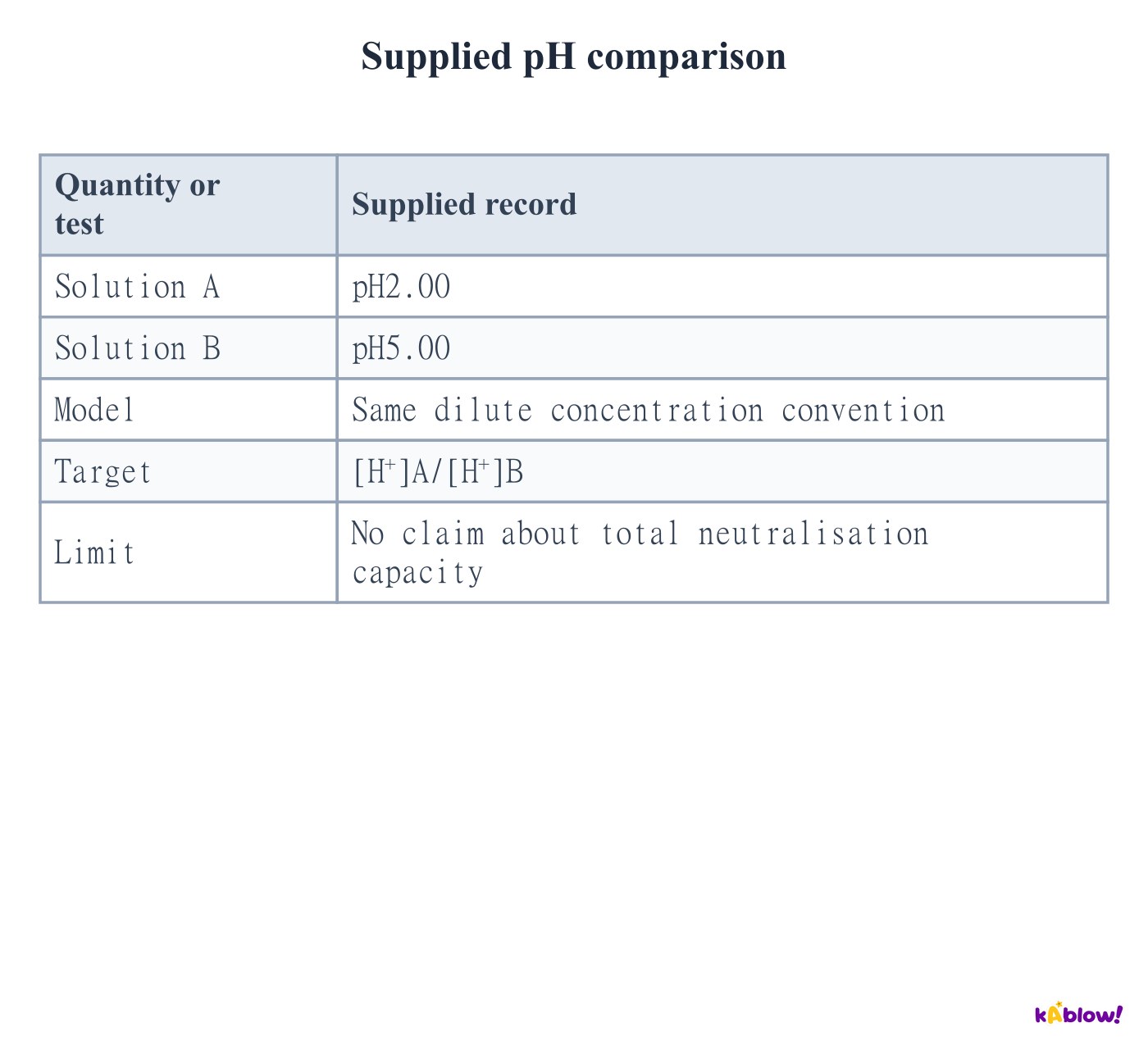
- One unit lower pH means ten times the hydrogen-ion concentration in the same concentration model.
- The supplied pH2.00 versus5.00 differs by three units, giving[H⁺]A/[H⁺]B=10³=1000.
- This ratio compares hydrogen-ion concentrations. It does not by itself compare solution volumes, total acid moles, strength or the amount of alkali needed for complete neutralisation.
Supplied pH comparison
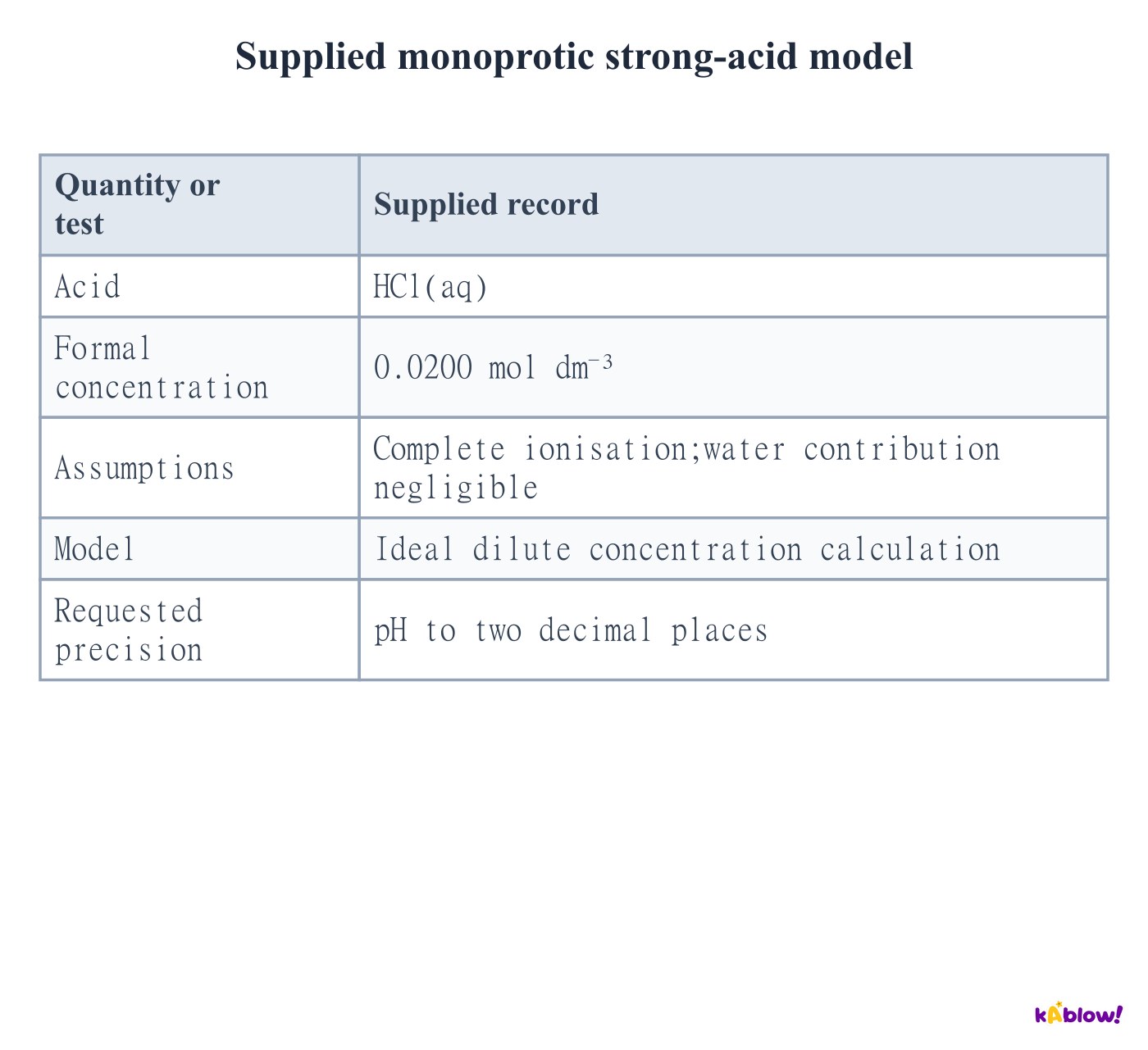
Use the strong monoprotic-acid approximation
- For a completely ionised monoprotic acid with negligible water contribution, each mole supplies one mole of aqueous H⁺.
- The supplied0.0200 mol dm⁻³ HCl therefore gives[H⁺]≈0.0200 mol dm⁻³ and pH1.698970...≈1.70.
- State the assumptions. This shortcut does not automatically apply to every polyprotic acid or to solutions so dilute that water’s ionisation is comparable to the added acid.
Supplied monoprotic strong-acid model
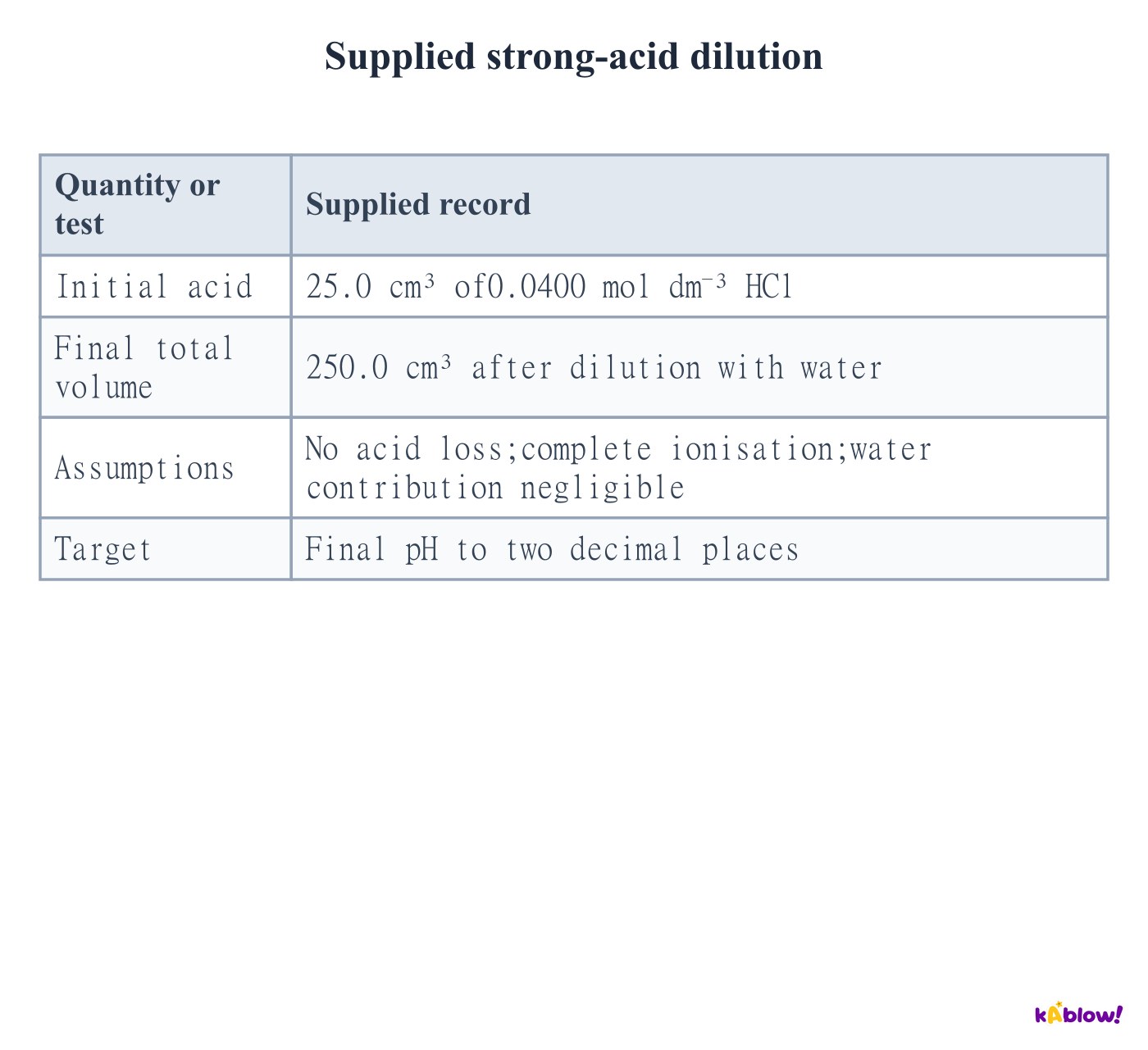
Use the final total volume in a dilution
- With no solute loss, n=cV is conserved during dilution. Use the final total solution volume, not just the volume of water added.
- The supplied volume rises tenfold from 25.0 to 250.0 cm³, so HCl concentration falls from.0400 to.00400 mol dm⁻³.
- With the stated strong-acid approximation, pH changes from 1.40 to 2.40, an increase of one unit. This simple logarithmic dilution rule does not describe all weak-acid or extreme-dilution cases.
Supplied strong-acid dilution
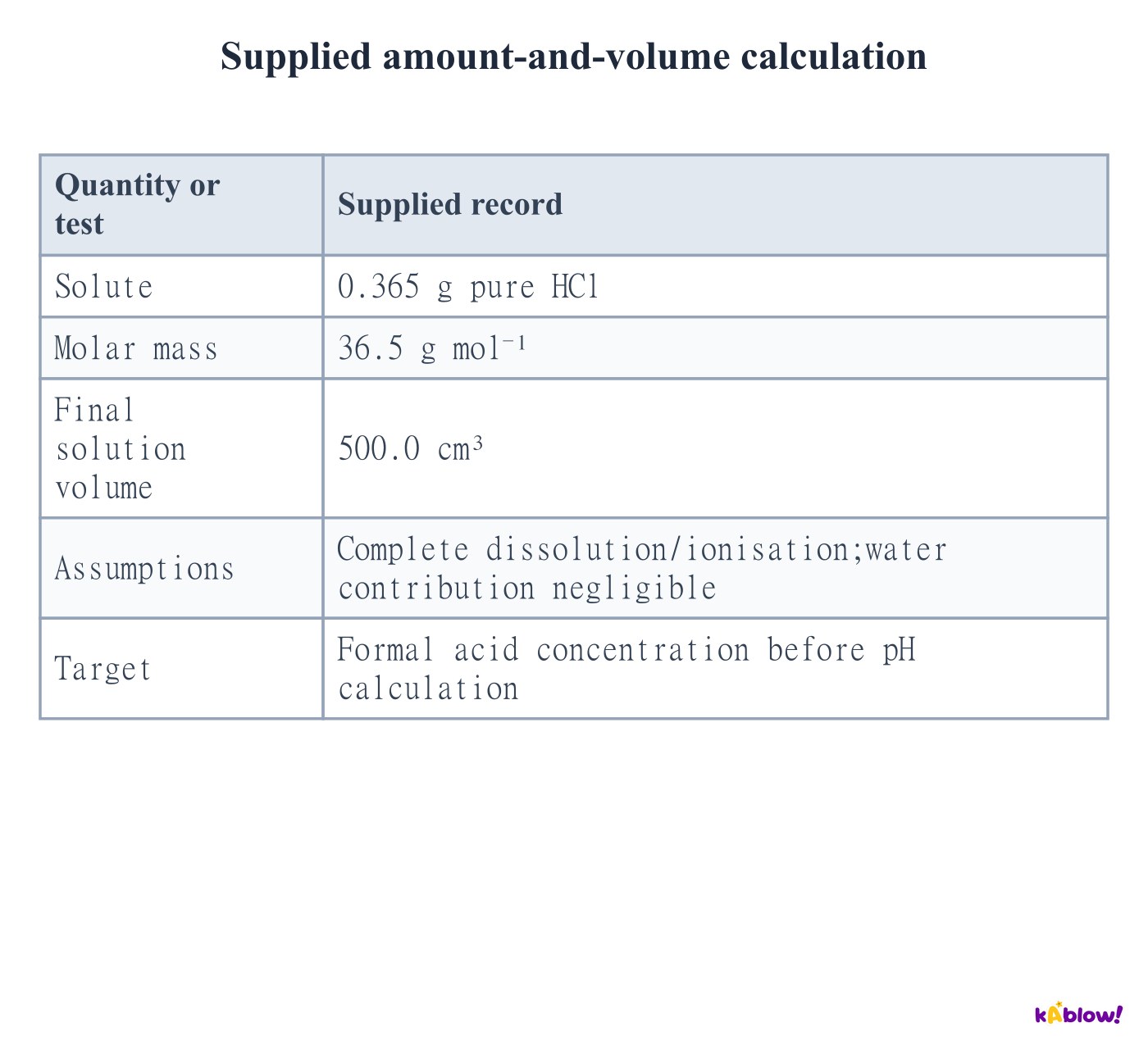
Convert amounts and volumes before taking logarithms
- Find amount from n=m/M. The supplied.365 g HCl corresponds to.0100 mol using M=36.5 g mol⁻¹.
- Convert500.0 cm³ to.5000 dm³ before c=n/V. The resulting formal concentration is.0200 mol dm⁻³.
- Only after establishing concentration and ionisation assumptions should you calculate pH. Mixing cm³ with mol dm⁻³ introduces a factor-of 1000 error.
Supplied amount-and-volume calculation
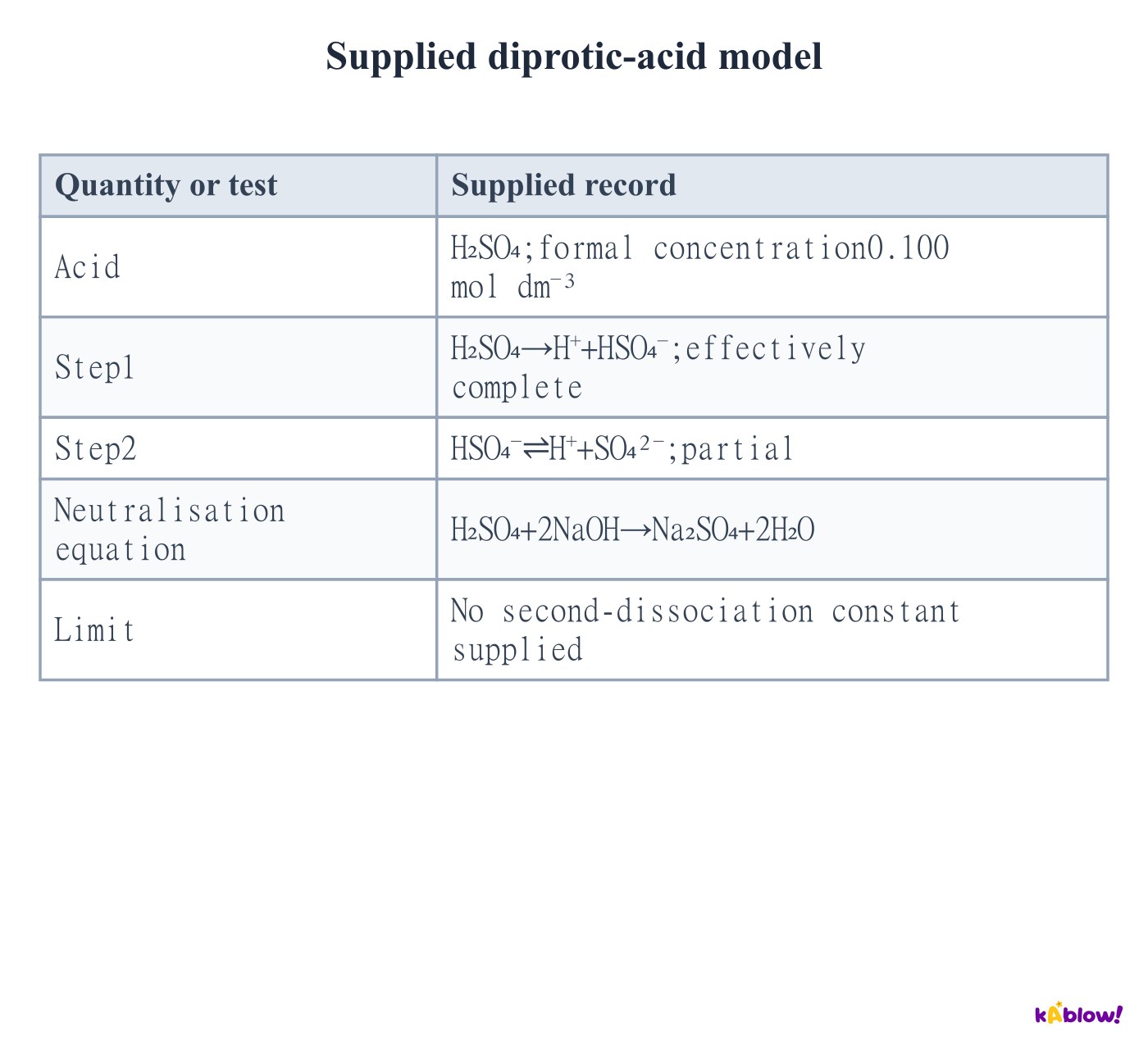
Separate diprotic neutralisation from ionisation assumptions
- A diprotic acid can supply two protons during complete neutralisation. The supplied equation therefore consumes two moles NaOH per mole H₂SO₄.
- This stoichiometry does not prove both ionisation steps are complete in the original acid solution. Sulfuric acid’s second ionisation is condition dependent.
- For the supplied complete-first/partial-second model, do not set[H⁺]=2C or ignore the second step without instruction. A numerical pH needs an appropriate equilibrium constant or an explicit approximation.
Supplied diprotic-acid model
Use the ionic product at the stated temperature
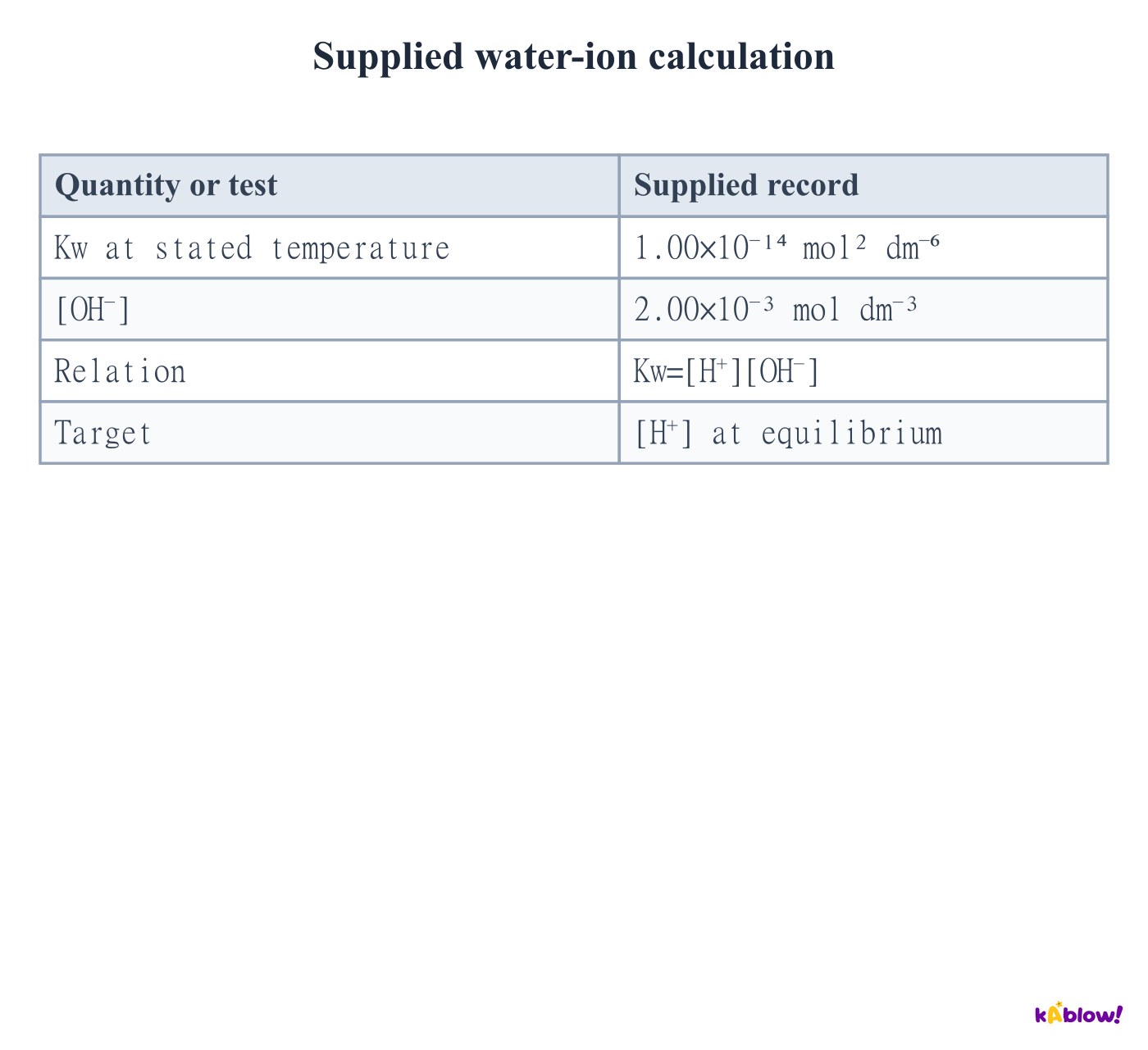
- Water maintains the equilibrium2H₂O⇌H₃O⁺+OH⁻. In the concentration convention, Kw=[H⁺][OH⁻].
- Using the supplied rounded Kw=1.00×10⁻¹⁴ mol² dm⁻⁶ and[OH⁻]=2.00×10⁻³ gives[H⁺]=5.00×10⁻¹² mol dm⁻³.
- Kw depends on temperature. Acidic and alkaline aqueous solutions still contain both ions, with one often present at much lower concentration.
Supplied water-ion calculation
Define neutrality by equal ion concentrations
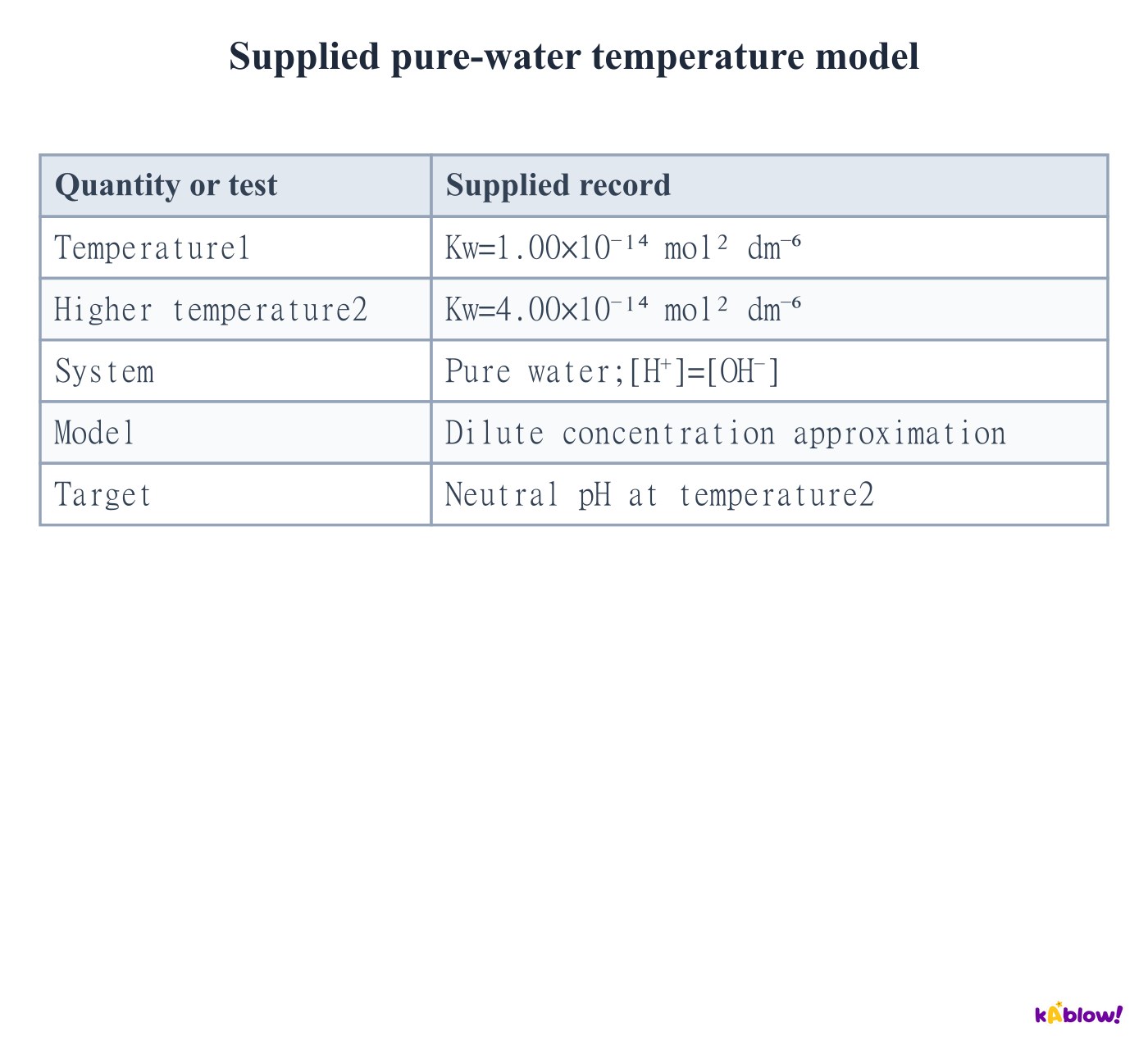
- Neutrality requires[H⁺]=[OH⁻] in this aqueous concentration model. For pure water each concentration equals√Kw.
- At the supplied higher temperature, Kw=4.00×10⁻¹⁴ gives both ions2.00×10⁻⁷ mol dm⁻³ and neutral pH6.70.
- Heating pure water increases Kw over the ordinary range because ionisation is endothermic. Both ions increase together; lower pH does not make this pure water acidic relative to neutrality at that temperature.
Supplied pure-water temperature model
Calculate pH from a strong alkali
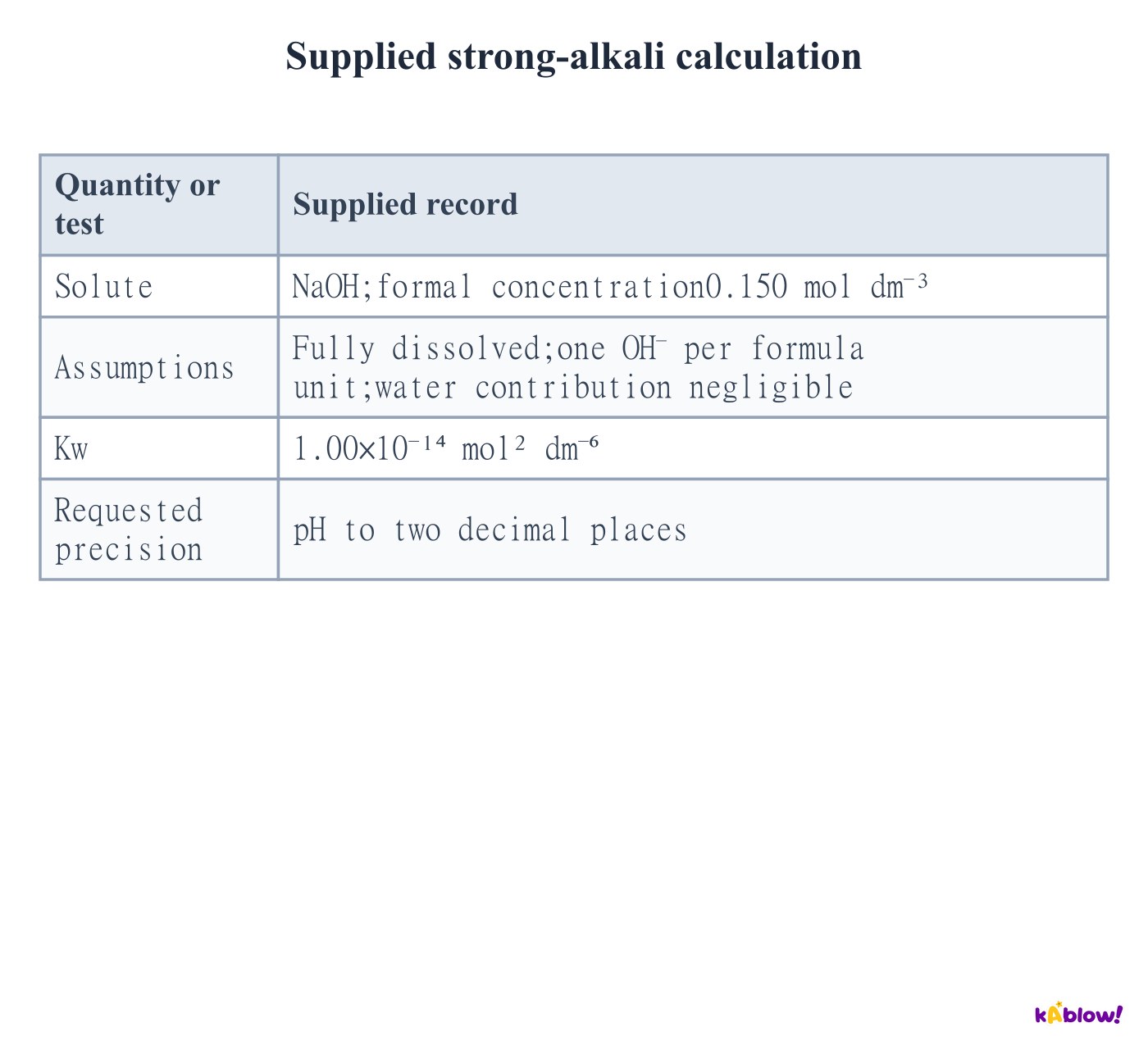
- Fully dissolved NaOH supplies one hydroxide per formula unit. With water contribution negligible, [OH⁻]≈.150 mol dm⁻³.
- Using the supplied Kw gives[H⁺]=6.666...×10⁻¹⁴ mol dm⁻³. Its pH is 13.176091..., rounding to 13.18.
- Keep guard digits until the end. Truncating to 13.17 is not rounding to two decimal places, and the temperature-specific Kw must remain consistent.
Supplied strong-alkali calculation
Count hydroxide ions per dissolved formula unit
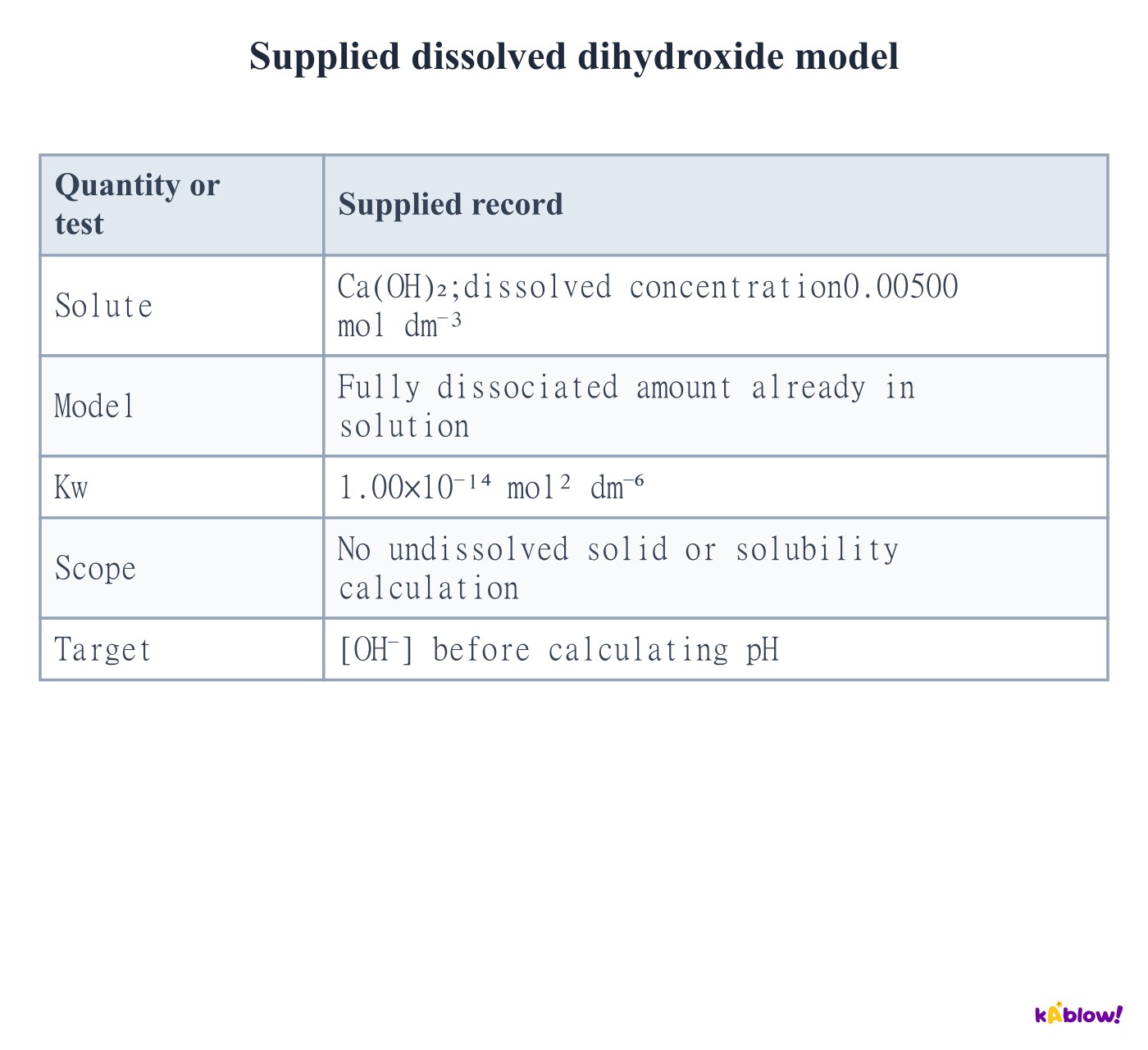
- Fully dissociated Ca(OH)₂ gives Ca²⁺+2OH⁻. The supplied dissolved concentration.00500 mol dm⁻³ therefore gives[OH⁻]=.0100 mol dm⁻³.
- With Kw=1.00×10⁻¹⁴ this implies[H⁺]=1.00×10⁻¹² mol dm⁻³ and pH12.00.
- The given amount is already dissolved. Do not assume an arbitrary added mass of a sparingly soluble hydroxide all dissolves; a solubility problem would need separate information.
Supplied dissolved dihydroxide model
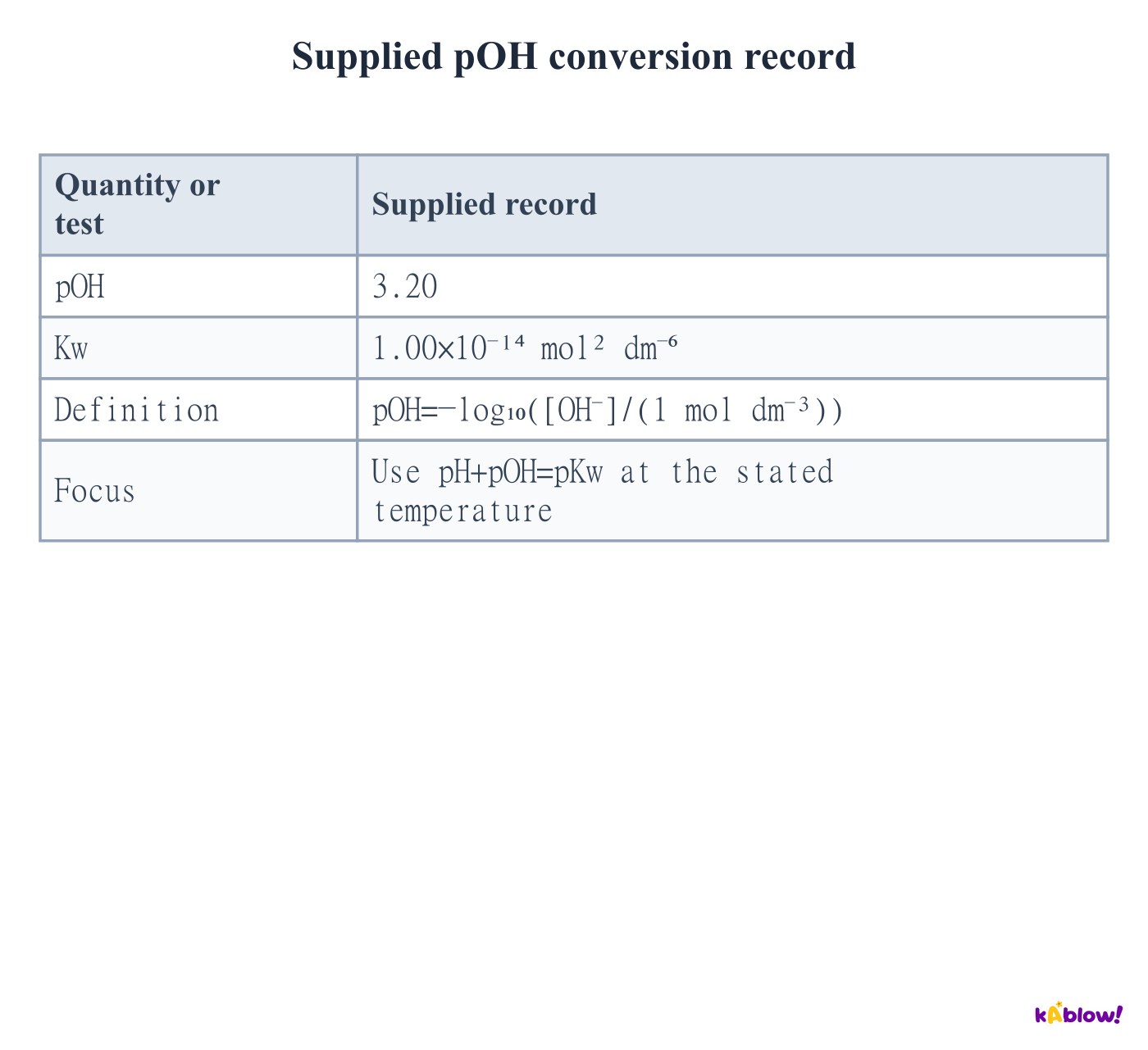
Relate pH and pOH using p Kw
- Define pOH=−log₁₀([OH⁻]/(1 mol dm⁻³)). Taking negative logarithms of Kw gives pH+pOH=p Kw.
- For the supplied rounded Kw=10⁻¹⁴, p Kw=14.00. A pOH of 3.20 therefore gives pH10.80.
- The sum is not always14 at every temperature. Use the given Kw to find p Kw if the temperature or model value changes.
Supplied pOH conversion record
Classify a solution at its own temperature
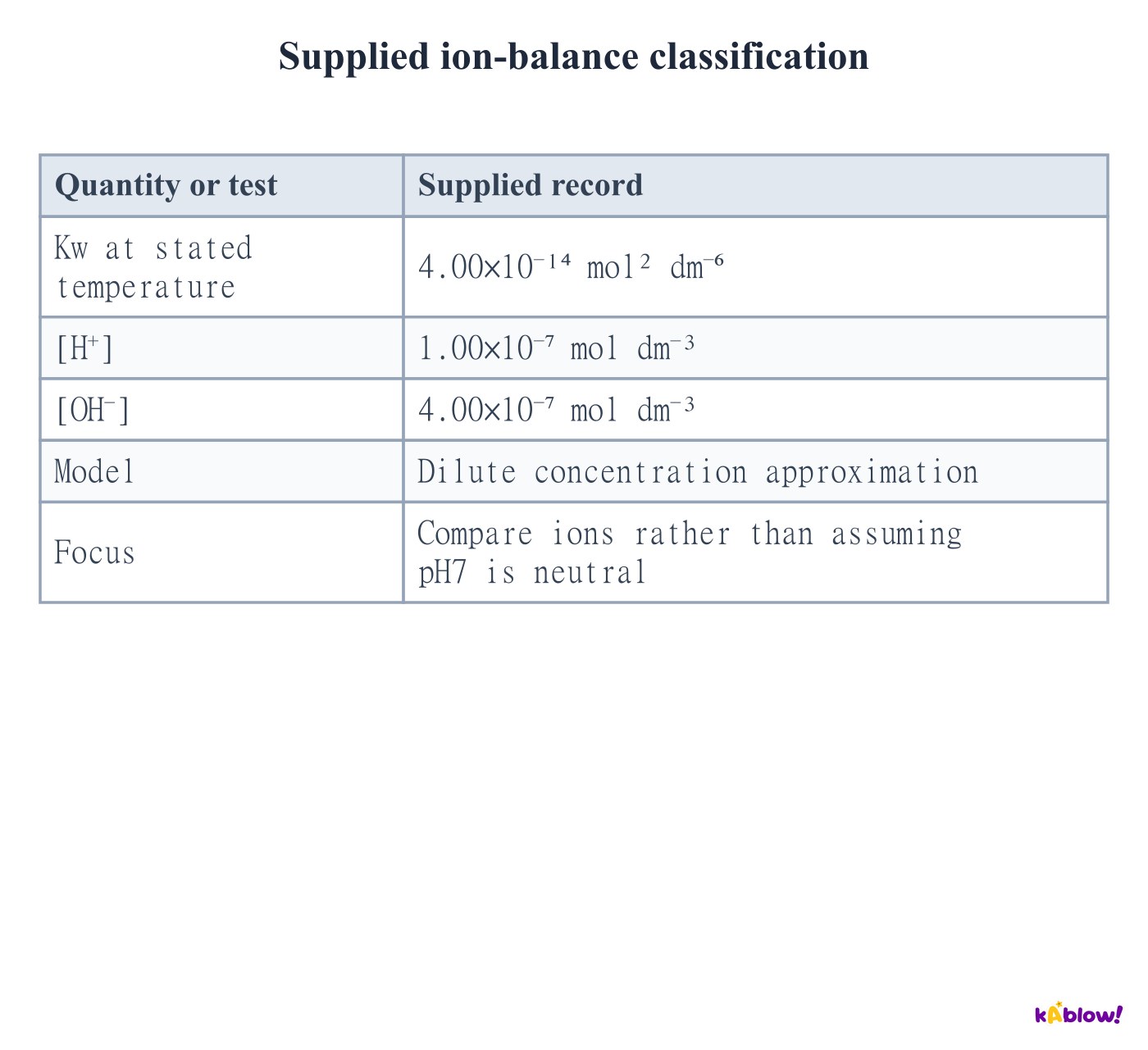
- Compare hydrogen and hydroxide concentrations: more H⁺ is acidic, equal concentrations are neutral, and more OH⁻ is alkaline in this model.
- The supplied[H⁺]=1.00×10⁻⁷ and[OH⁻]=4.00×10⁻⁷ satisfy Kw=4.00×10⁻¹⁴. The solution is alkaline even though its pH is 7.00.
- Use the neutral point for the stated temperature, not a universal assumption that every pH7 solution is neutral.
Supplied ion-balance classification
Recognise when water’s contribution matters
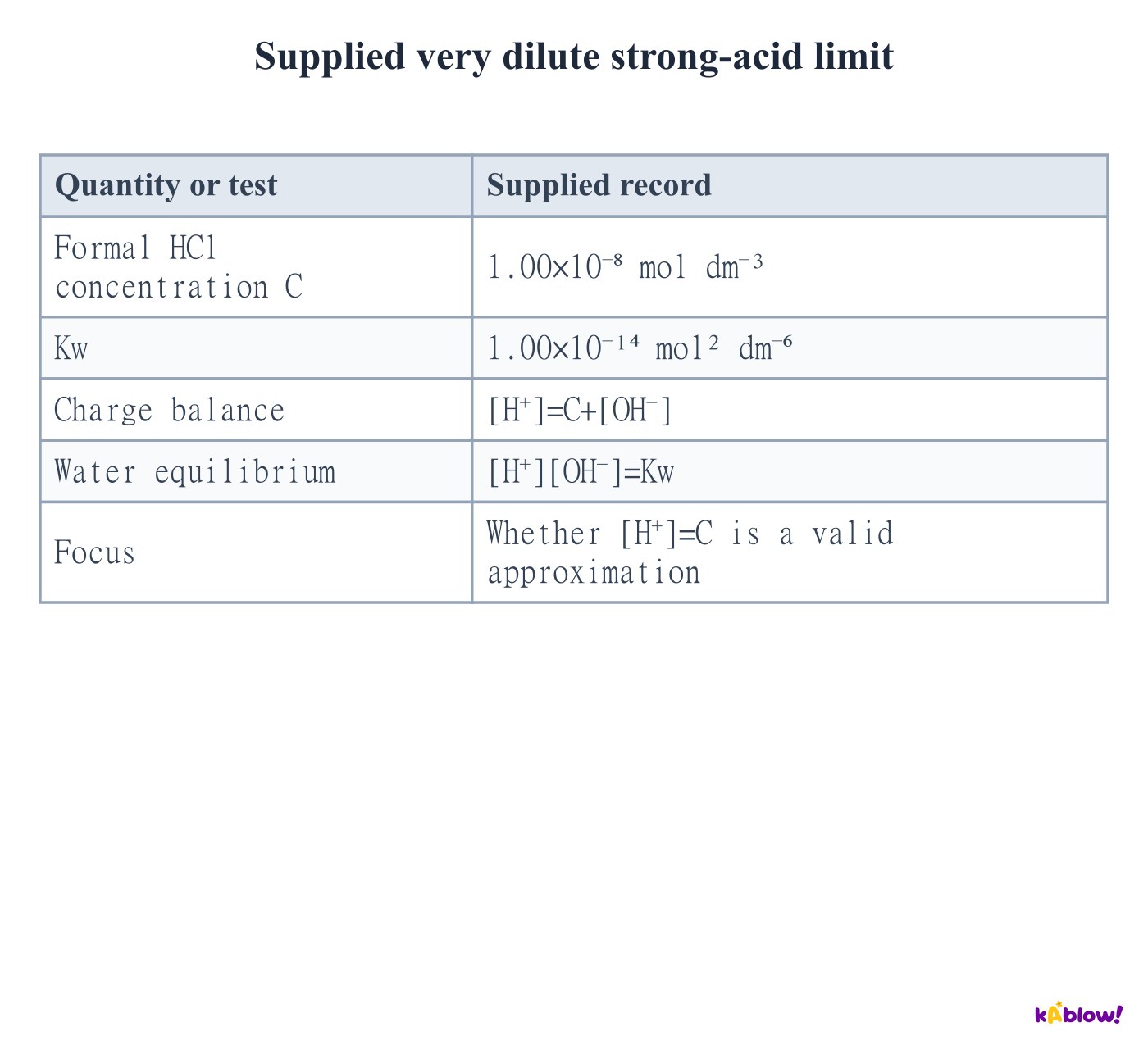
- For very dilute strong acid, setting[H⁺]=C can become invalid. The supplied C=10⁻⁸ mol dm⁻³ is comparable to water’s own ions.
- Extension: charge balance[H⁺]=C+[OH⁻] and Kw=[H⁺][OH⁻] give[H⁺]=(C+√(C²+4Kw))/2 for this ideal HCl model.
- The supplied case gives pH≈6.98 rather than 8.00. Acid dilution approaches neutrality; it does not turn pure strong acid plus pure water alkaline in this closed ideal model.
Supplied very dilute strong-acid limit
Round the final result rather than truncating
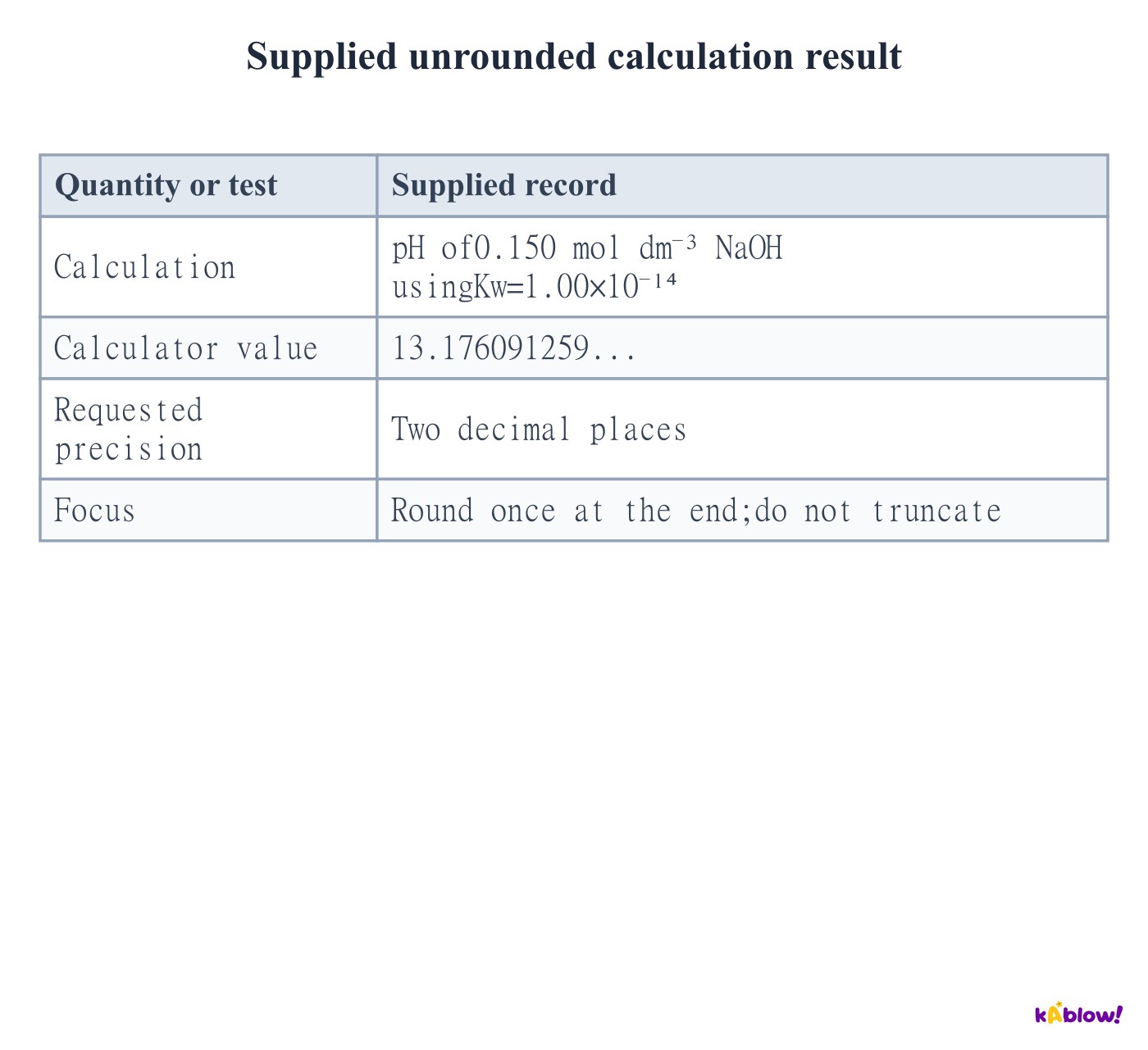
- Use all justified intermediate digits when dividing by Kw or taking logarithms. Round the final requested quantity once.
- The supplied unrounded13.176091259... becomes 13.18 to two decimal places because the third decimal digit is 6.
- pH is dimensionless, whereas[H⁺] and[OH⁻] carry concentration units. Follow the requested precision and keep the logarithm convention explicit.
Supplied unrounded calculation result
スライド
練習問題
無料プレビュー — 60問中8問。すべて見るには登録を。
1.Which reactant accepts a proton in the supplied forward reaction?
Medium- ANH₃
- BH₂O
- CNH₄⁺
- DOH⁻
2.Which supplied candidates are conjugate acid–base pairs?
Medium- AA and B
- BA and C
- CB and D
- DC and D
3.In which supplied reaction does water act as a proton donor?
Medium- AA only
- BB only
- CBoth A and B
- DNeither
4.Which pair is related by one proton in supplied step1?
Medium- AH₂CO₃ and HCO₃⁻
- BCO₂ and HCO₃⁻
- CCO₂ and H₂O
- DH₃O⁺ and H₂CO₃
5.Which comparison follows from the supplied acid record?
Medium- AX is stronger but more dilute than Y
- BX is weaker and more concentrated than Y
- CY must be strong because it is concentrated
- DThe two acids must have identical pH
6.Calculate pH for the supplied hydrogen-ion concentration to two decimal places.
Medium- A−3.80
- B3.80
- C4.20
- D1.60
7.What hydrogen-ion concentration follows from the supplied pH, to three significant figures?
Medium- A7.94×10⁻⁴ mol dm⁻³
- B3.10×10⁻³ mol dm⁻³
- C1.26×10³ mol dm⁻³
- D7.94×10⁴ mol dm⁻³
8.Calculate the supplied hydrogen-ion concentration ratio A/B.
Medium- A3
- B10
- C100
- D1000
過去問
このトピックの過去問練習は近日公開。
近日公開