
Introduction To Organic Chemistry
遊んで学ぼう
問題に答えてエネルギーを集めたら、釣りや探検を楽しもう。アカウント不要。
教育者の方へ: Introduction To Organic Chemistry(Chemistry、AQA)向けのすぐ使えるレッスンスライド, 復習ノート, 図解 — レッスンで使うか、学習者がライブゲームとして遊ぶインタラクティブなクラス活動としてトピックを実施できます。
レッスンノート
Explain carbon skeleton diversity
- Carbon commonly forms four covalent bonds. Strong carbon–carbon bonds allow connected chains, branches and rings; this capacity is catenation.
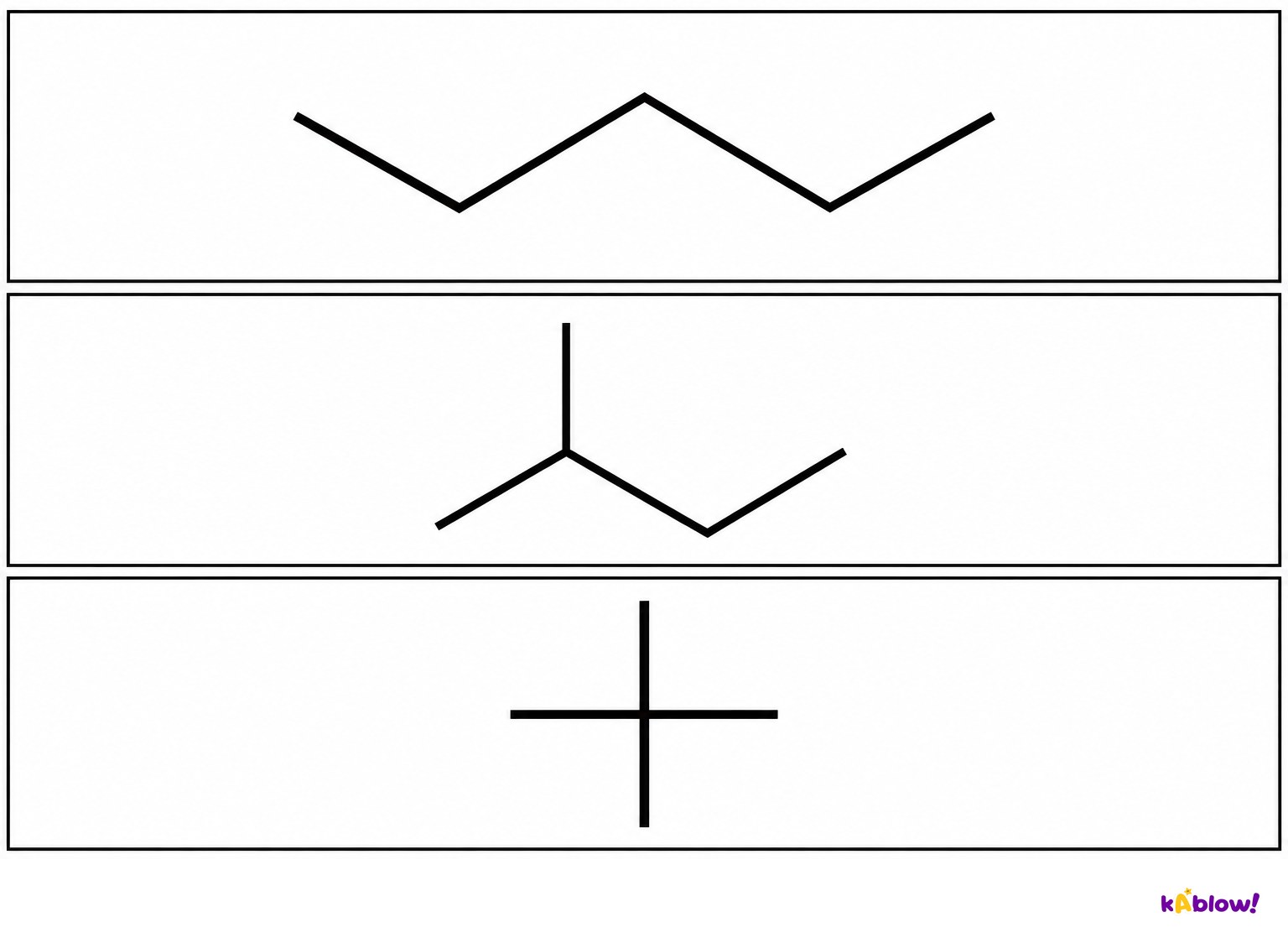
- The skeletal comparison shows three different carbon frameworks with the same total carbon count. Line ends and junctions represent carbon atoms unless another element is written.
- An ordinary displayed or skeletal formula is a connectivity model. A zigzag drawing does not mean a saturated chain is geometrically straight or all its atoms lie in one plane.
Three carbon skeletons
Recognise a homologous series
- Members of a specified homologous series share a characteristic functional group or bonding pattern and a common general formula. Neighbouring members differ by CH₂.
- They have similar characteristic chemistry rather than identical behaviour under every condition. Molecular size also changes physical properties.
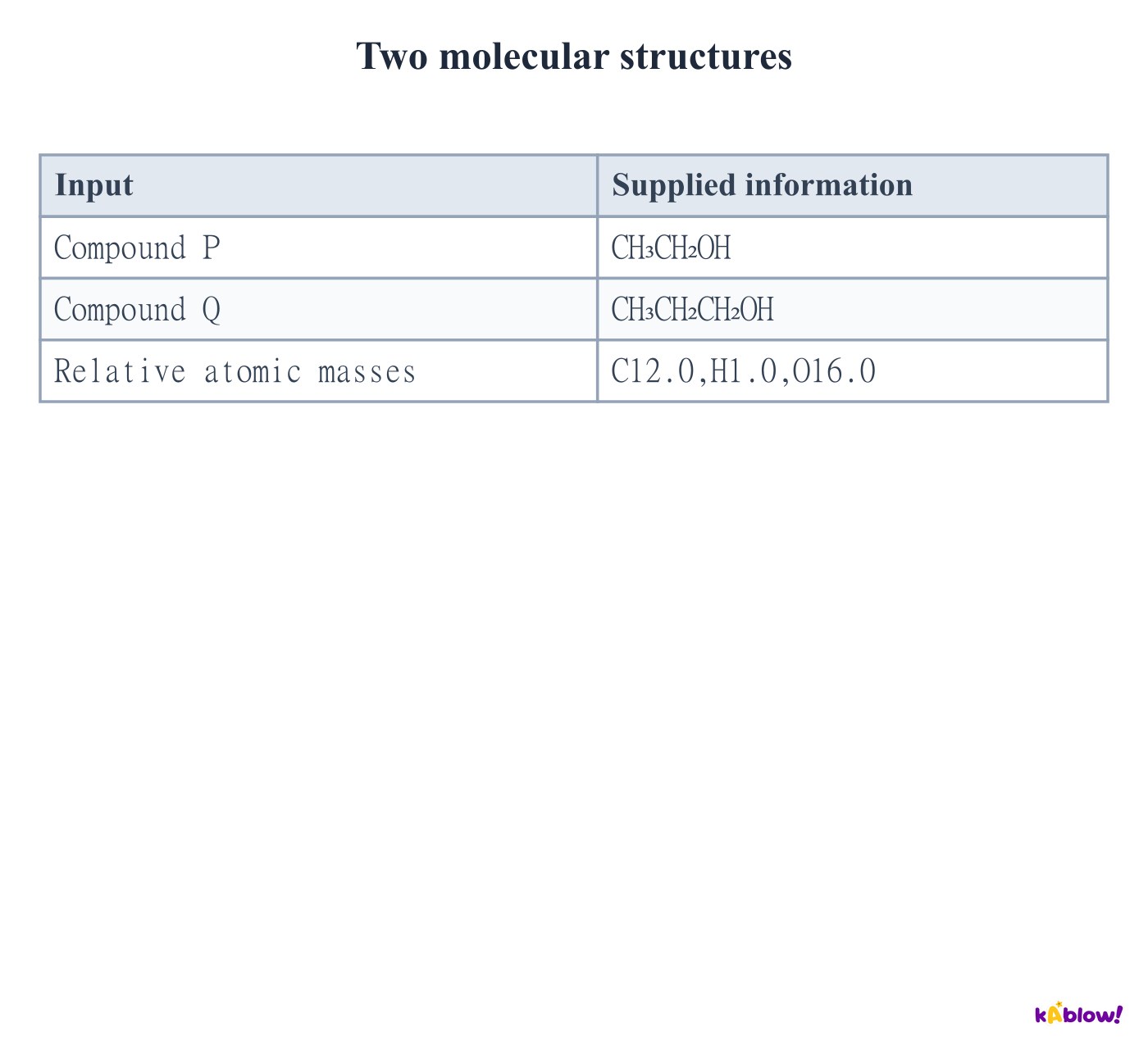
- The two alcohol examples have one hydroxyl group each. A formula alone may include other families, so inspect connectivity before assigning a series.
Two molecular structures
Interpret a physical-property pattern
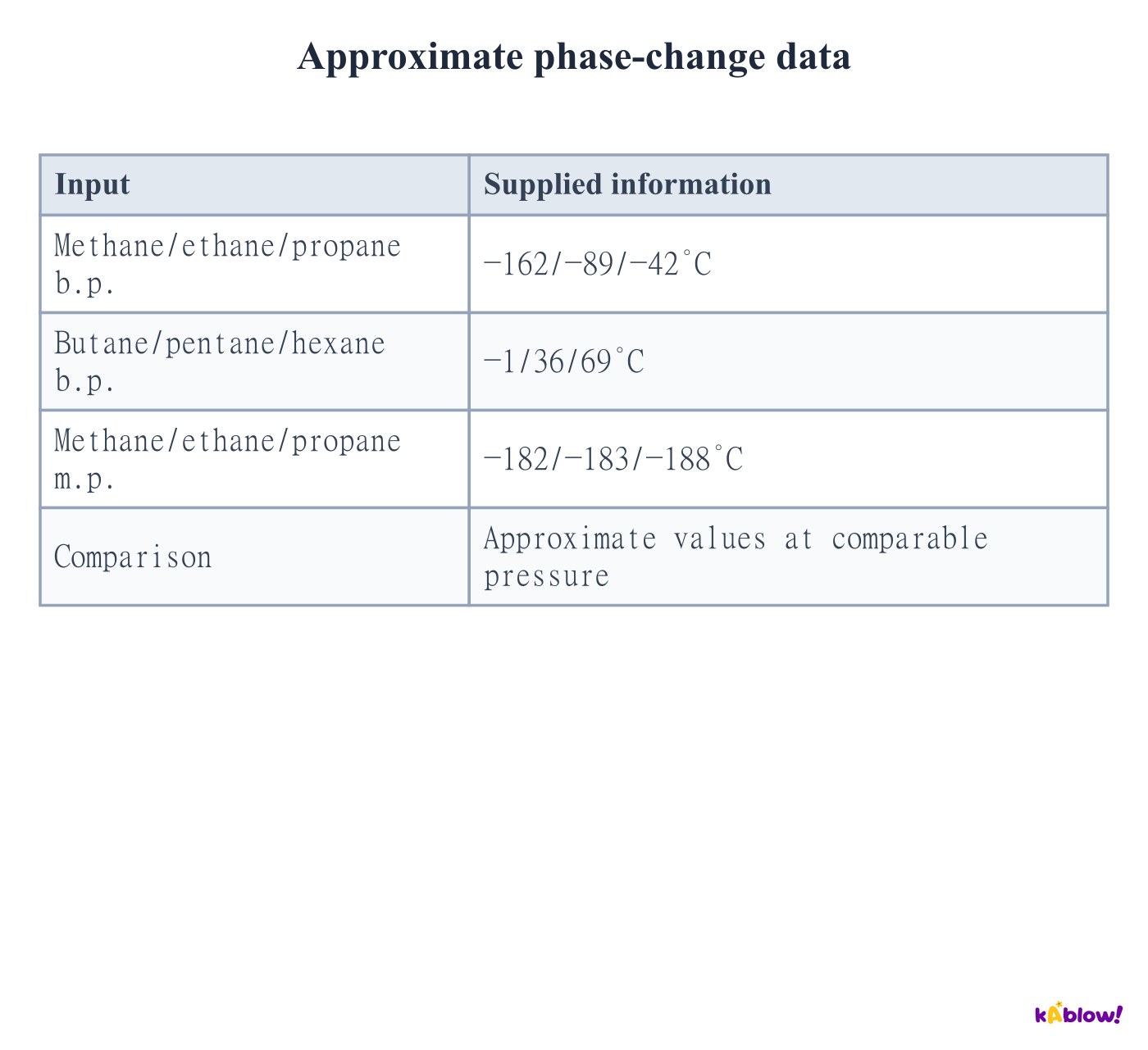
- The supplied values show boiling point rising from methane to hexane at comparable pressure. Larger electron clouds generally produce stronger London interactions.
- Boiling separates molecules; it does not normally break the covalent carbon skeleton. Members still share the alkane bonding pattern.
- Do not claim that every physical property changes monotonically. The melting temperatures in the same record show packing effects and do not rise at every step.
Approximate phase-change data
Separate hydrocarbons from other carbon compounds
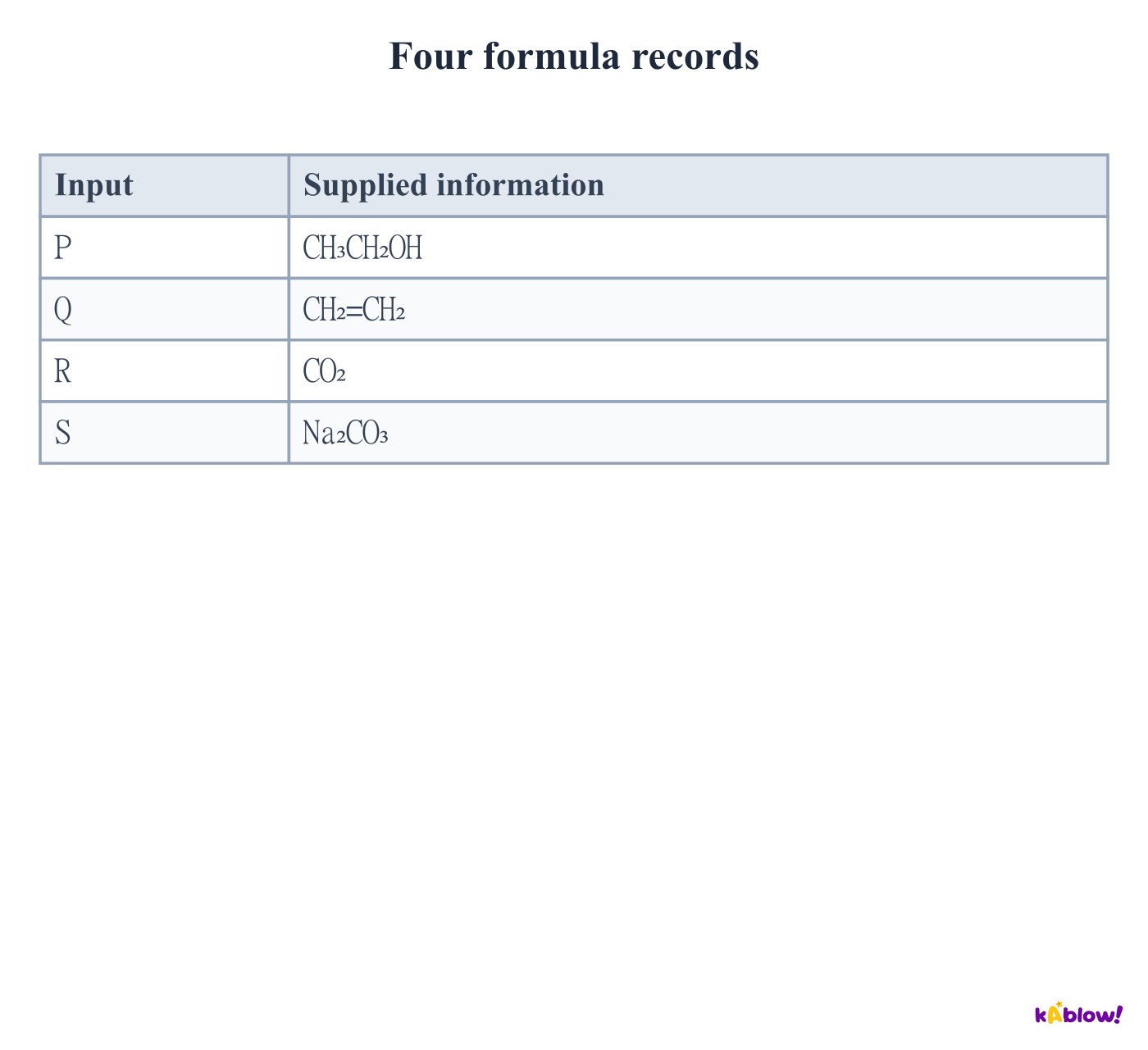
- A hydrocarbon contains only carbon and hydrogen. Methane and ethene meet that definition; ethanol contains oxygen as well.
- Organic chemistry largely concerns carbon compounds, but common carbon oxides and carbonates are conventionally treated as inorganic. Carbon content alone is not a complete classification test.
- Inspect the elements and bonding in the supplied formulas. A hydrocarbon need not be an alkane:it can contain multiple bonds or rings.
Four formula records
Identify local functional-group patterns
- A functional group is an atom or group of atoms associated with characteristic reactions. Its local bonding matters, not just the list of elements.
- Alkenes contain C=C; alcohols have an OH bonded to a suitable saturated carbon; halogenoalkanes have a carbon–halogen bond in the relevant framework.
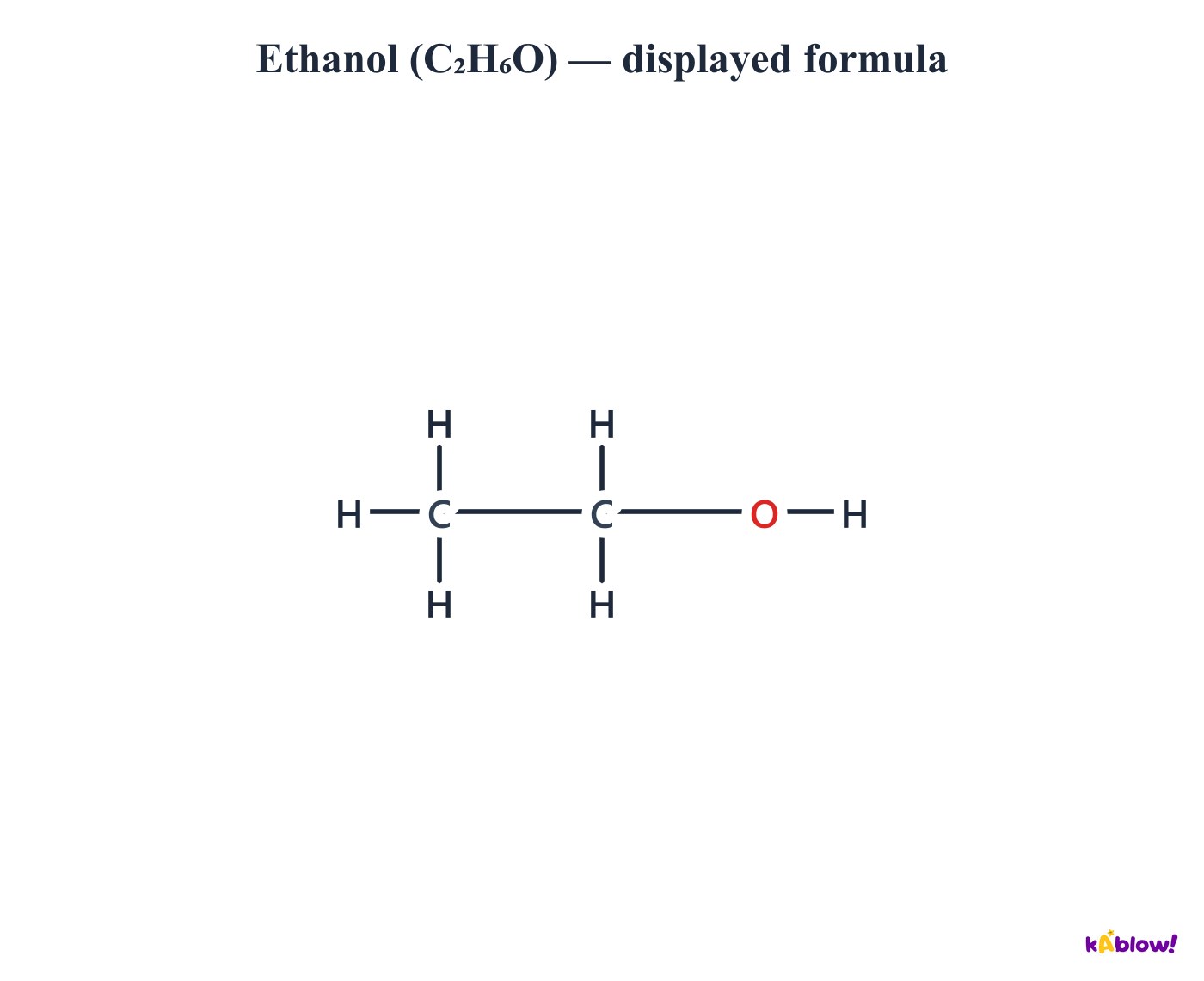
- The displayed ethanol formula shows that carbon is bonded to oxygen, which is bonded to hydrogen. Writing C–H–O would assign hydrogen an impossible two-bond role in this ordinary neutral model.
Displayed ethanol connectivity
Distinguish carbonyl-containing families
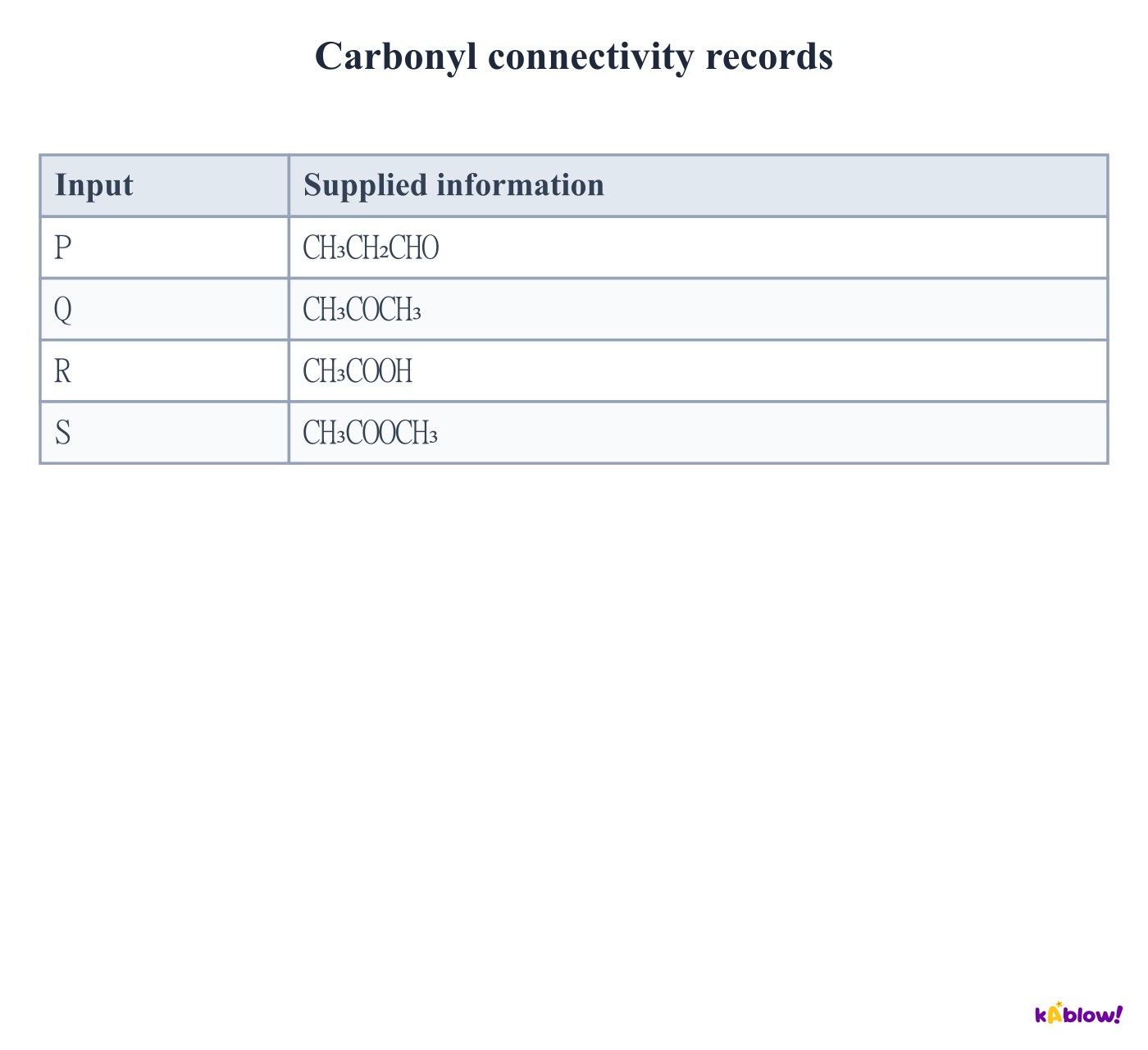
- Aldehydes include a carbonyl carbon bonded to H; ketones have carbon groups on both sides of the carbonyl carbon.
- Carboxylic acids contain C(=O)OH. Esters contain C(=O)O joined onward to another carbon group. A carbonyl alone does not distinguish all these families.
- Count the carbonyl carbon when counting the carbon framework. Inspect which atoms are directly connected to it before choosing the family or suffix.
Carbonyl connectivity records
Count nitrogen-containing functional groups
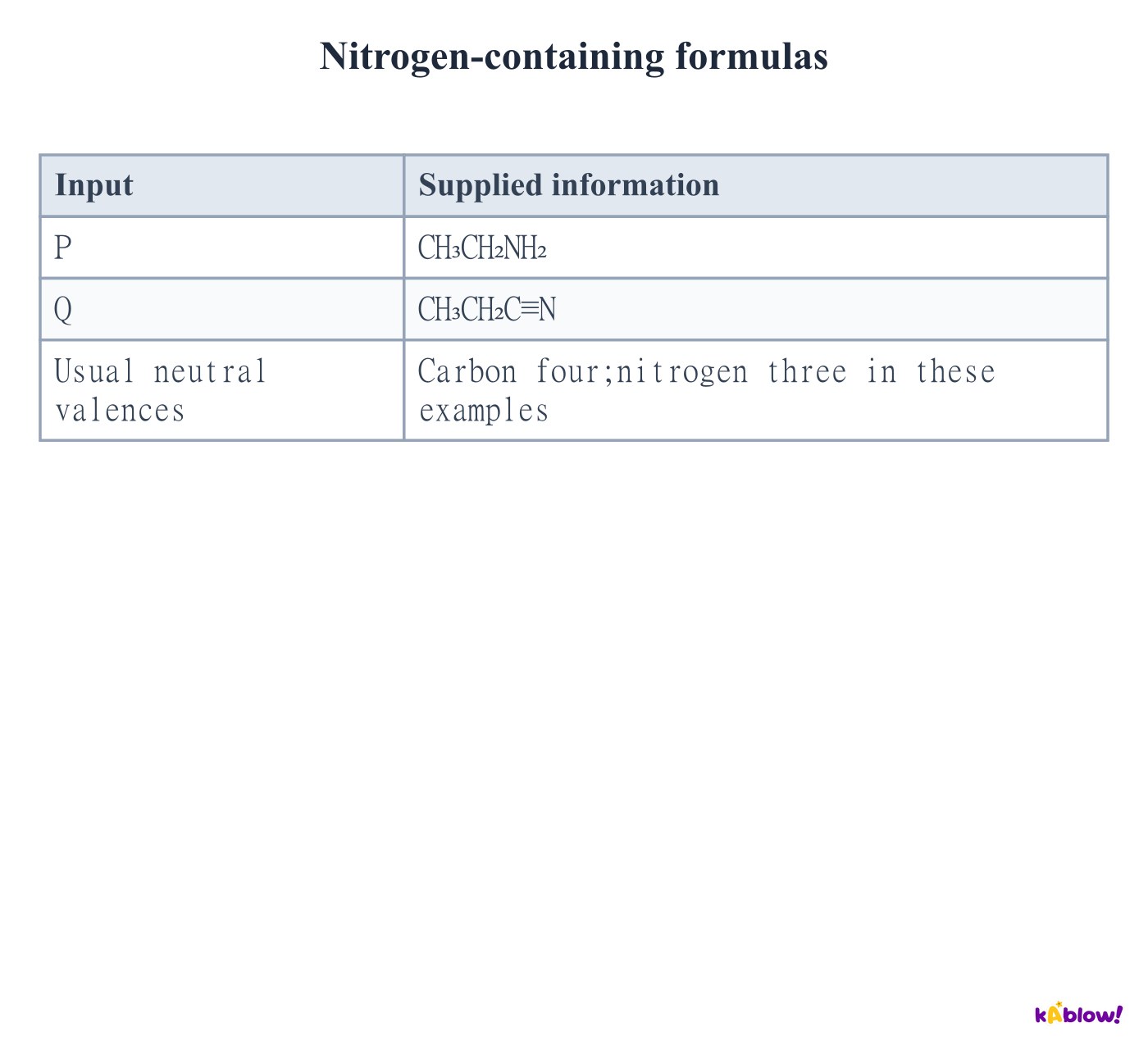
- A primary amine can be represented by RNH₂ with R an appropriate carbon group. Other amines have more carbon groups bonded to nitrogen.
- A nitrile contains a carbon triple-bonded to nitrogen. That nitrile carbon belongs to the total carbon count and usually to the parent name.
- R is a context-defined placeholder, not an element symbol or always any arbitrary atom. For these examples it denotes an appropriate hydrocarbon group.
Nitrogen-containing formulas
Relate molecular and empirical formulas
- A molecular formula records the actual count of each element in one molecule. It does not generally specify which atoms are bonded together.
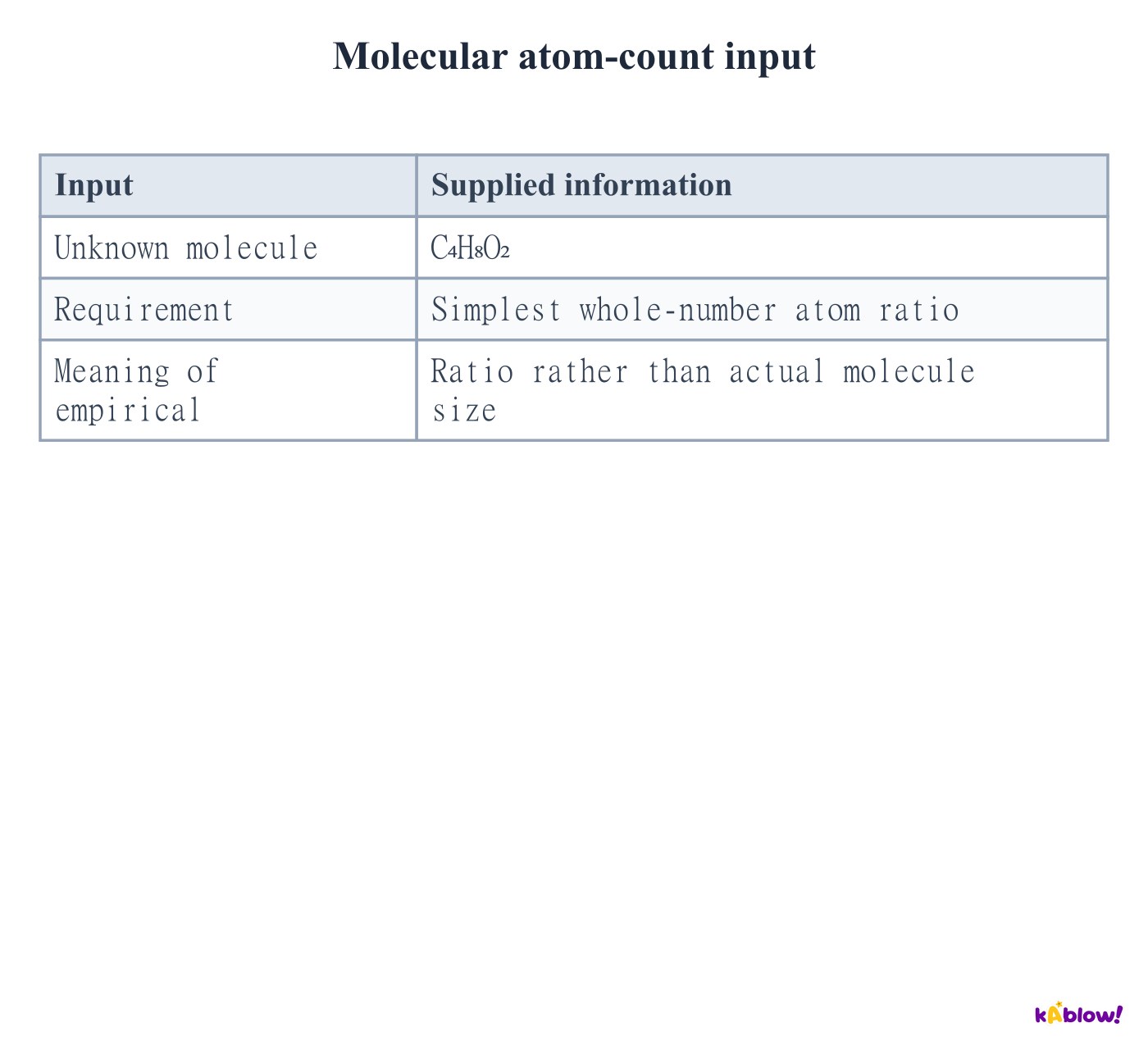
- An empirical formula gives the simplest whole-number element ratio. Reduce all subscripts by their common divisor; do not remove an element.
- Ethanoic acid has molecular formula C₂H₄O₂ and empirical formula CH₂O. A different molecular formula can have the same empirical ratio without being an isomer.
Molecular atom-count input
State the limits of a general formula
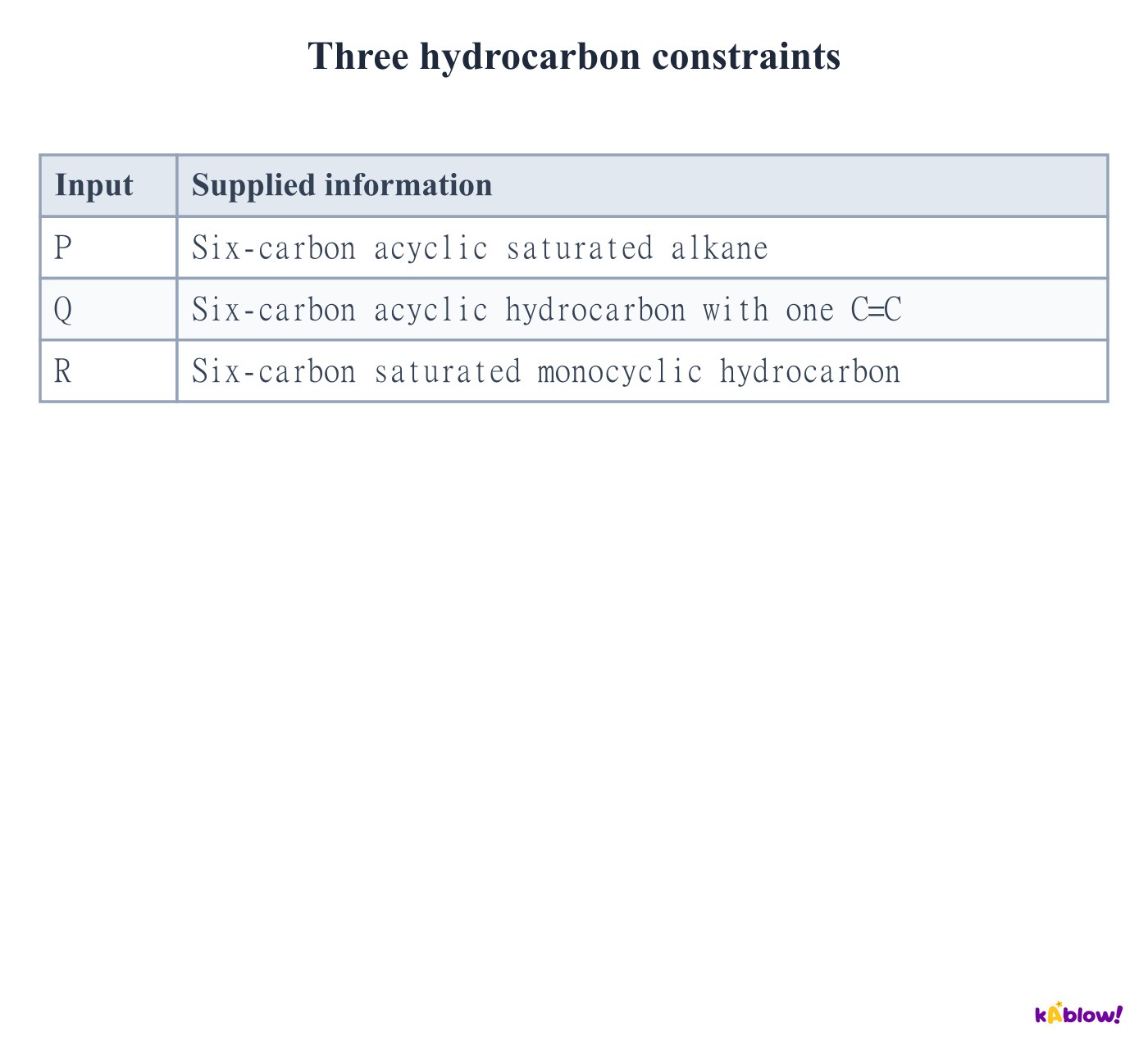
- Acyclic saturated alkanes obey CₙH₂ₙ₊₂. Acyclic hydrocarbons with one C=C and no other unsaturation obey CₙH₂ₙ.
- A saturated monocyclic hydrocarbon also has CₙH₂ₙ. The same formula pattern can describe different bonding arrangements.
- Always state the family constraints before using a formula to infer hydrogen count. Rings or additional multiple bonds change the relation.
Three hydrocarbon constraints
Read a displayed formula completely
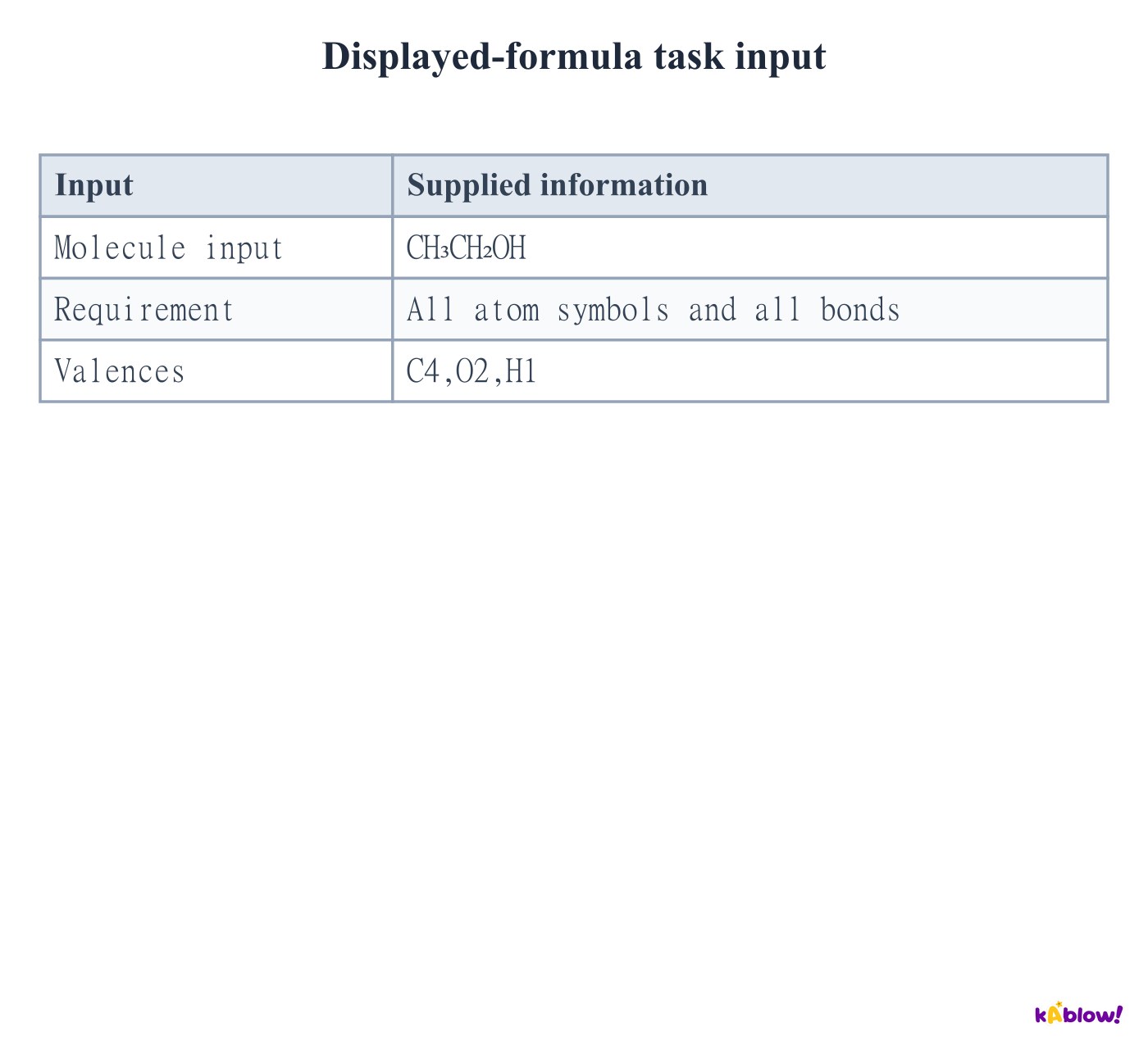
- A displayed formula shows every atom symbol and every covalent bond, including the C–H bonds. Double bonds require two bond lines.
- The ethanol illustration has two carbons, one oxygen and six hydrogens. Its single O–H bond is part of the displayed connectivity.
- Displayed formulas are not complete three-dimensional geometry measurements. A flat arrangement of C–H bonds is not a claim that a tetrahedral carbon is square planar.
Displayed ethanol connectivity
Expand brackets without losing atoms
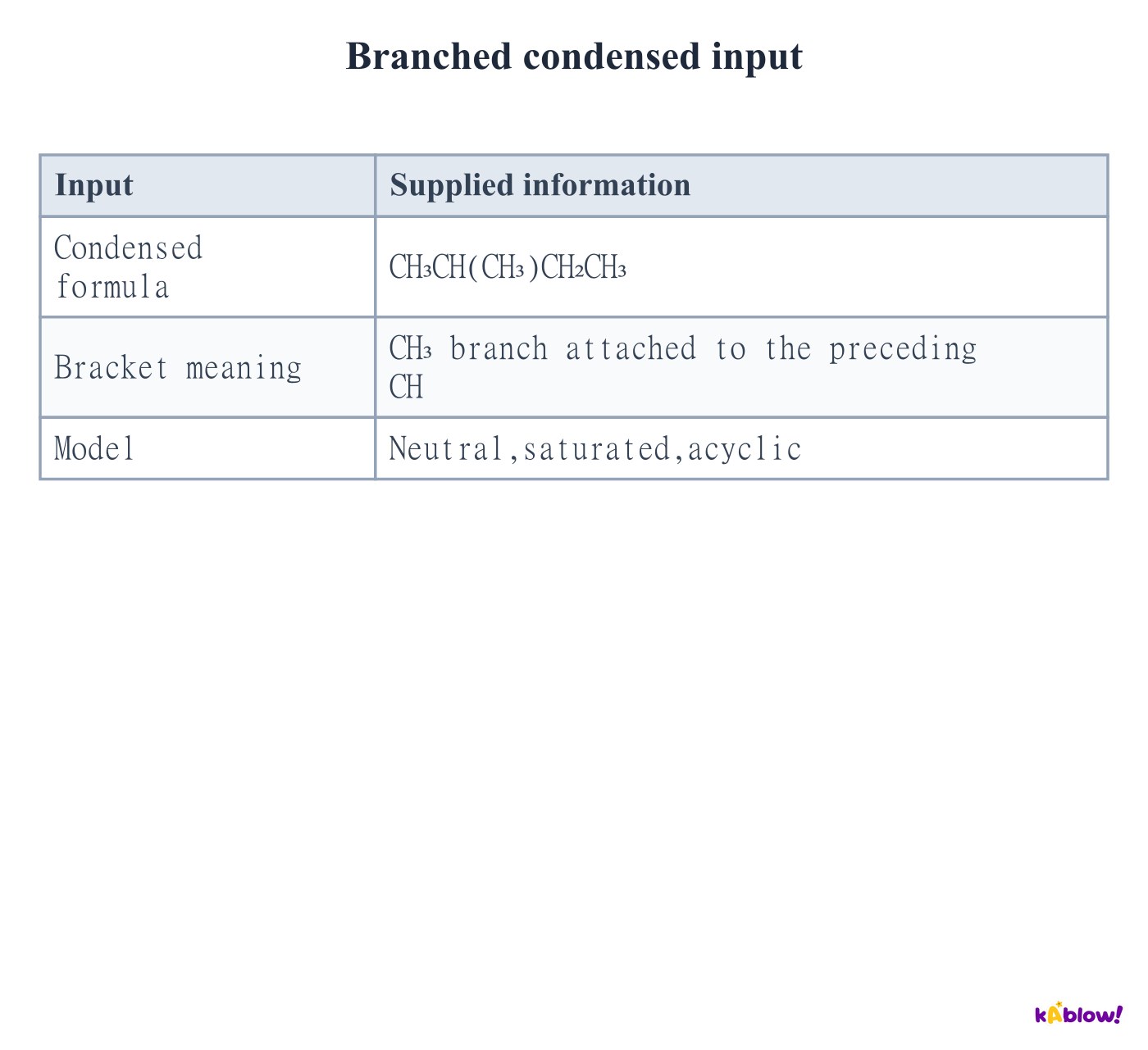
- A condensed structural formula groups atoms while retaining enough sequence and brackets to show connectivity. CH₃CH(CH₃)CH₂CH₃ has a methyl branch.
- The main four-carbon path and the extra methyl carbon make five carbons in total. Do not confuse the parent-chain length with total molecular carbon count.
- Expand the bracket at its attachment carbon before deriving the molecular formula or choosing an isomer comparison.
Branched condensed input
Recover atoms from a skeletal formula
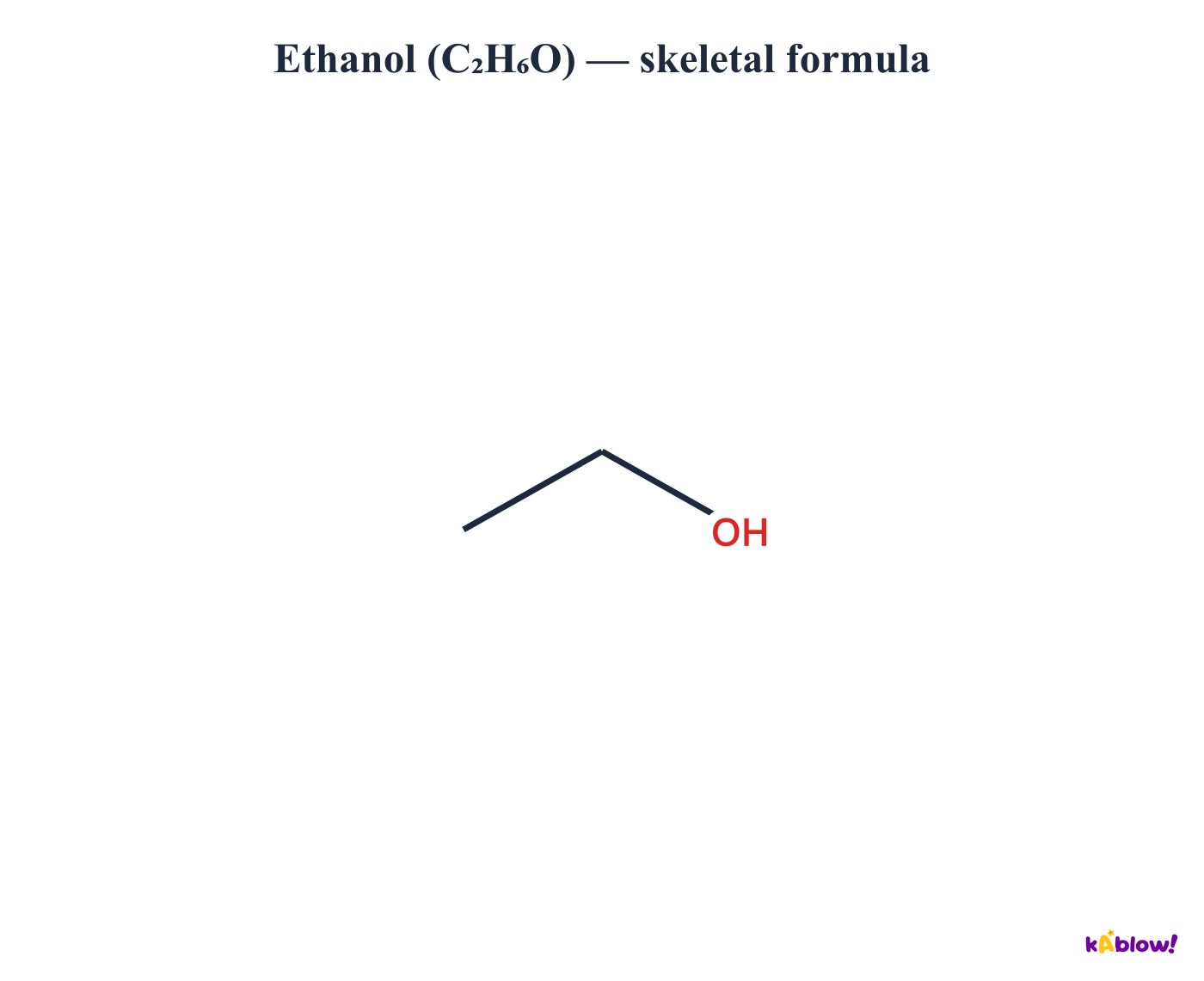
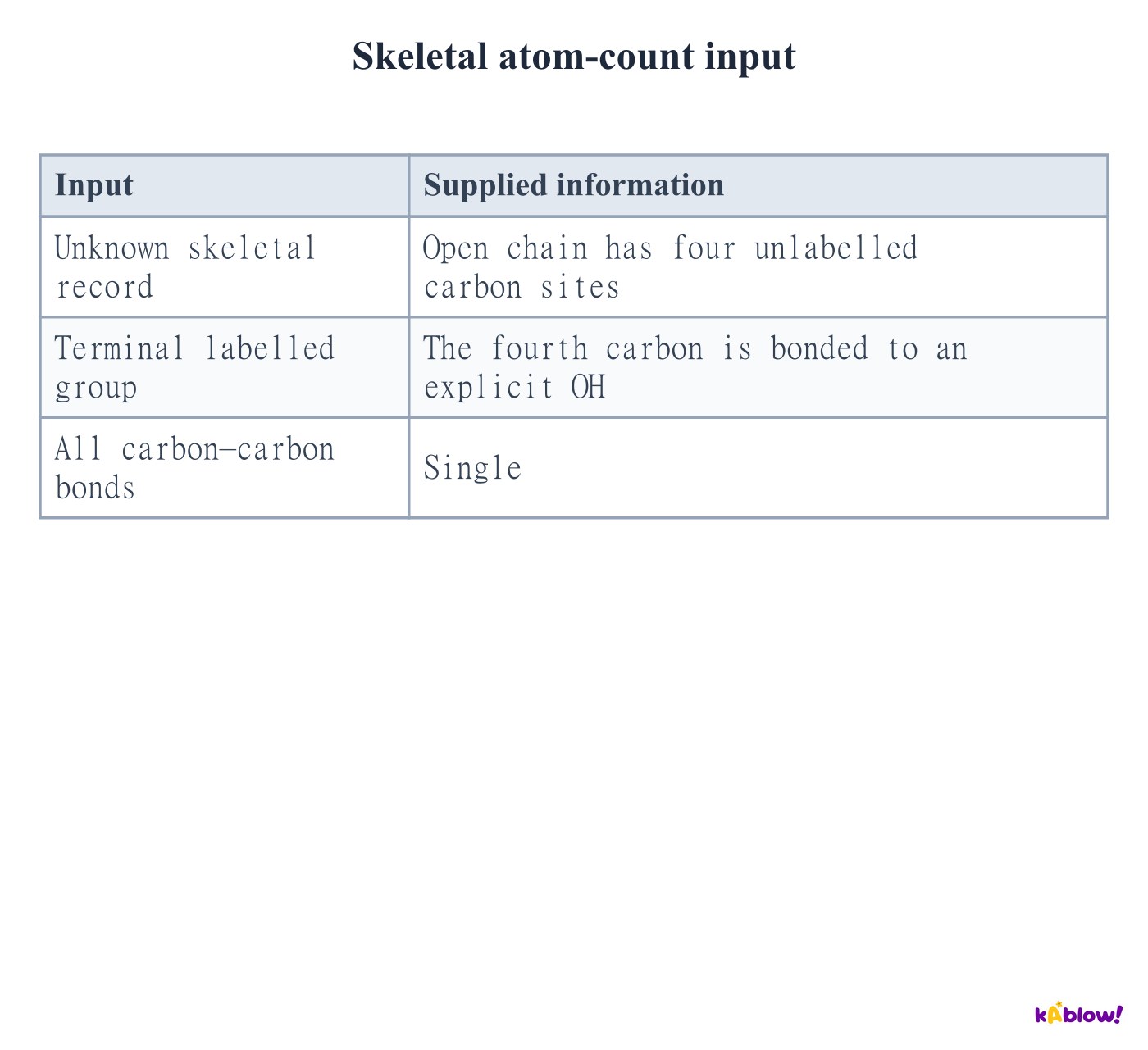
- In a skeletal formula, unlabelled line ends and corners normally represent carbon. Hydrogens attached to carbon are omitted and recovered from carbon valence four.
- Heteroatoms and relevant heteroatom-bound hydrogens remain explicit in the simple examples here. A labelled O endpoint is oxygen rather than an extra carbon.
- The ethanol skeletal drawing retains the OH group. A single unlabelled line ending at O cannot be counted as carbon at that labelled endpoint.
Skeletal ethanol connectivity
Choose a parent chain before naming branches
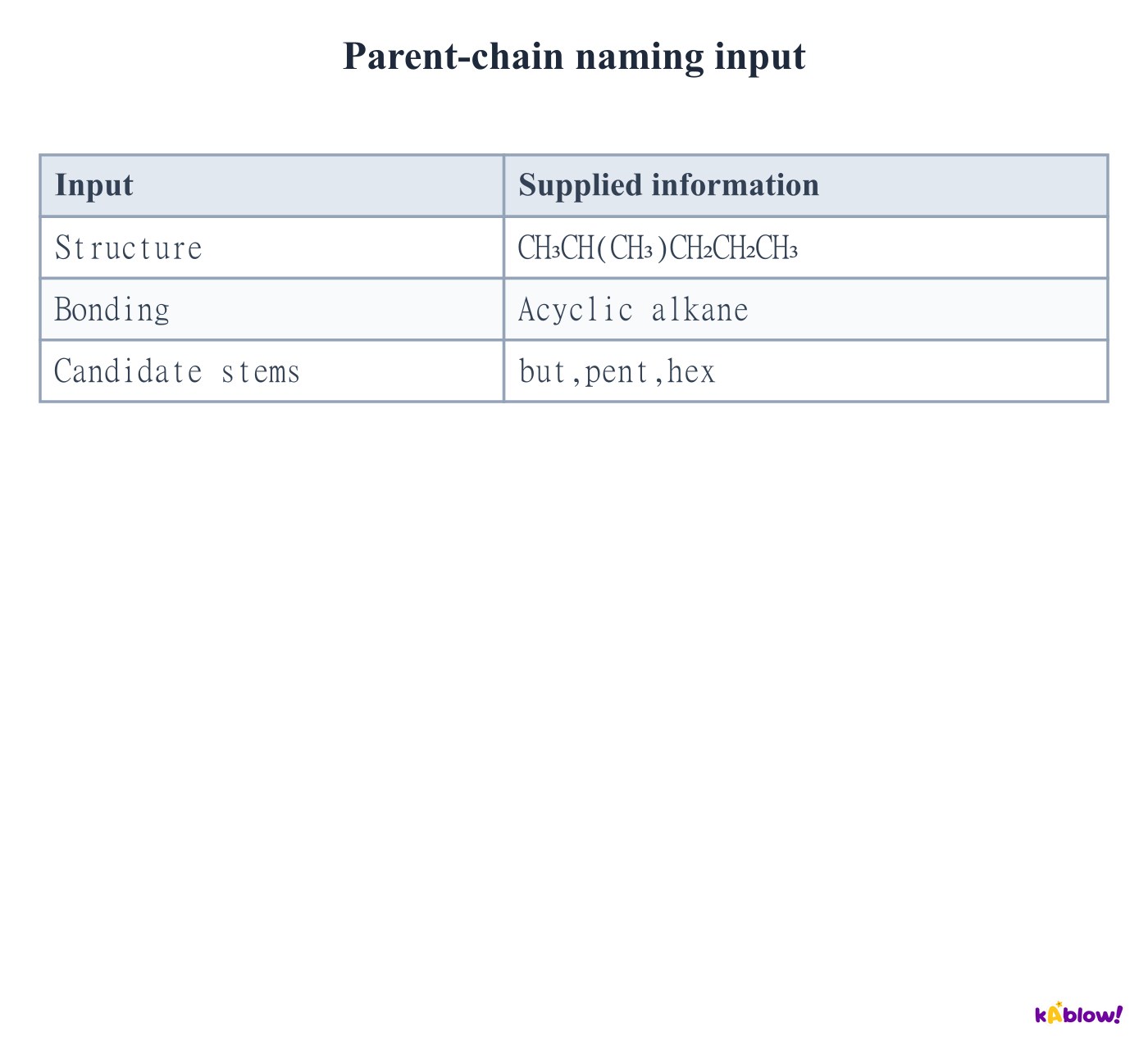
- The parent must include the relevant principal group and required multiple bond in the naming cases considered. Then use the appropriate longest allowed chain.
- For a simple branched alkane, identify the longest continuous carbon path. It may bend across the page rather than follow a visually horizontal line.
- The stem counts the chosen parent carbons, not every carbon in branches:meth, eth, prop, but, pent and hex correspond to one through six.
Parent-chain naming input
Compare locant sets at the first difference
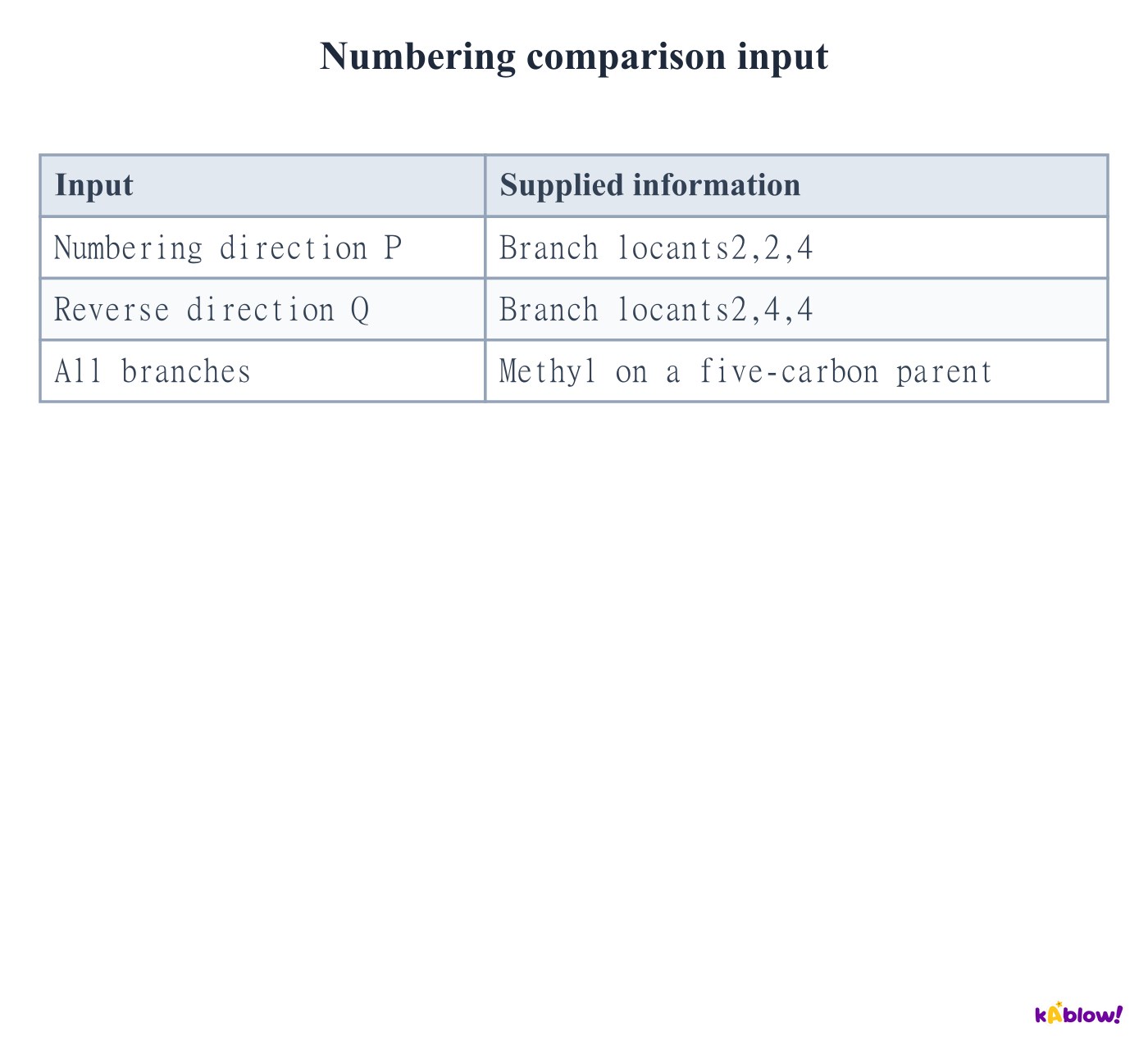
- Choose numbering according to the appropriate naming priorities. For equivalent parent chains of simple substituted alkanes, compare ordered locant sets at the first point of difference.
- Do not choose numbering merely because the sum of locants is smaller. A first lower locant can decide the comparison before later numbers are considered.
- Repeated identical branches use di, tri or tetra. Commas separate locants; hyphens separate locants from words.
Numbering comparison input
Order different substituent names alphabetically
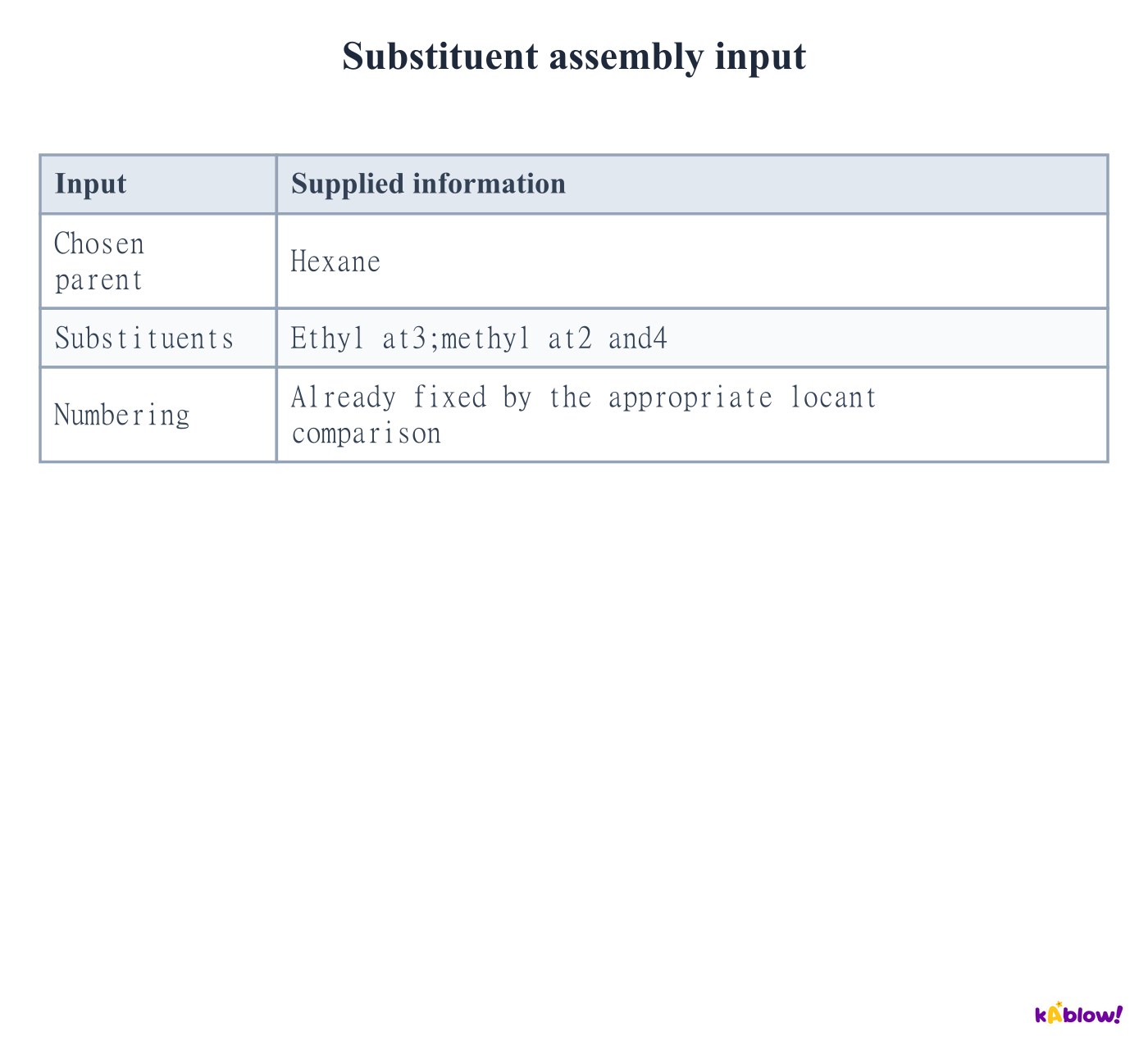
- After locating substituents, list different simple substituent names alphabetically. Multipliers such as di and tri do not decide this ordering.
- The supplied compound has an ethyl group and two methyl groups on a six-carbon parent. Ethyl is listed before methyl despite methyl’s multiplicity.
- Punctuation communicates the numbered structure. Keep commas between repeated locants and hyphens between numbers and words.
Substituent assembly input
Give the principal group its numbering priority
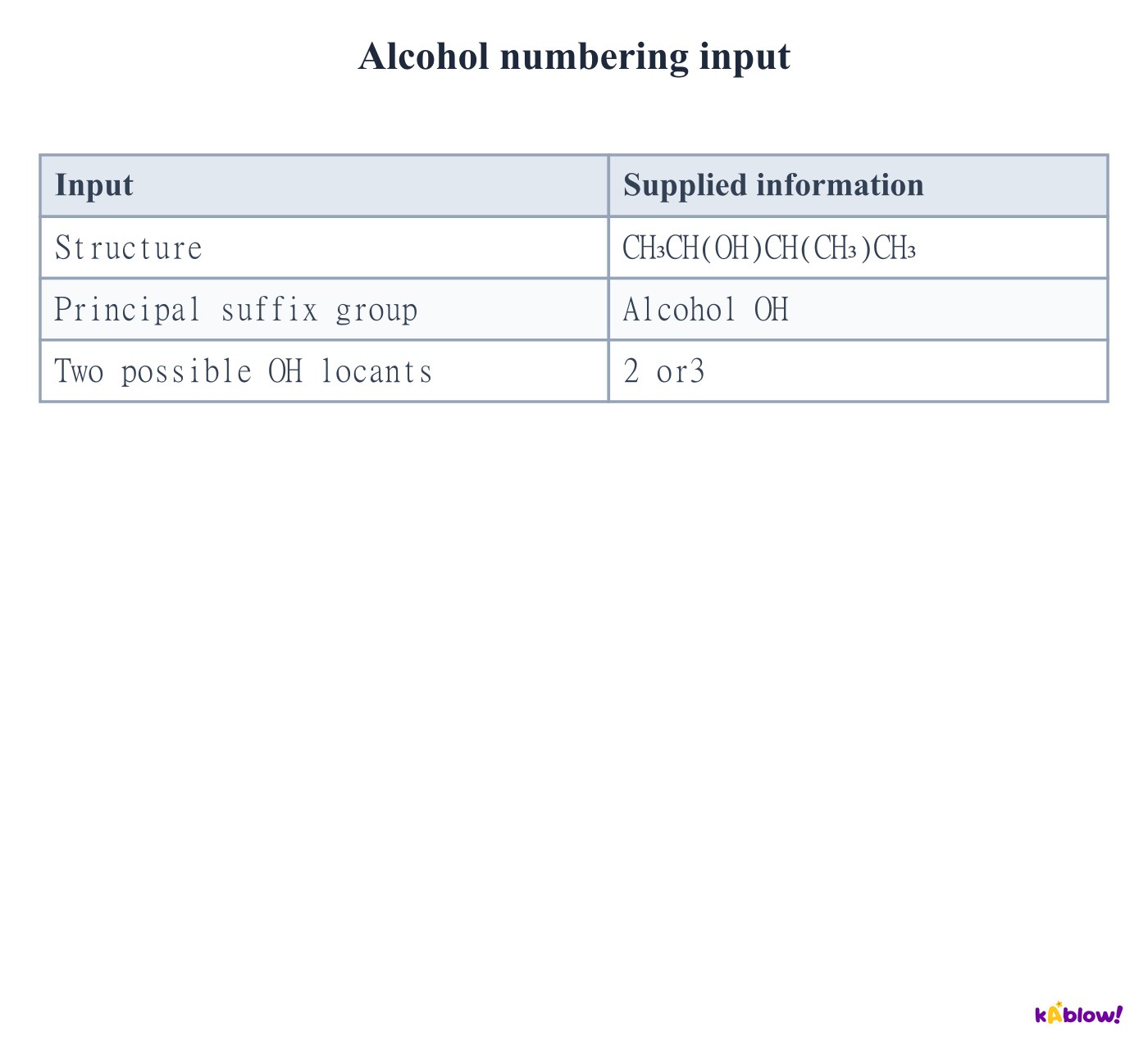
- An instruction to choose the smallest numbers is incomplete without stating what has priority. In the simple alcohol case, the hydroxyl suffix locant precedes a methyl substituent locant.
- For CH₃CH(OH)CH(CH₃)CH₃, the preferred alcohol numbering gives OH at 2 and methyl at 3. Reversing would give OH at 3.
- A carbon–carbon double-bond locant identifies its lower-numbered carbon. Use names such as but-2-ene and butan-2-ol with the correct stem and suffix placement.
Alcohol numbering input
Include terminal functional-group carbons
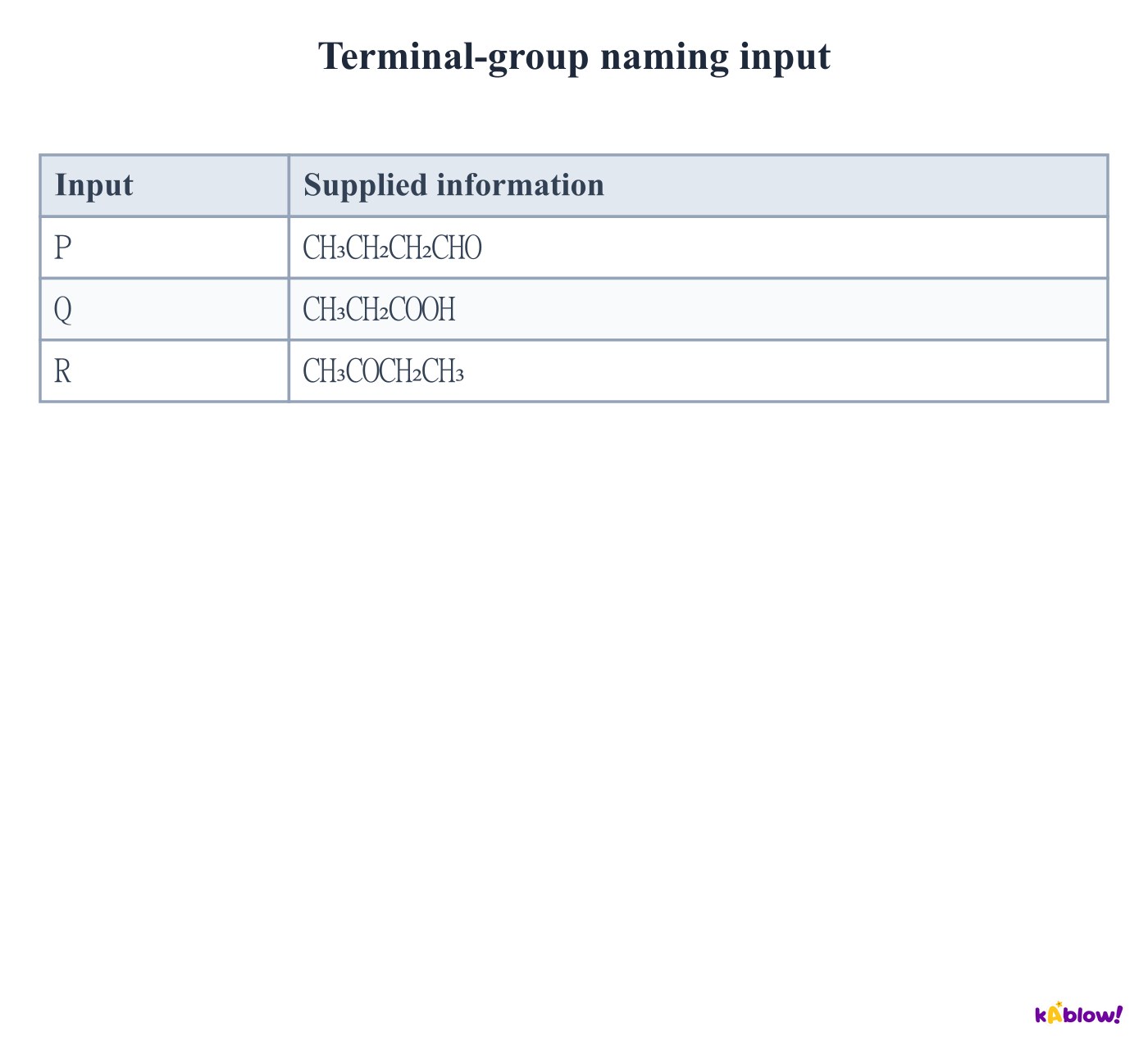
- For a simple aldehyde, the carbonyl carbon carrying H belongs to the parent and is carbon 1. A simple monocarboxylic acid similarly counts its carboxyl carbon as 1.
- CH₃CH₂CHO is propanal, not ethanal:the CHO carbon is the third carbon in the molecular count. CH₃CH₂COOH is propanoic acid.
- An internal ketone needs a locant where necessary. Naming identifies connectivity rather than merely counting visible CH₃ or CH₂ groups.
Terminal-group naming input
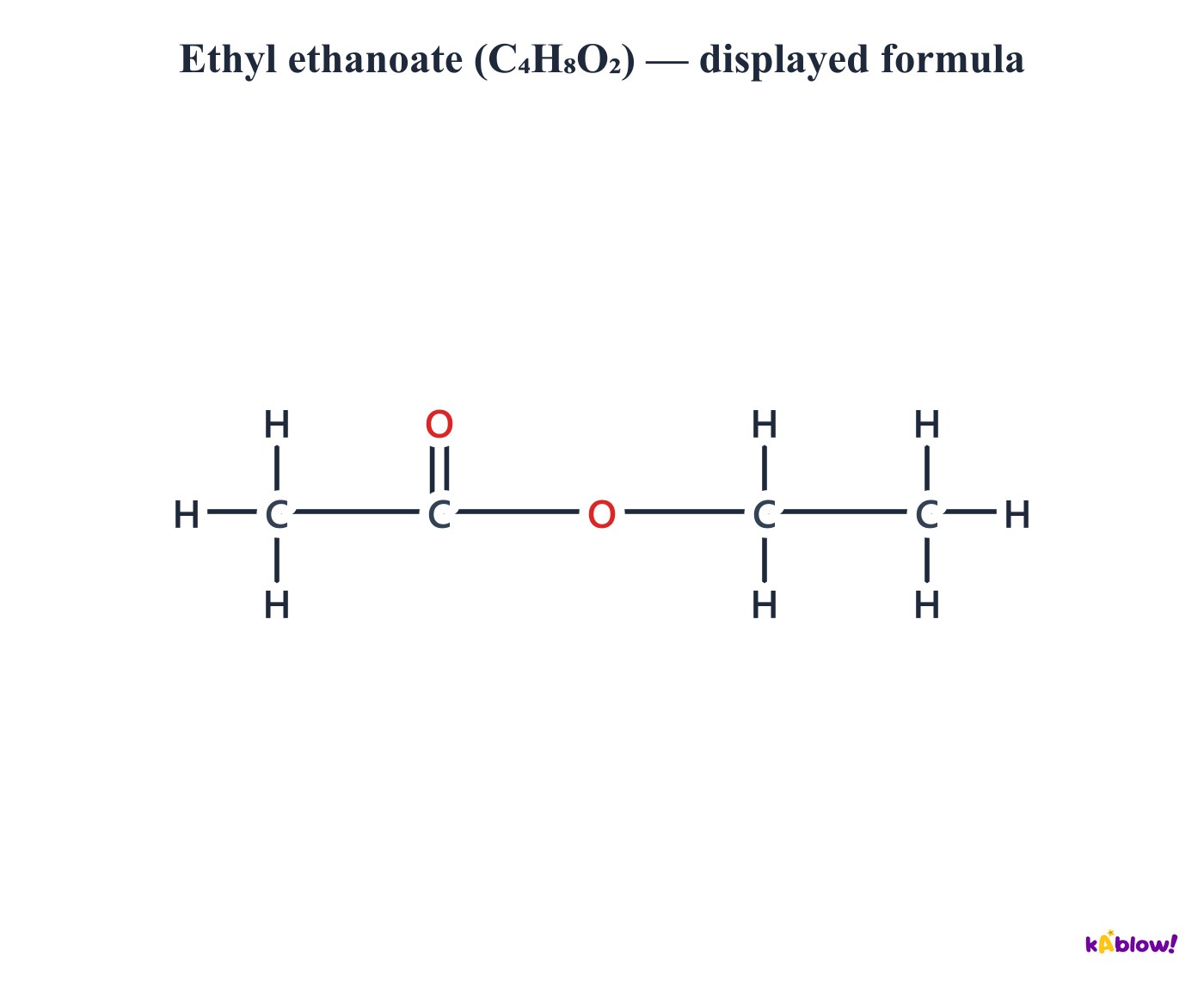
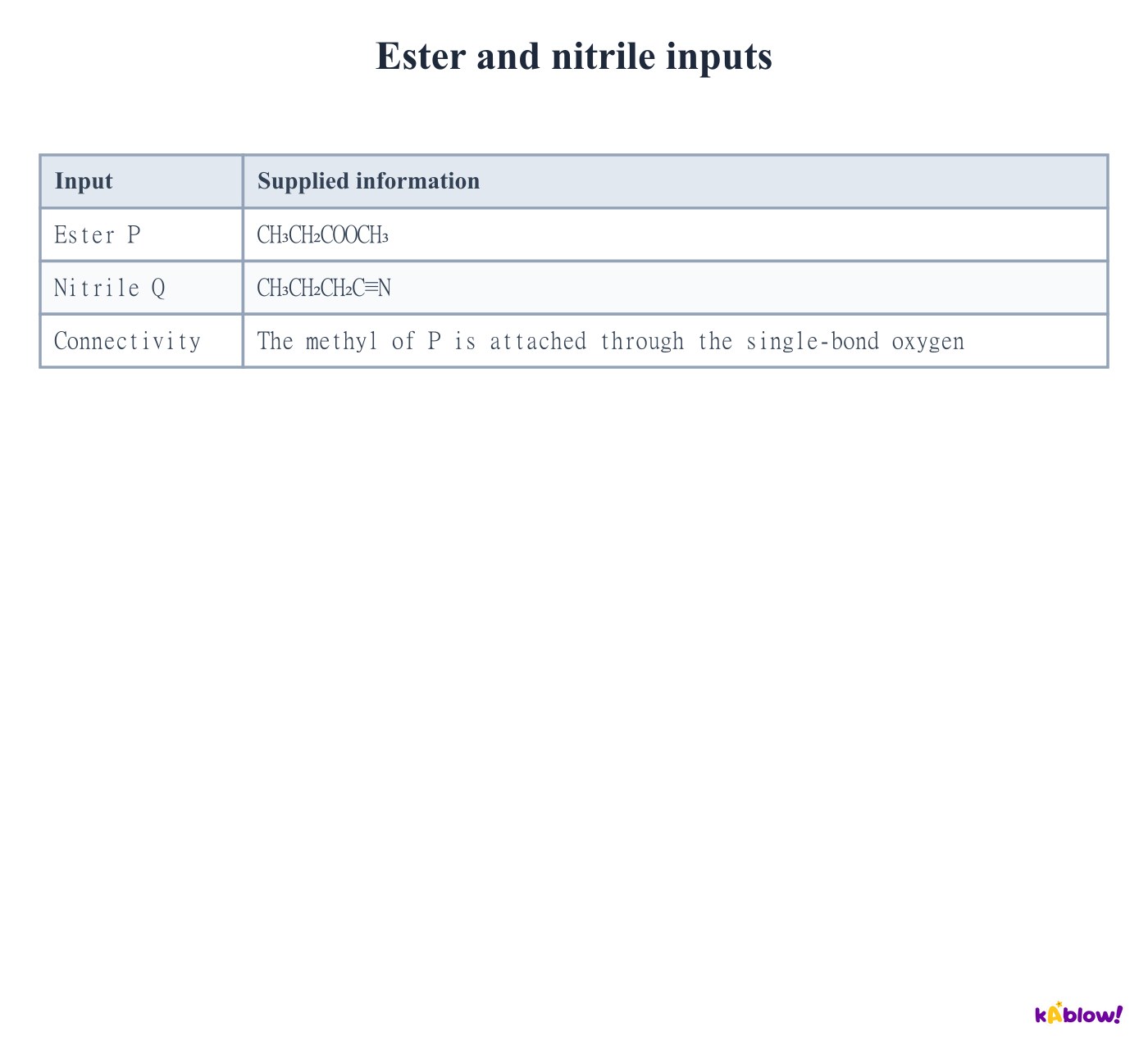
Count both sides of an ester and the nitrile carbon
- An ester name starts with the alkyl group attached to oxygen, then identifies the acid-derived alkanoate portion. Count the carbonyl carbon in that second portion.
- Ethyl ethanoate has two carbons on the alcohol-derived side and two on the acid-derived side. The molecular formula is C₄H₈O₂.
- In CH₃CH₂CN, the nitrile carbon is counted, so the name is propanenitrile. Nitrogen is not a carbon site and does not add another carbon to the parent.
Displayed ethyl ethanoate connectivity
Require molecular identity before calling compounds isomers
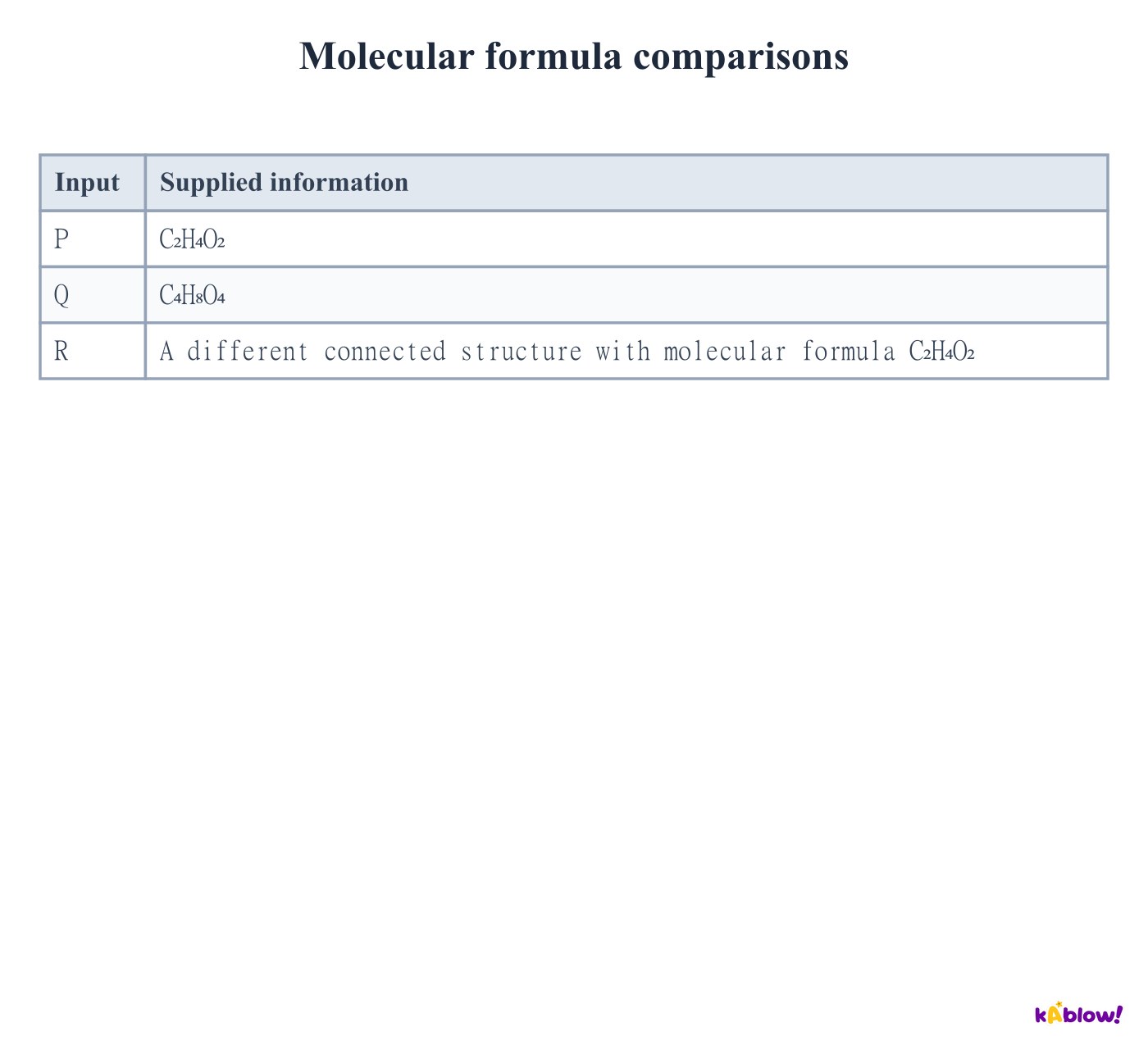
- Structural isomers have the same molecular formula but different atom connectivity. Matching empirical formulas alone is insufficient.
- Molecular formulas can conceal chain, position or functional-group differences. Reversing a drawing without changing connectivity does not make a new structural isomer.
- Always establish actual atom counts first, then compare bonded neighbours. Spatial rearrangement with unchanged connectivity belongs to stereoisomerism.
Molecular formula comparisons
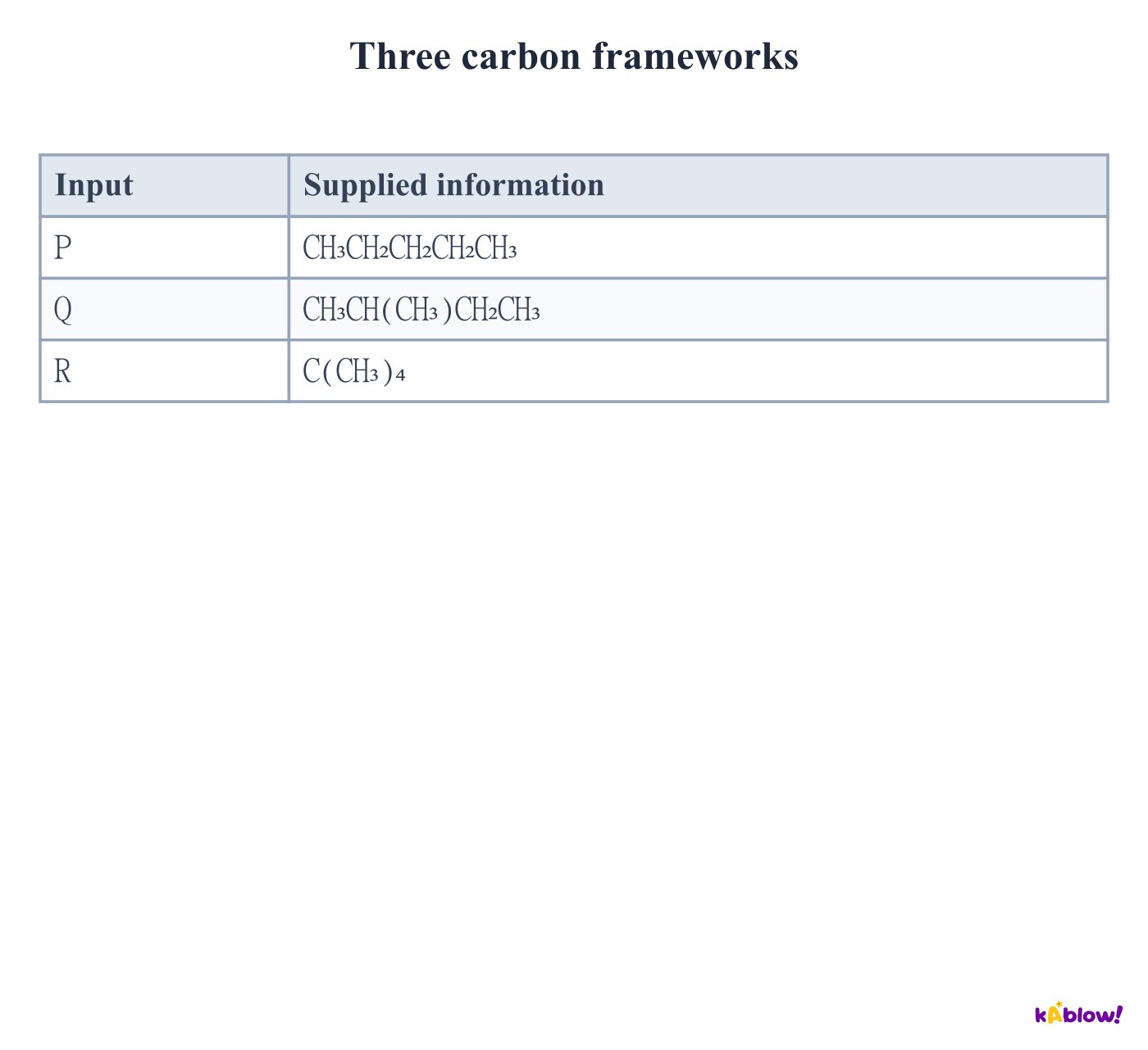
Compare carbon skeletons rather than drawing shapes
- The three skeletal panels represent pentane,2-methylbutane and 2,2-dimethylpropane from top to bottom. Each contains five carbon sites and gives C₅H₁₂.
- They are chain isomers because the carbon connectivity differs. A branch can change the longest path, but longest-chain length alone is not a complete definition of chain isomerism.
- The cross in the bottom panel represents one four-connected carbon with four terminal carbons. It is a connectivity notation, not square-planar carbon geometry.
Three carbon skeletons
Recognise position isomerism on a common framework
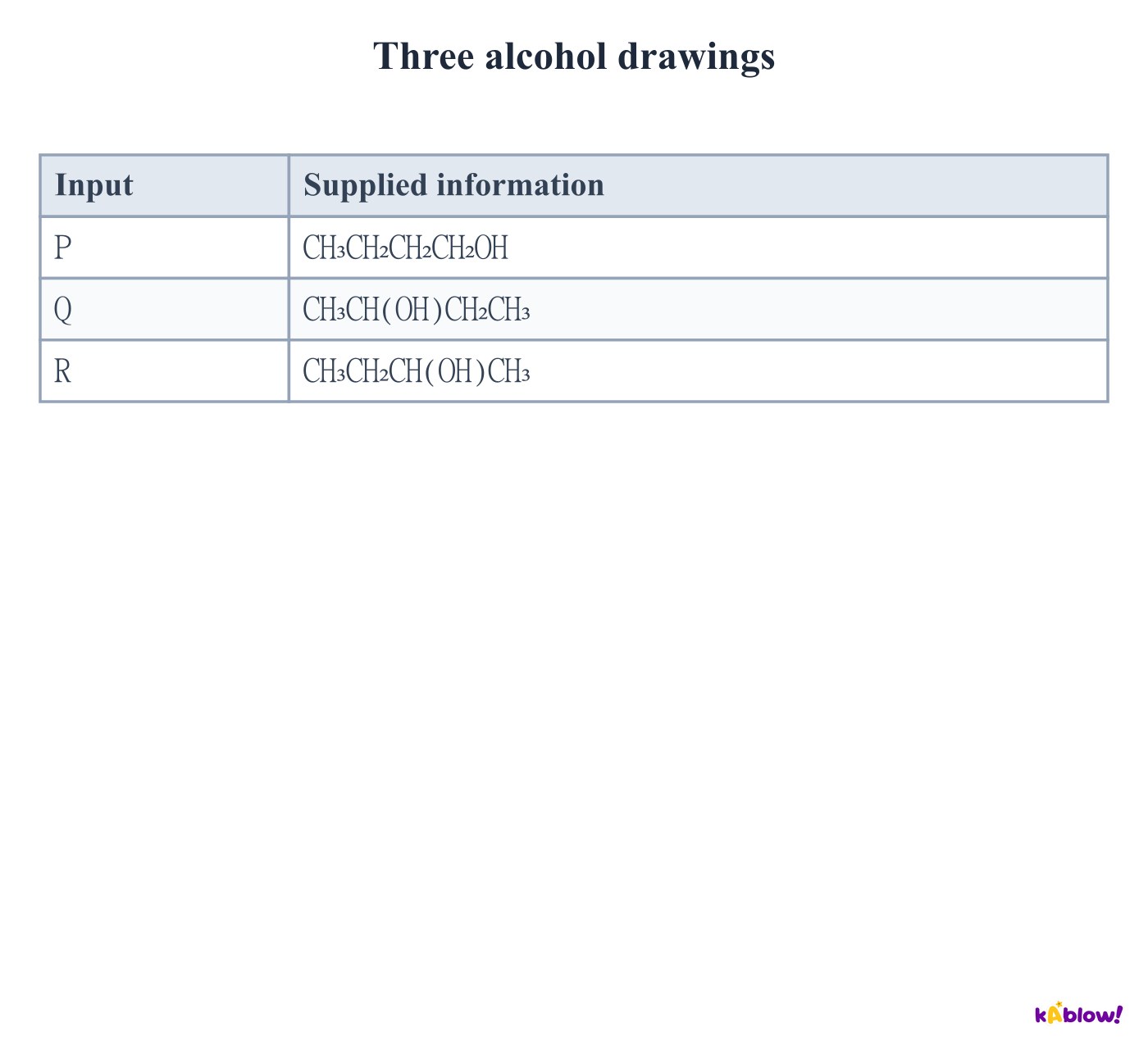
- Position isomers retain the same functional-group type and carbon framework while its position changes. Butan-1-ol and butan-2-ol both have C₄H₁₀O.
- Number from the appropriate end before comparing locants. Butan-3-ol is the same connectivity as butan-2-ol viewed from the other end.
- A shifted double bond or halogen can also give positional isomers where symmetry does not make the drawings identical.
Three alcohol drawings
Change the functional group while retaining the formula
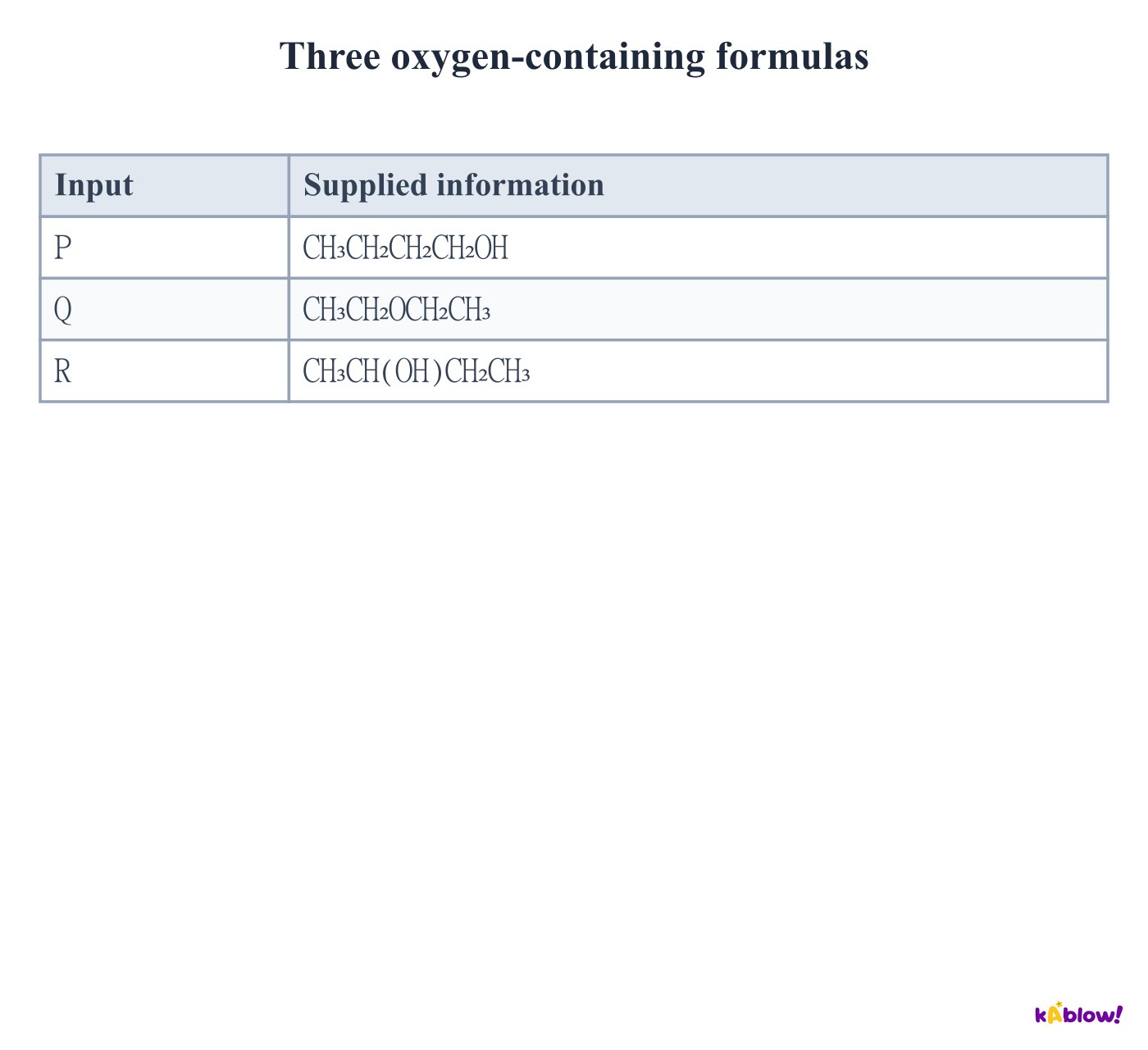
- Butan-1-ol and ethoxyethane both have C₄H₁₀O, but one has an alcohol group and the other an ether linkage. They are functional-group isomers.
- An aldehyde and a ketone can likewise share a formula. Different local bonding often produces different characteristic reactions.
- Functional-group isomerism is not a claim that every property differs in every comparison. Use the actual structures and conditions to predict chemistry.
Three oxygen-containing formulas
Enumerate structural isomers without symmetry duplicates
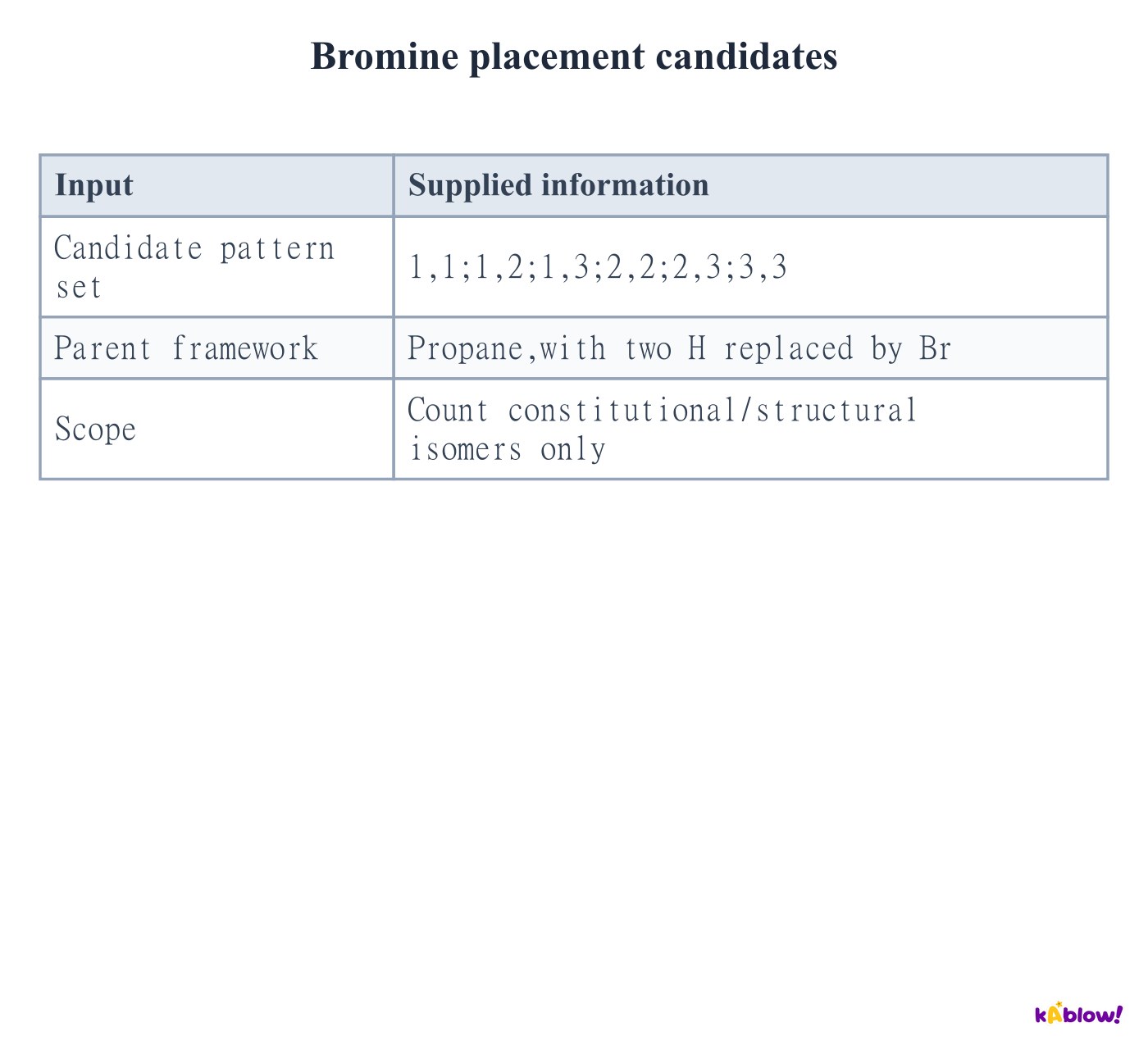
- For dibromopropane, keep the three-carbon skeleton and place two Br substitutions systematically. Reversing the chain removes duplicate locant patterns.
- The distinct structural patterns are 1,1;1,2;1,3; and 2,2. Patterns 2,3 and 3,3 duplicate 1,2 and 1,1 by reversal.
- This is a structural count. The possible optical stereoisomers of a structure are a separate question and must not be silently added to it.
Bromine placement candidates
Distinguish conformations from new connectivity
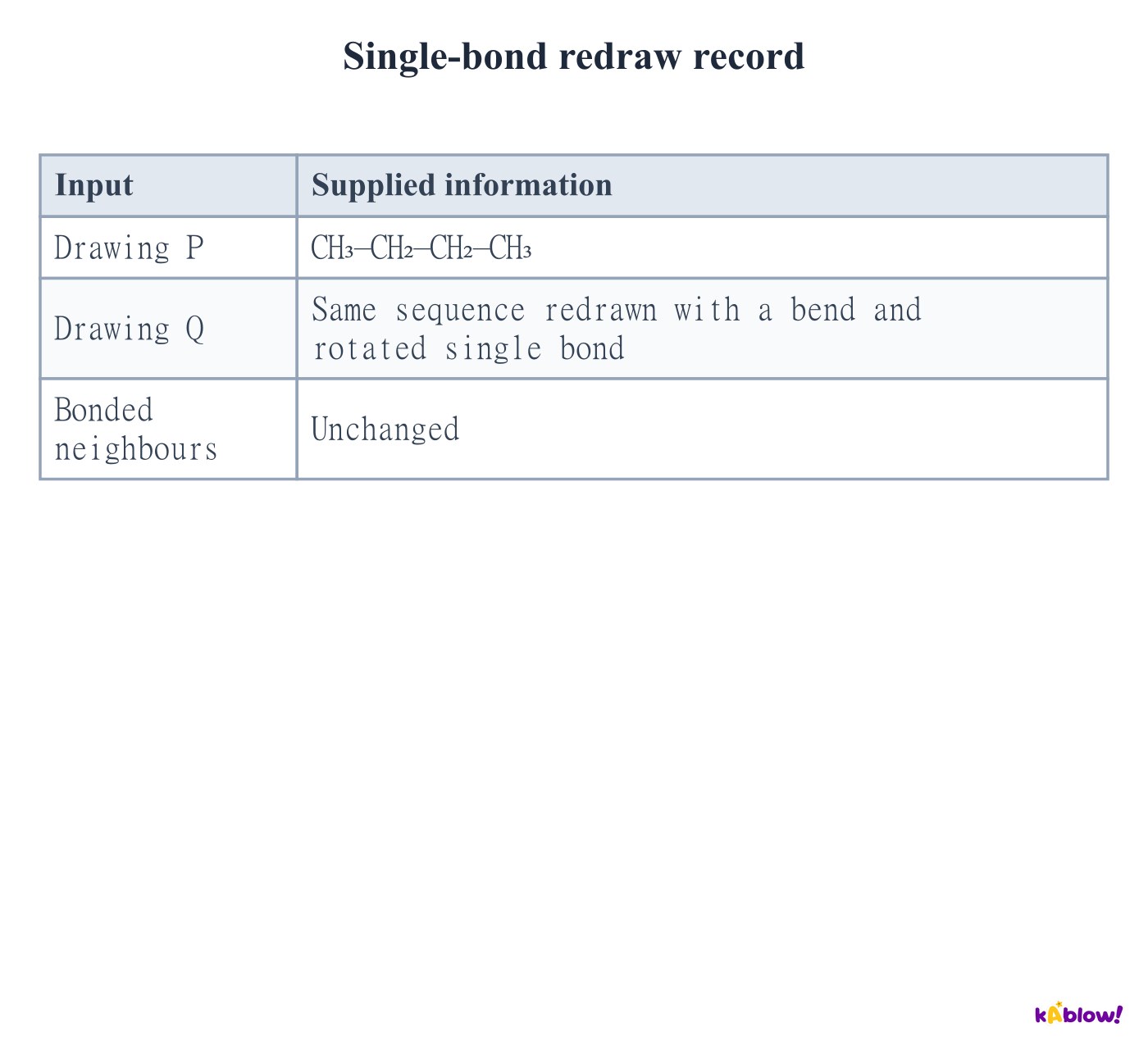
- Rotation around a carbon–carbon single bond can change the appearance of a chain while leaving bonded neighbours unchanged.
- Two bent drawings of propane are not automatically different structural isomers. Trace the atom connections and identify symmetry before counting.
- Stereochemical classification must be used carefully:ordinary bond rotations can describe conformations, but they do not turn butane into 2-methylpropane.
Single-bond redraw record
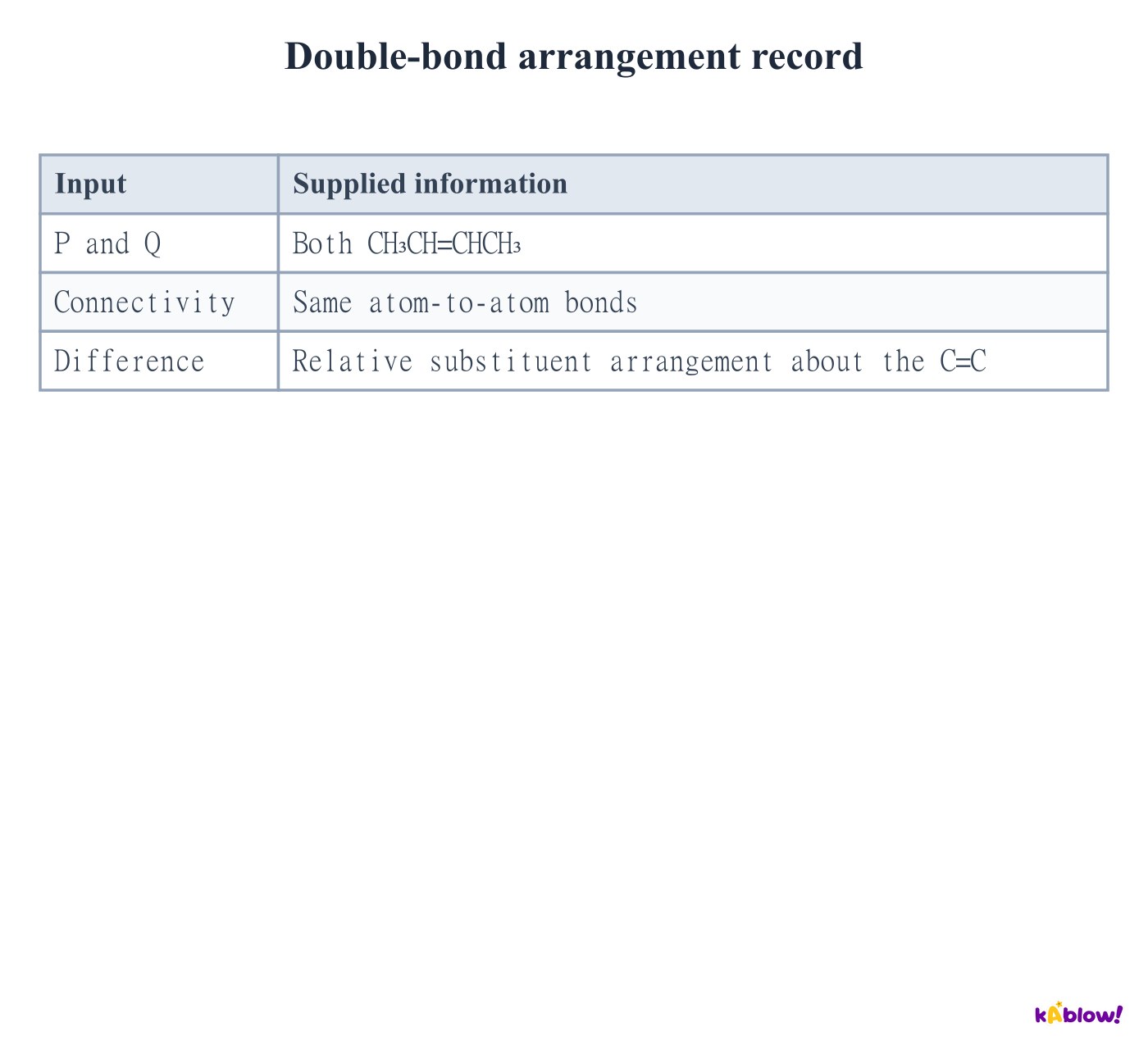
Define stereoisomerism using connectivity and space
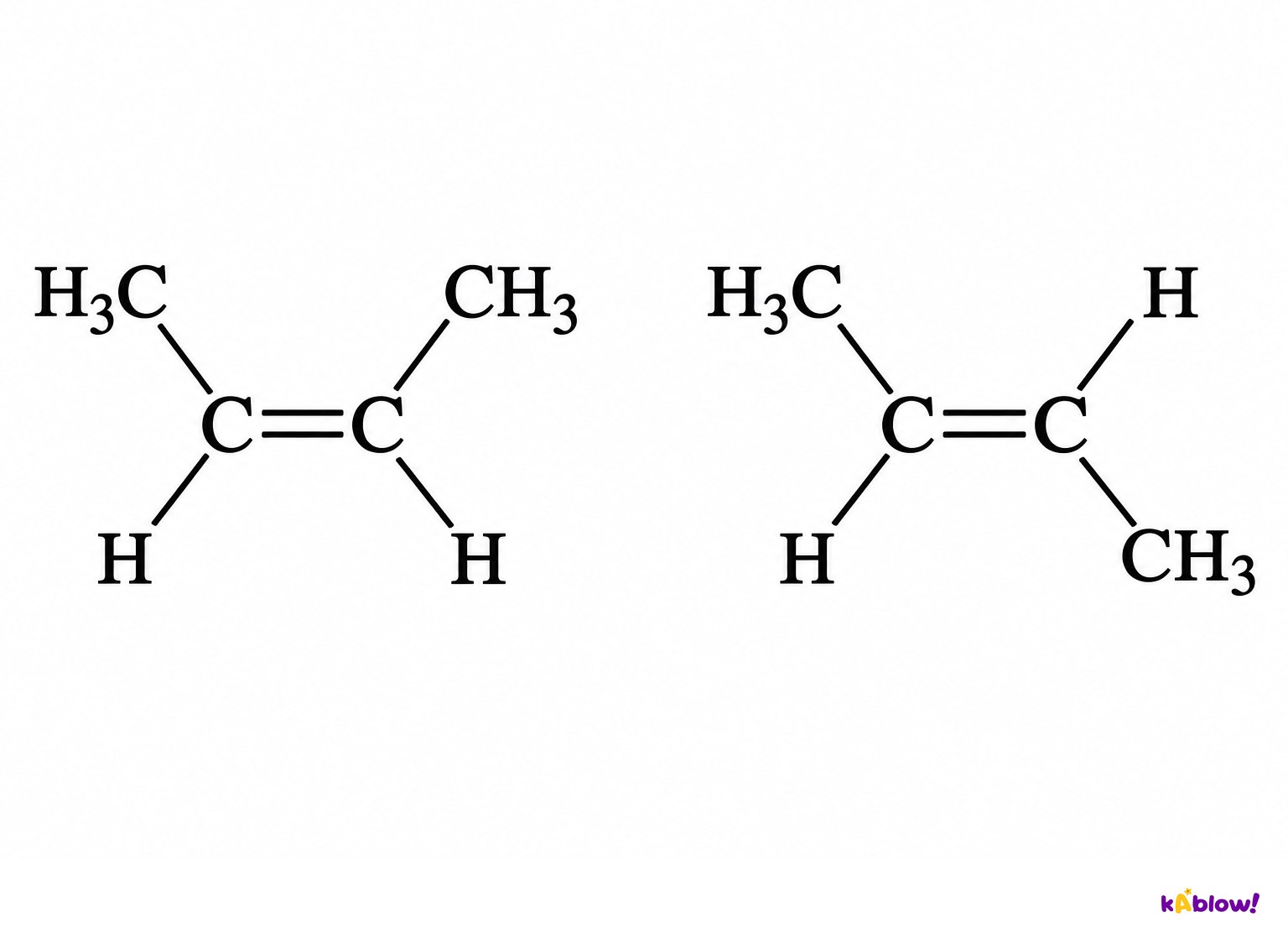
- Stereoisomers have the same molecular formula and atom connectivity but differ in spatial arrangement. E/Z alkene isomers are one example.
- The two but-2-ene structures preserve CH₃–CH=CH–CH₃ connectivity. They differ in how substituents are arranged across the double bond.
- The distinction from structural isomerism is the unchanged bonded-neighbour pattern. Optical isomerism is developed in its separate later lesson.
Two double-bond arrangements
Check both ends before assigning E or Z
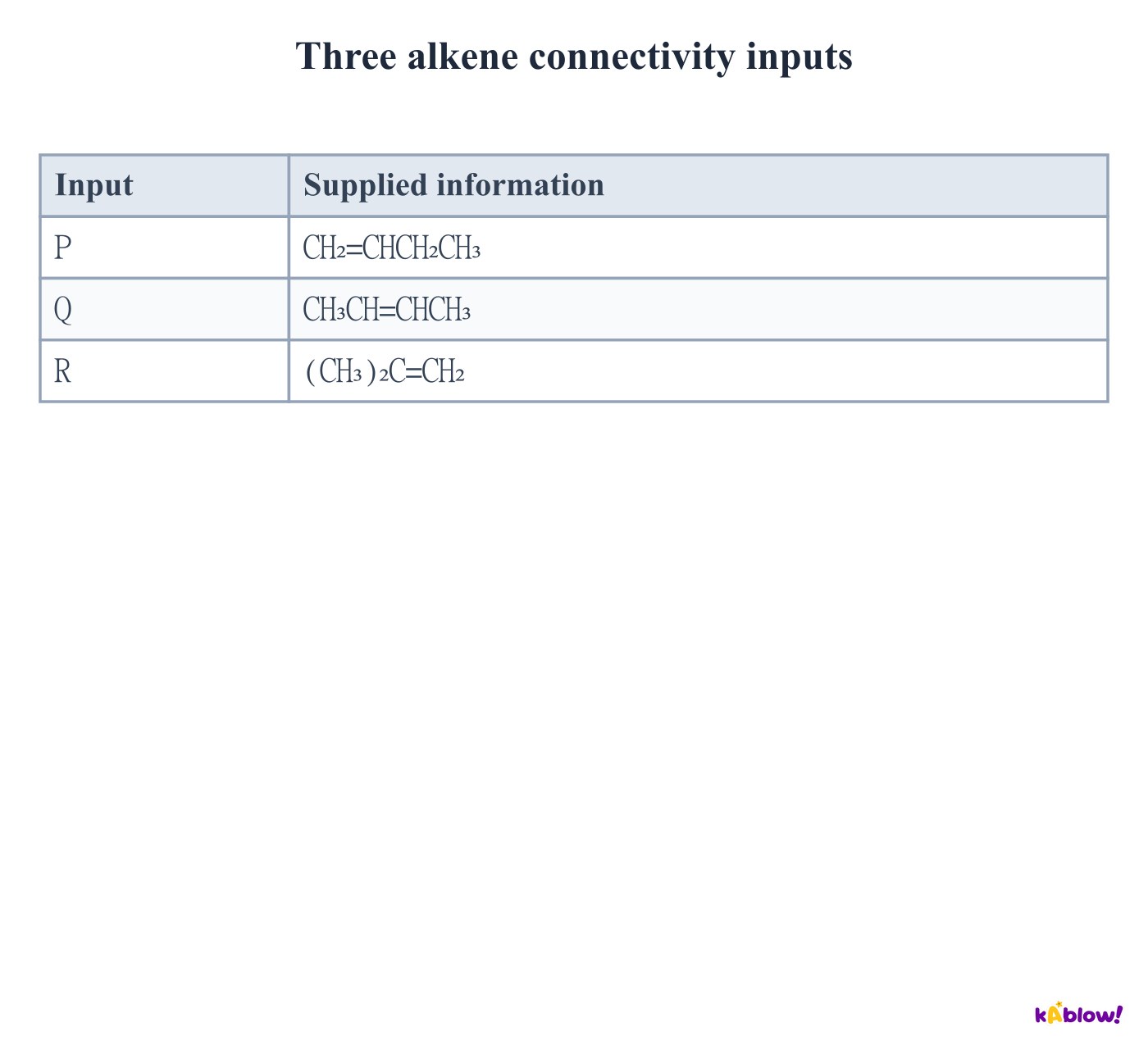
- The carbon–carbon double bond restricts rotation because twisting disrupts the sideways overlap responsible for the π bond.
- For E/Z isomerism at the ordinary alkene in this course, each double-bond carbon must carry two different substituents. Restricted rotation alone is insufficient.
- The two substituents at one end may match groups at the other end. Four mutually different groups are not required:but-2-ene already satisfies the condition.
Three alkene connectivity inputs
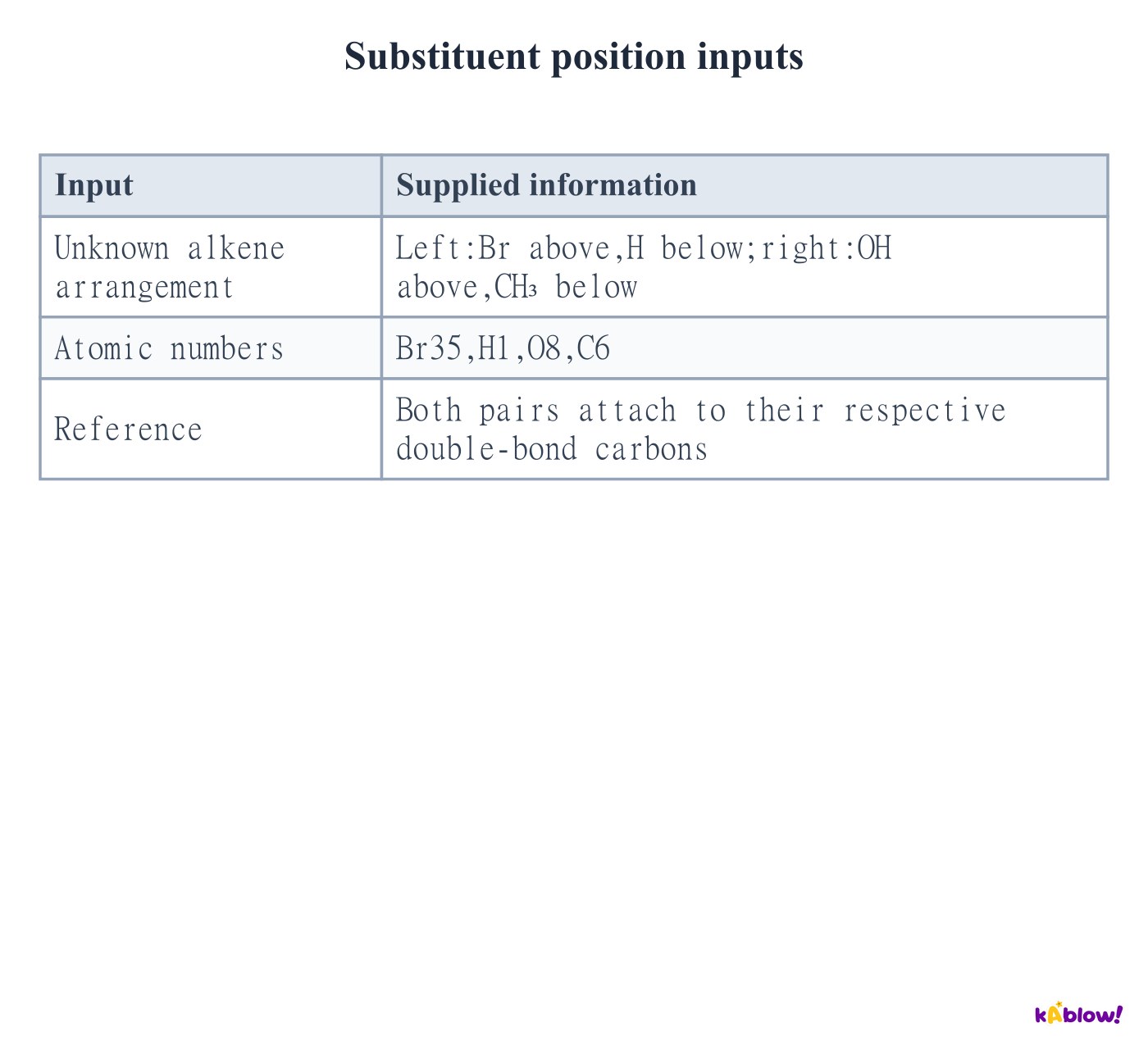
Rank the first directly bonded atoms
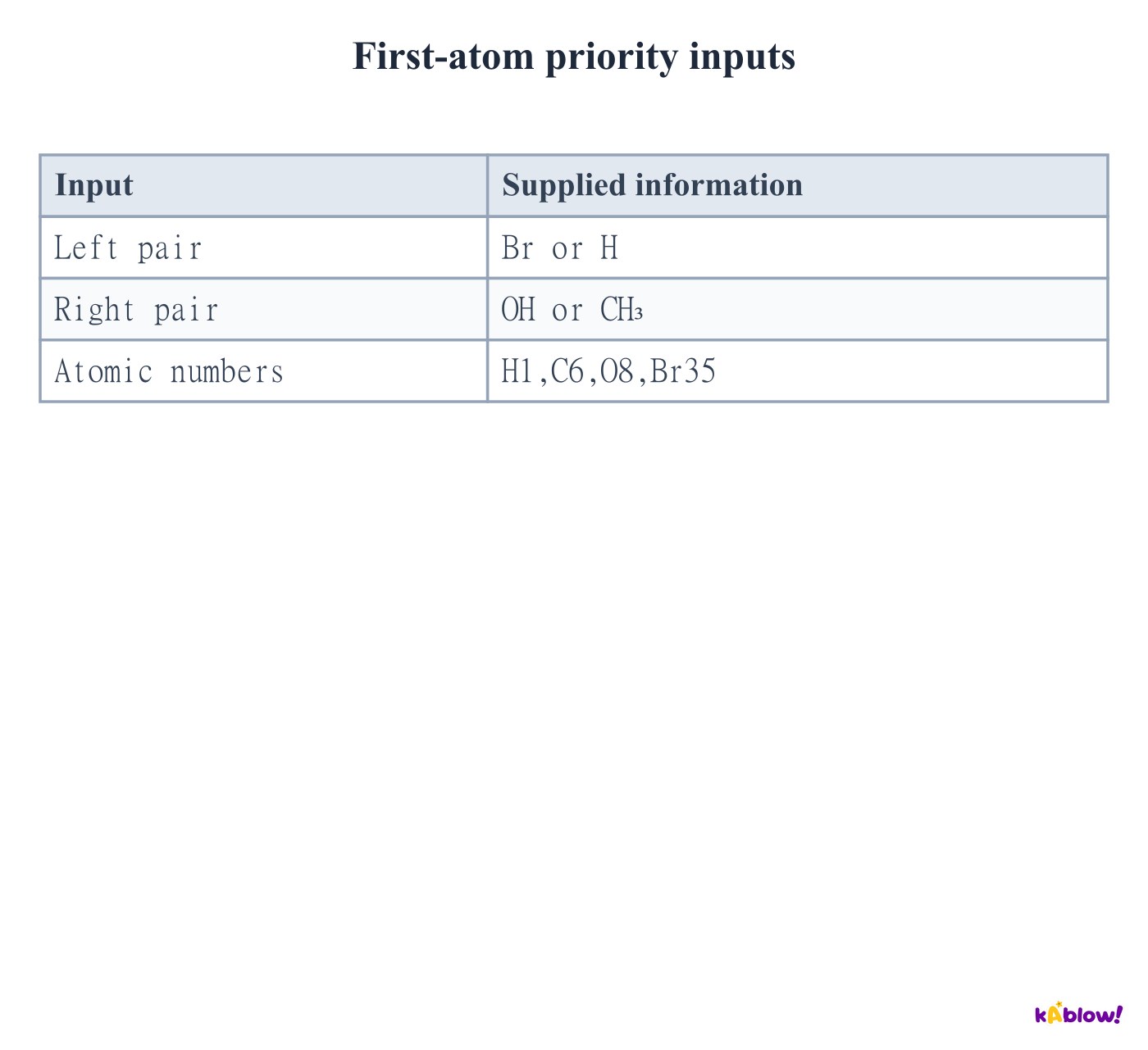
- CIP priority begins with the atomic number of the atom directly attached to the double-bond carbon. Compare the two substituents at each carbon separately.
- For Br versus H, the directly attached bromine outranks hydrogen. For OH versus CH₃, the oxygen outranks carbon.
- Do not choose priority from group size, visual position or total group mass. The first point of difference in the prescribed sequence decides.
First-atom priority inputs
Resolve equal first atoms at the next difference
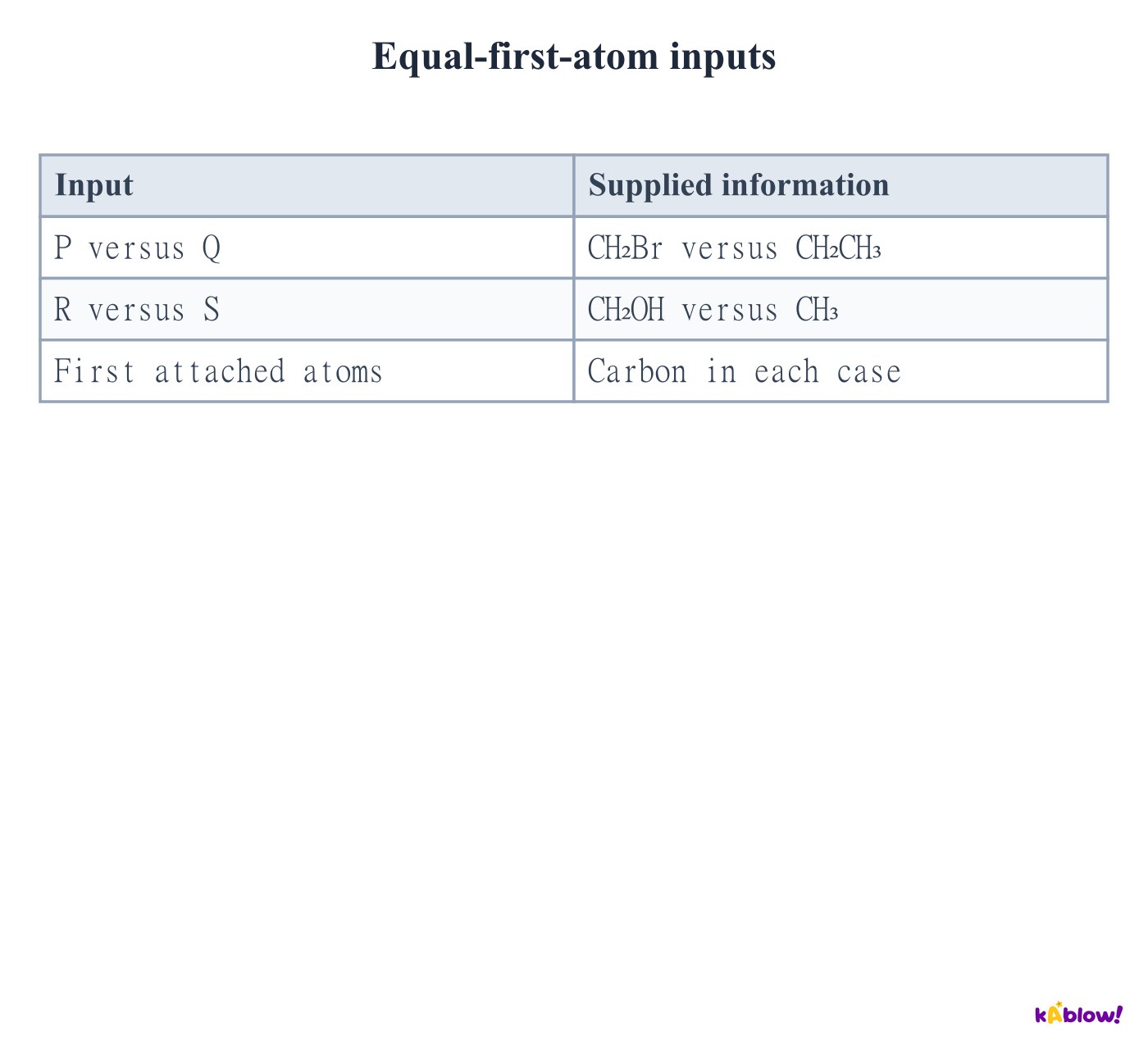
- If both directly attached atoms are carbon, compare their next attached atoms in descending atomic-number order, excluding the alkene carbon being traced back to.
- CH₂Br supplies Br, H, H whereas CH₂CH₃ supplies C, H, H; the bromine entry wins at the first difference. CH₂OH similarly outranks CH₃ because O outranks H at that next layer.
- Compare corresponding entries until a difference appears. Counting the total hydrogens or the longest remote chain is not the priority rule.
Equal-first-atom inputs
Assign the spatial descriptor after ranking
- Rank the groups independently at each alkene carbon, then compare the two higher-priority groups. Same side gives Z; opposite sides gives E.
- In the illustrated but-2-ene pair, the methyl groups have higher priority than H. The left structure is Z and the right is E.
- For this simple pair, cis and trans also track the methyl arrangement. Do not assume cis always translates to Z in every substituted system; E/Z explicitly uses CIP priority.
Two double-bond arrangements
Track electron pairs in a reaction mechanism
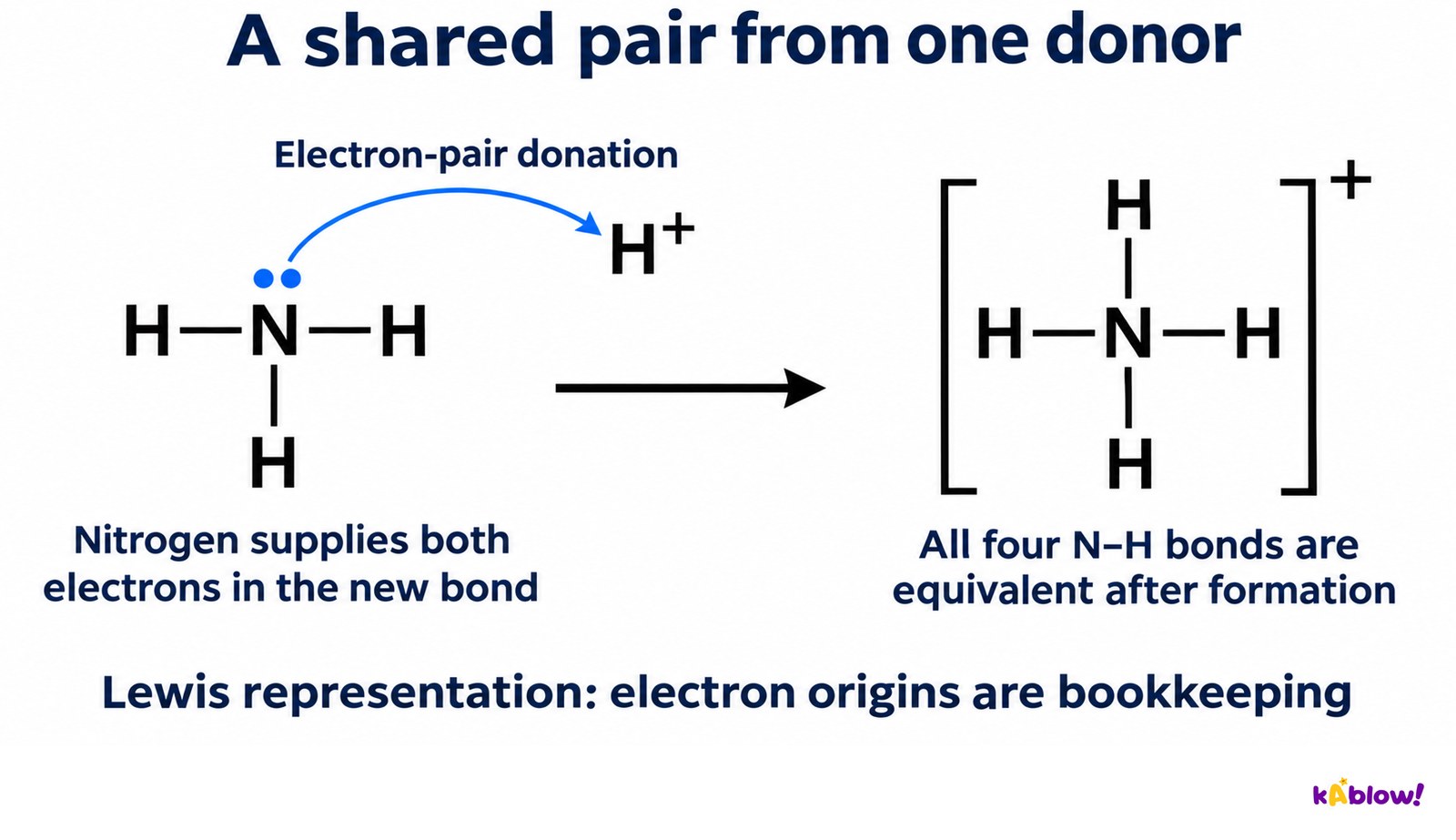
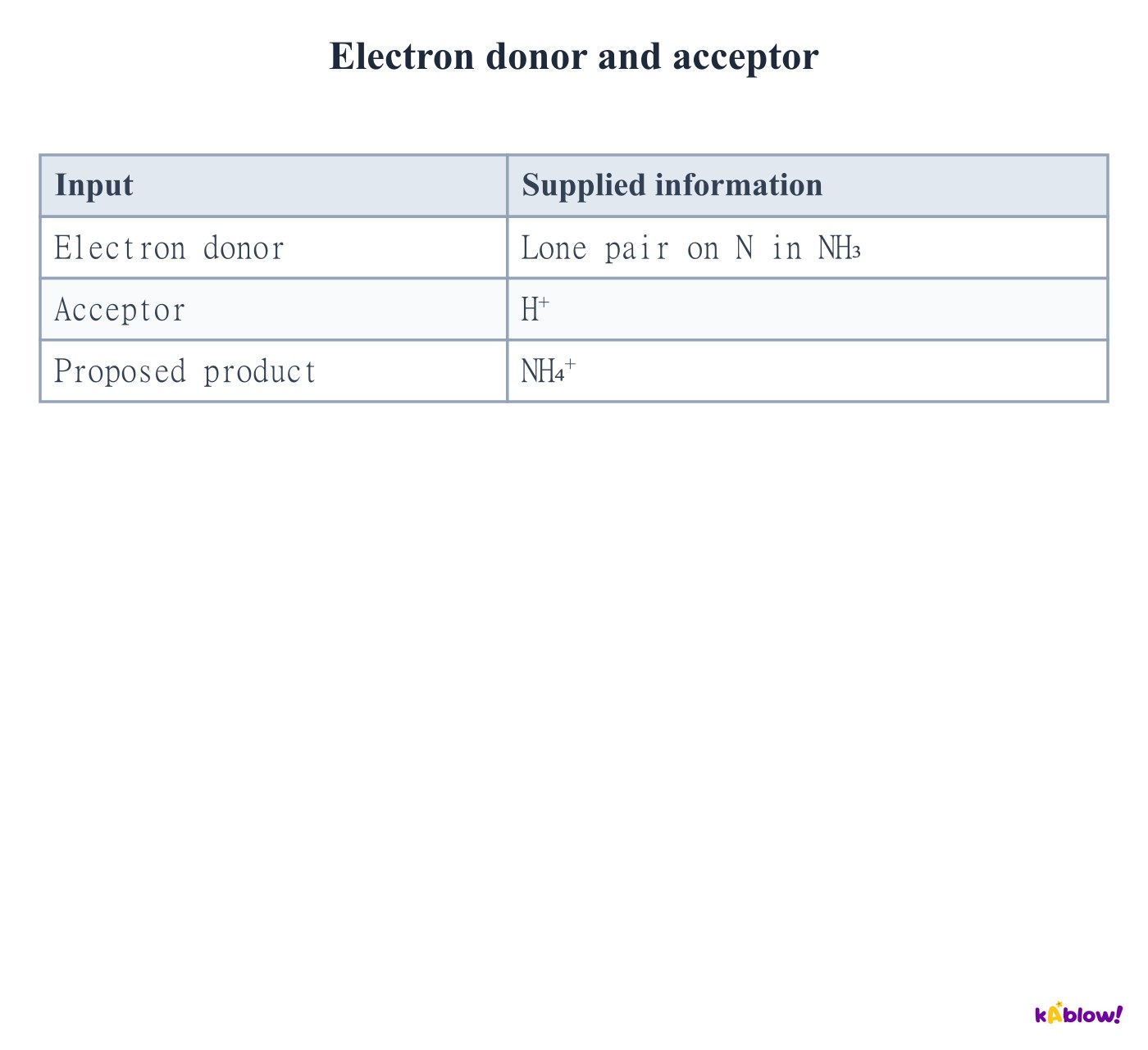
- A mechanism describes bond changes step by step. A full-headed curly arrow tracks an electron pair from a lone pair or covalent bond to its destination.
- For bond formation, the arrow starts at the electron source rather than a positive charge. For heterolytic bond cleavage, the arrow starts on the bond and points toward the atom retaining the pair.
- The supplied input describes a lone pair on ammonia approaching a proton. Forming NH₄⁺ uses that pair without changing the total atom count or charge.
Electron-pair donation to a proton
Use dots and balanced steps for free radicals
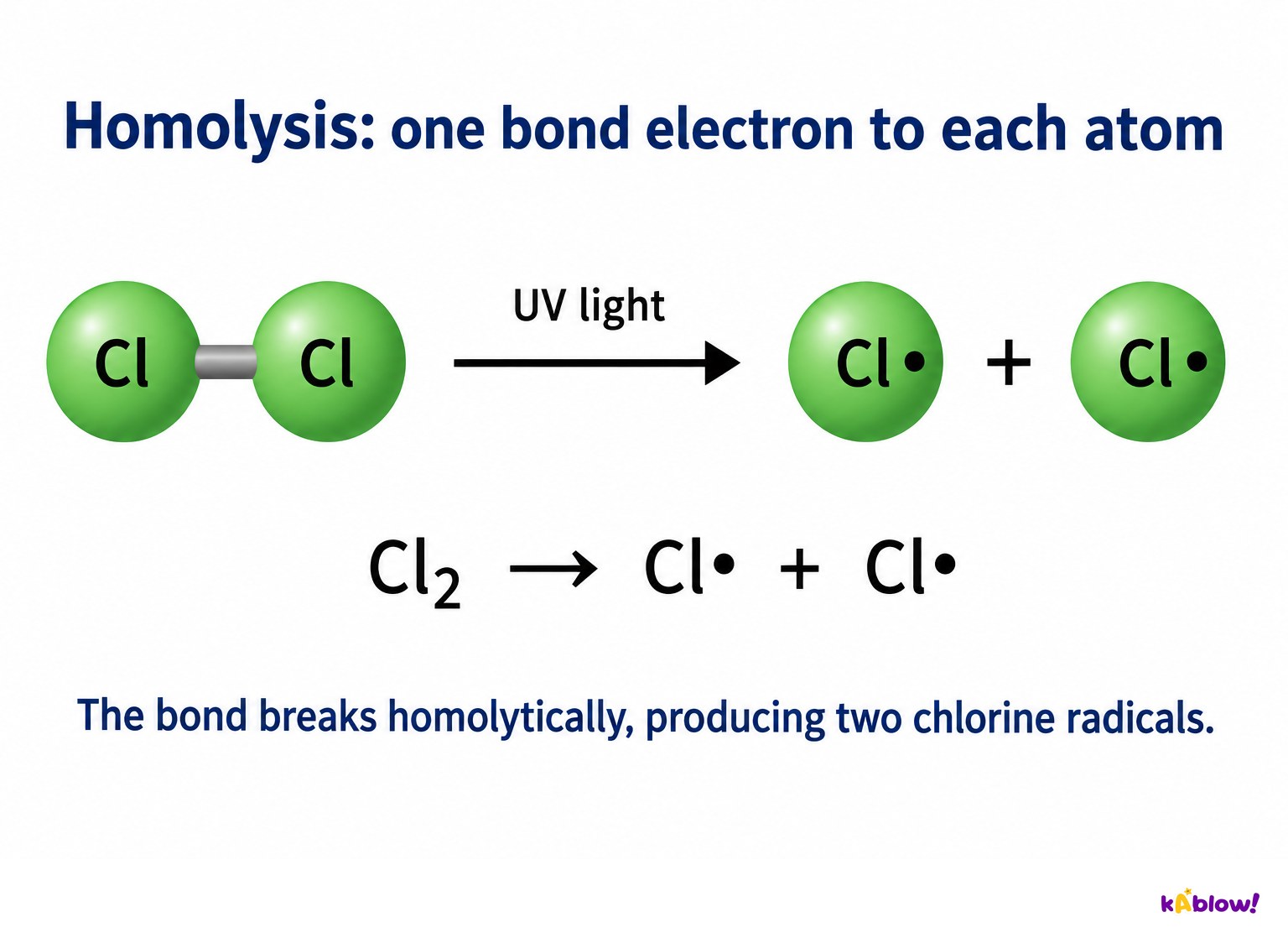
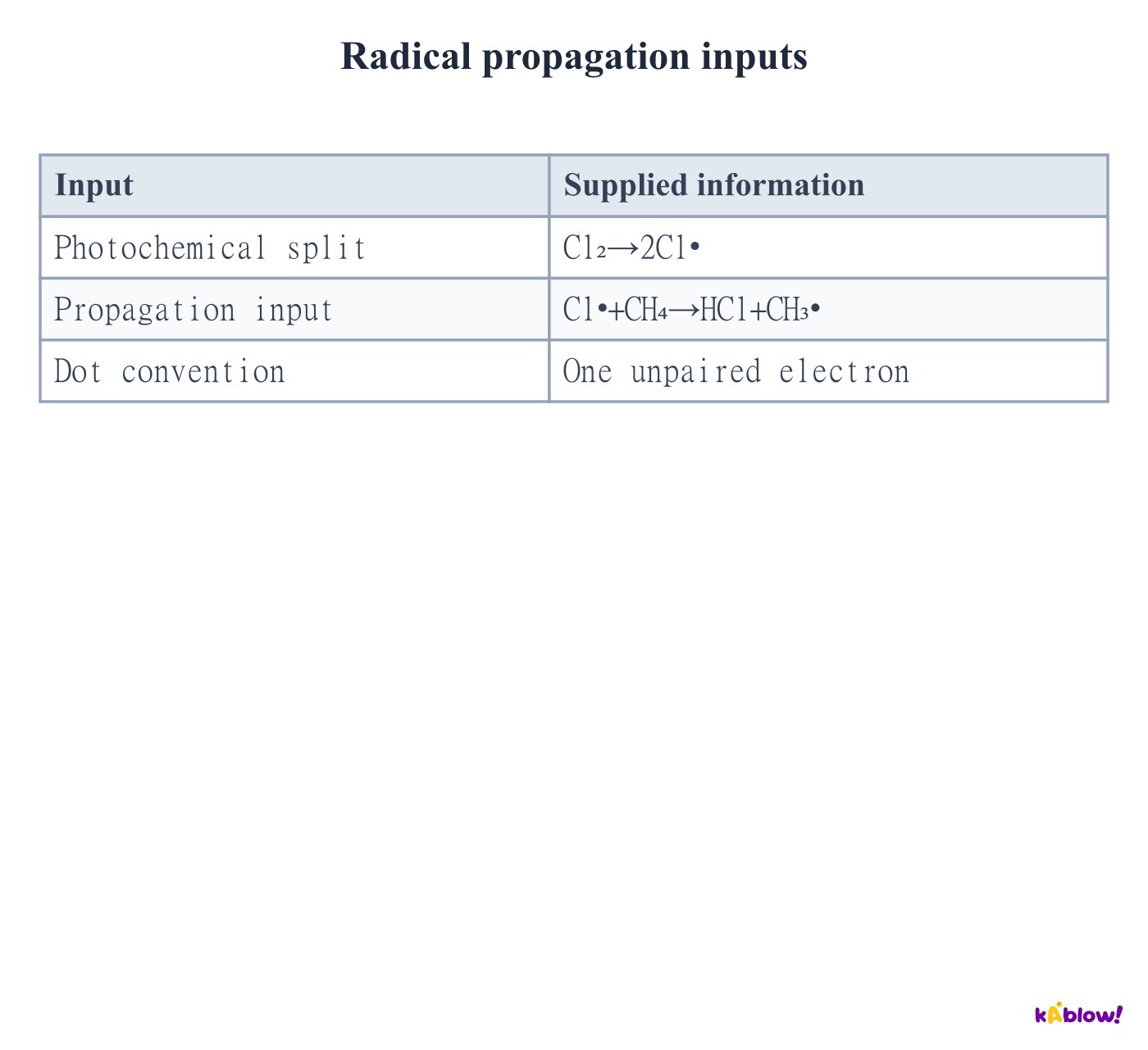
- A radical has an unpaired electron, shown by a dot. Homolytic splitting of Cl₂ gives two Cl• species, one electron from the original bond to each atom.
- Propagation can conserve a radical overall while producing a different radical intermediate. For example, Cl•+CH₄→HCl+CH₃• conserves all atoms.
- AQA does not require curly arrows for the radical mechanisms here. Do not replace radical dots with ionic charge signs or confuse homolysis with heterolytic Cl⁺/Cl⁻ formation.
Chlorine homolysis and radical notation
スライド
練習問題
無料プレビュー — 60問中8問。すべて見るには登録を。
1.How many carbon–carbon bonds connect the six sites in the supplied open chain?
Medium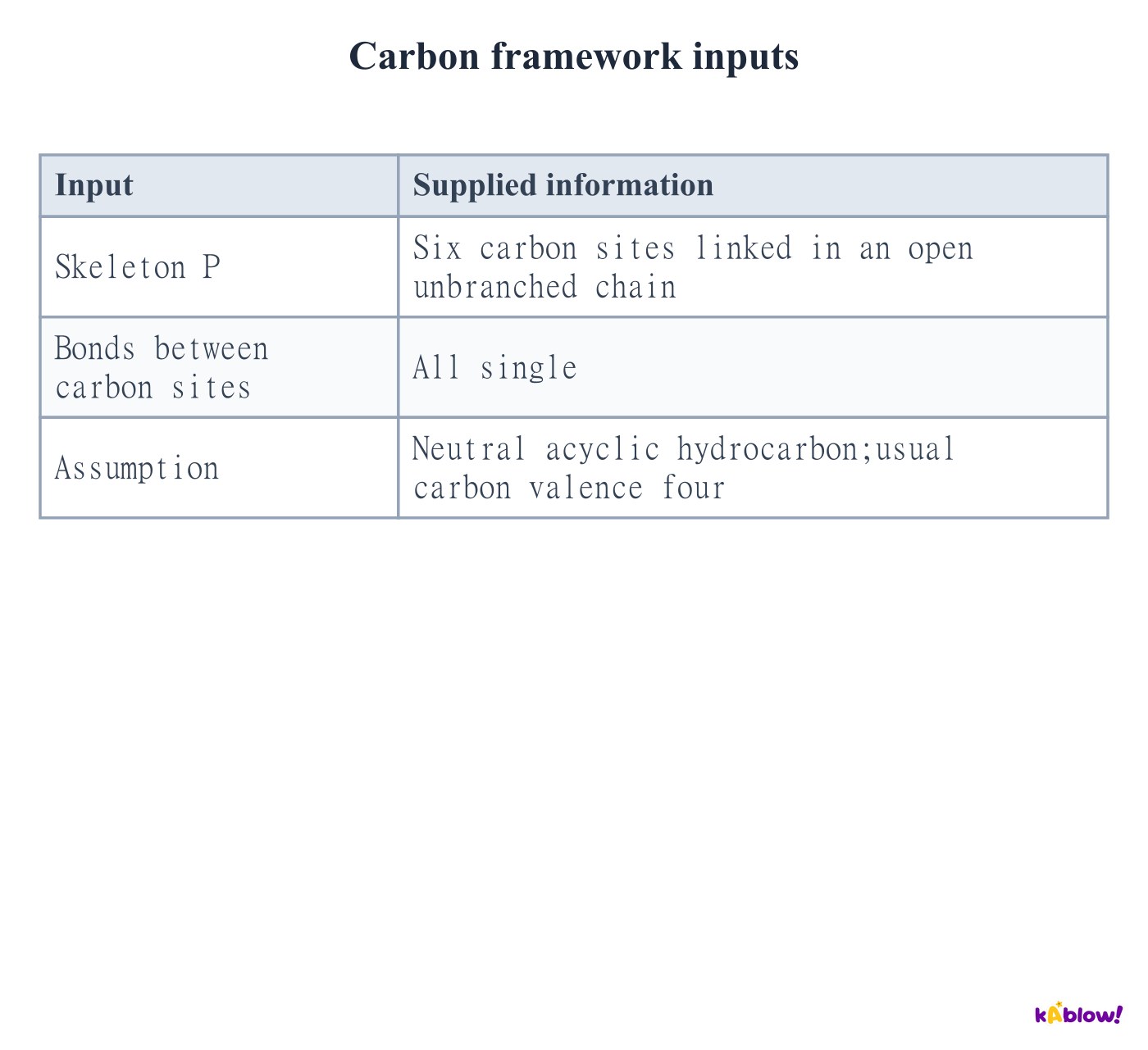
- A4
- B5
- C6
- D12
2.What is the relative molecular mass increase from P to Q?
Medium- A2
- B12
- C14
- D16
3.Which conclusion is supported by both sets of supplied data?
Medium- AEvery melting point rises
- BBoiling breaks all C–C bonds
- CAll six compounds have identical physical properties
- DBoiling rises here but melting does not rise at every step
4.Which supplied species is an unsaturated hydrocarbon?
Medium- AQ
- BP
- CR
- DS
5.Which supplied compound has an alcohol group attached to a two-carbon saturated chain?
Medium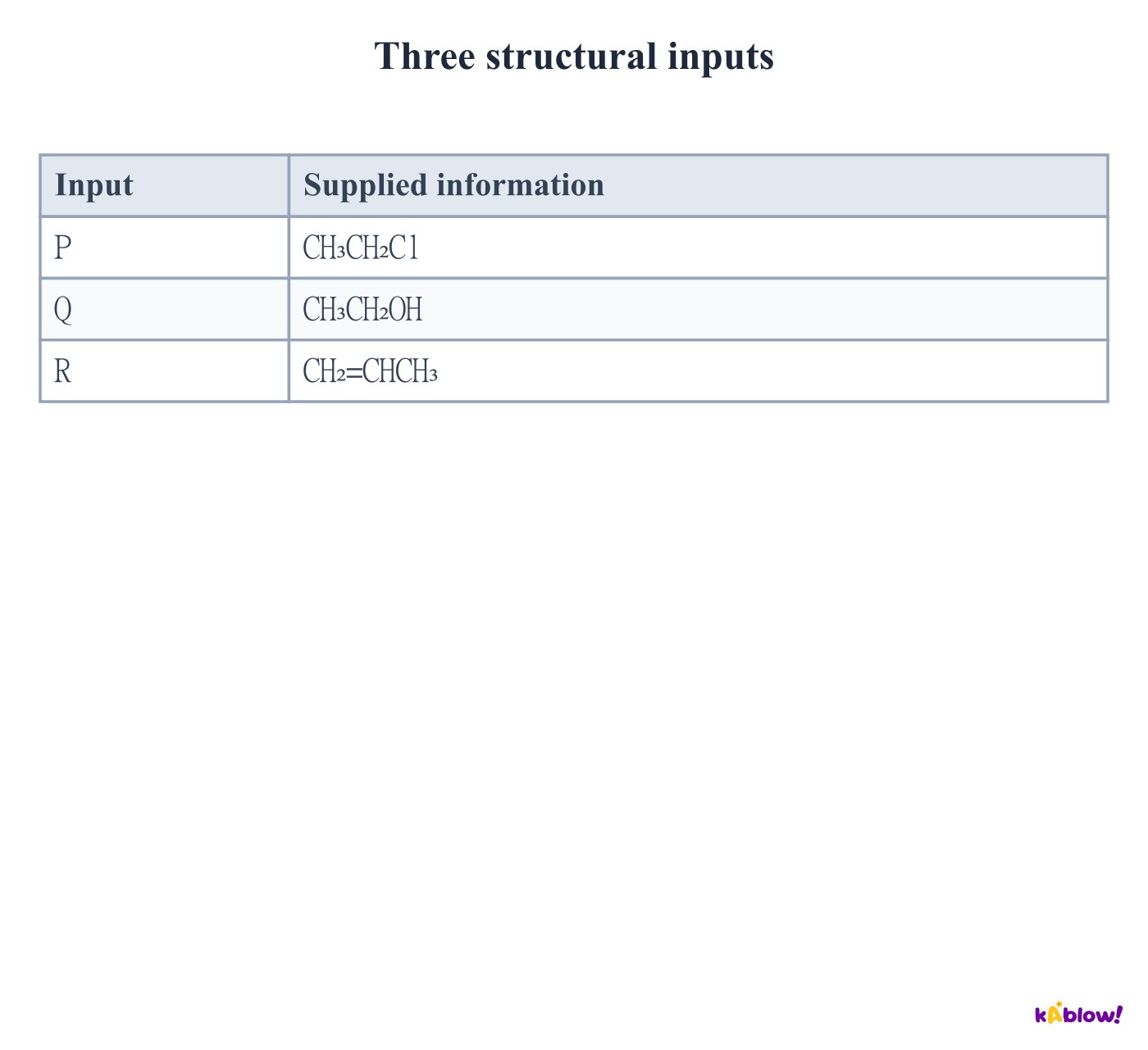
- AP
- BQ
- CR
- DAll three
6.Which pair have the same molecular formula but aldehyde/ketone connectivity?
Medium- AP and R
- BR and S
- CP and Q
- DQ and S
7.How many carbon atoms are present in the nitrile Q?
Medium- A1
- B2
- C4
- D3
8.Which empirical formula follows for the supplied unknown?
Medium- AC₂H₄O
- BCH₂O
- CC₄H₈O
- DC₂H₄O₂
過去問
このトピックの過去問練習は近日公開。
近日公開