
Evaluating and annotating your own work
遊んで学ぼう
問題に答えてエネルギーを集めたら、釣りや探検を楽しもう。アカウント不要。
教育者の方へ: Evaluating and annotating your own work(Art and Design、Exam Skills)向けのすぐ使えるレッスンスライド, 復習ノート — レッスンで使うか、学習者がライブゲームとして遊ぶインタラクティブなクラス活動としてトピックを実施できます。
レッスンノート
Annotation and evaluation do different jobs
- Annotations can record observations, processes, reasons or decisions. An evaluation makes a reasoned judgement against an intention or explicit relevant criterion; description supplies evidence but does not alone justify the judgement.
- What, how and why are helpful prompts rather than a fixed formula. Use enough detail to make the relationship clear, without inventing a process or claiming a guaranteed grade from a sentence type.
Separate the parts of a useful comment
Observe a feature and connect it to the aim
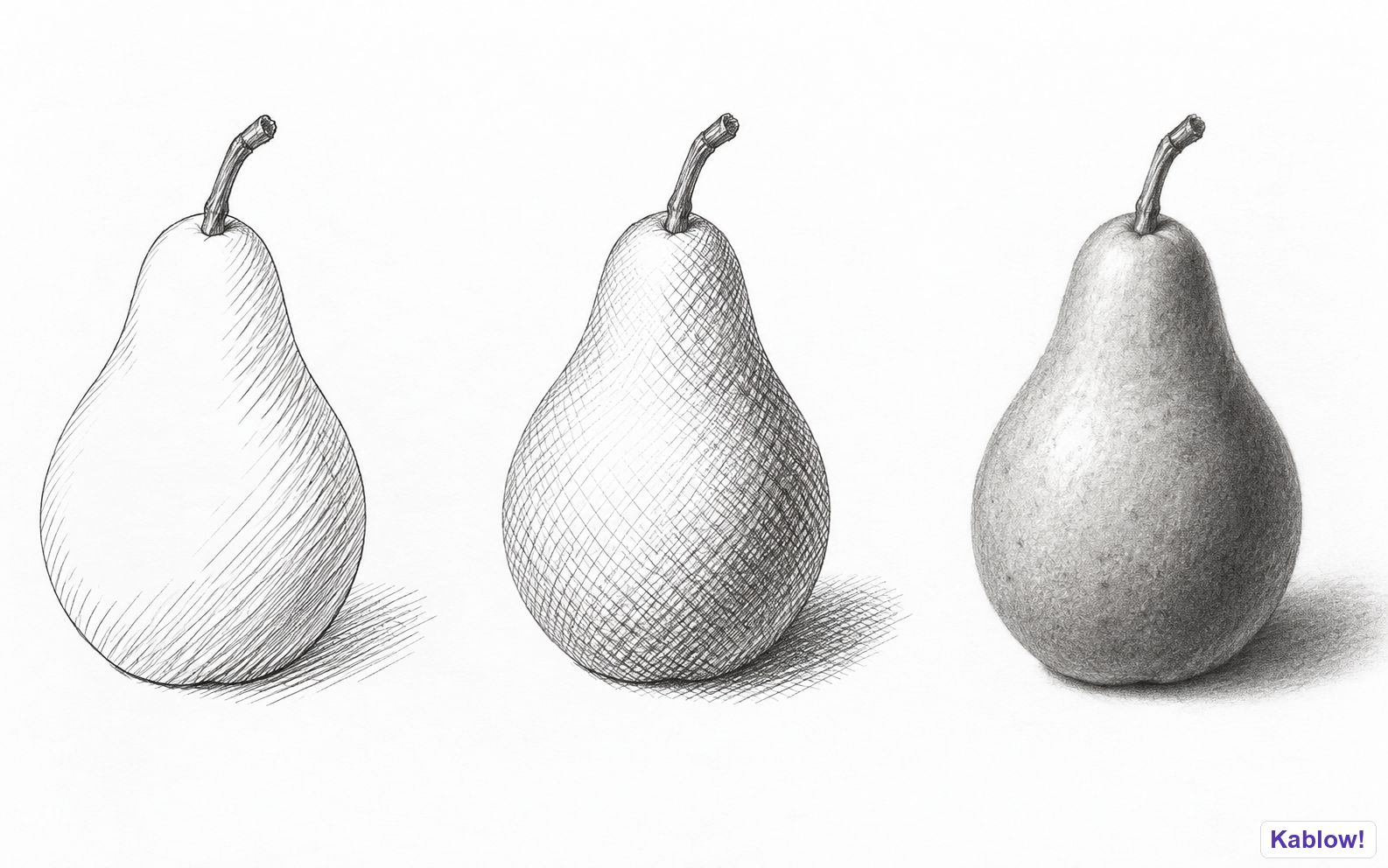
- The original pear studies compare visible hatching, intersecting hatching and smoother tone. A preference becomes useful when supported by a specific feature and an intention, such as emphasising line direction or continuous tonal transition.
- These are teaching illustrations, not real student submissions or a named historical artist’s work. No technique is universally strongest, and the image alone does not reveal a maker’s private intention or physical method in every detail.
Evaluate marks against an intention
Intention, effect and judgement
- An intention is what you aim to explore or communicate; an observed feature is evidence of what is actually present. A proposed effect or reading should be tied to that evidence and may differ between viewers.
- Evaluate how the relationship serves the intention, including trade-offs. More detail, stronger contrast, thick paint or neat edges are not automatic improvements independent of the enquiry.
Language that supports reasoning
- Use accurate terms such as tone, texture and composition to identify a particular feature. Verbs and connectives can make the relationship clear, but a technical word or because alone does not prove the claim.
- Qualify interpretations where needed: a colour may suggest an atmosphere in this setting without having one universal meaning. Personal preference can begin reflection, followed by a reason that the work supports.
Language needs evidence
Source connections and truthful attribution
- Identify the named work and selected feature that informed an actual trial. Explain what you retained, changed or rejected and why it matters to your own intention.
- Do not invent an artist influence or present copied work as wholly self-created. A source may provide a useful comparison after a trial, but label that relationship accurately instead of rewriting the history of making.
Name the actual source relationship
Plan a useful next test
- In the supplied invented shell scenario, denser cross-hatching on shadowed curves and lighter paper can support a reading of rounded form. Additional mid-tone marks are one possible test of the transition, not a guaranteed improvement.
- A next action can repeat, simplify, retain, compare or return to an earlier option. Explain what the test would reveal and how the criterion would guide the decision; do not claim observations from a trial not performed.
A next test has an open result
Constructive honesty
- Identify strengths and limitations with evidence against the intention. An unresolved result can reveal a useful question, while deliberate roughness or empty space may already serve the aim.
- Avoid harsh unsupported self-judgement and a manufactured story of automatic improvement. A clear record can acknowledge changed aims, uncertainty and alternatives without promising marks.
Concise review and next decision
- A useful review connects an intention, a relevant observation, a reasoned judgement and a next question. Include comparisons or source links when they inform the actual decision.
- Keep descriptions specific enough to support the judgement. Longer text, biographies and vocabulary lists do not substitute for evidence, a criterion and a realistic consequence.
A concise review follows evidence
スライド
練習問題
無料プレビュー — 32問中8問。すべて見るには登録を。
1.What is an annotation?
Easy- Aa short note explaining your work
- Ba drawing
- Ca paint
- Da frame
2.What is an evaluation?
Easy- Aa copy
- Ba drawing
- Ca frame
- Da reasoned judgement against intentions or relevant criteria
3.What does 'intention' mean?
Easy- Athe price
- Bthe frame
- Cwhat you aim to achieve
- Dthe colour
4.What does 'strength' mean?
Easy- Aa cost
- Ba feature that serves a stated intention or criterion
- Ca flaw
- Da tool
5.What does 'next step' mean?
Easy- Aa proposed action informed by a result or question
- Bthe end
- Ca frame
- Da signature
6.Which comment gives the least specific evidence for its judgement?
Easy- AThe contrast between the red shape and blue field draws my attention.
- BI used scumbling to create texture.
- CThe repeated diagonals direct my eye toward the corner.
- DIt looks nice.
7.Which is specific?
Easy- AI like it.
- BIt is nice.
- CThe raised paint ridges make the surface physically textured.
- DIt is good.
8.Which word is a connective?
Easy- Acanvas
- Bbecause
- Cpaint
- Dbrush
過去問
このトピックの過去問練習は近日公開。
近日公開