
Sculpture and 3D work
遊んで学ぼう
問題に答えてエネルギーを集めたら、釣りや探検を楽しもう。アカウント不要。
教育者の方へ: Sculpture and 3D work(Art and Design、Materials and Processes)向けのすぐ使えるレッスンスライド, 復習ノート — レッスンで使うか、学習者がライブゲームとして遊ぶインタラクティブなクラス活動としてトピックを実施できます。
レッスンノート
Form, space and different viewing conditions
- Sculpture explores three-dimensional form and space, including relief, freestanding, installed and kinetic approaches. Relief has a supporting background and need not be viewed from every side.
- Kinetic work incorporates actual movement. Site-specific work relates to its location; installation can combine sculpture with other media. Consider the intended viewing conditions instead of treating every work as a statue on a plinth.
Methods and material compatibility
- Modelling shapes workable material, carving removes material, constructing assembles parts and casting forms material in a mould as it sets or solidifies. A work can combine these approaches.
- Armatures can support compatible modelling/construction systems. A temporary clay model, paper form and kiln-fired ceramic work need different support plans; do not assume ordinary internal wire or mixed materials can remain through firing.
Ways to make form
Clay handbuilding and material stages
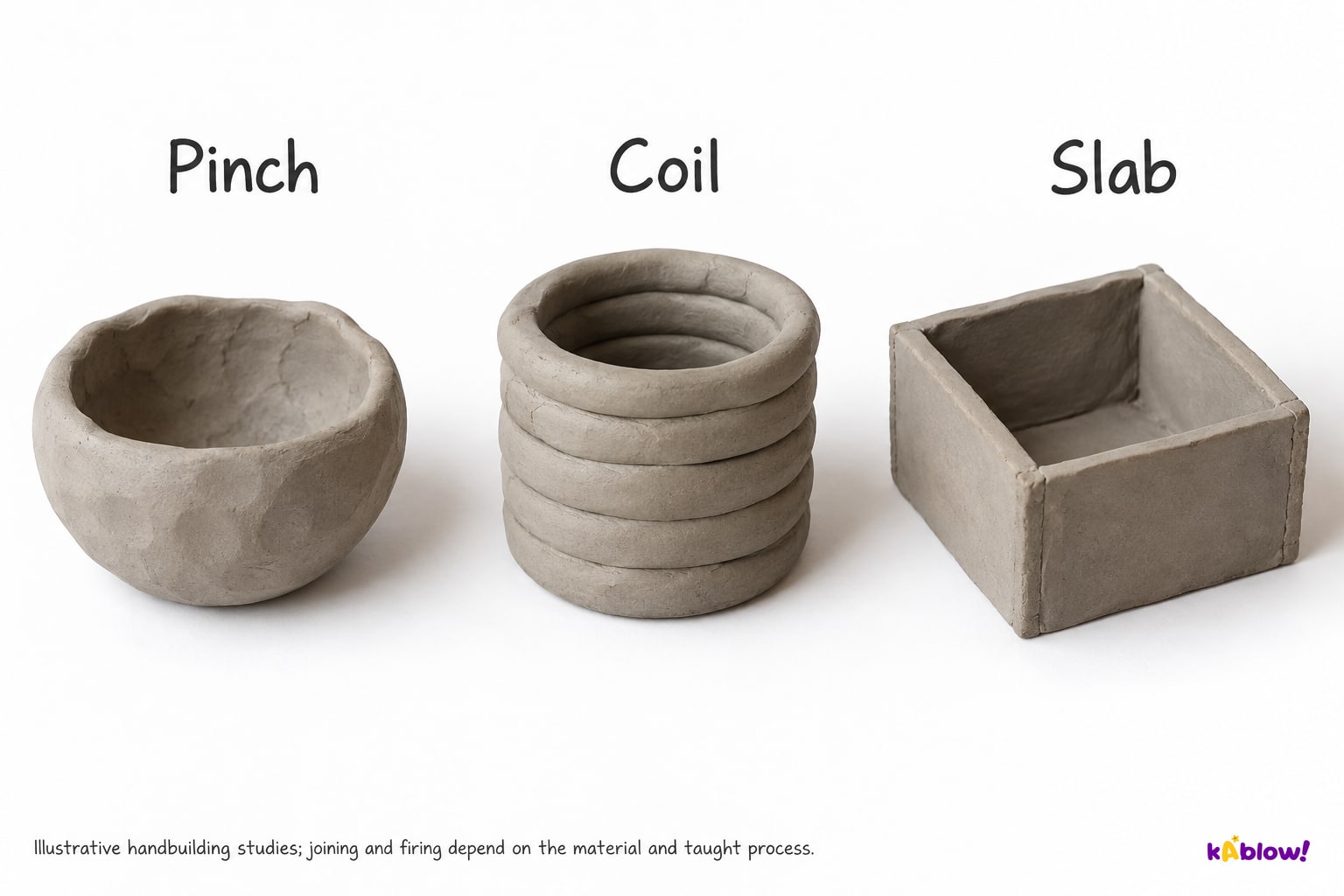
- Pinching forms a bowl from a clay mass; coils build a wall from joined rolls; slabs use sheets. Sound joins and compatible moisture matter, with scoring and suitable slip used where the taught process requires them.
- Slip is clay in water and can also serve decoration. A common ceramic route includes drying, an initial bisque firing and a later glaze stage, but systems vary. Air-dry materials and other clay-like compounds must follow their own instructions, not a ceramic kiln sequence.
Pinch, coil and slab studies
Scale, stability and display
- Scale compares the work with viewers or a setting. Negative spaces within or between forms, surface texture and the route around the work affect its experience.
- Visual balance is not physical stability. Plan bases, joins and supports using the approved method; a small maquette cannot establish all full-size structural demands. Movement or suspension still needs a controlled support system.
Plan spatial and practical relationships
Named practitioner references
- Henry Moore’s Reclining Figure: Holes and Barbara Hepworth’s pierced forms offer examples for investigating mass and openings. Alberto Giacometti’s Man Walking II (1960) uses an elongated human figure.
- Antony Gormley’s Angel of the North (1998) gives a named example for scale and site. These are selected references rather than complete career definitions. The handbuilding illustration is original teaching artwork, not a reproduction of these sculptures.
Study a named reference
Approved studio methods
- Control dust exposure through a suitable taught method, cleanup and any required equipment or protection. Do not assume a generic mask alone makes dry sanding appropriate. Use the actual material instructions and classroom supervision.
- Kilns, casting and chemical finishes need approved facilities and guidance. This lesson teaches distinctions, not an independent molten-metal, plaster-body-casting or kiln-operation procedure.
Use the approved studio system
Other materials and finishes
- Papier-mâché uses paper strips or pulp with a suitable binder. Mould materials and casts must be compatible; some moulds are temporary and others reusable.
- Paint, glaze, polish or patina can change a surface where appropriate. Patina often concerns metal appearance altered by age, reaction or an applied treatment; a finish should serve the intention and material rather than follow a universal recipe.
Match the material process
スライド
練習問題
無料プレビュー — 33問中8問。すべて見るには登録を。
1.What is sculpture?
Easy- Aart concerned with three-dimensional form and space
- Bflat art
- Ca painting
- Da print
2.What is relief sculpture?
Easy- Aa freestanding statue
- Ba drawing
- Ca print
- Dforms projecting from or worked into a supporting background
3.What is modelling?
Easy- Apouring liquid
- Bprinting
- Cshaping and building with a workable material
- Dcutting away
4.What is carving?
Easy- Asewing
- Bcutting away material
- Cadding material
- Dpouring
5.What is casting?
Easy- Aforming a material in a mould and allowing it to set or solidify
- Bcarving
- Cdrawing
- Dprinting
6.What is a coil pot?
Easy- Aa pinched pot
- Ba slab pot
- Ca cast pot
- Da pot built from rolled coils of clay
7.What is a slab method?
Easy- Apinching
- Bcasting
- Cbuilding with flat sheets of clay
- Dcoils
8.What is slip?
Easy- Aa kiln
- Bclay suspended in water, used for suitable joining or decoration
- Ca type of glaze
- Da tool
過去問
このトピックの過去問練習は近日公開。
近日公開