
The Mole, Avogadro & The Ideal Gas Equation
플레이하며 배우기
이 문제들을 풀어 에너지를 얻은 뒤 낚시하고 탐험하세요. 계정이 필요 없어요.
교육자를 위해: The Mole, Avogadro & The Ideal Gas Equation(Chemistry, AQA)을(를) 위한 바로 쓸 수 있는 수업 슬라이드, 복습 노트, 다이어그램 — 수업에 사용하거나, 학습자들이 실시간 게임으로 즐기는 인터랙티브 클래스 활동으로 진행하세요.
수업 노트
Define amount of substance and the mole
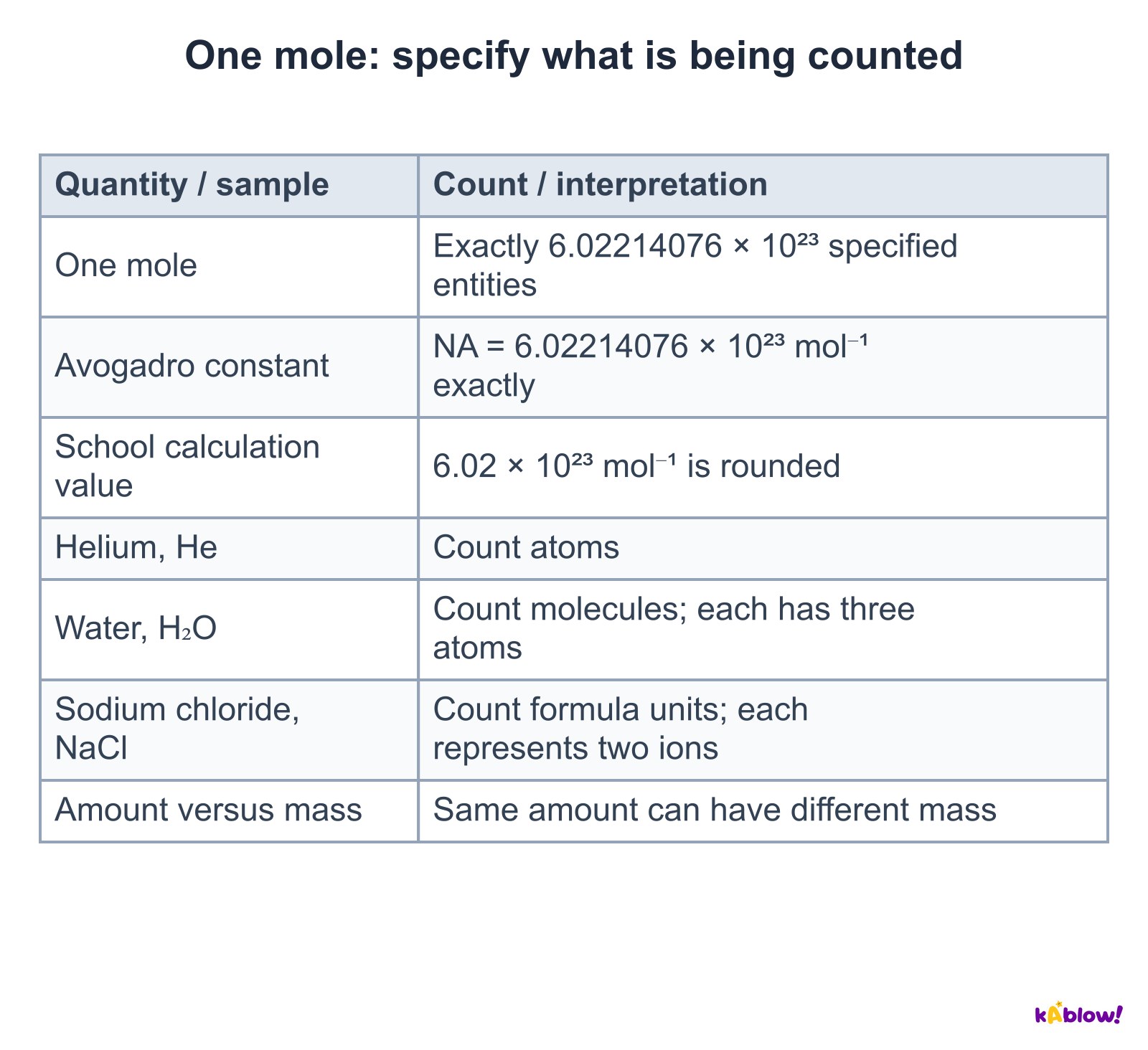
- Amount of substance, n, measures how many specified entities are present and has the SI unit mol. State whether the entities are atoms, molecules, ions, electrons or a specified group.
- One mole contains exactly 6.02214076 × 10²³ specified entities. This fixed-number SI definition replaced the historical carbon-12 definition; 6.02 × 10²³ mol⁻¹ is a rounded calculation value.
- Use the constant supplied by a question. AQA does not require recall of its numerical value. Equal amounts contain equal numbers of the stated entities, but their masses can differ.
One mole: specify the counted entity
Convert between amounts and specified particle counts
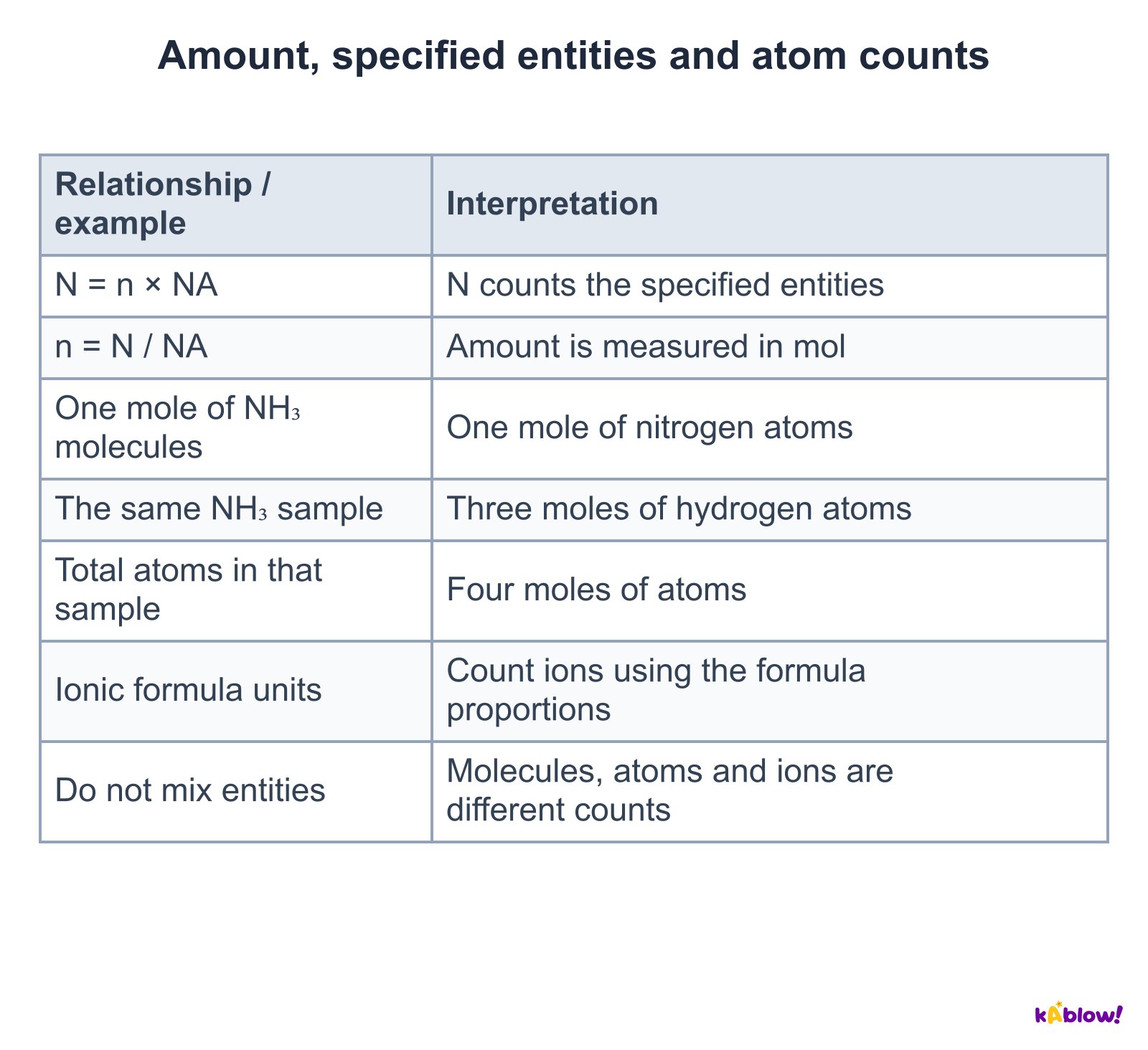
- Use N = nNₐ to find a count and n = N/Nₐ to find an amount. N is a number of the stated entities; n has unit mol and Nₐ has unit mol⁻¹.
- Count the entities asked for before calculating. For N₂, a molecular count and an atom count differ by a factor of two; for NH₃ the total atom count is four times the molecular count.
- Keep powers of ten clear. In the supplied nitrogen example, the calculation uses the stated rounded constant rather than silently switching to the exact SI value.
Amount, particles and atom counts
Count ions using an ionic formula
- An ionic solid such as sodium chloride is described by formula units rather than discrete NaCl molecules. Its formula expresses the ratio of constituent ions.
- For CaF₂, the formula ratio is one Ca²⁺ to two F⁻. One mole of formula units therefore represents one mole of calcium ions and two moles of fluoride ions.
- Do not call these free neutral atoms. If a task asks for total ions, add the amounts of both ionic species after applying the formula ratio.
One mole: specify the counted entity
Distinguish relative mass, molar mass and sample mass
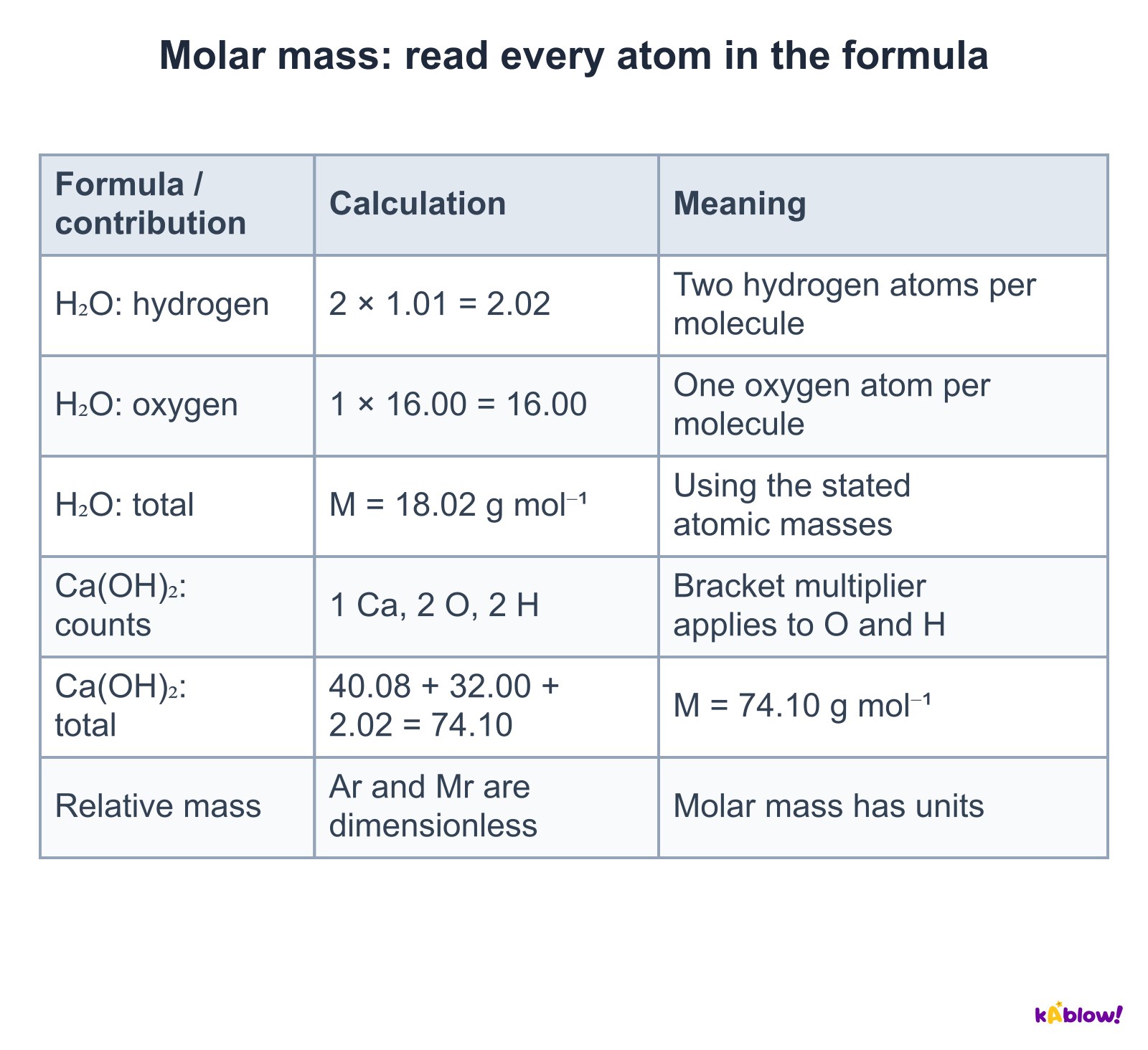
- Relative atomic and molecular/formula masses are dimensionless ratios. Molar mass M is mass per amount, commonly in g mol⁻¹ for these calculations.
- Sum every atom indicated by the formula, including bracket multipliers. In Ca(OH)₂, the subscript outside the brackets applies to both O and H.
- The mass of a one-mole sample is expressed in grams, while its molar mass is expressed in grams per mole. Use the atomic masses supplied for the task rather than mixing rounded values from different examples.
Molar mass from the formula
Find amount from mass and molar mass
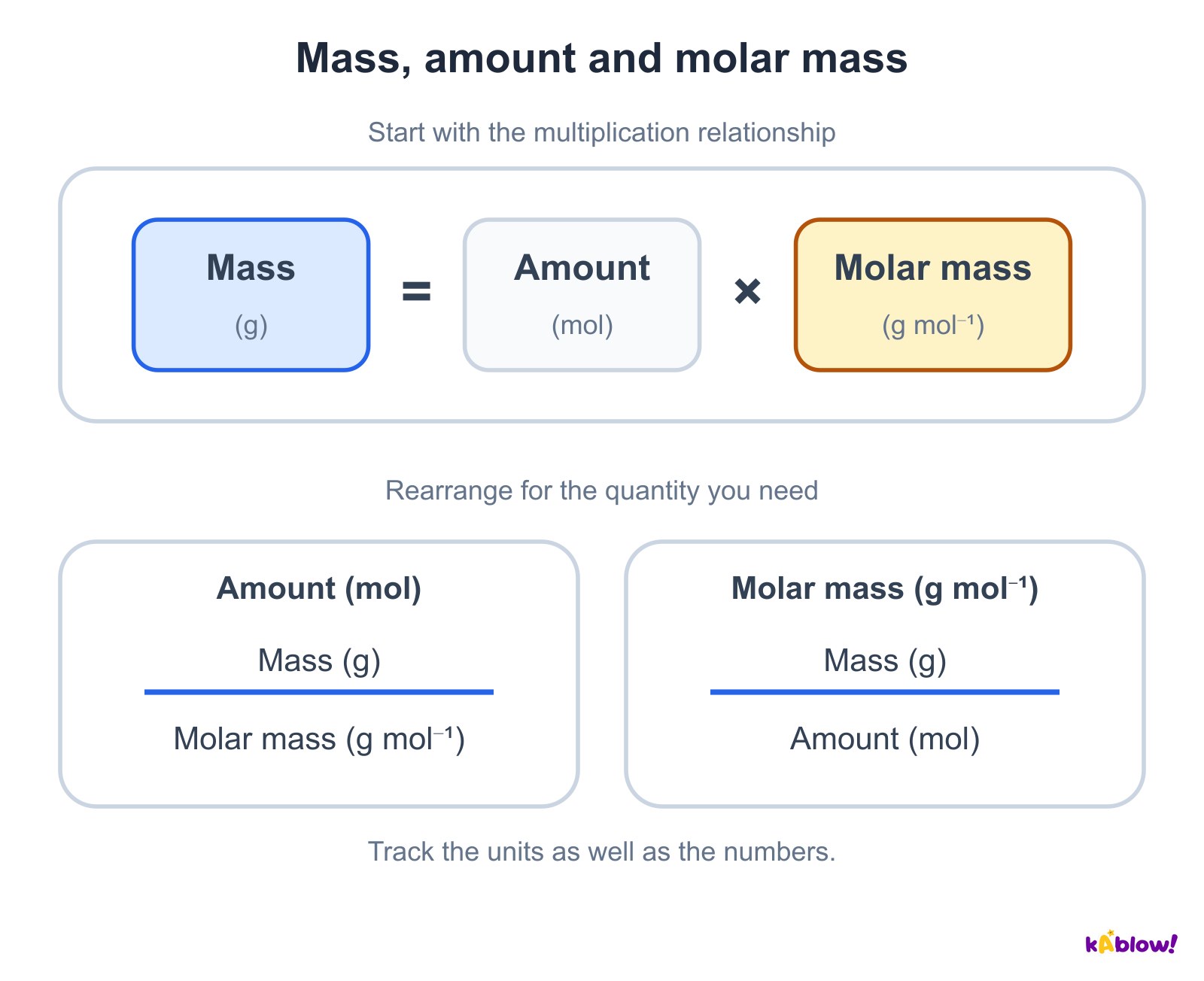
- The relationship m = nM gives n = m/M. With m in g and M in g mol⁻¹, the result is in mol.
- Check the substance and formula before choosing its molar mass. A mass of oxygen atoms and a mass of O₂ molecules require different entity descriptions.
- For a known pure substance, the amount is proportional to mass. The equation alone does not correct for an impure sample or a mixture of unknown composition.
Mass, amount and molar mass
Link particle count to sample mass
- A count-to-mass problem usually needs two steps: divide the count by Nₐ to obtain amount, then multiply by the appropriate molar mass.
- Keep the entity consistent across both steps. Monatomic helium uses helium atoms; molecular hydrogen uses H₂ molecules unless the task explicitly asks for hydrogen atoms.
- Write units through the calculation. A number of atoms cannot be multiplied directly by g mol⁻¹ without first converting the count to moles.
Amount, particles and atom counts
Use a balanced equation for reacting masses
- Convert the known mass to amount, apply the balanced-equation mole ratio, then convert the required amount to mass. Coefficients are amount ratios, not generally mass ratios.
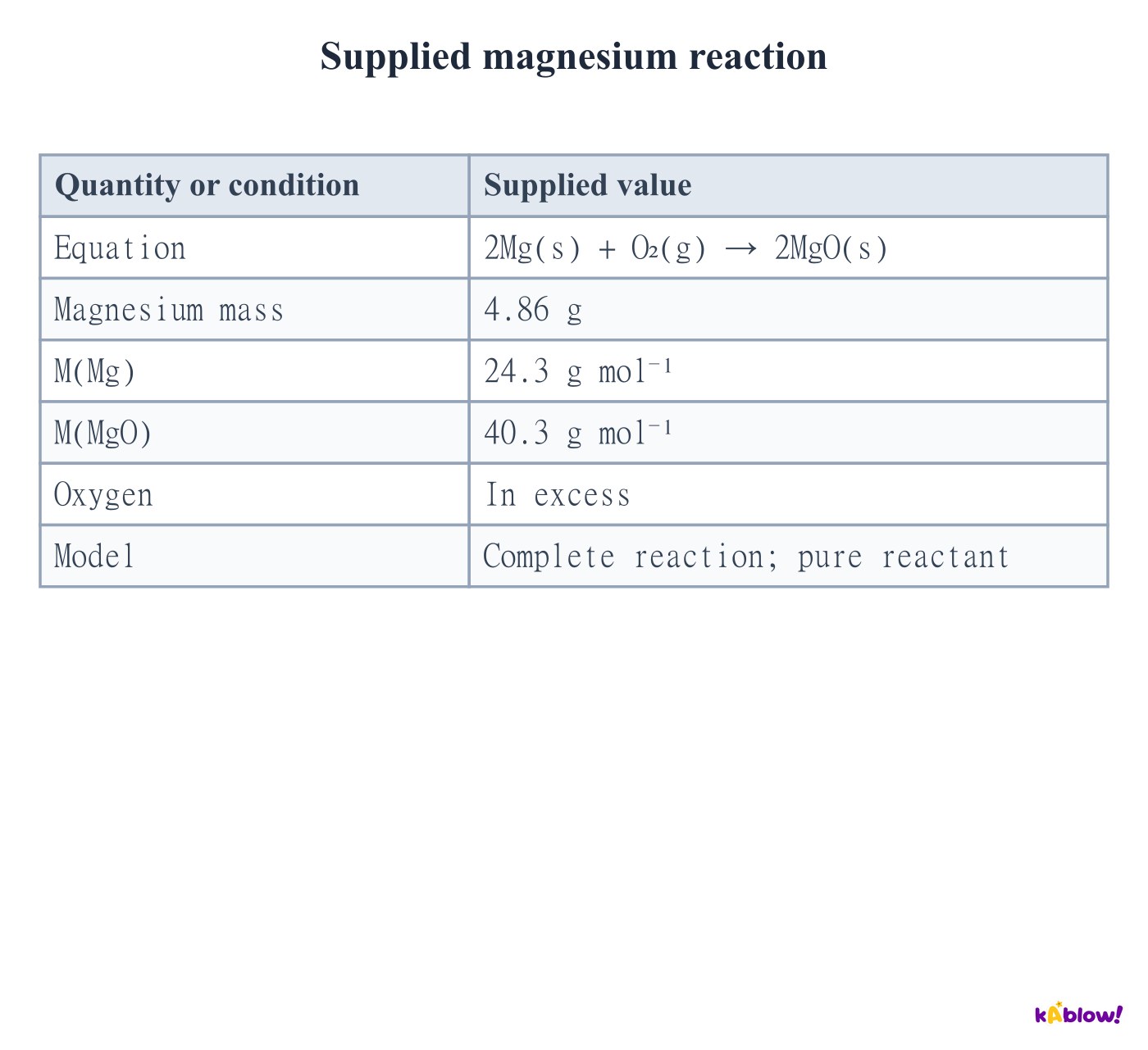
- The supplied magnesium equation gives a 1:1 Mg-to-MgO amount ratio. Oxygen is explicitly in excess and the model assumes complete conversion of pure magnesium.
- The calculated product mass is a theoretical maximum under those conditions. Actual isolated mass can differ through incomplete reaction, side reactions or product loss.
Supplied magnesium reaction
Check which reactant limits the product
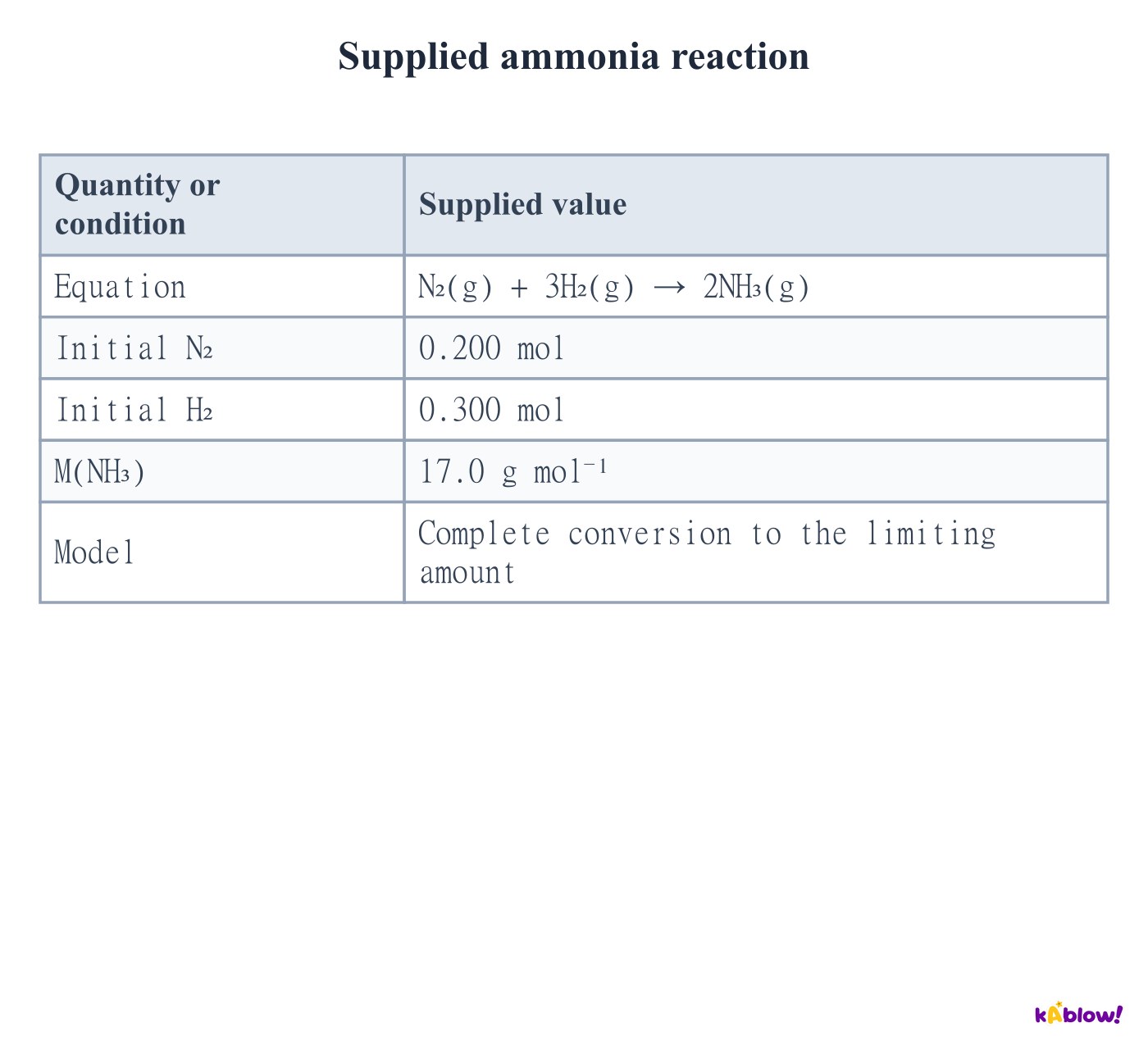
- For multiple reactants, compare the available amount divided by its stoichiometric coefficient. The smallest value limits the reaction extent in the stated complete-reaction model.
- For N₂ +3H₂ →2NH₃, equal initial amounts of N₂ and H₂ would not be stoichiometric. Three moles of H₂ are needed per mole of N₂.
- Use the limiting amount for the theoretical product and calculate any excess separately. An equilibrium reaction may not reach this theoretical maximum in practice.
Supplied ammonia reaction
Calculate amount concentration using solution volume
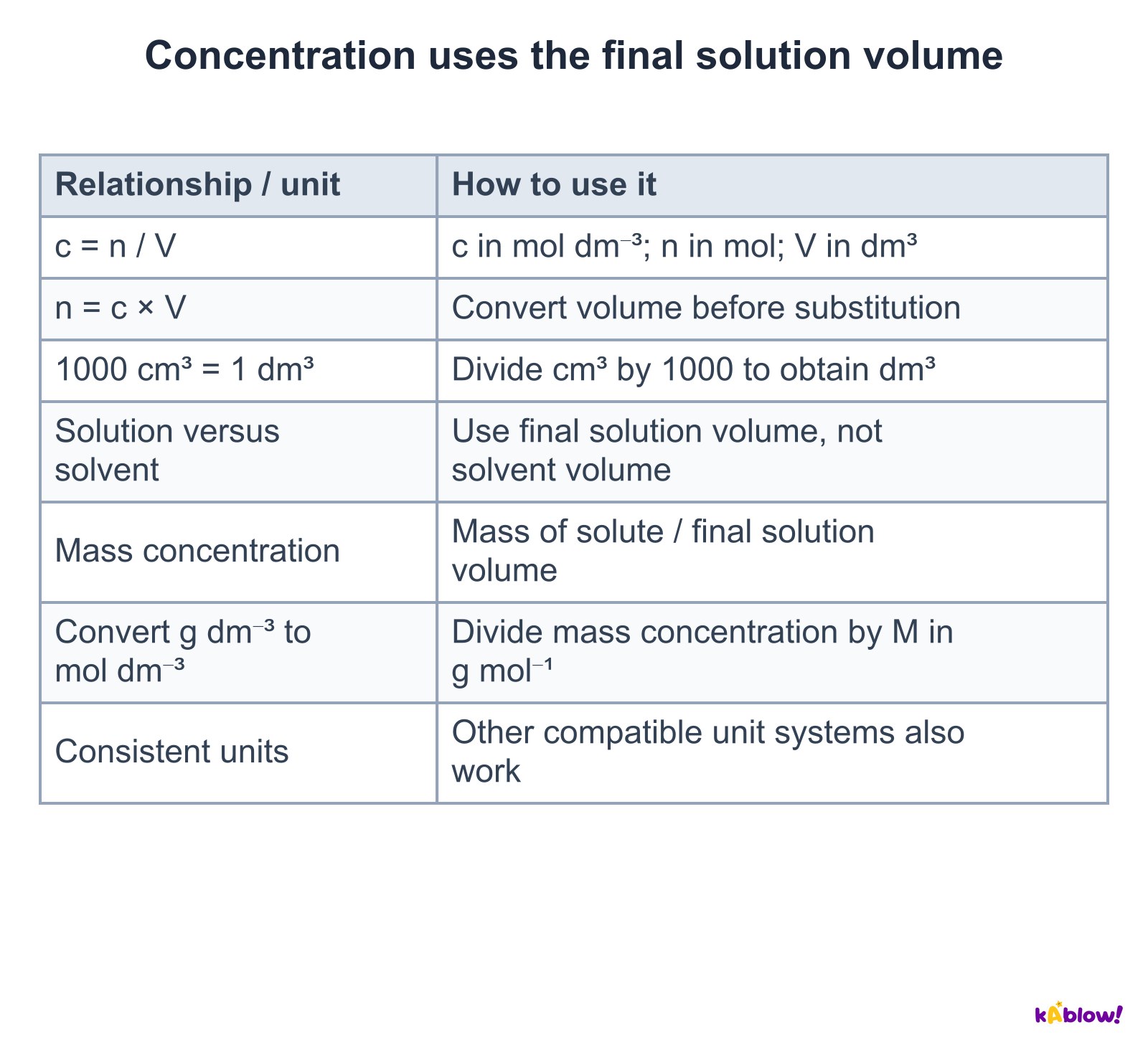
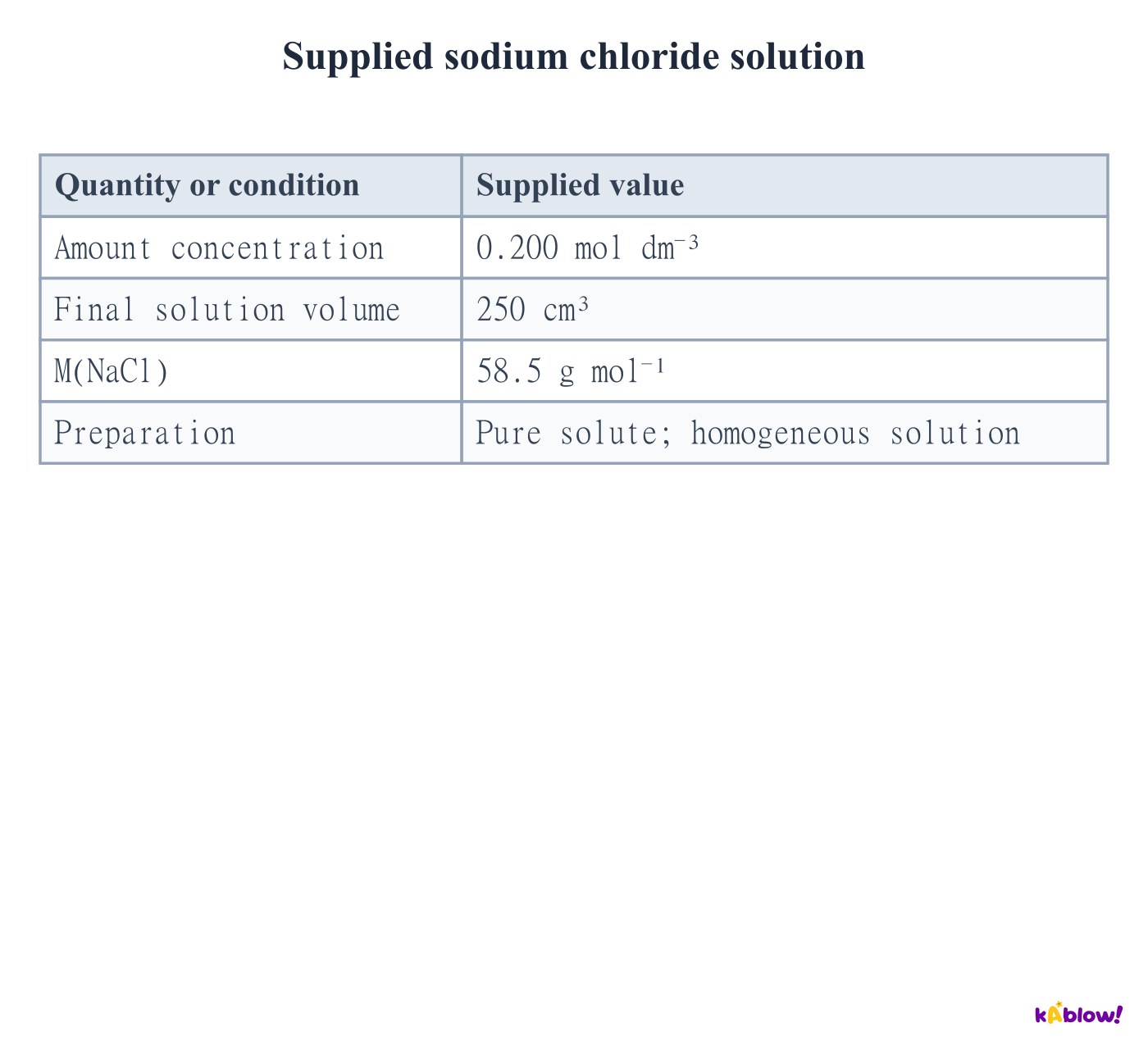
- Amount concentration c = n/V. For c in mol dm⁻³, use the final solution volume in dm³; 1000 cm³ = 1 dm³.
- The relevant volume is the homogeneous solution’s volume, rather than only the solvent volume added. Concentration describes a ratio and does not by itself give the total amount.
- Rearrange to n = cV when the amount is required. A concentrated small sample can contain less solute than a larger dilute sample.
Concentration and final solution volume
Convert solution concentration to a solute mass
- Combine n = cV with m = nM. Use compatible concentration/volume units before applying the molar mass.
- Mass concentration, for example g dm⁻³, is different from amount concentration in mol dm⁻³. Conversion between them requires the substance’s molar mass.
- Retain intermediate digits and round the final answer as instructed. Do not treat a numerical concentration as though it were a mass in the sample.
Concentration and final solution volume
Use the correct ratio in solution reactions
- A solution-reaction calculation links measured volume and concentration through the balanced equation. Do not assume all neutralisations have a 1:1 ratio.
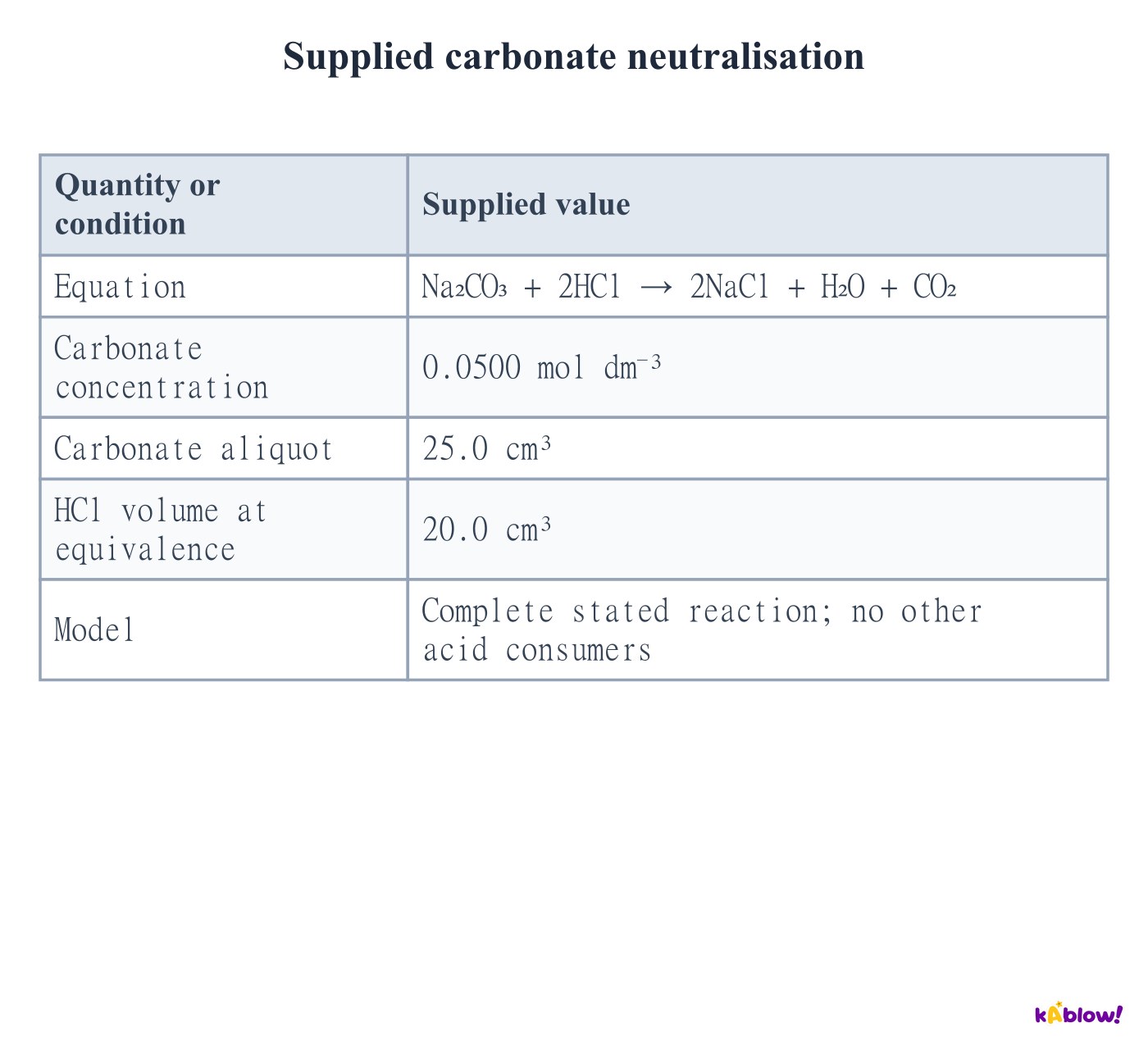
- Complete carbonate neutralisation in the supplied model requires two moles of HCl per mole of Na₂CO₃. The product is 2NaCl, not Na₂Cl.
- Calculate carbonate amount from its aliquot, apply the 1:2 ratio, then divide HCl amount by its own volume in dm³ to find the acid concentration.
Supplied carbonate neutralisation
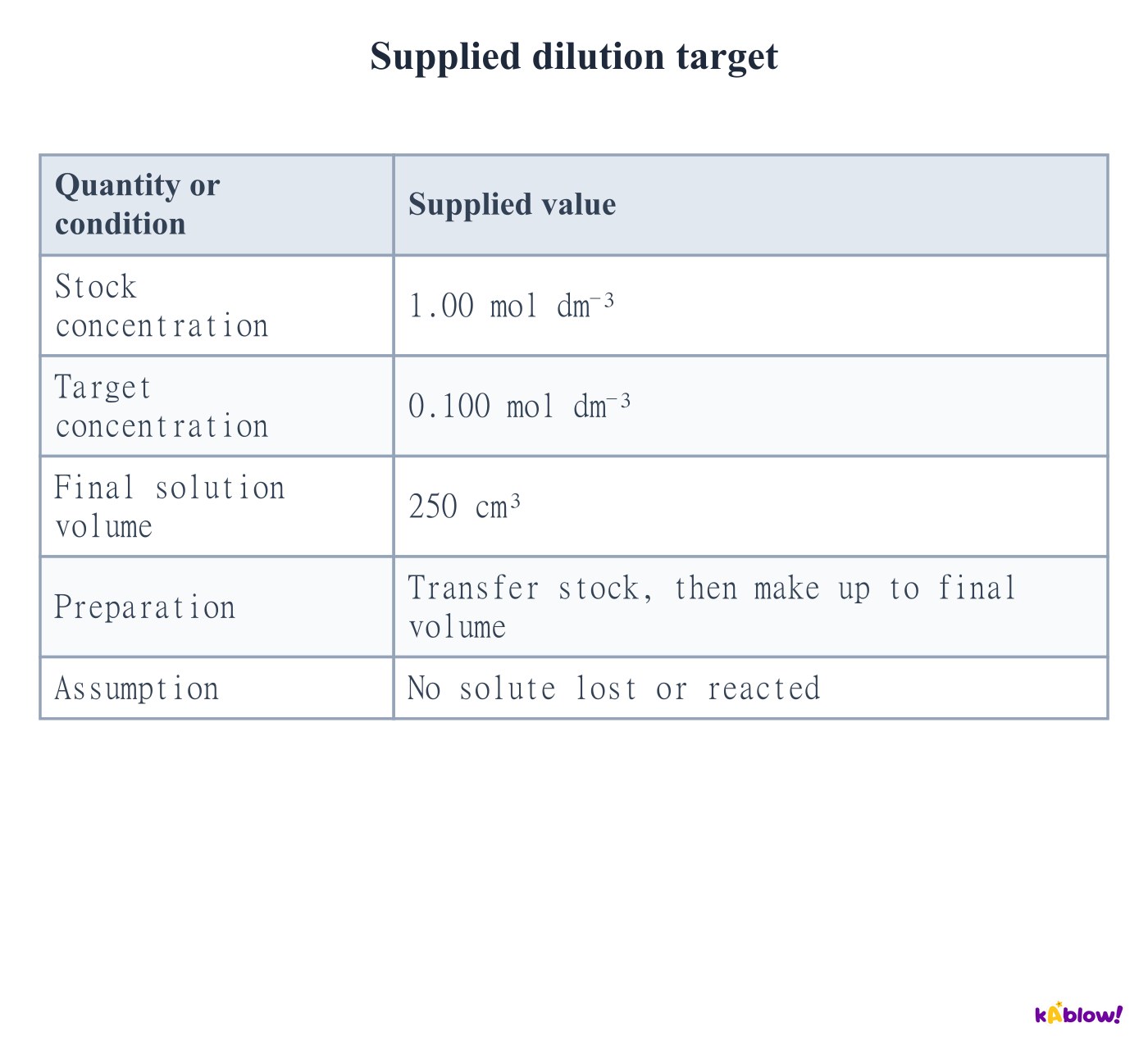
Plan a dilution by conserving solute amount
- If no solute is lost or reacted, the transferred stock amount equals the amount in the final diluted solution. This gives c₁V₁ = c₂V₂ with compatible units.
- The required final volume includes the transferred stock solution. Transfer the calculated stock volume, then make up to the final volume rather than adding that entire final volume as water.
- A dilution changes concentration, while the amount transferred remains the same. Choose measuring apparatus suited to the specified volume and required precision.
Supplied dilution target
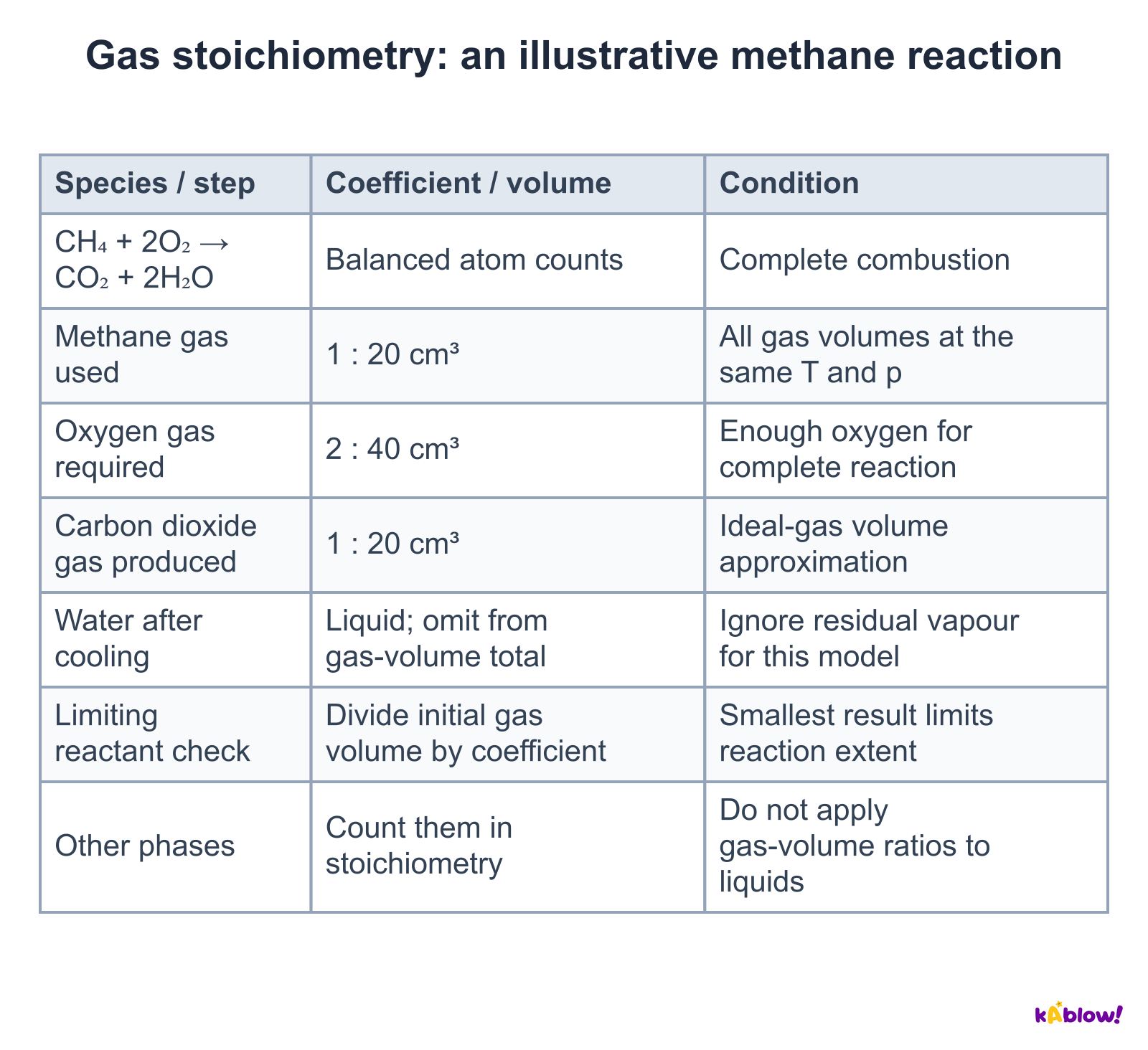
Relate gas-volume ratios to the balanced equation
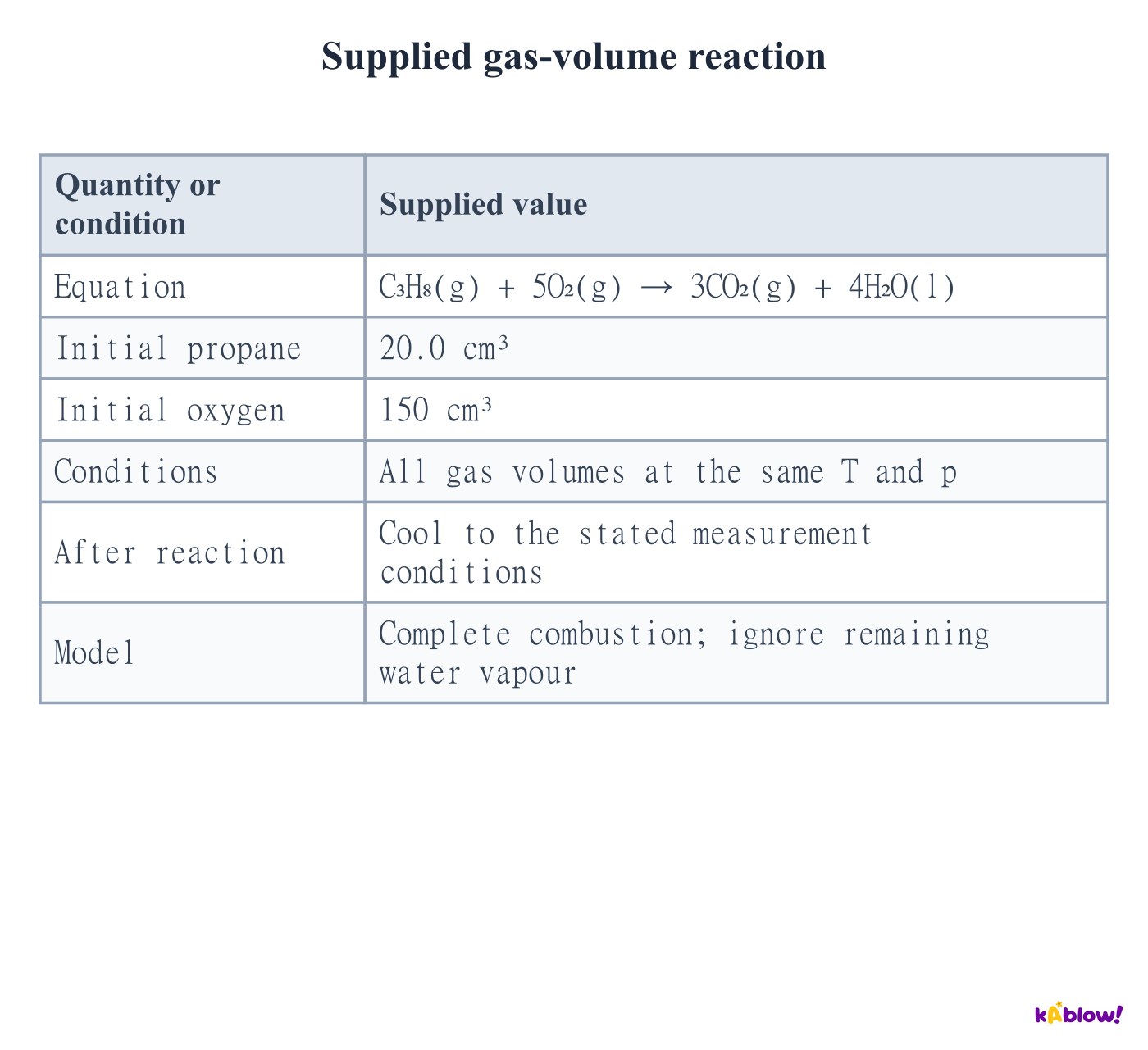
- At the same temperature and pressure, gas-volume ratios follow mole ratios in an ideal-gas approximation. Do not apply these volume ratios directly to a liquid or solid.
- Account for excess reactant and the phases present when gas volumes are measured. In the supplied combustion model, water is liquid after cooling and residual water vapour is ignored.
- A total dry gas volume can include both gaseous product and unreacted oxygen. It is not necessarily the volume of the carbon dioxide alone.
Gas stoichiometry: a worked model
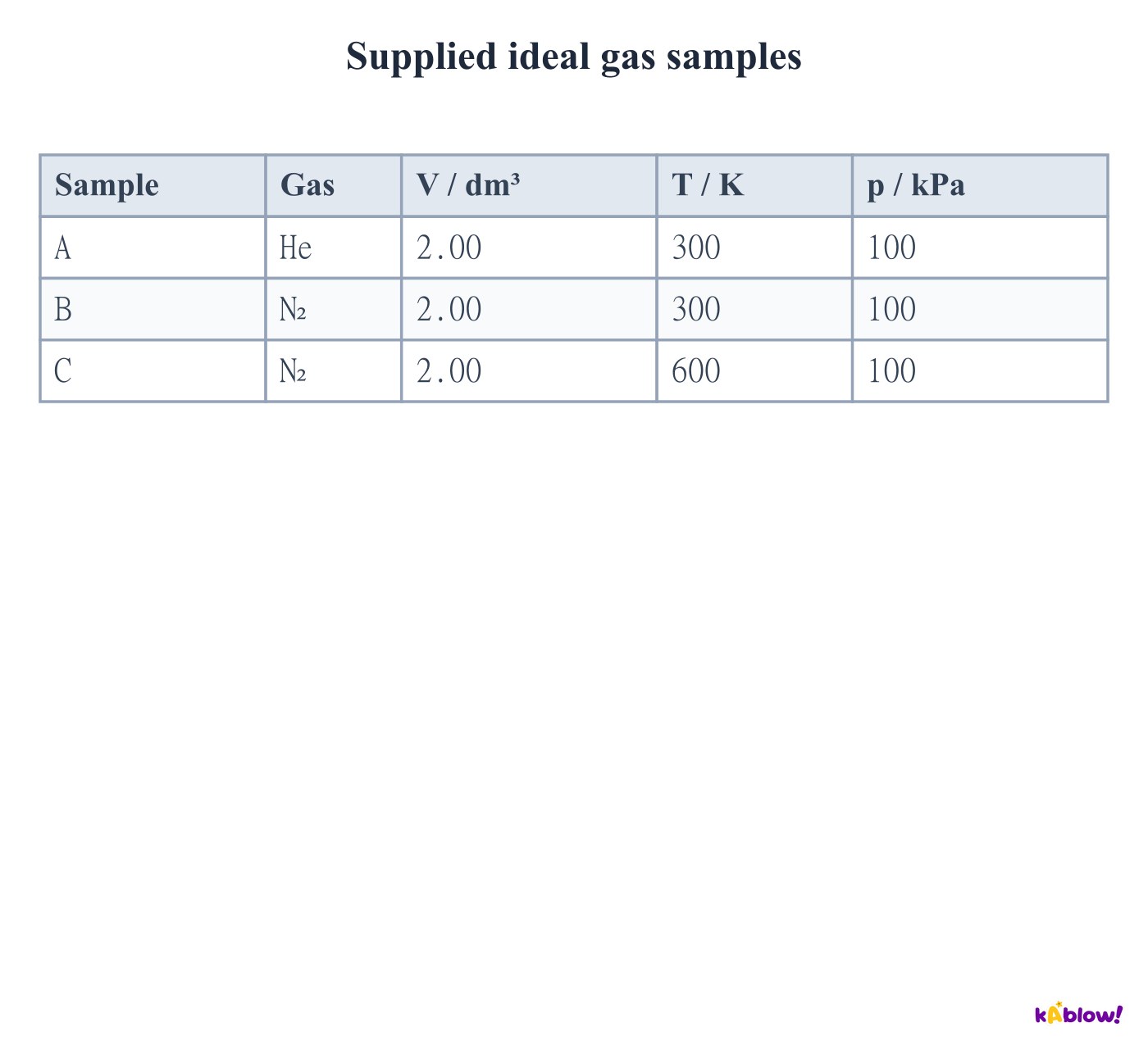
Specify temperature and pressure when comparing gases
- Equal volumes of ideal gases at the same temperature and pressure contain equal numbers of gas entities. These may be atoms for helium or molecules for nitrogen.
- Equal gas-entity counts do not guarantee equal atom counts or masses. Nitrogen molecules each contain two atoms, while helium is monatomic.
- Changing temperature or pressure changes the amount associated with a fixed volume. Check the full state rather than comparing volumes alone.
Supplied ideal gas samples
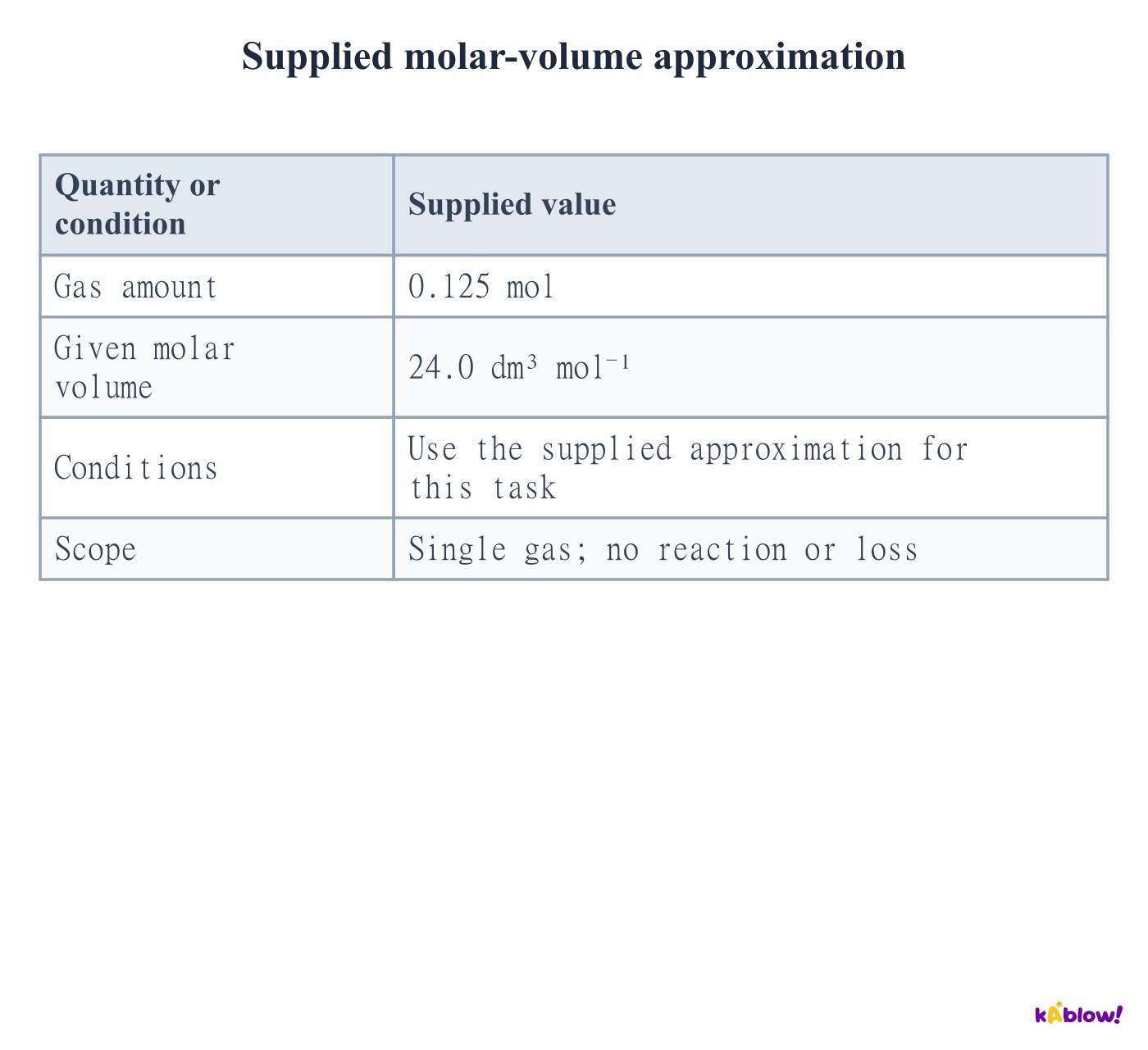
Use a molar gas volume only for its stated conditions
- Molar gas volume Vₘ is volume per amount at specified temperature and pressure. Use V = nVₘ or n = V/Vₘ when an appropriate value is supplied.
- A value such as 24.0 dm³ mol⁻¹ is an approximation for a stated task, not an exact universal property of every gas at every room condition.
- If temperature or pressure differs, or the question requests pV = nRT, calculate using those state variables. Do not silently mix inconsistent room-condition conventions.
Supplied molar-volume approximation
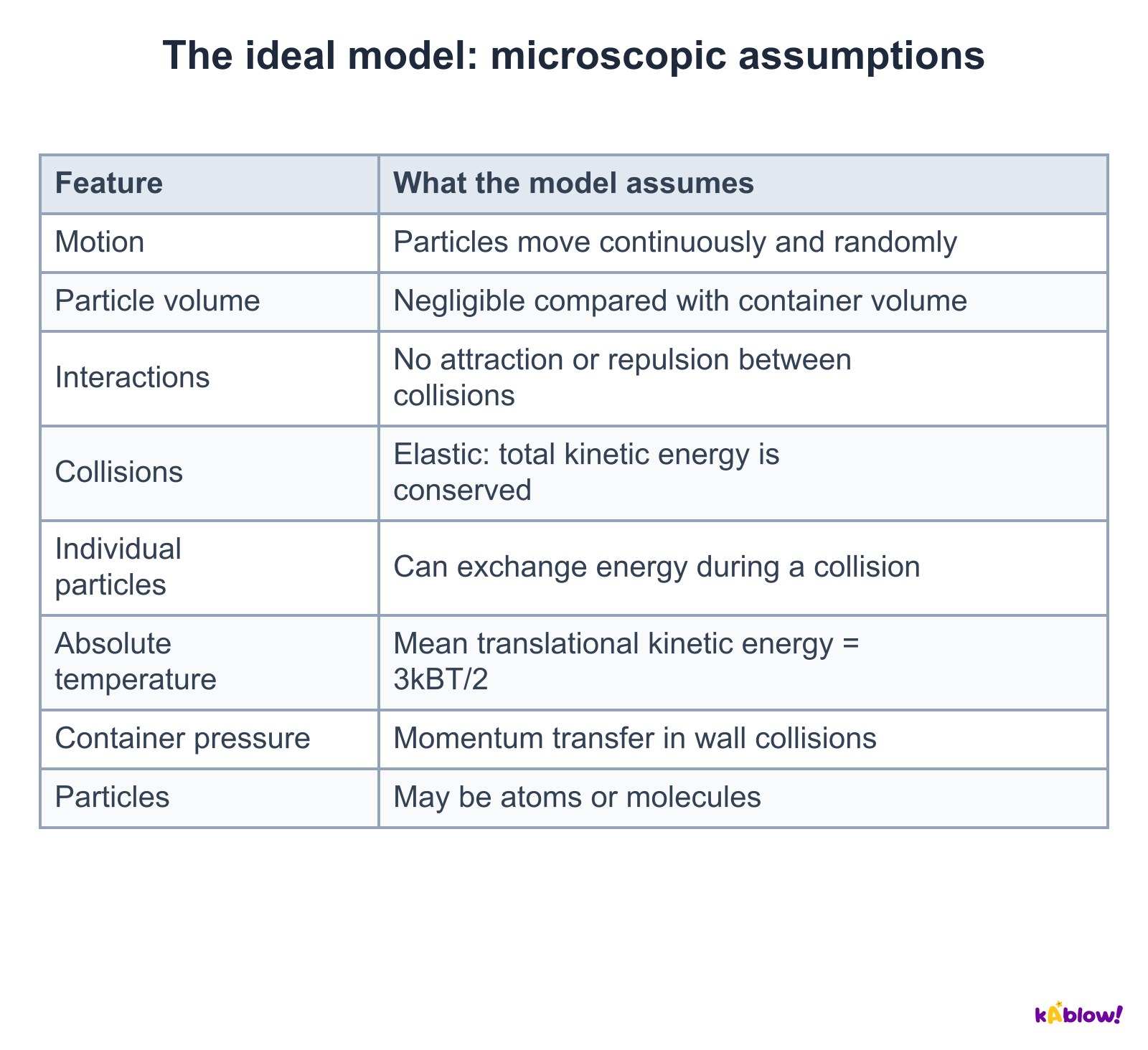
Explain the ideal-gas particle model
- Particles move continuously and randomly, with negligible own volume compared with the container. Interparticle forces are neglected between collisions in this model.
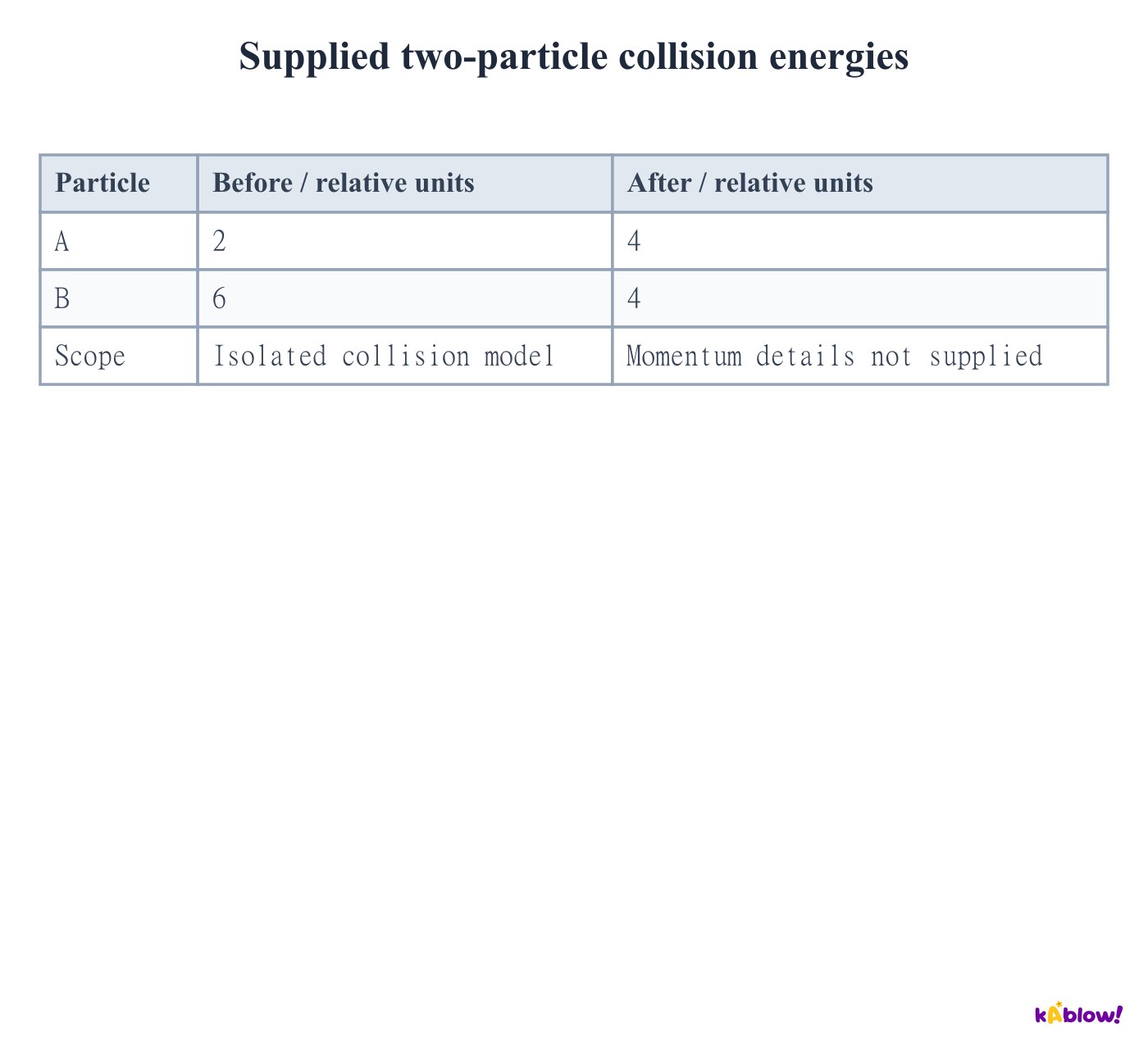
- Elastic collisions conserve total kinetic energy. Individual particles can exchange energy, and pressure comes from momentum transfer in collisions with the walls.
- Mean translational kinetic energy is proportional to absolute temperature. This does not mean every particle has the same energy or that particle speed is directly proportional to temperature.
Connect particles to the ideal model
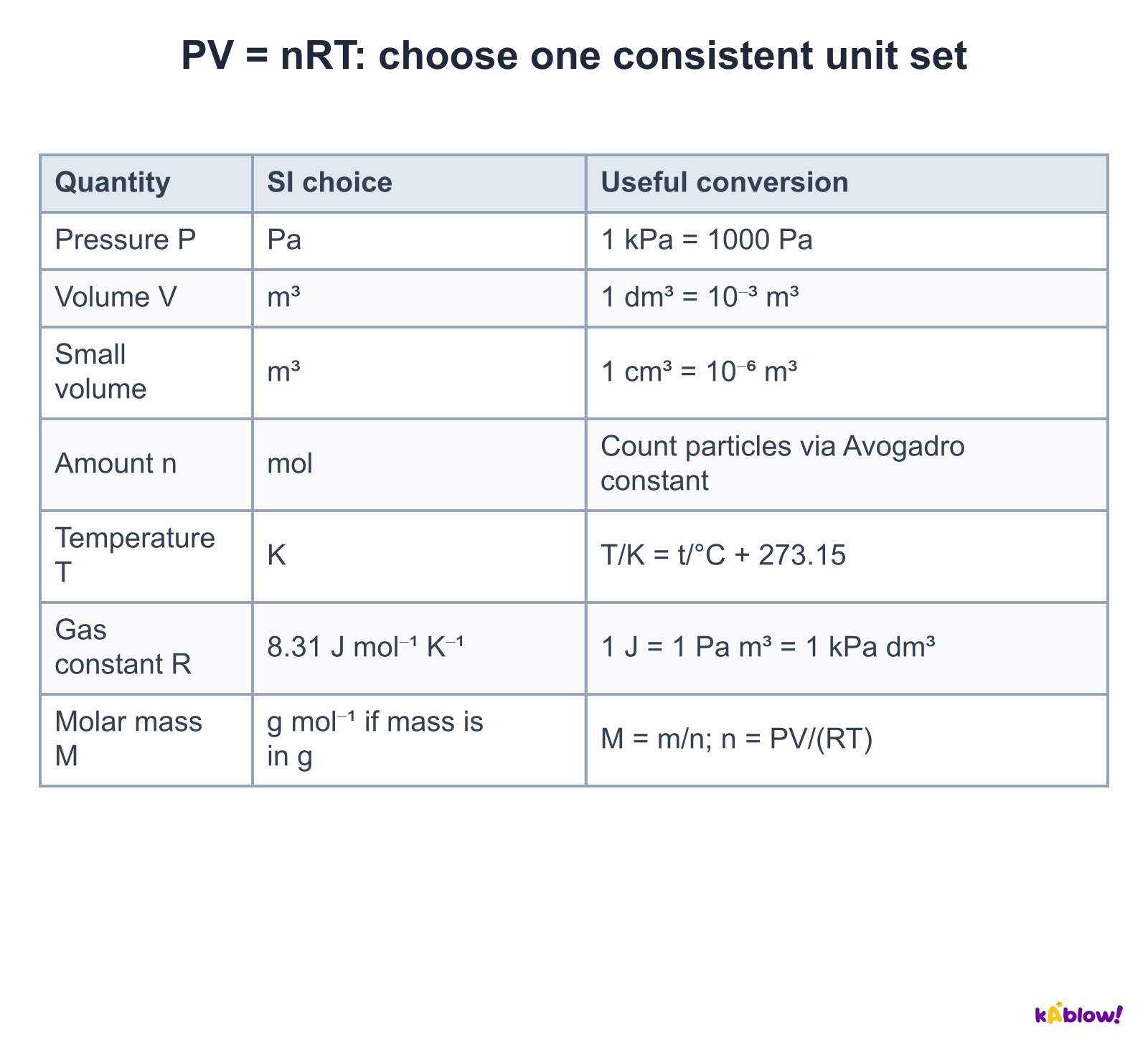
Choose consistent units for pV = nRT
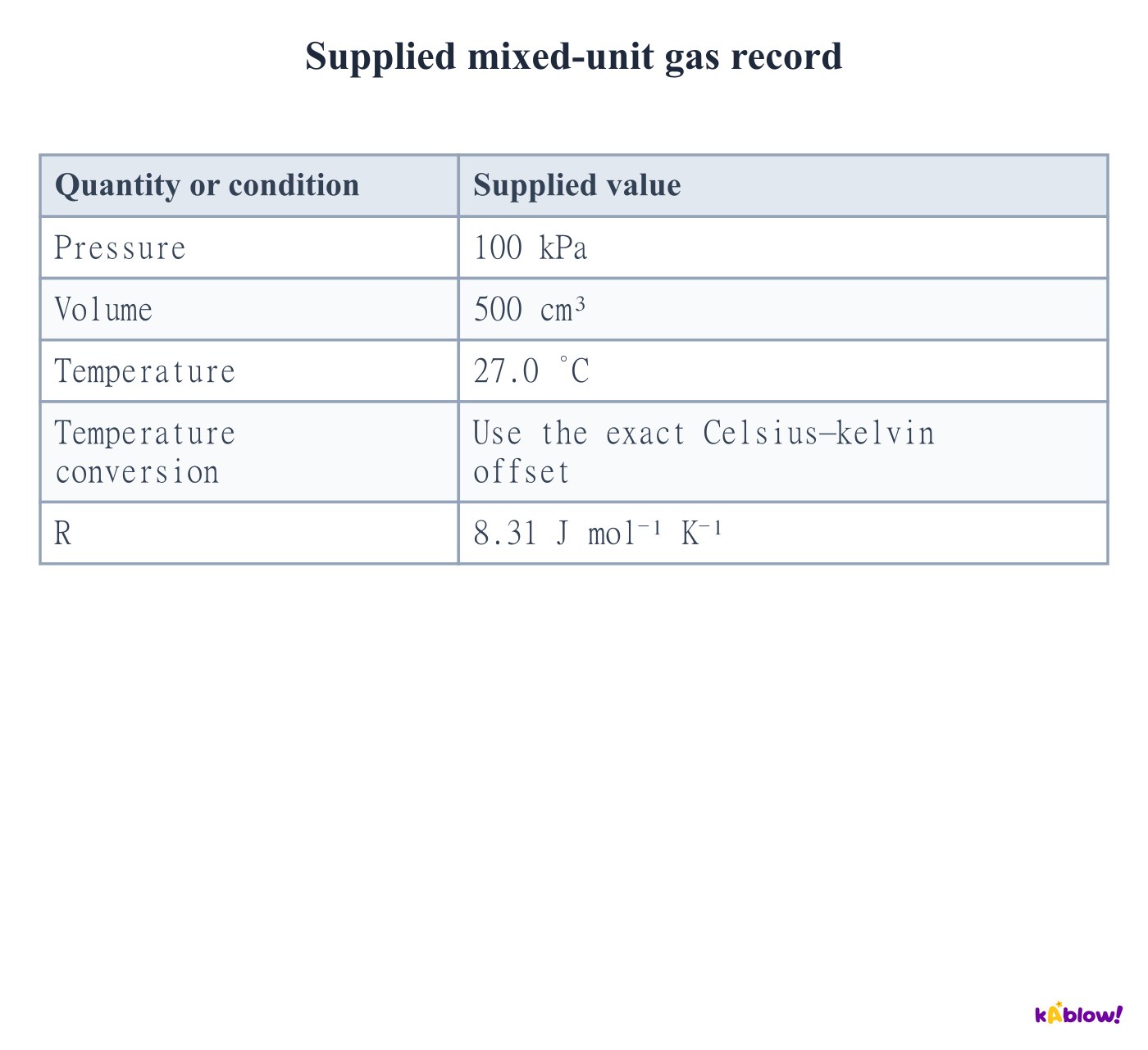
- With R in J mol⁻¹ K⁻¹, use absolute pressure p in Pa, volume V in m³, amount n in mol and temperature T in K for the SI calculation.
- Multiply kPa by 1000; divide dm³ by 1000 and cm³ by 10⁶ to obtain m³. The exact Celsius–kelvin conversion is T/K = t/°C +273.15; use a stated exam approximation consistently if one is given.
- Kelvin ratios are needed for gas laws. A gauge-pressure reading needs an appropriate absolute-pressure conversion before being used as p.
Use compatible units in PV = nRT
Rearrange the ideal gas equation to find volume
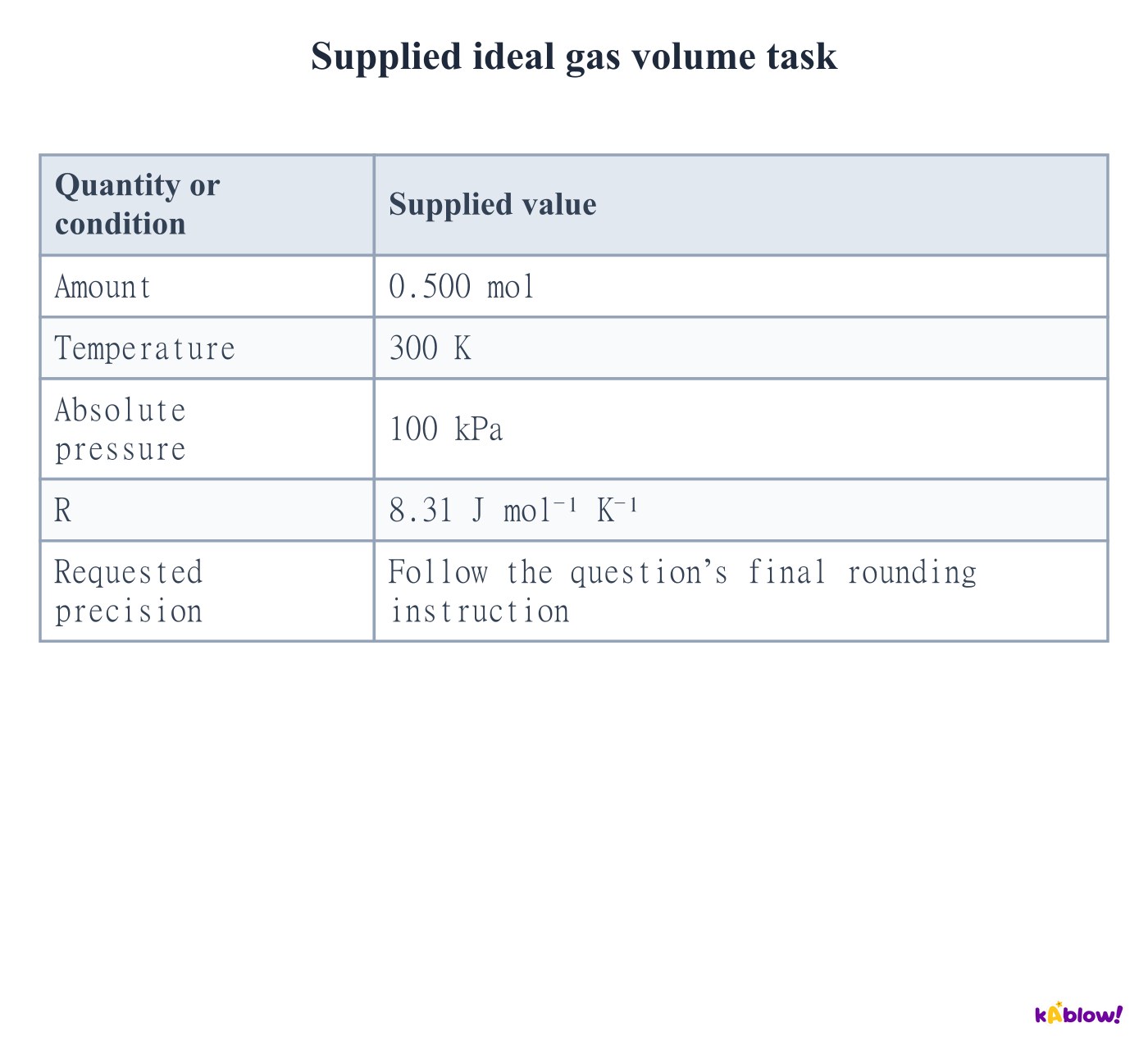
- For an ideal-gas approximation, V = nRT/p. Convert the pressure before substituting and identify the volume unit produced.
- With SI inputs, the result is in m³. Multiply by 1000 to express that volume in dm³, or by 10⁶ for cm³.
- Show substitution and keep intermediate precision. The appropriate model and supplied conditions are as important as the arithmetic.
Use compatible units in PV = nRT
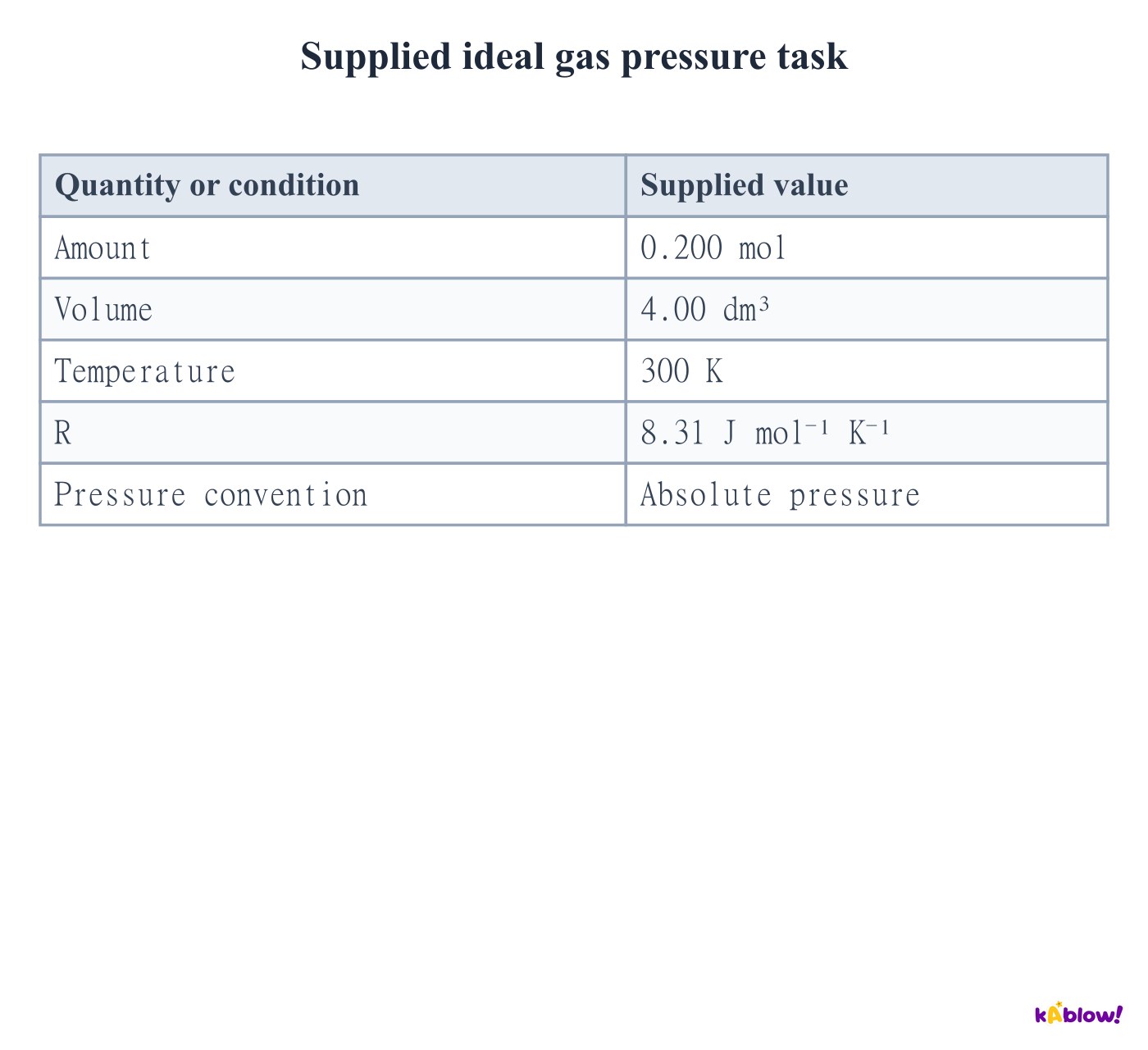
Find pressure and check that it is absolute
- Rearrange to p = nRT/V. A small volume in dm³ must be converted correctly before using the SI value of R.
- An answer initially calculated in Pa can then be divided by 1000 to obtain kPa. Retain the pressure convention in the interpretation.
- For the same ideal amount and temperature, a smaller volume gives a larger pressure. This provides a useful direction check on the calculation.
Use compatible units in PV = nRT
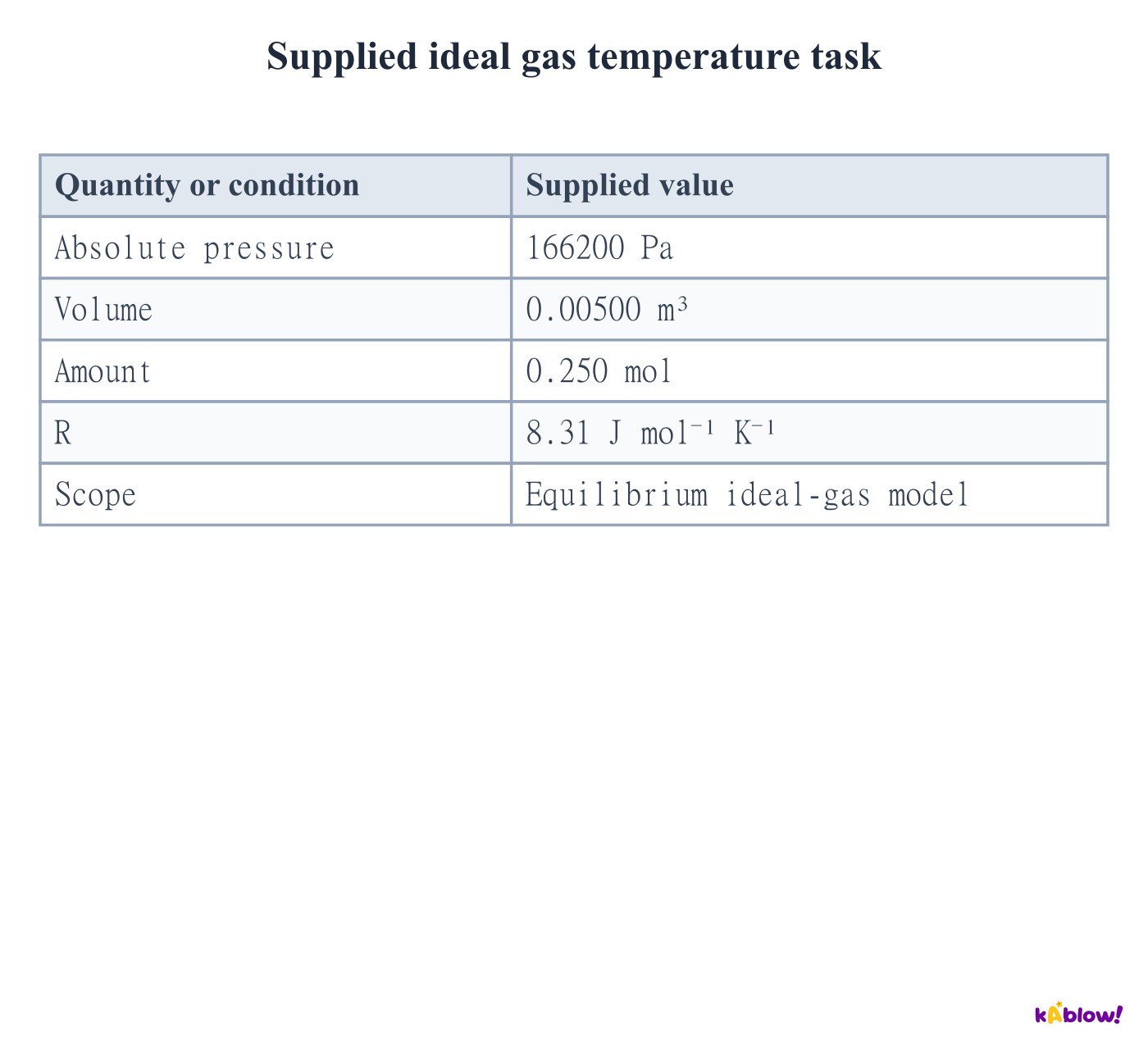
Find an absolute temperature from a gas state
- Rearrange to T = pV/(nR). With the supplied SI quantities the result is in kelvin, not directly in degrees Celsius.
- If a Celsius temperature is requested afterwards, subtract the appropriate Celsius–kelvin offset. Do not use Celsius directly in the original gas equation.
- Check that the sample and measurement conditions support the gas model. A numerical result alone does not prove that a real material remained a single gas phase.
Use compatible units in PV = nRT
Combine gas amount with mass to find molar mass
- First find n = pV/(RT), then use M = m/n. If sample mass is in grams, this second step gives M in g mol⁻¹.
- For a pure molecular gas, the numerical relative molecular mass corresponds to the molar-mass value expressed in g mol⁻¹, but Mᵣ itself has no unit.
- Keep the calculated amount’s intermediate digits. Mixtures, condensation, leaks and inaccurate state measurements can undermine a molar-mass estimate.
Mass, amount and molar mass
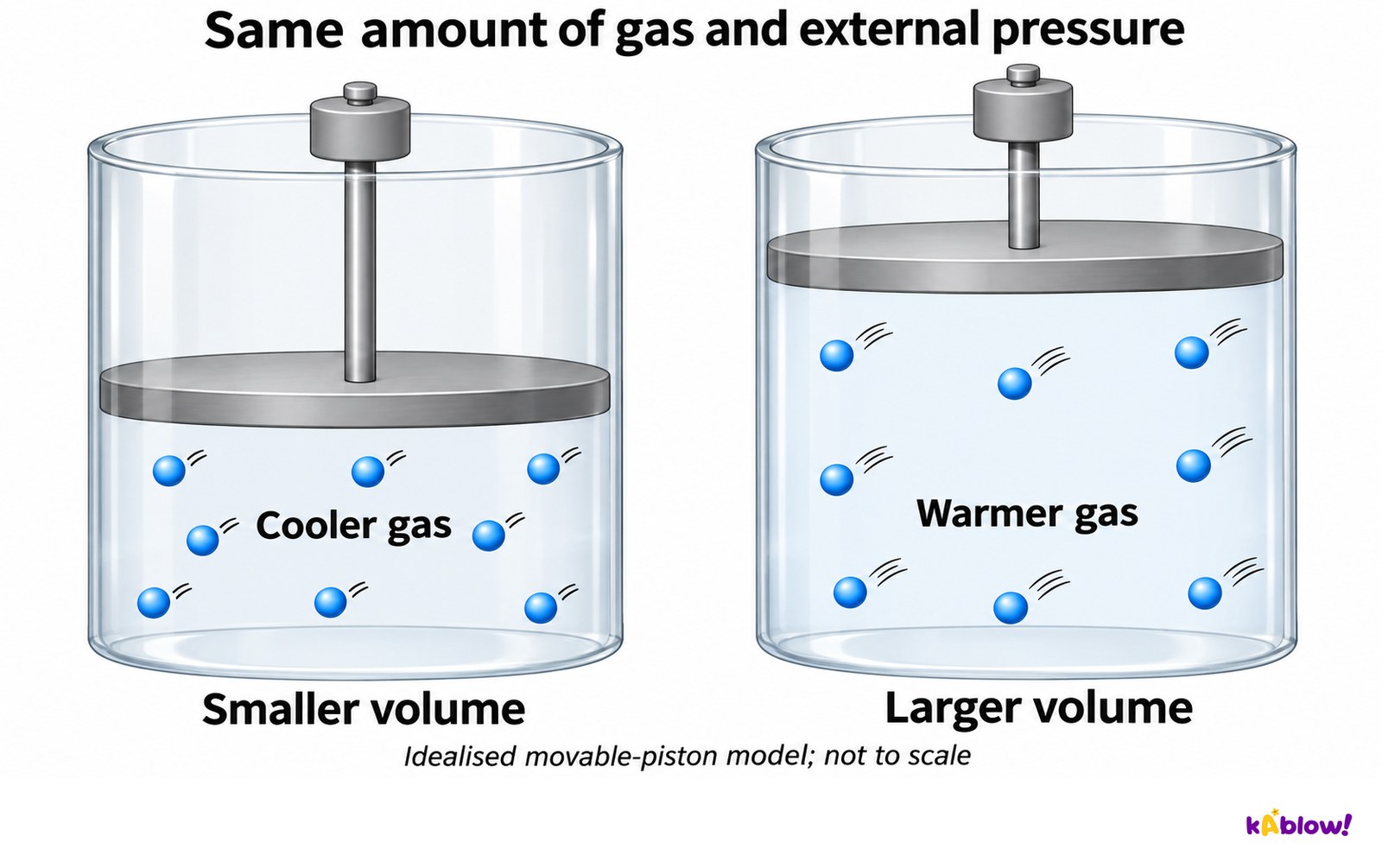
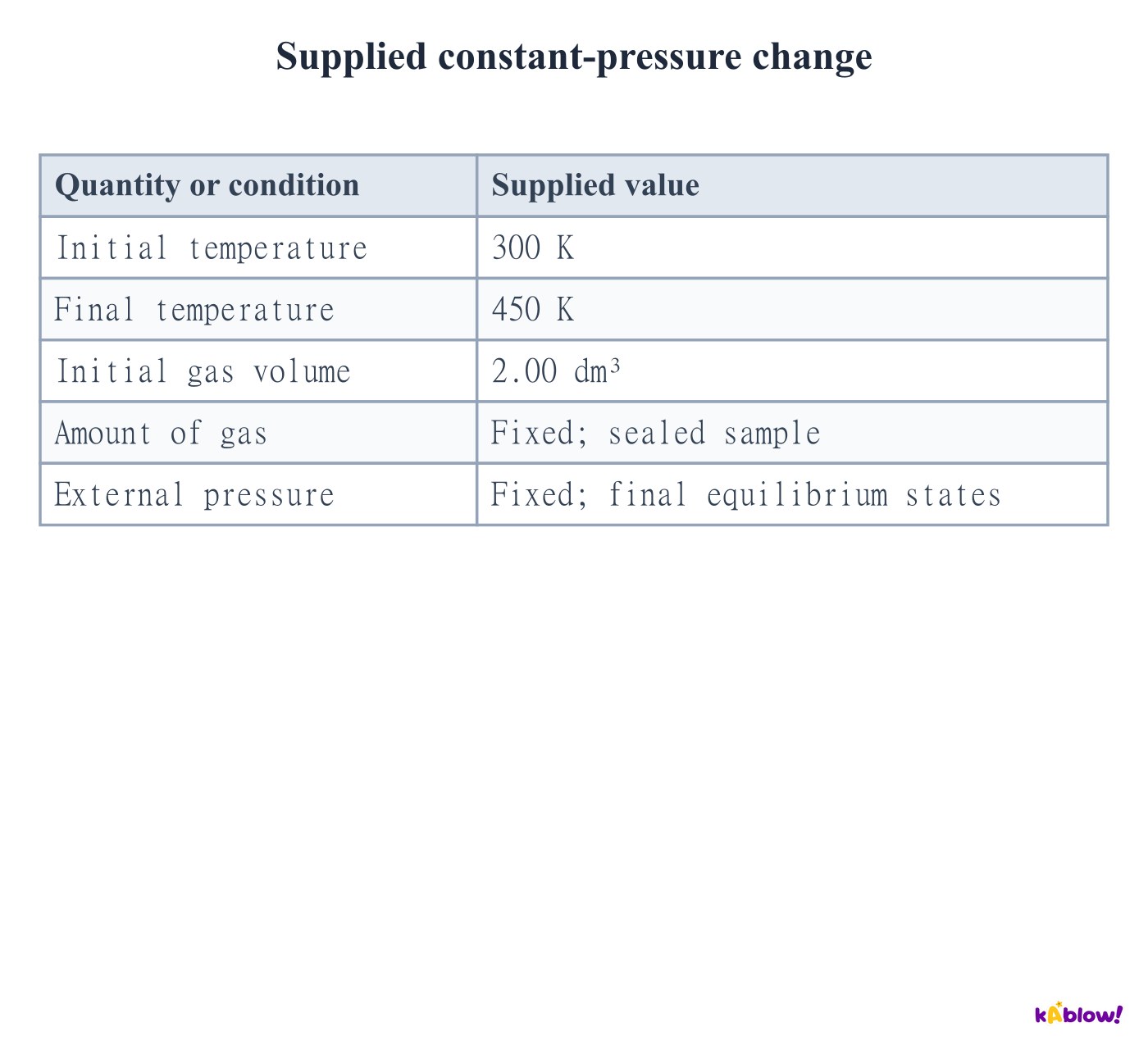
Explain expansion at fixed external pressure
- The piston illustration shows two equilibrium states of the same sealed gas amount under the same external pressure. Heating allows the movable piston to rise, increasing gas volume.
- For fixed n and p in the ideal model, V/T is constant with temperature in kelvin. The spheres keep the same size; expansion is increased spacing rather than swollen particles.
- Avoid claiming the final wall-collision frequency must increase at constant pressure: heating also changes particle density. Explain the balanced pressure and larger equilibrium volume.
A sealed gas under fixed external pressure
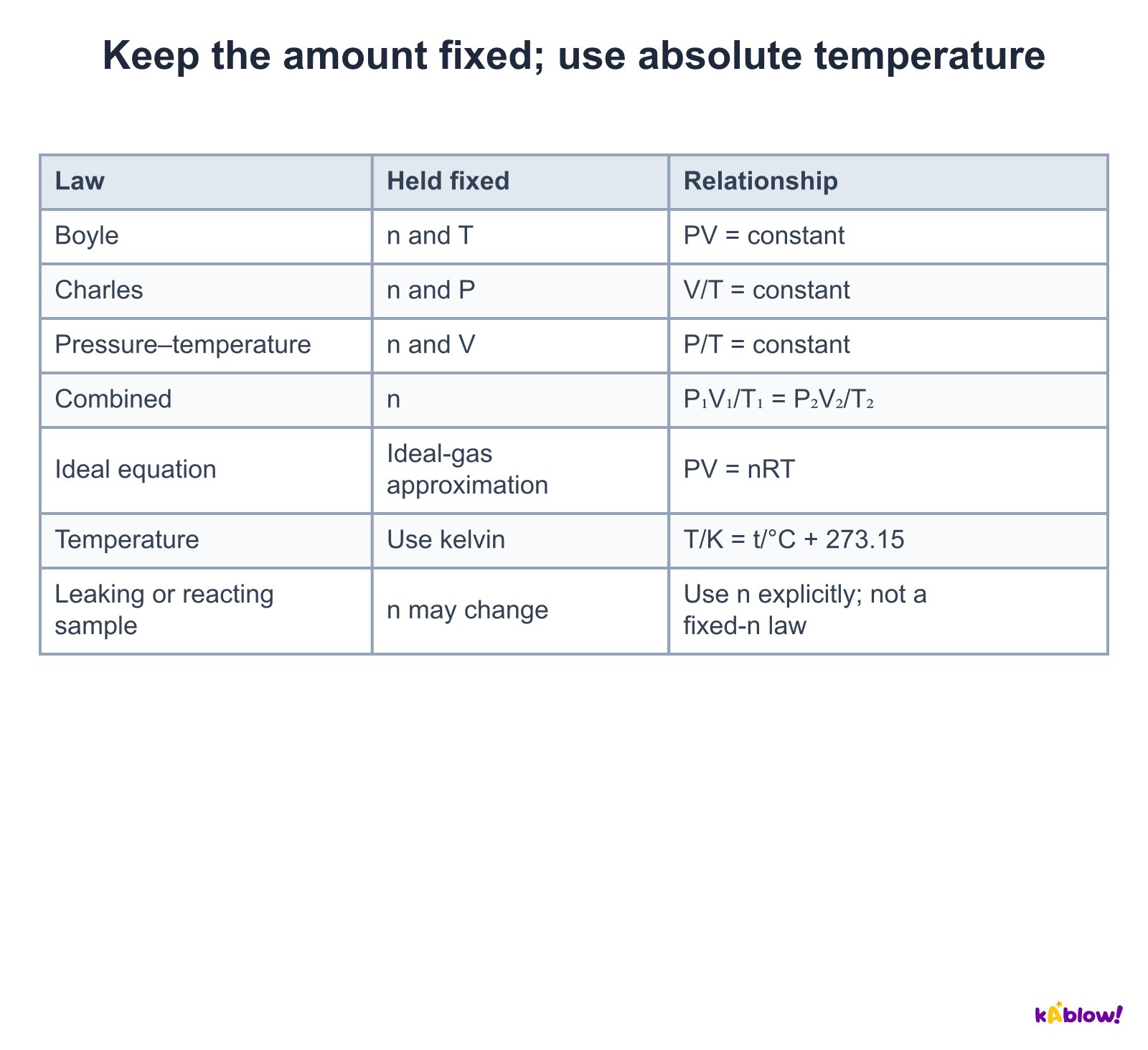
Keep the correct variables fixed in gas-law changes
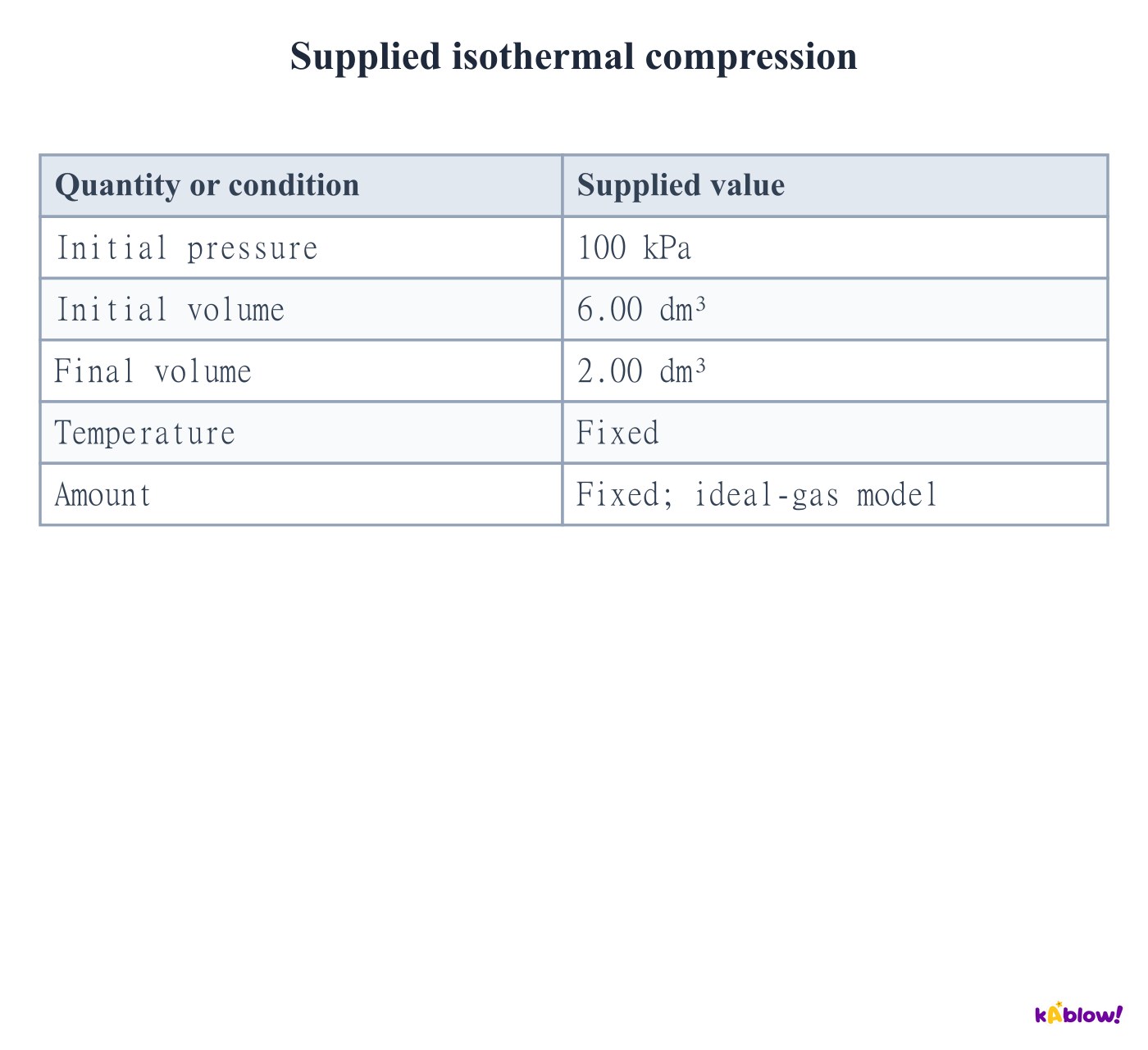
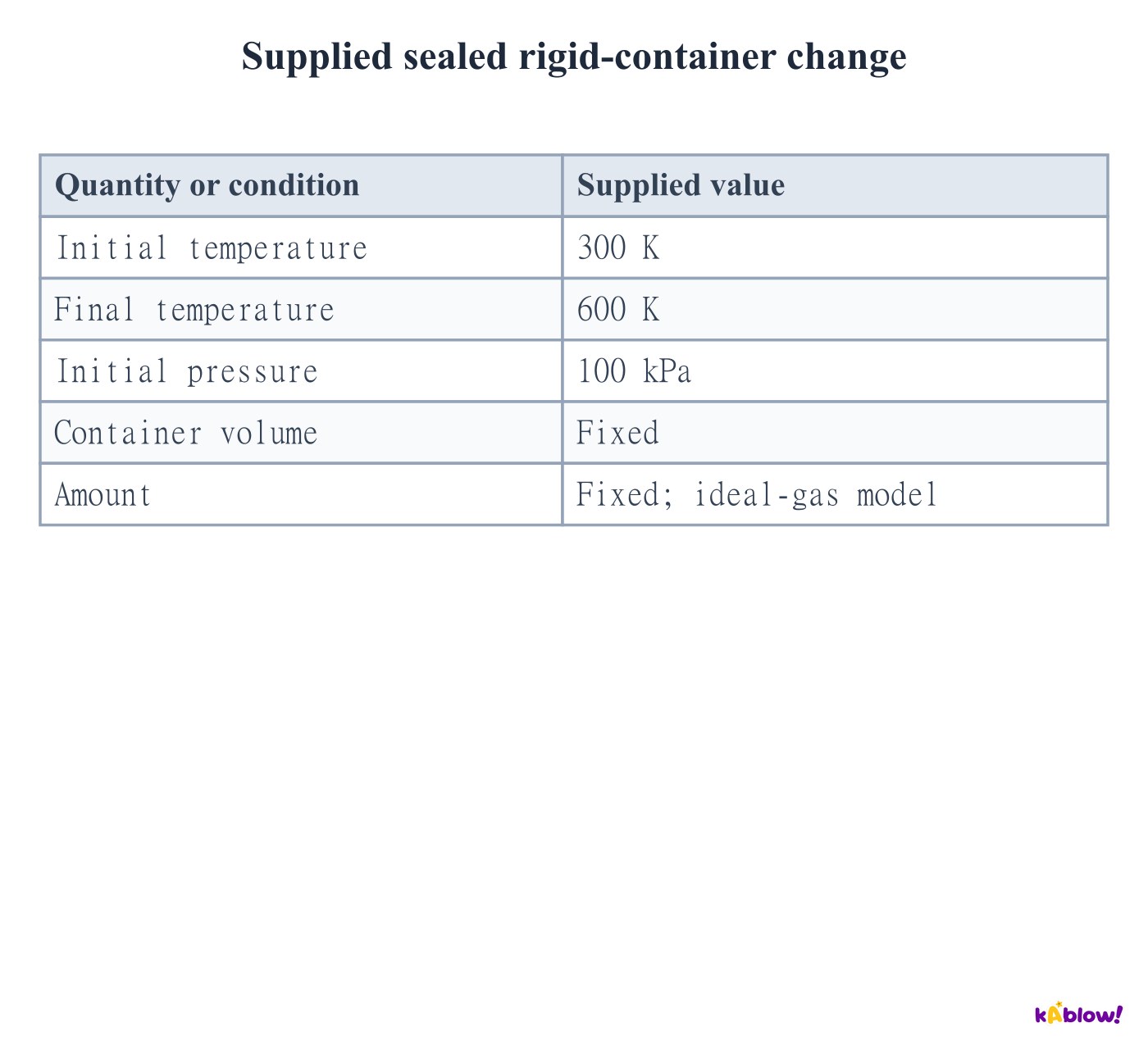
- For fixed n and T, pV is constant. For a sealed rigid container with fixed n and V, p/T is constant instead.
- For a fixed ideal-gas amount with both temperature and volume changing, compare p₁V₁/T₁ with p₂V₂/T₂. These are consequences of pV = nRT, with different held conditions.
- A reacting or leaking gas may change n. In that case use the actual amounts rather than a fixed-amount relationship without justification.
Choose the correct fixed conditions
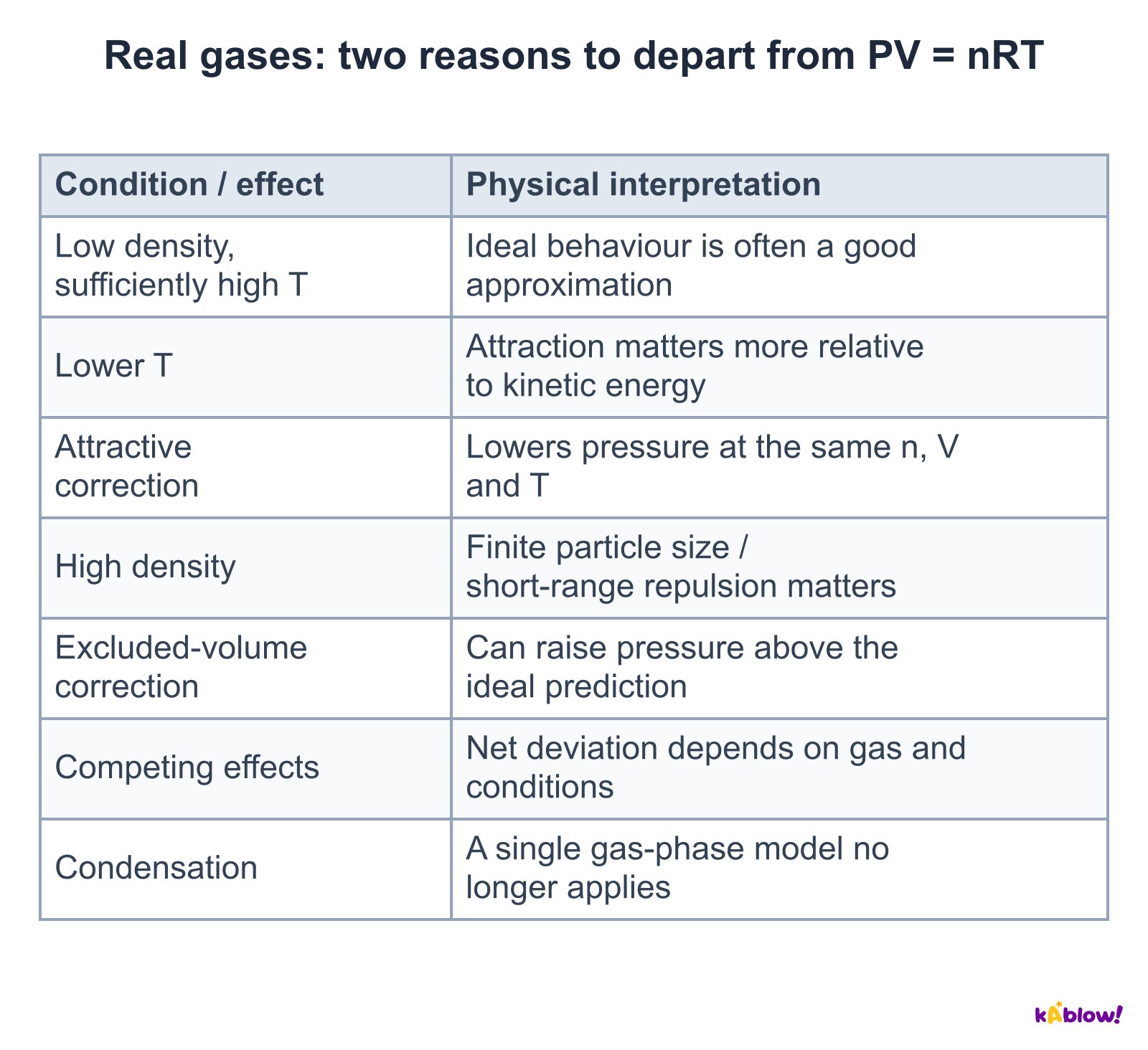
Recognise limits of the ideal-gas approximation
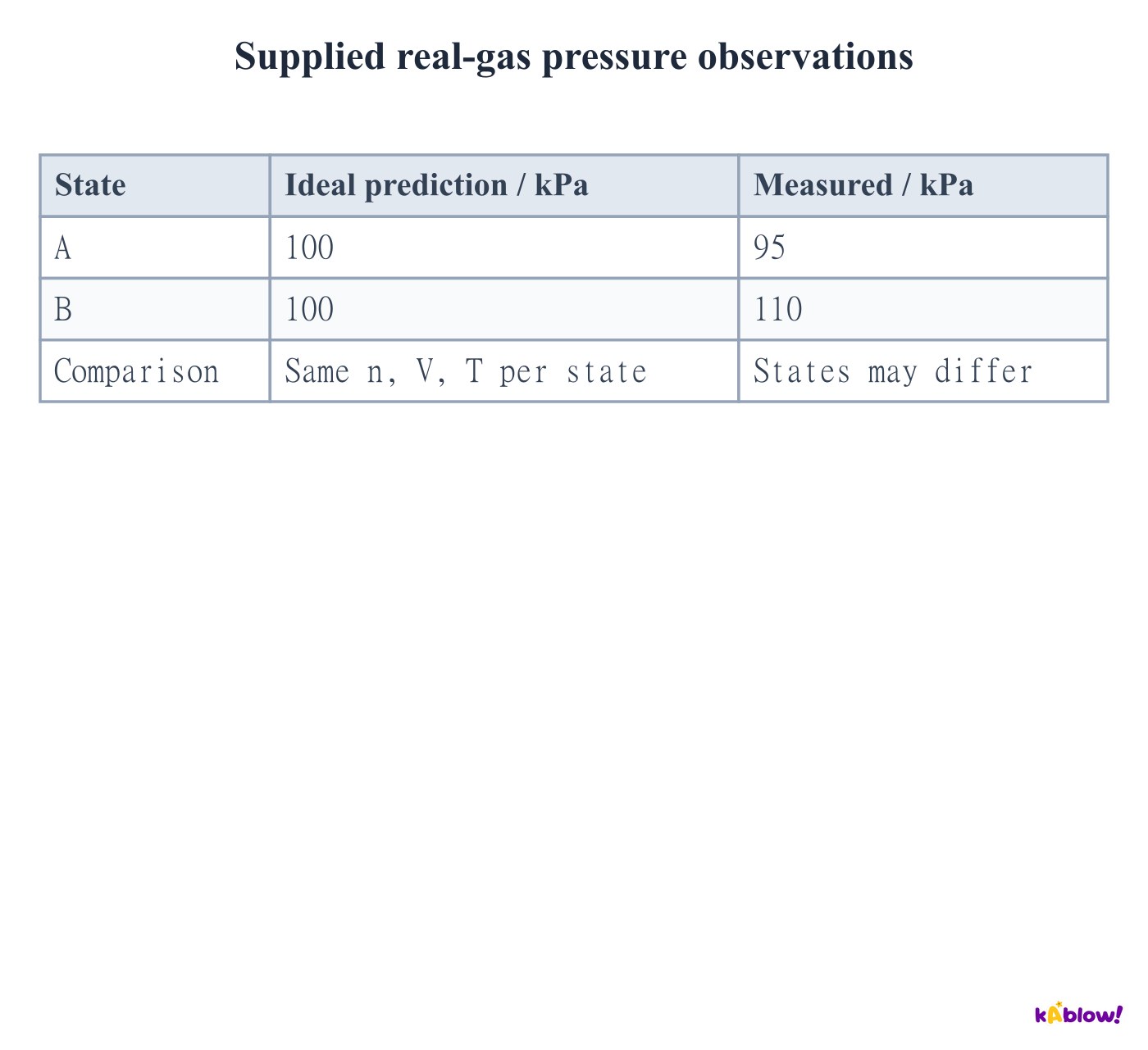
- Real gases often approach ideal behaviour at low density and sufficiently high temperature. At lower temperature, attractions can matter more relative to kinetic energy.
- Attractions can lower pressure relative to an ideal prediction at the same n, V and T. Finite particle size and short-range repulsion can produce an opposing deviation at high density.
- Do not assume every real gas always has a lower pressure than ideal. The net departure depends on the gas and conditions, and condensation requires more than a single gas-phase ideal model.
Identify both sources of deviation
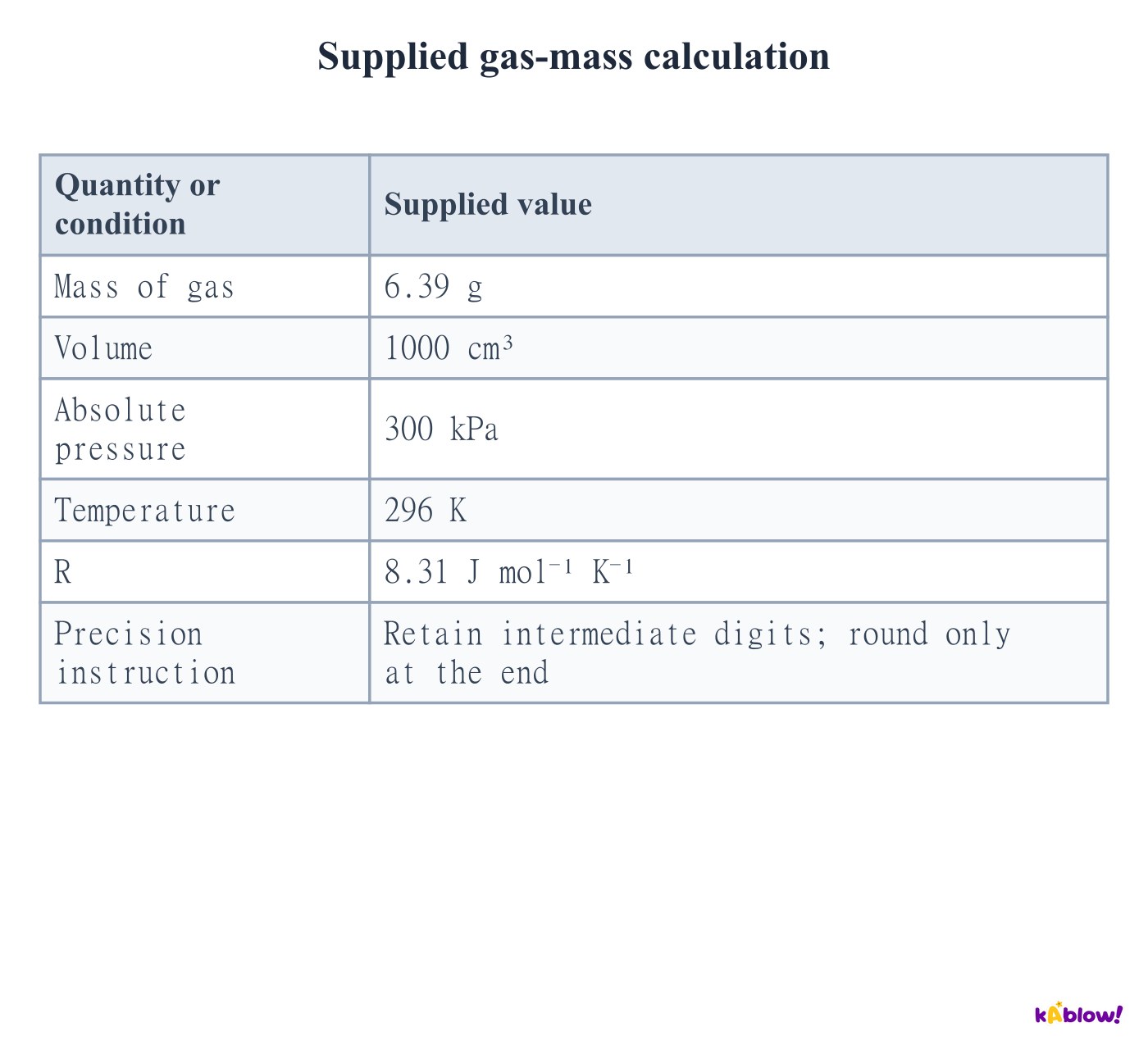
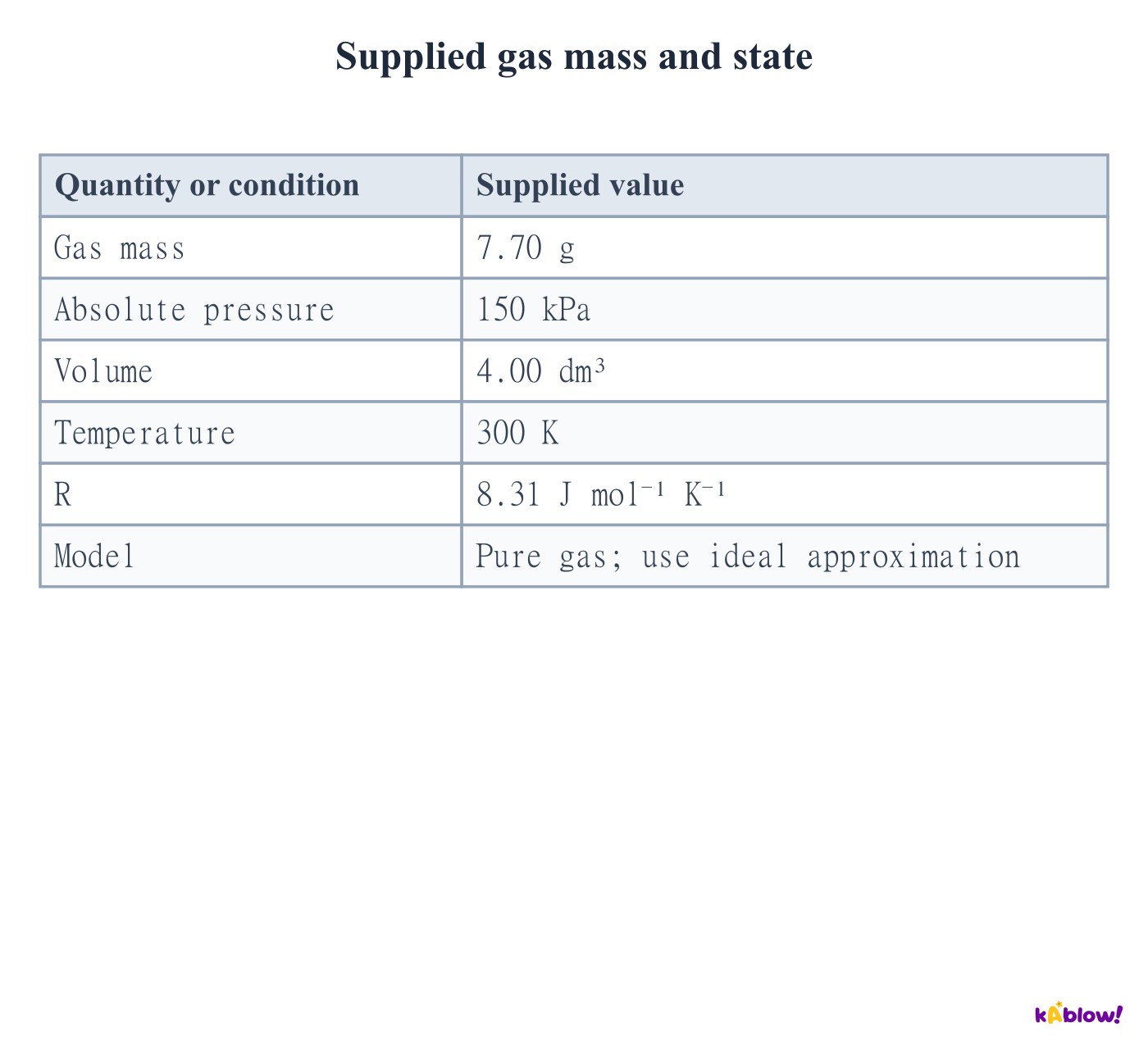
Retain intermediate precision and report the requested quantity
- Rounding a calculated amount too early can noticeably change the final molar mass. Carry useful intermediate digits and round once at the end.
- In the supplied precision example, n is about 0.121963 mol. Replacing this prematurely with 0.12 mol would distort the subsequent mass-per-amount result.
- Label the final quantity correctly: molar mass has units, relative molecular mass does not. Respect the stated significant figures and the precision supported by the input data.
Supplied gas-mass calculation
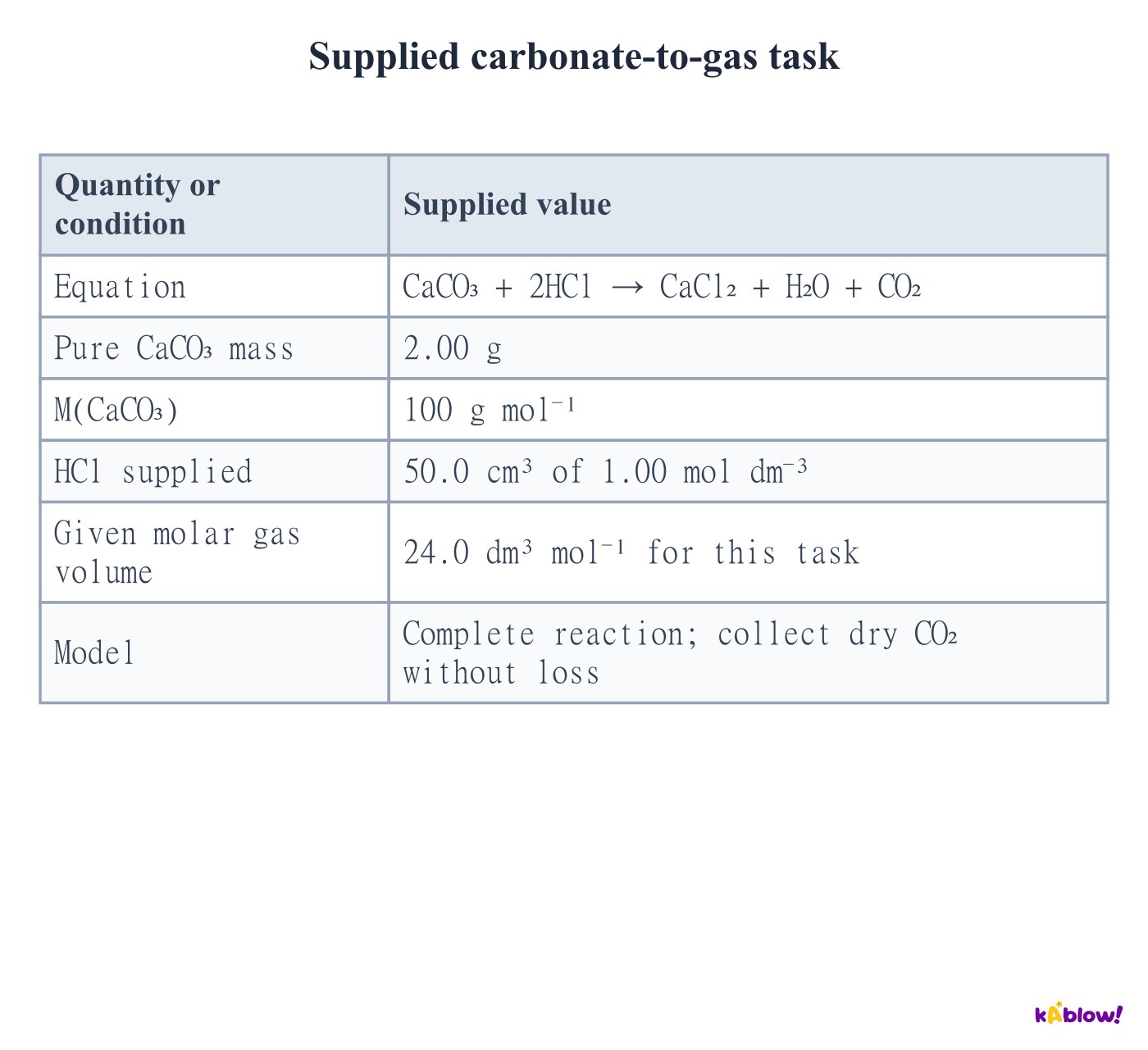
Combine mass, solution stoichiometry and gas volume
- Organise a multistep task by identifying the measured quantity, finding amounts, checking the limiting reactant and then calculating the requested product quantity.
- In the supplied carbonate model, compare the acid supplied with the two-mole requirement per mole of CaCO₃. The gas-volume step uses the task’s explicitly supplied molar-volume approximation.
- State the assumptions: pure carbonate, complete stated reaction and dry carbon dioxide collected without loss. Other gas species or residual water vapour would require a suitable correction.
Supplied carbonate-to-gas task
슬라이드
연습 문제
무료 미리 보기 — 60개 중 8개 문제. 가입하면 전부 볼 수 있어요.
1.Use the supplied nitrogen sample. To 3 significant figures, give the coefficient of the molecular count written as a × 1023.
Medium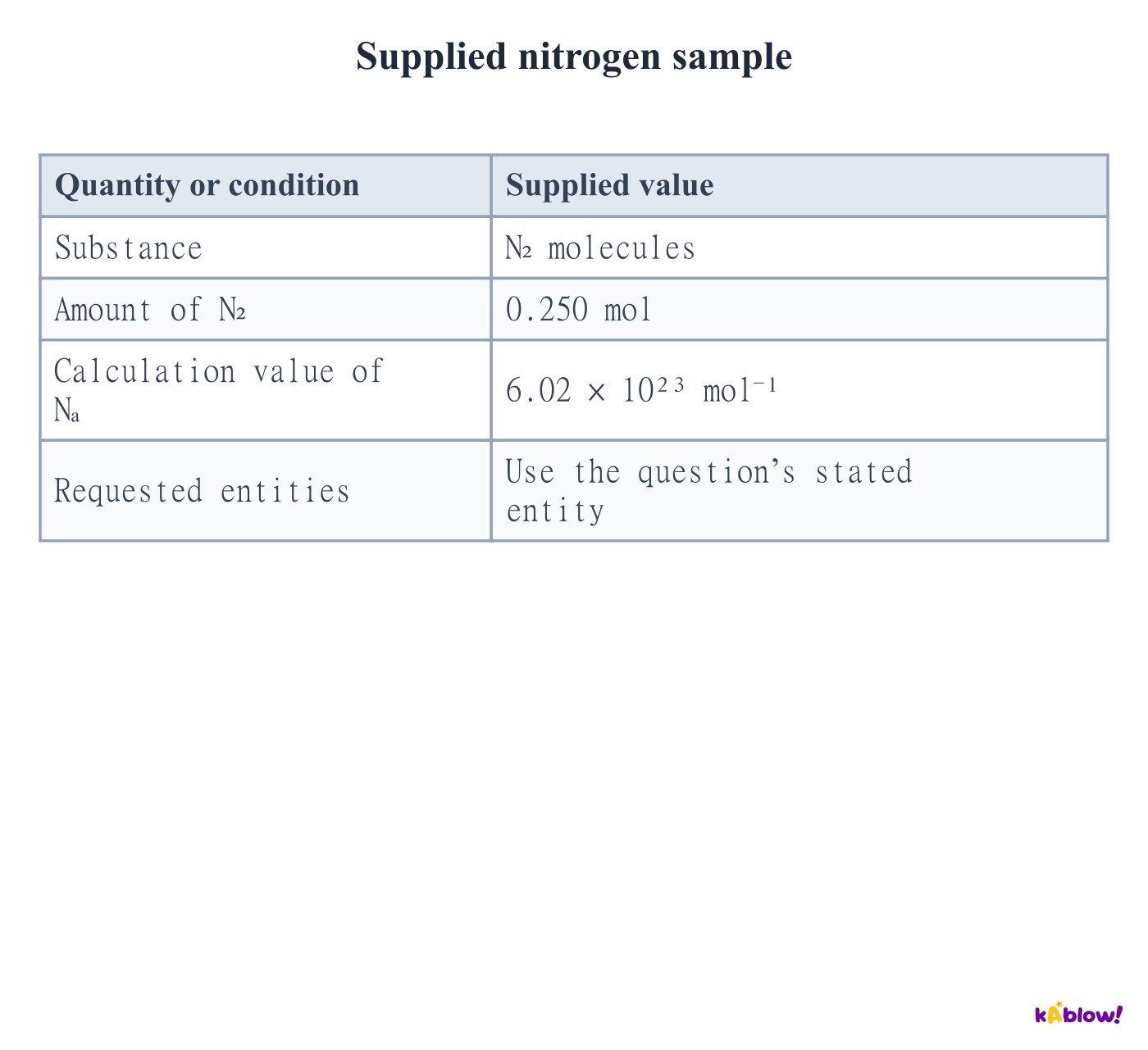
2.Use the supplied nitrogen sample. Give the coefficient of the nitrogen-atom count written as a × 1023.
Medium3.Use the supplied CaF₂ sample. Calculate the amount of fluoride ions.
Medium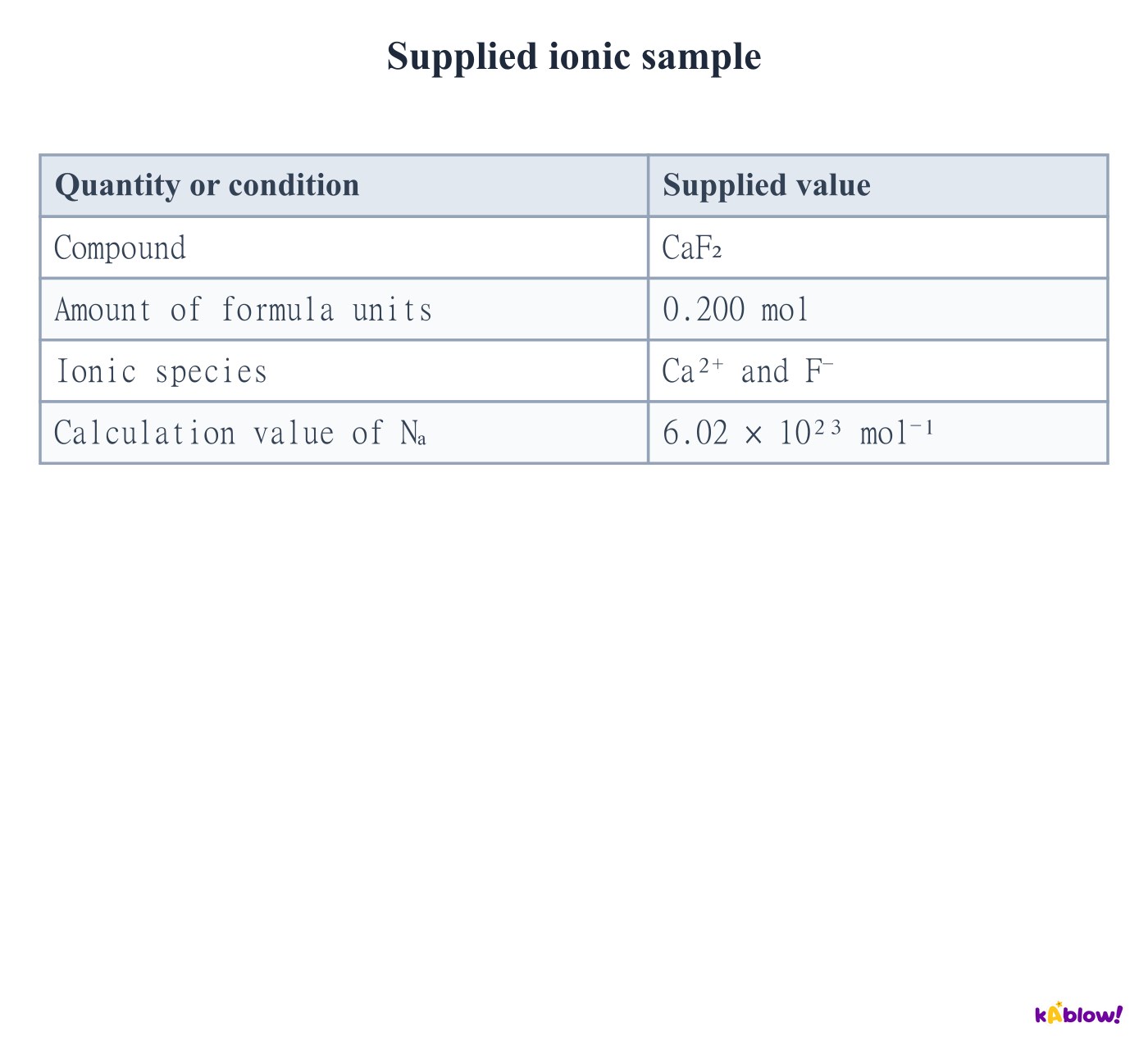
4.Use the supplied CaF₂ sample. Calculate the total amount of constituent ions.
Medium5.Use the supplied formula and atomic masses. Calculate the relative formula mass of Ca(OH)₂.
Medium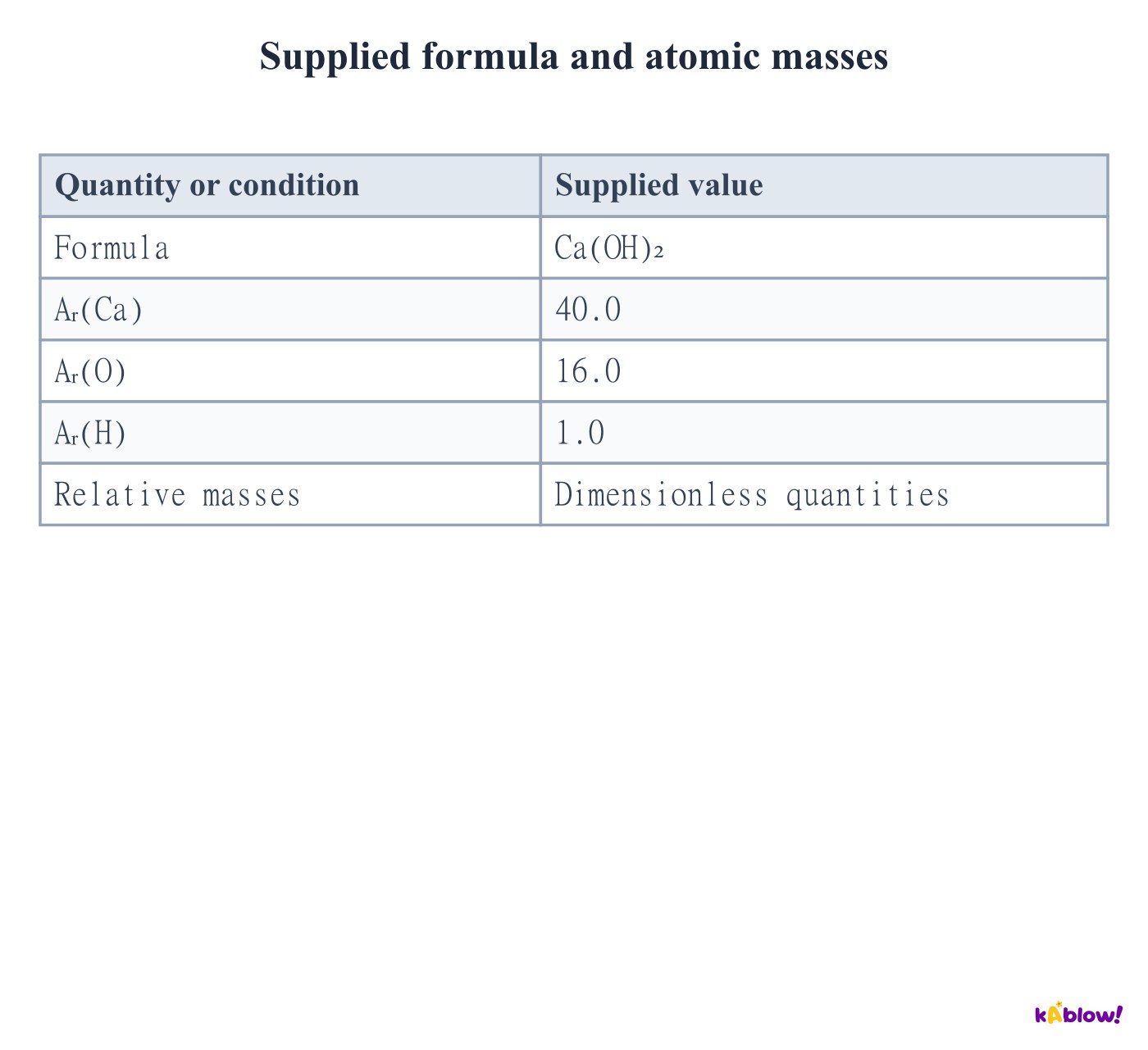
6.Use the supplied sodium chloride mass. Calculate its amount of formula units.
Medium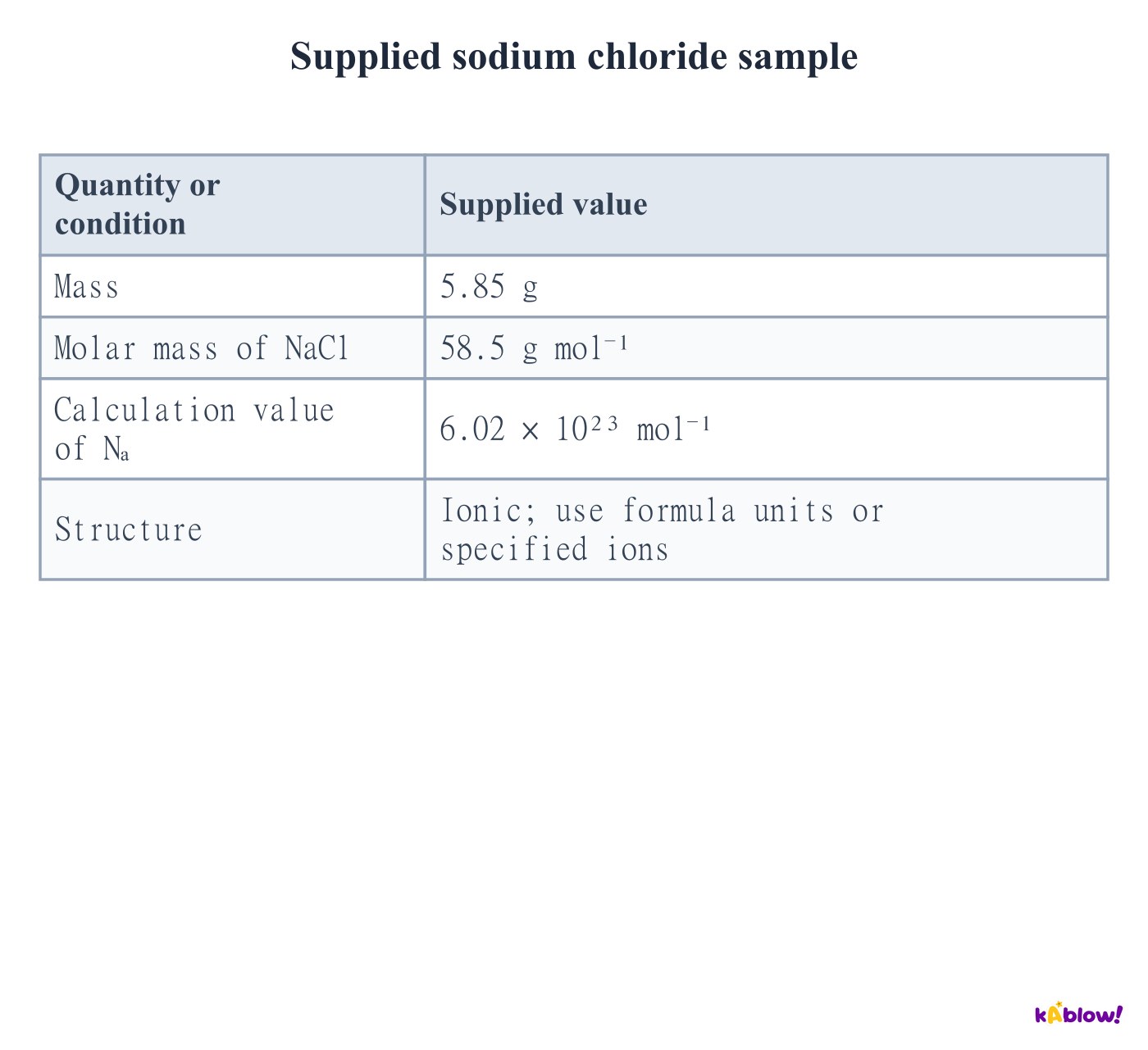
7.Use the supplied helium count and constants. Calculate its mass.
Medium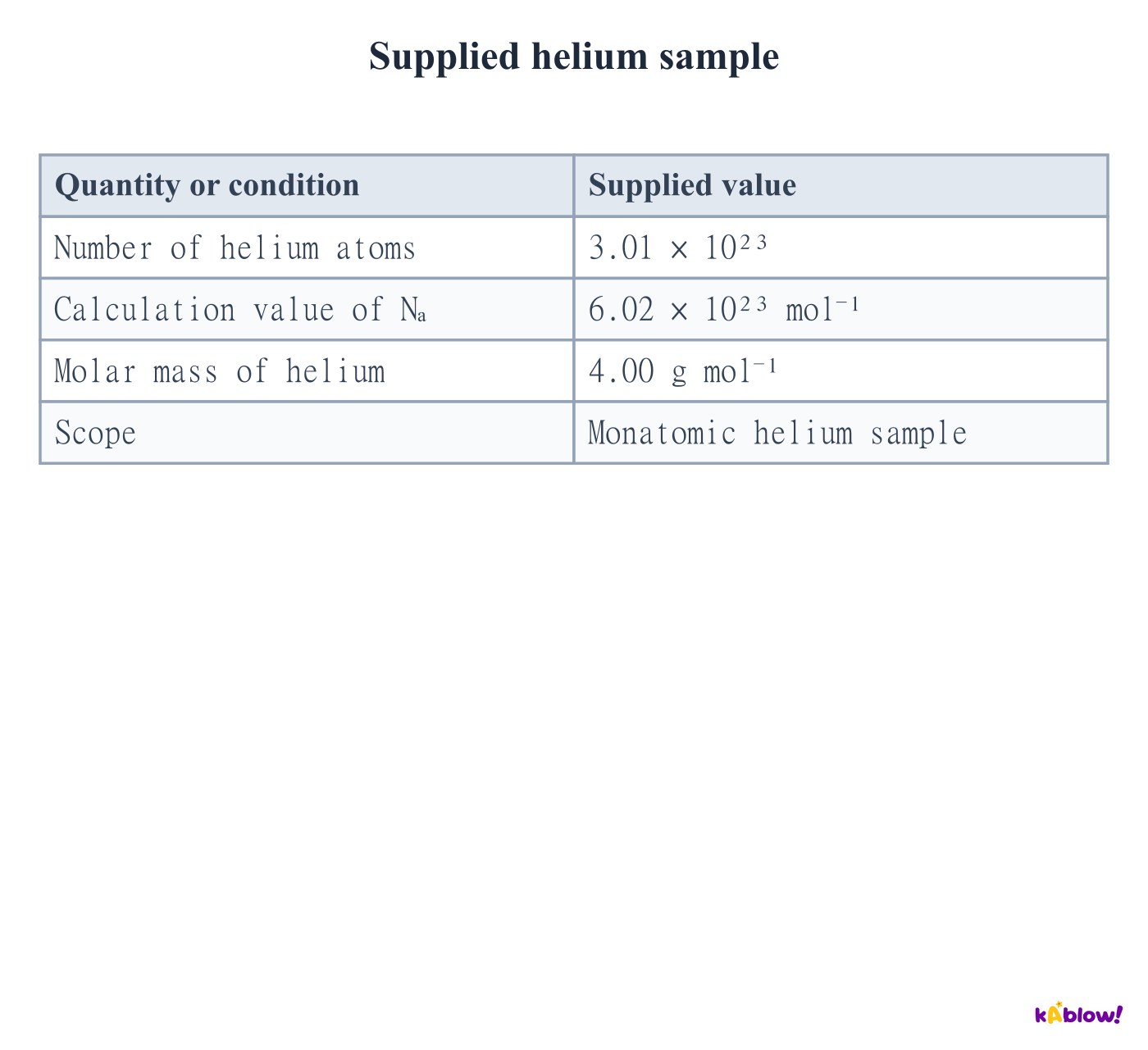
8.Use the supplied magnesium reaction. Calculate the theoretical mass of MgO.
Medium
기출 문제
이 주제의 기출 문제 연습이 곧 나와요.
곧 출시