교육자를 위해: Analysing and responding to artists' work(Art and Design, Critical and Contextual Study)을(를) 위한 바로 쓸 수 있는 수업 슬라이드, 복습 노트 — 수업에 사용하거나, 학습자들이 실시간 게임으로 즐기는 인터랙티브 클래스 활동으로 진행하세요.
Describe observable subject, marks, colours, forms or spaces, then examine how relationships between them work. Interpretation proposes a meaning or atmosphere supported by those observations and relevant evidence.
Evaluation makes a reasoned judgement against an intention or criterion. These operations can interact rather than follow a compulsory four-paragraph recipe. A possible effect should not be presented as a fact about every viewer.
Four useful thinking operations
Context and sources
Investigate the work’s relevant time, place, material, audience, purpose and cultural setting. An artist’s recorded statement can inform an enquiry into intention, but should still be read critically and in context.
Primary and secondary depend on the research question, not simply on whether the source is a book or website. Attribute the maker’s statement, a historian’s interpretation and your own response separately; a date alone does not establish a private emotion.
Identify the basis of a claim
Visual language and vocabulary
Visual language is how elements and relationships communicate or create effects; vocabulary supplies words such as composition, contrast, palette, brushwork and medium to discuss it. Use a term to explain a specific feature rather than to decorate an unsupported claim.
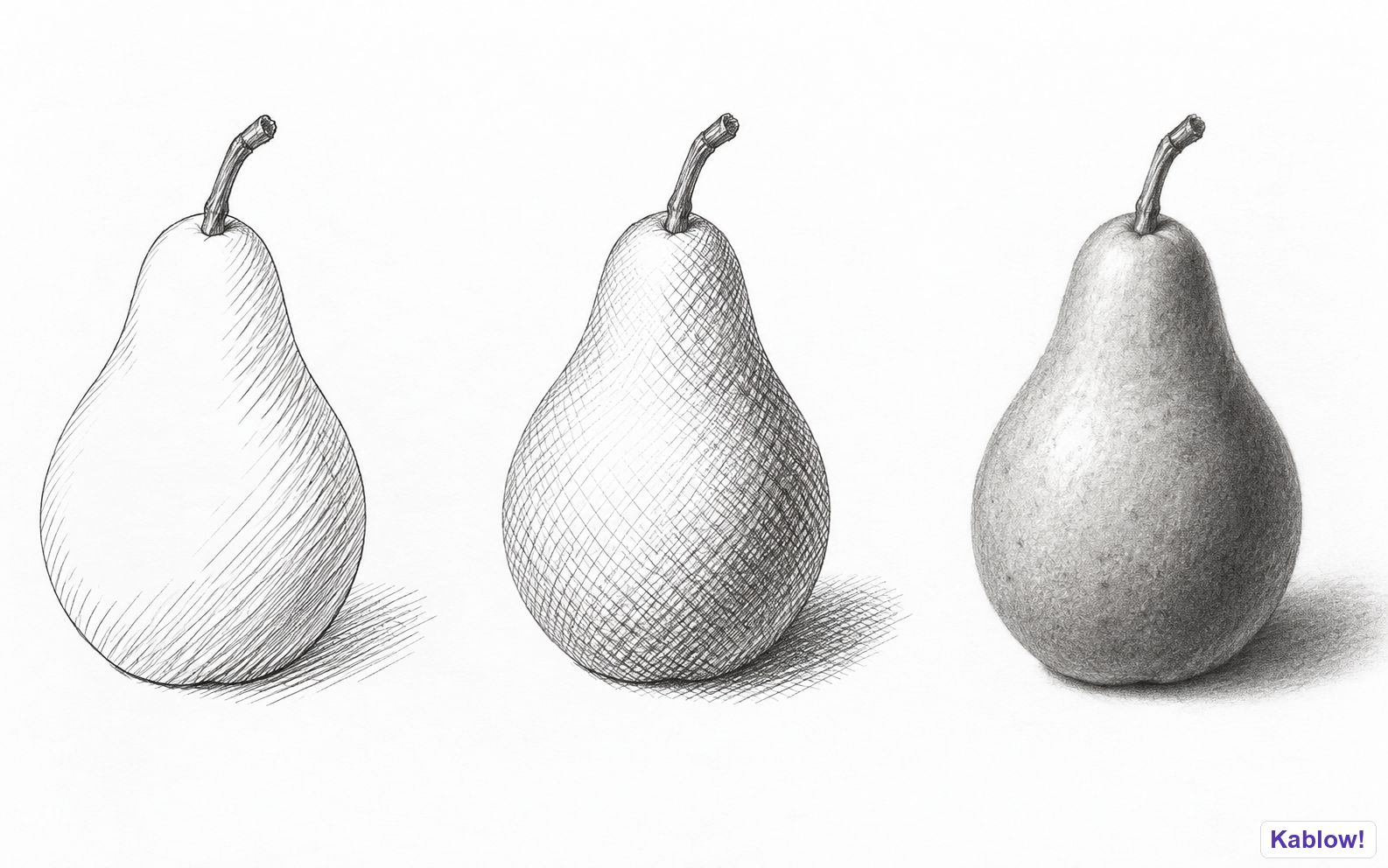
The original pear studies compare visible directional lines, intersecting hatching and smoother tone. Their marks can be analysed for how they describe form, without assuming a named artist, physical pencil grade or universal mood.
Analyse marks in three teaching studies
Comparing selected works
Choose a clear focus and compare particular examples using evidence from each. Connectives such as similarly and whereas can make the relationship explicit, but the significance of the comparison still needs explaining.
For the teaching pears, compare how line direction and tonal transition suggest the same kind of rounded subject. No method is inherently superior; judge it against the intended effect and the actual result.
Make a focused comparison
Respond through development
A credited study or partial copy can investigate a source’s technique. Develop a personal response by selecting a useful feature, testing it with your own subject or intention, and evaluating the change.
Record what you retained, adapted and rejected, with reasons and source details. Personal development need not disclose private experiences or conceal the influence; presenting copied imagery as wholly original would misrepresent the work.
Turn a source into a personal test
Evidence-led writing
A point, evidence and explanation structure can support clear writing, but it is optional. Explain how an observed feature produces a plausible effect and distinguish that reading from a documented statement of intention.
The supplied invented colour study supports a tonal contrast between pale pear and dark blue cloth and a possible second emphasis from an orange cup. Those observations make the exercise answerable without an absent painting or invented biography.
Observation supports a possible effect
Evaluate with practical limits
Use intentions or explicit criteria and evidence to support a judgement. Liking a work can start a response, but explaining the formal, contextual or practical reason makes it useful.
Reproductions can alter apparent colour, surface and scale. State what you can establish, cite reliable information and identify what further observation or research would resolve. More art vocabulary alone cannot repair an unsupported assertion.
슬라이드
Sign up free to view the lesson slides
Step through every slide for this topic — plus flashcards and revision notes — with a free account.
Can area that attracts particular visual attention
Dthe border
4.What is a medium?
Easy
Athe price
Ba material or form of artistic practice
Cthe size
Dthe colour
5.When discussing a painting’s colour choices, what does palette mean?
Easy
Athe colours chosen
Bthe canvas
Cthe frame
Dthe brush
6.What is brushwork?
Easy
Athe type of brush only
Bthe canvas
Cthe frame
Dthe way paint is applied
7.What is composition?
Easy
Athe paper
Bthe price
Chow elements are arranged
Dthe colour only
8.What is contrast?
Easy
Aa frame
Bdifference between elements such as light and dark
Csimilarity
Da pattern
더 많은 문제
9.What is symbolism?
Easy
Ausing visual features to represent ideas beyond their literal appearance
Bcopying
Crealism
Dprinting
10.What is mood in an artwork?
Easy
Aits size
Bits price
Cits frame
Da perceived atmosphere or emotional quality
11.What is an artist's intention?
Easy
Athe size
Bthe frame
Cwhat the artist aimed to explore, make or communicate
Dthe cost
12.Which sentence connects a formal feature with a possible effect?
Medium
AIt is old.
BThe repeated diagonals may suggest movement and tension.
CThe painting is big.
DThe artist is famous.
13.Which sentence mainly describes visible subject and colour?
Medium
AThe painting shows a woman in a blue dress.
BIt makes me feel sad because of the dark tones.
CIt was painted in 1889.
DIt is a good painting.
14.Which sentence uses a clearly identified hypothetical context without claiming to know an artist’s feelings?
Medium
AIt has blue paint.
BIt is rectangular.
CIt has a frame.
DIf the catalogue dates this work to wartime, I would investigate how that setting relates to its imagery.
15.Why compare two artists?
Medium
Ato copy
Bto list names
Cto see similarities and differences in ideas and methods
Dto avoid analysis
16.Which connective shows contrast?
Medium
Aalso
Bwhereas
Csimilarly
Dand
17.What should annotations in a sketchbook include?
Medium
Arelevant observations, reasons for choices and links to development
Bonly titles
Conly dates
Dnothing
18.Why is an exact copy alone insufficient evidence of developing a personal response?
Medium
Ait is too creative
Bit is too original
Cit is allowed always
Dit does not by itself show how you develop and use the source in your own decisions
19.After studying directional brush marks in a sourced painting, which action develops a personal experiment?
Medium
Aavoid texture
Buse only pencil
Ctest directional marks in an observed subject of your own and explain the effect
Dcopy the whole painting
20.Why does context affect how we see an artwork?
Medium
Acontext is hidden
Bbeliefs and events of the time shape meaning
Cit does not
Dart is timeless only
21.What makes an evaluation strong?
Medium
Aa judgement supported by visual evidence
Bopinion only
Ca copy of facts
Dno reasons
22.What is visual language?
Easy
Aa spoken language
Ba code
Ca font
Dhow visual elements and relationships communicate ideas or effects
23.For a study of an artist’s stated intention, which is the most direct primary source?
Easy
Aan unsigned review guessing it
Ban unrelated visitor’s comment
Cthe artist’s original recorded statement
Da later textbook summarising it
24.For research into an artist’s career, which is a secondary interpretation?
Medium
Aa recorded interview with the artist
Ba historian’s later essay analysing the career
Cthe artist’s original studio diary
Dthe original painting being studied
25.What does 'evaluate' require?
Medium
Agive a reasoned judgement
Blist colours
Ccopy
Dsign
26.Context can help explain the meaning of artworks.
Easy
True or false?
27.Visual language concerns relationships such as composition, colour and marks.
Easy
True or false?
28.You should copy an artist exactly with no personal response.
Easy
True or false?
29.Comparing artists involves similarities and differences.
Easy
True or false?
30.Describing an artwork means explaining its meaning.
Medium
True or false?
31.Which can support formal analysis and a reasoned interpretation?
Medium
Acomposition
Bcolour
Ctexture
Dmood
Ea claim with no stated evidence
32.Which questions investigate the context of a work?
Medium
AWhen and where was it made?
BWhat cultural settings are relevant?
CWhich biographical evidence is relevant?
DFor what purpose or audience was it made?
EHow many points do I get for liking it?
33.An invented still-life study places a pale pear on a dark blue cloth, with a small orange cup near the right edge. Using only these supplied observations, analyse two possible effects of colour or tone. Do not invent the artist’s intention.
Medium
Unlock all 33 questions & more
무료 계정을 만들어 이 주제의 모든 문제, 슬라이드, 플래시카드, 복습 노트를 확인하세요.