
Photography and digital media
플레이하며 배우기
이 문제들을 풀어 에너지를 얻은 뒤 낚시하고 탐험하세요. 계정이 필요 없어요.
교육자를 위해: Photography and digital media(Art and Design, Materials and Processes)을(를) 위한 바로 쓸 수 있는 수업 슬라이드, 복습 노트 — 수업에 사용하거나, 학습자들이 실시간 게임으로 즐기는 인터랙티브 클래스 활동으로 진행하세요.
수업 노트
Composition, focus and capture
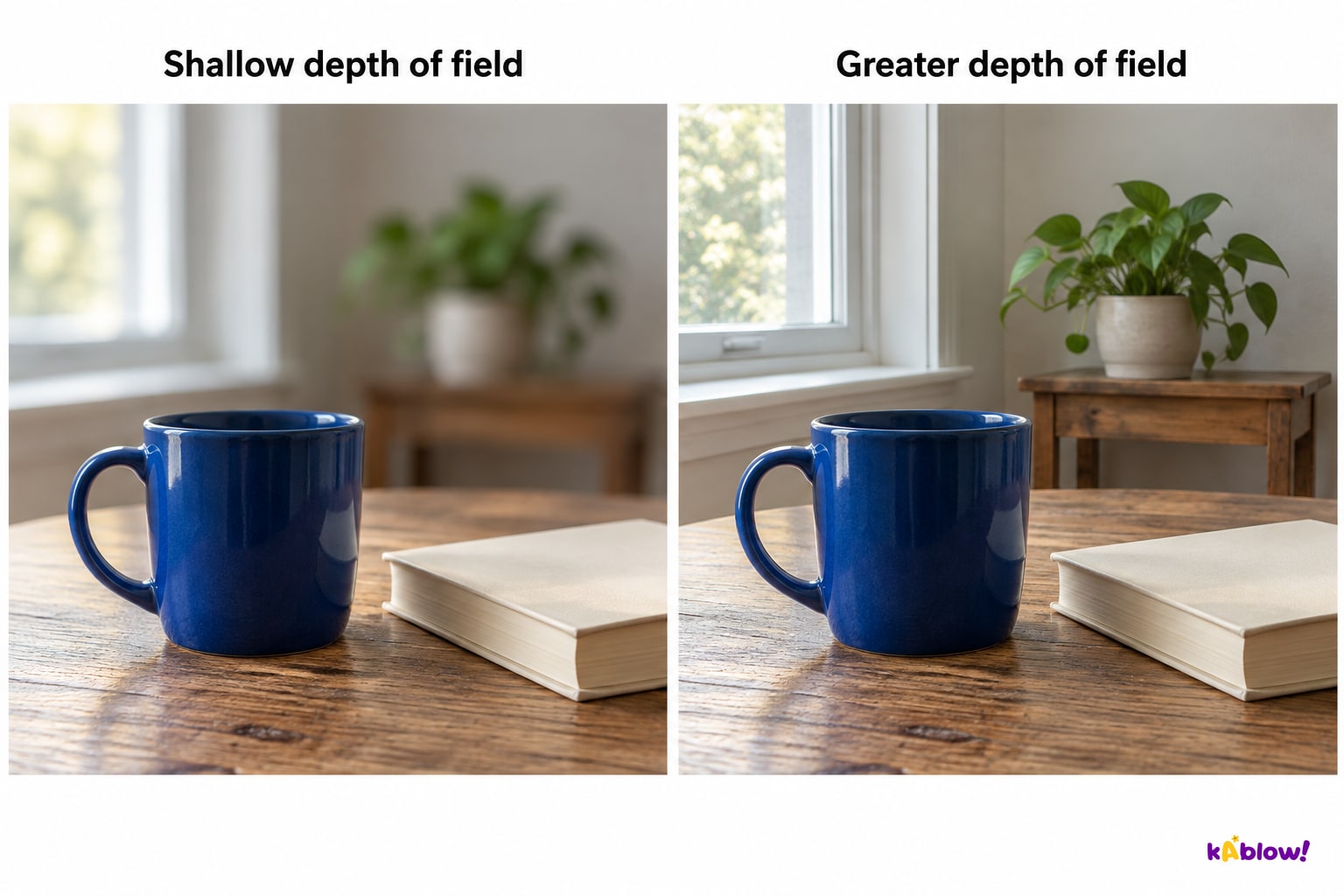
- Depth of field is the range of depth appearing acceptably sharp, not a synonym for a blurred background. The generated mug comparison illustrates shallow and greater apparent focus range without claiming real camera settings.
- Choose viewpoint, framing, leading lines and focus relationships for the intention. Genres may overlap: a portrait can be staged, abstracted or documentary, while landscape orientation is different from landscape subject matter.
Shallow and greater apparent focus range
Editing and digital work
- Preserve an original and use a working file with separate layers. Adjustments and masks can retain flexibility; flattening or exporting may discard some editable structure. Digital drawing, painting, montage and animation offer different possibilities.
- Cropping, tonal and colour changes, filters and compositing should serve a stated intention. Explain which changes were made and distinguish an openly constructed image from one presented as documentary evidence.
Preserve editing options
Selection and presentation
- Use a contact sheet to compare alternatives and explain the selected viewpoint, light, crop and focus. A series can be sequenced for meaning rather than simply arranged by filename.
- Choose suitable pixel dimensions and output for the intended print or display. Cropping discards pixels; a larger file-size alone does not prove greater sharpness or a better image. Retain the original and editable working version.
Review and present deliberately
Respectful project practice
- Agree participation and intended use for a class portrait, respecting the participant’s wishes and school process. State whether work is staged, edited or generated when relevant to its interpretation.
- Check permissions for source material and credit contributions. A credit alone does not grant reuse permission. For documentary claims, context, captions, framing and content changes affect how viewers judge the evidence.
Explain the image’s status
Camera settings and noise
- Aperture is the lens opening and contributes to depth of field; smaller f-numbers generally mean larger openings under comparable conditions. Shutter speed is exposure duration and affects motion blur. Lens and focus distance also influence apparent focus range.
- Digital ISO changes signal gain or brightness interpretation rather than admitting more light when aperture and time are fixed. Digital noise is brightness/colour variation, often more visible with low collected light and strong brightness processing. It is distinct from physical film grain.
Separate the setting roles
Light, negative and constructed images
- Backlight is behind the subject relative to the camera and can produce a silhouette or rim, depending on exposure and fill. Side light can show form; low-angle golden-hour conditions vary rather than last an exact universal hour.
- A conventional negative reverses tonal relationships compared with a positive; colour negatives encode colours differently too. Not every film image is a negative, because reversal film produces positives. Photomontage combines photographic elements physically or digitally.
Practitioners and context
- Dorothea Lange’s Migrant Mother is from a 1936 series of Florence Owens Thompson and her children. Ansel Adams is particularly associated with landscapes and conservation. Henri Cartier-Bresson’s Images à la sauvette was published in English as The Decisive Moment.
- Cindy Sherman uses herself to stage constructed characters and representations rather than simple autobiographical self-portraits. Study particular works and their context; the generated still life is not a reproduction of any named practitioner’s artwork.
Use a contextual practitioner reference
슬라이드
연습 문제
무료 미리 보기 — 33개 중 8개 문제. 가입하면 전부 볼 수 있어요.
1.What is photography?
Easy- Amaking images using light
- Bpainting
- Csculpting
- Dprinting
2.What is a portrait?
Easy- Aan image defined only by horizontal orientation
- Ba label meaning every object is in focus
- Ca file type that prevents editing
- Dan image presenting a person or group as its main subject
3.What is a landscape photograph?
Easy- Aan image that cannot include a person
- Ban image that cannot be abstracted
- Can image concerned with scenery or an environment
- Dany image only because it is wider than tall
4.What is a still life?
Easy- Aa portrait
- Ban arrangement of objects
- Can action shot
- Da crowd
5.What is cropping?
Easy- Aremoving outer parts to change the image’s framing
- Badding colour
- Cprinting
- Dframing
6.What does aperture control?
Easy- Ashutter length
- Bfilm speed
- Czoom
- Dthe lens opening, affecting light passage and depth of field with other factors
7.What does shutter speed control?
Easy- Acolour
- Bprint size
- Cthe exposure duration over which light is recorded
- Dfocus only
8.In basic digital-camera use, what does the ISO setting mainly change?
Easy- Azoom
- Bhow the recorded signal is amplified or interpreted for image brightness
- Cfocus
- Dcolour
기출 문제
이 주제의 기출 문제 연습이 곧 나와요.
곧 출시