
Printmaking and mixed media
플레이하며 배우기
이 문제들을 풀어 에너지를 얻은 뒤 낚시하고 탐험하세요. 계정이 필요 없어요.
교육자를 위해: Printmaking and mixed media(Art and Design, Materials and Processes)을(를) 위한 바로 쓸 수 있는 수업 슬라이드, 복습 노트 — 수업에 사용하거나, 학습자들이 실시간 게임으로 즐기는 인터랙티브 클래스 활동으로 진행하세요.
수업 노트
Printing mechanisms
- Relief prints from raised inked surfaces, while intaglio transfers ink from recesses. Traditional acid etching chemically bites exposed metal; drypoint scratches directly. A collagraph is an assembled matrix and may be inked in relief, intaglio or combined ways.
- Screen printing passes ink through open stencil/mesh areas. Lithography uses prepared image and non-image areas based on ink/water behaviour. Printmaking includes multiples and unique impressions rather than always making identical editions.
Printing mechanisms differ
Simple relief process and its limits
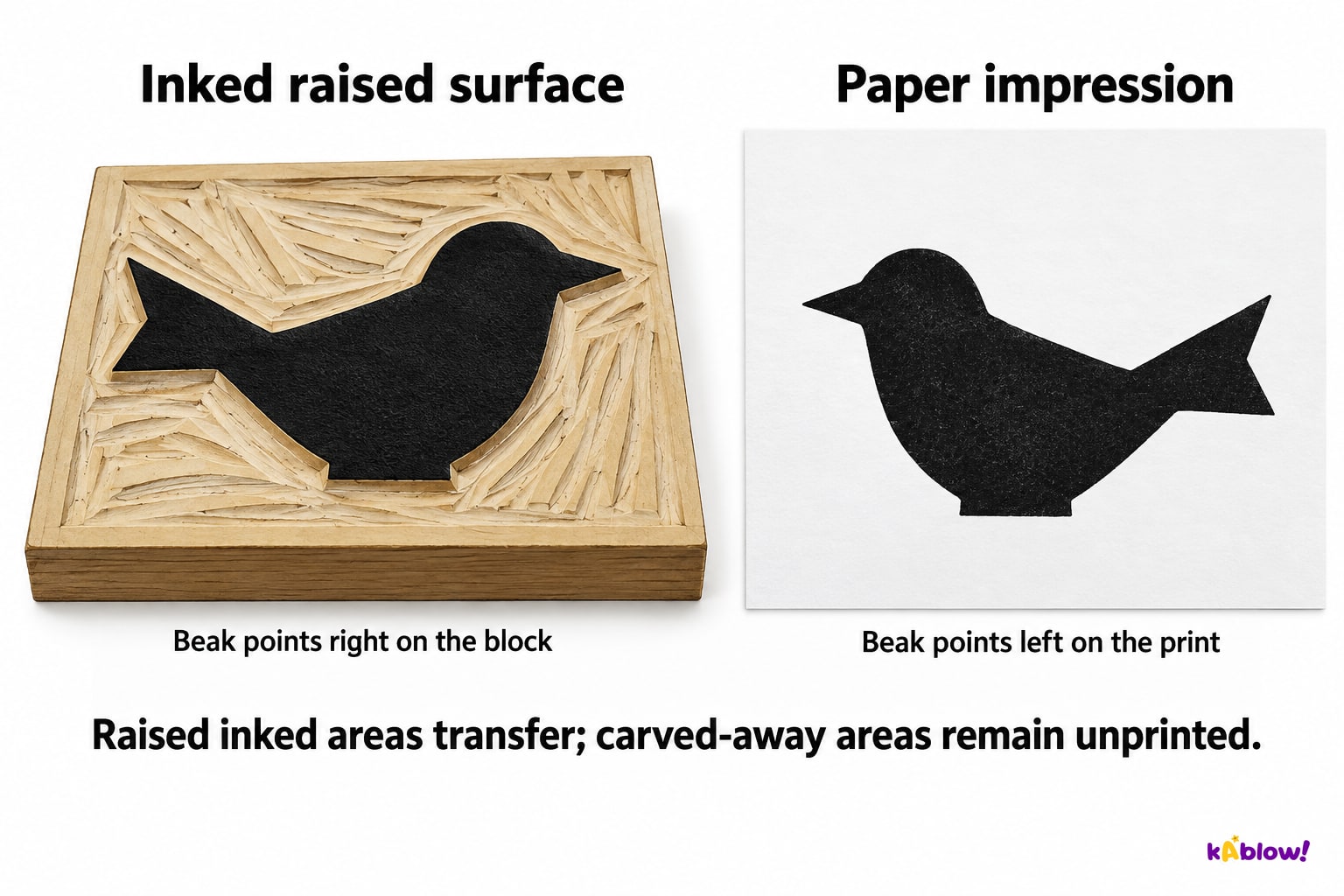
- For a supervised lino project, plan the reversal, transfer the design, cut non-printing areas with approved support and technique, ink the raised surface and align the receiving paper. Transfer with the taught hand method or press and review a proof.
- A brayer suits this inking exercise, but not every print process uses a roller. Direct relief reverses the image relative to the block face; screen and other transfer systems require their own orientation planning.
Raised relief image and reversed impression
Mixed media with an intention
- Combine print, drawing, paint, collage, fabric or found materials purposefully, testing adhesion and what each layer reveals or obscures. More materials do not automatically create unity.
- Schwitters’ Merz is a contextual example of collage and found-material work. Acknowledge relevant sources and develop your own choices. Found or chance elements can be organised coherently; unity need not depend only on a fixed palette.
Make a mixed-media choice
Approved studio practice
- Use supervised lino-cutting technique with the block supported, cutting path away from the body and supporting hand, and fingers outside the path. A bench hook reduces movement but does not remove the need for instruction.
- Follow the actual ink, solvent, ventilation and waste instructions. Presses and chemical processes need suitable equipment and approved teaching; do not infer a chemical recipe or a safe setup from a brief conceptual definition.
Use the approved studio method
Editions and presentation
- An edition is a defined group of impressions. 3/10 means impression number 3 within a numbered edition of 10; it does not prove chronological pulling order or quality. Standard editions seek consistency with normal hand-process variation.
- Variable editions, unique impressions and hand additions should be described accurately. Signatures and pencil margin labels are common conventions rather than universal compulsory rules. Follow the submission brief and retain useful proof/development evidence.
Unique print terminology
- Monotype commonly describes transfer from paint or ink on a smooth surface without a permanently repeatable image. Monoprint can describe a unique impression using repeatable elements, variable inking or hand additions; terms are also used more broadly in some contexts.
- Residual ink can yield a lighter ghost impression rather than an identical reproduction. Explain the actual process and accept the broader terminology where it is appropriate rather than marking a valid term wrong without context.
Describe edition or unique status
Registration and proof review
- Registration aligns paper and matrices or successive colour passages. Multiple blocks/layers are one route; reduction methods can alter and reuse one block. The intended alignment may be precise or deliberately offset.
- Use a proof to compare coverage, pressure, alignment and the intended effect. Not every imperfect-looking area is an error if variation is purposeful, but explain those choices rather than claim all impressions must be identical.
Review a proof
슬라이드
연습 문제
무료 미리 보기 — 33개 중 8개 문제. 가입하면 전부 볼 수 있어요.
1.What is printmaking?
Easy- Atransferring an image from a prepared surface or matrix, as multiples or unique impressions
- Bdrawing only
- Cpainting only
- Dsculpting
2.What is mixed media?
Easy- Aone material only
- Bphotography only
- Cprinting only
- Dusing different materials together
3.Which description best fits making a linocut relief image?
Easy- Adrawing on lino
- Bmelting lino
- Ccutting away non-printing areas so the remaining raised surface can be inked
- Dpainting on lino
4.What is a collagraph?
Easy- Aa drawing
- Ba printing matrix built up from collaged materials or textures
- Ca lino block
- Da photograph
5.In traditional acid etching on metal, what creates the recessed image?
Easy- Aacid biting into exposed areas of the prepared metal
- Bcarving wood
- Cpainting
- Dsticking
6.What is drypoint?
Easy- Ausing acid
- Busing a screen
- Cusing wood
- Dscratching lines into a plate with a needle
7.What is a brayer?
Easy- Aa brush
- Ba frame
- Ca roller for inking
- Da knife
8.What is an edition?
Easy- Aa painting
- Ba group of impressions issued as a defined print edition
- Ca one-off print
- Da drawing
기출 문제
이 주제의 기출 문제 연습이 곧 나와요.
곧 출시