
Realising and presenting a final piece
플레이하며 배우기
이 문제들을 풀어 에너지를 얻은 뒤 낚시하고 탐험하세요. 계정이 필요 없어요.
교육자를 위해: Realising and presenting a final piece(Art and Design, Personal Investigation)을(를) 위한 바로 쓸 수 있는 수업 슬라이드, 복습 노트 — 수업에 사용하거나, 학습자들이 실시간 게임으로 즐기는 인터랙티브 클래스 활동으로 진행하세요.
수업 노트
Realising an intention
- A final outcome is a resolved personal response developed through an investigation. It may use painting, drawing, sculpture, textiles, photography, digital work or another appropriate form.
- Explain how sources and practical decisions inform it. An outcome may differ from early sketches when the changes are supported by the enquiry; resemblance to the first plan is not the sole test of coherence.
Explain a changed outcome
Purposeful planning
- Thumbnails compare composition; mock-ups test a proposal; maquettes explore three-dimensional form. Select tests for actual uncertainties about scale, arrangement, materials or colour.
- Plan time for practical stages, review, documentation and presentation. Where relevant, allow drying and assembly time. Small samples inform decisions without guaranteeing identical full-scale behaviour.
Choose the test for the question
Making with appropriate control
- Choose processes for the intended effect. Building layers suits some painting or collage; it is not compulsory for every medium. Suitable material properties matter more than expense.
- If observed accuracy is intended, compare relative proportions and negative spaces. Deliberate distortion may serve a different intention. Record meaningful stages and test purposeful changes rather than adding detail automatically.
Process follows intention
Presentation choices
- Consider viewer access, arrangement, lighting, scale, labels and relevant context. Some work benefits from mounting or framing; an installation may rely on its relationship to a space and can include drawings, objects or other elements.
- Test the actual display for glare, obscured features or unsuitable support. Show selected development evidence as required by the brief; it need not all be physically exhibited beside the outcome.
Presentation affects experience
Evaluation with evidence
- Compare a clear intention with specific features of the actual work. Explain strengths and limitations, the contribution of sources and experiments, and a purposeful possible change.
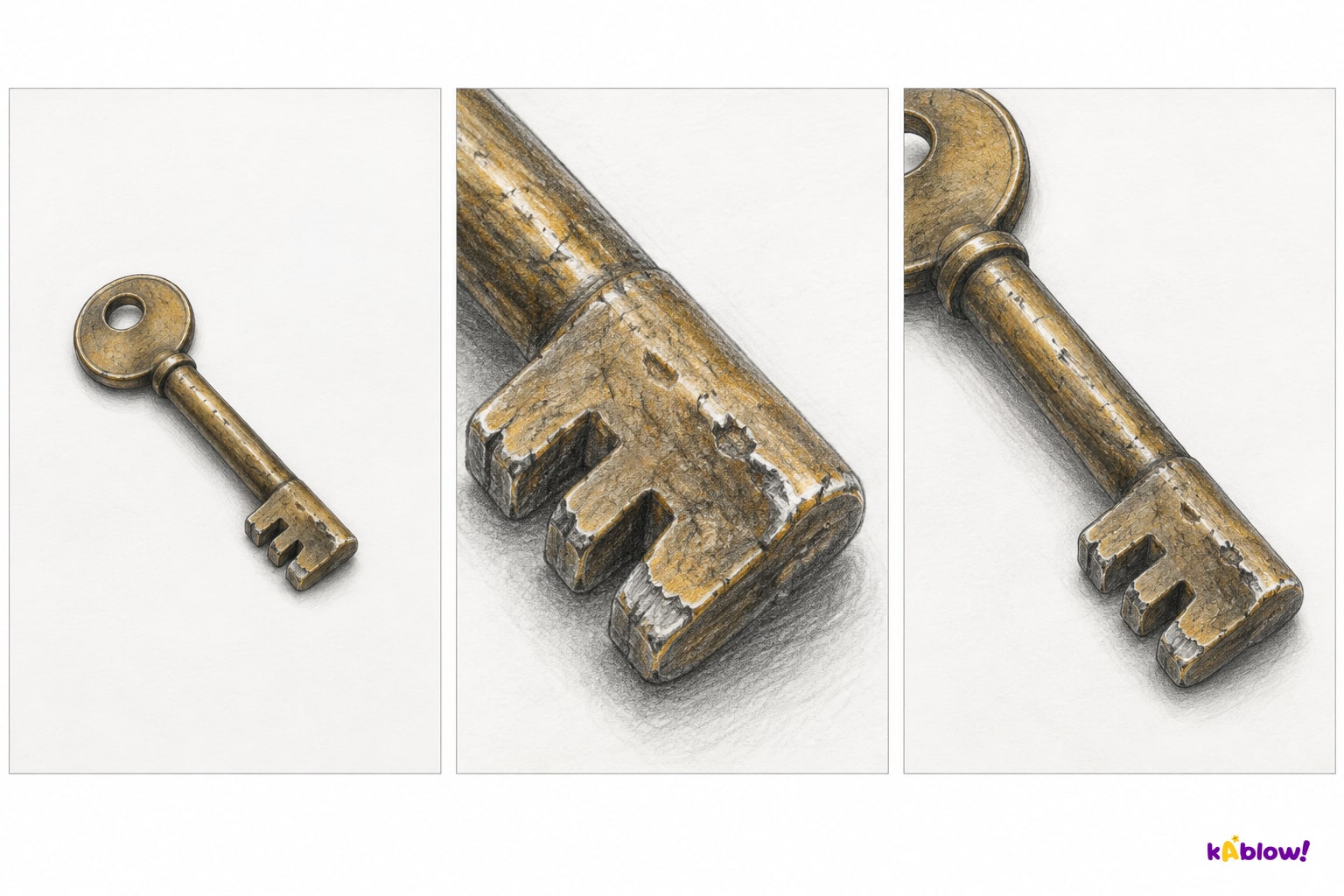
- For an illustrative worn-key study, the intermediate crop might retain context while the close crop reveals more surface. Either can suit a different intention; justify the judgement using what is visible.
Evaluate from evidence
Avoid unresolved choices
- A rushed finish can leave practical or visual issues, but quick, controlled making can be intentional. Name the actual problem rather than assuming every rapid response is poor.
- Check that sources and changes are acknowledged, the display serves the intention and the outcome has been reviewed. Avoid relying on page count, expensive materials or generic praise as evidence of quality.
Crop comparison as illustrative evidence
- The original generated key studies are teaching illustrations, not photographs of real student coursework or a named artist’s work. They compare broad, close and intermediate cropping rather than a compulsory sequence of stages.
- A wide crop retains context; an extreme close crop excludes much of the object; an intermediate crop shows part of the stem and bow with the worn bit. Decide which supports an intention by comparing retained and lost information.
Compare emphasis and context
슬라이드
연습 문제
무료 미리 보기 — 33개 중 8개 문제. 가입하면 전부 볼 수 있어요.
1.In this project, what is meant by a final outcome?
Easy- Aa resolved response developed through the investigation
- Bonly a large framed painting
- Ca compulsory exact copy of the first sketch
- Da title page without evidence of making
2.What is a mock-up?
Easy- Athe finished outcome by definition
- Ba final assessment grade
- Ca list of materials without a visual test
- Da preliminary version used to test an aspect of the outcome
3.What are intentions?
Easy- Aframes
- Bprices
- Cwhat you aim to communicate and achieve
- Dmaterials
4.For a work on paper, what does mounting commonly involve?
Easy- Aerase
- Battach work neatly to a backing for display
- Cdraw
- Dpaint
5.In composition planning, what is a thumbnail sketch?
Easy- Aa small quick sketch
- Ba final piece
- Ca model
- Da tool
6.Why take progress photographs?
Easy- Ato waste time
- Bto avoid making
- Cto hide work
- Dto record stages as evidence
7.Why plan composition before starting?
Easy- Ato avoid time
- Bto hide it
- Cto compare possible arrangements before committing, while leaving room to adapt
- Dto avoid ideas
8.Why is a time plan useful?
Easy- Ato hide work
- Bto finish the piece on time
- Cto avoid planning
- Dto slow down
기출 문제
이 주제의 기출 문제 연습이 곧 나와요.
곧 출시