
Computer Science exam technique and programming tasks
플레이하며 배우기
이 문제들을 풀어 에너지를 얻은 뒤 낚시하고 탐험하세요. 계정이 필요 없어요.
교육자를 위해: Computer Science exam technique and programming tasks(Computer Science, Exam Skills)을(를) 위한 바로 쓸 수 있는 수업 슬라이드, 복습 노트 — 수업에 사용하거나, 학습자들이 실시간 게임으로 즐기는 인터랙티브 클래스 활동으로 진행하세요.
수업 노트
Know the papers
- Check the current specification and assessment arrangements for your chosen board: paper names, timing and programming requirements vary.
- This generic lesson practises computer-systems knowledge, algorithms, tracing and programming responses; its illustrative papers do not represent official exam documents.
Preparing systems and programming skills

Command words
- State/Give/Name: short fact. Describe: say what something is or does. Explain: give a reason ("because"). Compare: similarities and differences. Evaluate/Discuss: weigh up advantages and disadvantages and reach a judgement. Write/Complete: produce code or fill in a table.
Answering a storage question
Reading and writing algorithms
- Read pseudocode carefully; trace with a table; write code using the language or pseudocode listed. Use meaningful names, indentation and comments. Check boundaries and loop conditions (off-by-one errors).
Check an algorithm with a trace
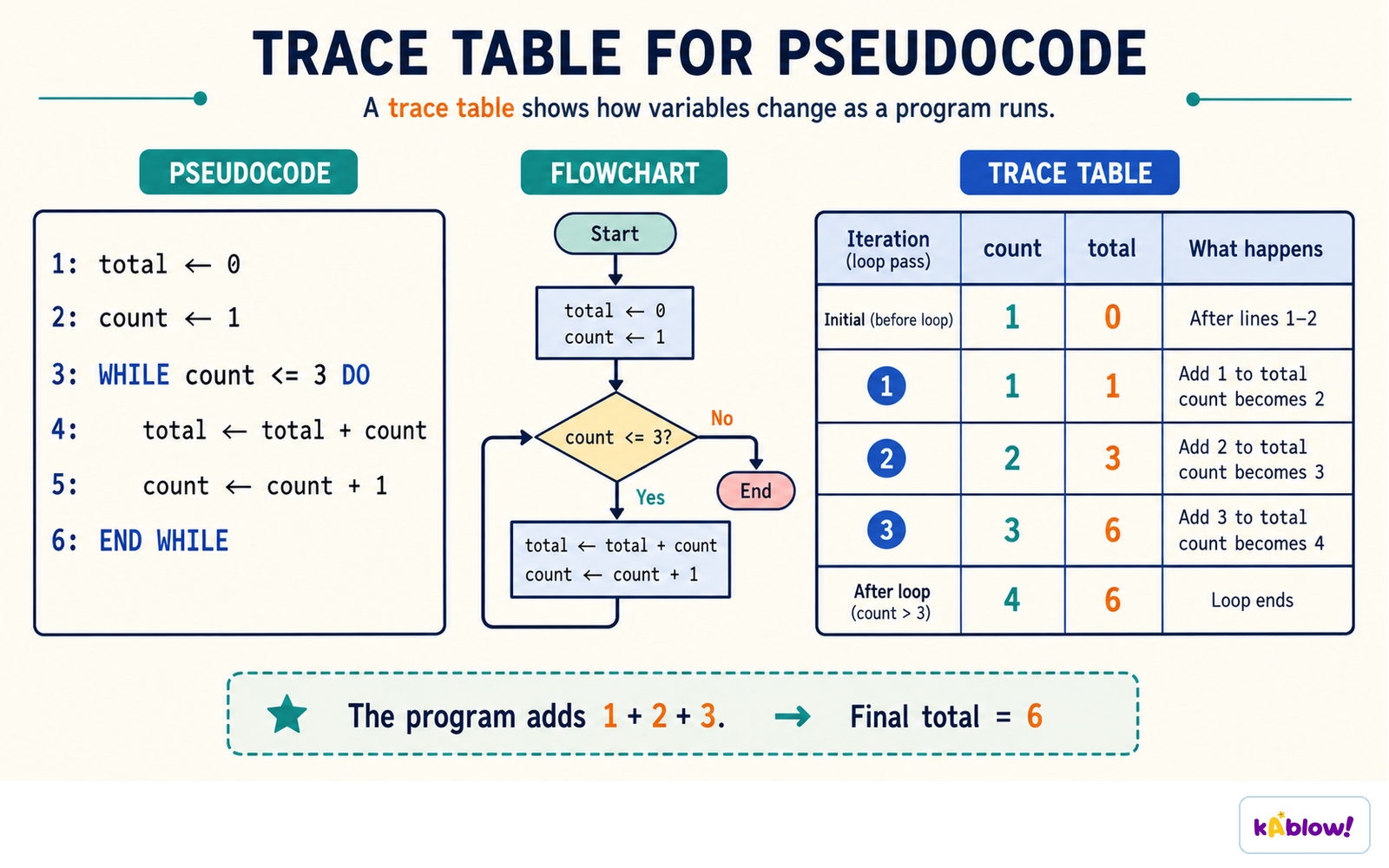
Extended-response questions
- Use chains of reasoning: point, because, therefore. Apply knowledge to the scenario; use technical terms accurately; include both sides for evaluation.
Calculations
- Convert between binary, denary and hexadecimal; file-size calculations; show working.
Time management
- Use the paper’s actual duration and total marks to plan an approximate time budget, leaving time to check. Do not assume a universal one-mark-per-minute rule.
- Attempt relevant steps in difficult questions; partial-credit rules depend on the mark scheme.
Revision
- Practise past papers; flash cards for key terms; write code; use trace tables; review mistakes.
슬라이드
연습 문제
무료 미리 보기 — 31개 중 8개 문제. 가입하면 전부 볼 수 있어요.
1.What does the command word State normally ask you to provide?
Easy- Aa concise relevant fact
- Ban unsupported personal opinion
- Cevery fact you know
- Da complete program regardless of the question
2.What does 'describe' ask you to do?
Easy- Asay what something is or does
- Bmake a list
- Cdraw only
- Dgive a number
3.What does 'compare' ask for?
Easy- Asimilarities and differences
- Bone fact
- Ca drawing
- Da code
4.What is a good way to prepare for exams?
Easy- Apractise past papers
- Bread once
- Cavoid practice
- Dskip topics
5.Which tool helps you follow an algorithm step by step?
Easy- Atrace table
- Bflowchart only
- Ccompiler
- DIDE
6.For a 6-mark evaluate question, what should you include?
Easy- Aadvantages, disadvantages and a judgement
- Bone fact
- Ca list of terms
- Da diagram only
7.What does 'off-by-one' error mean?
Easy- Aa loop runs one too many or too few times
- Bone wrong letter
- Ca missing semicolon
- Da crash
8.What is the first step when answering a pseudocode question?
Easy- Aread the code and any variables carefully
- Bguess
- Cskip
- Dwrite at once
기출 문제
이 주제의 기출 문제 연습이 곧 나와요.
곧 출시