
Surface treatments and finishes
플레이하며 배우기
이 문제들을 풀어 에너지를 얻은 뒤 낚시하고 탐험하세요. 계정이 필요 없어요.
교육자를 위해: Surface treatments and finishes(Design and Technology, Making)을(를) 위한 바로 쓸 수 있는 수업 슬라이드, 복습 노트 — 수업에 사용하거나, 학습자들이 실시간 게임으로 즐기는 인터랙티브 클래스 활동으로 진행하세요.
수업 노트
Why finish a product?
- A surface treatment can change appearance, durability or another functional property. Protection is specific to the material, treatment and service conditions. A product may need no applied finish, or it may use several compatible treatments.
- Separate surface finish from bulk material properties. A paint film does not turn weak or cracked stock into a sound structure, and a smooth appearance does not prove corrosion protection or safe performance.
What must the surface do?
Timber finishes
- Varnish generally forms a transparent film, while paint usually provides an opaque coloured coating. A translucent stain colours timber while retaining visible grain; products vary in protection and topcoat requirements. Teak oil is a formulation name, often involving oils and resins, rather than literal nourishment or proof that the oil came from teak.
- Oil, wax and preservative treatments have different roles and maintenance needs. Biological preservative action is not the same thing as a weather-resistant surface film. Select the product for the timber, exposure and intended contact conditions, and prepare the substrate appropriately.
Compare timber treatment roles
Metal finishes
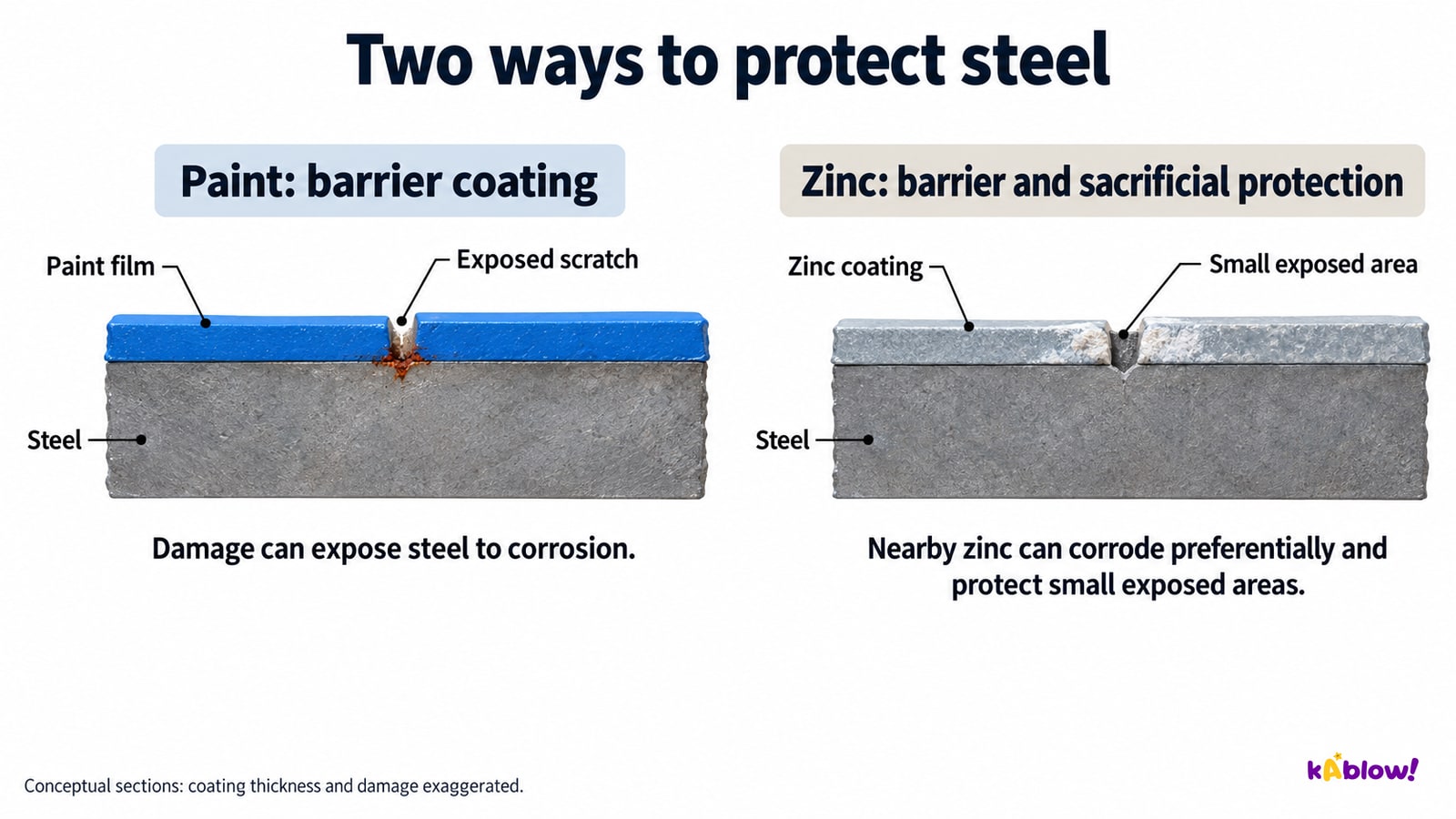
- Paint and many polymer coatings act mainly as barriers. If a damaged film exposes steel to a corrosive environment, corrosion may develop at the breach and beneath adjacent coating. Hot-dip galvanising supplies a zinc coating that acts as a barrier and can provide sacrificial protection to small exposed areas under suitable conditions.
- A compatible paint system over galvanising can add colour and another barrier. Preparation and compatibility are essential; the combination does not mean unlimited protection or no maintenance. The illustration exaggerates thickness and damage and does not predict a service life.
- Plating deposits another surface layer, commonly metal. Anodising instead develops the substrate oxide electrochemically, commonly on aluminium and also on some other suitable metals. Polishing changes surface condition; powder coating commonly uses polymer powder and heat. Embossing can deform suitable metal sheet as well as paper.
Barrier and sacrificial protection
Polymer finishes
- Polymers may contain colour through the material or receive compatible printing, coatings or decals. Acrylic edge polishing can improve smoothness and clarity after preparation, but is not a repair for every crack or a proof of load-bearing integrity.
- Finish compatibility depends on polymer grade, residual stress, chemical exposure and the selected process. A pleasant surface appearance does not alone establish long-term performance.
Paper and board finishes
- Printing deposits an ink image. Lamination bonds a layer or film and can improve handling or spill resistance, but edges and damage matter and mixed materials can complicate recovery. UV-curable varnish is defined by ultraviolet curing, not by guaranteed outdoor ultraviolet resistance or only a gloss finish.
- Embossing creates raised relief by deformation. Hot foil blocking transfers a decorative foil layer using a heated die and pressure. Foils can provide colours and effects beyond a metallic appearance.
Decoration and protection are different roles
Textiles
- Dyeing colours suitable fibres, yarn or fabric; screen printing transfers ink through a stencil-bearing mesh. Ink, dye, fibre and treatment determine appearance, adhesion and colourfastness.
- Water-repellent surfaces encourage droplets to bead or shed, while an appropriate coating or membrane can resist penetration under specified conditions. Seams, openings, wear and care affect the complete product. A flame-retardant treatment changes specified burning behaviour; it does not make the garment fireproof or alone establish final-product performance.
Name the required textile performance
Choosing
- Start with the substrate, required appearance and service conditions, then select preparation and compatible coating layers. Include application method, achievable quality, cure, maintenance, repair and end-of-life options rather than judging only the price of a tin.
- Compare the actual product information and evidence. A water-based formulation may reduce solvent emissions or allow water clean-up compared with an alternative, but it may still contain VOCs or other hazardous ingredients. Whole-life impact also depends on finish life, reapplication and disposal. This is a selection lesson, not a chemical application recipe.
Select the whole finish system
슬라이드
연습 문제
무료 미리 보기 — 33개 중 8개 문제. 가입하면 전부 볼 수 있어요.
1.Why are finishes applied?
Easy- Ato protect and improve appearance
- Bto weaken a product
- Cto reduce function
- Dto hide design
2.What is varnish?
Easy- Aa metal
- Ba fabric
- Can uncoated woven fabric
- Da clear protective coating for timber
3.What is the main appearance effect of a suitable translucent timber stain?
Easy- Amakes it waterproof only
- Bsoftens timber
- Ccolours timber while showing the grain
- Dhides the grain
4.What is teak oil used for?
Easy- Aprinting paper
- Benhancing appearance and providing formulation-dependent surface protection
- Cpolishing metal
- Ddyeing cloth
5.What is galvanising?
Easy- Acoating steel in zinc
- Bpainting steel
- Cpolishing steel
- Dheating steel
6.What is chrome plating?
Easy- Apainting
- Boiling
- Cpolishing wood
- Dcoating metal with a thin layer of chromium
7.What is anodising?
Easy- Aplating
- Bpolishing
- Ccontrolled electrochemical development of an oxide surface on suitable aluminium
- Dpainting
8.What is lamination?
Easy- Astitching
- Bcovering paper or board with a plastic film
- Cfolding
- Dcutting
기출 문제
이 주제의 기출 문제 연습이 곧 나와요.
곧 출시