Biological Molecules
Learn it by playing
Answer these questions to earn energy, then fish and explore. No account needed.
Lesson notes
Chemical Elements in Living Organisms
- Most biological molecules are organic, meaning they contain carbon.
- The three main groups of organic molecules are carbohydrates, proteins, and lipids.
- Carbohydrates contain carbon, hydrogen, and oxygen only.
- Proteins contain carbon, hydrogen, oxygen, and nitrogen (some also contain sulfur).
- Fats (lipids) contain carbon, hydrogen, and oxygen only.
Carbohydrates
- Carbohydrates are made of simple sugars (monosaccharides) like glucose.
- Two glucose molecules join to form maltose (a disaccharide).
- Many glucose molecules join to form starch, glycogen, or cellulose (polysaccharides).
- Starch is the storage carbohydrate in plants; glycogen is the storage carbohydrate in animals.
- Cellulose is a structural polysaccharide used in plant cell walls.
Fats (Lipids)
- Most fats are triglycerides: one glycerol molecule bonded to three fatty acid chains.
- Fatty acids vary in size and structure.
- Fats are solid at room temperature; oils are liquid at room temperature.
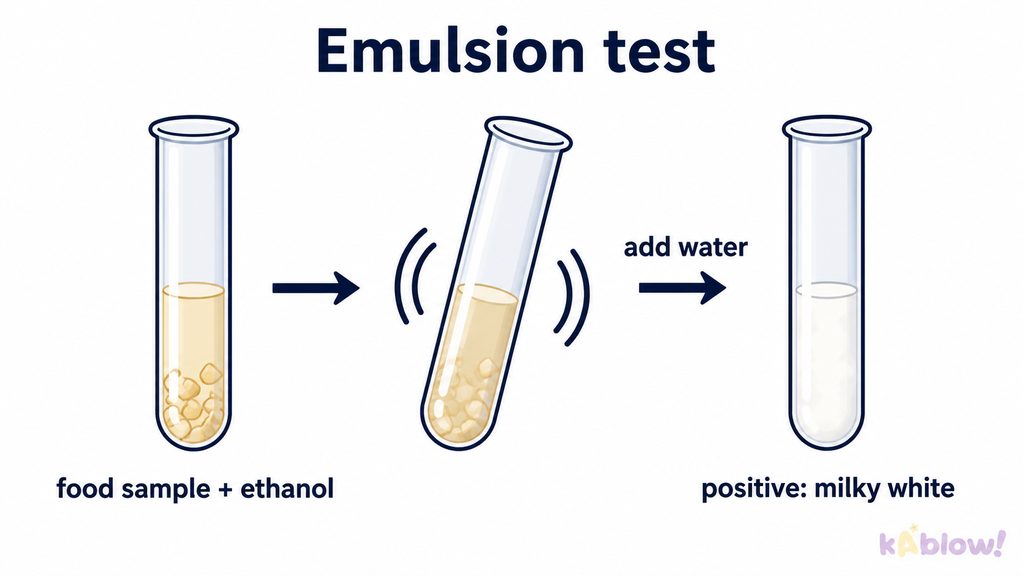
- Lipids can be detected using the emulsion test: add ethanol and shake, then add water. A milky-white emulsion is a positive result.
The emulsion test for lipids
Proteins
- Proteins are long chains of amino acids.
- There are about 20 different amino acids found in living organisms.
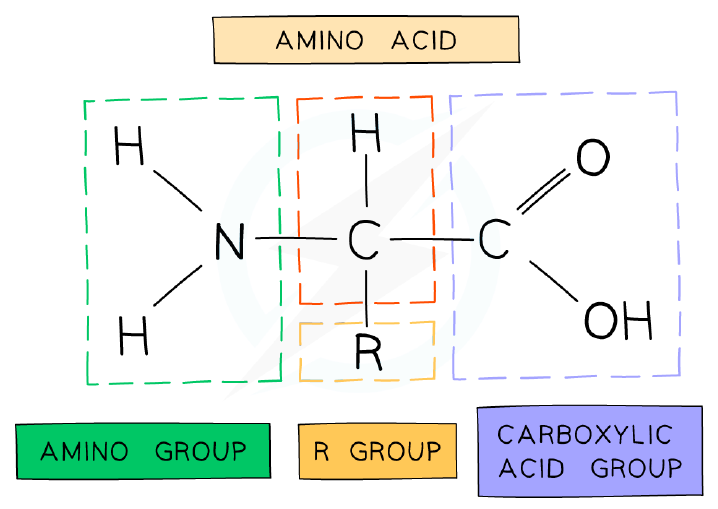
- All amino acids have the same basic structure but differ in their R group.
- The order of amino acids determines the protein's structure and function.
- Even a small change in the amino acid sequence can produce a different protein.
General structure of an amino acid
Food Tests
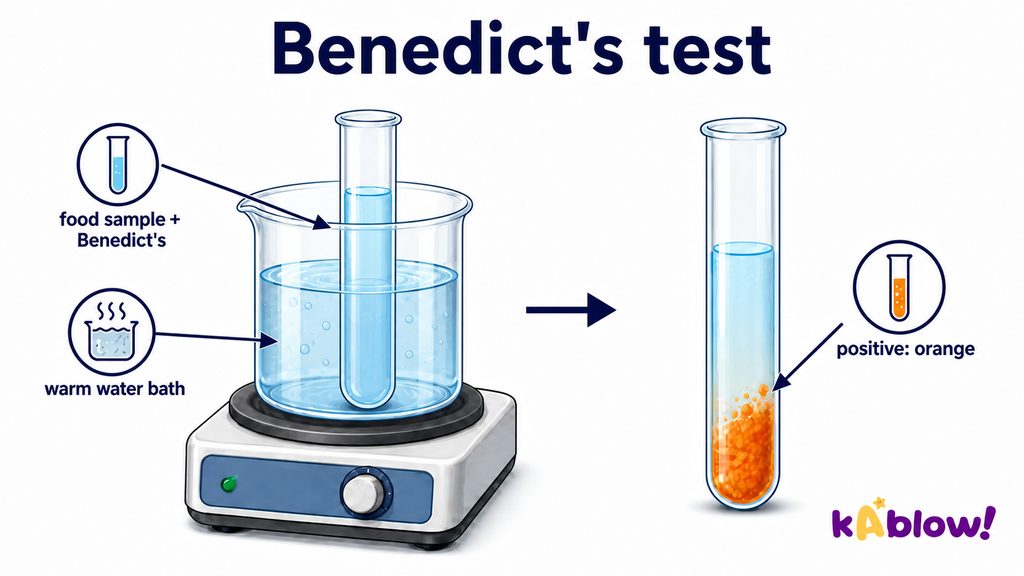
- Benedict's test for reducing sugars: add Benedict's solution, heat at 80°C for 5 min; positive: blue → orange/brick red.
- Iodine test for starch: add iodine solution; positive: orange-brown → blue-black.
- Biuret test for protein: add Biuret solution; positive: blue → violet/purple.
- Ethanol emulsion test for lipids: shake sample with ethanol, then add cold water; positive: cloudy emulsion forms.
- DCPIP test for vitamin C: add DCPIP solution to sample; positive: blue colour disappears (becomes colourless).
Benedict's test for reducing sugars: apparatus and colour change on heating.
DNA Structure (Extended)
- DNA is a double helix of two strands wound around each other.
- The monomer of DNA is a nucleotide, consisting of a phosphate, deoxyribose sugar, and a base.
- There are four bases: Adenine (A), Thymine (T), Cytosine (C), and Guanine (G).
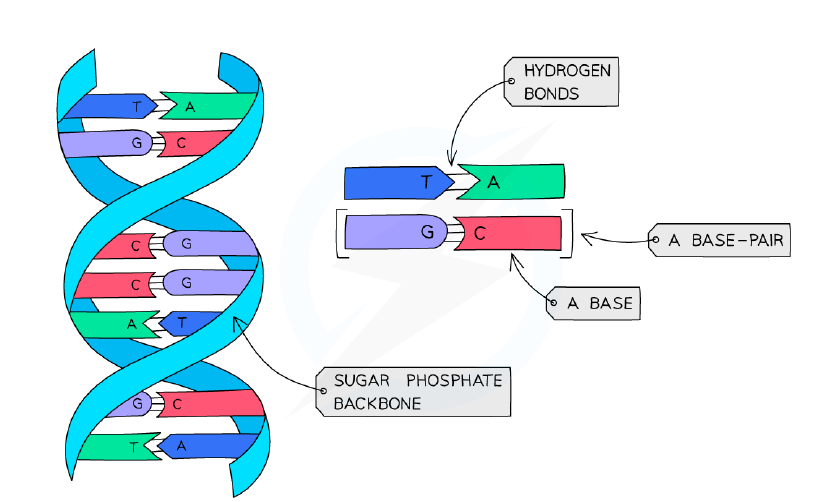
- Base pairing: A pairs with T, C pairs with G (held by hydrogen bonds).
- The sugar–phosphate backbone is on the outside; the bases form the rungs of the ladder.
- The sequence of bases codes for the formation of proteins.
DNA double helix showing complementary base pairs (A-T, C-G) joined by hydrogen bonds.
Slides
Sign up free to view the lesson slides
Step through every slide for this topic — plus flashcards and revision notes — with a free account.
Practice questions
Free preview — 8 of 40 questions. Sign up to see them all.
1.Which of the following is a monosaccharide?
Easy- AGlucose
- BMaltose
- CStarch
- DGlycogen
2.What are the chemical elements present in all carbohydrates?
Easy- ACarbon, hydrogen and oxygen
- BCarbon, hydrogen, oxygen and nitrogen
- CCarbon, hydrogen, oxygen, nitrogen and sulfur
- DCarbon, hydrogen and nitrogen
3.Which food test gives a colour change from blue to violet/purple for a positive result?
Easy- ABiuret test
- BBenedict's test
- CIodine test
- DEmulsion test
4.What is the basic unit of a fat molecule?
Easy- AOne glycerol and three fatty acids
- BOne glycerol and one fatty acid
- CThree glycerols and one fatty acid
- DAmino acids
5.Which bases pair together in DNA?
Easy- AA with T and C with G
- BA with C and T with G
- CA with G and C with T
- DA with U and C with G
6.Which of the following is a polysaccharide?
Easy- ACellulose
- BGlucose
- CMaltose
- DSucrose
7.A food sample gives a blue-black colour with iodine solution. Which substance is present?
Easy- AStarch
- BGlucose
- CProtein
- DLipid
8.Which of the following elements is found in proteins but not in carbohydrates or lipids?
Easy- ANitrogen
- BCarbon
- CHydrogen
- DOxygen
Unlock all 40 questions & more
Create a free account to see every question, the slides, flashcards and revision notes for this topic.