Enzymes
Learn it by playing
Answer these questions to earn energy, then fish and explore. No account needed.
Lesson notes
What are Enzymes?
- Enzymes are biological catalysts that speed up chemical reactions without being changed or used up.
- They are proteins made of amino acids.
- Enzymes are necessary for life — they maintain metabolic reaction speeds at a rate that sustains life.
- Without digestive enzymes, digesting a meal would take 2–3 weeks; with enzymes it takes ~4 hours.
Enzyme Action & Specificity
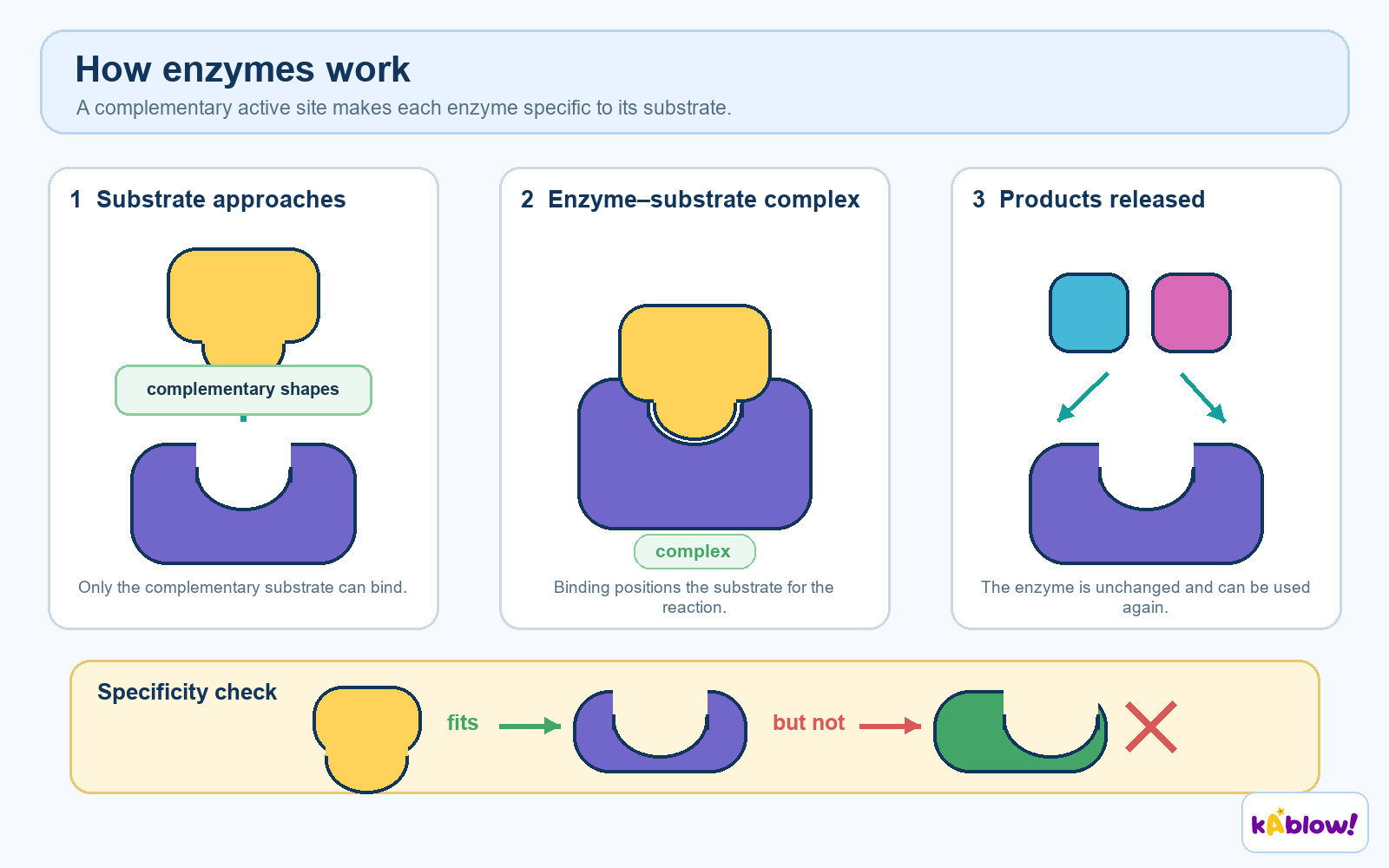
- Each enzyme has an active site with a specific 3D shape complementary to its substrate.
- This is the lock and key hypothesis: only a substrate of the correct shape fits the active site.
- When substrate binds, an enzyme-substrate complex forms; the reaction occurs and products are released.
- The enzyme is unchanged and can catalyse further reactions.
- Enzymes and substrates collide randomly in solution; a successful collision forms the complex.
Lock and key model of enzyme action
Effect of Temperature
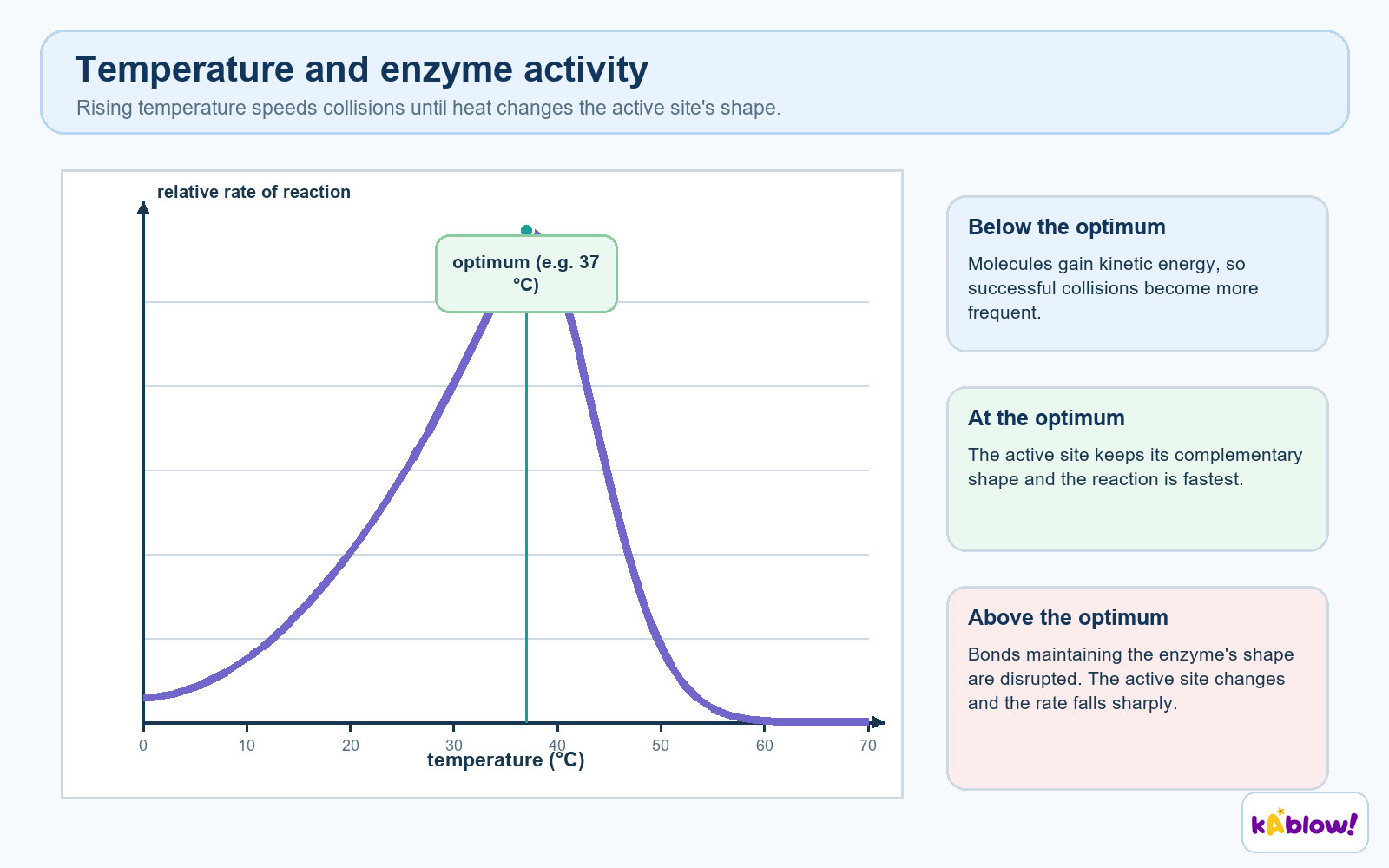
- Enzymes have an optimum temperature (e.g. 37 °C in the human body).
- From 0 °C to optimum, increasing temperature gives molecules more kinetic energy, increasing collisions and rate of reaction.
- Above the optimum, bonds holding the enzyme's shape break — the enzyme denatures (active site changes shape).
- Denaturation is irreversible; substrate can no longer fit the active site, so activity stops.
- Low temperatures do not denature enzymes; they only slow the reaction.
Effect of temperature on the rate of an enzyme-controlled reaction
Effect of pH
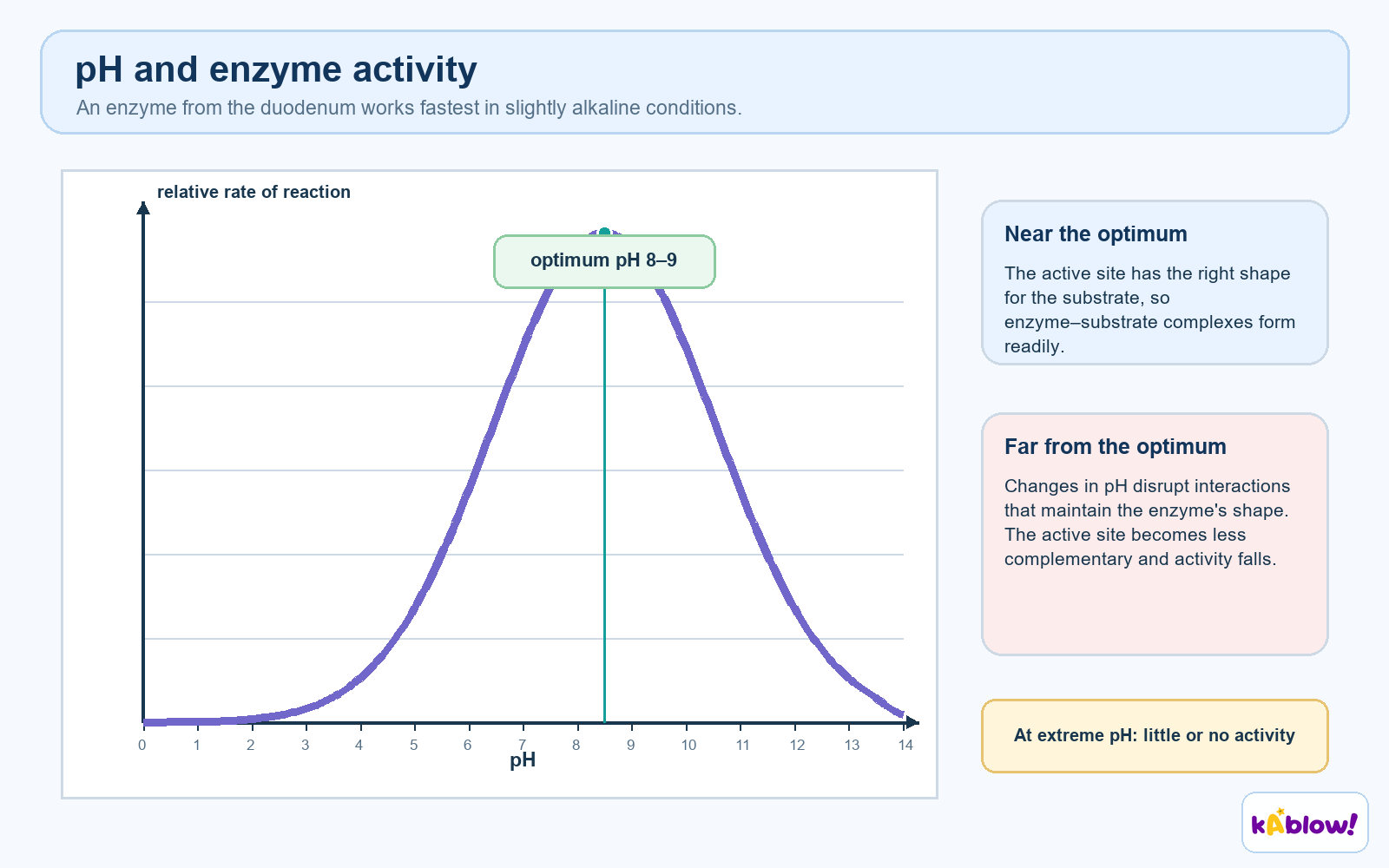
- Most enzymes have an optimum pH near 7, but some work best at acidic pH (e.g. pepsin in stomach, pH 2) or alkaline pH (e.g. in duodenum, pH 8–9).
- Extreme pH breaks bonds in the protein, denaturing the enzyme and altering the active site.
- Moving away from optimum pH reduces activity; far from optimum, denaturation occurs and activity stops.
Effect of pH on the rate of an enzyme-controlled reaction
Enzyme Investigations
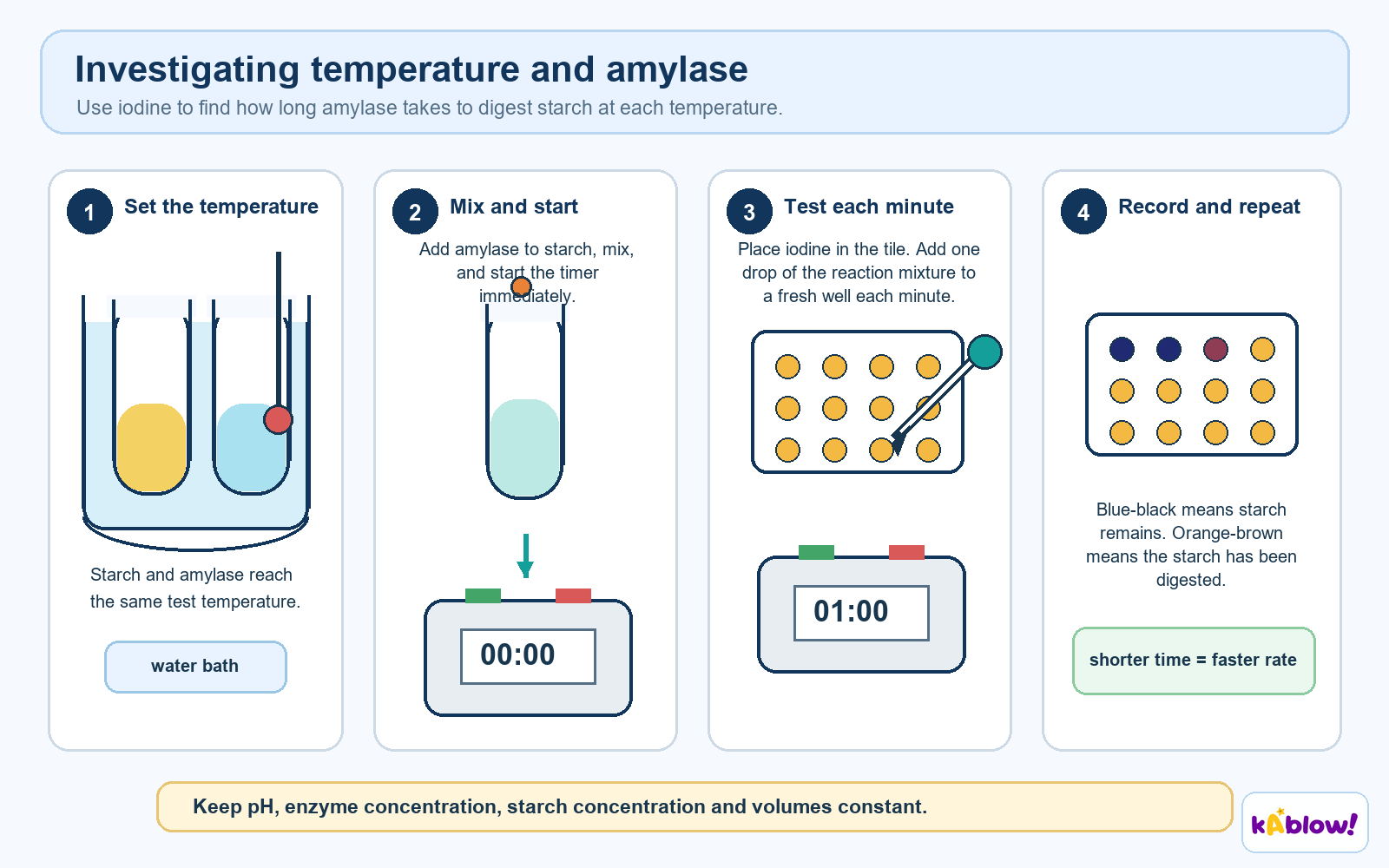
- Temperature investigation: Heat starch solution to set temp, add amylase, sample every minute into iodine. Time until iodine stays orange-brown (no starch) measures activity.
- pH investigation: Mix amylase, buffer (pH), and starch; sample every 10 s into iodine. Shorter time to orange-brown = faster reaction at that pH.
- Iodine test: Iodine turns blue-black in presence of starch; orange-brown means starch is fully digested.
- Control variables: temperature, pH, enzyme/substrate concentration.
Investigating the effect of temperature on amylase activity
Key Terms
- Catalyst: substance that speeds up a reaction without being changed.
- Substrate: molecule(s) that bind to the enzyme's active site.
- Active site: region on the enzyme where the reaction occurs.
- Denaturation: irreversible loss of enzyme shape (active site) due to heat or extreme pH.
- Optimum: condition (temperature or pH) at which an enzyme works fastest.
Slides
Sign up free to view the lesson slides
Step through every slide for this topic — plus flashcards and revision notes — with a free account.
Practice questions
Free preview — 8 of 45 questions. Sign up to see them all.
1.Which of the following statements about enzymes is correct?
Easy- AEnzymes are used up during chemical reactions.
- BEnzymes are biological catalysts that speed up reactions without being changed.
- CEnzymes are made of carbohydrates.
- DEnzymes increase the activation energy of reactions.
2.All enzymes are composed of which type of biological molecule?
Easy- ACarbohydrates
- BLipids
- CProteins
- DNucleic acids
3.Using the model, predict what happens if a substrate is replaced by a molecule with a different shape that is not complementary to the active site.
Easy- AIt binds more tightly.
- BIt is less likely to form an enzyme-substrate complex.
- CIt permanently changes the enzyme into a product.
- DIt makes the enzyme work without an active site.
4.A student investigates the effect of temperature on the activity of amylase. Which statement describes what happens to the enzyme at 80°C?
Easy- AThe enzyme works faster due to increased kinetic energy.
- BThe enzyme is denatured and its active site changes shape.
- CThe enzyme is reversibly inhibited.
- DThe enzyme remains unchanged but the substrate is destroyed.
5.In an experiment to investigate the effect of pH on amylase activity, a student uses iodine solution as an indicator. What colour change indicates that starch is still present?
Easy- AOrange-brown to blue-black
- BBlue-black to orange-brown
- COrange-brown to colourless
- DBlue-black to colourless
6.What is the optimum pH for the enzyme pepsin, which is secreted in the stomach?
Easy- ApH 2
- BpH 7
- CpH 8
- DpH 10
7.The graph shows an enzyme working below its optimum temperature. The reaction mixture is cooled from 30°C to 10°C and then returned to 30°C. What is the most likely result, if no enzyme or substrate is lost?
Medium- AThe rate decreases, then returns close to its original value.
- BThe enzyme is permanently denatured at 10°C.
- CThe rate increases during cooling and remains high.
- DThe enzyme is used up during cooling.
8.Which of the following elements are all enzymes composed of?
Easy- ACarbon, hydrogen, oxygen, nitrogen
- BCarbon, hydrogen, oxygen, nitrogen, sulfur
- CCarbon, hydrogen, oxygen
- DCarbon, hydrogen, oxygen, nitrogen, phosphorus
Unlock all 45 questions & more
Create a free account to see every question, the slides, flashcards and revision notes for this topic.