Transport In Plants
Learn it by playing
Answer these questions to earn energy, then fish and explore. No account needed.
Lesson notes
Xylem & Phloem
- Xylem vessels transport water and mineral ions from roots to leaves.
- Phloem vessels transport sucrose and amino acids from sources to sinks.
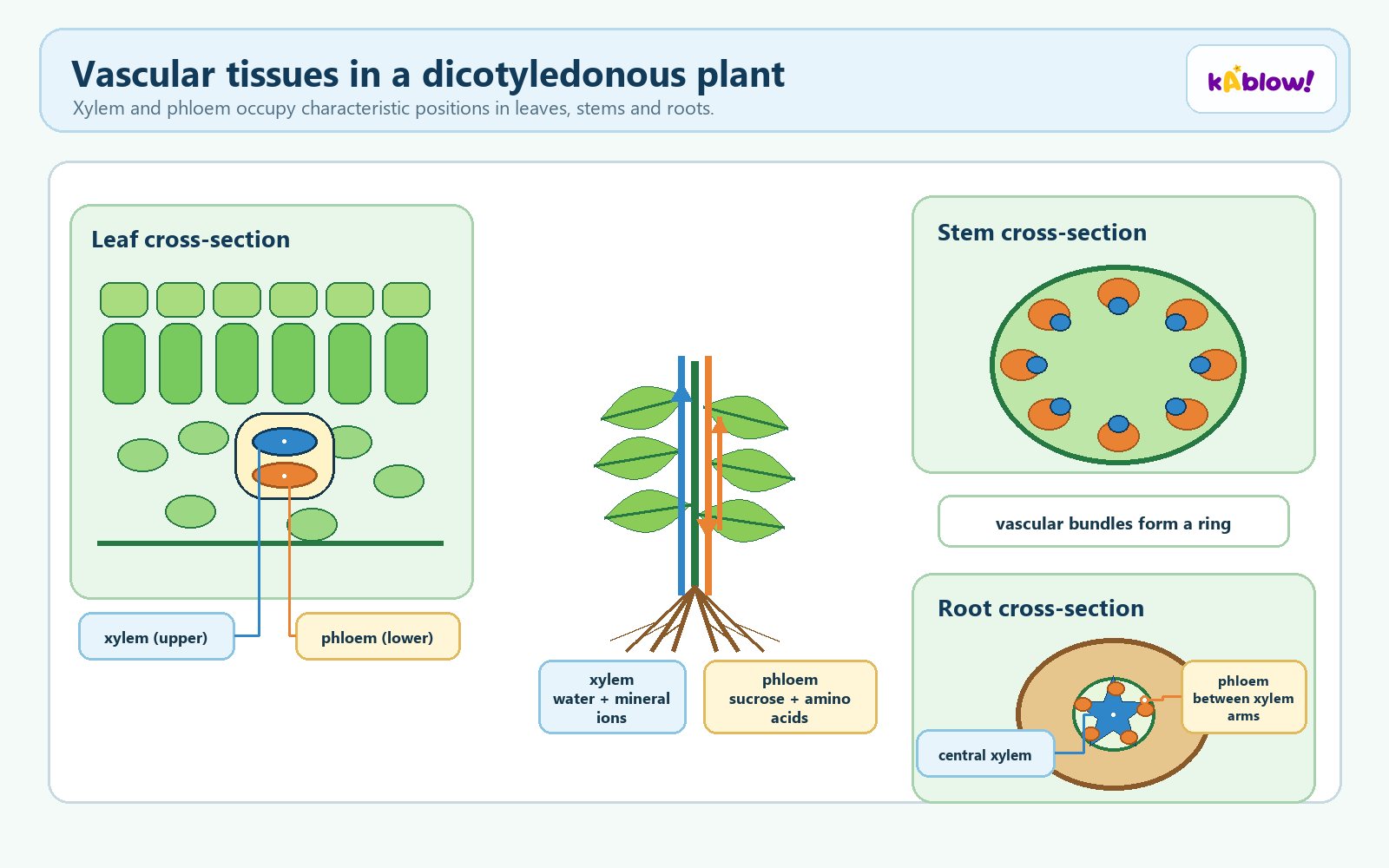
- Xylem and phloem are arranged in vascular bundles throughout the plant.
- In cross-section, xylem is on the inside and phloem on the outside.
- Xylem adaptations: cells joined end-to-end with no cross walls, dead and hollow, walls thickened with lignin.
- Phloem consists of living cells with sieve plates at end walls for easy flow.
Vascular tissue in a dicotyledonous plant
Root Hair Cells
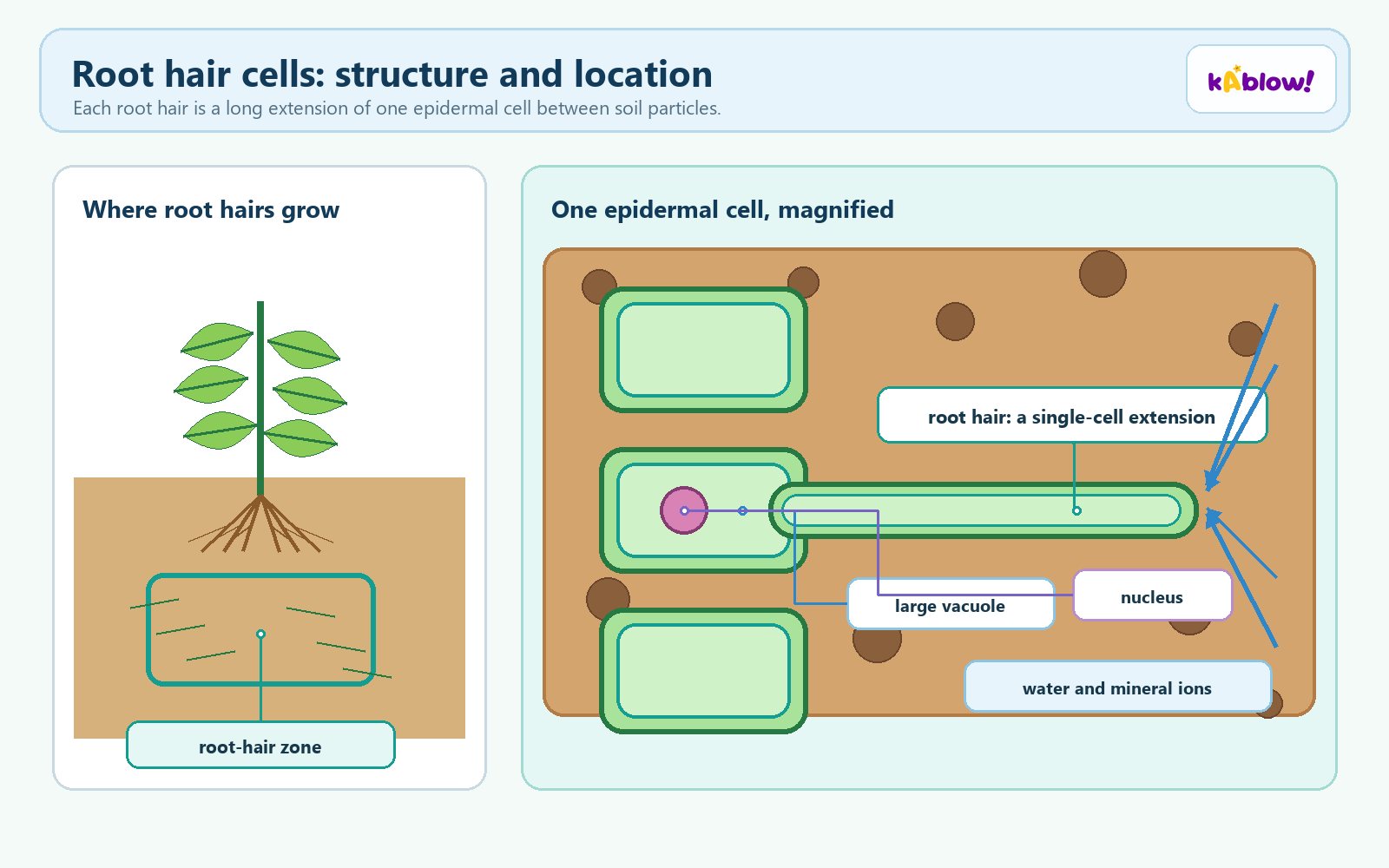
- Root hairs are single-celled extensions of root epidermis cells.
- They grow between soil particles to absorb water and minerals.
- Water enters root hair cells by osmosis (soil water has higher water potential).
- Large surface area of root hairs increases rate of water uptake by osmosis and mineral ion uptake by active transport.
Structure of the root and root hair cells
Pathway of Water
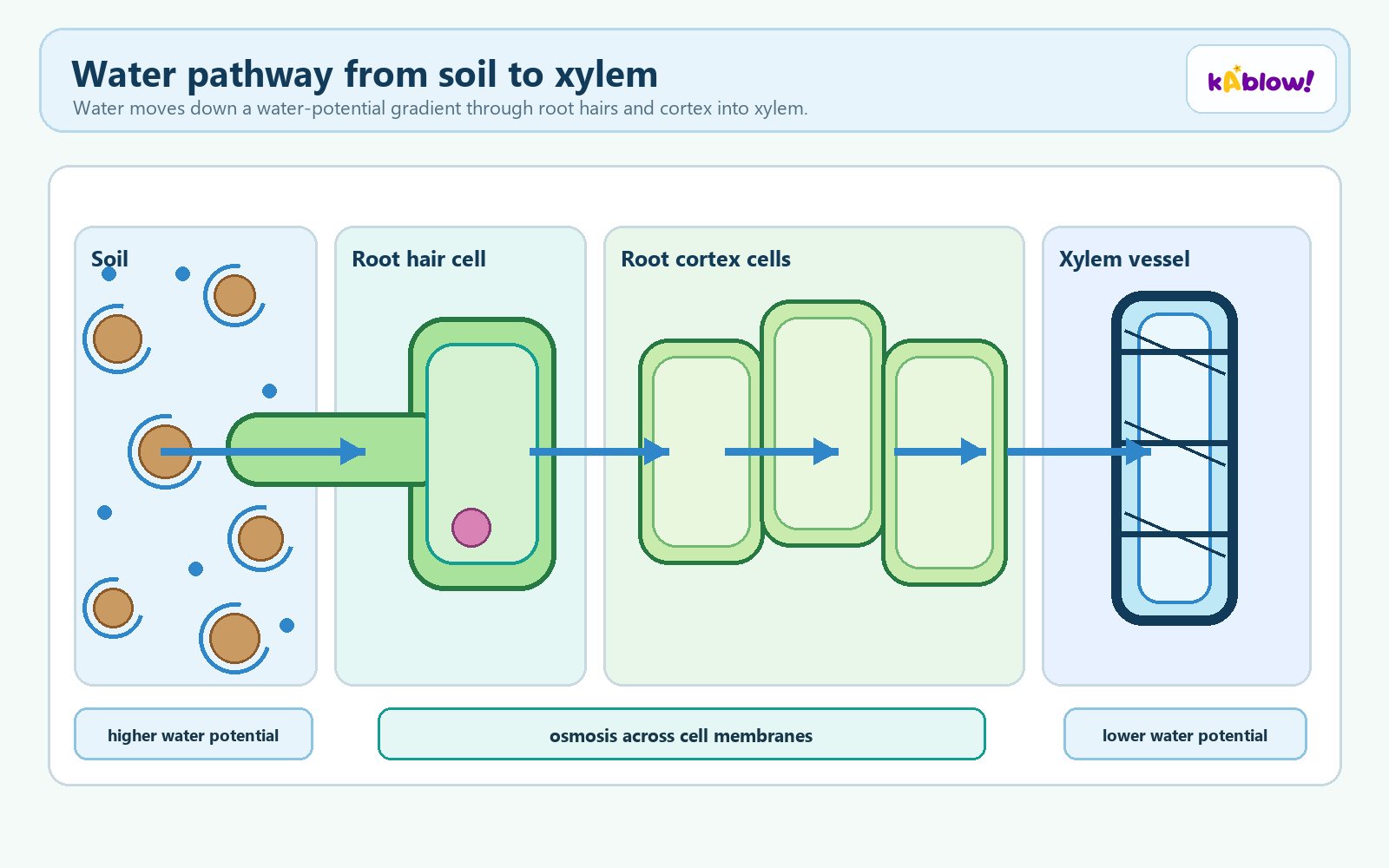
- Water moves: root hair cell → root cortex cells → xylem → leaf mesophyll cells.
- Water crosses the root cortex by osmosis.
- Water is transported up the xylem to the leaves.
- Pathway can be shown using a stain/dye (e.g., celery in dyed water); dye appears in xylem on cross-section.
Pathway of water into and across a root
Transpiration
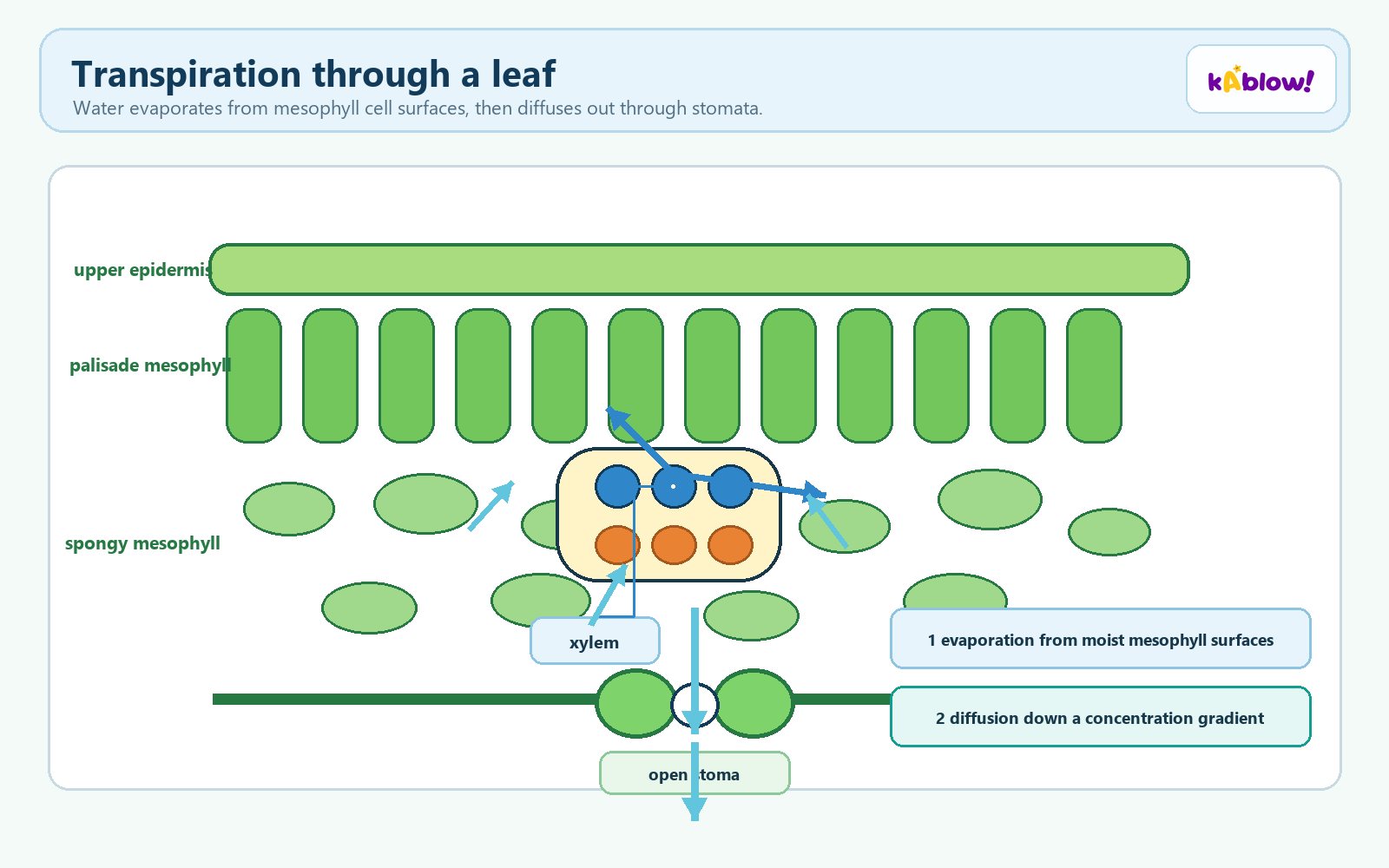
- Transpiration is the loss of water vapour from leaves by evaporation from mesophyll cells and diffusion through stomata.
- Functions: transports mineral ions, keeps cells turgid, provides water for photosynthesis, cools leaves.
- Water moves up xylem in a transpiration stream – continuous column pulled by cohesion.
- Transpiration creates a tension/pull on water in xylem due to cohesive forces between water molecules.
Transpiration in plants
Factors Affecting Transpiration Rate
- High temperature increases transpiration rate (more evaporation).
- High wind speed increases transpiration rate (removes water vapour, steepens diffusion gradient).
- High humidity decreases transpiration rate (reduces diffusion gradient).
- Light intensity increases transpiration rate (stomata open wider).
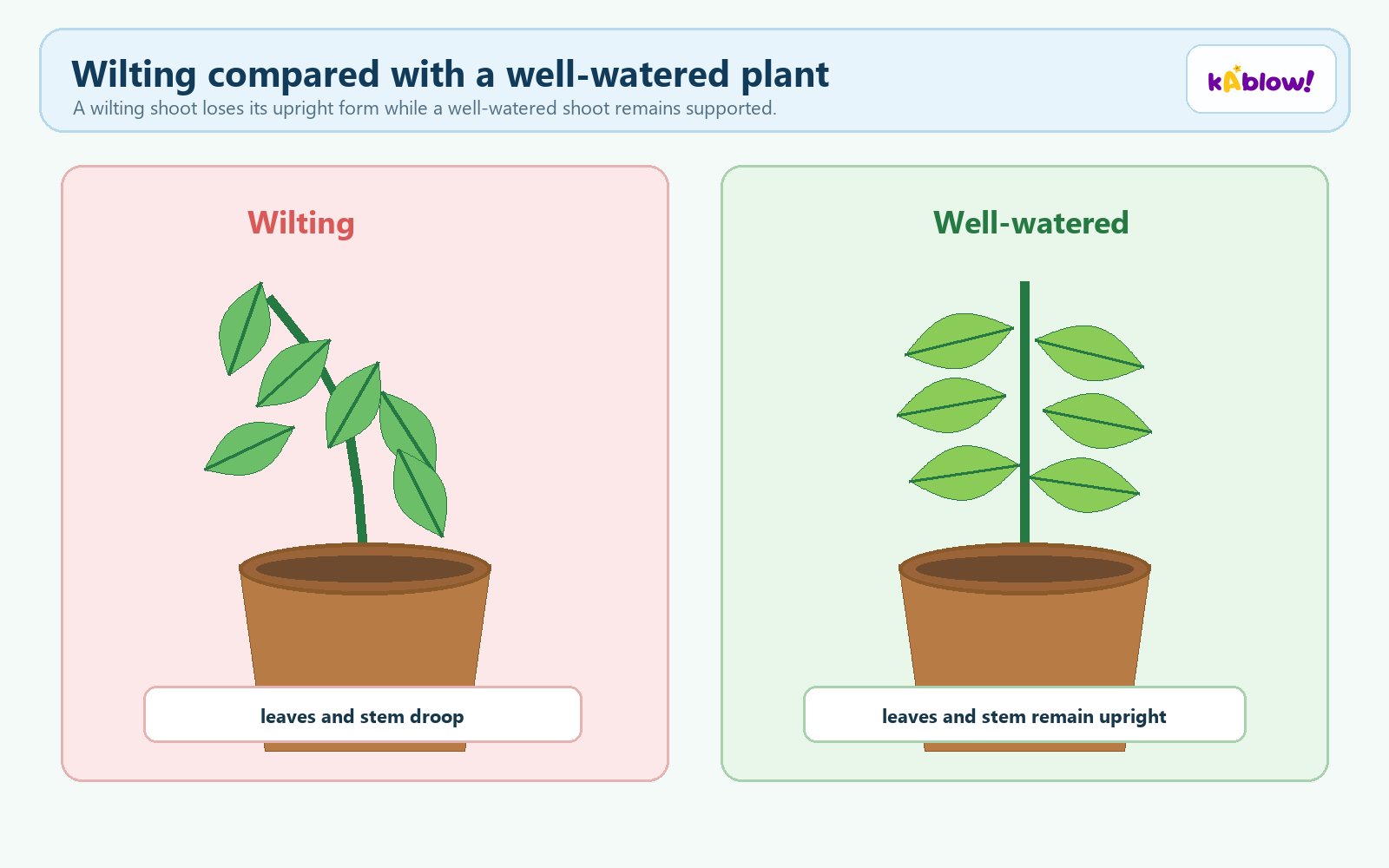
- Wilting occurs when water loss exceeds water uptake; cells lose turgor and plant collapses.
A wilted plant
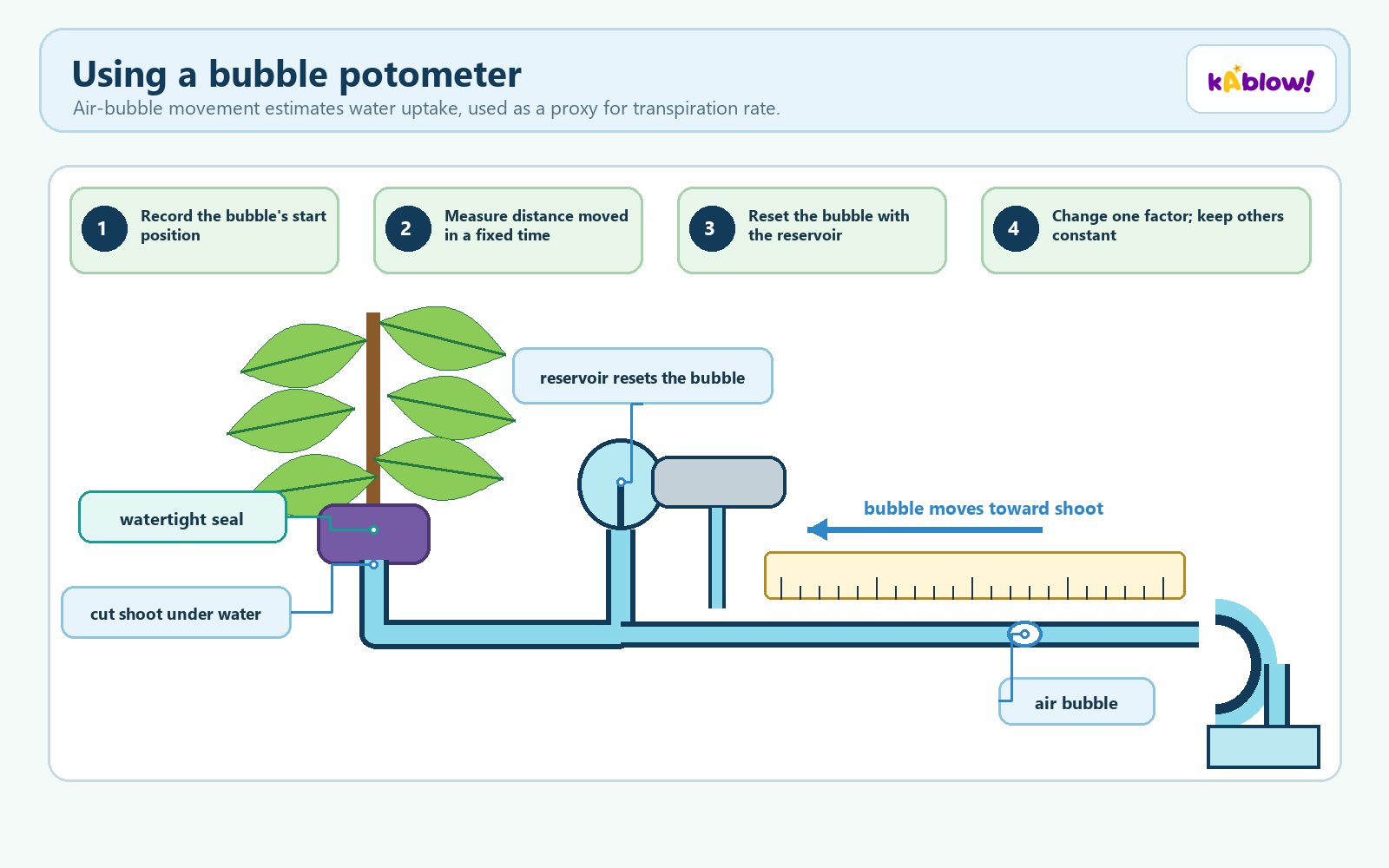
Investigating Transpiration (Potometer)
- A potometer measures transpiration rate by movement of an air bubble in a capillary tube.
- Method: cut shoot underwater, set up airtight, dry leaves, introduce air bubble, record distance moved over time.
- Factors investigated: temperature (warm/cold room), wind speed (fan), humidity (plastic bag), light intensity.
- Further bubble movement in same time = faster transpiration.
Potometer apparatus
Translocation
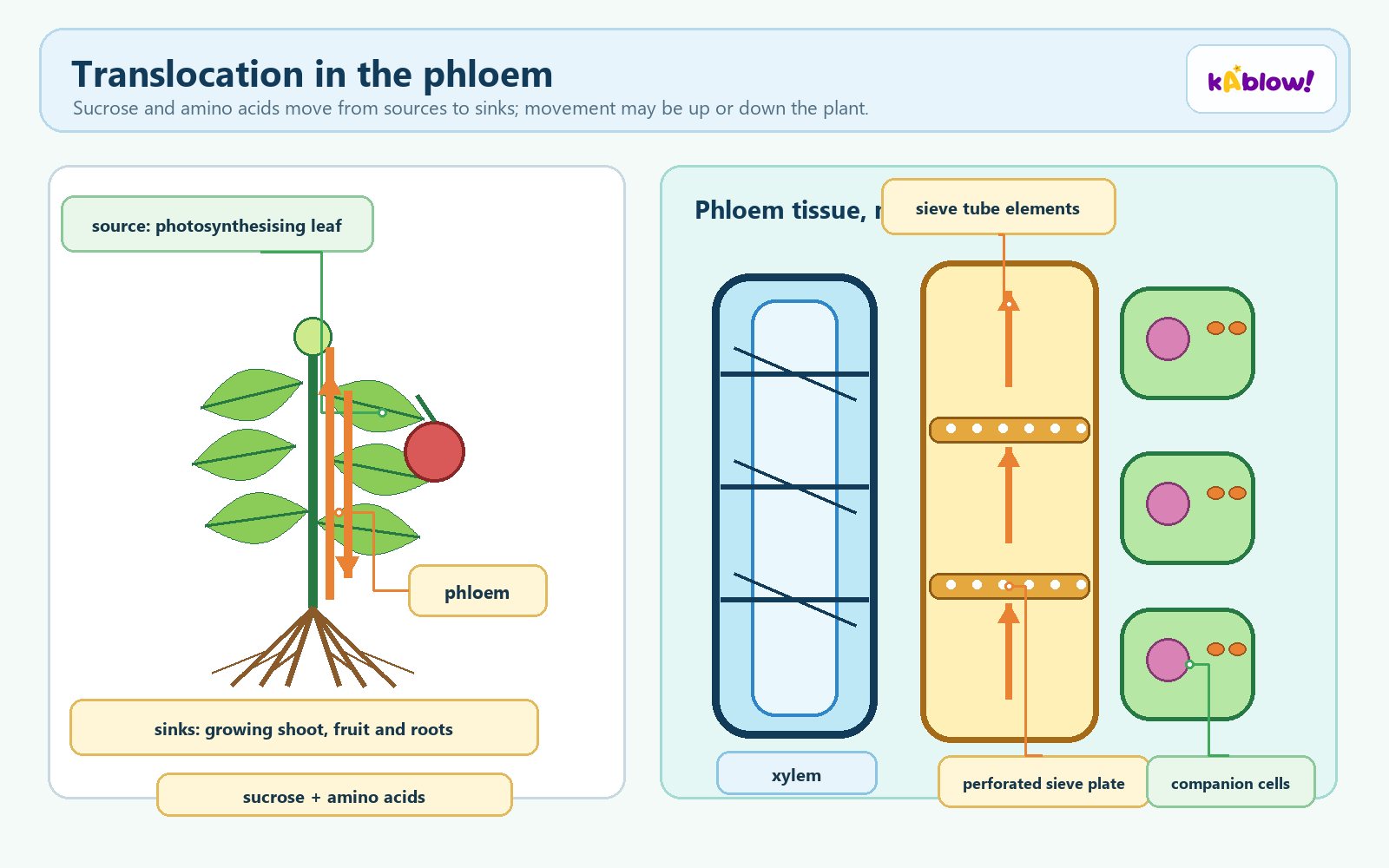
- Translocation is the transport of sucrose and amino acids in phloem from source to sink.
- Phloem is made of living cells with sieve plates; transport is bi-directional depending on plant needs.
- Sources: photosynthesising leaves (summer) or storage organs (winter).
- Sinks: growing regions (roots, shoots, fruits) or storage organs.
Translocation through the phloem
Slides
Sign up free to view the lesson slides
Step through every slide for this topic — plus flashcards and revision notes — with a free account.
Practice questions
Free preview — 8 of 46 questions. Sign up to see them all.
1.Which of the following is the main function of xylem vessels in a plant?
Easy- ATransport of water and mineral ions from roots to leaves
- BTransport of sucrose and amino acids from leaves to roots
- CTransport of carbon dioxide from leaves to roots
- DTransport of oxygen from roots to leaves
2.The diagram shows a root hair cell. Which process is primarily responsible for the entry of water into the root hair cell?
Easy- AActive transport
- BDiffusion
- COsmosis
- DTranspiration
3.A student places a celery stalk in a beaker of red dye. After a few hours, a cross-section of the stem is cut. Which part of the stem will be stained red?
Medium- APhloem
- BXylem
- CCortex
- DEpidermis
4.Which of the following correctly describes the process of transpiration?
Easy- ALoss of water vapour from leaves by evaporation and diffusion through stomata
- BLoss of water droplets from leaves by guttation
- CUptake of water by roots from the soil
- DMovement of water through xylem from roots to leaves
5.Which environmental condition would most reduce the rate of transpiration?
Medium- AHigh temperature and low humidity
- BHigh temperature and high humidity
- CLow temperature and low humidity
- DLow temperature and high humidity
6.Which of the following substances is transported in the phloem?
Easy- AWater and mineral ions
- BSucrose and amino acids
- COxygen and carbon dioxide
- DStarch and cellulose
7.Evaporation of water, which contributes to transpiration, occurs from the surface of which leaf structure?
Medium- ACuticle
- BSpongy mesophyll
- CStoma
- DXylem
8.In a potometer experiment, which of the following would increase the speed of the air bubble?
Medium- ADecreasing the temperature
- BIncreasing the humidity around the leaves
- CIncreasing the wind speed around the leaves
- DCovering the leaves with petroleum jelly
Unlock all 46 questions & more
Create a free account to see every question, the slides, flashcards and revision notes for this topic.