Ions & Ionic Bonds
Learn it by playing
Answer these questions to earn energy, then fish and explore. No account needed.
Lesson notes
Formation of Ions
- An ion is an electrically charged atom or group of atoms formed by loss or gain of electrons.
- Atoms lose or gain electrons to obtain a full outer shell (noble gas configuration).
- Cations are positive ions formed when atoms lose electrons (metals).
- Anions are negative ions formed when atoms gain electrons (non-metals).
- Group 1 elements form 1+ ions; Group 2 form 2+ ions.
- Group 6 elements form 2– ions; Group 7 form 1– ions.
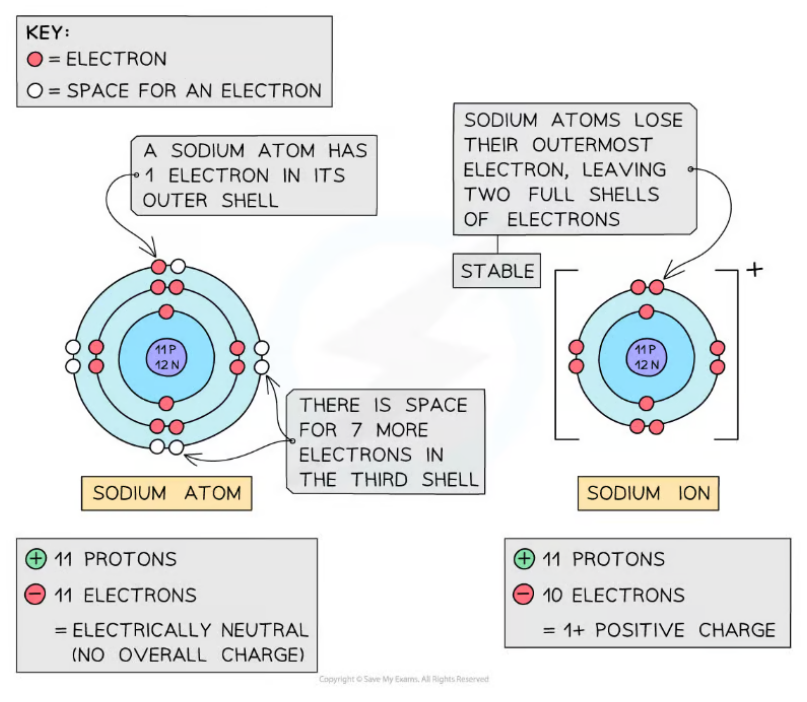
Bohr-shell diagrams of a sodium atom and the sodium ion it forms.
Ionic Bonding
- Ionic bonding occurs between metal and non-metal atoms.
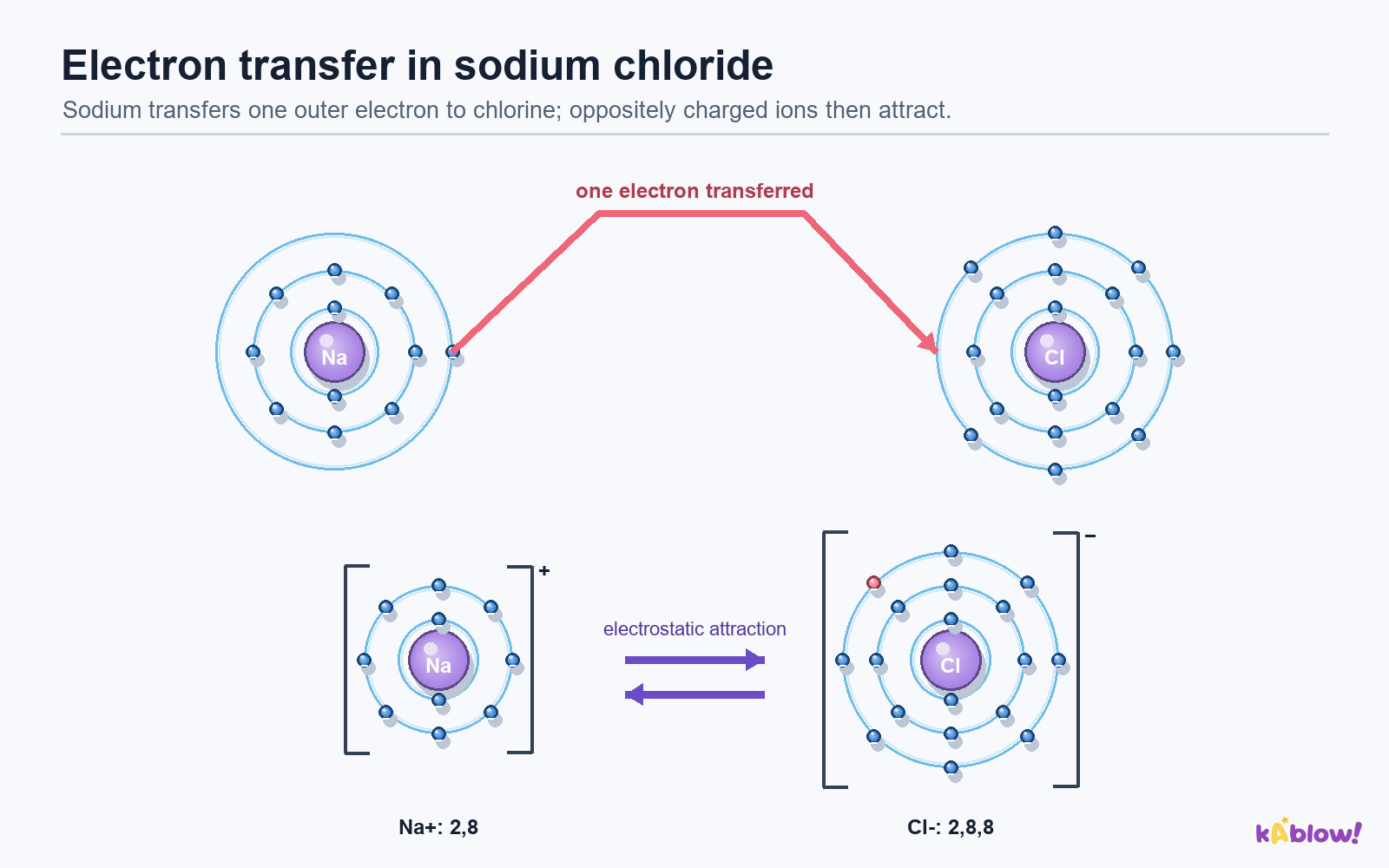
- Metal atoms lose electrons to non-metal atoms, forming positive and negative ions.
- The oppositely charged ions are held together by strong electrostatic forces of attraction.
- This electrostatic attraction is the ionic bond.
- The overall charge of an ionic compound is zero.
Sodium loses one electron and chlorine gains an electron.
Dot-and-Cross Diagrams
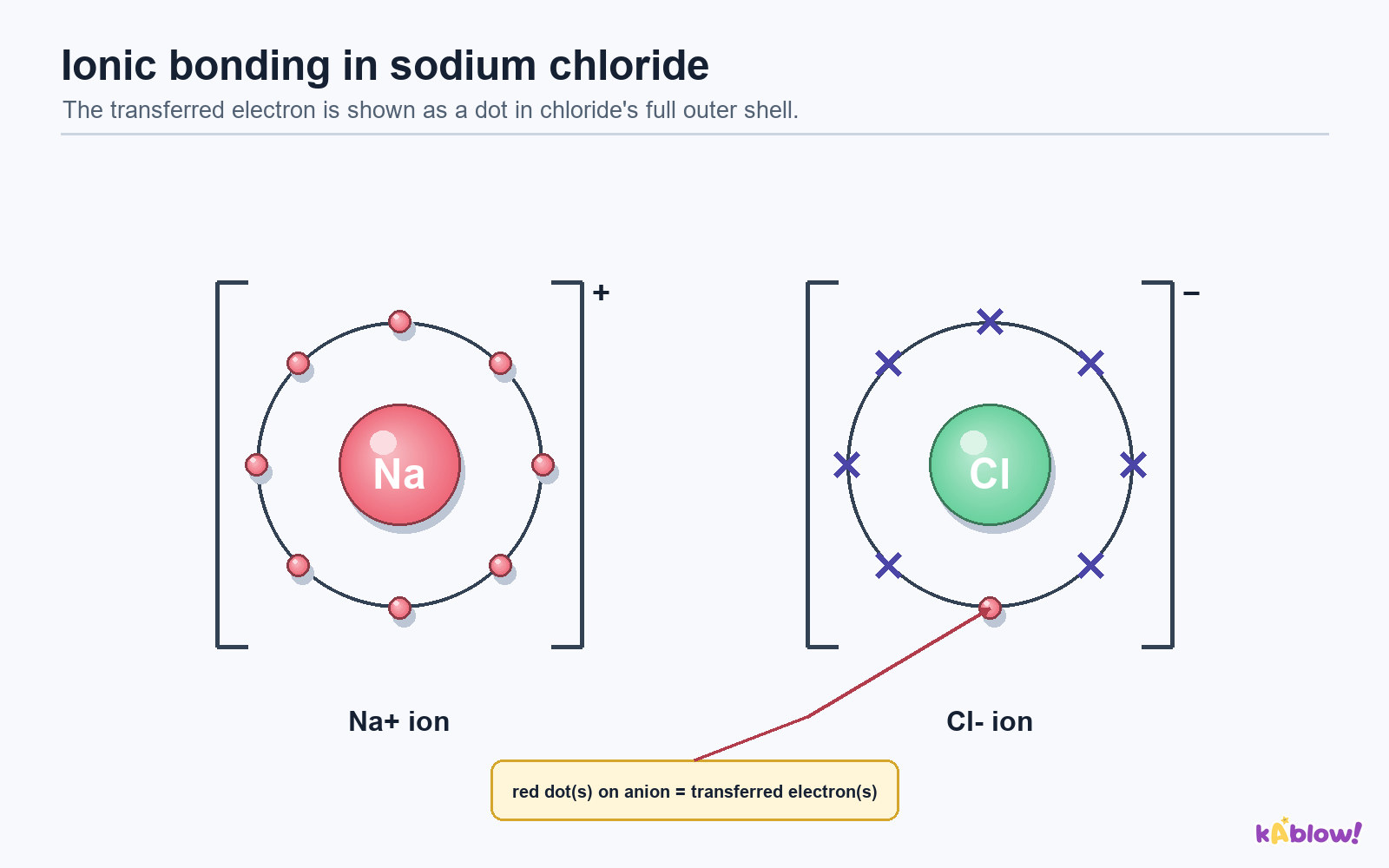
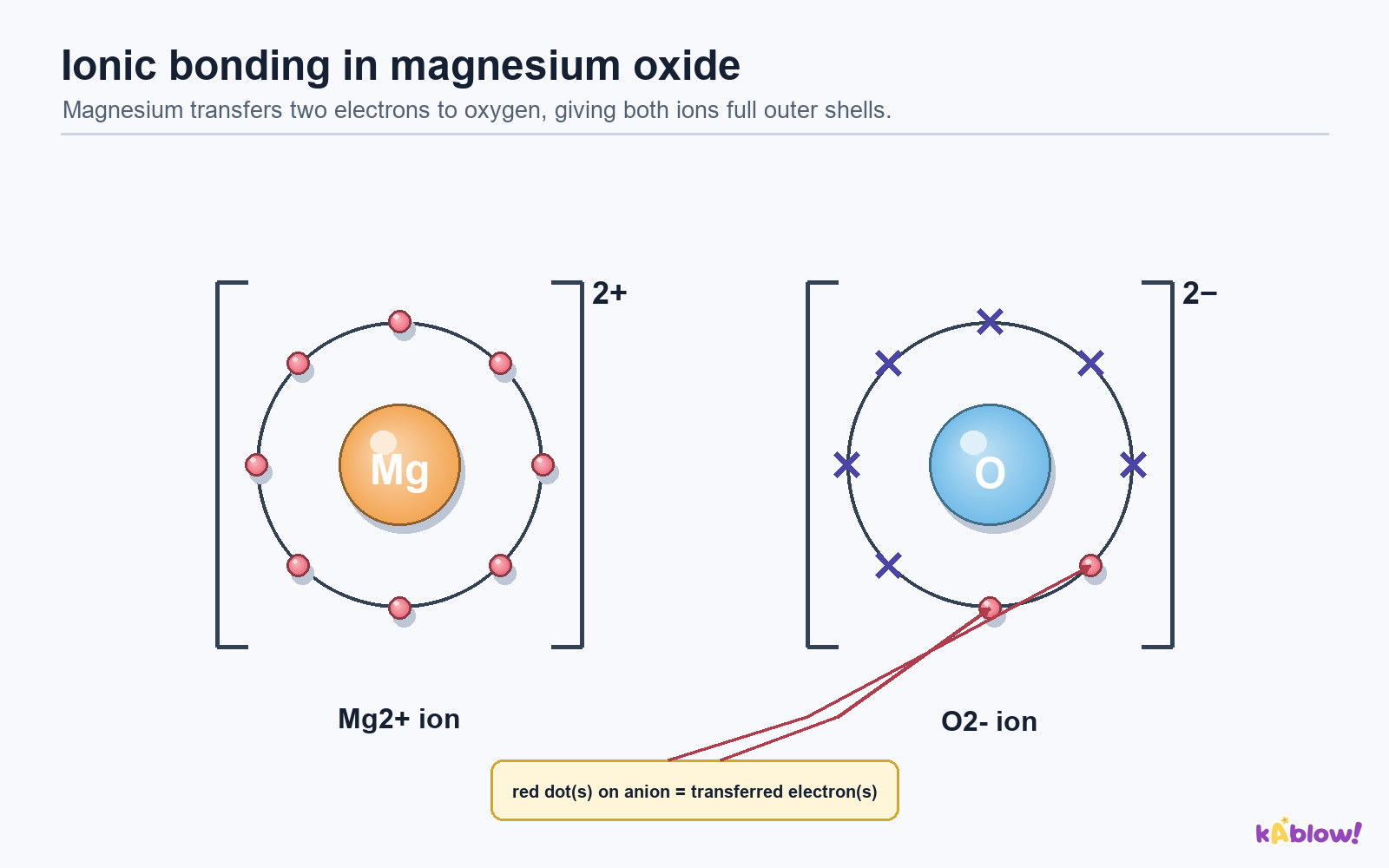
- Dot-and-cross diagrams show the arrangement of outer-shell electrons only.
- Electrons from one atom are shown as dots, from the other as crosses.
- Each ion is enclosed in square brackets with the charge written at the top right.
- Example: NaCl – Na loses one electron (becomes Na⁺), Cl gains one electron (becomes Cl⁻).
Ionic bonding in sodium chloride.
Ionic Lattice Structure (Extended)
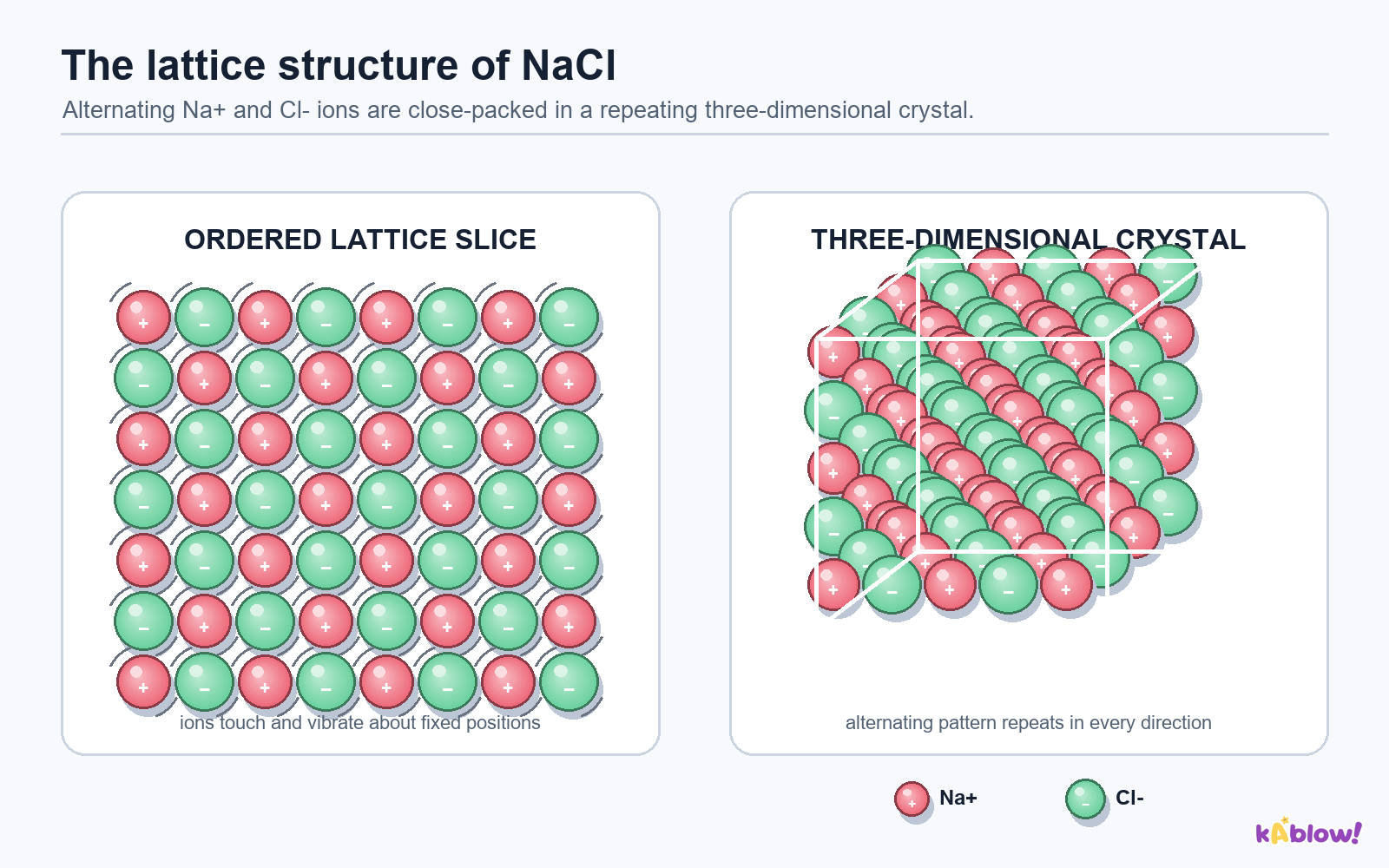
- Ionic compounds form a giant lattice structure.
- The lattice consists of a regular arrangement of alternating positive and negative ions.
- Strong electrostatic forces act in all directions between oppositely charged ions.
- Example: NaCl lattice – each Na⁺ is surrounded by Cl⁻ and vice versa.
The lattice structure of NaCl.
Properties of Ionic Compounds
- Ionic compounds are solid at room temperature.
- They have high melting and boiling points due to strong electrostatic forces.
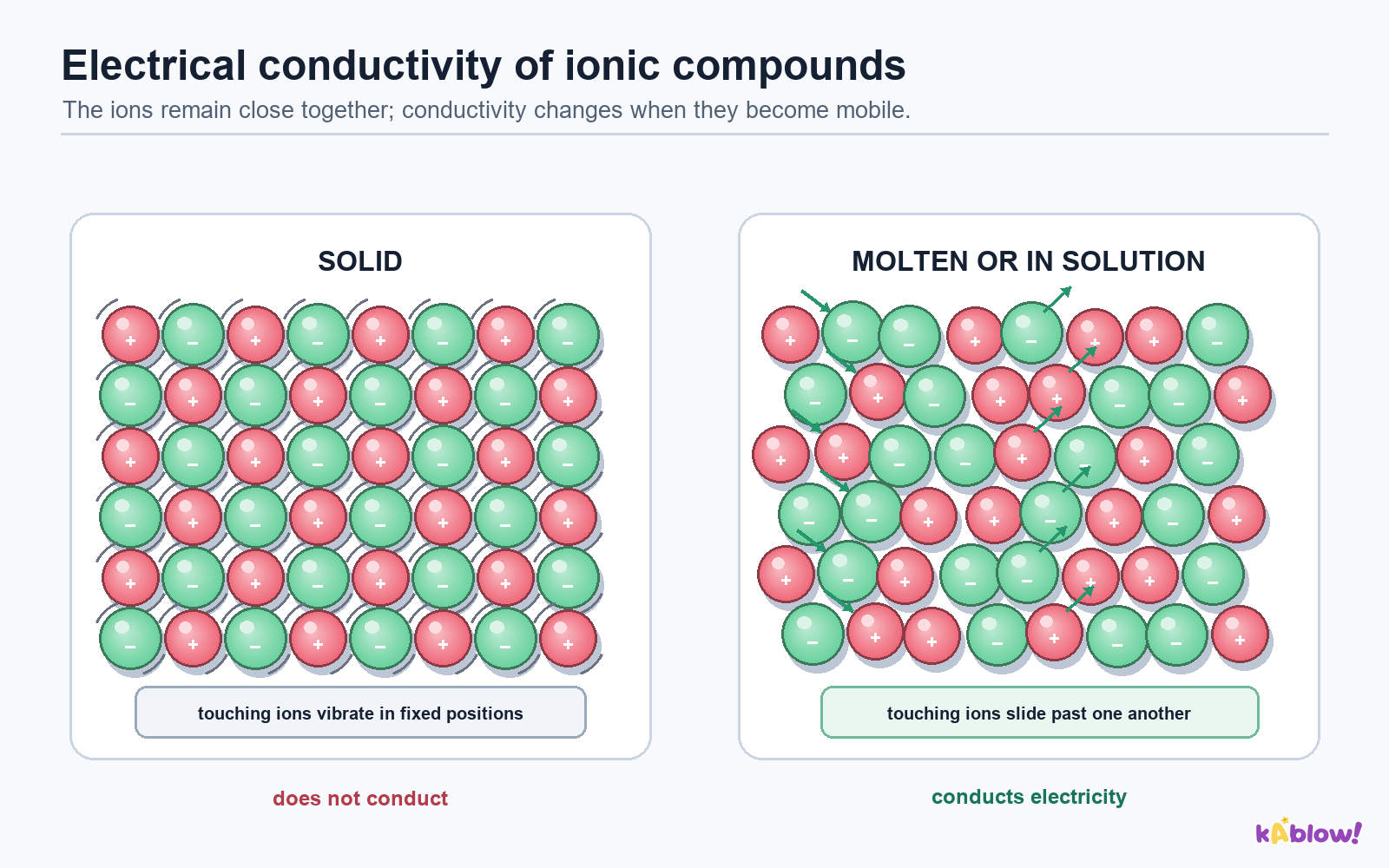
- They conduct electricity when molten or in aqueous solution (ions free to move).
- They do not conduct electricity when solid (ions fixed in lattice).
- Higher charge on ions leads to stronger forces and higher melting point (e.g., MgO > NaCl).
Electrical conductivity of ionic compounds.
Slides
Sign up free to view the lesson slides
Step through every slide for this topic — plus flashcards and revision notes — with a free account.
Practice questions
Free preview — 8 of 55 questions. Sign up to see them all.
1.What change occurs to an atom when it forms a negative ion?
Easy- AIt loses electrons.
- BIt gains protons.
- CIt gains electrons.
- DIt loses protons.
2.Which of the statements describes ionic bonding?
Easy- AElectrostatic attraction between atoms
- BElectrostatic attraction between positively charged particles and delocalised electrons
- CElectrostatic attraction between oppositely charged ions
- DElectrostatic attraction between the nuclei of two atoms and a shared pair of electrons
3.The electronic configuration of an ion was determined to be 2.8.8. What could the identity of the ion be?
Medium- ACa²⁺
- BS²⁻
- CBoth Ca²⁺ and S²⁻
- DNeither Ca²⁺ nor S²⁻
4.Calcium reacts with fluorine to form calcium fluoride. Which statement describes what happens to calcium atoms in this reaction?
Medium- ACalcium ions lose electrons to form positive charges.
- BCalcium atoms gain 3 electrons to form positive ions.
- CCalcium ions gain 2 electrons to form positive ions.
- DCalcium atoms lose 2 electrons to form positive ions.
5.Three statements about sodium chloride are shown. 1. Sodium chloride has a low melting point because the attractive forces between the ions in the lattice are weak. 2. Sodium chloride conducts electricity in aqueous solution because the ions are free to move. 3. Sodium chloride conducts electricity when solid because the ions can carry an electric current through the lattice. Which statements are correct?
Medium- A1 and 2
- B2 only
- C2 and 3
- D3 only
6.Ionic compounds are formed when a metal reacts with a nonmetal. Which two elements combine to form this kind of compound? Element Q: electronic structure 2.4 Element R: electronic structure 2.8 Element S: electronic structure 2.8.1 Element T: electronic structure 2.8.7
Medium- AS and T
- BR and S
- CQ and R
- DQ and T
7.Ionic compounds are formed when metals react with nonmetals. Which row correctly describes the electron transfer when an ionic bond is formed and the nature of the bond?
Easy- AMetal to nonmetal; Opposite ions attract
- BMetal to nonmetal; Opposite ions repel
- CMetal to metal; Same ions repel
- DNonmetal to metal; Opposite ions attract
8.Potassium and bromine chemically combine to form the compound potassium bromide. During formation, each bromine atom …..1….. one electron which is completely …..2….. from the outer shell of the potassium atom. The …..3….. force of attraction is formed from the attraction between the opposite charges on each ion. What words correctly fill gaps 1, 2 and 3?
Medium- Aloses; shared; electrical
- Bloses; transferred; intermolecular
- Cgains; shared; electrostatic
- Dgains; transferred; electrostatic
Unlock all 55 questions & more
Create a free account to see every question, the slides, flashcards and revision notes for this topic.