Organic Families
Learn it by playing
Answer these questions to earn energy, then fish and explore. No account needed.
Lesson notes
Fossil Fuels
- A fuel is a substance that releases heat energy when burned.
- Common fossil fuels: coal, natural gas (mainly methane, CH₄), and petroleum (crude oil).
- Hydrocarbons are compounds containing only hydrogen and carbon atoms.
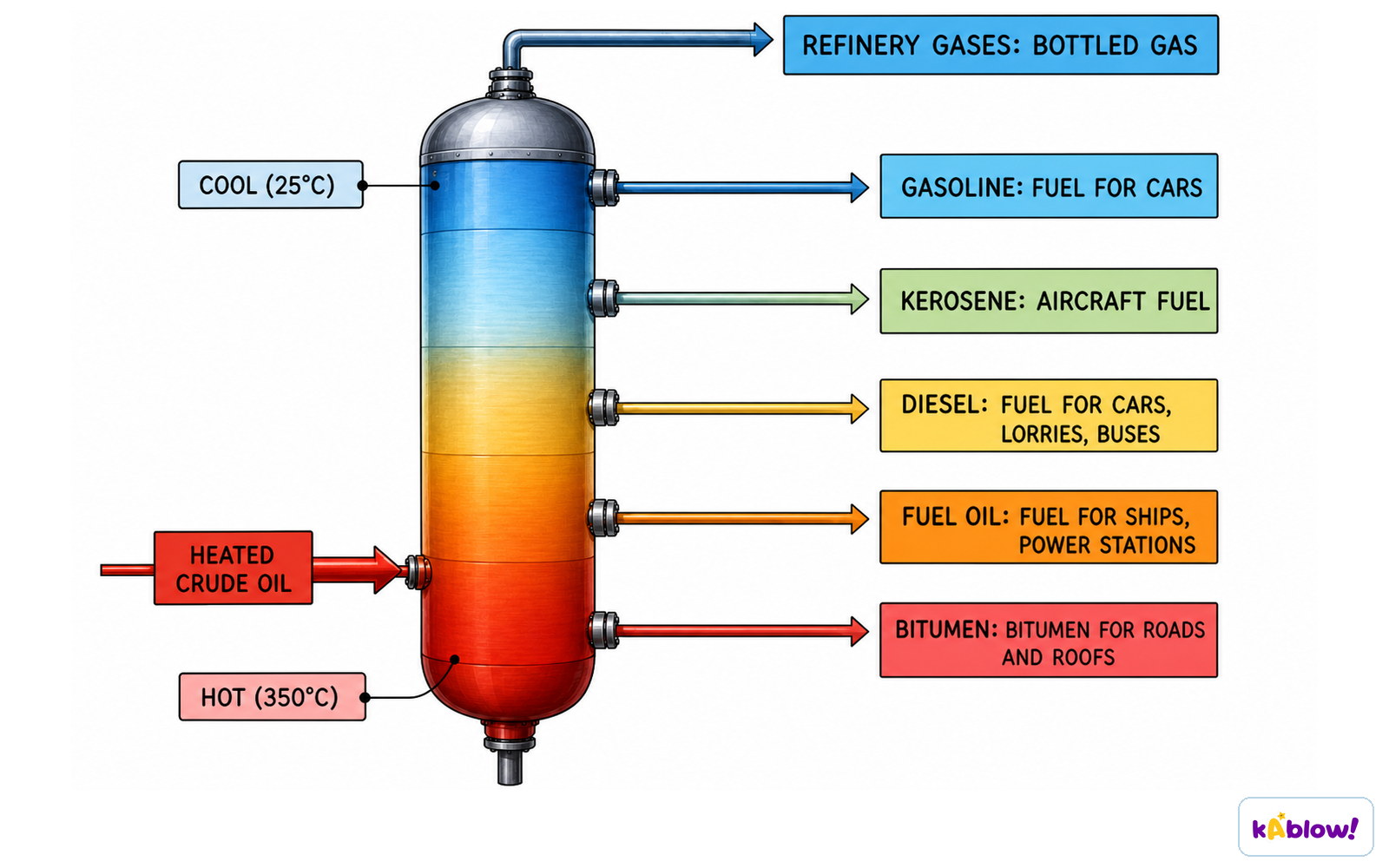
- Petroleum is a mixture of hydrocarbons separated by fractional distillation into fractions with similar boiling points.
- Fractional distillation uses a column with a temperature gradient: hot at bottom, cool at top.
- Properties of fractions: as chain length increases, viscosity increases, volatility decreases, and boiling point increases.
- Uses: refinery gas (heating/cooking), gasoline (car fuel), naphtha (chemicals), kerosene (jet fuel), diesel (engines), fuel oil (ships), lubricating oil, bitumen (roads).
Fractional distillation of petroleum
Alkanes
- Alkanes are saturated hydrocarbons with only single C–C bonds; general formula CₙH₂ₙ₊₂.
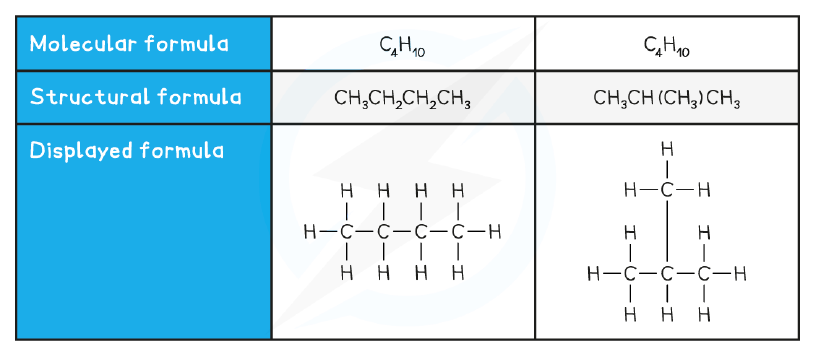
- First five: methane (CH₄), ethane (C₂H₆), propane (C₃H₈), butane (C₄H₁₀), pentane (C₅H₁₂).
- They undergo complete combustion: alkane + O₂ → CO₂ + H₂O.
- They can be cracked into smaller molecules (alkanes, alkenes, H₂).
- Substitution reaction with halogens (e.g., Cl₂) in UV light: H atom replaced by halogen (e.g., CH₄ + Cl₂ → CH₃Cl + HCl).
Butane and its branched isomer
Alkenes
- Alkenes are unsaturated hydrocarbons containing at least one C=C double bond; general formula CₙH₂ₙ.
- First four: ethene (C₂H₄), propene (C₃H₆), but-1-ene (C₄H₈), pent-1-ene (C₅H₁₀).
- Catalytic cracking of long-chain alkanes (600–700°C, alumina/silica catalyst) produces shorter alkanes, alkenes, and H₂.
- Alkenes decolourise bromine water (orange → colourless) – test for unsaturation; alkanes do not.
- More reactive than alkanes due to the C=C bond.
But-1-ene, an alkene
Addition Reactions (Extended)
- In addition reactions, atoms add across the C=C bond; only one product formed.
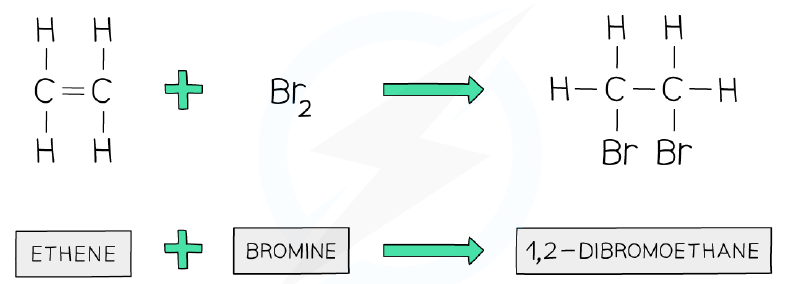
- With bromine: ethene + Br₂ → 1,2-dibromoethane (saturated).
- With hydrogen (Ni catalyst): ethene + H₂ → ethane.
- With steam (hydration, acid catalyst): ethene + H₂O → ethanol.
- These reactions produce saturated compounds from alkenes.
Addition reaction of ethene and bromine
Alcohols
- Alcohols contain the hydroxyl (-OH) functional group; general formula CₙH₂ₙ₊₁OH.
- First three: methanol (CH₃OH), ethanol (C₂H₅OH), propanol (C₃H₇OH).
- Ethanol is used in alcoholic drinks, as a fuel, and as a solvent; burns to CO₂ and H₂O.
- Manufacture: hydration of ethene (300°C, 60 atm, H₃PO₄ catalyst) – continuous, pure product, uses non-renewable crude oil.
- Manufacture: fermentation of glucose (yeast, 25–35°C, anaerobic) – batch process, renewable, dilute product.
- Fermentation equation: C₆H₁₂O₆ → 2CO₂ + 2C₂H₅OH.
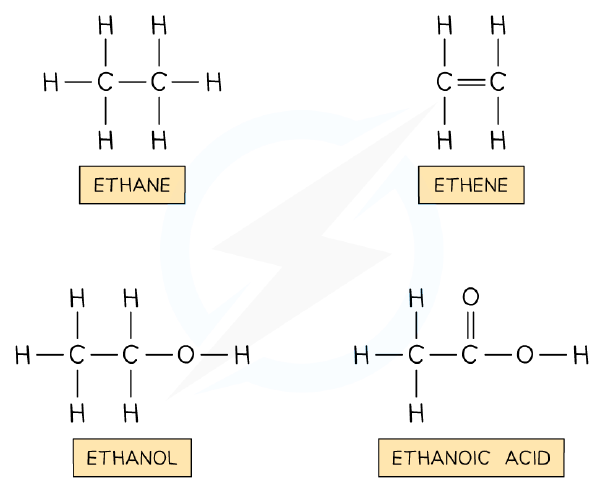
Displayed formulae of ethane, ethene, ethanol and ethanoic acid
Carboxylic Acids
- Carboxylic acids contain the -COOH group; they behave as typical acids.
- React with metals: e.g., 2CH₃COOH + Mg → (CH₃COO)₂Mg + H₂.
- React with bases (neutralisation): CH₃COOH + KOH → CH₃COOK + H₂O.
- React with carbonates: 2CH₃COOH + K₂CO₃ → 2CH₃COOK + H₂O + CO₂.
- Salts end in -anoate (e.g., ethanoate from ethanoic acid).
Displayed formulae of ethane, ethene, ethanol and ethanoic acid
Ethanoic Acid & Esterification (Extended)
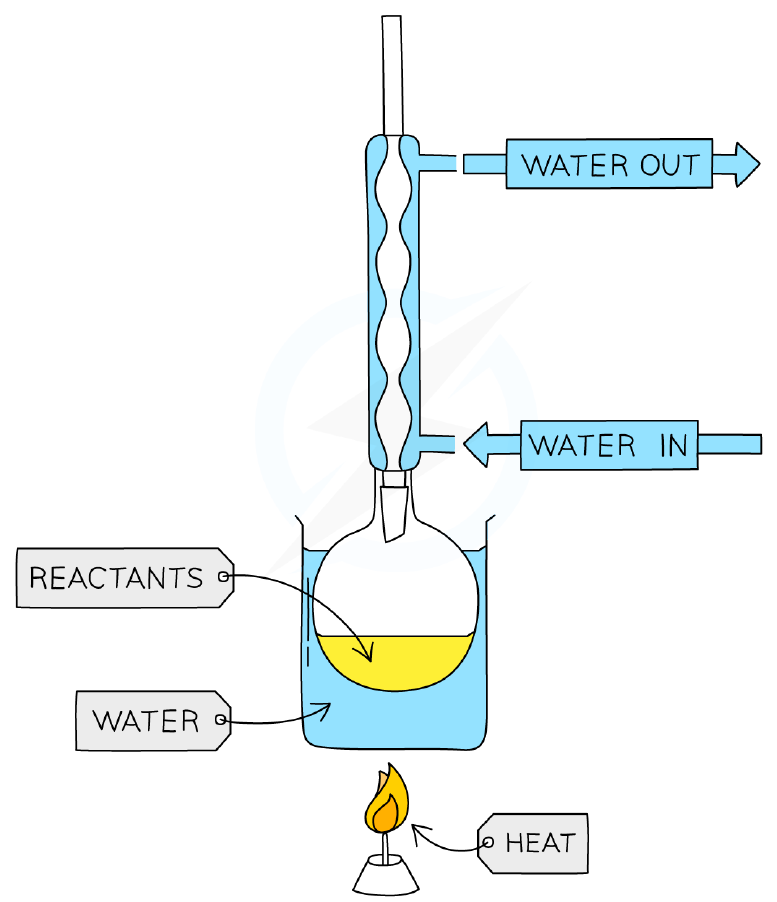
- Ethanoic acid (CH₃COOH) is made by oxidation of ethanol: via fermentation (air, bacteria) or using acidified KMnO₄ (purple → colourless).
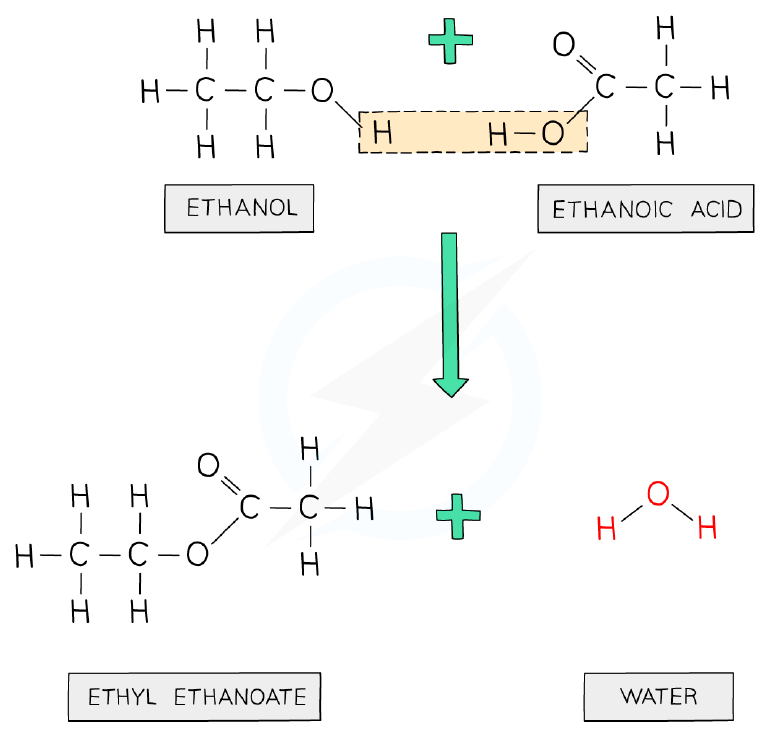
- Esterification: alcohol + carboxylic acid → ester + water, with concentrated H₂SO₄ catalyst.
- Example: CH₃COOH + C₂H₅OH ⇌ CH₃COOC₂H₅ (ethyl ethanoate) + H₂O.
- Esters are sweet-smelling oils used in flavourings and perfumes.
- Naming: first part from alcohol (ends -yl), second from acid (ends -oate); e.g., pentanol + butanoic acid → pentyl butanoate.
Reflux apparatus for the oxidation of ethanol
Slides
Sign up free to view the lesson slides
Step through every slide for this topic — plus flashcards and revision notes — with a free account.
Practice questions
Free preview — 8 of 48 questions. Sign up to see them all.
1.What is meant by the term hydrocarbon?
Easy- AA compound containing hydrogen and carbon only
- BA compound containing carbon and oxygen only
- CA compound containing hydrogen, carbon and oxygen
- DA compound containing carbon and nitrogen only
2.What is meant by the term saturated in the context of hydrocarbons?
Easy- AContains only single carbon-carbon bonds
- BContains at least one carbon-carbon double bond
- CContains the maximum number of hydrogen atoms possible
- DContains only carbon and hydrogen atoms
3.What is the general formula for the homologous series of alkanes?
Easy- ACₙH₂ₙ₊₂
- BCₙH₂ₙ
- CCₙH₂ₙ₋₂
- DCₙH₂ₙ₊₁OH
4.Which of the following is the correct equation for the complete combustion of methane?
Easy- ACH₄ + 2O₂ → CO₂ + 2H₂O
- BCH₄ + O₂ → CO₂ + H₂O
- CCH₄ + 2O₂ → CO + 2H₂O
- DCH₄ + 2O₂ → CO₂ + H₂
5.Which of the following is a test to distinguish between an alkane and an alkene?
Easy- AShake with bromine water; alkane remains orange, alkene turns colourless
- BShake with bromine water; alkane turns colourless, alkene remains orange
- CAdd sodium hydroxide; alkane produces gas, alkene does not
- DAdd silver nitrate; alkane gives precipitate, alkene does not
6.What are the products of the cracking of decane (C₁₀H₂₂) when it produces octane and ethene?
Medium- AC₈H₁₈ and C₂H₄
- BC₈H₁₆ and C₂H₆
- CC₈H₁₈ and C₂H₆
- DC₈H₁₆ and C₂H₄
7.In the esterification reaction between ethanoic acid and ethanol, which catalyst is used?
Easy- AConcentrated sulfuric acid
- BNickel
- CPhosphoric acid
- DAlumina
8.Which of the following fractions of crude oil is used as fuel for cars?
Easy- AGasoline (petrol)
- BKerosene
- CDiesel
- DBitumen
Unlock all 48 questions & more
Create a free account to see every question, the slides, flashcards and revision notes for this topic.