Reactivity Series & Corrosion Of Metals
Learn it by playing
Answer these questions to earn energy, then fish and explore. No account needed.
Lesson notes
Reactivity Series
- The reactivity series lists metals in order of their reactivity based on reactions with water and acids.
- Non-metals carbon and hydrogen are included for extraction and displacement contexts.
- Order (most to least reactive): K, Na, Ca, Mg, Al, C, Zn, Fe, H, Cu, Ag, Au.
- Mnemonic: “Please send cats, monkeys and cute zebras into hot countries signed Gordon”.
- Metals above hydrogen react with dilute HCl; those below do not.
- More reactive metals react more vigorously with water and acids.
Reactions with Water and Steam
- K, Na, Ca react with cold water: metal + water → metal hydroxide + hydrogen.
- K reacts violently, Na quickly, Ca less strongly.
- Mg reacts very slowly with cold water but vigorously with steam: Mg + H₂O → MgO + H₂.
- Metals below Mg do not react with cold water or steam.
Reactions with Dilute Hydrochloric Acid
- Metals above H in the series react: metal + 2HCl → metal chloride + H₂.
- Mg, Zn, Fe react; Cu, Ag, Au do not.
- Reaction vigour increases with reactivity: Mg > Zn > Fe.
- K and Na react explosively with acids.
Displacement Reactions (Extended)
- A more reactive metal displaces a less reactive metal from its salt solution.
- More reactive metals lose electrons more easily (better reducing agents).
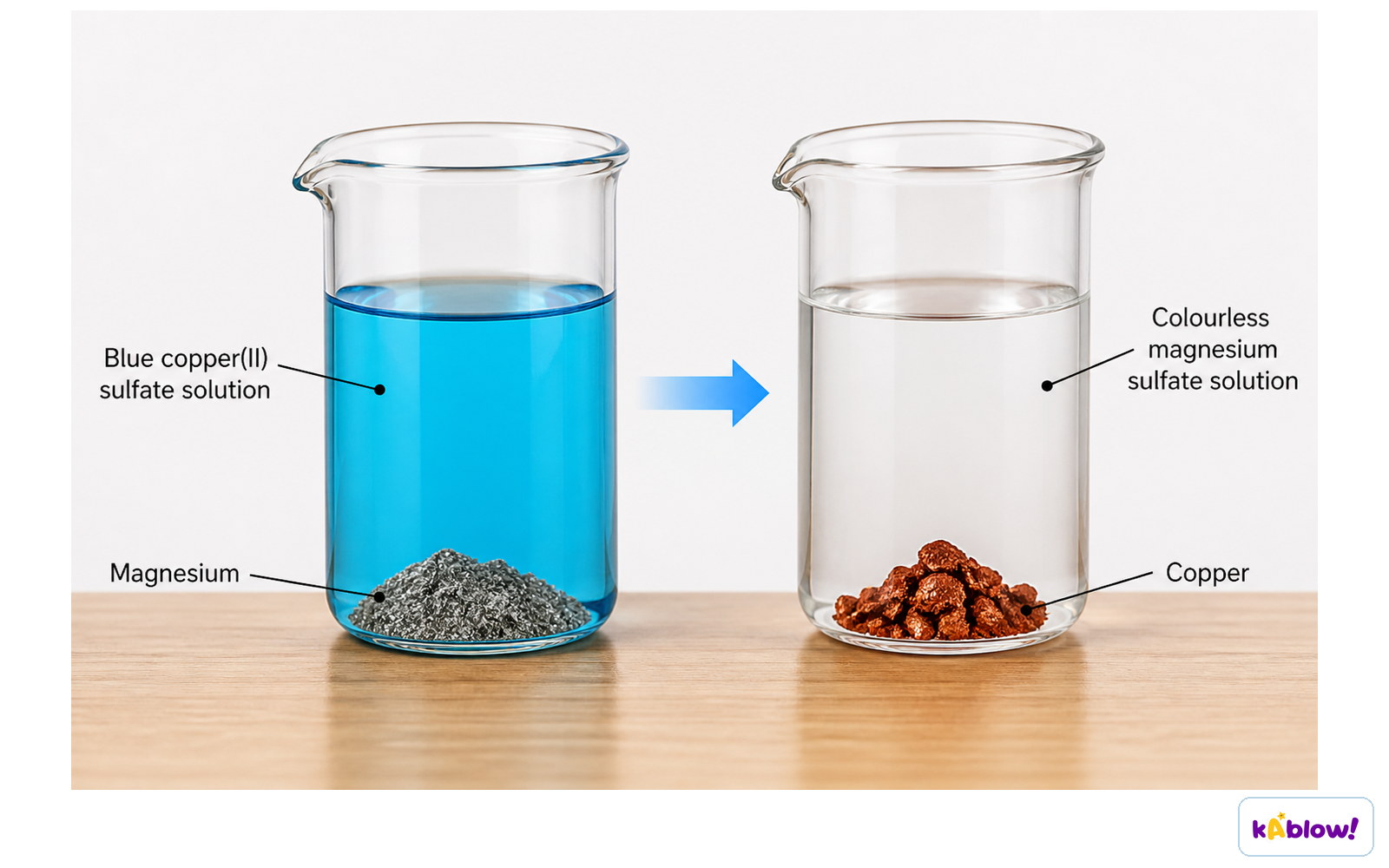
- Example: Mg + CuSO₄ → MgSO₄ + Cu (blue solution fades, copper deposits).
- No reaction occurs if the added metal is less reactive than the metal in the salt.
- Displacement experiments can determine relative reactivity order.
Displacement of copper by magnesium
Explaining Reactivity (Extended)
- Reactivity depends on the tendency to lose electrons and form positive ions.
- Metals high in the series lose electrons easily; low metals lose electrons with difficulty.
- Aluminium appears less reactive due to a protective oxide layer (Al₂O₃).
Rusting of Iron
- Rusting requires iron, water, and oxygen; product is hydrated iron(III) oxide (reddish-brown).
- Word equation: iron + water + oxygen → hydrated iron(III) oxide.
- Only iron or steel rusts; other metals corrode (not rust).
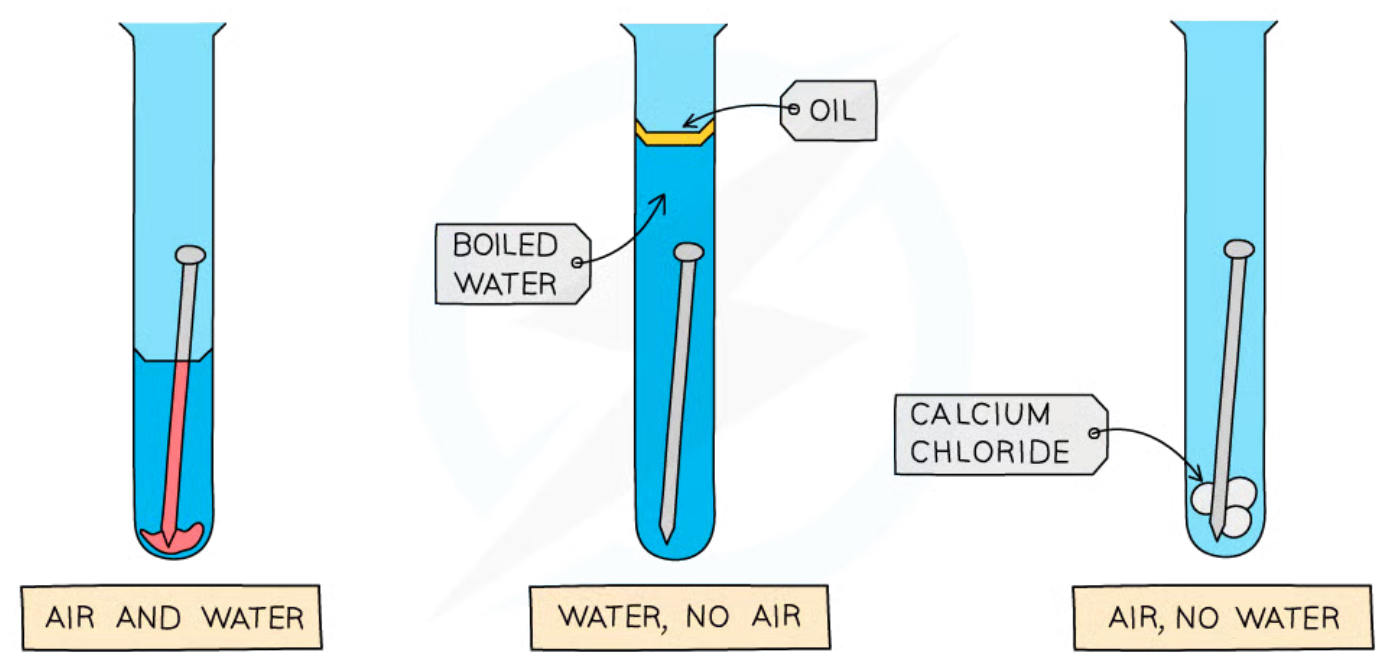
- Investigating rusting: nail in air+water rusts; nail in boiled water+oil (no air) does not; nail with calcium chloride (no water) does not.
Requirements for rusting
Rust Prevention: Barrier Methods
- Barrier methods coat iron/steel to exclude water and oxygen.
- Common barriers: grease, oil, paint, plastic.
- If the coating is scratched, the iron is exposed and will rust.
Galvanising & Sacrificial Protection (Extended)
- Galvanising coats iron with a layer of zinc (by electroplating or dipping in molten zinc).
- Zinc forms ZnCO₃ barrier; if scratched, zinc provides sacrificial protection.
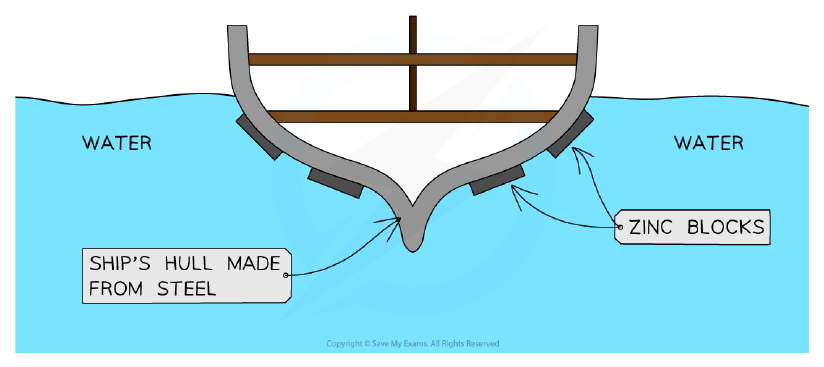
- Sacrificial protection attaches a more reactive metal (e.g., zinc) to iron.
- Zinc oxidises preferentially: Zn → Zn²⁺ + 2e⁻, protecting the iron.
- Zinc blocks on ship hulls must be replaced periodically.
Zinc bars on steel ship hulls
Slides
Sign up free to view the lesson slides
Step through every slide for this topic — plus flashcards and revision notes — with a free account.
Practice questions
Free preview — 8 of 42 questions. Sign up to see them all.
1.Which word equation represents the rusting of iron?
Easy- Airon + water + oxygen → hydrated iron(III) oxide
- Biron + water + hydrogen → hydrated iron(III) oxide
- Ciron + water + oxygen → hydrated iron(II) oxide
- Diron + water + hydrogen → hydrated iron(II) oxide
2.Which of the following metals does NOT react with dilute hydrochloric acid?
Easy- AMagnesium
- BZinc
- CCopper
- DIron
3.What is the chemical name for rust?
Easy- AIron(II) oxide
- BIron(III) oxide
- CHydrated iron(III) oxide
- DHydrated iron(II) oxide
4.Which of the following is a correct statement about the reactivity series?
Medium- APotassium reacts more vigorously with cold water than calcium.
- BCopper reacts with steam to form copper oxide and hydrogen.
- CCarbon is more reactive than zinc.
- DGold reacts with dilute hydrochloric acid.
5.In the context of rust prevention, what is galvanising?
Easy- ACoating iron with a layer of zinc.
- BAttaching a more reactive metal to iron.
- CPainting iron with oil.
- DPlating iron with copper.
6.The following section of the reactivity series shows a newly discovered element, Y. The only oxide of Y has the formula YO. Ca Mg Fe Y H Cu Which of the equations shows a reaction which would take place?
Hard- A2Y(s) + Cu²⁺(aq) → 2Y⁺(aq) + Cu(s)
- BY(s) + Fe₂O₃(s) → 2Fe(s) + 3YO(s)
- CY(s) + 2HCl(aq) → YCl₂(aq) + H₂(g)
- DCu(s) + Y²⁺(aq) → Cu²⁺(aq) + Y(s)
7.In an experiment to investigate the composition of air, a student left iron nails in a test tube inverted over water. After one week, the water level inside the test tube rose. Which statement explains why the water level rose?
Medium- ANitrogen monoxide was produced.
- BIron oxide was produced.
- CThe temperature of the water increased.
- DSulfur dioxide was produced.
8.A student adds zinc to copper(II) sulfate solution. Which observations are correct for this reaction?
Medium- ASolution colour stays the same; pale grey crystals forming.
- BSolution turns darker blue; grey residue on the metal.
- CSolution turns orange/brown; blue crystals form on the metal.
- DSolution turns paler blue; orange/brown residue on the metal.
Unlock all 42 questions & more
Create a free account to see every question, the slides, flashcards and revision notes for this topic.