The Characteristic Properties Of Acids & Bases
Learn it by playing
Answer these questions to earn energy, then fish and explore. No account needed.
Lesson notes
Properties of Acids
- Acids have pH < 7, sour taste (if edible), and are corrosive.
- Acids neutralise bases to form a salt and water.
- In water, acids produce H⁺ ions (e.g., HCl → H⁺ + Cl⁻).
- Acids react with metals (above H in reactivity series) to give salt + hydrogen.
- Acids react with metal carbonates to give salt + CO₂ + water.
- Acids react with bases (metal oxides/hydroxides) to give salt + water (neutralisation).
Properties of Bases & Alkalis
- Bases have pH > 7; a water‑soluble base is an alkali.
- Bases neutralise acids to form a salt and water.
- In water, alkalis produce OH⁻ ions (e.g., NaOH → Na⁺ + OH⁻).
- Alkalis react with ammonium salts on warming to produce ammonia gas (damp red litmus turns blue).
- Common bases are metal oxides and metal hydroxides.
Indicators
- Indicators change colour in acid or alkali; litmus (red in acid, blue in alkali) is from lichens.
- Methyl orange: red in acid, yellow in alkali.
- Thymolphthalein: colourless in acid, blue in alkali.
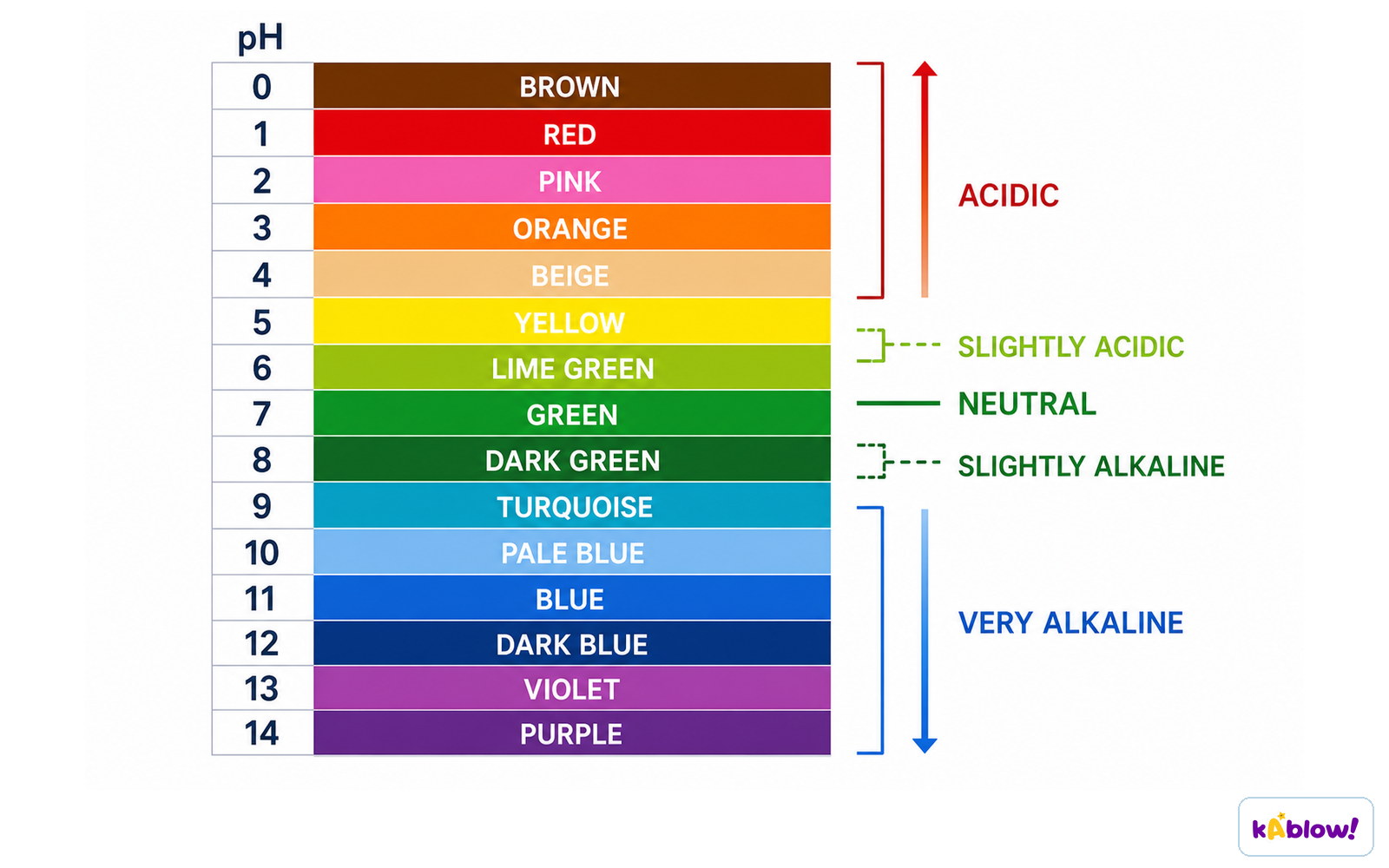
- Universal indicator is a mixture giving a range of colours to estimate pH.
- Synthetic indicators (methyl orange, thymolphthalein) have sharp colour changes for titrations; litmus is not suitable for titrations.
Universal indicator colours across the pH scale
The Ions in Acids & Alkalis & Neutralisation
- Acids are sources of H⁺ ions; alkalis are sources of OH⁻ ions.
- Neutralisation: H⁺(aq) + OH⁻(aq) → H₂O(l).
- Not all acid reactions are neutralisations (e.g., acid + metal produces no water).
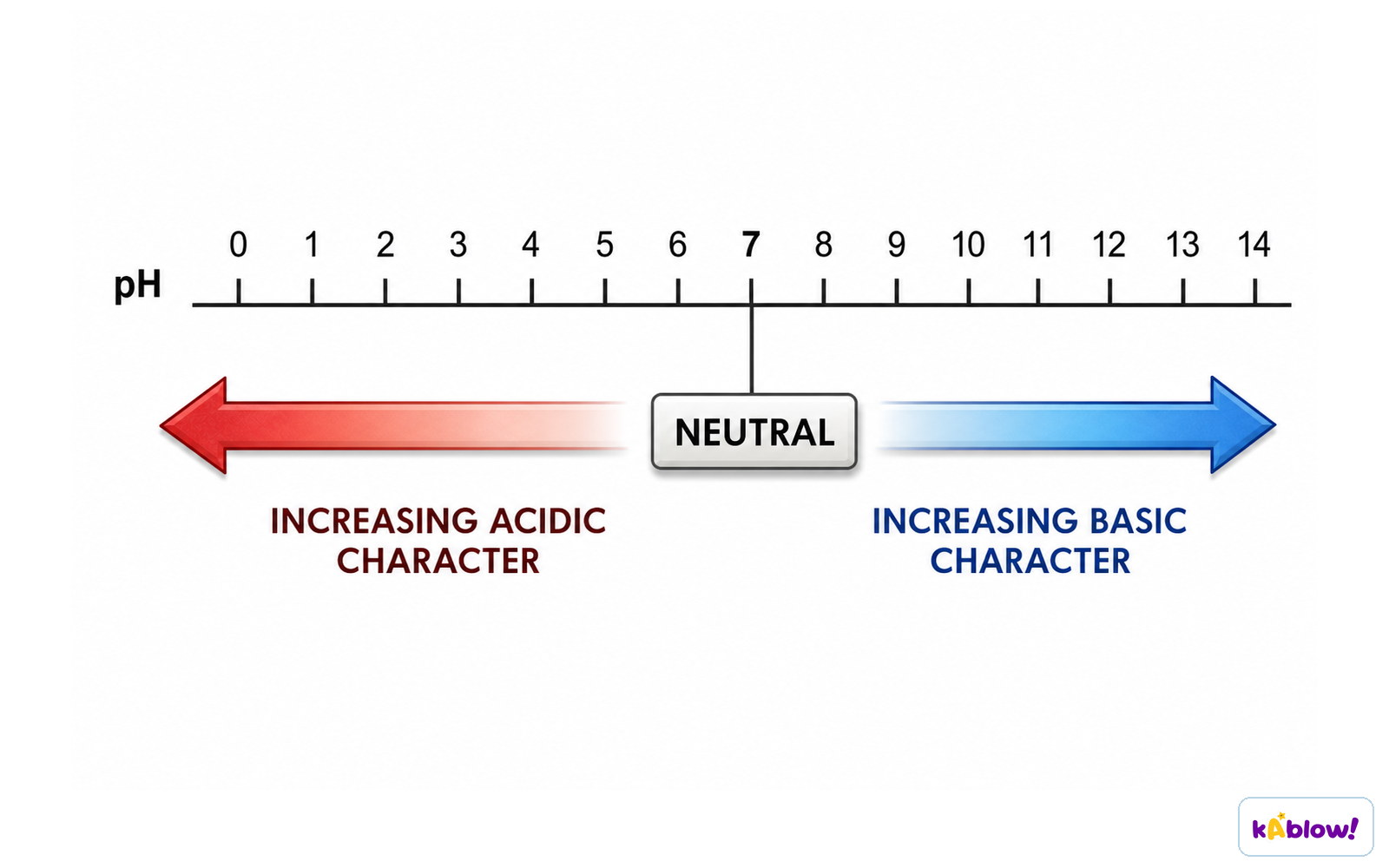
- The pH scale runs 0–14; pH < 7 = acid, pH = 7 = neutral, pH > 7 = alkali.
- pH is a logarithmic measure of H⁺ concentration: a change of 1 pH unit = ×10 change in [H⁺].
- Strong acids have pH 0–2; weak acids pH 3–6; weak alkalis pH 8–11; strong alkalis pH 12–14.
The pH scale showing acidity, neutrality and alkalinity
Proton Transfer (Extended Tier)
- Acids are proton donors (H⁺ = proton).
- Bases are proton acceptors.
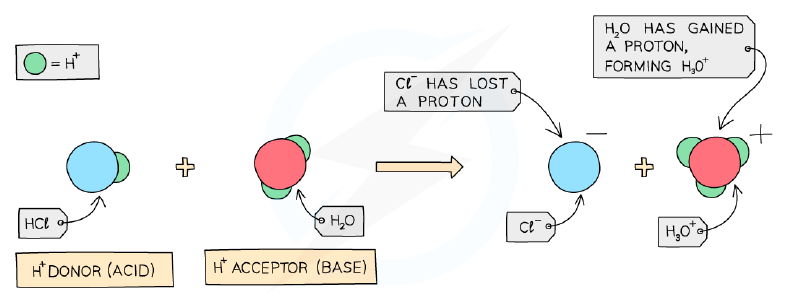
- In water, HCl donates a proton to H₂O, forming H₃O⁺ and Cl⁻.
Proton transfer between hydrochloric acid and water
Strong & Weak Acids (Extended Tier)
- Strong acids completely dissociate in water (e.g., HCl, H₂SO₄).
- Weak acids partially dissociate; an equilibrium exists (e.g., CH₃CH₂COOH ⇌ H⁺ + CH₃CH₂COO⁻).
- Concentration ≠ strength: a dilute strong acid can be more acidic than a concentrated weak acid.
- Weak acids have pH closer to 7 (e.g., propanoic acid pH ≈ 5).
Classifying Oxides
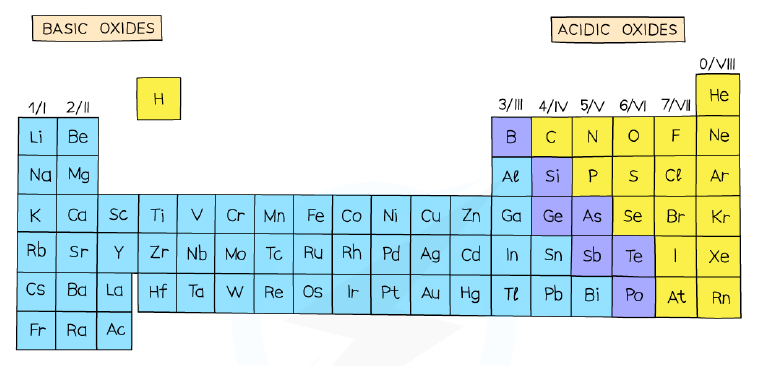
- Acidic oxides (non‑metal + oxygen): react with bases to form salt + water; produce acidic solutions (e.g., CO₂, SO₂).
- Basic oxides (metal + oxygen): react with acids to form salt + water; produce alkaline solutions (e.g., CuO, CaO).
- Amphoteric oxides (e.g., ZnO, Al₂O₃) react with both acids and bases to give salt + water.
- Neutral oxides (e.g., N₂O, NO, CO) do not react with acids or bases.
- Al₂O₃ + 6HCl → 2AlCl₃ + 3H₂O (as base); Al₂O₃ + 2NaOH → 2NaAlO₂ + H₂O (as acid).
Metals form basic oxides while non-metals form acidic oxides
Slides
Sign up free to view the lesson slides
Step through every slide for this topic — plus flashcards and revision notes — with a free account.
Practice questions
Free preview — 8 of 40 questions. Sign up to see them all.
1.Which of the following is a property of acids?
Easy- AThey have a pH greater than 7
- BThey turn blue litmus red
- CThey are proton acceptors
- DThey release hydroxide ions in water
2.Which ion is present in aqueous solutions of alkalis?
Easy- AH⁺
- BOH⁻
- CCl⁻
- DNa⁺
3.What is the colour of methyl orange in an alkaline solution?
Easy- ARed
- BYellow
- CBlue
- DColourless
4.Which of the following statements about strong and weak acids is correct?
Medium- AA strong acid has a higher pH than a weak acid of the same concentration
- BA weak acid partially dissociates in water
- CA strong acid has a lower concentration of hydrogen ions than a weak acid
- DA weak acid completely dissociates in water
5.Which type of oxide is formed when a non-metal combines with oxygen?
Medium- ABasic oxide
- BAcidic oxide
- CAmphoteric oxide
- DNeutral oxide
6.Which substance could be used to neutralise an acid?
Medium- ALemon juice (pH 2)
- BBattery acid (pH 1)
- CToothpaste (pH 8)
- DVinegar (pH 3)
7.Which gas is produced when an acid reacts with a metal carbonate?
Medium- AHydrogen
- BOxygen
- CCarbon dioxide
- DAmmonia
8.The pH of acid X is 6 and the pH of acid Y is 3. Which statement is correct?
Hard- AThe hydrogen ion concentration of acid X is 1000 times greater than acid Y
- BThe hydrogen ion concentration of acid Y is 3 times greater than acid X
- CThe hydrogen ion concentration of acid Y is 1000 times greater than acid X
- DThe hydrogen ion concentration of acid X is 100 times greater than acid Y
Unlock all 40 questions & more
Create a free account to see every question, the slides, flashcards and revision notes for this topic.