Enzymes
Learn it by playing
Answer these questions to earn energy, then fish and explore. No account needed.
Lesson notes
What Are Enzymes?
- Enzymes are biological catalysts that speed up chemical reactions without being changed or used up.
- They are proteins made in living cells.
- Enzymes maintain metabolic reaction speeds at a rate that can sustain life.
- Without enzymes, digestion would take 2–3 weeks per meal; with enzymes it takes ~4 hours.
Enzyme Action & Specificity (Extended)
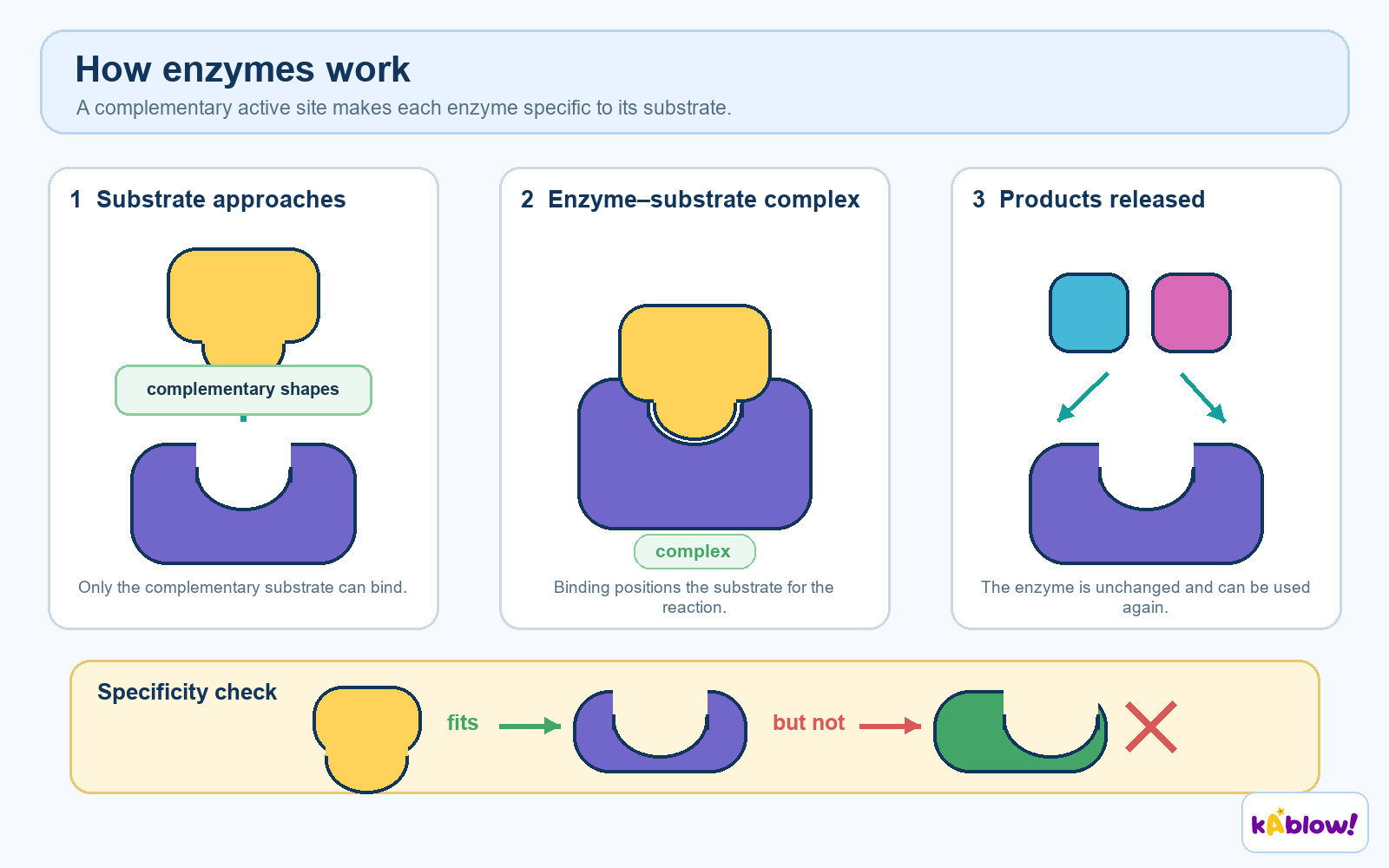
- Each enzyme has a specific active site with a shape complementary to its substrate (lock and key hypothesis).
- When substrate binds to the active site, an enzyme-substrate complex forms.
- After the reaction, products leave the active site; the enzyme is unchanged and can catalyse further reactions.
- Enzymes and substrates move randomly in solution; collisions lead to reaction when shapes match.
How enzymes work
Effect of Temperature (Extended)
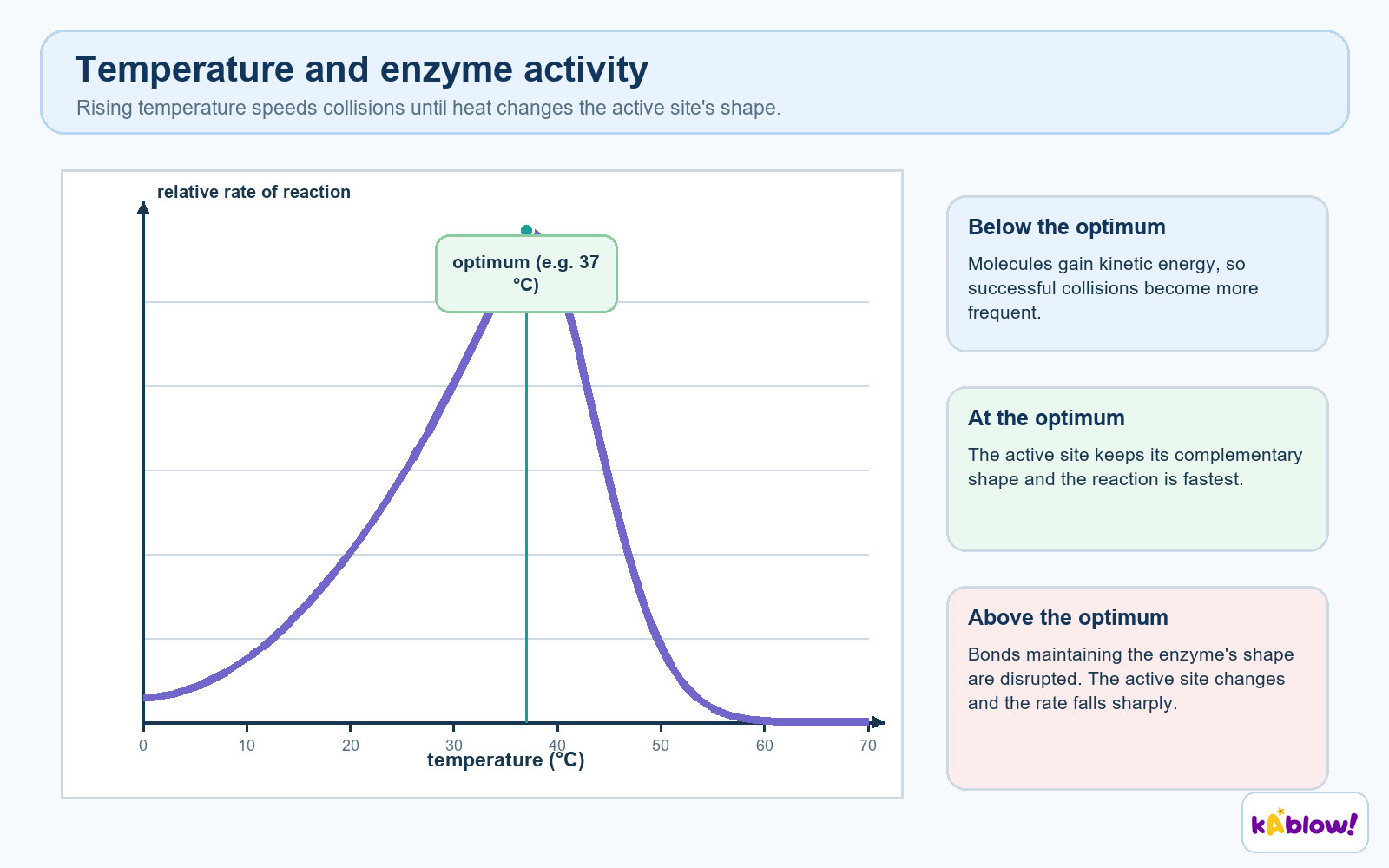
- Enzymes have an optimum temperature (e.g., 37 °C in the human body) where activity is fastest.
- Increasing temperature from 0 °C to optimum increases kinetic energy, more collisions, faster rate.
- Above optimum, bonds holding the enzyme's shape break → denaturation (active site changes shape irreversibly).
- Low temperatures slow activity but do not denature enzymes.
Graph showing the effect of temperature on the rate of enzyme activity
Effect of pH (Extended)
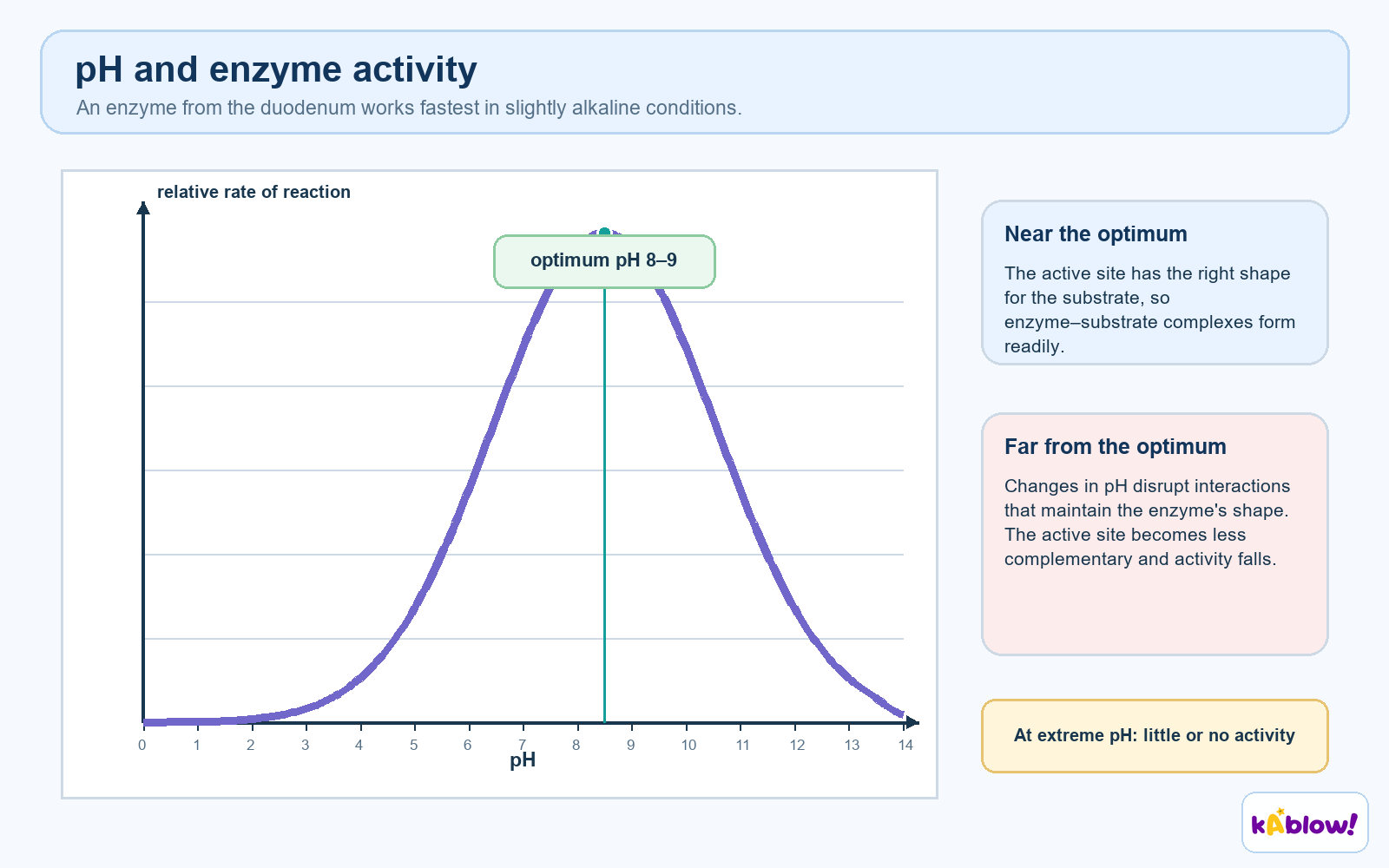
- Most enzymes have an optimum pH near 7; some (e.g., in stomach) work best at pH 2; others (e.g., in duodenum) at pH 8–9.
- Extreme pH disrupts bonds in the protein, altering the active site shape → denaturation.
- Moving away from optimum pH reduces activity; too far causes irreversible denaturation.
Graph showing the effect of pH on rate of activity for an enzyme from the duodenum
Investigating Enzyme Activity
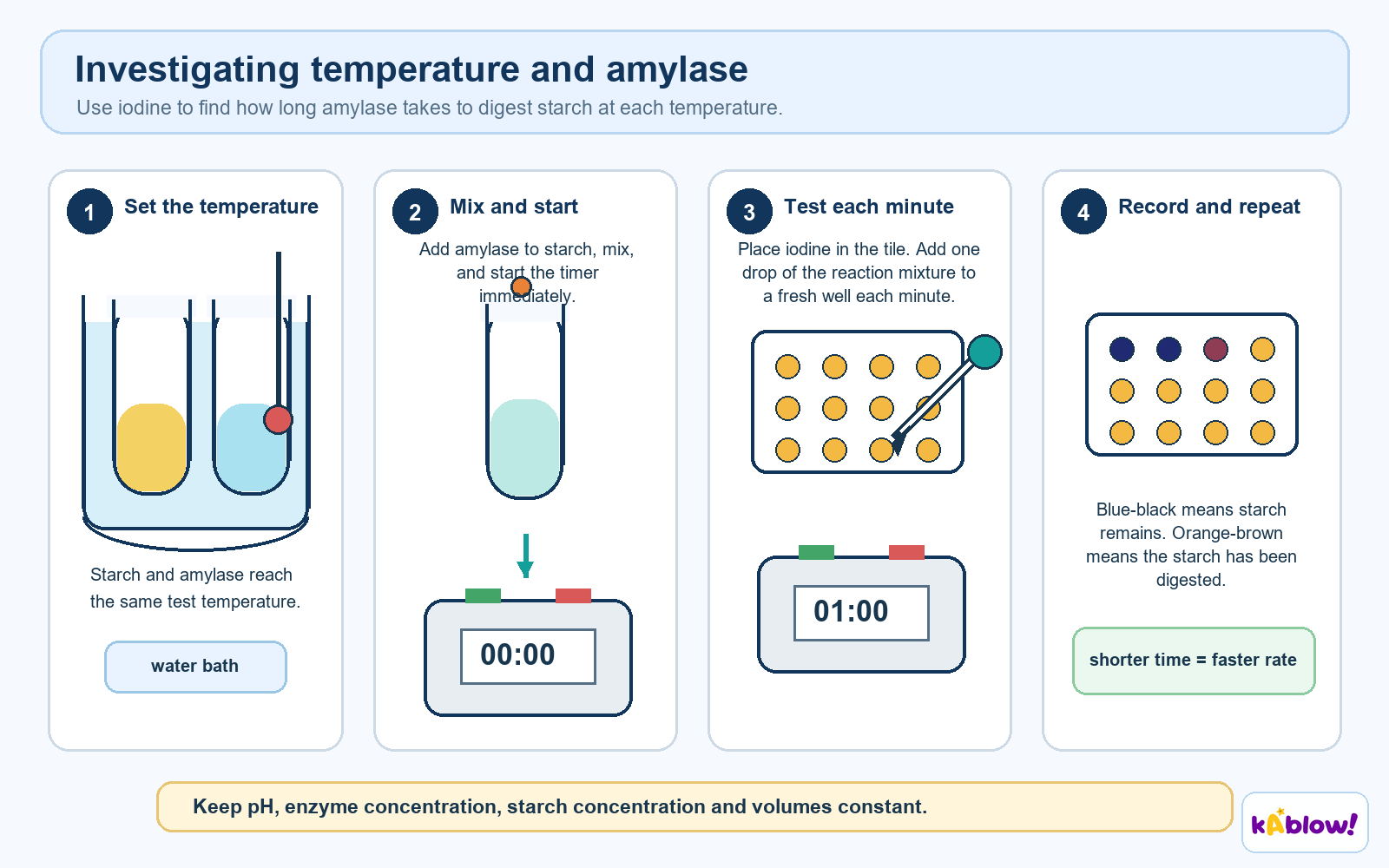
- Temperature investigation: Heat starch and amylase at set temperatures; test with iodine every minute until no blue-black colour (starch digested).
- pH investigation: Mix amylase, buffer, and starch; test with iodine every 10 s until orange-brown (starch digested).
- Shorter time to digest starch indicates higher enzyme activity at that temperature/pH.
- Always control variables like enzyme concentration, substrate volume, and temperature (except the independent variable).
Investigating the effect of temperature on amylase activity
Slides
Sign up free to view the lesson slides
Step through every slide for this topic — plus flashcards and revision notes — with a free account.
Practice questions
Free preview — 8 of 54 questions. Sign up to see them all.
1.Which of the following best describes what an enzyme is?
Easy- AA catalyst that speeds up reactions in cells, being used up in the process
- BA protein that speeds up reactions in cells, being used up in the process
- CA carbohydrate that functions as a biological catalyst
- DA protein that functions as a biological catalyst
2.What is a feature of all catalysts?
Easy- AThey are made from protein
- BThey are not changed by the reaction
- CThey are broken down in the reaction
- DThey are altered by the rate of the reaction
3.What can be said to be true of all enzymes?
Medium- Atheir optimum pH is 7
- Bthey are made from amino acids
- Cthey move about randomly in a fluid
- Dthey are all proteins
4.Name the group of compounds that ensures metabolic reactions take place in living organisms at a speed necessary to sustain life.
Easy5.The pH of an enzyme-controlled reaction is decreased by a pH of 2. How does this affect the rate of the reaction?
Medium- AIt has no effect on the rate.
- BIt always decreases the rate.
- CIt always increases the rate.
- DIt may increase or decrease the rate.
6.A student decided to investigate the effect of pH on the activity of the enzyme lipase. Five different test tubes are set up. Each test tube contains a mixture of the enzyme lipase and its substrate, a lipid. Which condition should not be kept the same in each of the five test tubes?
Medium- ATemperature
- BConcentration of lipase
- CVolume of lipid solution
- DpH
- 7.Medium
Starch is digested by the enzyme amylase. Four identical mixtures of starch and amylase were kept at different temperatures. The table shows the time taken for the starch to be completely digested at each temperature.
Temperature (°C) 10 20 30 40 Time taken (minutes) 18 9 4 11 At which temperature is the rate of reaction highest?
- A10°C
- B20°C
- C30°C
- D40°C
8.Fill in the blank to complete the sentence about enzymes.
EasyEnzymes are biological ____ that speed up chemical reactions without being changed.
Unlock all 54 questions & more
Create a free account to see every question, the slides, flashcards and revision notes for this topic.