Gas Exchange In Humans
Learn it by playing
Answer these questions to earn energy, then fish and explore. No account needed.
Lesson notes
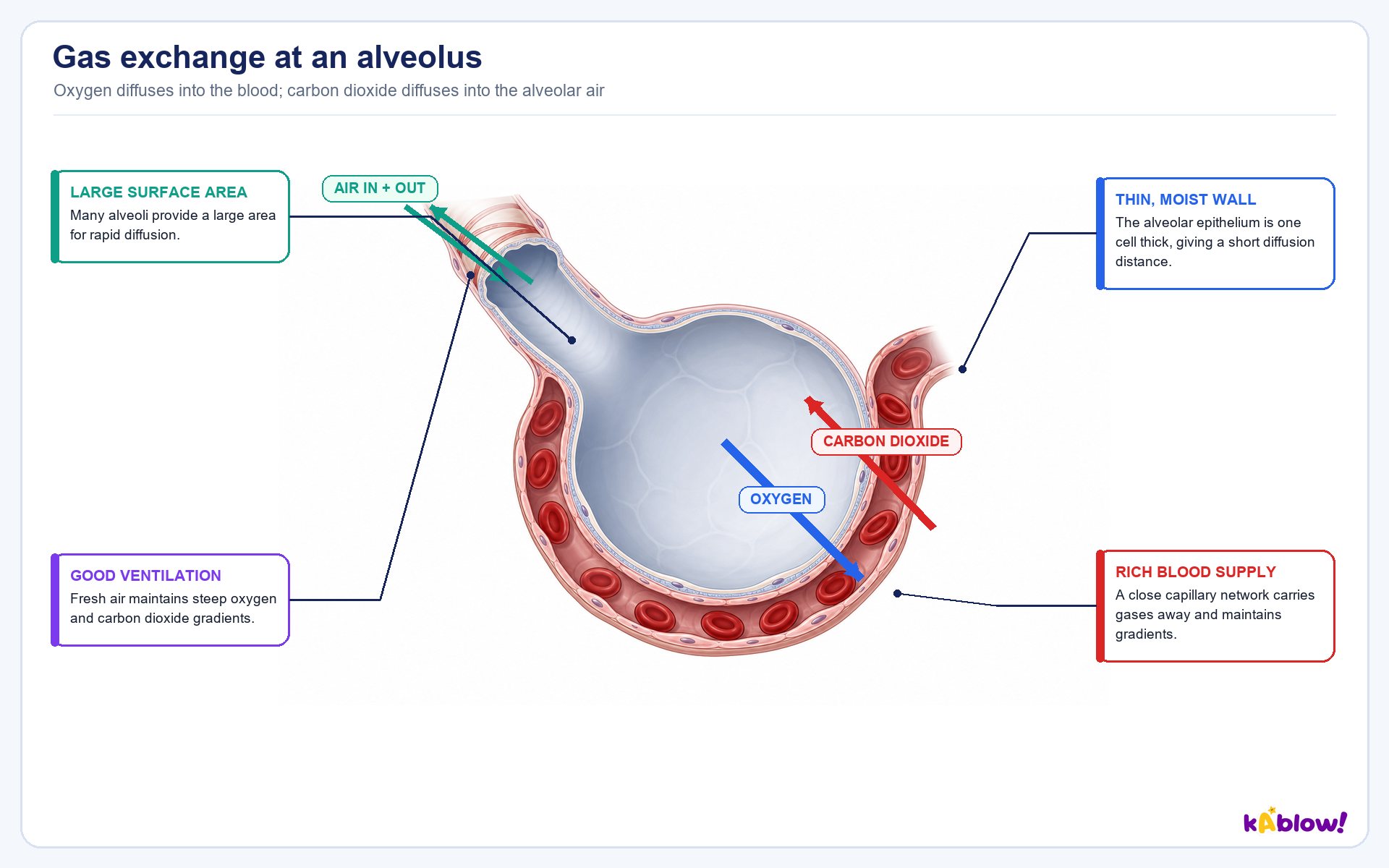
Features of Gas Exchange Surfaces
- All gas exchange surfaces share common features to maximise diffusion.
- Large surface area allows faster diffusion of gases.
- Thin walls ensure short diffusion distances.
- Good ventilation maintains diffusion gradients.
- Good blood supply maintains high concentration gradients.
- In humans, the alveolus is the gas exchange surface.
Features of gas exchange surfaces
The Breathing System
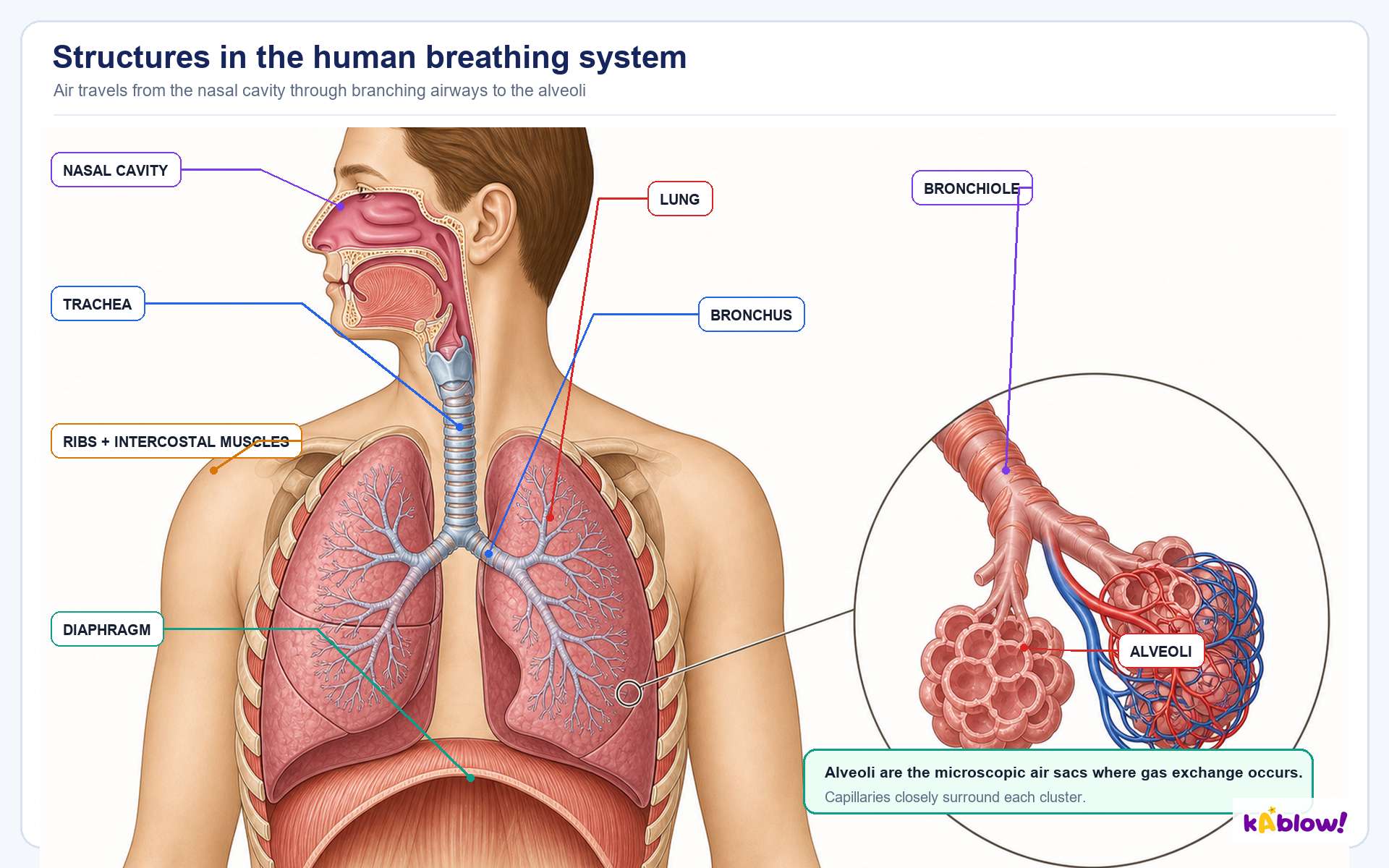
- Air enters through the nose/mouth, passes through the trachea.
- The trachea splits into two bronchi (one to each lung).
- Bronchi branch into smaller bronchioles.
- Bronchioles end in tiny air sacs called alveoli.
- The diaphragm and intercostal muscles help move air in and out.
- Rib cage protects the lungs.
Structures in the human breathing system
Investigating Differences in Inspired & Expired Air
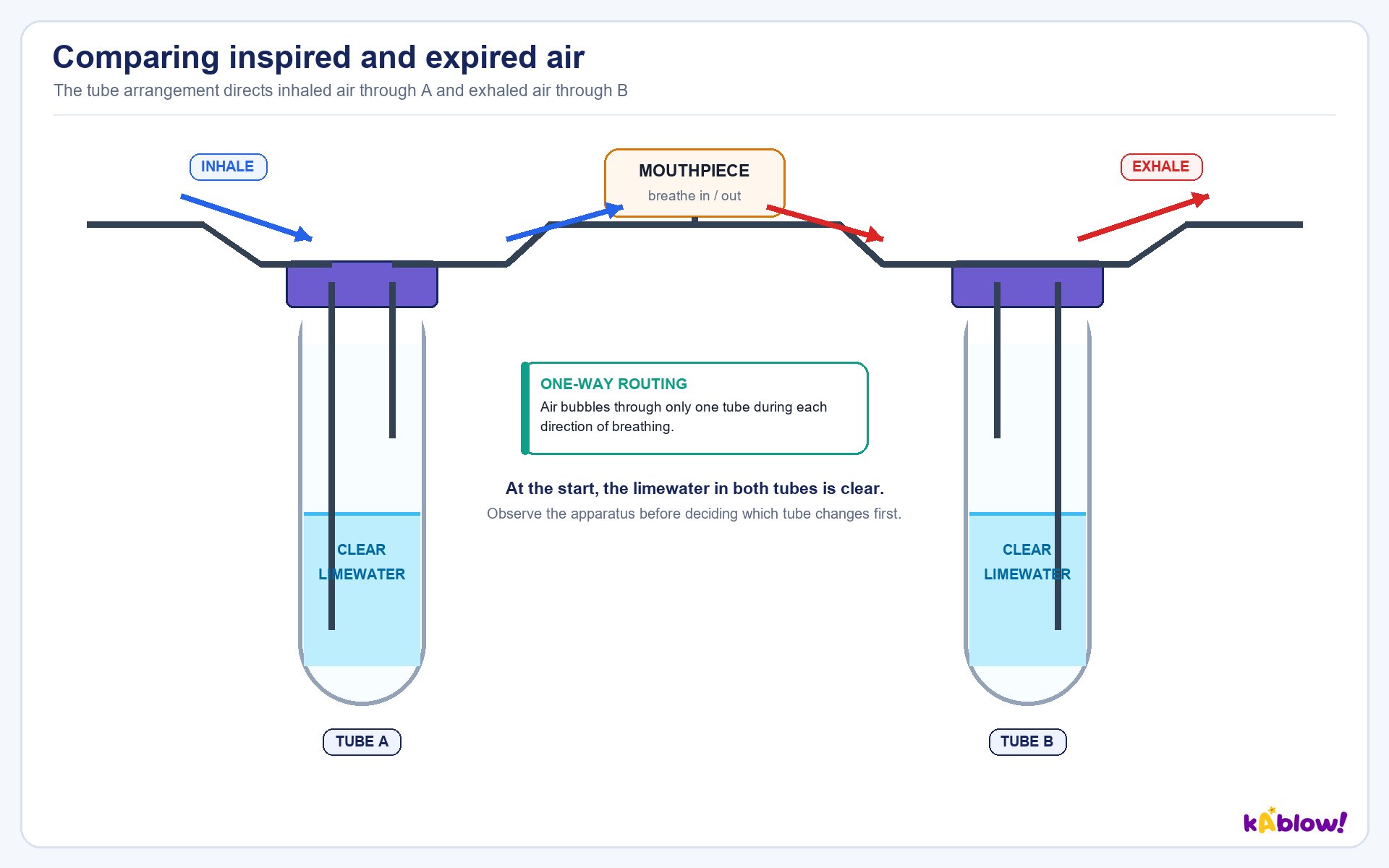
- Use limewater to test for carbon dioxide: clear → cloudy/milky with CO₂.
- Setup: inspired air drawn through boiling tube A, expired air blown into tube B.
- Tube A (inspired) limewater stays clear; tube B (expired) turns cloudy.
- Shows expired air has higher CO₂ concentration than inspired air.
The limewater test apparatus
Differences in Inspired & Expired Air
- Inspired air: ~21% oxygen, ~0.04% carbon dioxide, variable water vapour.
- Expired air: ~16% oxygen, ~4% carbon dioxide, ~1% more water vapour.
- Expired air is warmer due to heat from respiration.
- Differences result from gas exchange in alveoli.
Investigating Effects of Physical Activity on Breathing
- Exercise increases frequency and depth of breathing.
- Measure breaths per minute and chest expansion at rest.
- After ≥3 minutes exercise, measure again.
- Both breaths per minute and chest expansion increase after exercise.
Explaining Differences in Inspired & Expired Air (Extended)
- Oxygen diffuses from alveoli into blood; carbon dioxide diffuses from blood into alveoli.
- Oxygen used in respiration; carbon dioxide produced as a waste product.
- Water vapour added from moist surfaces of respiratory tract.
- Heat from respiration warms expired air.
Explaining the Link Between Physical Activity & Breathing (Extended)
- Muscles respire more during exercise, increasing oxygen demand and CO₂ production.
- Increased CO₂ in blood lowers pH (more acidic).
- Receptors in the brain detect changes in CO₂ and pH.
- Brain sends nerve impulses to diaphragm and intercostal muscles.
- Rate and depth of breathing increase to supply more O₂ and remove more CO₂.
- Respiration (chemical reactions) vs breathing (mechanical movement of air).
Slides
Sign up free to view the lesson slides
Step through every slide for this topic — plus flashcards and revision notes — with a free account.
Practice questions
Free preview — 8 of 57 questions. Sign up to see them all.
1.Which of the following is a feature of gas exchange surfaces that allows rapid diffusion?
Easy- AThick walls
- BSmall surface area
- CThin walls
- DPoor blood supply
2.What is the approximate percentage of oxygen in expired air?
Easy- A16%
- B4%
- C21%
- D0.04%
3.Which gas causes limewater to turn cloudy?
Easy- AOxygen
- BNitrogen
- CCarbon dioxide
- DWater vapour
4.Expired air contains more carbon dioxide than inspired air.
EasyTrue or false?
5.The alveoli have thick walls to prevent gas exchange.
EasyTrue or false?
6.State two features of the alveoli that make them efficient for gas exchange.
Medium7.What is the name of the process by which oxygen moves from the alveoli into the blood?
Easy8.Complete the sentence.
EasyThe site of gas exchange in humans is the al____.
Unlock all 57 questions & more
Create a free account to see every question, the slides, flashcards and revision notes for this topic.