Extraction Of Metals
Learn it by playing
Answer these questions to earn energy, then fish and explore. No account needed.
Lesson notes
Metals and Ores
- The Earth’s crust contains metals and metal compounds.
- A metal ore is a rock containing enough metal to make extraction worthwhile.
- Many metal ores are oxides (e.g., hematite – iron ore, bauxite – aluminium ore).
- Extraction involves removing oxygen from the compound, so it is a reduction process.
- Very unreactive metals like gold and platinum occur native (uncombined).
Reactivity Series and Extraction Method
- The higher a metal in the reactivity series, the harder it is to extract.
- Metals above carbon must be extracted by electrolysis (e.g., aluminium).
- Metals below carbon can be extracted by heating with carbon or carbon monoxide (e.g., iron in blast furnace).
- Very unreactive metals (e.g., gold, silver) are often found native or require little processing.
Extraction of Iron from Hematite – The Blast Furnace
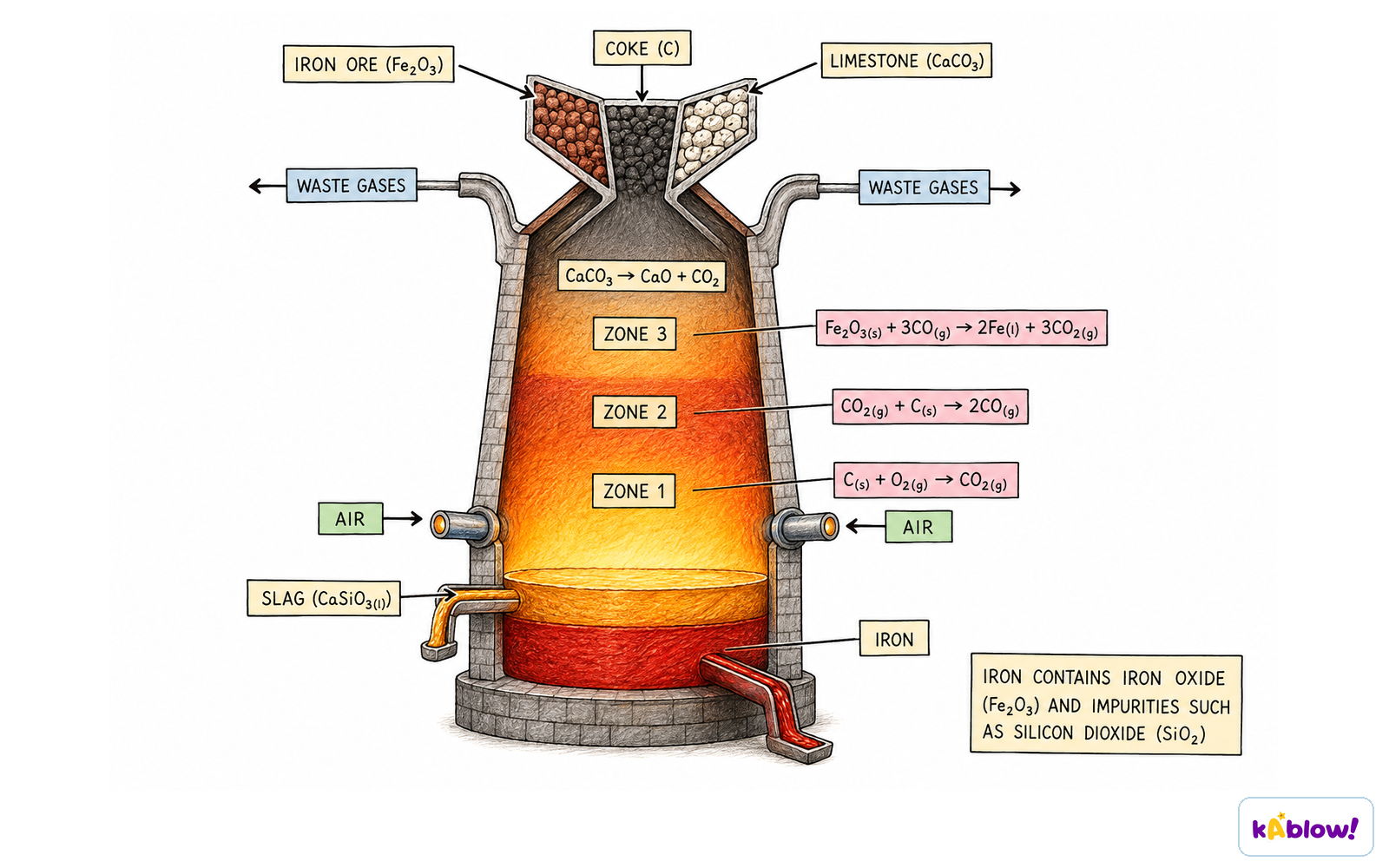
- Iron is extracted in a blast furnace from its ore hematite (Fe₂O₃).
- Raw materials: iron ore, coke (impure carbon), and limestone are added at the top.
- Hot air is blown into the bottom.
- Zone 1: Coke burns in hot air to form CO₂, providing heat: C + O₂ → CO₂.
- Zone 2: Coke reacts with CO₂ to form CO (main reducing agent): C + CO₂ → 2CO.
- Zone 3: CO reduces iron(III) oxide to molten iron: Fe₂O₃ + 3CO → 2Fe + 3CO₂.
- Limestone decomposes to CaO, which reacts with SiO₂ impurity to form slag (calcium silicate).
- Molten iron and slag are tapped off separately.
The blast furnace
Extraction of Aluminium from Bauxite – Electrolysis
- Aluminium is above carbon in the reactivity series, so it cannot be reduced by carbon.
- Its ore is bauxite (aluminium oxide, Al₂O₃).
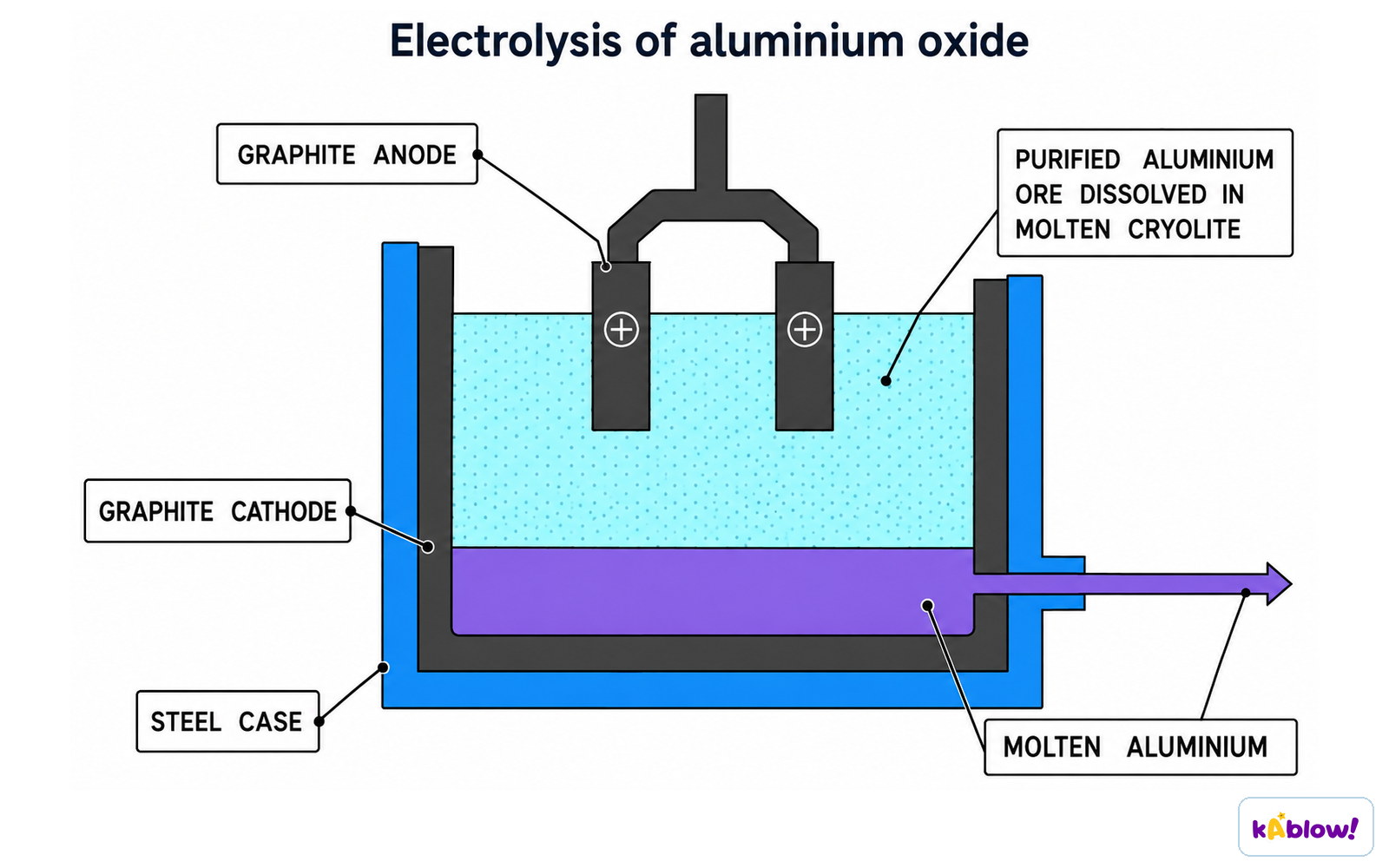
- Aluminium oxide is dissolved in molten cryolite to lower the melting point.
- The mixture is electrolysed using carbon electrodes.
- Aluminium ions are reduced at the cathode to form molten aluminium metal.
- Oxide ions are oxidised at the anode to form oxygen gas.
- The carbon anodes are burned away by the oxygen and must be replaced regularly.
Electrolysis of aluminium oxide
Key Equations (Extended Tier)
- Burning of coke: C(s) + O₂(g) → CO₂(g)
- Formation of CO: CO₂(g) + C(s) → 2CO(g)
- Reduction of iron ore: Fe₂O₃(s) + 3CO(g) → 2Fe(l) + 3CO₂(g)
- Thermal decomposition of limestone: CaCO₃(s) → CaO(s) + CO₂(g)
- Slag formation: CaO(s) + SiO₂(s) → CaSiO₃(l)
Slides
Sign up free to view the lesson slides
Step through every slide for this topic — plus flashcards and revision notes — with a free account.
Practice questions
Free preview — 8 of 59 questions. Sign up to see them all.
1.What is a metal ore?
Easy- AA rock that contains enough of a metal to make extraction worthwhile
- BA pure metal found in the Earth's crust
- CA compound of a metal with oxygen only
- DA mineral that contains carbon
2.Extraction of a metal from its ore is a reduction process because oxygen is removed from the compound.
EasyTrue or false?
3.Which metal is found native (uncombined) in the Earth's crust?
Easy- AIron
- BAluminium
- CGold
- DZinc
4.Complete the sentence about the extraction of iron.
EasyIn the blast furnace, the main reducing agent is ____.
5.State two raw materials added to the top of the blast furnace for iron extraction.
Medium6.How many tonnes of iron does a modern blast furnace produce per day?
Easy- A9000
- B10000
- C12000
- D11000
7.Why is aluminium extracted by electrolysis rather than by heating with carbon?
Medium- AAluminium is more reactive than carbon
- BAluminium is less reactive than carbon
- CAluminium ore is not an oxide
- DAluminium has a low melting point
8.What is the purpose of adding limestone to the blast furnace?
Easy
Unlock all 59 questions, flashcards & more
Create a free account to see every question, the slides, flashcards and revision notes for this topic.