Giant Structures
Learn it by playing
Answer these questions to earn energy, then fish and explore. No account needed.
Lesson notes
Giant Covalent Structures: Diamond & Graphite
- Both diamond and graphite are allotropes of carbon with giant covalent structures.
- Giant covalent structures contain billions of non-metal atoms joined by covalent bonds forming a giant lattice.
- In diamond, each carbon atom bonds to four others in a tetrahedral arrangement.
- In graphite, each carbon atom bonds to three others, forming layers of hexagons with one delocalised electron per atom.
- Covalent bonds within graphite layers are very strong; layers are held by weak intermolecular forces.
- Diamond has no free electrons – all outer electrons are in covalent bonds, so it does not conduct electricity.
- Graphite conducts electricity because delocalised electrons can move between layers and carry charge.
- Both have very high melting points due to strong covalent bonds requiring much energy to break.
Diamond — giant covalent structure
Properties & Uses of Diamond
- Diamond is extremely hard and dense because each carbon is bonded to four others in a rigid tetrahedral structure.
- It is used in cutting tools (e.g., drills) due to its hardness.
- Diamond is brittle – hard but can be smashed with a hammer.
- It does not conduct electricity (no delocalised electrons).
Properties & Uses of Graphite
- Graphite is slippery – layers can slide over each other due to weak intermolecular forces.
- Used in pencils and as an industrial lubricant because of its slipperiness.
- Graphite conducts electricity – used in electrodes.
- Pencil 'lead' is actually graphite, not the metal lead.
Graphite — giant covalent structure (layers)
Metallic Bonding
- Metals consist of a giant lattice of positive metal ions surrounded by a 'sea of delocalised electrons'.
- Metallic bond is the strong electrostatic attraction between positive ions and delocalised electrons.
- Delocalised electrons are free to move throughout the structure.
- Metal alloys are mixtures of metals with the same bonding type.
Metallic bonding
Properties of Metals
- Most metals have high melting and boiling points due to strong metallic bonds.
- Metals are good conductors of heat and electricity because delocalised electrons carry charge and energy.
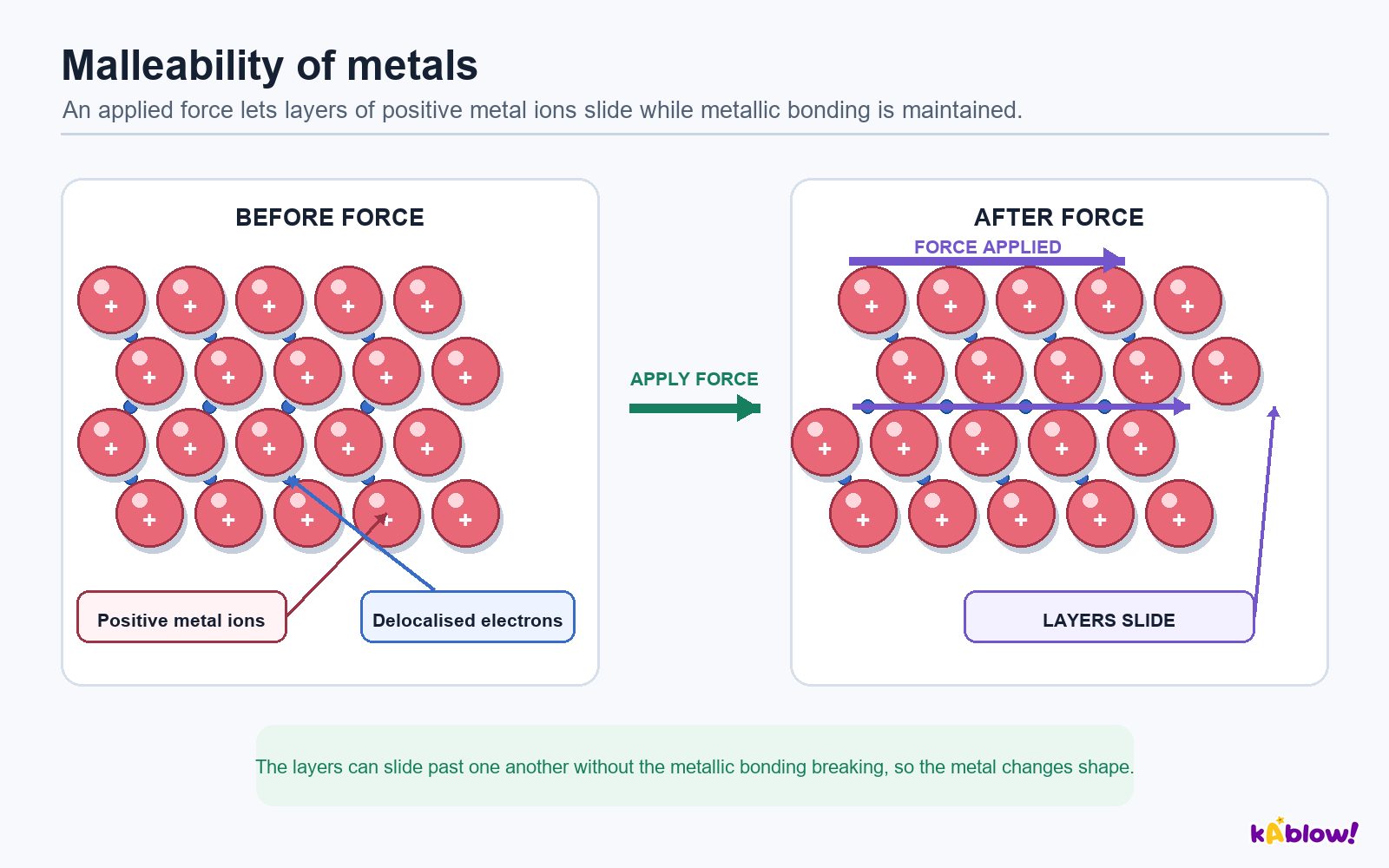
- Metals are malleable (can be hammered into shape) and ductile (can be drawn into wires) because layers of ions can slide over each other.
- Conduction in metals is by free electrons; in molten/ aqueous ionic compounds it is by free ions.
Malleability of metals
Slides
Sign up free to view the lesson slides
Step through every slide for this topic — plus flashcards and revision notes — with a free account.
Practice questions
Free preview — 8 of 56 questions. Sign up to see them all.
1.What type of structure does graphite have?
Easy- AGiant ionic structure
- BGiant covalent structure
- CSimple molecular structure
- DMetallic structure
2.Why does graphite conduct electricity?
Easy- AIt has free ions
- BIt has delocalised electrons
- CIt has a giant ionic lattice
- DIt has strong covalent bonds
3.State one use of diamond that relies on its hardness.
Easy4.Diamond conducts electricity.
EasyTrue or false?
5.Complete the sentence.
EasyIn graphite, each carbon atom is bonded to ____ other carbon atoms.
6.How many carbon atoms is each carbon atom bonded to in diamond?
Easy- A3
- B4
- C6
- D5
7.Arrange the following substances in order of increasing electrical conductivity: diamond, graphite, copper.
Medium- diamond
- graphite
- copper
8.Match each property to the correct carbon allotrope.
Medium- Conducts electricity
- Very hard
- Slippery layers
- Diamond
- Graphite
- Both
Unlock all 56 questions, flashcards & more
Create a free account to see every question, the slides, flashcards and revision notes for this topic.