Pressure
Learn it by playing
Answer these questions to earn energy, then fish and explore. No account needed.
Lesson notes
Definition and Formula
- Pressure is defined as the force per unit area.
- Measured in pascals (Pa), where 1 Pa = 1 N/m².
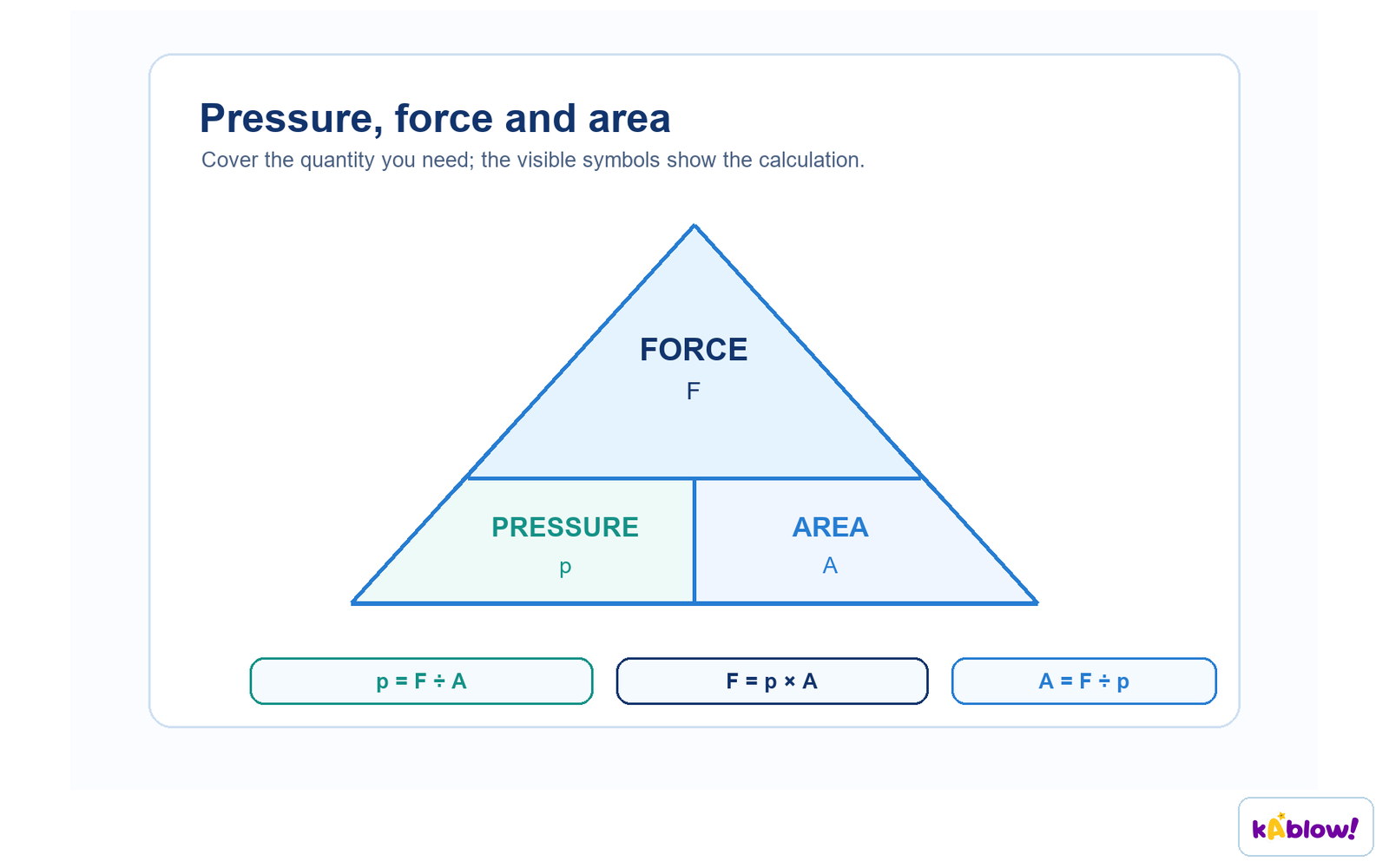
- Formula: p = \frac{F}{A} , with p = pressure (Pa), F = force (N), A = area (m²).
- A formula triangle can be used to rearrange the equation: cover the quantity you want to find.
Pressure formula triangle
Effect of Area on Pressure
- For a given force, increasing area decreases pressure; decreasing area increases pressure.
- Large area → small pressure (e.g., tractor tyres).
- Small area → large pressure (e.g., drawing pin tip, high heels).
Examples of Pressure in Action
- Tractors have wide tyres to spread weight over a large area, reducing pressure and preventing sinking into mud.
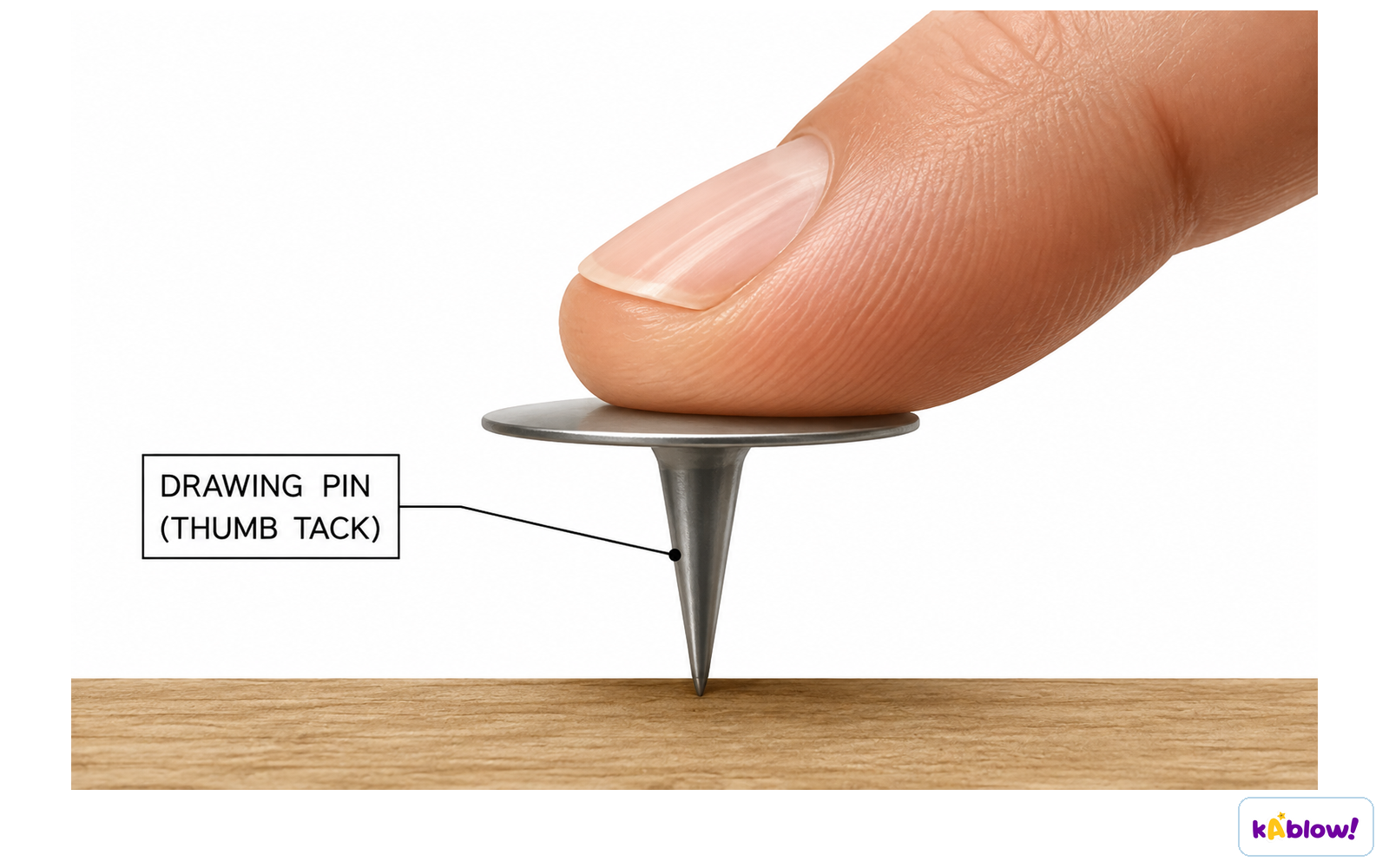
- Drawing pins have a sharp point with very small area, concentrating force to produce large pressure so it can be pushed into a wall.
- High heels have a small contact area, producing high pressure that causes them to sink into soft surfaces; flat shoes spread weight over a larger area, reducing pressure.
Applying a force to a drawing pin
Calculating Pressure, Force, or Area
- Use p = \frac{F}{A} to find pressure when force and area are known.
- Rearrange to F = p \times A to find force, or A = \frac{F}{p} to find area.
- Always use SI units: force in N, area in m², pressure in Pa.
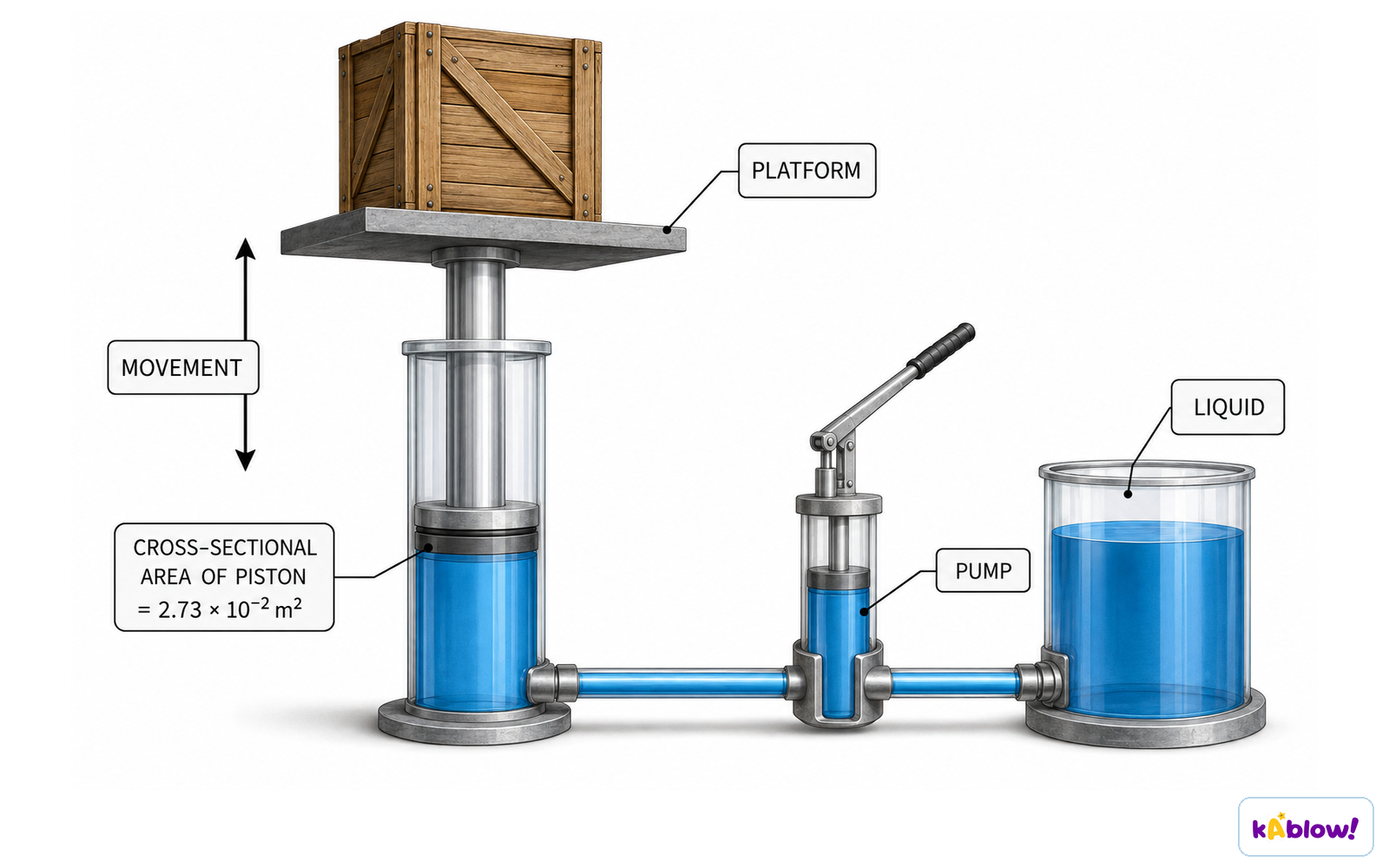
- Worked example: A pump creates pressure of 5.28 \times 105 \, \text{Pa} on a piston of area 2.73 \times 10-2 \, \text{m}2 . Force = p \times A = 14\,400 \, \text{N} (14.4 kN).
Hydraulic lift apparatus
Key Points from Past Papers
- Pressure depends on both force and area; changing the area while keeping force constant alters pressure.
- To reduce sinking in snow, increase the area of contact (e.g., wear larger shoes).
- When calculating pressure exerted by an object on a surface, use the area of contact between the object and the surface.
- Smallest pressure for a given force comes from the largest area (e.g., 40 N over 2.0 m² gives 20 Pa).
Slides
Sign up free to view the lesson slides
Step through every slide for this topic — plus flashcards and revision notes — with a free account.
Practice questions
Free preview — 8 of 51 questions. Sign up to see them all.
1.A woman is in contact with the floor. In which of these poses does she produce the most pressure on the floor? Assume she is wearing flat shoes in each pose.
Easy- AStanding on one foot
- BStanding on two feet
- CLying down
- DSitting on a chair
2.Which is an example of a force acting over a small area to produce a large pressure?
Easy- AA skier wearing large skis on snow
- BA hammer being used to push a nail into a piece of wood
- CA tractor having very wide tyres
- DA person lying down, rather than walking upright on a roof
3.A water-filled tank is resting on a table. The tank has a rectangular base of length 0.5 m and width 0.5 m. Using the measurements, determine the area which should be used to calculate the pressure the tank exerts on the table.
Medium- A0.25 m²
- B0.5 m²
- C0.75 m²
- D1.0 m²
4.A briefcase, with flat, rectangular sides rests on the floor. The briefcase is now turned so that it rests with its large, flat side on the floor. How has the change affected the force on the floor, and the pressure exerted by the briefcase on the floor?
Medium- AForce unchanged, pressure decreased
- BForce unchanged, pressure unchanged
- CForce decreased, pressure decreased
- DForce decreased, pressure unchanged
5.A wooden block rests on a table. The block has dimensions: side A (1 cm x 2 cm), side B (2 cm x 3 cm), side C (1 cm x 3 cm). On which surface should the block be laid to produce the largest pressure on the table?
Medium- ASide A
- BSide B
- CSide C
- DAny side, they will all produce the same pressure
6.An object has a weight of 12 N and a contact area of 2.0 m². What pressure does it exert on the ground?
Easy- A4.0 Pa
- B6.0 Pa
- C12 Pa
- D24 Pa
7.Four combinations of force and area are given below. Which combination gives the smallest pressure exerted on the surface?
Medium- AForce 40 N, Area 0.5 m²
- BForce 40 N, Area 2.0 m²
- CForce 80 N, Area 0.5 m²
- DForce 80 N, Area 2.0 m²
8.A person walking through snow sinks into it. The person makes a change so that they do not sink as far next time they go out. What do they do?
Medium- ACrouch as they walk to lower their centre of mass
- BRun as fast as they can to increase the power they dissipate
- CWear shoes with a much larger area on the bottom to increase the area of their feet in contact with the snow
- DWear a heavy backpack to increase their weight and so make them more stable
Unlock all 51 questions & more
Create a free account to see every question, the slides, flashcards and revision notes for this topic.