Radioactivity
Learn it by playing
Answer these questions to earn energy, then fish and explore. No account needed.
Lesson notes
Ionising Nuclear & Background Radiation
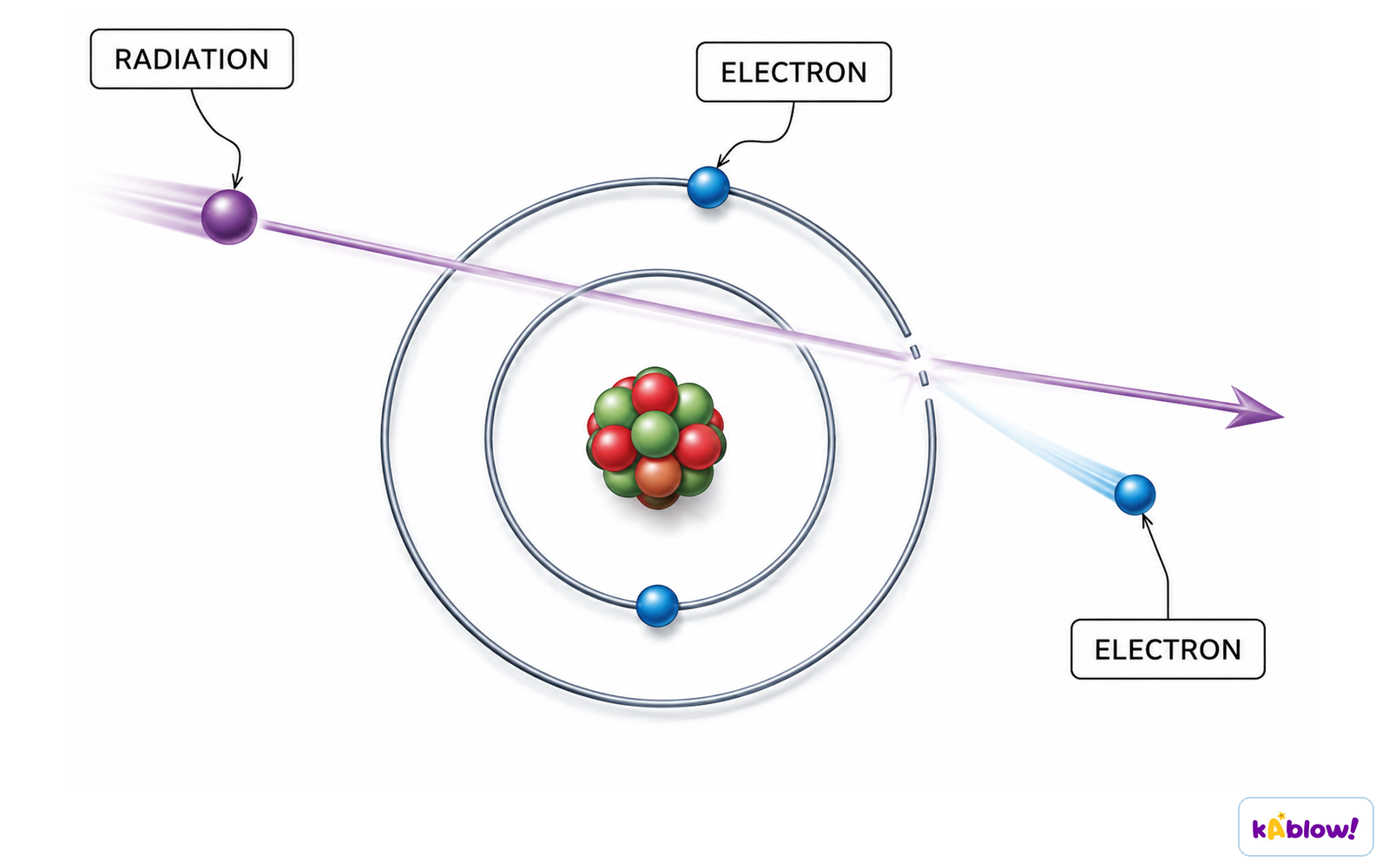
- Ionisation is when an atom gains or loses electrons, becoming charged; nuclear radiation can ionise atoms by removing electrons.
- Background radiation is the radiation that exists around us all the time from natural and man-made sources.
- Natural sources include radon gas (from rocks), rocks and buildings, food and drink, and cosmic rays from space.
- Man-made sources include medical X-rays, nuclear waste, nuclear fallout, and nuclear accidents.
- Radiation is detected using a Geiger–Müller tube; the count rate (counts per second) measures the number of decays detected.
- The count rate decreases as the distance from the source increases because radiation spreads out.
Nuclear radiation ionising an atom
Types of Radioactive Decay
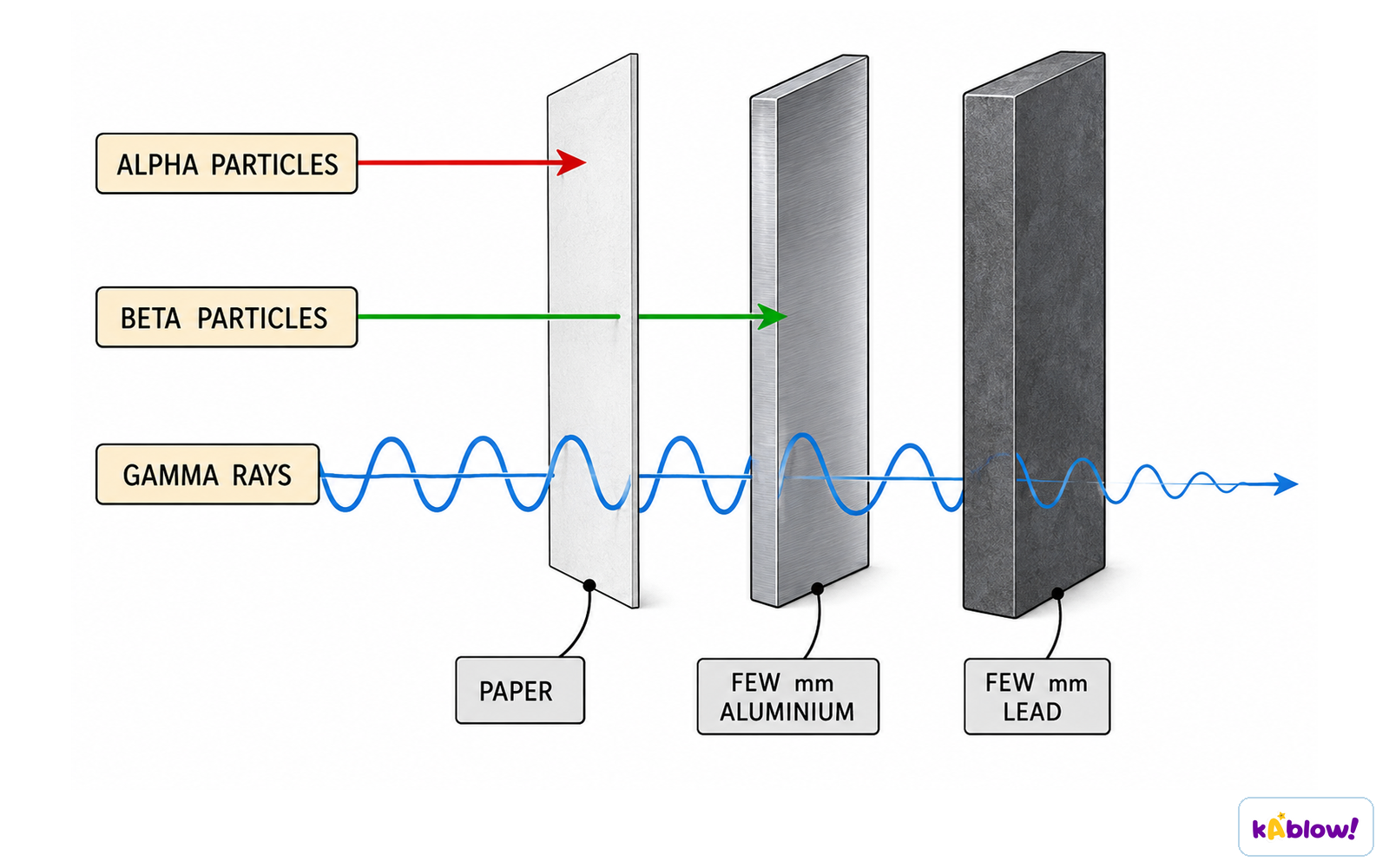
- α (α) particles are helium nuclei (2 protons, 2 neutrons), charge +2, high ionising ability, stopped by paper.
- β (β) particles are fast-moving electrons, charge -1, moderate ionising ability, stopped by a few mm of aluminium.
- Gamma (γ) rays are electromagnetic waves, no charge, low ionising ability, reduced by thick lead.
- Penetrating power increases from α to β to γ; ionising ability decreases from α to β to γ.
- α has a range of a few cm in air, β a few tens of cm, gamma is infinite (but intensity decreases).
Penetrating power of alpha, beta and gamma radiation
Changes During Radioactive Decay
- In α-decay, the nucleus loses 2 protons and 2 neutrons; mass number decreases by 4, atomic number decreases by 2.
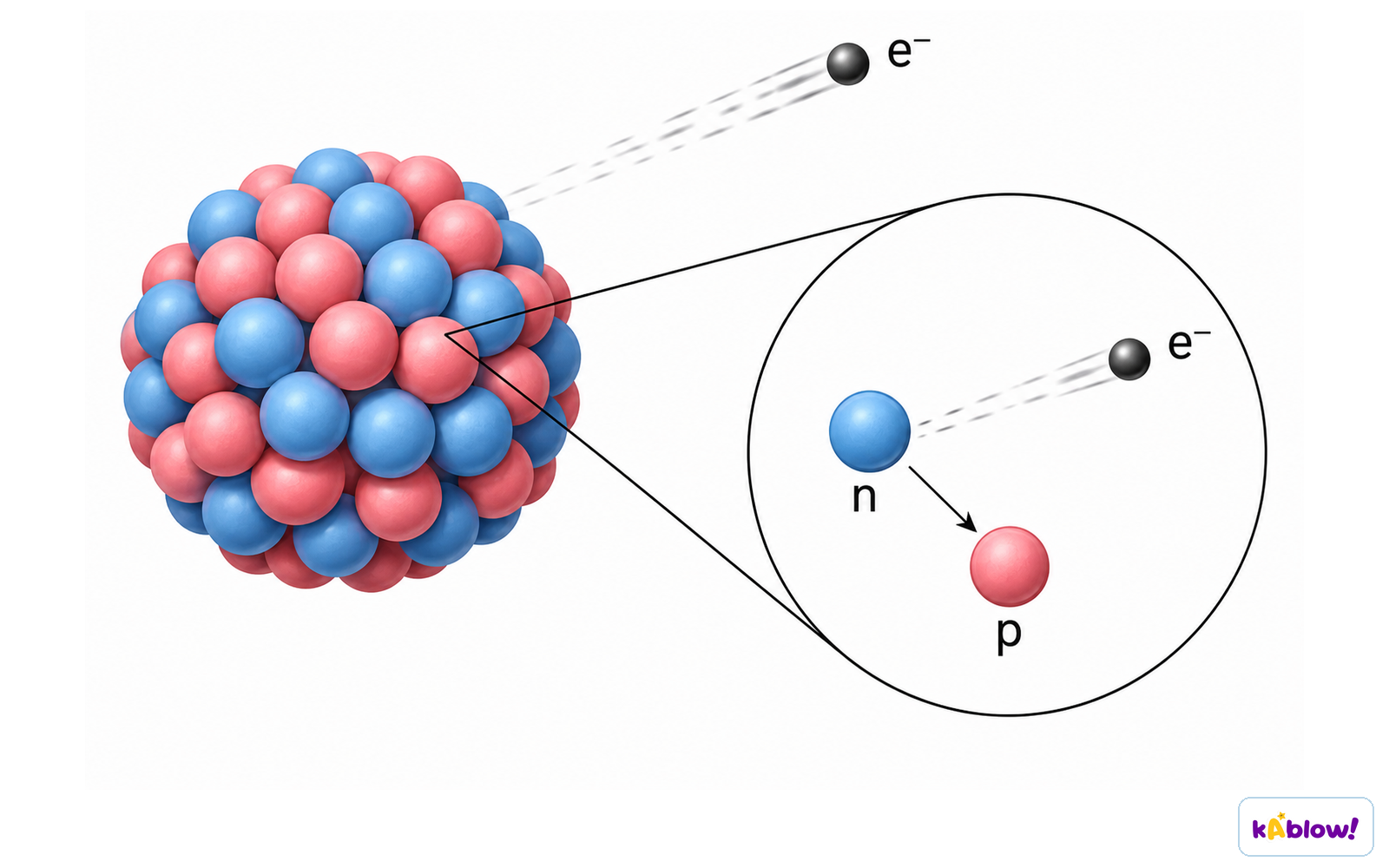
- In β-decay, a neutron changes into a proton and an electron; mass number stays the same, atomic number increases by 1.
- In γ-decay, a gamma ray is emitted; mass number and atomic number do not change, but the nucleus becomes less energetic.
- Decay equations must balance mass and atomic numbers on both sides.
- Example α-decay: ²¹²Po → ²⁰⁸Pb + ⁴He (polonium-212 decays to lead-208, emitting an α particle)
- Example β-decay: ²⁴Na → ²⁴Mg + β⁻ (sodium-24 decays to magnesium-24, emitting a β particle)
Beta decay
Half-Life
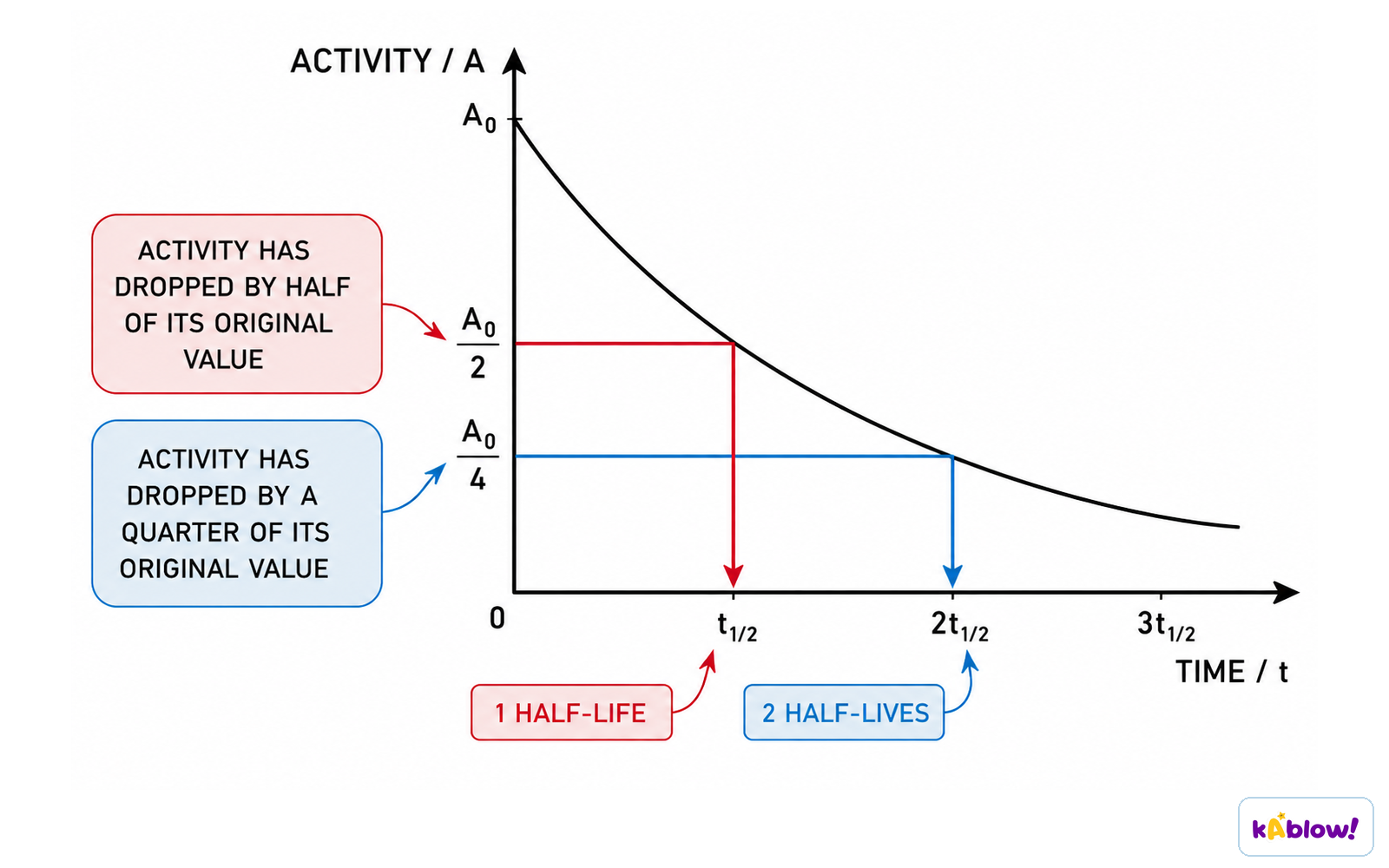
- Half-life is the time taken for half the nuclei in a sample to decay (or for activity to halve).
- Half-life is constant for a given isotope and can range from fractions of a second to billions of years.
- After one half-life, 50% remains; after two, 25%; after three, 12.5%; and so on.
- Half-life can be determined from an activity–time graph by reading the time for activity to fall to half its initial value.
- Example: If a 10 mg sample decays to 2.5 mg, that is ¼ remaining = 2 half-lives; if half-life is 1.17 min, time = 2.34 min.
A half-life graph
Uses of Radioactivity
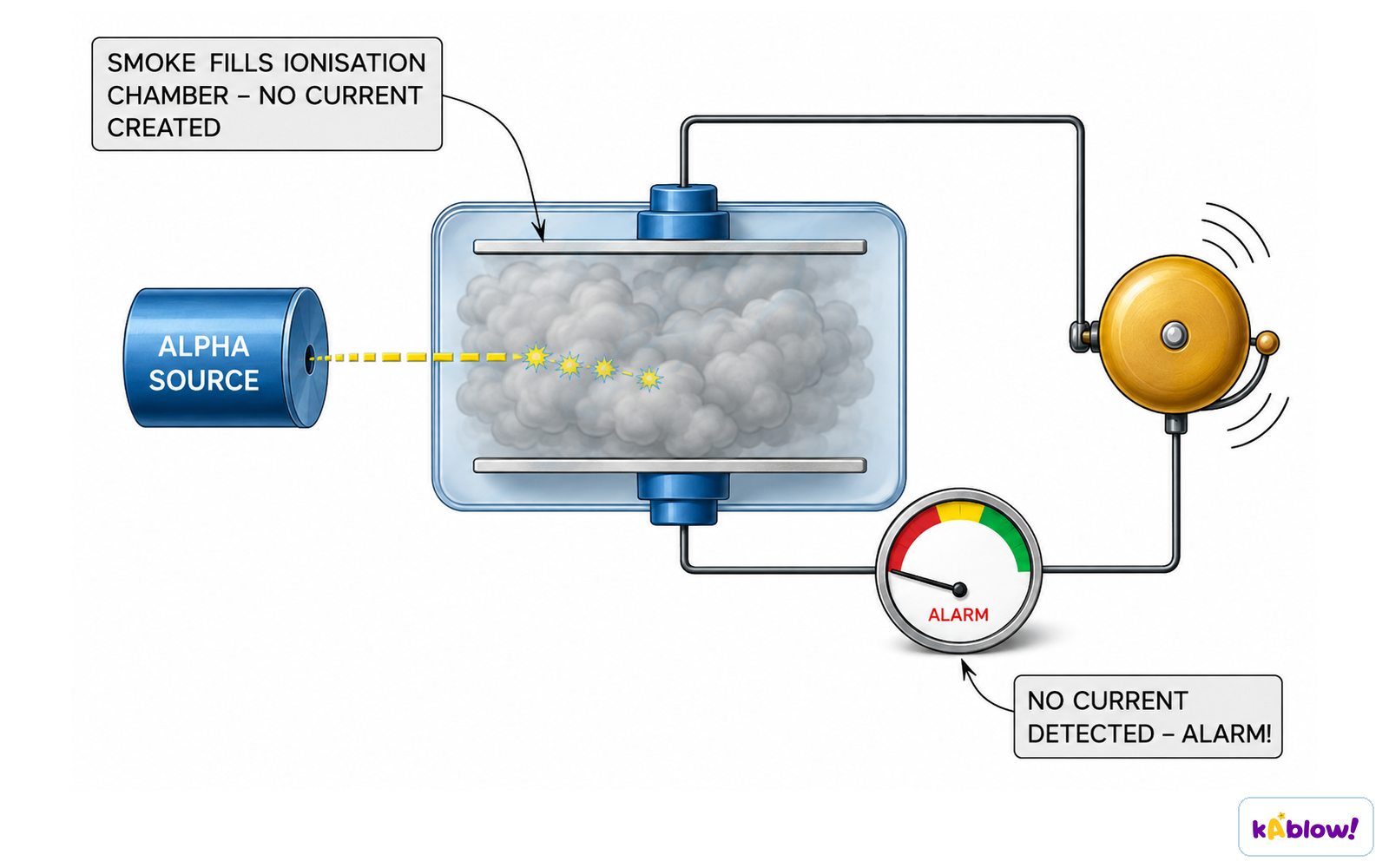
- α radiation is used in smoke detectors: α ionises air, smoke absorbs α, triggering the alarm.
- β radiation is used to measure thickness of materials (e.g., paper): more absorption indicates thicker material.
- Gamma radiation is used to sterilise medical equipment and irradiate food to kill bacteria.
- Gamma rays are used in radiotherapy to treat cancer: beams are directed at tumours to kill cancer cells.
- Radioactive tracers (e.g., in PET scans) help diagnose cancer and track substances in the body.
How a smoke detector uses alpha radiation
Dangers of Radioactivity
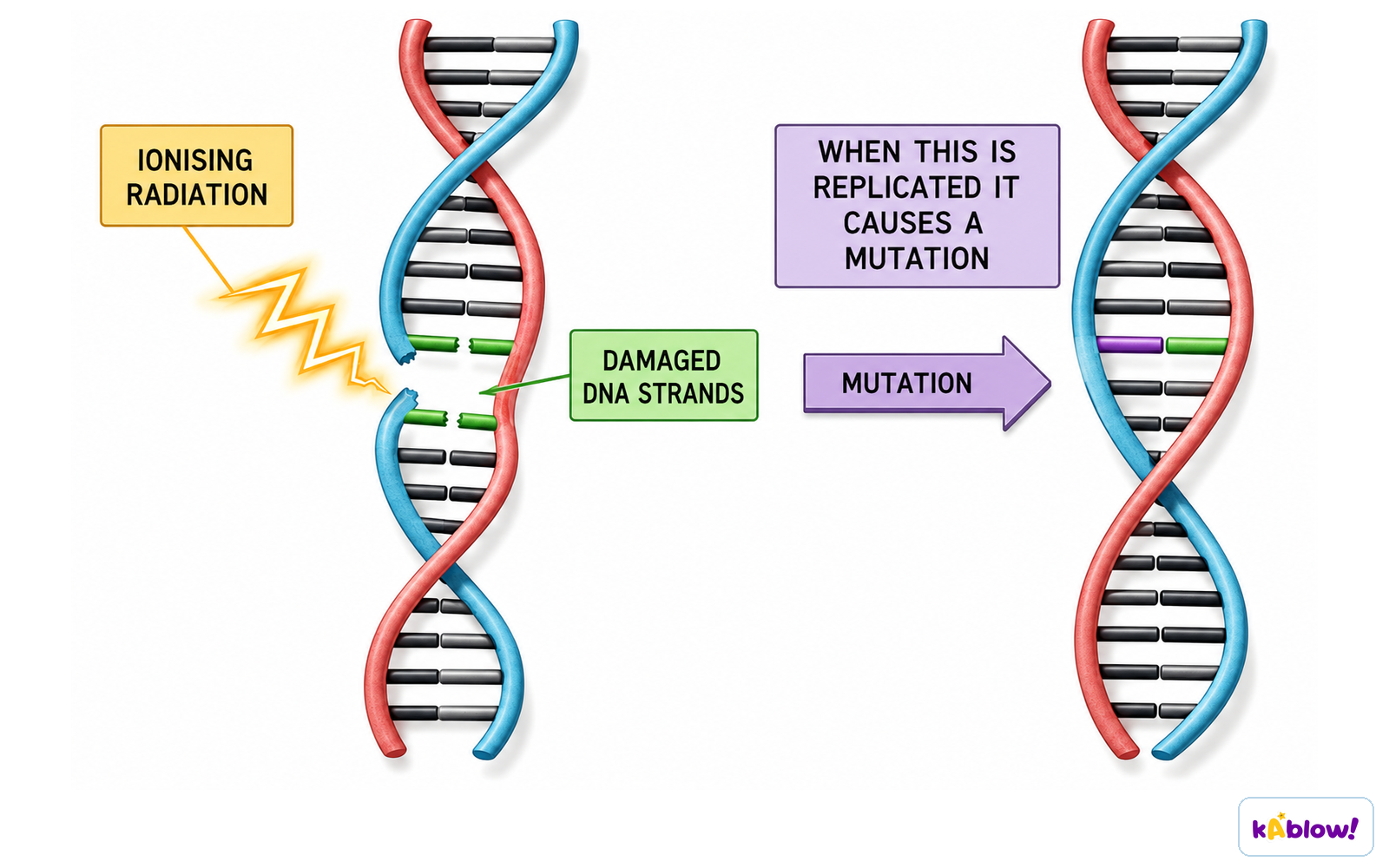
- Ionising radiation can damage DNA, causing mutations or cancer; high doses can cause cell death and skin burns.
- Radiation dose is measured in sieverts (Sv); acute exposure can lower white blood cell count, increasing infection risk.
- Safety precautions: reduce exposure time, increase distance (use tongs), and use shielding (lead, concrete, water).
- Radioactive sources should be stored safely in lead-lined containers, and workers wear lead aprons and dosimeters.
Ionising DNA is a danger of radioactivity
Slides
Sign up free to view the lesson slides
Step through every slide for this topic — plus flashcards and revision notes — with a free account.
Practice questions
Free preview — 8 of 51 questions. Sign up to see them all.
1.Which type of radiation is the most ionising?
Easy- Aα
- Bβ
- CGamma
- DNeutron
2.Which type of radiation is stopped by a thin sheet of paper?
Easy- Aα
- Bβ
- CGamma
- DAll of the above
3.Name the device commonly used to detect and measure count rate of radiation.
Easy4.Background radiation is only caused by human activities.
EasyTrue or false?
5.A radioactive sample has an activity of 800 Bq. After 12 days, its activity is 100 Bq. What is the half-life in days?
Medium- A3
- B6
- C5
- D4
6.Complete the sentence about α decay.
EasyWhen a nucleus emits an α particle, its mass number decreases by ____ and its atomic number decreases by ____.
7.A nucleus with 92 protons and 146 neutrons undergoes α decay. What are the proton and neutron numbers of the daughter nucleus?
Medium- A90 protons, 144 neutrons
- B90 protons, 142 neutrons
- C94 protons, 148 neutrons
- D92 protons, 146 neutrons
8.State one natural source of background radiation.
Easy
Unlock all 51 questions & more
Create a free account to see every question, the slides, flashcards and revision notes for this topic.