The Solar System
Learn it by playing
Answer these questions to earn energy, then fish and explore. No account needed.
Lesson notes
The Solar System
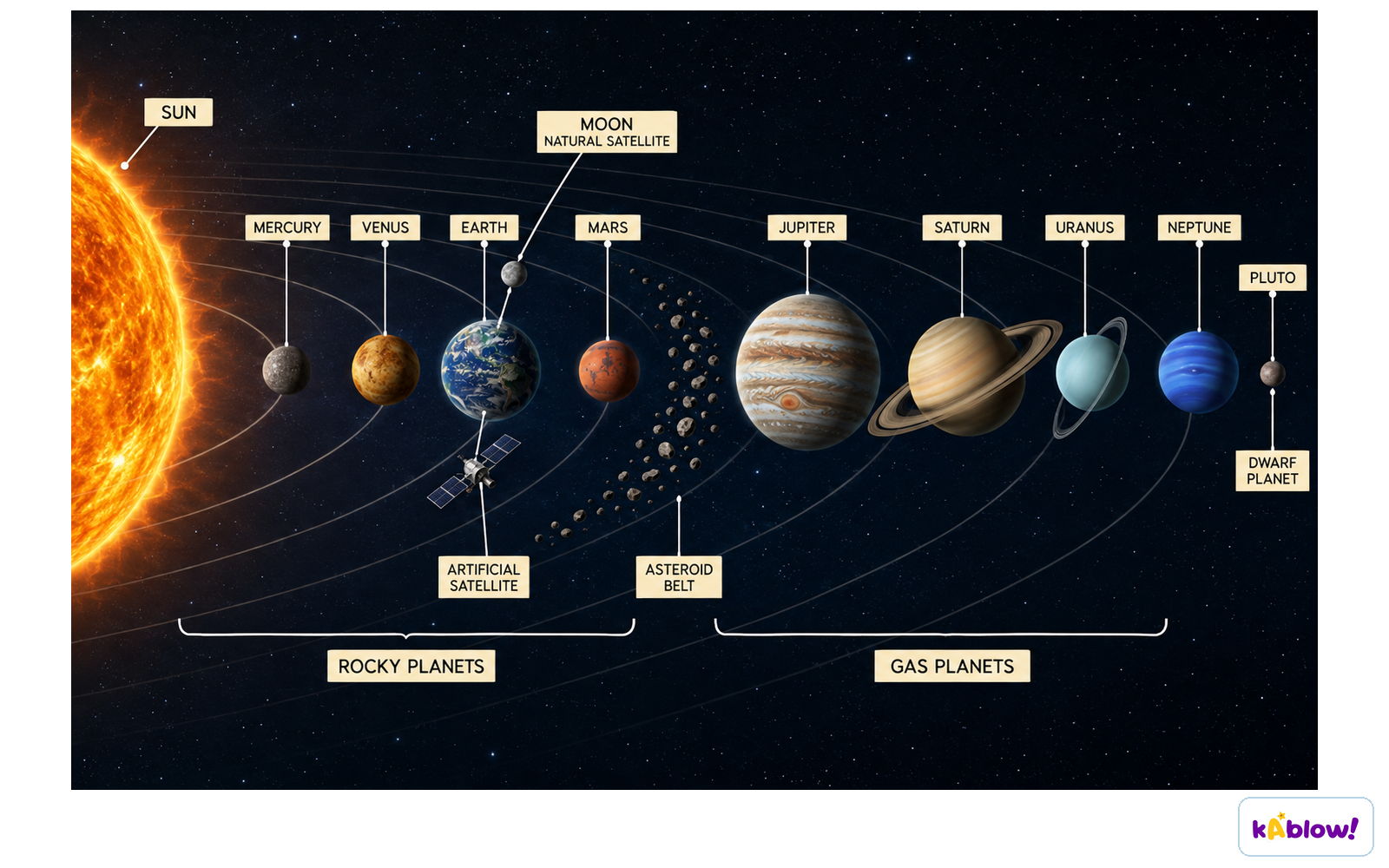
- The Solar System consists of the Sun, eight planets, natural and artificial satellites, and minor planets (including dwarf planets).
- The Sun is a star at the centre; it contains >99% of the Solar System's mass.
- The eight planets in order from the Sun: Mercury, Venus, Earth, Mars, Jupiter, Saturn, Uranus, Neptune.
- Planets are divided into inner rocky planets (Mercury, Venus, Earth, Mars) and outer gas giants (Jupiter, Saturn, Uranus, Neptune).
- A dwarf planet is similar to a planet but smaller; its gravity is not strong enough to clear its orbit of other objects.
- Natural satellites (moons) orbit planets; artificial satellites (e.g., ISS) are man-made and orbit Earth.
- Smaller bodies orbit larger ones: planets orbit the Sun, moons orbit planets.
The Solar System: the Sun, eight planets, natural and artificial satellites, and the asteroid belt
Light Speed Calculations
- Light travels at a constant speed of 3.0 × 10⁸ m/s in a vacuum.
- Objects in the Solar System are visible because they reflect sunlight; light takes time to travel these large distances.
- Light from the Sun takes about 8 minutes to reach Earth, and about 5 hours to reach the outer Solar System.
- The time for light to travel a distance is calculated using: time = distance / speed of light.
- Example: Light from Sun to Mercury (radius 5.8 × 10¹⁰ m) takes 193 s (about 3 minutes).
Gravitational Field Strength
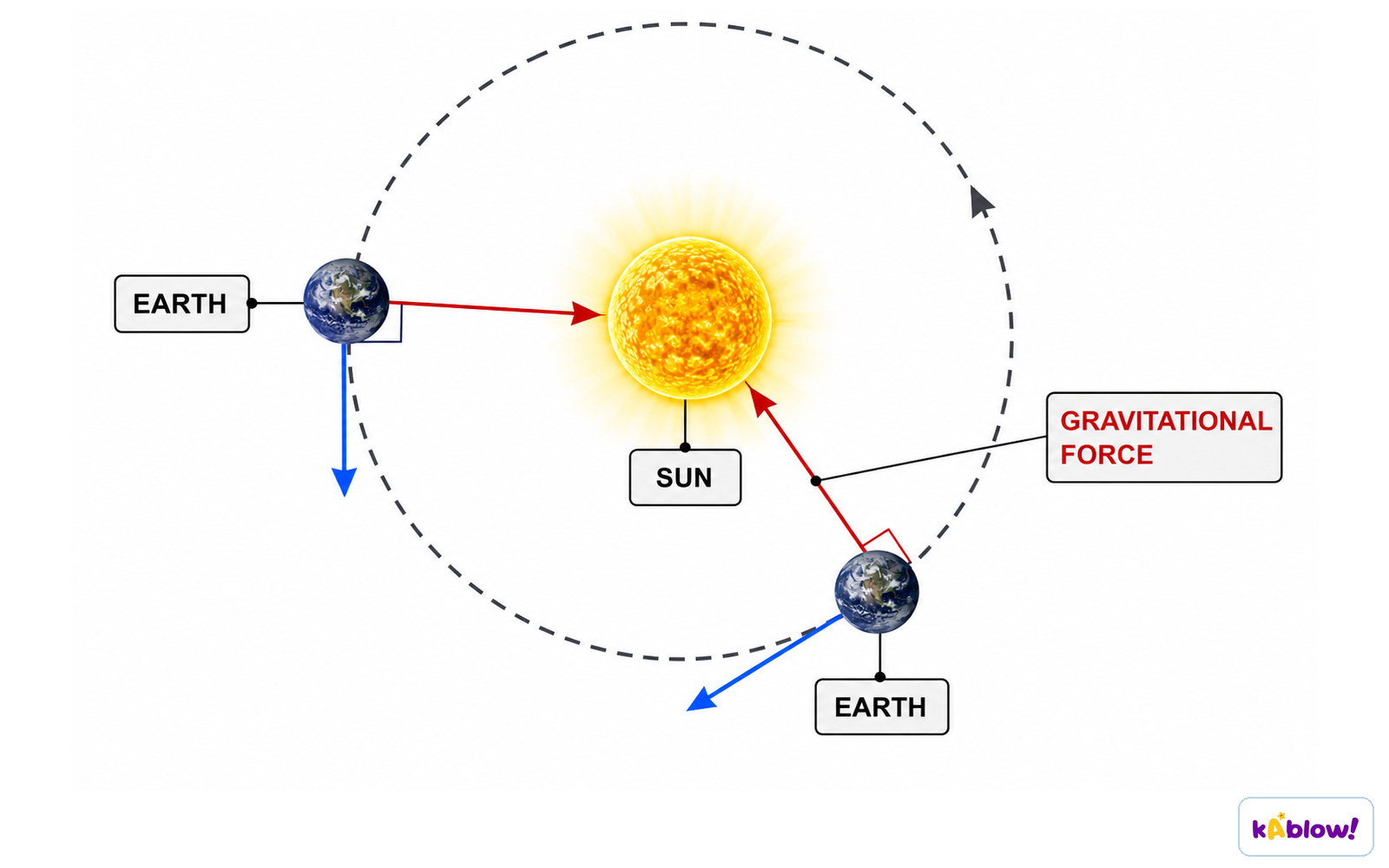
- Orbital motion is caused by the gravitational force of attraction between two bodies.
- Gravitational force acts towards the centre of the larger body and keeps the orbiting body in a circular path.
- The Sun's gravitational attraction keeps planets in orbit; the force is directed from the planet to the Sun's centre.
- As distance from the Sun increases, the Sun's gravitational field strength decreases.
- For a circular orbit, the centripetal force is provided by the Sun's gravitational attraction.
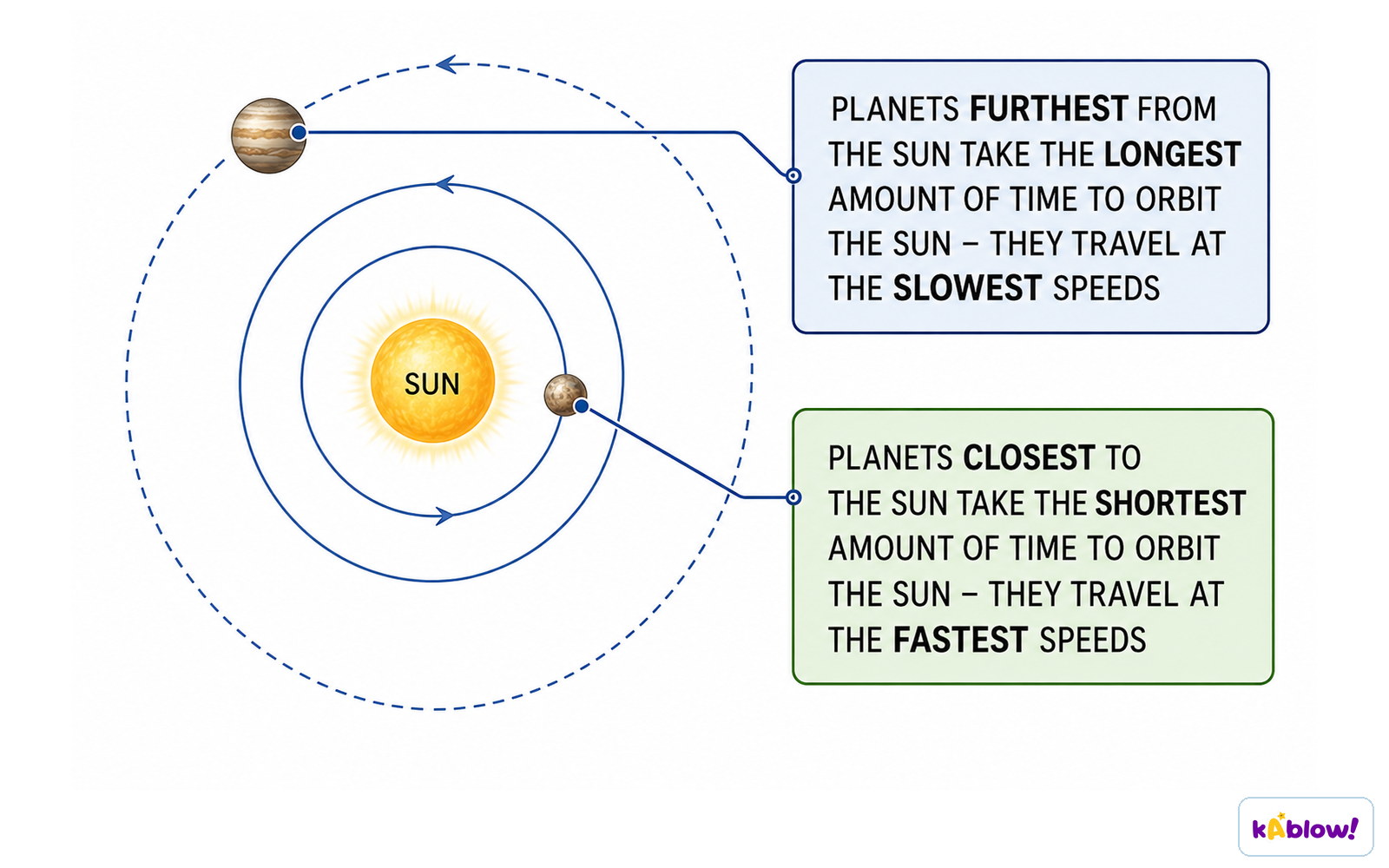
- The further a planet is from the Sun: the smaller its orbital speed and the longer its orbital period.
The Sun's gravitational force of attraction keeps the Earth in orbit around the Sun
Orbital Speed Equation
- For a circular orbit, the distance travelled in one orbit is the circumference: 2πr.
- The average orbital speed is given by: v = 2πr / T, where r is orbital radius and T is orbital period.
- Orbital period is the time taken to complete one orbit.
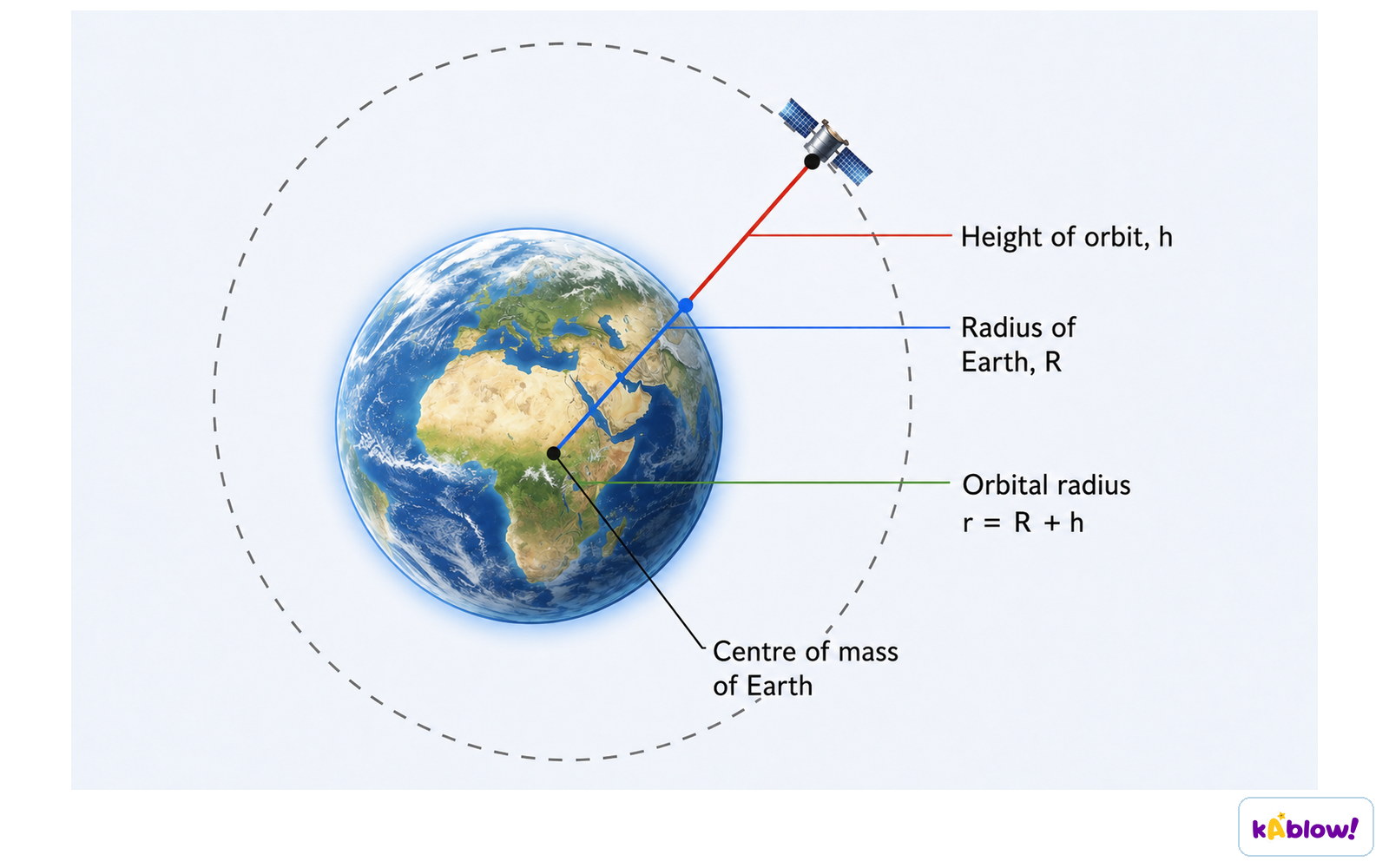
- The orbital radius r is measured from the centre of the body being orbited (e.g., from the Sun's centre for a planet).
- If given height above a planet's surface, add the planet's radius to get the orbital radius.
- Example: Hubble telescope at 560 km above Earth (Earth radius 6400 km) orbits in 96 min; its orbital speed is 7590 m/s.
Orbital radius is measured from the centre of mass of the body being orbited: r = R + h
Orbital Data and Trends
- Mercury: orbital radius 57.9 million km, orbital speed 47.9 km/s, period 88 days.
- Earth: orbital radius 149.6 million km, orbital speed 29.8 km/s, period 365 days.
- Neptune: orbital radius 4495.1 million km, orbital speed 5.4 km/s, period 165 years.
- The closest planets to the Sun have the fastest orbital speeds and shortest periods; the furthest have the slowest speeds and longest periods.
The closest planets to the Sun have the fastest orbital speeds, and the furthest have the slowest
Slides
Sign up free to view the lesson slides
Step through every slide for this topic — plus flashcards and revision notes — with a free account.
Practice questions
Free preview — 8 of 47 questions. Sign up to see them all.
1.What is the name of the star at the centre of the Solar System?
Easy- AThe Sun
- BEarth
- CMercury
- DThe Moon
2.How many planets are there in the Solar System?
Easy- A7
- B8
- C9
- D10
3.Arrange the following planets in order of increasing distance from the Sun.
Easy- Earth
- Jupiter
- Mercury
- Neptune
- Saturn
- Uranus
4.The Moon is a natural satellite of the Earth.
EasyTrue or false?
5.Artificial satellites are natural objects that orbit planets.
EasyTrue or false?
6.Complete the sentence:
EasyThe gravitational field around a ____ is strong enough to pull in nearby objects, but that around a dwarf planet is not.
7.State one difference between a planet and a dwarf planet.
Medium8.The radius of Mercury's orbit around the Sun is 5.8 × 10¹⁰ m. The speed of light is 3.0 × 10⁸ m/s. Calculate the time taken for light from the Sun to reach Mercury. Give your answer in seconds.
Medium- A231
- B174
- C193
- D212
Unlock all 47 questions & more
Create a free account to see every question, the slides, flashcards and revision notes for this topic.