Thermal Properties And Temperature
Learn it by playing
Answer these questions to earn energy, then fish and explore. No account needed.
Lesson notes
Thermal Expansion
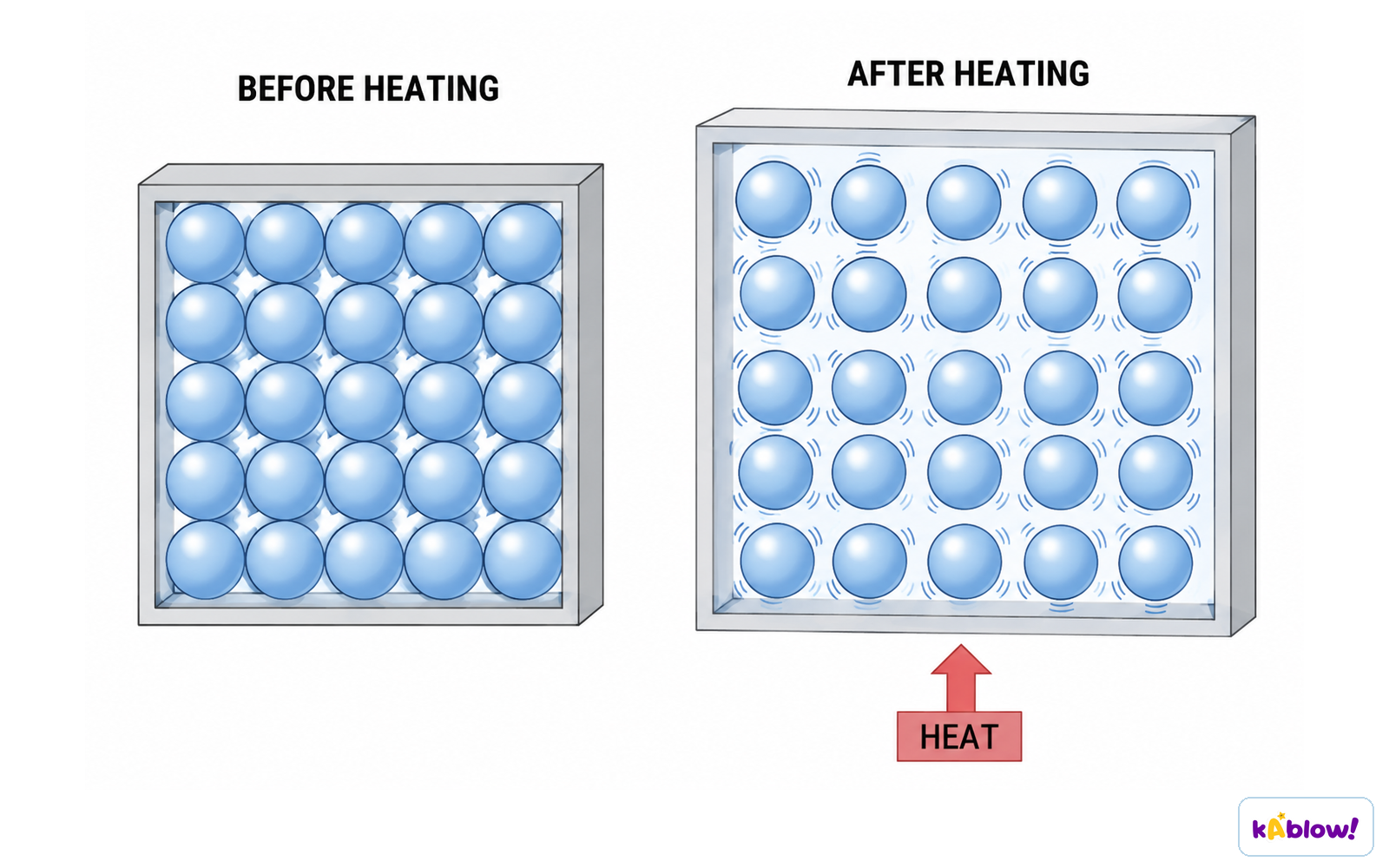
- When a material is heated at constant pressure, its temperature increases, volume increases (expands), and density decreases.
- Expansion occurs because molecules gain kinetic energy, move/vibrate faster, and push each other apart.
- For equal temperature rise, gases expand most, solids least, and liquids in between.
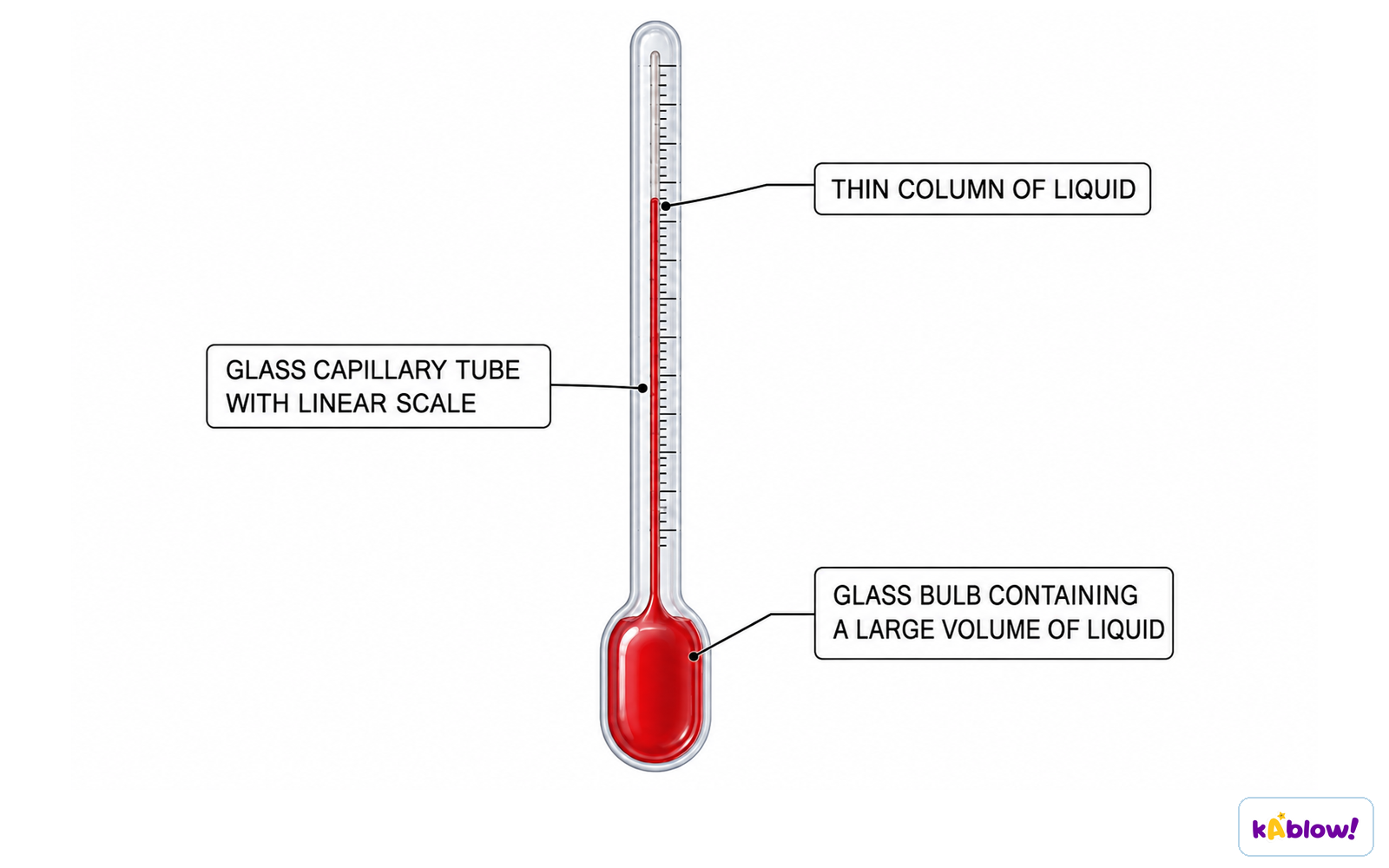
- Liquid-in-glass thermometers use thermal expansion: liquid in bulb expands into narrow capillary tube; scale measures temperature.
- Temperature-activated switches use a bimetallic strip (two metals with different expansion rates) that bends when heated to close a circuit.
- Unwanted expansion can cause buckling in railway tracks, roads, and bridges; expansion gaps are built in to allow safe expansion.
Thermal expansion diagram
Melting & Boiling
- Fixed points of pure water: melting point = 0 °C, boiling point = 100 °C (at atmospheric pressure).
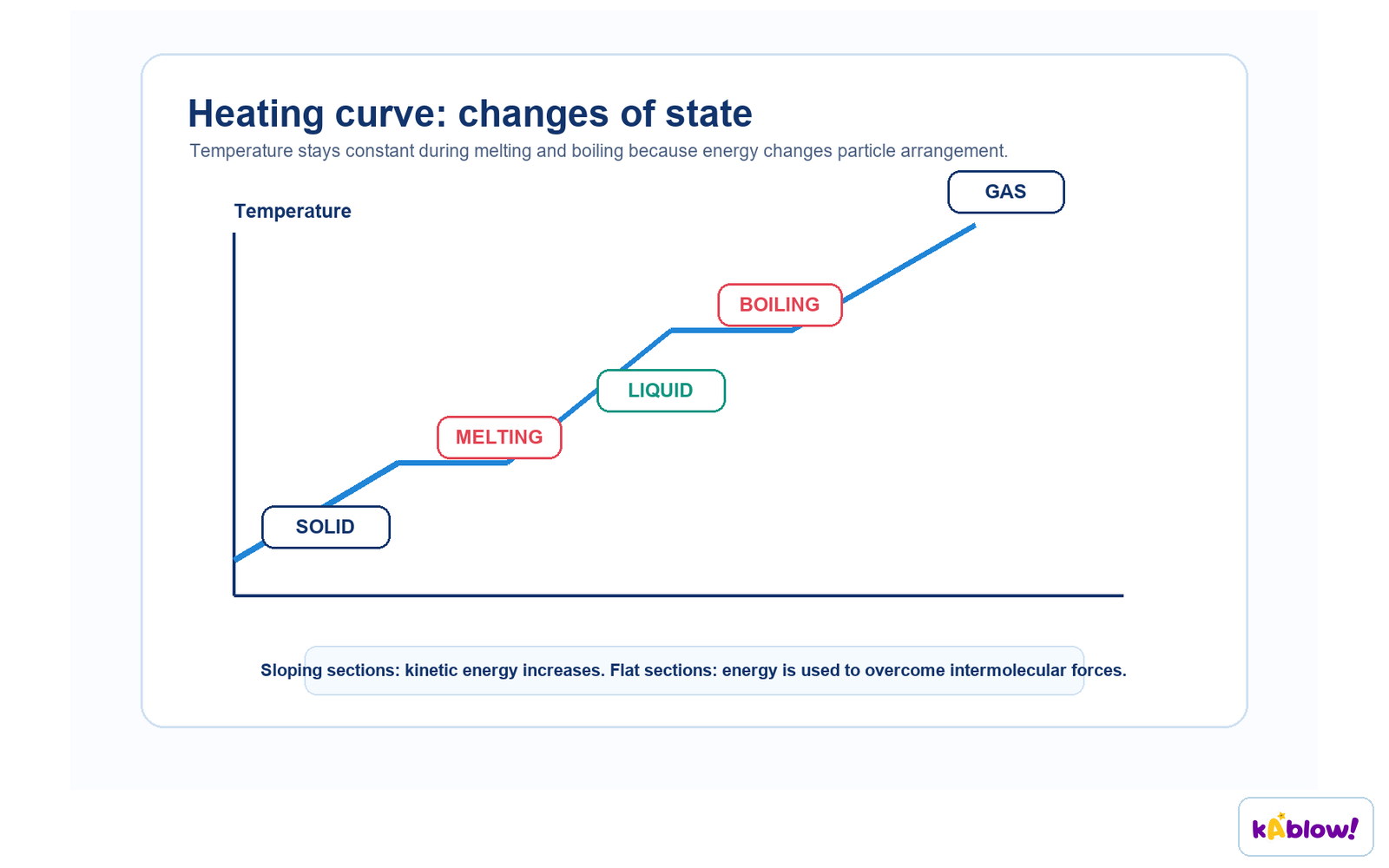
- During a change of state (melting/boiling), temperature remains constant even though thermal energy is added or removed.
- Added energy goes into the potential store (overcoming intermolecular forces), not the kinetic store, so temperature stays constant.
- Melting: solid → liquid; particles gain ability to flow but remain close together.
- Boiling: liquid → gas; intermolecular forces are completely overcome; bubbles form throughout the liquid.
- Condensation (gas → liquid) and solidification (liquid → solid) release energy; temperature stays constant during the change.
Heating curve showing changes of state
Evaporation
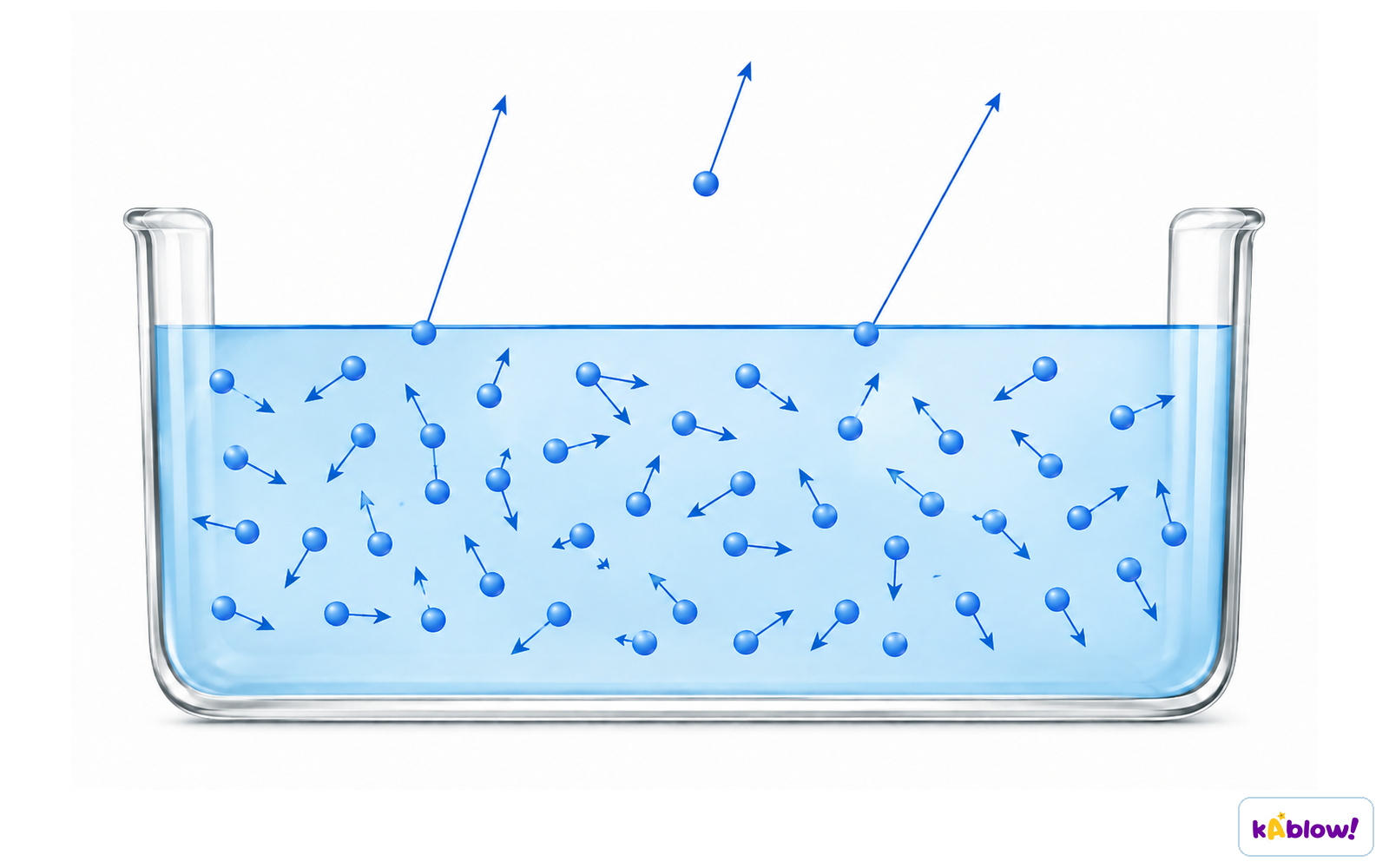
- Evaporation is a change of state from liquid to gas that occurs at any temperature and only from the surface.
- More energetic molecules near the surface escape, reducing the average kinetic energy of the remaining liquid → cooling effect.
- Rate of evaporation increases with higher temperature, larger surface area, and greater air movement (wind/fan).
- Boiling vs evaporation: boiling occurs at the boiling point throughout the liquid; evaporation occurs at any temperature only at the surface.
Evaporation of liquid molecules
Liquid-in-Glass Thermometer (Extended Tier)
- Sensitivity increases if the capillary tube diameter is reduced (same volume change gives longer liquid column) or if the bulb volume is increased (more liquid expands further).
- Range is affected by the length of the capillary tube and the amount of liquid; a smaller bulb (less mercury) reduces the range because less expansion occurs.
Liquid-in-glass thermometer
Slides
Sign up free to view the lesson slides
Step through every slide for this topic — plus flashcards and revision notes — with a free account.
Practice questions
Free preview — 8 of 54 questions. Sign up to see them all.
1.State the fixed point on the Celsius scale for the melting point of pure water.
Easy- A0
- B2
- C-1
- D1
2.State the fixed point on the Celsius scale for the boiling point of pure water.
Easy- A120
- B90
- C110
- D100
3.Equal volumes of steel, oil and hydrogen are heated from 20 °C to 60 °C. Which substance has the greatest increase in volume?
Medium- Asteel
- Boil
- Chydrogen
- Dall increase by the same amount
4.State the temperature reading on a liquid-in-glass thermometer that shows the liquid level exactly at the 20 °C mark.
Easy5.State the temperature range of a liquid-in-glass thermometer that measures from -10 °C to 110 °C.
Easy6.Describe, in terms of molecules, what happens when a liquid evaporates.
Medium7.State two changes in the weather that help wet clothes to dry more quickly.
Easy8.Explain, in terms of molecules, how thermal expansion takes place in a liquid.
Medium
Unlock all 54 questions & more
Create a free account to see every question, the slides, flashcards and revision notes for this topic.