Databases
Learn it by playing
Answer these questions to earn energy, then fish and explore. No account needed.
Lesson notes
What is a Database?
- A database is an organised collection of data.
- It consists of one or more tables made up of fields and records.
- Databases allow easy storage, retrieval, and management of information.
- They are stored on secondary storage and often on remote servers for multi-user access.
- Data can be sorted and searched efficiently, and databases are more secure than text files.
Fields & Records
- A field is one piece of information relating to one person/item/object; represented as a column.
- A record is a collection of fields relating to one person/item/object; represented as a row.
- Example: In a student table, fields include StudentID, FirstName, LastName; each row is a record.
Text Files vs Databases
- Text files are useful for small amounts of data; stored on secondary storage and read into a program.
- Each entry is stored on a new line or separated by a delimiter (e.g., comma).
- It can be difficult to know where a record begins and ends in a text file.
- Databases provide better structure, security, and efficiency for large data.
Data Types
- A data type defines the type of data held in a field, set when designing a table.
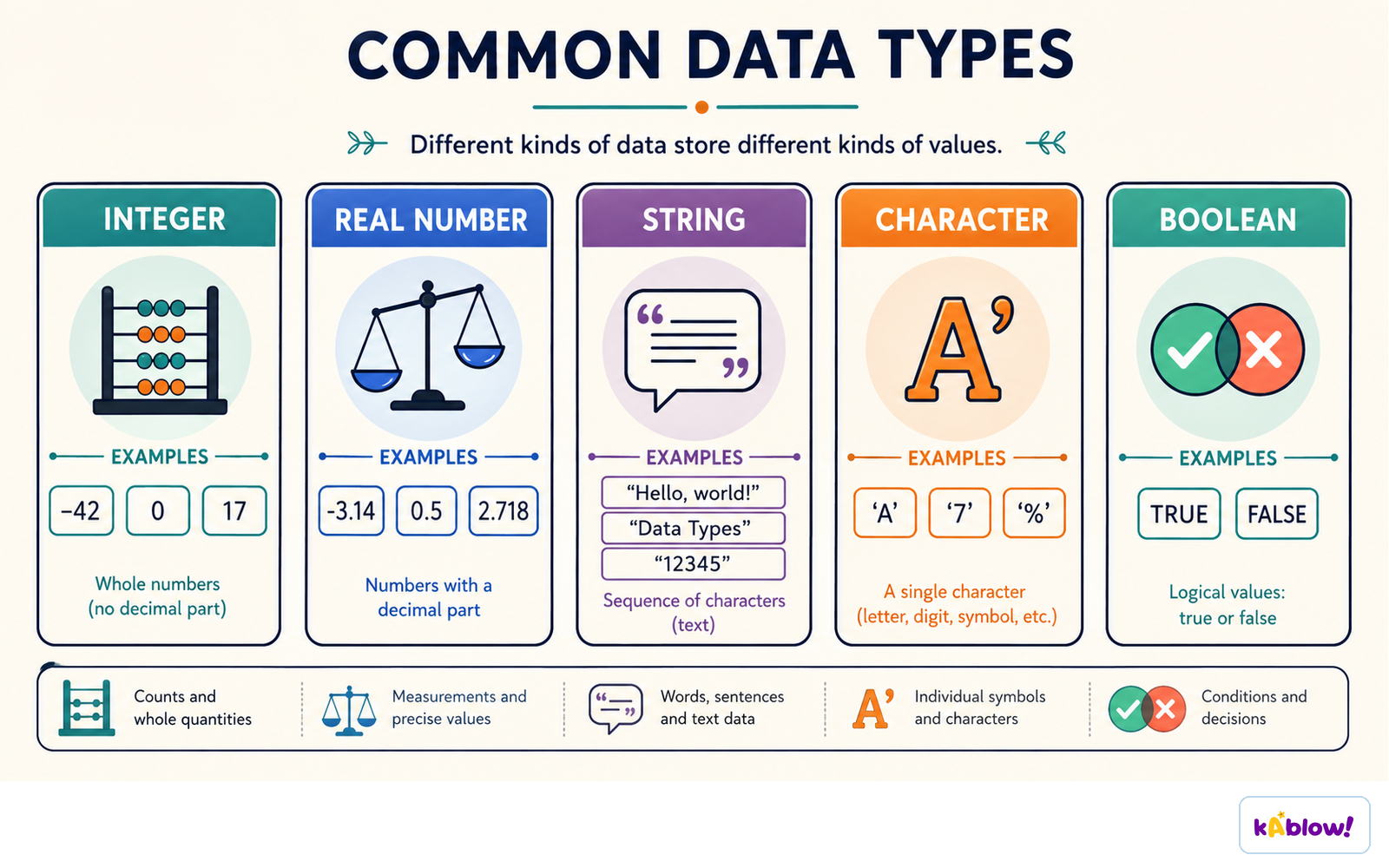
- Common data types: Integer (whole number), Real (decimal), Text/alphanumeric, Character (single), Date/Time, Boolean (true/false).
- Example: In a cars table, carid is Integer, make is Text, price is Real.
Integer, real, string, character and Boolean each store a different kind of value.
Validation Checks
- Validation rules control what data can be entered into a field.
- Length check: ensures a fixed number of characters (e.g., phone number 11 digits).
- Format check: ensures data matches a pattern (e.g., two letters + five numbers).
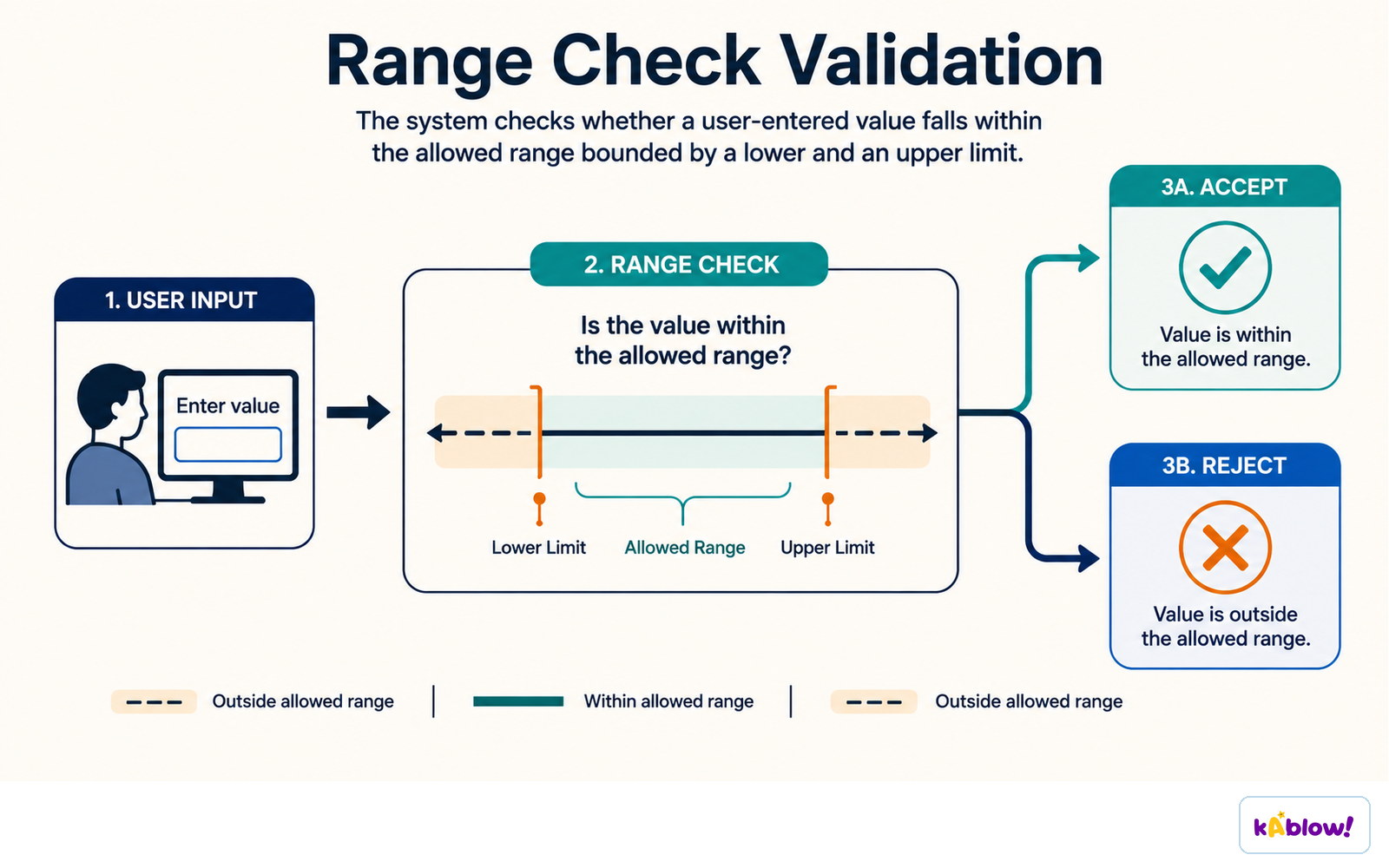
- Range check: ensures a number is within a range (e.g., age 0–40).
- Presence check: ensures a field cannot be left blank.
- Type check: ensures data is of the correct data type (e.g., date field cannot have text).
- Check digit: a digit added to a number to verify accuracy using an algorithm.
A range check accepts a value only when it falls between the lower and upper limits.
Primary Keys
- A primary key is a unique field that identifies each record in a table.
- It must be unique for every record and cannot be null.
- Examples: CustomerID, StudentID, Car Registration, ProductID.
- Primary keys are often ID numbers (e.g., MemberID in a Members table).
Key Database Terminology
- Table: a collection of records with a similar structure.
- Record: a group of related fields representing one data entry (a row).
- Field: a single piece of data in a record (a column).
- Data type: the type of data held in a field.
- Primary key: a unique identifier for each record, usually an ID number.
Slides
Sign up free to view the lesson slides
Step through every slide for this topic — plus flashcards and revision notes — with a free account.
Practice questions
Free preview — 8 of 60 questions. Sign up to see them all.
1.What is a database?
Easy- AAn organised collection of data
- BA collection of text files
- CA single table of data
- DA program for editing data
2.In a database table, a field is represented by a:
Easy- ARow
- BColumn
- CRecord
- DTable
3.In a database table, a record is represented by a:
Easy- AColumn
- BField
- CRow
- DPrimary key
4.Which of the following is the most suitable primary key for a table storing information about books in a library?
Easy- AAuthor
- BTitle
- CISBN
- DPublisher
5.Which validation check would ensure that a phone number field contains exactly 11 digits?
Easy- ARange check
- BLength check
- CFormat check
- DPresence check
6.A product code must be two letters followed by five numbers. Which validation check should be applied?
Medium- ALength check
- BRange check
- CFormat check
- DType check
7.Which data type would be most appropriate for a field storing a person's date of birth?
Easy- AInteger
- BText
- CDate/Time
- DBoolean
8.A field is defined as 'Boolean'. What type of values can it store?
Easy- AWhole numbers only
- BDecimal numbers
- CTrue or false values
- DSingle characters
Unlock all 60 questions & more
Create a free account to see every question, the slides, flashcards and revision notes for this topic.