Congruence And Similarity
Learn it by playing
Answer these questions to earn energy, then fish and explore. No account needed.
Lesson notes
Congruence
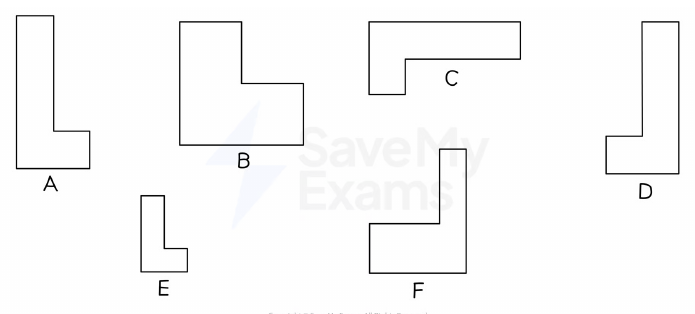
- Two shapes are congruent if they are identical in shape and size.
- One may be a reflection, rotation, or translation of the other.
- If a shape is an enlargement, it is not congruent (different size).
- To prove congruence, show corresponding sides are equal and corresponding angles are equal.
- Tracing paper can help check congruence if shapes are drawn to scale.
Congruent Shapes
Similarity
- Two shapes are similar if they have the same shape and corresponding sides are in proportion.
- One shape is an enlargement of the other; similarity does not imply congruence.
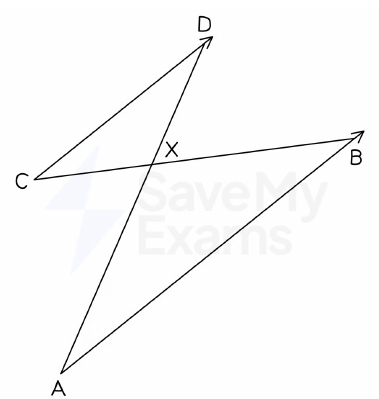
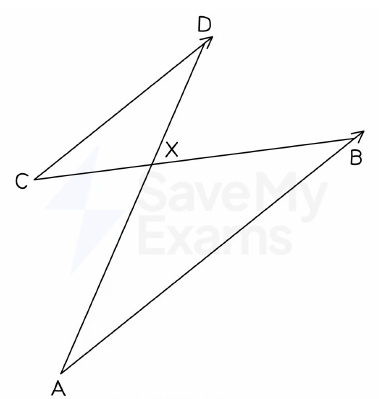
- For triangles, prove similarity by showing all three corresponding angles are equal.
- For non-triangular shapes, show that the scale factor is the same for all corresponding sides.
- Look for equal angles using properties like vertically opposite, alternate, and corresponding angles on parallel lines.
Similar Triangles in an Hourglass
Similar Lengths – Scale Factor
- The scale factor links corresponding lengths on similar shapes.
- If the second shape is larger, scale factor > 1; if smaller, 0 < scale factor < 1.
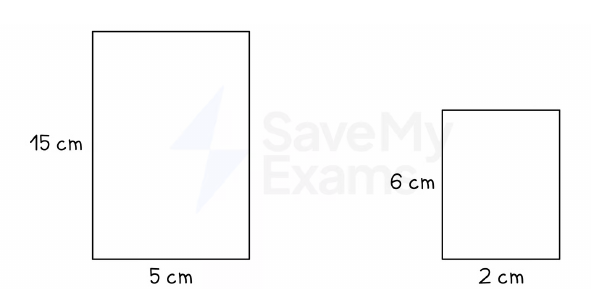
- To find scale factor: divide a length on the second shape by the corresponding length on the first.
- Method 1: Find scale factor from first to second (may be <1), then multiply/divide accordingly.
- Method 2: Find scale factor from smaller to larger (always >1), then multiply/divide accordingly.
Similar Rectangles
Similar Lengths – Finding Missing Lengths
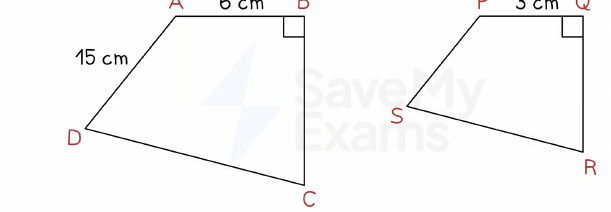
- To find a missing length on the second shape: multiply the corresponding length on the first by the scale factor.
- To find a missing length on the first shape: divide the corresponding length on the second by the scale factor.
- If using the smaller-to-larger scale factor: to find a length on the larger, multiply the smaller by the scale factor; to find a length on the smaller, divide the larger by the scale factor.
- Redraw overlapping similar shapes separately to avoid confusion.
Finding a Missing Length on a Similar Shape
Slides
Sign up free to view the lesson slides
Step through every slide for this topic — plus flashcards and revision notes — with a free account.
Practice questions
Free preview — 8 of 59 questions. Sign up to see them all.
1.Which word describes two polygons that are the same shape and size?
Easy- ACongruent
- BSimilar
- CRegular
- DIsosceles
2.Two shapes are similar. Which of the following is always true?
Easy- AThey are the same size
- BTheir corresponding sides are in proportion
- CThey are congruent
- DThey have the same area
3.Which of the following transformations always produces a shape congruent to the original?
Easy- AEnlargement
- BRotation
- CShear
- DStretch
4.Two triangles are similar. Their corresponding angles are:
Easy- AEqual
- BSupplementary
- CDifferent
- DSum to 180°
5.What is the scale factor from a shape of side 4 cm to a similar shape of side 10 cm?
Easy- A2.5
- B0.4
- C6
- D14
6.Two similar rectangles have widths 3 cm and 5 cm. The smaller rectangle has length 7 cm. What is the length of the larger rectangle?
Medium- A11.67 cm
- B4.2 cm
- C8 cm
- D10 cm
7.In the diagram, triangles ABC and DEF are similar. AB = 6 cm, DE = 9 cm, BC = 8 cm. Find EF.
Medium- A12 cm
- B5.33 cm
- C6 cm
- D15 cm
8.A shape with side 12 cm is enlarged to a similar shape with side 4 cm. What is the scale factor?
Easy- A1/3
- B3
- C8
- D48
Unlock all 59 questions, flashcards & more
Create a free account to see every question, the slides, flashcards and revision notes for this topic.