Expanding And Factorising Brackets
Learn it by playing
Answer these questions to earn energy, then fish and explore. No account needed.
For educators: ready-to-use lesson slides, revision notes, diagrams for Expanding And Factorising Brackets (Maths [CIE], Core) — use them in your lesson, or run the topic as an interactive class activity your learners play as a live game.
Lesson notes
Expanding Single Brackets
- Expanding means multiplying the term outside the bracket by each term inside.
- For example, 3x(x + 2) = 3x × x + 3x × 2 = 3x² + 6x.
- Watch out for negative signs: − × − = +, − × + = −.
- Use brackets around negative terms to avoid mistakes.
Simplifying After Expanding Single Brackets
- First expand each bracket separately, then collect like terms.
- Example: 4(x + 7) + 5x(3 − x) = 4x + 28 + 15x − 5x² = 19x + 28 − 5x².
- Be careful with subtraction: 3x(x + 2) − 7(x − 6) = 3x² + 6x − 7x + 42 = 3x² − x + 42.
Expanding Double Brackets
- Multiply every term in the first bracket by every term in the second.
- Use FOIL: First, Outer, Inner, Last.
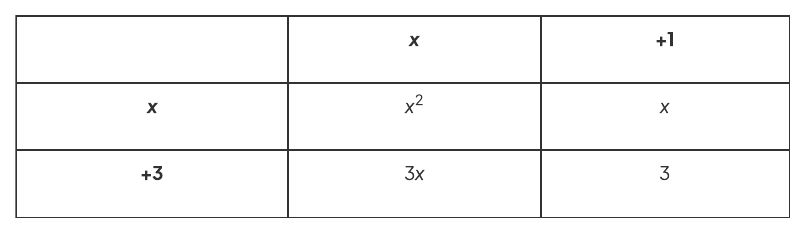
- Example: (x + 1)(x + 3) = x·x + x·3 + 1·x + 1·3 = x² + 4x + 3.
- A grid can help organise the multiplication visually.
Grid method for double brackets
Expanding a Bracket Squared
- Write (x + 3)² as (x + 3)(x + 3) and expand using FOIL.
- Example: (x + 3)² = x² + 3x + 3x + 9 = x² + 6x + 9.
- Common mistake: (x + y)² is not x² + y².
Factorising Out Terms
- Factorising is the reverse of expanding: write as a product of factors.
- Find the highest common factor (HCF) of the number parts and algebra parts.
- Place the HCF outside brackets and the remaining terms inside.
- Example: 12x² + 18x = 6x(2x + 3).
Factorising with Multiple Variables
- Find the HCF of numbers and each variable separately.
- Example: 2a³b² − 4a²b³: number HCF = 2, a HCF = a², b HCF = b² → overall HCF = 2a²b².
- Result: 2a²b²(a − 2b).
- Always check by expanding: factorise fully (e.g., 2x(3x + 5) not x(6x + 10)).
Exam Tips
- Check factorisation by expanding the brackets.
- Factorise fully means take out the greatest common factor.
- Practice with past paper questions: easy, medium, hard.
Slides
Sign up free to view the lesson slides
Step through every slide for this topic — plus flashcards and revision notes — with a free account.
Practice questions
Free preview — 8 of 59 questions. Sign up to see them all.
1.Expand 5(x - 3).
Easy- A5x - 15
- B5x - 3
- C5x + 15
- D5x + 3
2.Factorise 3x + 12.
Easy- A3(x + 4)
- B3(x + 12)
- Cx(3 + 12)
- D3x(1 + 4)
3.Factorise 5y - 6py.
Medium- Ay(5 - 6p)
- By(5 - 6)
- C5y(1 - 6p)
- Dp(5y - 6)
4.Factorise 12x + 15.
Easy- A3(4x + 5)
- B3(4x + 15)
- C12(x + 15)
- D5(12x + 3)
5.Factorise 5p + pt.
Easy- Ap(5 + t)
- B5(p + t)
- Cp(5 + pt)
- Dt(5p + 1)
6.Multiply out 9(3 - x).
Easy- A27 - 9x
- B27 + 9x
- C9x - 27
- D27 - x
7.Factorise completely 18x - 24.
Medium- A6(3x - 4)
- B3(6x - 8)
- C2(9x - 12)
- D18(x - 6)
8.Expand x(2y + x).
Easy- A2xy + x2
- B2xy + x
- Cx2 + 2y
- D2x2y
Unlock all 59 questions, flashcards & more
Create a free account to see every question, the slides, flashcards and revision notes for this topic.
Past papers
Past-paper practice for this topic is coming soon.
Coming soon