Powers Roots And Standard Form
Learn it by playing
Answer these questions to earn energy, then fish and explore. No account needed.
For educators: ready-to-use lesson slides, revision notes for Powers Roots And Standard Form (Maths [CIE], Core) — use them in your lesson, or run the topic as an interactive class activity your learners play as a live game.
Lesson notes
Powers & Roots
- Powers (indices) show repeated multiplication: e.g., 6³ = 6 × 6 × 6.
- Any non-zero number to the power of 0 equals 1: e.g., 3⁰ = 1.
- Any number to the power of 1 equals itself: e.g., 3¹ = 3.
- Square roots are the reverse of squaring; every positive number has two square roots (positive and negative).
- The symbol √ denotes the positive square root only: e.g., √25 = 5.
- Cube roots are the reverse of cubing; each number has only one cube root: e.g., ³√125 = 5.
- For nth roots, if n is even there are two roots (positive and negative); if n is odd there is one.
- The reciprocal of a number is 1 divided by that number; a number and its reciprocal multiply to 1.
Laws of Indices
- a¹ = a – anything to the power 1 is itself.
- a⁰ = 1 – anything (non-zero) to the power 0 is 1.
- aᵐ × aⁿ = aᵐ⁺ⁿ – to multiply indices with the same base, add the powers.
- aᵐ ÷ aⁿ = aᵐ⁻ⁿ – to divide indices with the same base, subtract the powers.
- (aᵐ)ⁿ = aᵐⁿ – to raise a power to another power, multiply the powers.
- (ab)ⁿ = aⁿbⁿ – to raise a product to a power, apply the power to each factor.
- (a/b)ⁿ = aⁿ / bⁿ – to raise a fraction to a power, apply the power to numerator and denominator.
- a⁻ⁿ = 1/aⁿ – a negative power means the reciprocal of the positive power.
Converting to & from Standard Form
- Standard form is a × 10ⁿ where 1 ≤ a < 10 and n is an integer.
- For large numbers (≥10), n is positive: count how many places the decimal moves left.
- For small numbers (0 < number < 1), n is negative: count how many places the decimal moves right.
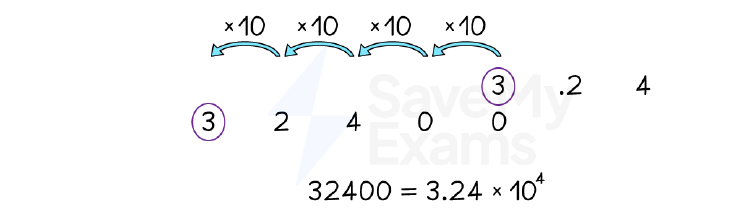
- Example: 32 400 = 3.24 × 10⁴ (decimal moves 4 places left).
- Example: 0.0000324 = 3.24 × 10⁻⁵ (decimal moves 5 places right).
- To convert from standard form to ordinary number, move the decimal point n places (right if n>0, left if n<0).
Converting 32,400 to standard form
Operations with Standard Form
- Use your calculator for calculations with standard form (calculator paper only).
- Enter numbers using the ×10ˣ button and brackets: e.g., (3×10⁸)×(2×10⁻³).
- If the calculator output is not in standard form, rewrite it: e.g., 37 500 000 = 3.75×10⁷.
- Alternatively, rewrite a in standard form and apply index laws: e.g., 243×10²⁰ = (2.43×10²)×10²⁰ = 2.43×10²².
Worked Examples from Past Papers
- Write 0.0018 in standard form: 1.8 × 10⁻³.
- Write 6.09×10⁸ as an ordinary number: 609 000 000.
- Find 5⁰: 1; find 5⁻²: 1/25.
- Calculate (4.1×10⁻³)×(8.9×10⁷) = 3.649×10⁵ (using calculator).
- Solve 5ˣ × 5³ = 5¹² → x = 9 (since x+3=12).
- Solve 5ᵖ ÷ 5⁸ = 5¹³ → p = 21 (since p-8=13).
Slides
Sign up free to view the lesson slides
Step through every slide for this topic — plus flashcards and revision notes — with a free account.
Practice questions
Free preview — 8 of 61 questions. Sign up to see them all.
1.Write down the value of 190.
Easy- A0
- B1
- C19
- D190
2.The cost of building a ship was $153000000. Write 153000000 in standard form.
Easy- A1.53 × 108
- B1.53 × 107
- C15.3 × 107
- D1.53 × 109
3.Write the number 40 in standard form.
Easy- A4 × 101
- B40 × 100
- C4.0 × 101
- D0.4 × 102
4.Write 2020 in standard form.
Easy- A2.02 × 103
- B2.02 × 104
- C20.2 × 102
5.Write 15060 in standard form.
Easy- A1.506 × 104
- B1.506 × 103
- C15.06 × 103
- D1.506 × 105
6.Write 72000 in standard form.
Easy- A7.2 × 104
- B7.2 × 103
- C72 × 103
- D7.2 × 105
7.Write 0.0018 in standard form.
Easy- A1.8 × 10-3
- B1.8 × 10-4
- C18 × 10-4
- D1.8 × 103
8.Write down the value of 250.
Easy- A0
- B1
- C25
- D250
Unlock all 61 questions, flashcards & more
Create a free account to see every question, the slides, flashcards and revision notes for this topic.
Past papers
Past-paper practice for this topic is coming soon.
Coming soon