Pythagoras
Learn it by playing
Answer these questions to earn energy, then fish and explore. No account needed.
Lesson notes
Pythagoras' Theorem
- Pythagoras was a Greek mathematician who lived over 2500 years ago.
- Pythagoras' theorem links the lengths of the three sides of a right-angled triangle.
- The hypotenuse is the longest side, opposite the right angle.
- Formula: a² + b² = c², where c is the hypotenuse and a, b are the shorter sides.
- It does not matter which shorter side is labelled a or b.
Right-angled triangle
Finding the Hypotenuse
- To find the hypotenuse: square the two shorter sides, add them, then take the positive square root.
- Formula: c = √(a² + b²).
- When finding the hypotenuse, you add inside the square root.
- Example: If a = 3, b = 4, then c = √(3² + 4²) = √25 = 5.
Finding a Shorter Side
- To find a shorter side: square the hypotenuse and the other shorter side, subtract the smaller from the larger, then take the square root.
- Formula: a = √(c² – b²).
- When finding a shorter side, you subtract inside the square root.
- Ensure the hypotenuse is longer than any other side; otherwise, check your working.
Using Pythagoras with Other Shapes
- Pythagoras can be applied to any shape that can be split into right-angled triangles.
- For a rectangle or square, the diagonal splits the shape into two identical right-angled triangles.
- The diagonal becomes the hypotenuse of those triangles.
- Example: In a rectangle 14 cm by w cm with diagonal 23 cm, use Pythagoras to find w: w = √(23² – 14²).
Multi-Step Problems
- In multi-step problems, leave intermediate answers as exact values (e.g., √63) to avoid rounding errors.
- Only round the final answer to the required degree of accuracy.
- Work through each right-angled triangle step by step.
- Example: Find BC in a trapezium by first finding BD using triangle ABD, then DC = AC – AD, then BC = √(BD² + DC²).
Worked example: two right-angled triangles
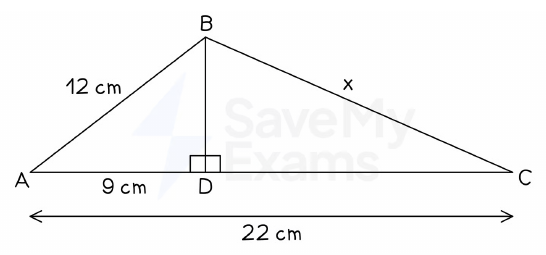
Common Mistakes & Tips
- The hypotenuse must be the longest side; if it isn't, you've made an error.
- When subtracting for a shorter side, always subtract the smaller square from the larger square.
- Otherwise, you'll get a negative number and a 'Math Error' when taking the square root.
- Always check that your answer is reasonable.
Slides
Sign up free to view the lesson slides
Step through every slide for this topic — plus flashcards and revision notes — with a free account.
Practice questions
Free preview — 8 of 36 questions. Sign up to see them all.
1.Which side of a right-angled triangle is the hypotenuse?
Easy- AThe side opposite the right angle
- BThe side adjacent to the right angle
- CThe shortest side
- DAny side
2.Pythagoras' theorem states that for a right-angled triangle with sides a, b and hypotenuse c:
Easy- Aa2 + b2 = c2
- Ba + b = c
- Ca2 = b2 + c2
- Da2 - b2 = c2
3.A right-angled triangle has legs of lengths 3 cm and 4 cm. What is the length of the hypotenuse?
Easy- A5 cm
- B7 cm
- C12 cm
- D25 cm
4.A flagpole is 25 m tall. A rope from the top is tied to the ground 8 m from the base. What is the length of the rope?
Easy- A26.2 m
- B24.0 m
- C33.0 m
- D17.0 m
5.In a right-angled triangle, the hypotenuse is 10 cm and one leg is 6 cm. What is the length of the other leg?
Easy- A8 cm
- B4 cm
- C16 cm
- D11.7 cm
6.A rectangle is 14 cm wide and has a diagonal of 23 cm. What is the length of the rectangle?
Medium- A18.2 cm
- B26.9 cm
- C9.0 cm
- D18.0 cm
7.A right-angled triangle has legs of lengths x and 8 cm, and hypotenuse 17 cm. What is x?
Medium- A15 cm
- B18.8 cm
- C9 cm
- D25 cm
8.The length of one side of a rectangle is 12 cm and the diagonal is 13 cm. What is the area of the rectangle?
Medium- A60 cm2
- B156 cm2
- C30 cm2
- D144 cm2
Unlock all 36 questions, flashcards & more
Create a free account to see every question, the slides, flashcards and revision notes for this topic.