3d Pythagoras And Trigonometry
Learn it by playing
Answer these questions to earn energy, then fish and explore. No account needed.
Lesson notes
3D Pythagoras Theorem
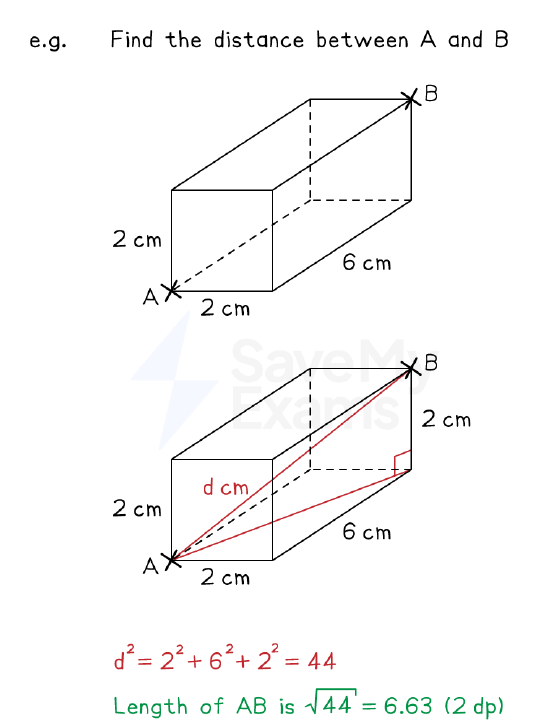
- 3D Pythagoras theorem: d² = x² + y² + z², where d is the distance between two points and x, y, z are distances in three perpendicular directions.
- You can always break a 3D problem into two 2D right-angled triangles instead of using the 3D formula.
- The 3D formula is not given in the exam; you must derive it or use 2D steps.
- Example: In a cuboid of dimensions 3 cm × 4 cm × 6 cm, the longest diagonal is √(3²+4²+6²) = √61 ≈ 7.81 cm.
Cone: base radius and height
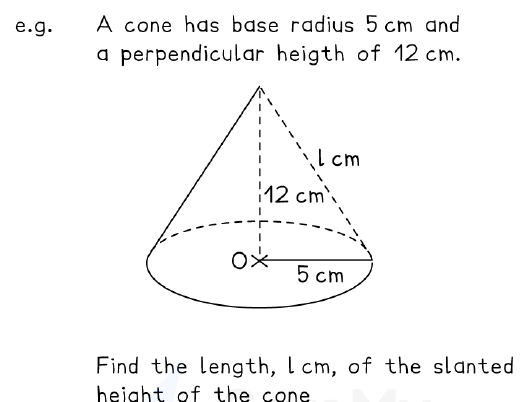
Using Pythagoras in 3D Shapes
- Identify right-angled triangles within the 3D shape (e.g., on faces or cross-sections).
- Redraw the 2D triangle flat on the page to apply Pythagoras or trigonometry.
- Find missing lengths step by step: e.g., first find a face diagonal, then the space diagonal.
- Common shapes: cuboids, prisms, pyramids with square bases.
Distance between two vertices of a cuboid
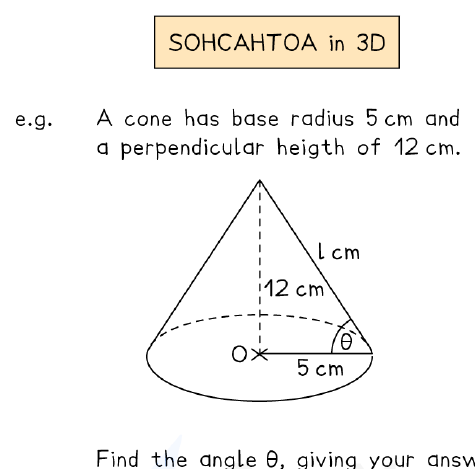
Trigonometry (SOHCAHTOA) in 3D
- Use SOHCAHTOA in right-angled triangles formed within the 3D shape.
- Look for triangles that include the required angle or side; you may need to combine multiple triangles.
- Always draw the relevant 2D triangle flat to avoid confusion.
- Example: In a cuboid, to find the angle between a diagonal and a face, form a triangle with the height perpendicular to that face.
Cone: angle at the base
Angle Between a Line and a Plane
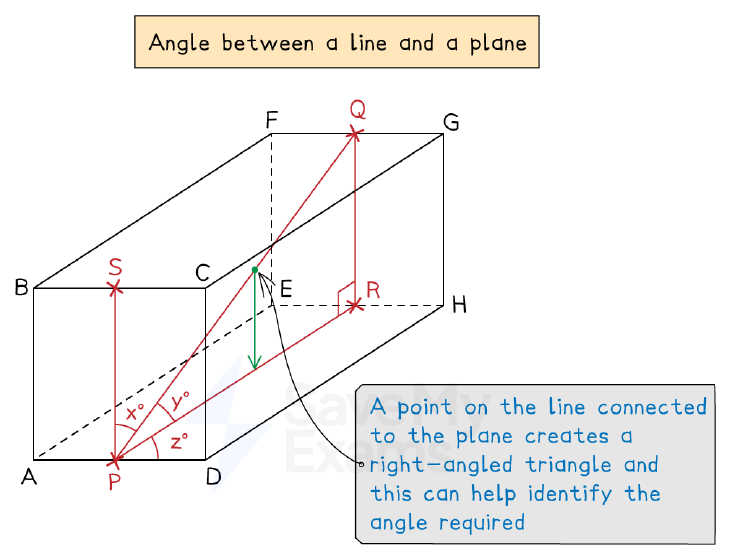
- The angle between a line and a plane is the angle between the line and its projection onto the plane.
- Construct a right-angled triangle where the height is perpendicular to the plane.
- Use SOHCAHTOA to find the angle; the perpendicular side is often a vertical edge.
- Tip: Imagine lowering a vertical fishing line from the line to the plane to visualise the right angle.
Angle between a line and a plane in a cuboid
Angle Between Two Lines or Planes
- The angle between two lines in 3D can be found by placing them in a common triangle.
- The angle between two planes is found by considering the angle between lines perpendicular to their line of intersection.
- In pyramids, the angle between a sloping edge and the base is found using the vertical height and half the base diagonal.
- Example: In a square-based pyramid with side 8 cm and vertical height 10 cm, the angle between VA and base is tan⁻¹(10 / (8√2/2)).
Right triangle for a pyramid's sloping edge
Solving Multi-Step Problems
- Break the problem into 2D right-angled triangles; solve each step sequentially.
- Redraw each triangle flat on paper with all known lengths.
- Use Pythagoras to find missing sides, then trigonometry to find angles.
- If stuck, start finding any lengths or angles – they may lead to the answer and earn partial marks.
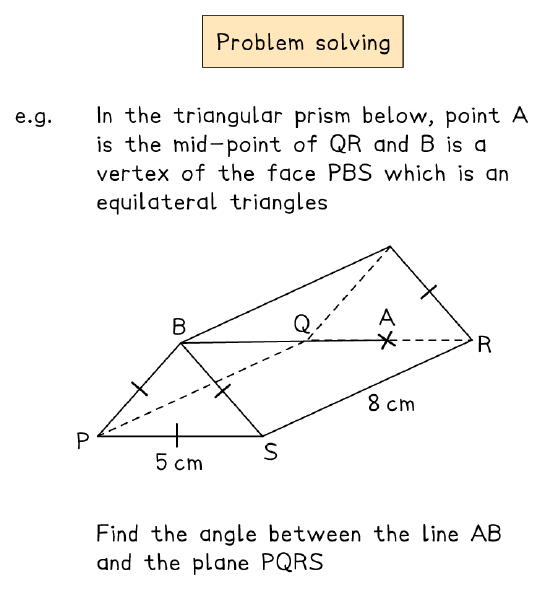
Triangular prism problem
Common Question Types
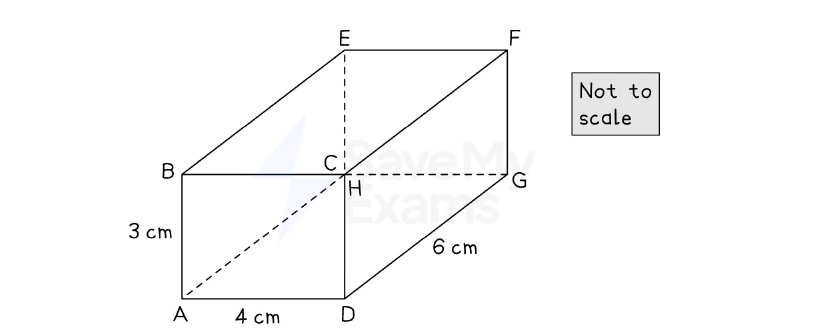
- Finding the length of a space diagonal (e.g., longest object that fits in a box).
- Calculating the angle between a diagonal and a face (e.g., angle between AG and base ABCD).
- Finding the angle between a sloping edge and the base in a pyramid.
- Using given ratios or volumes to find missing dimensions and then angles.
Cuboid box for a diagonal problem
Examiner Tips
- The 3D Pythagoras formula is not provided – you must derive it or use 2D steps.
- Always redraw 2D triangles flat to avoid misinterpreting the 3D diagram.
- If unsure, start calculating any lengths or angles – you may score method marks.
- Label all known lengths on the diagram before starting calculations.
Slides
Sign up free to view the lesson slides
Step through every slide for this topic — plus flashcards and revision notes — with a free account.
Practice questions
Free preview — 8 of 34 questions. Sign up to see them all.
1.In a cuboid with dimensions 3 cm, 4 cm and 6 cm, what is the length of the longest diagonal?
Medium- A7.81 cm
- B9.22 cm
- C6.71 cm
- D13.0 cm
2.A cuboid has a base measuring 5 cm by 8 cm and a height of 10 cm. Find the angle between the longest diagonal and the base.
Medium- A46.7°
- B43.3°
- C35.6°
- D21.3°
3.A cuboid has dimensions 5 cm, 12 cm and 13 cm. Find the angle between the longest diagonal and the base.
Medium- A45.0°
- B30.0°
- C60.0°
- D22.6°
4.In a cuboid, the length of the diagonal of the base is 10 cm and the height is 6 cm. What is the length of the space diagonal?
Easy- A11.66 cm
- B16.0 cm
- C8.0 cm
- D11.0 cm
5.A cuboid has a base measuring 4 cm by 7 cm and a height of 9 cm. Calculate the angle between the space diagonal of the cuboid and the base.
Hard- A48.1°
- B41.9°
- C35.4°
- D19.3°
6.A cuboid has dimensions 5 cm, 8 cm and 10 cm. Calculate the angle between the space diagonal and the base.
Hard- A46.7°
- B43.8°
- C52.4°
- D37.6°
7.In the cuboid ABCDEFGH, AB = 6 cm, BC = 8 cm and CG = 10 cm. Find the length of AG.
Medium- A14.1 cm
- B10.0 cm
- C12.8 cm
- D16.0 cm
8.A cuboid has dimensions 3 cm, 4 cm and 12 cm. What is the angle between the space diagonal and the longest edge?
Medium- A22.6°
- B67.4°
- C45.0°
- D30.0°
Unlock all 34 questions & more
Create a free account to see every question, the slides, flashcards and revision notes for this topic.