Area And Perimeter
Learn it by playing
Answer these questions to earn energy, then fish and explore. No account needed.
Lesson notes
Perimeter
- Perimeter is the total distance around the outside of a 2D shape; for a circle it is called circumference.
- Perimeter is a length measured in one dimension, in units such as mm, cm, m.
- Add together the lengths of all the sides of the shape.
- For any regular shape, the perimeter is the number of sides multiplied by the length of one side (e.g., square side x cm has perimeter 4x cm).
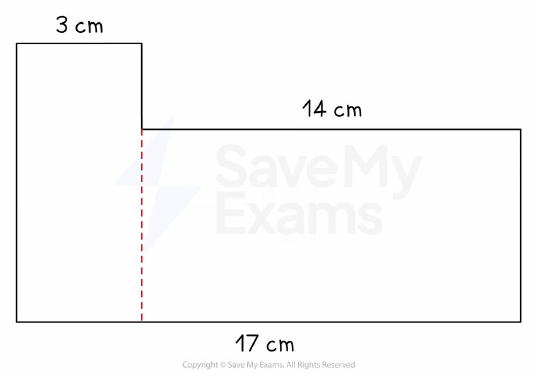
- For compound shapes, split into rectangles, triangles or parts of circles, and use properties of shapes (equal sides, Pythagoras' theorem) to find missing lengths.
- In an L-shape, the sum of the lengths of two shorter sides equals the length of the longer side opposite.
Perimeter of a Compound Shape
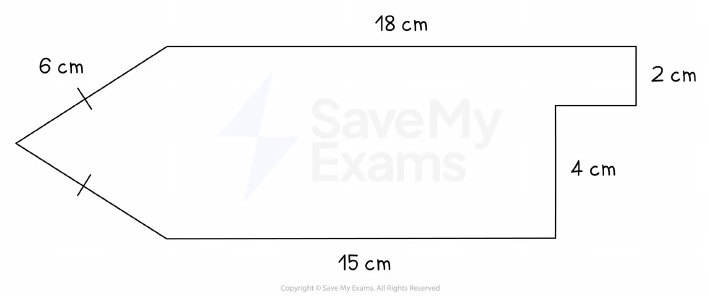
Worked Example: Compound Shape Perimeter
- The shape splits into a triangle and two rectangles; the dashes on the triangle show its two slanted sides are equal, so the missing side is 6 cm.
- The horizontal lengths of the two rectangles add up to the longest horizontal line: 15 + missing = 18, so the missing horizontal length is 3 cm.
- Add all the sides: 6 + 6 + 18 + 2 + 3 + 4 + 15 = 54 cm.
Compound Shape Perimeter
Area
- Area is the amount of space within the perimeter of a 2D shape, measured in square units (mm², cm², m²).
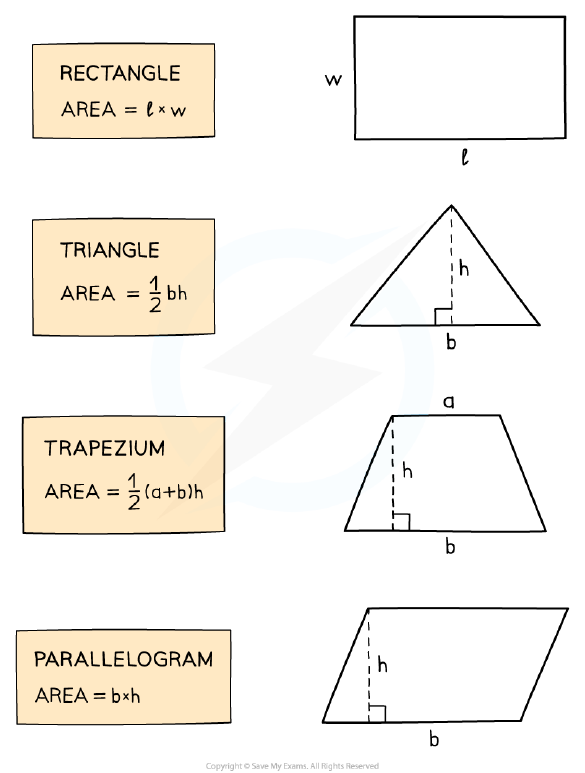
- Rectangle area = length × width (A = lw).
- Triangle area = ½ × base × perpendicular height (A = ½bh) — this formula is given in the exam.
- Trapezium area = ½ × (sum of parallel sides) × perpendicular height (A = ½(a+b)h).
- Parallelogram area = base × perpendicular height (A = bh).
- The perpendicular height is the distance between the base and the opposite side, not necessarily a side length.
Area Formulas
Worked Example: Trapezium Area
- Parallel sides a = 30 cm, b = 15 cm, perpendicular height h = 20 cm.
- Area = ½ × (30 + 15) × 20 = 450 cm².
Area of a Trapezium
Worked Example: Parallelogram Area
- Base = 15 cm, perpendicular height = 12 cm.
- Area = 15 × 12 = 180 cm².
Area of a Parallelogram
Worked Example: Triangle Area
- Base = 8 cm, perpendicular height = 7 cm.
- Area = ½ × 8 × 7 = 28 cm².
Area of a Triangle
Adding & Subtracting Areas
- Compound shapes can be split into standard shapes (rectangles, triangles, etc.) and their areas added together.
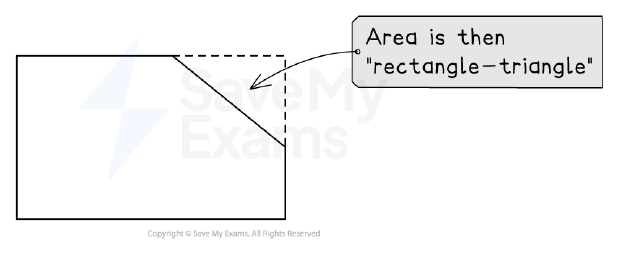
- Alternatively, complete the shape into a larger standard shape, then subtract the area of the extra piece added.
- For the shape shown, the area is the rectangle's area minus the triangle's area.
- Always check for missing lengths using the given dimensions and the properties of the shapes involved.
Compound Shape by Subtraction
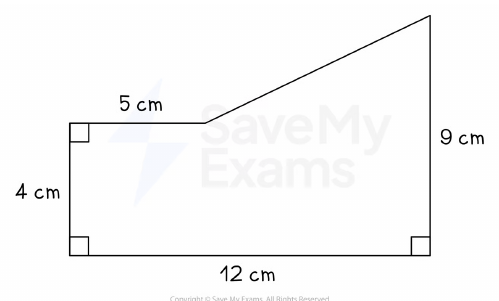
Worked Example: Compound Shape Area (Pentagon)
- Split the pentagon into a rectangle (12 cm by 4 cm) and a triangle (base 7 cm, height 5 cm), using the given lengths to find the triangle's base and height.
- Rectangle area = 12 × 4 = 48 cm²; triangle area = ½ × 7 × 5 = 17.5 cm².
- Total area = 48 + 17.5 = 65.5 cm².
Compound Shape Area (Pentagon)
Problem Solving with Areas
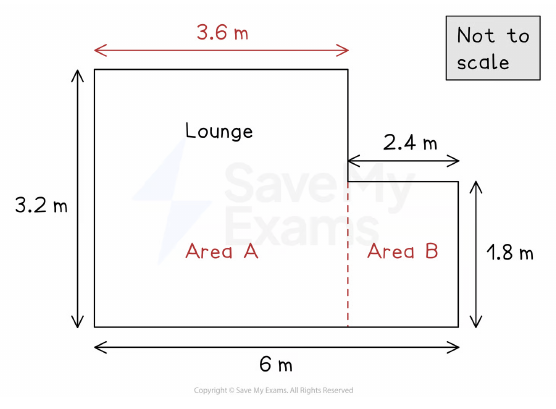
- Real-life problems often involve area and cost (e.g., carpet, paint, tiles) — read the context carefully for key words like area, cost, minimum, maximum.
- Compound units (e.g. £/m²) hint at which calculations are needed.
- Annotate diagrams with known and missing lengths as you work through the problem.
- Compare different options (e.g., companies) by calculating the total cost for each using the area.
- Show your working even if you don't reach a final answer — marks are given for correct steps.
Splitting a Compound Shape for a Real Problem
Slides
Sign up free to view the lesson slides
Step through every slide for this topic — plus flashcards and revision notes — with a free account.
Practice questions
Free preview — 8 of 27 questions. Sign up to see them all.
1.What is the perimeter of a rectangle with length 8 cm and width 5 cm?
Easy- A26 cm
- B13 cm
- C40 cm
- D18 cm
2.The area of a triangle with base 10 cm and perpendicular height 6 cm is
Easy- A30 cm²
- B60 cm²
- C16 cm²
- D20 cm²
3.A square has side length 7 cm. Its perimeter is
Easy- A28 cm
- B49 cm
- C14 cm
- D21 cm
4.The area of a trapezium with parallel sides 12 cm and 8 cm and perpendicular height 5 cm is
Medium- A50 cm²
- B100 cm²
- C40 cm²
- D60 cm²
5.A rectangle measures 8.5 cm by 10.7 cm, both correct to 1 decimal place. Calculate the upper bound of the perimeter.
Medium- A38.6 cm
- B38.4 cm
- C38.2 cm
- D38.8 cm
6.The area of triangle ABC is 27 cm² and AB = 6 cm. Calculate the perpendicular height h from AB to C.
Medium- A9 cm
- B4.5 cm
- C18 cm
- D3 cm
7.An equilateral triangle has side length 12 cm, correct to the nearest centimetre. Find the lower bound of the perimeter.
Hard- A34.5 cm
- B35.5 cm
- C36 cm
- D35 cm
8.The area of a square is 42.5 cm², correct to the nearest 0.5 cm². Calculate the lower bound of the length of the side.
Hard- A6.48 cm
- B6.52 cm
- C6.50 cm
- D6.46 cm
Unlock all 27 questions & more
Create a free account to see every question, the slides, flashcards and revision notes for this topic.